
Life, 1910-02-17 · page 24 of 44
Life — February 17, 1910 — page 24: what you’re looking at
What you’re looking at
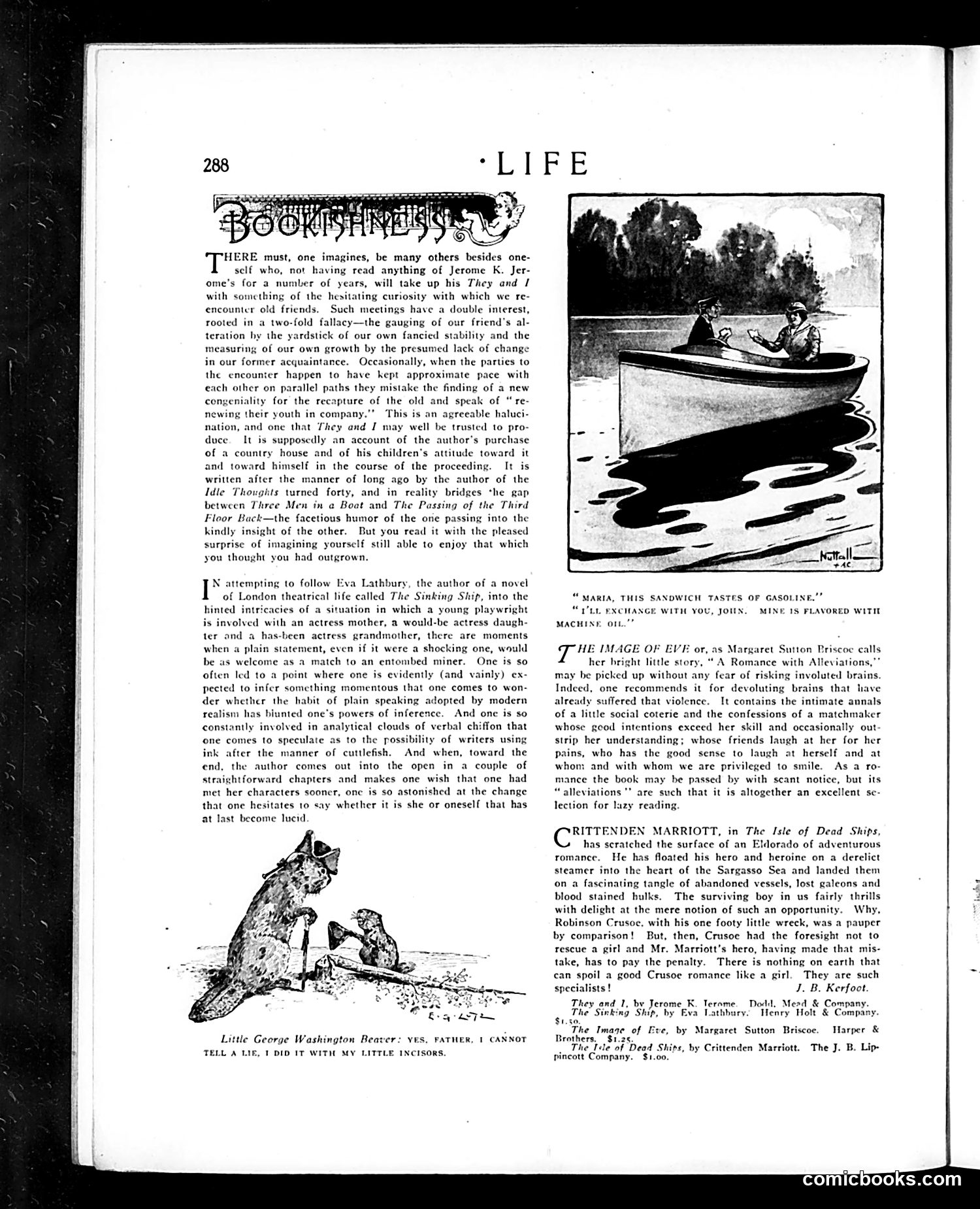
This page contains **book reviews** from Life magazine, with two cartoon illustrations offering satirical commentary. **The cartoons:** 1. **"Little George Washington Beaver"** (bottom left): A visual pun playing on the famous story of young George Washington confessing to chopping down his father's cherry tree. Here, a beaver claims responsibility using its teeth ("incisors") instead—a joke about beavers' well-known wood-gnawing behavior. The humor lies in the absurdist substitution of animal for human moral tale. 2. **Top right, captioned "Maria, this sandwich tastes of gasoline"**: Depicts two figures exchanging sandwiches at what appears to be a picnic. One has gasoline-flavored food, the other machine-oil flavored. This is **satirical commentary on early automotive culture**—likely mocking how the new prominence of cars and industrial products was contaminating even leisurely activities like picnics. The joke critiques modern life's intrusion into pastoral simplicity. Both cartoons use absurdist humor typical of Life's satirical approach to contemporary culture and social change.
📄 Transcribed text from this page (OCR, searchable)
Machine-transcribed from the original scan — historical spelling and the odd misread are preserved.
HERE must, one imagines, be many others besides one- self who, not having read anything of Jerome K. Jer- ome’s for a number of years, will take up his They and / with something of the hesitating curiosity with which we re- encounter old friends, Such meetings have a double interest, rooted in a two-fold fallacy—the gauging of our friend's al- teration hy the yardstick of our own fancied stability and the measuring of our own growth by the presumed lack of change in our former acquaintance. Occasionally, when the parties to the encounter happen to have kept approximate pace with each other on parallel paths they mistake the finding of a new congeniality for the recapture of the old and speak of “ re- newing their youth in company."’ This is an agreeable haluci- nation, and one that They and I may well be trusted to pro- duce It is supposedly an account of the author's purchase of a country house and of his children’s attitude toward it and toward himself in the course of the proceeding. It is written after the manner of long ago by the author of the Idle Thoughts turned forty, and in reality bridges he gap between Three Men in a Boat and The Passing of the Third Floor Back—the facetious humor of the onie passing into the kindly insight of the other. But you read it with the pleased surprise of imagining yoursclf still able to enjoy that which you thought you had outgrown. I’ tempting to follow Eva Lathbury, the author of a novel of London theatrical life called The Sinking Ship, into the inted intricacies of a situation in which a young playwright is involved with an actress mother, a would-be actress daugh- ter and a has-been actress grandmother, there are moments when a plain statement, even if it were a shocking one, would be as welcome as a match to an entombed miner. One is so often led to a point where one is evidently (and vainly) ex- pected to infer something momentous that one comes to won- der whether the habit of plain speaking adopted by modern realism has biunted one’s powers of inference. And onc is so constantly involved in analytical clouds of verbal chiffon that ‘one comes to speculate as to the possibility of writers using ink after the manner of cuttlefish. And when, toward the end, the author comes out into the open in a couple of straightforward chapters and makes one wish that one had met her characters sooner, onc is so astonished at the change that one hesitates 10 say whether it is she or oneself that has at last become lucid Little George Washington Beaver: ves, FATHER, 1 CANNOT TELL A LIF, 1 DID IT WITH MY LITTLE INCISORS, “MARIA, THIS SANDWICH TASTES OF GASOLIN “TLL EXCHANGE WITH YOU, JOUN. MINE 1S FLAVORED WITIT MACHINE tL THE IMAGE OF EVE or, as Margaret Sutton Briscoe calls her bright little story, may be picked up without any fear of risking involuted brains. Indeed, one recommends it for devoluting brains that have already suffered that violence. It contains the intimate annals of a little social coterie and the confessions of a matchmaker whose good intentions exceed her skill and occasionally out strip her understanding; whose friends laugh at her for her pains, who has the good sense to laugh at herself and at whom and with whom we are privileged to smile. As a ro- mance the book may be passed by with scant notice, but its “ alleviations "’ are such that it is altogether an excellent se: lection for lazy reading. A Romance with Alleviations,”” RITTENDEN MARRIOTT, in The Isle of Dead Ships, has scratched the surface of an Eldorado of adventurous romance. He has floated his hero and heroine on a derelict steamer into the heart of the Sargasso Sea and landed them on a fascinating tangle of abandoned vessels, lost galeons and blood stained hulks. The surviving boy in us fairly thrills with delight at the mere notion of such an opportunity. Why. Robinson Crusoe, with his one footy little wreck, was a pauper by comparison! But, then, Crusoe had the foresight not to rescue a girl and Mr. Marriott's hero, having made that mis- take, has to pay the penalty. There is nothing on earth that can spoil a good Crusoe romance like a girl. They are such specialists ! J. B. Kerfoot They and 1, by Jerome K. Terame. Dodd. Mead & Company. The Sinking Ship, by Eva Lathbury. Henry Holt. & Company. st “The Image of Eve, by Margaret Sutton Briscoe. Harper & Brothers, $1.26. The Tele of Dead Ships, by Crittenden Marriott. The J. B. Lip pincott Company. $1.00. comicbooks.com