
Life, 1910-02-17 · page 10 of 44
Life — February 17, 1910 — page 10: what you’re looking at
What you’re looking at
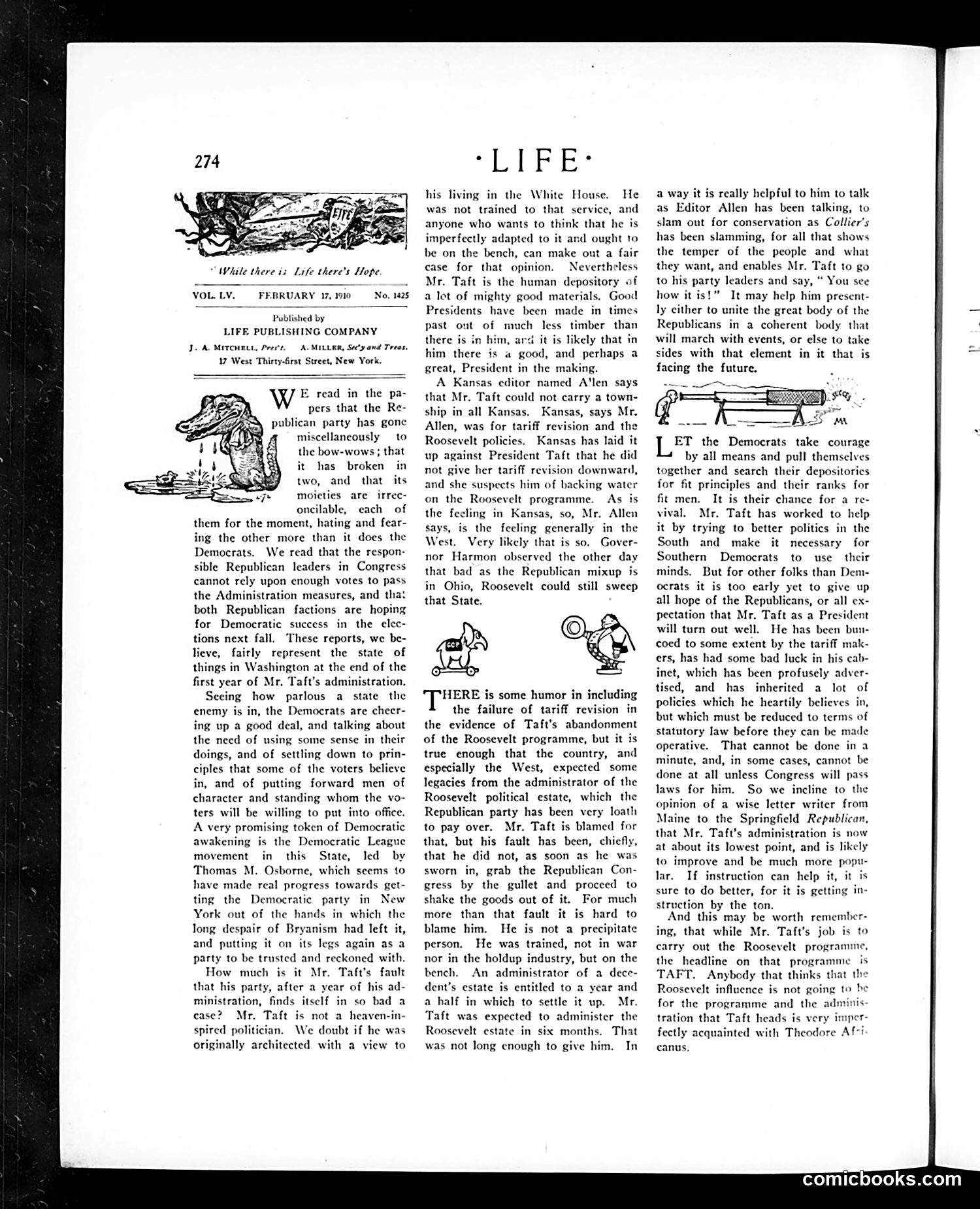
This *Life* magazine page critiques President William Howard Taft's administration. The text discusses Democratic Party strategy and Taft's struggles, particularly regarding: **Main Points:** - Taft's failure to deliver tariff revision (a key campaign promise) - Western discontent with his policies, especially in Kansas - The Republican Party's internal fracturing **The Cartoons:** Two small illustrations appear to depict donkeys—likely representing the Democratic Party—suggesting Democrats should capitalize on Republican divisions. The text implies Taft, originally positioned as Roosevelt's successor, has disappointed conservatives and progressives alike. The overall message: Democrats have an opportunity to gain power by letting Republicans self-destruct rather than aggressive campaigning. This reflects pre-1912 Republican Party tensions that would split the party.
📄 Transcribed text from this page (OCR, searchable)
Machine-transcribed from the original scan — historical spelling and the odd misread are preserved.
“While there is Life there's Hope. VOL.LV. FEBRUARY 17, 1910 No. 1425 Pablished by LIFE PUBLISHING COMPANY Jo A MITCHELL, Prove, A. MILLER, Secty and Treas. 17 West Thirty-first Street, New York. E read in the pa- pers that the Re- publican party has gone miscellaneously to the bow-wows ; that it has broken two, and that its moieties are irrec- oncilable, each of them for the moment, hating and fear- ing the other more than it does the Democrats. We read that the respon- sible Republican leaders in Congress cannot rely upon enough votes to pass the Administration measures, and that both Republican factions are hoping for Democratic success in the elec- tions next fall. These reports, we be- lieve, fairly represent the state of things in Washington at the end of the first year of Mr, Taft's administration. Seeing how parlous a state the enemy is in, the Democrats are cheer- ing up a good deal, and talking about the need of using some sense in their doings, and of settling down to prin- ciples that some of the voters believe in, and of putting forward men of character and standing whom the vo- ters will be willing to put into office. A very promising token of Democratic awakening is the Democratic League movement in this State, Ied by Thomas M. Osborne, which seems to have made real progress towards get- ting the Democratic party in New York out of the hands in which the long despair of Bryanism had left it, and putting it on its legs again as a party to be trusted and reckoned with. How much is it Mr. Taft's fault that his party, after a year of his ad- ministration, finds itself in so bad a case? Mr. Taft is not a heaven-in- spired politician, We doubt if he was originally architected with a view to ‘LIP E* his living in the White House. He was not trained to that service, and anyone who wants to think that he is imperfectly adapted to it and ought to be on the bench, can make out a fair case for that opinion. Nevertheless Mr. Taft is the human depository of a lot of mighty good materials, Good Presidents have been made in times past out of much less timber than there is in him, ard it is likely that in him there is a good, and perhaps a great, President in the making. A Kansas editor named A'len says that Mr. Taft could not carry a town- ship in all Kansas. Kansas, says Mr. Allen, was for tariff revision and the Roosevelt policies. Kansas has laid it up against President Taft that he did not give her tariff revision downward, and she suspects him of backing water on the Roosevelt programme. As is the feeling in Kansas, so, Mr. Allen says, is the feeling generally in the West. Very likely that is so. Gover- nor Harmon observed the other day that bad as the Republican mixup is in Ohio, Roosevelt could still sweep that State. HERE is some humor in including the failure of tariff revision in the evidence of Taft’s abandonment of the Roosevelt programme, but it is true enough that the country, and especially the West, expected some legacies from the administrator of the Roosevelt political estate, which the Republican party has been very loath to pay over. Mr. Taft is blamed for that, but his fault has been, chiefly, that he did not, as soon as he was sworn in, grab the Republican Con- gress by the gullet and proceed to shake the goods out of it. For much more than that fault it is hard to blame him. He is not a precipitate person. He was trained, not in war nor in the holdup industry, but on the bench. An administrator of a dece- dent’s estate is entitled to a year and a half in which to settle it up. Mr. Taft was expected to administer the Roosevelt estate in six months. That was not long enough to give him. In a way it is really helpful to him to talk as Editor Allen has been talking, to slam out for conservation as Collier's has been slamming, for all that shows the temper of the people and what they want, and enables Mr. Taft to go to his party leaders and say, “ You see how it is!” It may help him present- ly cither to unite the great body of the Republicans in a coherent body that will march with events, or else to take sides with that element in it that is facing the future. Lt the Democrats take courage by all means and pull themselves together and search their depositories for fit principles and their ranks for fit men. It is their chance for a re- vival. Mr. Taft has worked to help it by trying to better politics in the South and make it necessary for Southern Democrats to use their minds. But for other folks than Dem- ocrats it is too early yet to give up all hope of the Republicans, or all ex- pectation that Mr, Taft as a President will turn out well. He has been bun- coed to some extent by the tariff mak- ers, has had some bad luck in his cab- inet, which has been profusely adver- tised, and has inherited a lot of policies which he heartily believes in, but which must be reduced to terms of statutory law before they can be made operative. That cannot be done in a minute, and, in some cases, cannot be done at all unless Congress will pass laws for him. So we incline to the opinion of a wise letter writer from Maine to the Springfield Republican, that Mr. Taft’s administration is now at about its lowest point, and is likely to improve and be much more popu- lar. If instruction can help it, it is sure to do better, for it is getting in- struction by the ton. And this may be worth remember- ing, that while Mr. Taft's job is to carry out the Roosevelt programme, the headline on that programme is TAFT. Anybody that thinks that the Roosevelt influence is not going to be for the programme and the admi tration that Taft heads is very impe: fectly acquainted with Theodore Af-i canus, comicbooks.com