
Life, 1910-02-17 · page 26 of 44
Life — February 17, 1910 — page 26: what you’re looking at
What you’re looking at
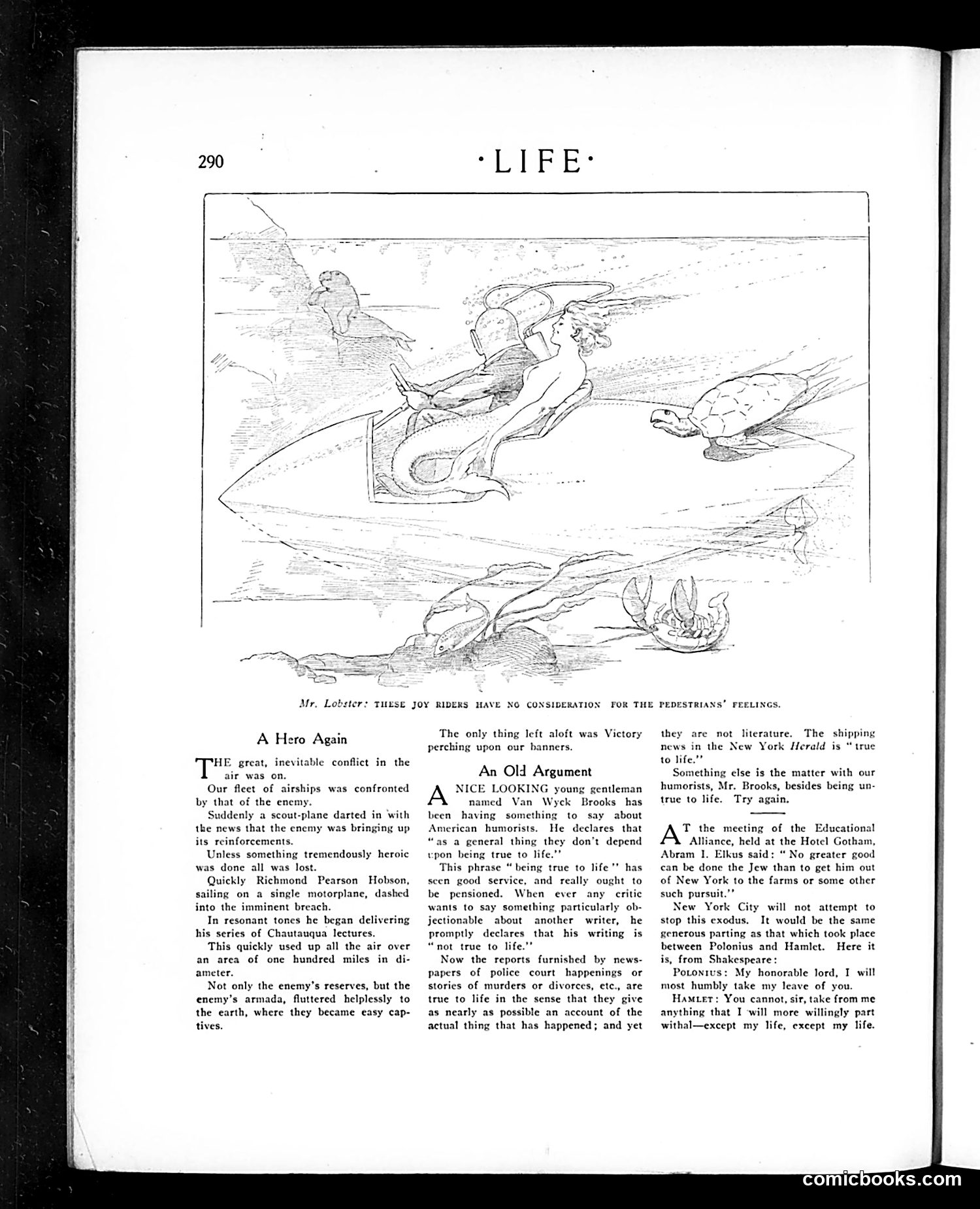
**The Main Cartoon:** Depicts "joy riders" (reckless motorists) on what appears to be a water vehicle, operating with no regard for pedestrians' safety. The satire critiques dangerous drivers' carelessness toward public welfare. **"A Hero Again":** Mocks Richmond Pearson Hobson (a real Spanish-American War hero known for Chautauqua lectures—popular educational tours). The joke: Hobson single-handedly defeats an enemy air fleet simply by delivering his notoriously verbose lectures, which consume all available air. This satirizes his reputation as a tedious, long-winded speaker. **"An Old Argument":** Defends American humorists against Van Wyck Brooks's criticism that they aren't "true to life." The writer argues that merely reporting facts (like newspaper crime stories or shipping news) doesn't constitute literature—the phrase "true to life" is an overused critical cliché. The Hamlet quote reinforces the point through irony about unwanted departures.
📄 Transcribed text from this page (OCR, searchable)
Machine-transcribed from the original scan — historical spelling and the odd misread are preserved.
cr: THESE JOY RIDERS HAVE NO CONSIDERATION A Hero Again TT" great, inevitable conflict in the ir was on. Our fleet of airships was confronted by that of the enemy. Suddenly a scout-plane darted in ‘with the news that the enemy was bringing up its reinforcements. Unless something tremendously heroic was done all was lost. Quickly Richmond Pearson Hobson, sailing on a single motorplane, dashed into the imminent breach. In resonant tones he began delivering his series of Chautauqua lectures. This quickly used up all the air over an area of one hundred miles in di- ameter. Not only the enemy’s reserves, but the enemy’s armada, fluttered helplessly to the earth, where they became easy cap- tives. The only thing left aloft was Victory perching upon our banners. An Old Argument NICE LOOKING young gentleman named Van Wyck Brooks has been having something to say about American humorists. He declares that “as a general thing they don’t depend cpon being true to life.” This phrase “being true to life’ has scen good service, and really ought to be pensioned. When ever any critic vants to say something particularly ob- jectionable about another writer, he promptly declares that his writing is “not true to life.” Now the reports furnished by news- papers of police court happenings or stories of murders or divorces, etc., are true to life in the sense that they give as nearly as possible an account of the actual thing that has happened; and yet FOR THE PEDESTRIANS’ FEELINGS. they are not literature. The shipping news in the New York Herald is “true to life.” Something else is the matter with our humorists, Mr. Brooks, besides being un- true to life. Try again, T the meeting of the Educational Alliance, held at the Hotel Gotham, Abram I. Elkus said: “No greater good can be done the Jew than to get him out of New York to the farms or some other such pursuit.” New York City will not attempt to stop this exodus. It would be the same generous parting as that which took place between Polonius and Hamlet. Here it is, from Shakespeare: Potontvs: My honorable lord, I will most humbly take my leave of you. Hamter: You cannot, sir, take from me anything that I more willingly part withal—except my life, except my life. comicbooks.com