
Life, 1910-02-17 · page 20 of 44
Life — February 17, 1910 — page 20: what you’re looking at
What you’re looking at
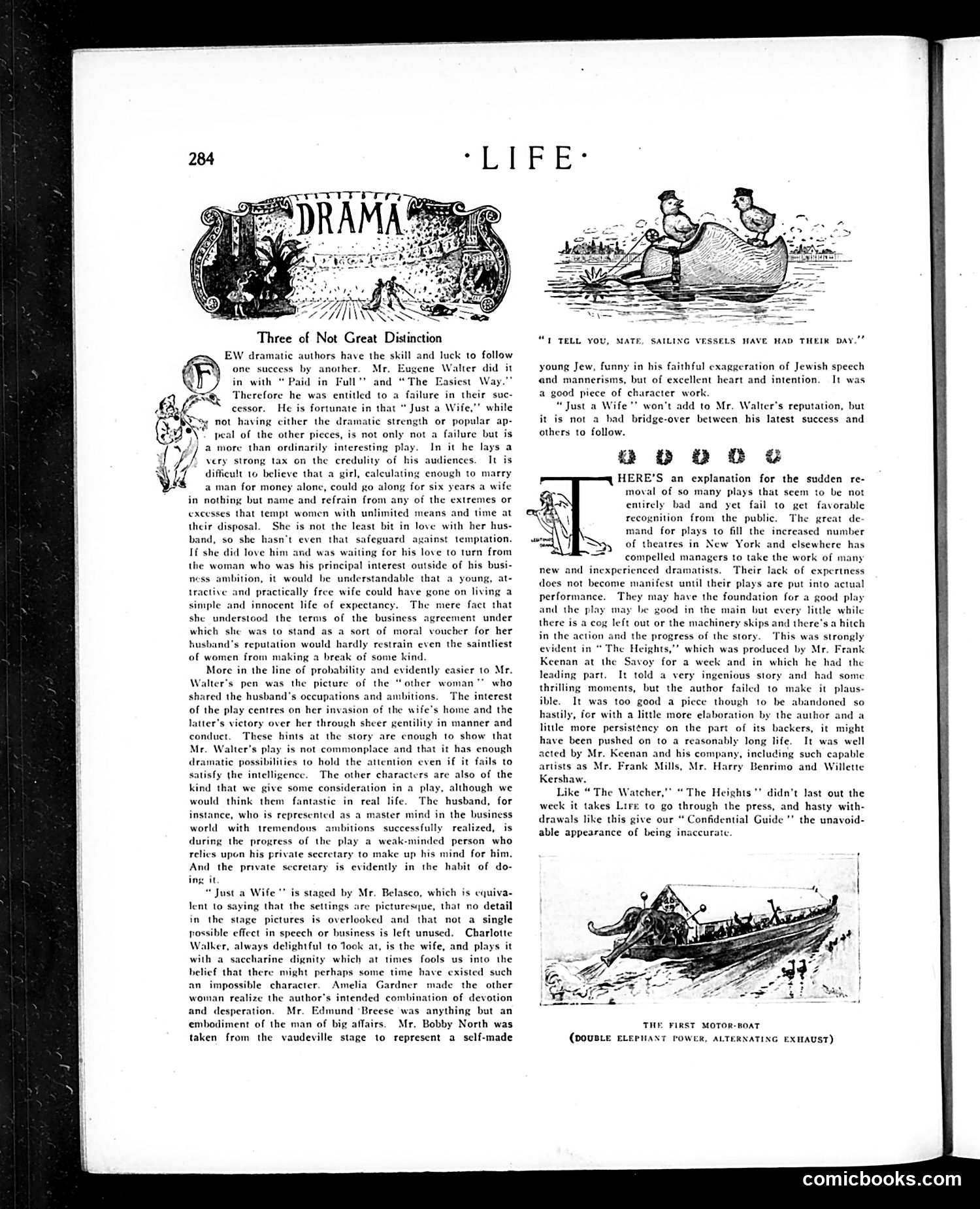
This page contains a theater review of Eugene Walter's play "Just a Wife," staged by producer David Belasco, starring Charlotte Walker. The critic analyzes the plot: a woman marries for money alone and remains faithfully married in name only for six years—a premise the reviewer finds implausibly virtuous, yet acknowledges the play succeeds through Belasco's meticulous staging. The review praises Walker's performance and supporting actors, including Bobby North as a young Jewish character, noted for "faithful exaggeration of Jewish speech and mannerisms." This reflects early 20th-century theatrical conventions where ethnic stereotyping was standard practice. The illustrations show period vignettes unrelated to the review's text. The page demonstrates Life's dual focus: satirical commentary on contemporary drama and society. No specific political content appears here—primarily cultural criticism of theatrical merit and character authenticity.
📄 Transcribed text from this page (OCR, searchable)
Machine-transcribed from the original scan — historical spelling and the odd misread are preserved.
Three of Not Great Distinction EW dramatic authors have the skill and luck to follow A one success by another. Mr. Eugene Walter did it e in with “Paid in Full’? and “The Easiest’ Way.’ ord, Therefore he was entitled to a failure in their suc- f cessor. He is fortunate in that “ Just a Wife,’’ while bee not having cither the dramatic strength or popular ap- dy YC peal of the other picces, is not only not a failure but is /} a more than ordinarily interesting play. In it / very strong tax on the credulity of his audiences. difficult to believe that a girl, calculating enough to marry a man for money alone, could go along for six years a wife in nothing but name and refrain from any of the extremes or excesses that tempt women with unlimited means and time at their disposal. She is not the least bit in love with her hus- band, so she hasn't even that safeguard against temptation. If she did love him and was waiting for his love to turn from the woman who was his principal interest outside of his busi- ness ambition, it would be understandable that a young, at- tractive and practically free wife could have gone on living a simple and innocent life of expectancy. The mere fact that she understood the terms of the business agreement under which she was to stand as a sort of moral voucher for her husband's reputation would hardly restrain even the saintliest of women from making a break of some kind. More in the line of probability and evidently easier to Mr. Walter's pen was the picture of the “other woman" who shared the husband’s occupations and ambitions. The interest of the play centres on her invasion of the wife's home and the latter’s victory over her through sheer gentility in manner and conduct. These hints at the story are enough to show that Mr. Walter's play is not commonplace and that it has enough dramatic possibilities to hold the attention even if it fails to isfy the intelligence. The other characters are also of the kind that we give some consideration in a play, although we would think them fantastic in real life. The husband, for ster mind in the business world with tremendous ambitions successfully realized, is instance, who is represented as ar during the progress of the play a weak-minded person who relics upon his private secretary to make up his mind for him. And the private secretary is evidently in the habit of do- ing it “Just a Wife’ is staged by Mr. Belasco, which is cquiv. lent to saying that the settings are picturesque, that no detail in the stage pictures is overlooked and that not a single possible effect in speech or business is left unused. Charlotte Walker, always delightful to Took at, is the wife, and plays it with a saccharine dignity which at times fools us into the belief that there might perhaps some time have existed such an impossible character. Amelia Gardner made the other woman realize the author's intended combination of devotion and desperation. Mr. Edmund “Breese was anything but an embodiment of the man of big affairs. Mr. Bobby North was taken from the vaudeville stage to represent a self-made I TELL YOU, MATE, SAILING VESSELS HAVE HAD THEIR DAY young Jew, funny in his faithful exaggeration of Jewish speech and mannerisms, but of excellent heart and intention. a good piece of character work Just a Wife"? won't add to Mr. Walter's reputation, but it is not a bad bridge-over between his latest success and others to follow. @ > 2 BB HERE’S an explanation for the sudden re- moval of so many plays that seem to be not entirely bad and yet fail to get favorable recognition from the public, The great de mand for plays to fill the increased number of theatres in New York and elsewhere has compelled managers to take the work of many new and inexperienced dramatists. Their lack of expertness does not become manifest until their plays are put into actual performance. They may have the foundation for a good play and the play may be good in the main but every little while there is a cog left out or the machinery skips and there's a hitch in the action and the progress of the story. This was strongly Fhe Heights,” which was produced by Mr. Frank Keenan at the Savoy for a week and in which he had the leading part. It told a very ingenious story and had some thrilling moments, but the author failed to make it plaus- ible. It was too good a picce though 10 be abandoned so hastily, for with a little more elaboration by the author and a little more persistency on the part of its backers, it might have been pushed on to a reasonably long life. It was well acted by Mr. Keenan and his company, including such capable tists as Mr. Frank Mills, Mr. Harry Benrimo and Willette Kershaw Like “The Watcher,” “The Heights"? didn’t last out the week it takes Lire to go through the press, and hasty with- drawals like this give our “ Confidential Guide "’ the unavoid- able appearance of being inaccurate Tt was evident in THE FIRST MOTOR-BOAT (DOUBLE ELEPMANT POWER, ALTERNATING EXHAUST) comicbooks.com