
Life, 1910-02-17 · page 19 of 44
Life — February 17, 1910 — page 19: what you’re looking at
What you’re looking at
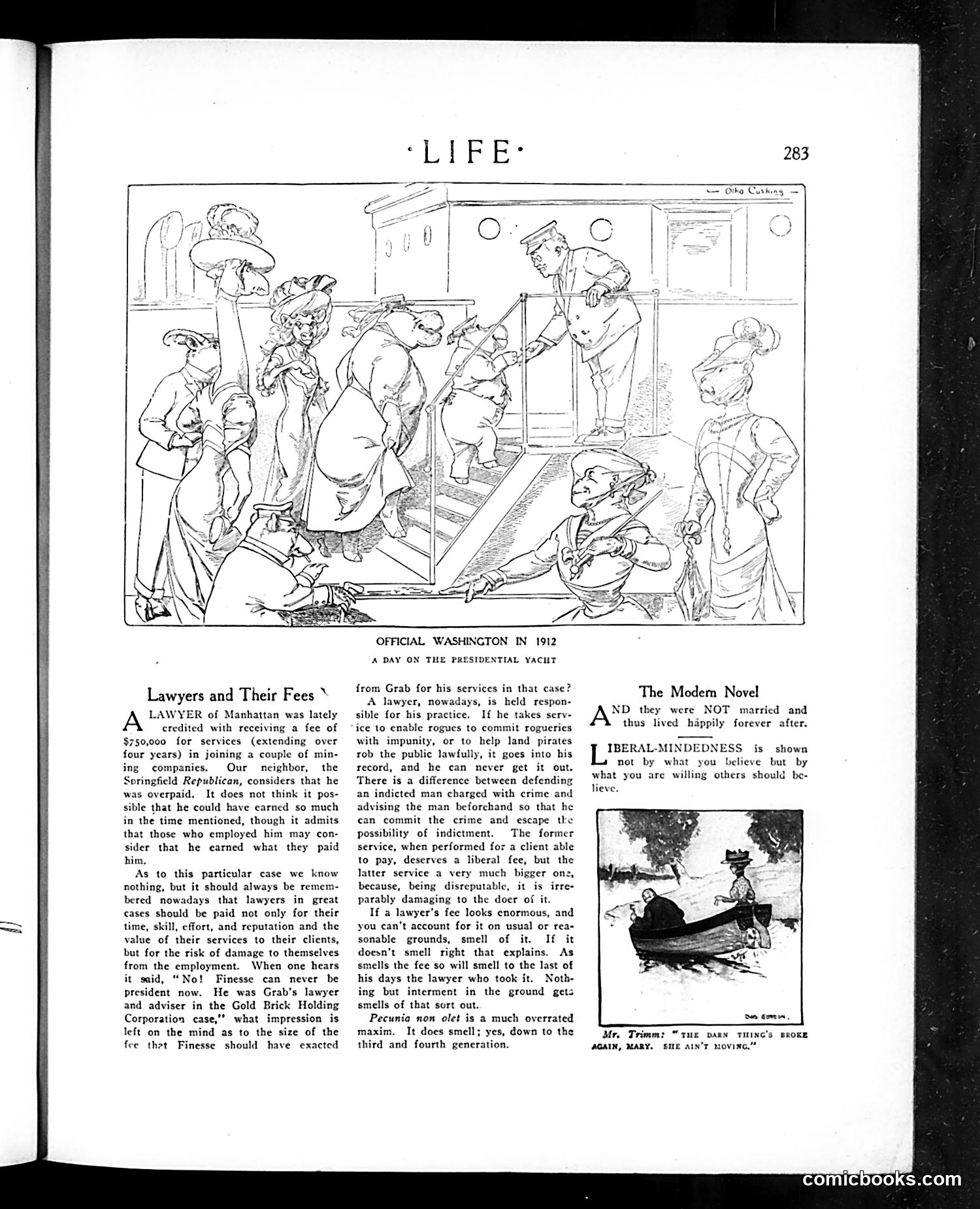
## Top Cartoon: "Official Washington in 1912" The large illustration depicts a crowded presidential yacht with well-dressed officials and what appear to be wealthy visitors being shown around. The satire likely mocks the formal, somewhat absurd pageantry of presidential entertainment and the mingling of political figures with the wealthy elite during the Taft administration (1912 is specified). ## Left Article: "Lawyers and Their Fees" Discusses a Manhattan lawyer's $750,000 fee for corporate merger work. The piece argues lawyers deserve premium compensation not just for time and skill, but for reputational risk—especially when advising on morally questionable dealings. A lawyer who facilitates crime or corporate malfeasance damages his professional reputation "down to the third and fourth generation." The Latin phrase "Pecunia non olet" (money doesn't stink) is challenged; the article argues ill-gotten fees *do* stink. ## Right Section: Brief satire on modern novels and a comic strip scene A quip about liberal-mindedness, and a domestic scene ("The Darn Thing's Broke Again, Mary") depicting working-class life.
📄 Transcribed text from this page (OCR, searchable)
Machine-transcribed from the original scan — historical spelling and the odd misread are preserved.
283 = Oko Cotas — Lawyers and Their Fees * Ay YAWYER of Manhattan was Iately credited with receiving a fee of $750,000 for services (extending over four years) in joining a couple of min- ing companies. Our neighbor, the Springfield Republican, considers that he was overpaid. It does not think it pos- sible that he could have earned so much in the time mentioned, though it admits that those who employed him may con- sider that he earned what they paid him. As to this particular case we know nothing, but it should always be remem- bered nowadays that lawyers in great cases should be paid not only for their time, skill, effort, and reputation and the value of their services to their clients, but for the risk of damage to themselves from the employment. When one hears it said, “No! Finesse can never be president now. He was Grab’s lawyer and adviser in the Gold Brick Holding Corporation case," what impression is left on the mind as to the size of the fee thet Finesse should have exacted OFFICIAL WASHINGTON IN 1912 A DAY ON THE PRESIDENTIAL YACHT from Grab for his services in that case? A lawyer, nowadays, is held respon- sible for his practice. If he takes serv- ice 10 enable rogues to commit rogueries with impunity, or to help land pirates rob the public lawfully, it goes into his record, and he can never get it out. There is a difference between defending an indicted man charged with crime and advising the man beforchand so that he can commit the crime and escape tke possibility of indictment. The former service, when performed for a client able to pay, deserves a liberal fee, but the latter service a very much bigger o' because, being disreputable, it is irre- parably damaging to the doer of it. If a lawyer's fee looks enormous, and you can’t account for it on usual or reas sonable grounds, smell of it. If it doesn't smell right that explains. As smells the fee so will smell to the last of his days the lawyer who took it. Noth- ing but interment in the ground gets smells of that sort out. Pecunia non olet is a much overrated maxim. It does smell; yes, down to the third and fourth generation. The Modem Novel ND they were NOT married and thus lived happily forever after. IBERAL-MINDEDNESS is shown not by what you believe but by what you are willing others should be- lieve. Mr. Trimm: “rue paRN TIING’S BROKE AGAIN, MARY, SITE AIN'T OVING.”” comicbooks.com