
A complete issue · 36 pages · 1910
Life — February 10, 1910
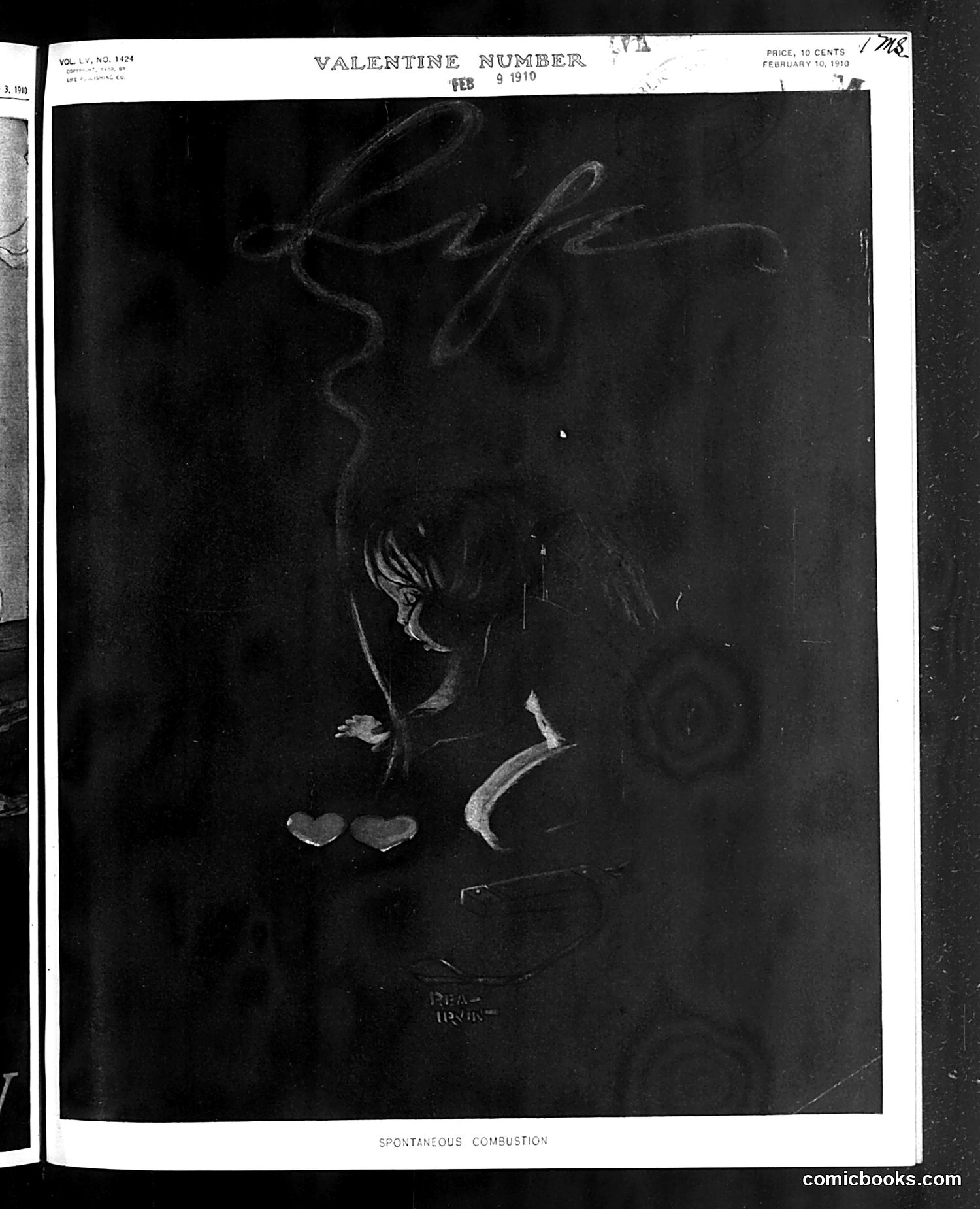
This is a Valentine's Day issue from Life magazine (February 10, 1919). The cartoon, titled "Spontaneous Combustion," depicts a figure whose head is engulfed in flames or explosive energy, with hearts floating nearby—a dark play on Valentine's imagery. The meaning is unclear without additional context, but the "spontaneous combustion" title suggests either: - Mockery of someone's passionate romantic feelings or declarations - Political satire about heated emotions or conflict (1919 was a volatile post-WWI period) - Social commentary on fervent idealism or revolutionary sentiment The handwritten notation at top and artist signature at bottom are partially legible but don't clarify the specific target. The image quality and lack of identifying labels make definitive interpretation difficult.
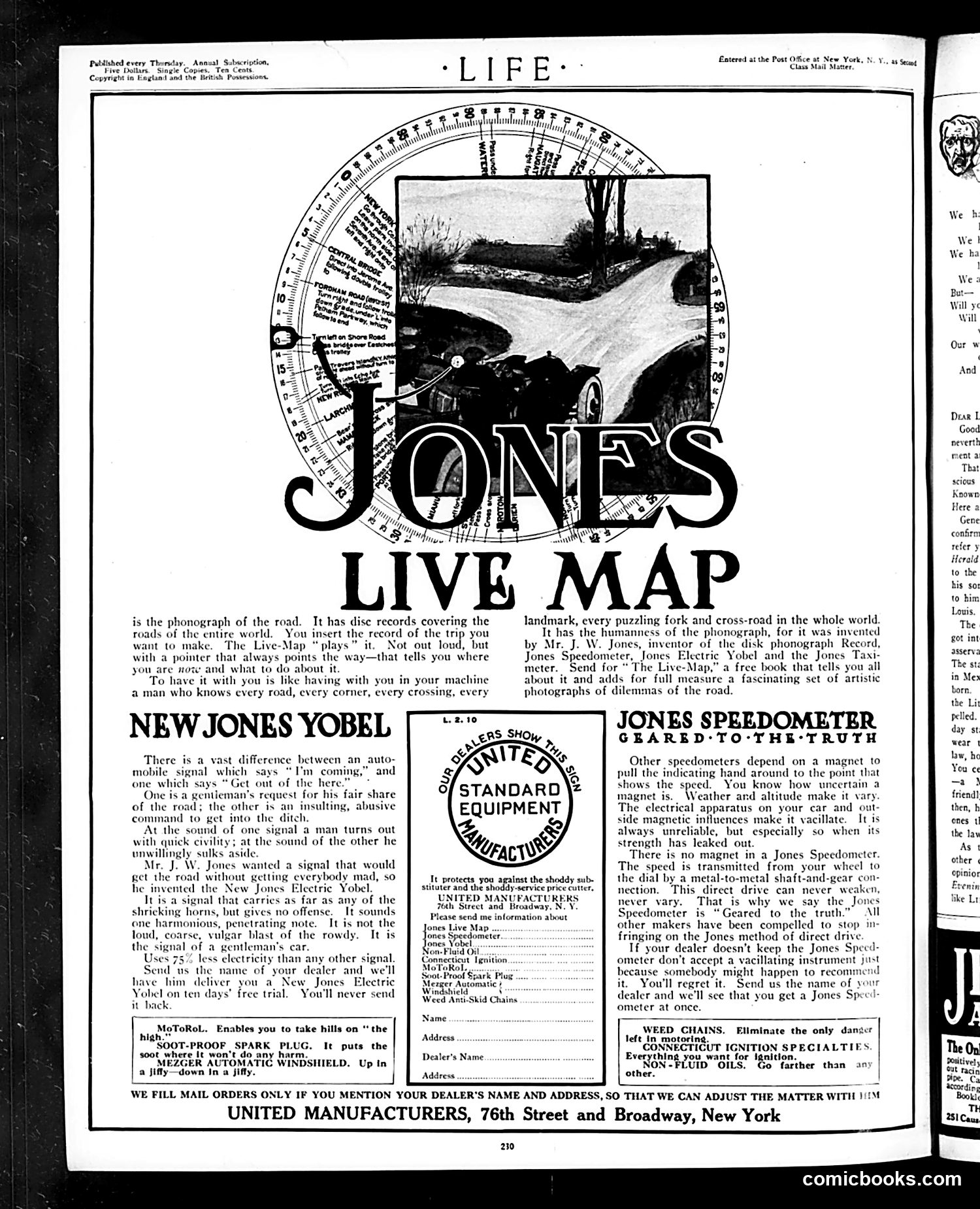
This page is **primarily advertising**, not political satire. It features ads for automobile accessories and parts from the 1910s-1920s era: **Main content:** The "Jones Live Map" advertisement showcases a phonograph-based road navigation device—essentially an early audio guide using recorded directions. A companion "Jones Speedometer" ad emphasizes precision engineering for automobile instruments. **Historical context:** These ads target early motorists navigating unmapped roads without GPS or paved highways. The "Live Map" represents contemporary innovation in automotive convenience technology. **Secondary ad:** The "New Jones Yobel" promotes an automotive signal device, while smaller ads discuss spark plugs and other mechanical components. There is **no political cartoon or satire** on this page—it's a straightforward product advertisement section from a period when Life magazine mixed humor content with commercial ads.
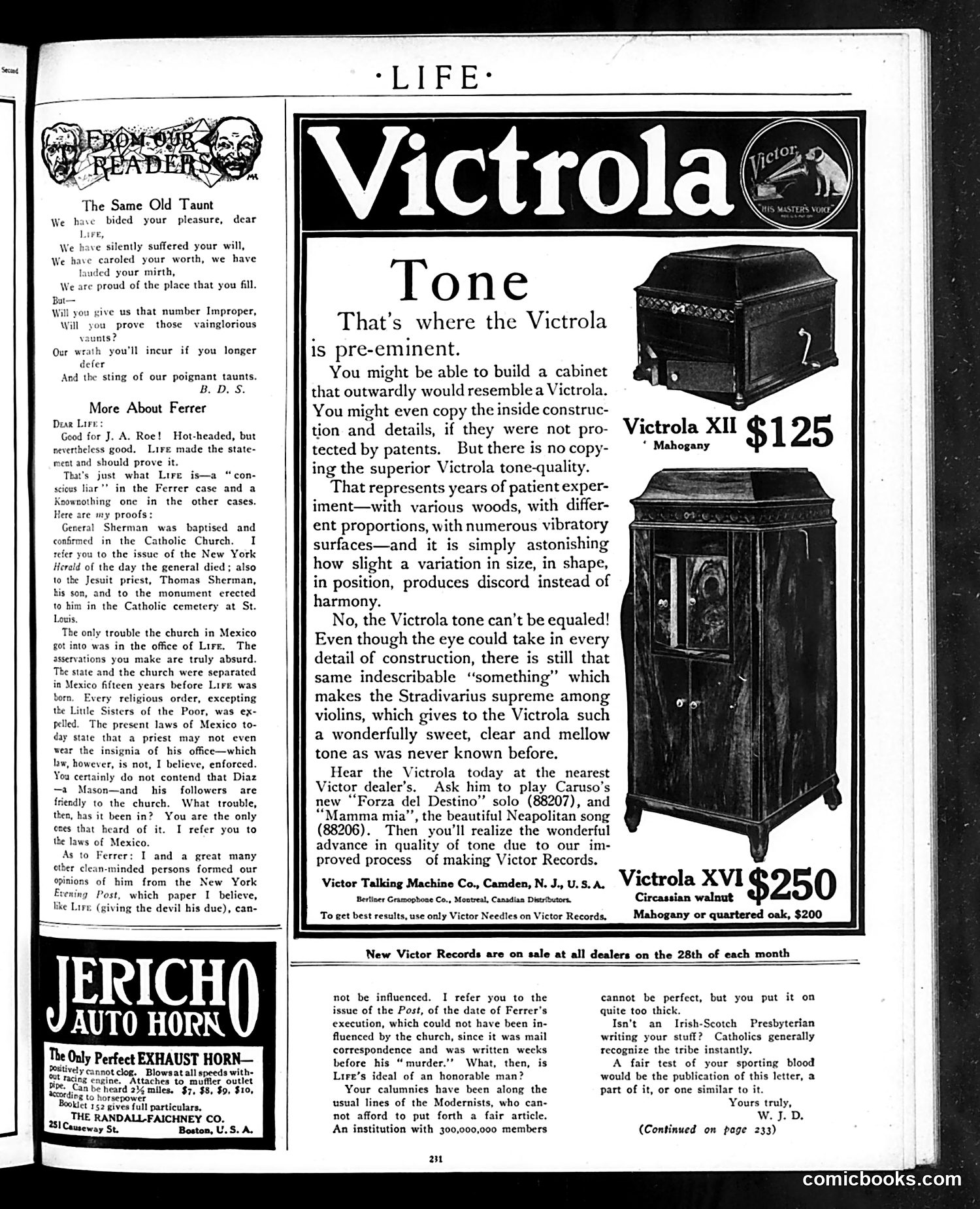
This page is primarily **advertising**, not political satire. The dominant content features three Victrola phonograph advertisements (models XII, XVI, and related offerings), emphasizing superior sound quality and construction. The small "From Our Readers" section contains letters debating General Ferrer's execution and its relationship to the Mexican church—a reference to **Ferrer's 1909 execution in Spain**, which generated international controversy over church-state relations. Readers contest whether Life magazine influenced political opinion on the matter. A minor ad for a Jericho auto horn appears at bottom left. The page reflects early 20th-century consumer culture alongside serious political correspondence—typical of Life's mixed editorial approach during this period.
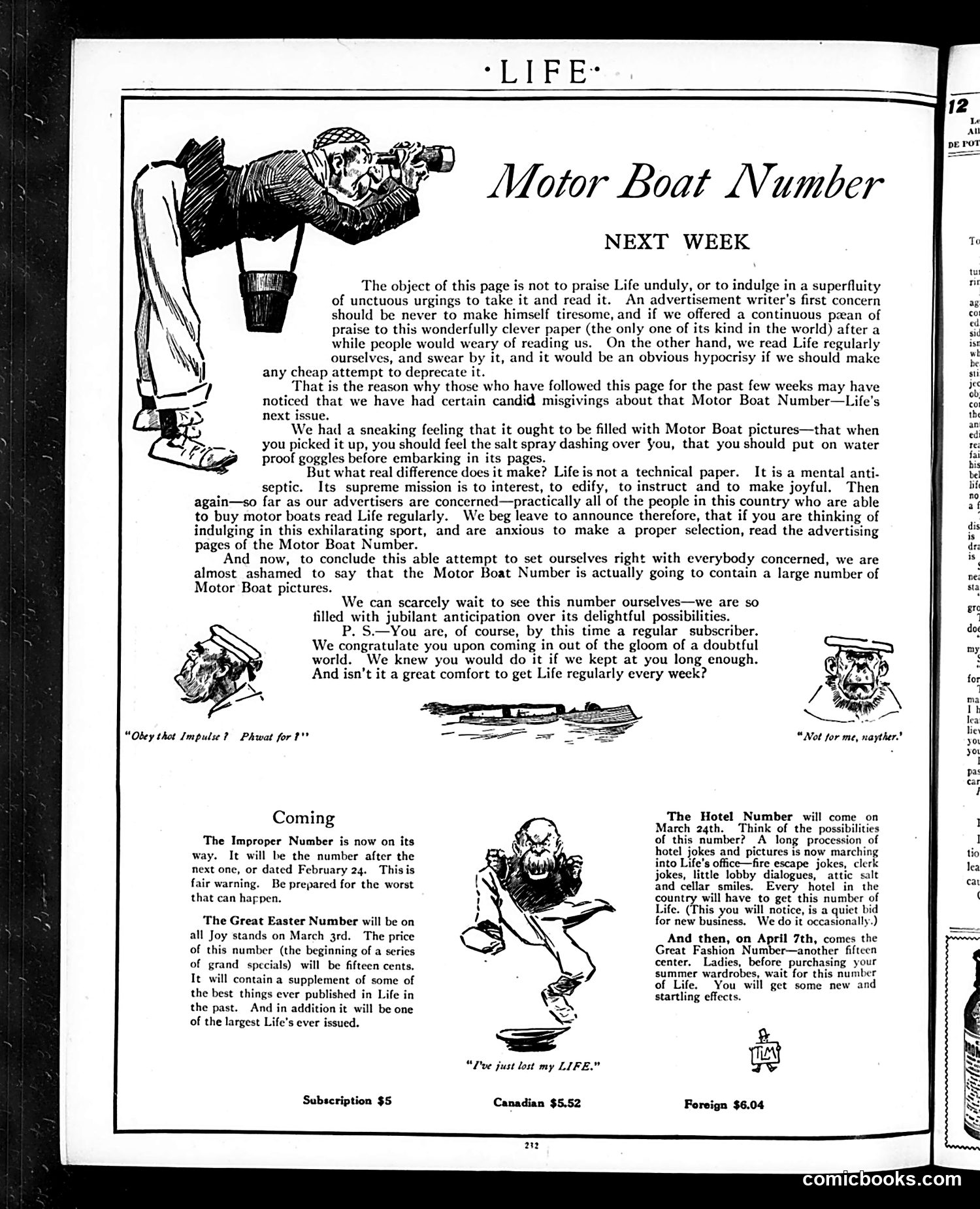
This page is primarily **self-promotional advertising** for Life magazine's upcoming "Motor Boat Number" issue. The text announces future special issues: - **Motor Boat Number** (next week) - featuring motorboat pictures and advertisements - **The Improper Number** (February 24) - **The Great Easter Number** (March 26) - described as fifteen cents with special content - **The Hotel Number** (April 7th) - targeting women shopping for summer wardrobes The cartoons are generic humorous illustrations unrelated to specific political figures or events. They support Life's pitch: the magazine offers entertainment value ("edify, instruct and make joyful") while serving advertisers reaching affluent readers who buy motor boats and travel. The subscription prices ($5 domestic, $5.52 Canadian, $6.04 foreign) indicate this was a premium publication targeting the wealthy.
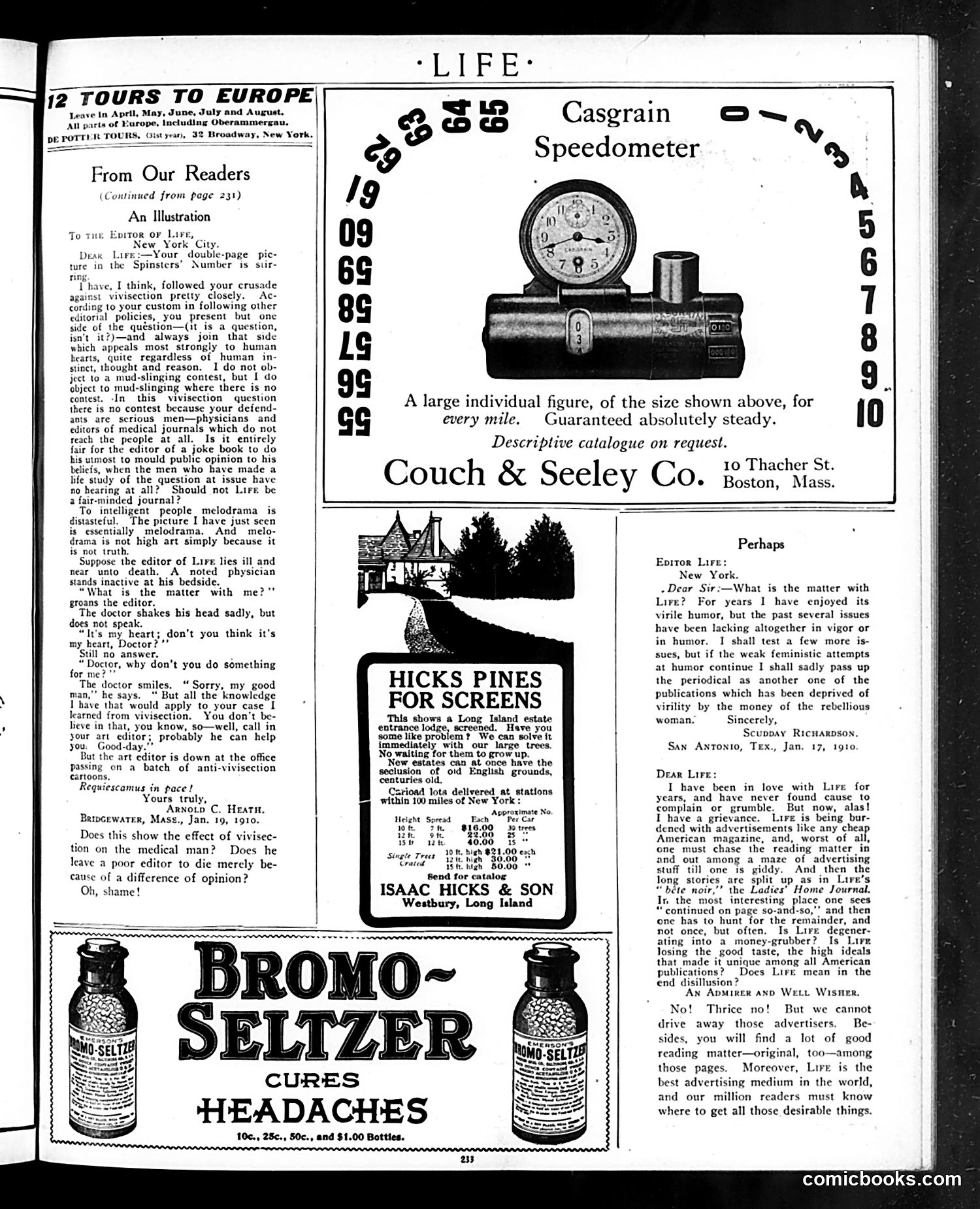
This page contains no political cartoons. Instead, it features: 1. **Letters to the Editor** ("From Our Readers"): Readers debate Life's editorial policies and content, with one correspondent criticizing the magazine's approach to medical and social issues. 2. **Advertisements**: The dominant content includes ads for a Casgrain Speedometer, Hicks Pines (for screens), and Bromo-Seltzer (for headaches). 3. **Reader Response Section**: An editor's reply defends Life's advertising model and editorial independence, stating that reader complaints about advertisements won't influence their publishing decisions. The page is primarily concerned with magazine business practices and reader-editor relations rather than satirical commentary.
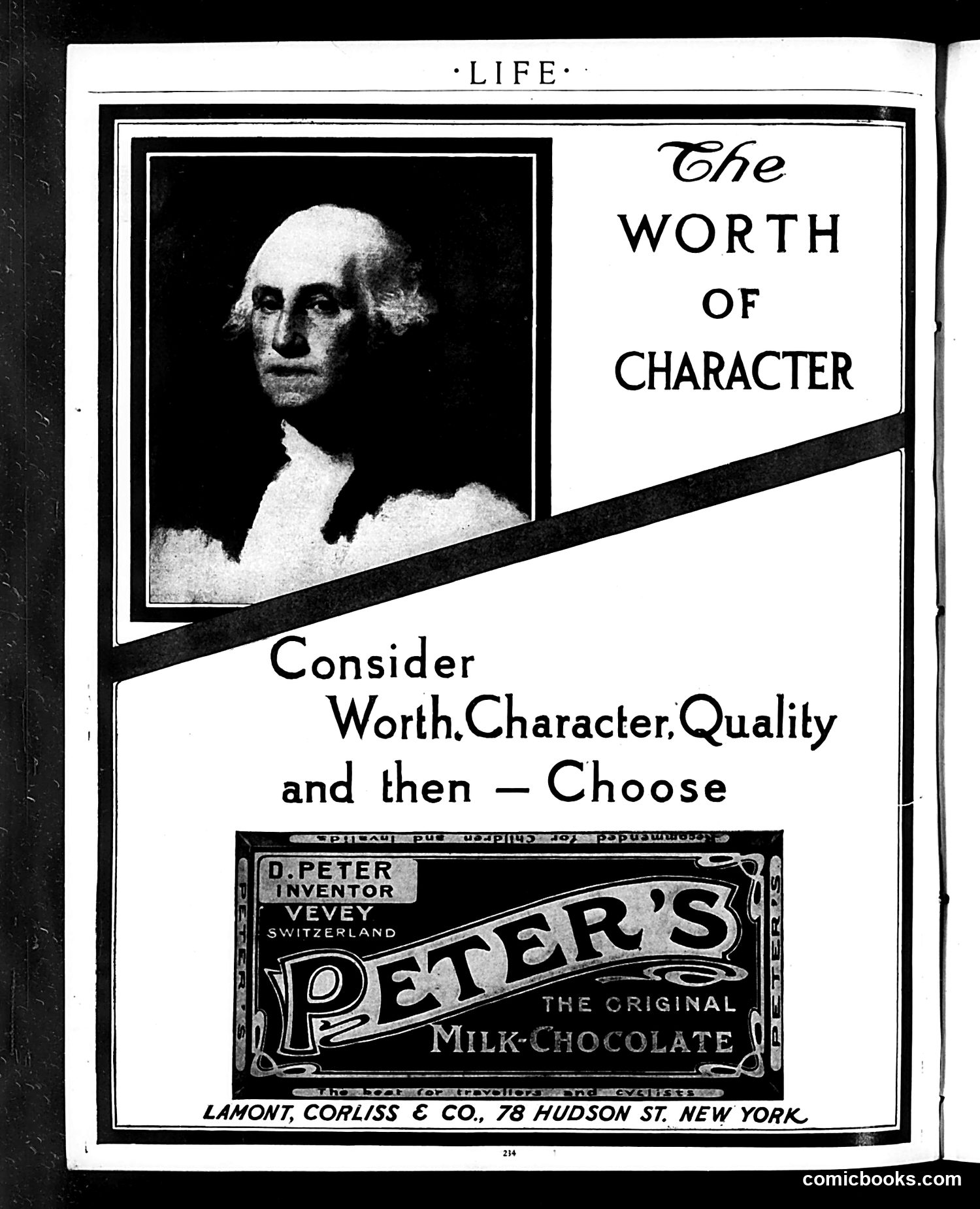
This is primarily a **Peter's Milk Chocolate advertisement**, not satire or political commentary. The page uses a portrait of an elderly gentleman in formal 18th-century dress to anchor the ad's message: "The Worth of Character—Consider Worth, Character, Quality and then—Choose Peter's." The advertisement employs a classical appeal to virtue and quality selection, suggesting that just as one would choose a person of good character, consumers should choose Peter's chocolate for its inherent worth and quality. The figure appears designed to evoke trustworthiness and tradition rather than represent a specific historical person. The ad's manufacturer, Lamont, Corliss & Co., was located at 78 Hudson Street, New York. This represents straightforward early 20th-century advertising rather than editorial satire.
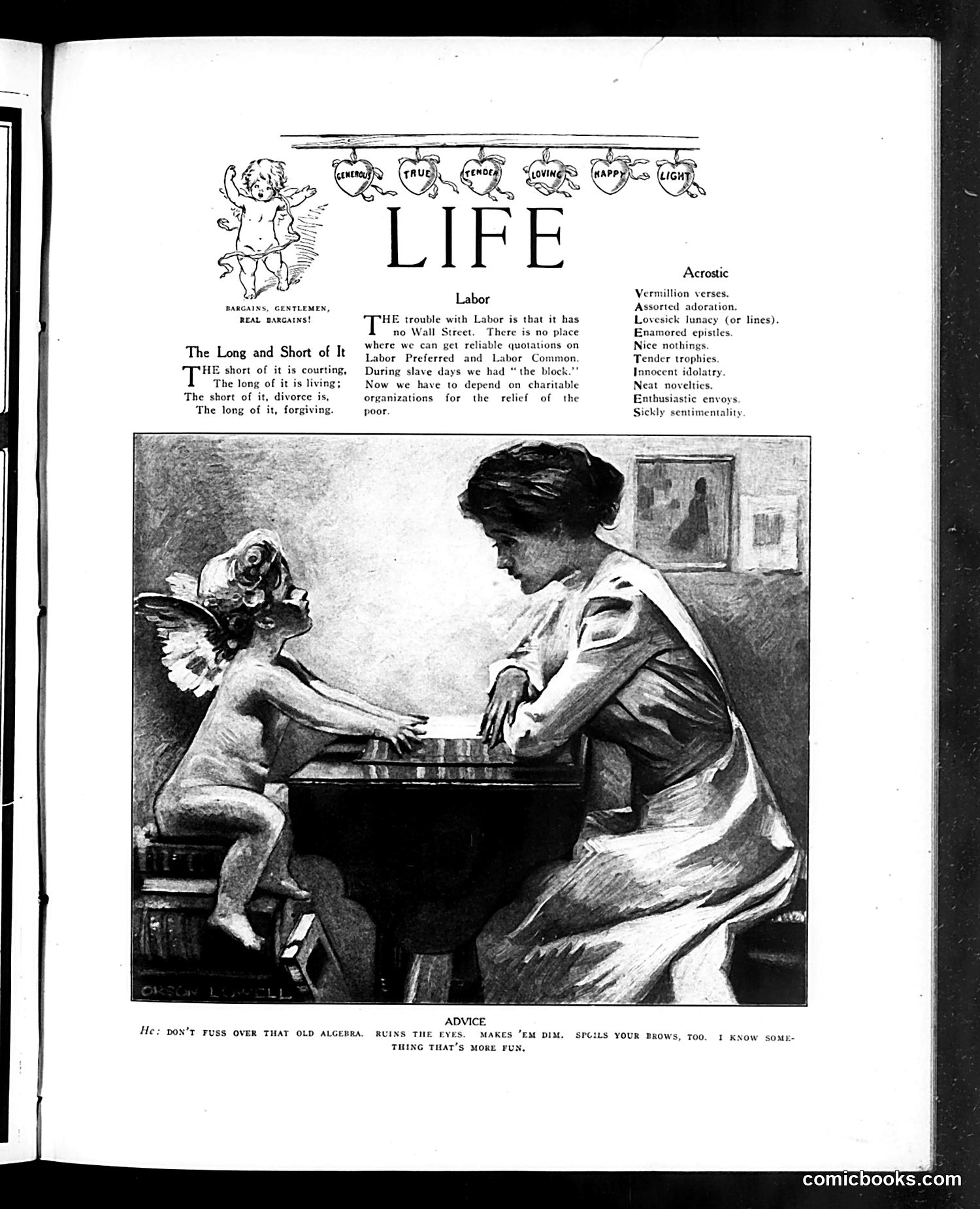
This page from the satirical magazine *Life* addresses labor issues and working conditions. The section titled "Labor" discusses the challenge of obtaining reliable information about labor practices, referencing historical "slave days" and contemporary charitable organizations' role in poor relief. The central illustration depicts a woman playing chess with a cherub (cupid-like figure), captioned "ADVICE: He don't fuss over that old algebra. Ruin the eyes. Makes 'em dim. Spoils your brows, too. I know something that's more fun." The joke appears to mock domestic advice-giving—suggesting trivial concerns (eyestrain from math) while advocating frivolous pursuits over education. This likely satirizes gender expectations and the limited intellectual aspirations society imposed on women during this era.
This page contains editorial text debating domestic economics and women's roles, illustrated with small decorative cartoons featuring animals and domestic scenes rather than political caricatures. The main argument critiques the high cost of food and argues that improved cooking skills could reduce waste. It contrasts American and French approaches to domestic economy, praising French women's expertise in making "cheap foods" stretch further. The text advocates better appreciation for women's housework and criticizes meat-price regulation proposals. A notable satirical point addresses the Post Office's expense in distributing magazines—the author challenges claims that rate increases cost nine cents per pound to deliver, calling the estimate "preposterous." The cartoons appear merely decorative rather than satirical commentary on the text itself.
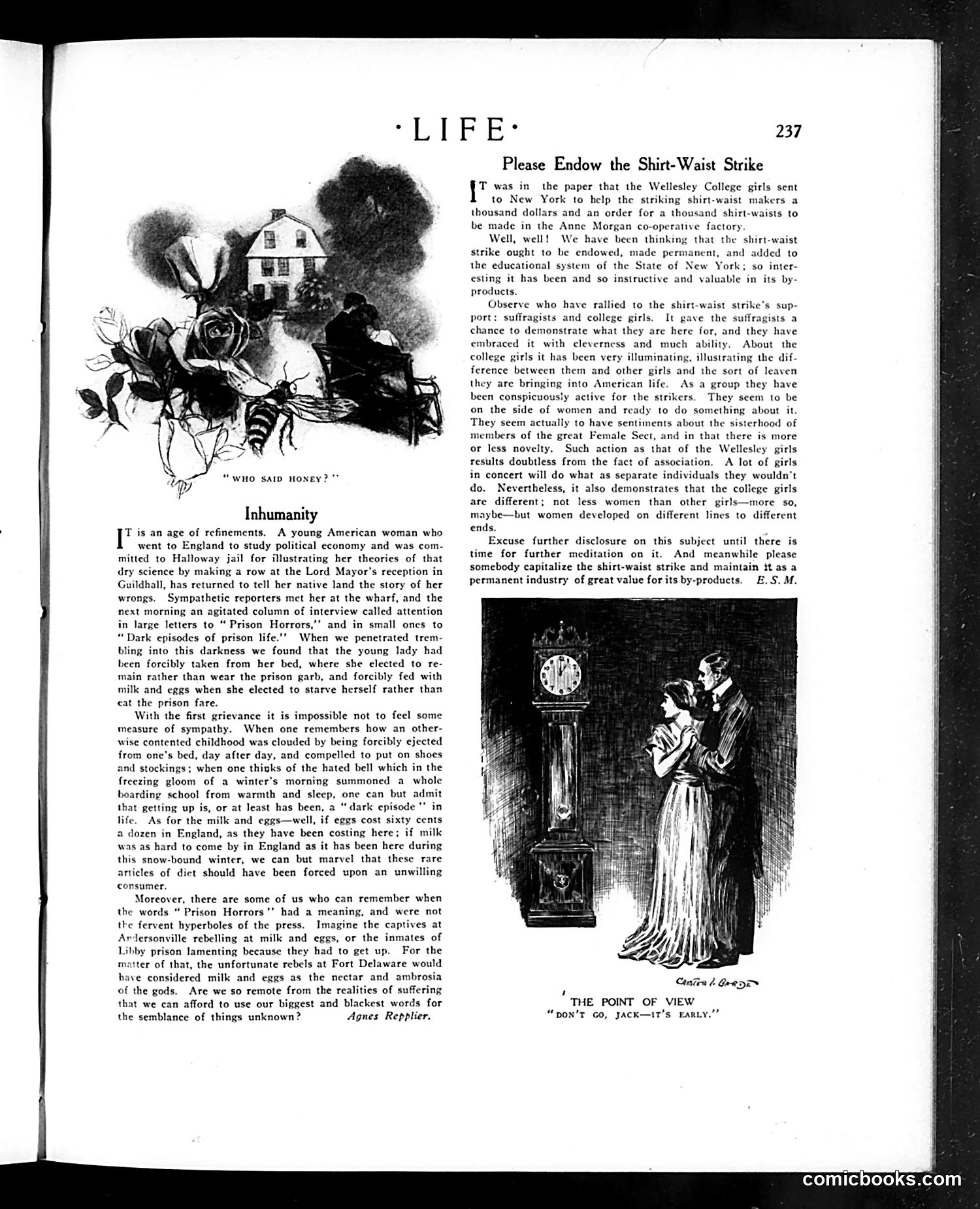
This page contains two distinct articles with illustrations: **"Please Endow the Shirt-Waist Strike"** (top) discusses the 1909 Wellesley College girls' fundraising efforts for striking shirtwaist makers in New York. The accompanying illustration shows a beehive near a house, captioned "WHO SAID HONEY?" — a visual pun linking the college girls' support to the strikers' cause. **"Inhumanity"** (bottom) critiques the treatment of a young American woman imprisoned for political activism. The article describes forced labor conditions (milk, eggs, prison garb) and compares them unfavorably to historical atrocities. The illustration shows a prison scene labeled "DON'T GO, JACK—IT'S EARLY," depicting a visitor departing from an inmate. Both pieces advocate for social reform and sympathize with those suffering under harsh conditions.
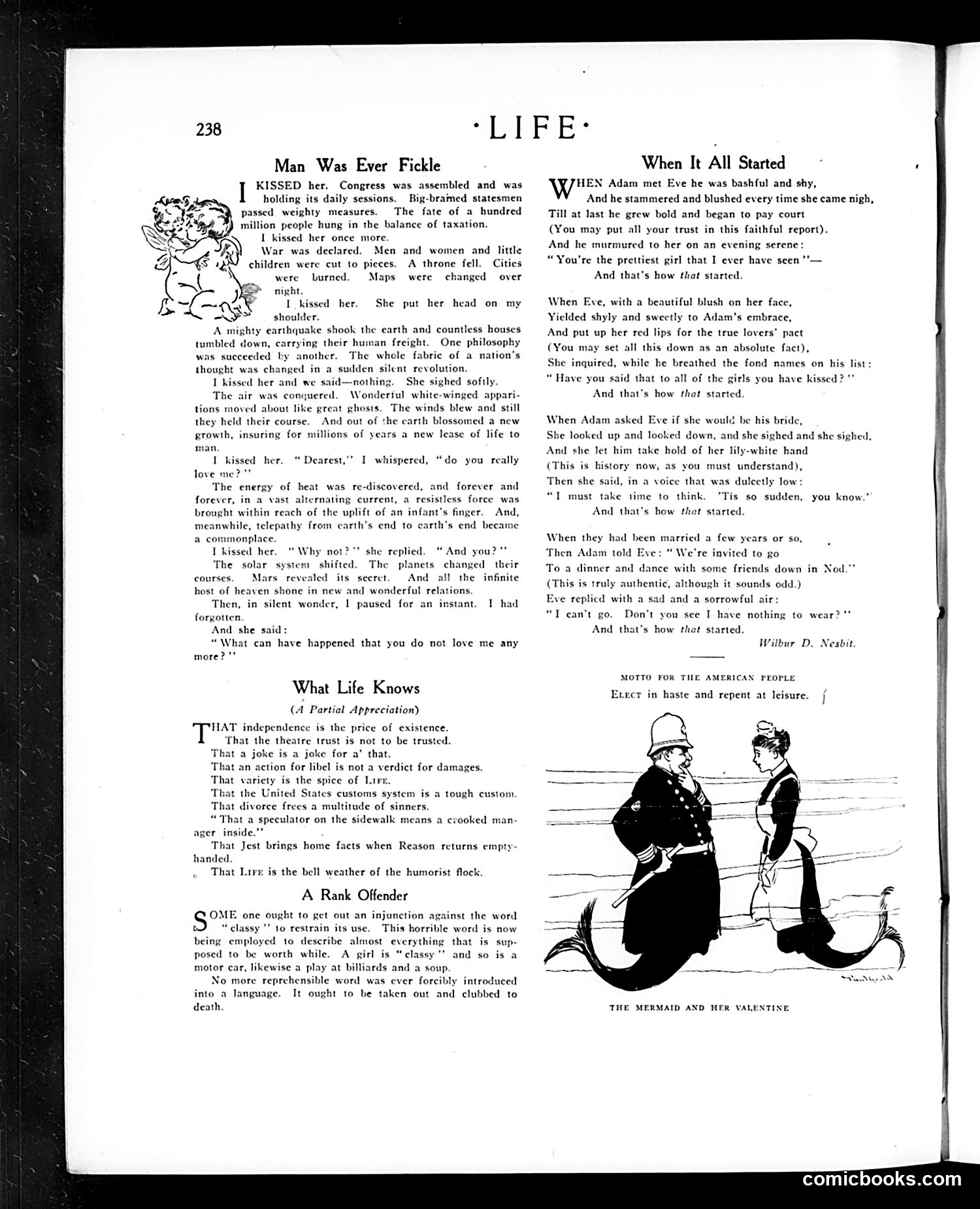
This cartoon depicts a romantic encounter between a mermaid and a man in formal attire. The humor appears to operate on multiple levels: the gentleman presents himself as a suitor offering courtship ("valentine"), while the mermaid—a fantastical creature—represents an impossible romantic pursuit. The surrounding satirical pieces mock contemporary social pretensions and linguistic trends. "A Rank Offender" criticizes the overuse of the word "classy" in American speech, arguing it debases language by being applied indiscriminately to everything from motor cars to billiards. The page reflects early 20th-century Life magazine's characteristic blend of whimsical illustration with social commentary on manners and language use.
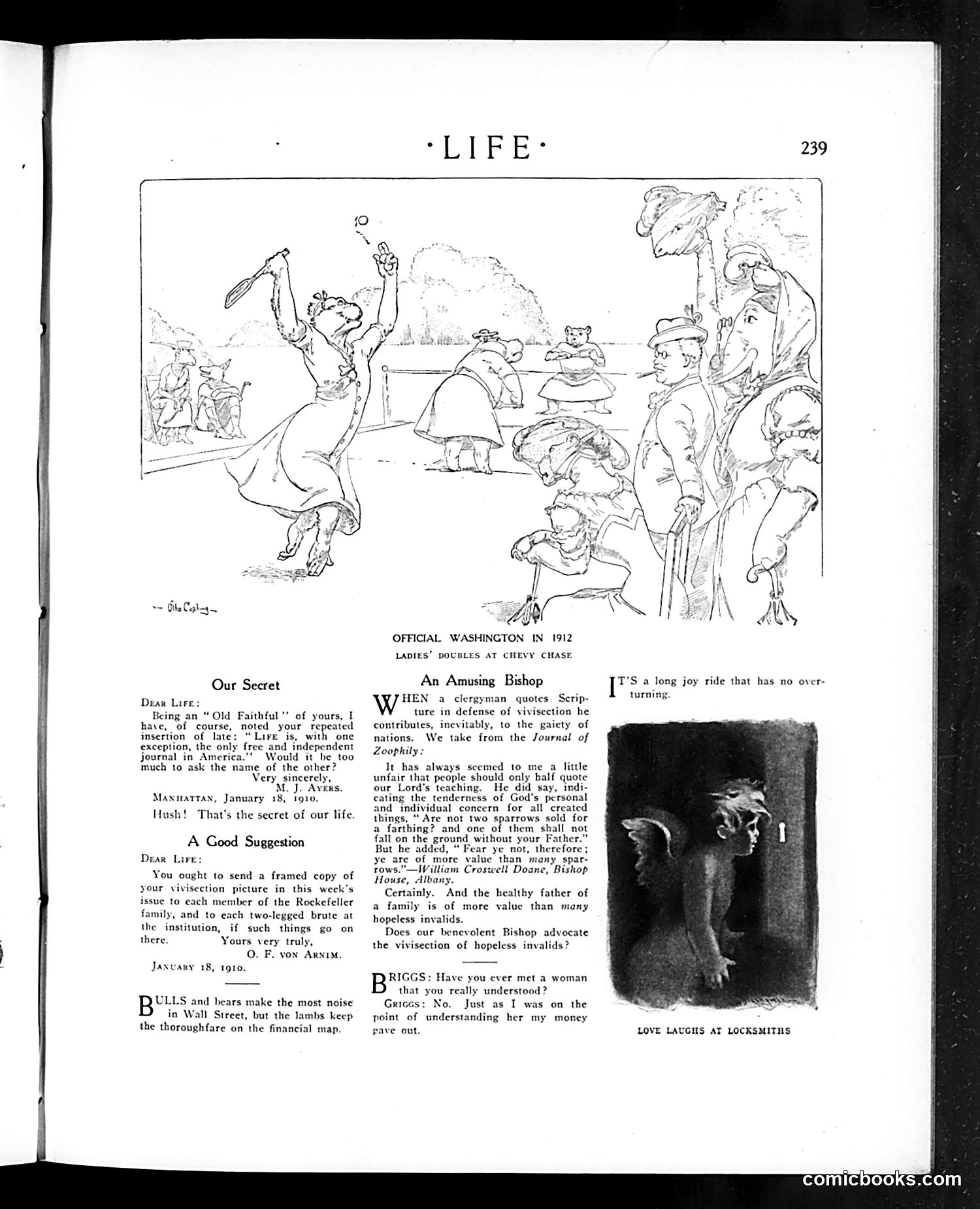
The top cartoon depicts women playing tennis at Chevy Chase Club in Washington, D.C. The sketch shows women in athletic poses—one doing a handstand or acrobatic move—watched by men in suits and hats. The satire appears to mock the novelty of women participating in sports and physical activities, presenting them as undignified or comical spectacles for male observation. The "1912" date places this during the Progressive Era when women's increased public participation in athletics was still considered somewhat scandalous or amusing by mainstream society. The exaggerated poses emphasize how unfamiliar and ridiculous such athletic women seemed to contemporary observers. The accompanying text sections ("Our Secret," "A Good Suggestion," "An Amusing Bishop") are unrelated filler content.
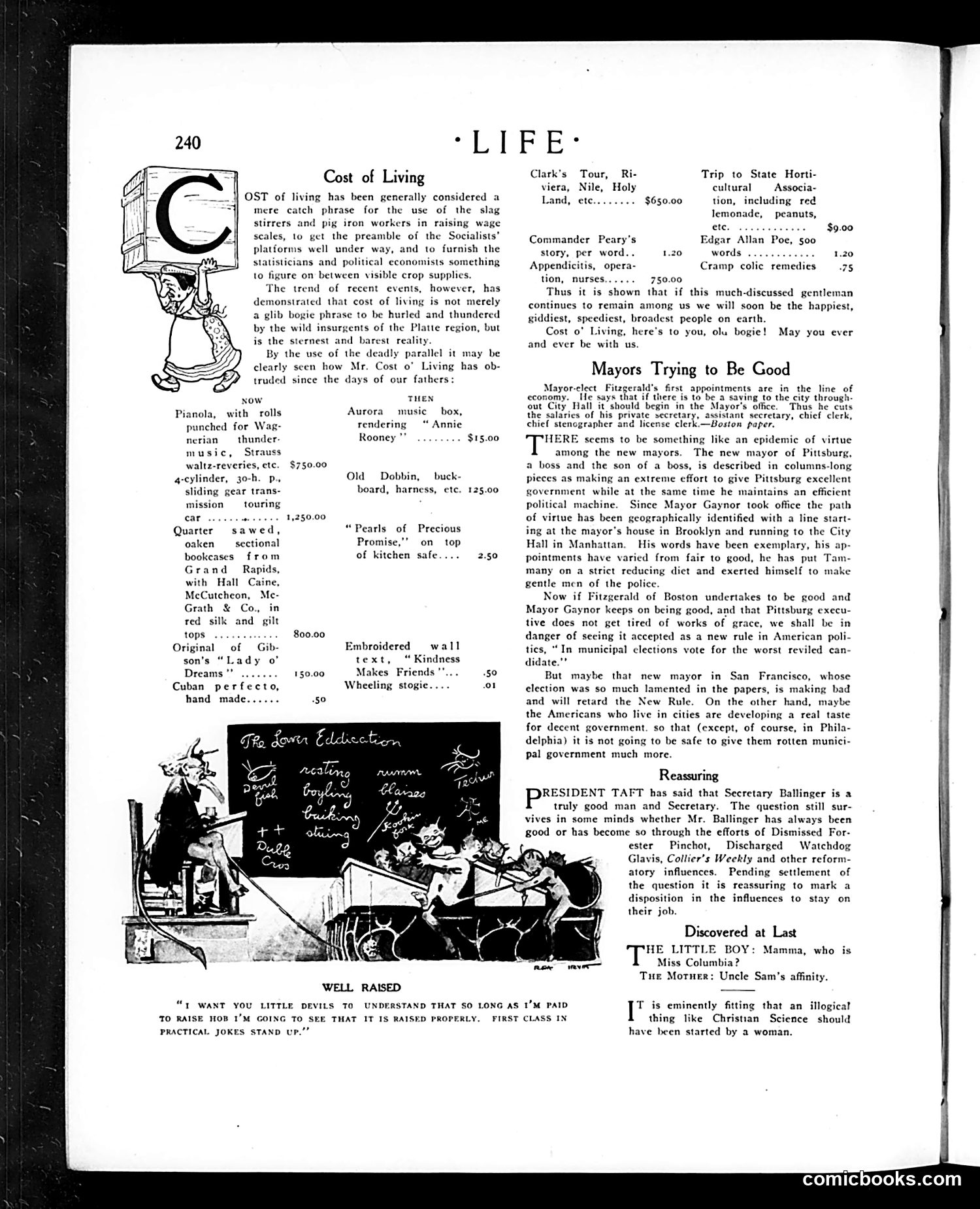
**"Cost of Living" Section:** The left column discusses living expenses and includes price lists for various goods (music boxes, silk tops, embroidered wall hangings). This appears to be satirizing how economists and politicians attempt to quantify and justify rising costs. **"Mayors Trying to Be Good":** The main article critiques new mayors—specifically mentioning Pittsburgh's mayor and Boston's Mayor Fitzgerald—who claim to promote governmental virtue and economy. The satire suggests these reformist pledges are performative; the text questions whether such mayors will maintain their promises or become corrupted by political machines. **Bottom Cartoon:** Labeled "Well Raised," this depicts child-rearing, with the caption joking about teaching children "practical jokes." It's a humorous commentary on parenting philosophies. The page overall satirizes politicians' reform rhetoric and living cost debates of the era.
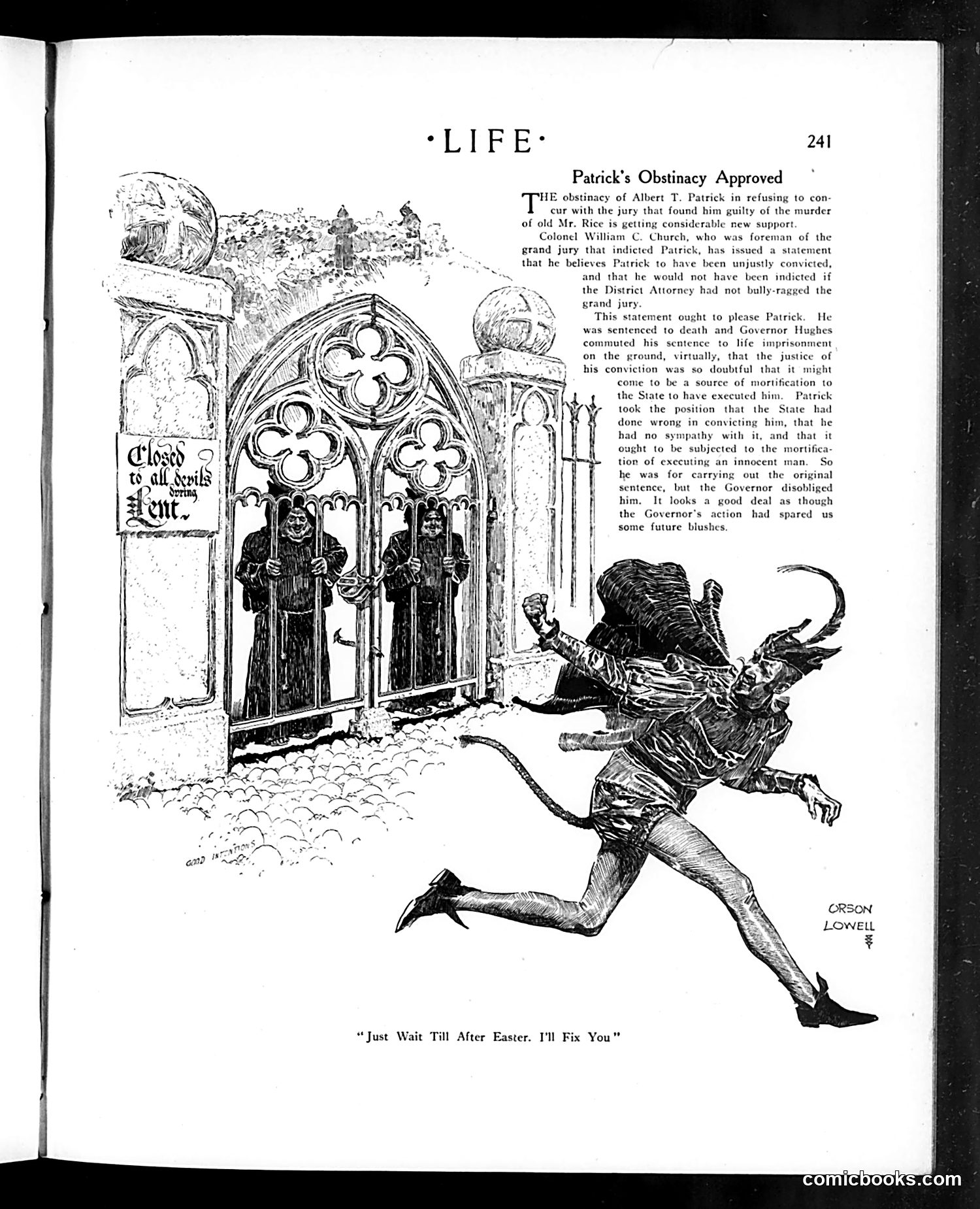
This page discusses Albert T. Patrick's legal case. Patrick was convicted of murdering an elderly man (Mr. Rice) and sentenced to death. The article explains that Colonel William C. Church, a jury foreman, has challenged the conviction's validity, arguing Patrick should not be executed given doubts about the case's justice. The cartoon by Orson Lowell depicts a demonic figure (representing Patrick or the case itself) fleeing a church, captioned "Just Wait Till After Easter, I'll Fix You." This suggests the cartoon satirizes Patrick's hope that Governor Hughes's commutation of his sentence to life imprisonment might eventually lead to further leniency—implying the legal battle isn't truly over despite the current outcome.
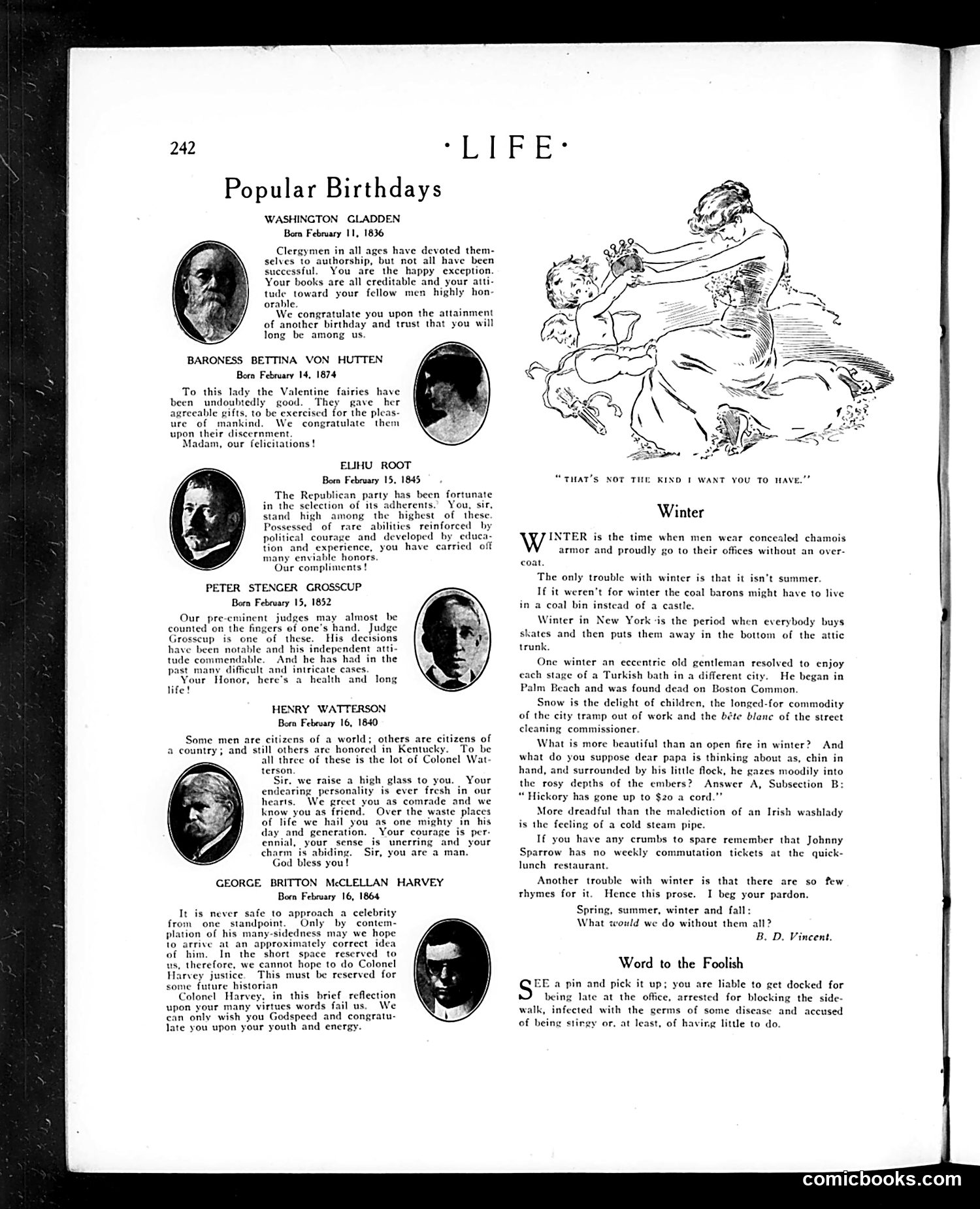
This page from Life magazine contains two distinct sections: "Popular Birthdays" and an essay on "Winter." **Popular Birthdays** celebrates the February birthdays of six prominent American figures: Washington Gladden (clergyman-author), Baroness Bettina von Hutten, Elihu Root (Republican politician), Peter Spencer Grosscup (judge), Henry Watterson (Kentucky newspaper editor and public figure), and George Britton McClellan Harvey (likely a publisher/editor). The congratulatory verses are earnest rather than satirical, praising their accomplishments and character. **The Winter essay** (right side) employs Life's characteristic satirical humor, poking fun at winter's contradictions and inconveniences: coal barons' wealth, New Yorkers' impractical skate-buying, the eccentric Turkish bath tourist, and snow's dual nature as children's delight and street-cleaners' nightmare. The concluding illustration shows cherubs, accompanying a caption about undesired gifts—likely satirizing sentimental Victorian winter imagery.
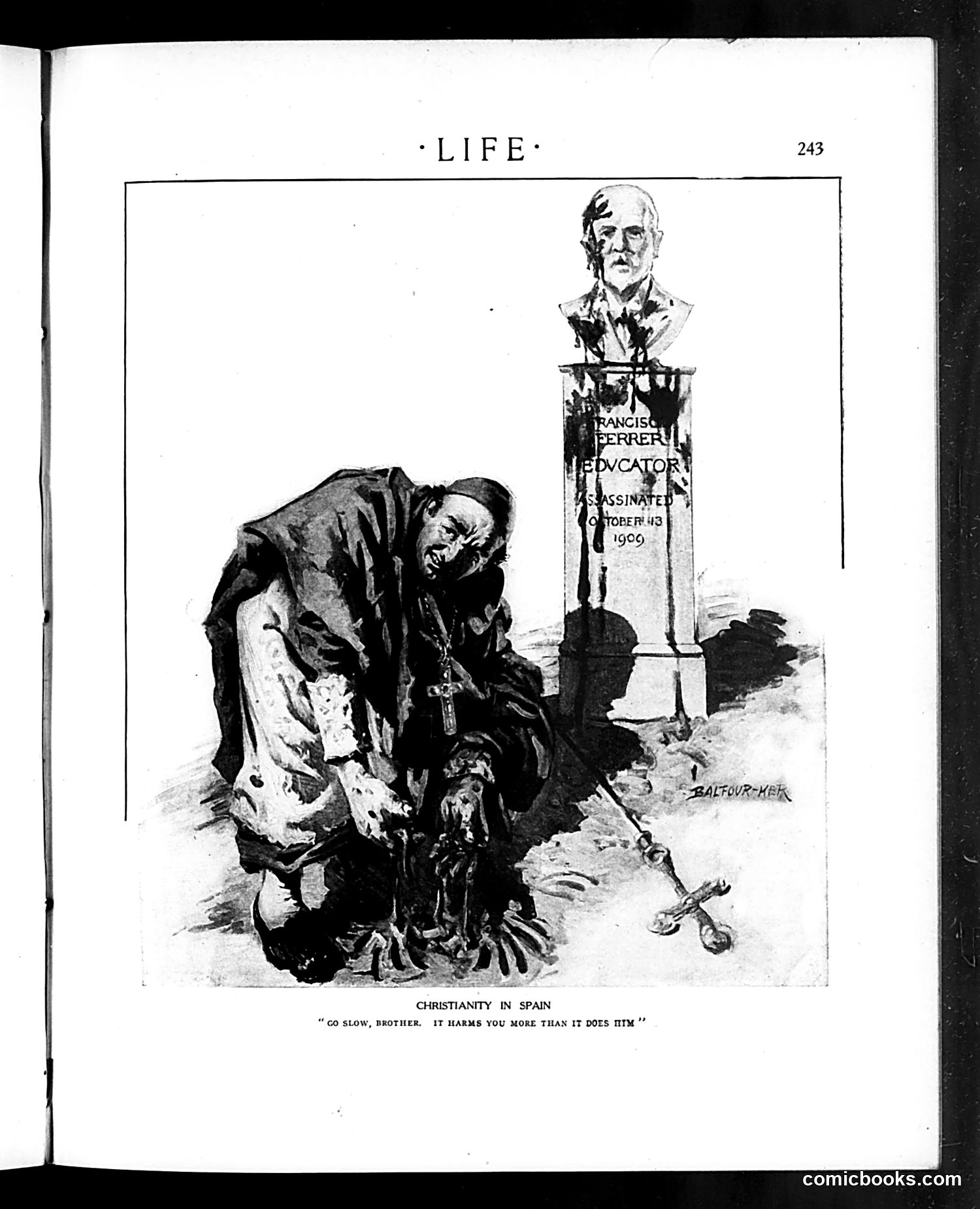
This political cartoon from Life magazine satirizes religious persecution in Spain. The central figure is a kneeling person in ragged clothes being tormented, while a bust labeled "Francisco Ferrer Educator Assassinated October 13 1909" stands behind as a monument. The satire critiques Spain's Catholic establishment for harming its own Christian values through brutality. The caption's ironic quote ("Go slow, brother. It harms you more than it does him") suggests the persecutor damages Spain's moral standing more than the victim's body. Francisco Ferrer was a real Spanish educator and anarchist executed in 1909, becoming a symbol of Spanish religious intolerance. The cartoon appears to condemn Spain's treatment of dissident intellectuals and secular reformers in the name of Christianity, presenting this as hypocrisy that undermines Spanish Catholicism itself.
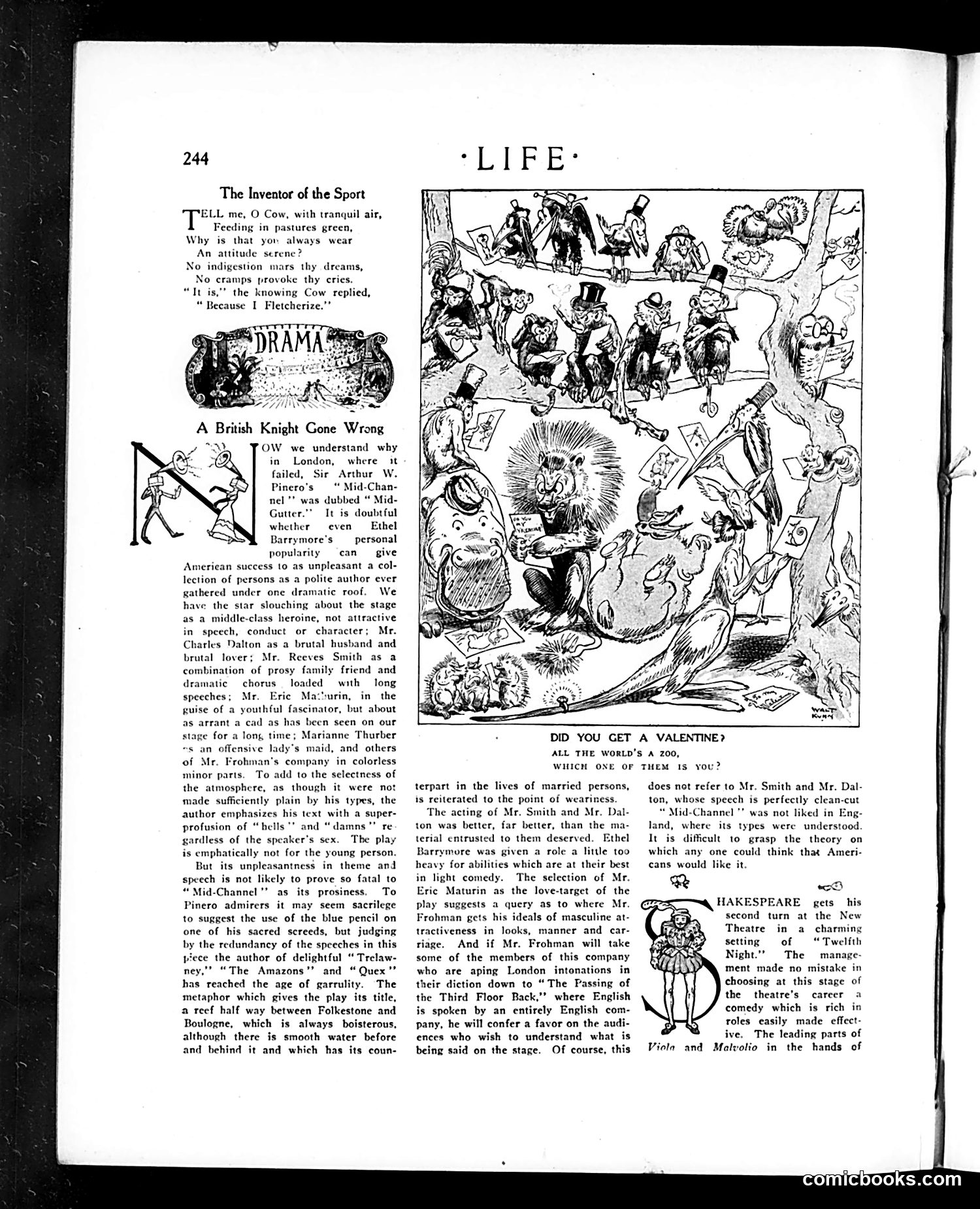
**"The Inventor of the Sport"** (top left): A humorous poem mocking the "Fletcherizing" fad—a dietary practice promoted by Horace Fletcher, who advocated thorough chewing. The cow claims its serene digestion results from this method. This satirizes a genuine health trend of the era that Life considered absurd. **"A British Knight Gone Wrong"** (center): A theater review of Arthur Wing Pinero's play "Mid-Channel." The critic argues the play, though successful in London, will fail in America because its characters are uniformly unlikeable and morally unattractive. The review criticizes the actors' affected English accents and excessive use of profanity. The title puns on the play's metaphor (a dangerous reef) to suggest the play itself is unnavigable. **"Did You Get a Valentine?"** (right): A satirical illustration depicting various animal caricatures, likely representing different human types or social classes. The caption suggests this is a social commentary on romantic relationships and human nature using animal stereotypes—a common satirical device.
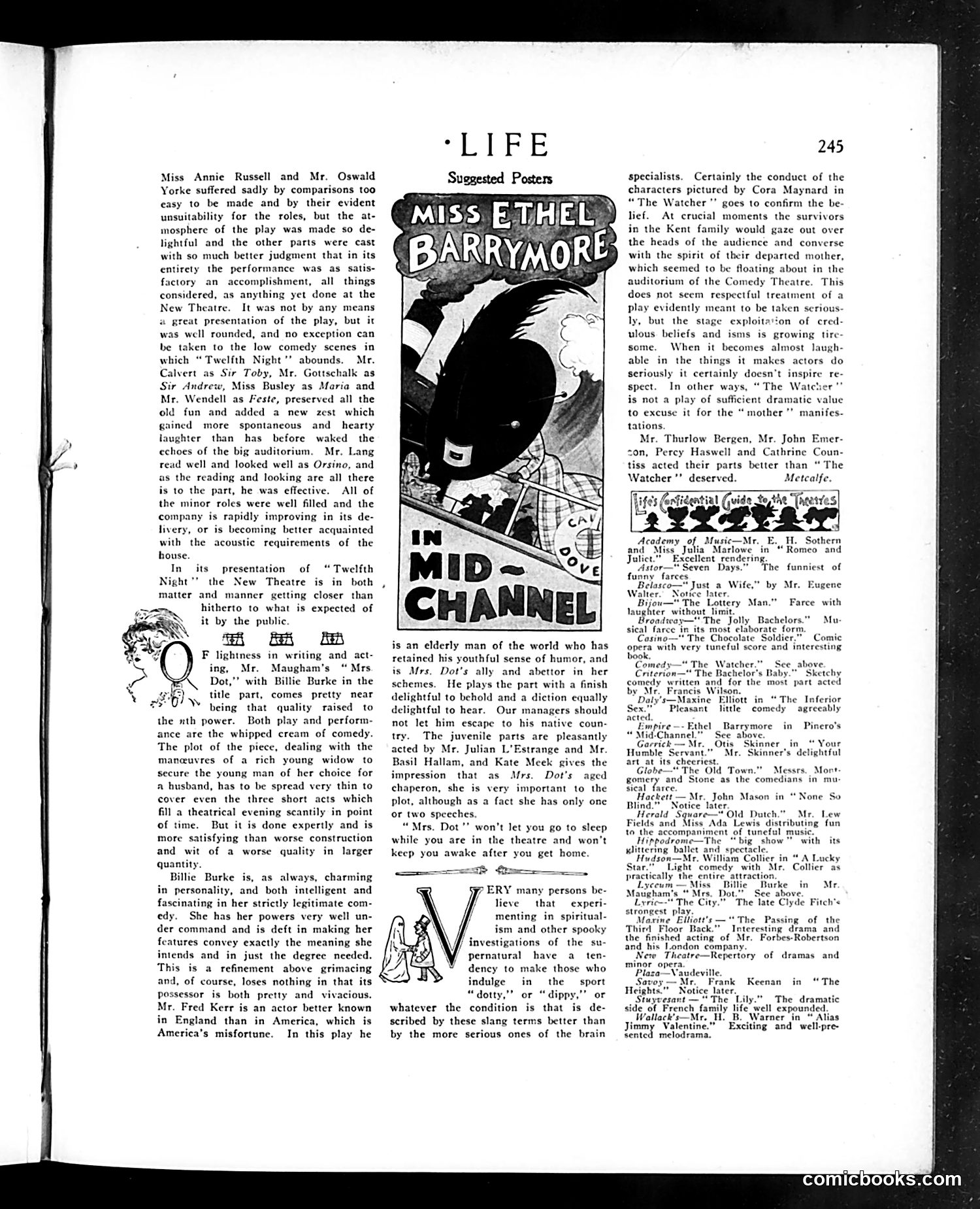
This page is a **theater review section** from Life magazine, primarily text-based with one illustrated poster advertisement for "Miss Ethel Barrymore in Mid-Channel." The reviews discuss stage productions: "Twelfth Night" at the New Theatre (praising supporting performances by Calvert and Gottschalk, though criticizing leads Annie Russell and Oswald Yorke), and "Mrs. Dot" featuring actress Billie Burke, which the critic praises as witty comedy. A brief section at page bottom discusses spiritualism, noting that people who investigate "spooky" supernatural phenomena tend to become "dotty" or "dippy" (mentally unstable). The text references a play called "The Watcher" by Cora Maynard that apparently dramatizes this belief. **The satire**: The spiritualism section gently mocks both spiritualist practices and the popular assumption that such interests cause mental instability—a common early 20th-century prejudice presented as scientific observation. The page reflects Life's role as cultural arbiter of theater and popular beliefs.
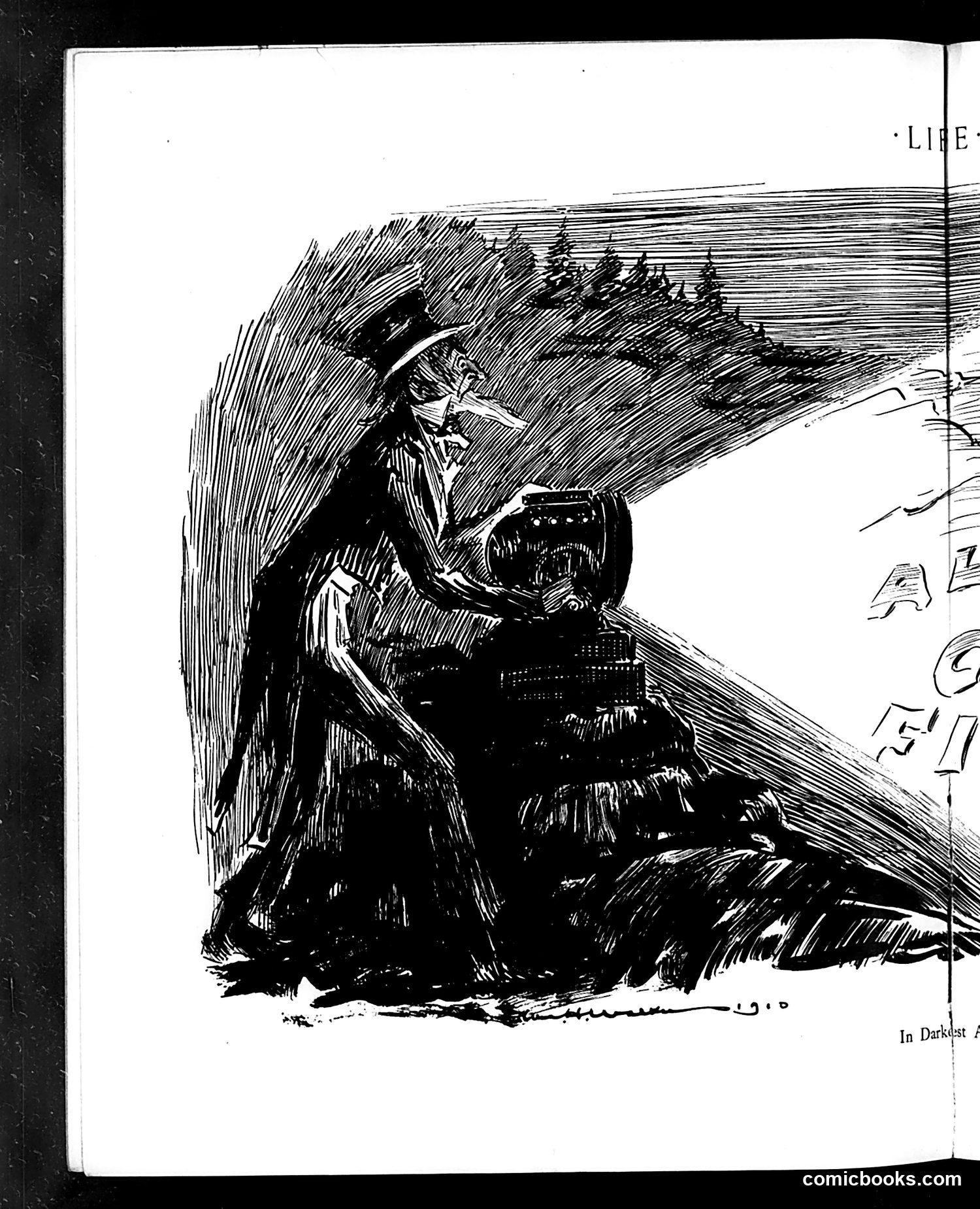
This appears to be a political cartoon from *Life* magazine, though the OCR text is too fragmentary to read clearly. The image shows a figure in formal dress (top hat and coat) seated and leaning back dramatically against what appears to be a large wave or sweeping force behind them. The artistic style uses heavy cross-hatching typical of late 19th or early 20th-century editorial illustration. Without clearer text or caption visible, I cannot definitively identify the specific figure or political event being satirized. The composition suggests commentary on someone being overwhelmed or swept away by circumstance, but the particular historical context remains unclear from this image alone.
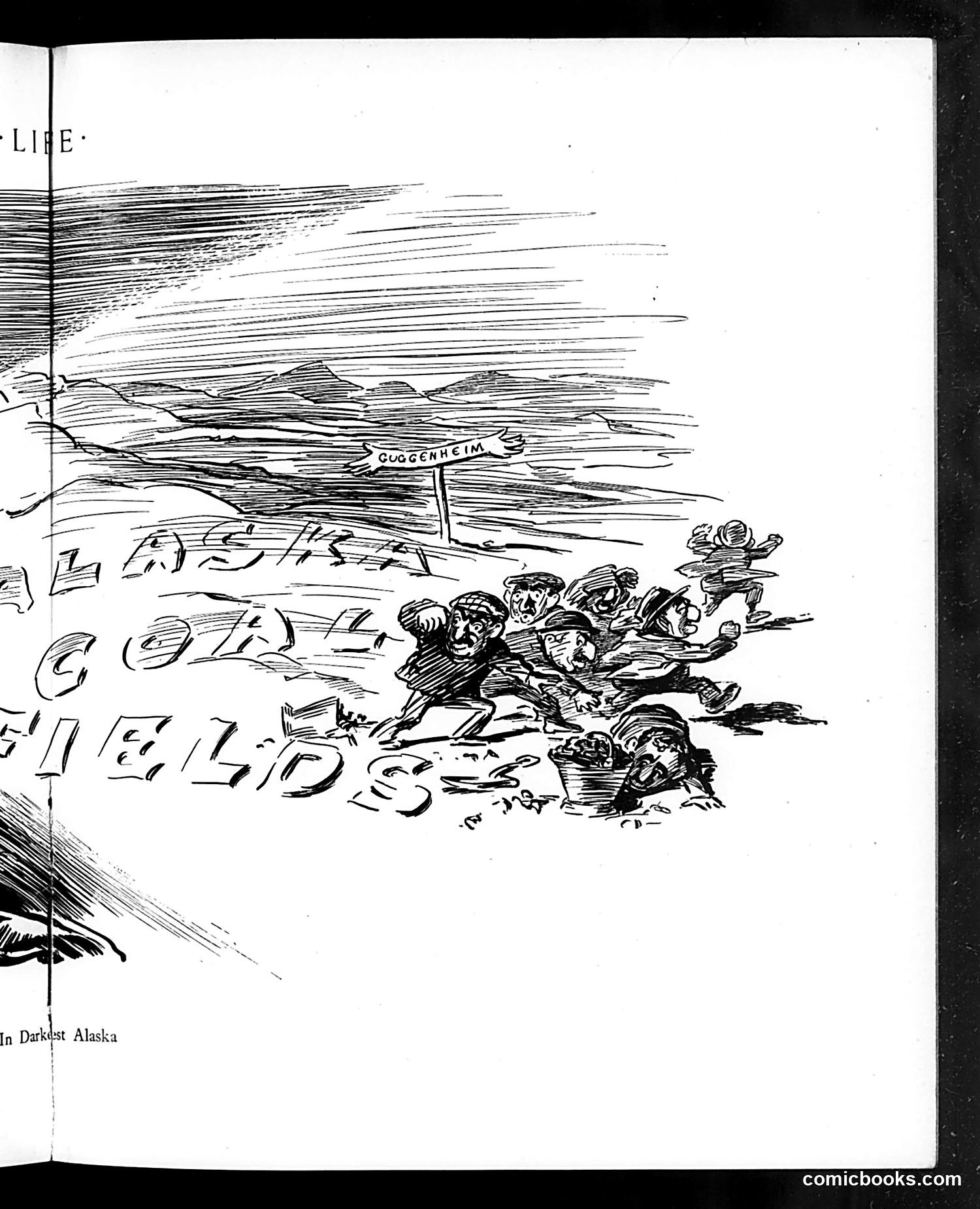
This Life magazine cartoon depicts a group of caricatured figures scrambling or fleeing across terrain labeled "In Darkest Alaska," with a sign reading "Guggenheim" visible. The scattered text fragments appear to spell out names or words (partially legible as "ALASKA" and other text). The cartoon likely satirizes business interests or wealthy industrialists (the Guggenheim family were prominent mining magnates) operating in Alaska. The chaotic scene of figures in apparent distress suggests either criticism of their activities or mockery of their scrambling for resources/profits in the remote Alaskan territory. Without clearer visibility of all text and knowing Life's publication date, the specific political event referenced remains uncertain, but it clearly critiques commercial exploitation or corporate behavior in Alaska.
This page satirizes the clichéd, formulaic nature of romantic proposals in early 20th-century courtship. The primary satire addresses how modern advances in science and technology haven't improved the stale vocabulary of love-making. **"A Modern Dilemma"** mocks the limited proposal phrases ("Darling, I love you," "Will you be mine?") by suggesting absurd alternatives in specialized vocabularies: philosophical language invoking Kant, nautical jargon from sea stories, automobile metaphors from Lloyd Osborne, and Henry James's deliberately obscure prose style. The joke is that even these ridiculous substitutions fail to improve upon tired conventions. **"Similes for Suitors"** extends the satire with deliberately inappropriate metaphors: comparing a lover's heartbeat to a circus drummer, teeth to marble tombstones, voice to a burglar's footstep. These anti-romantic comparisons mock the artificiality of poetic expression and the desperate inadequacy of language itself. The small decorative illustrations of cherubs reinforce the theme of worn-out romantic conventions. The overall message: courtship language hasn't evolved despite modern progress.
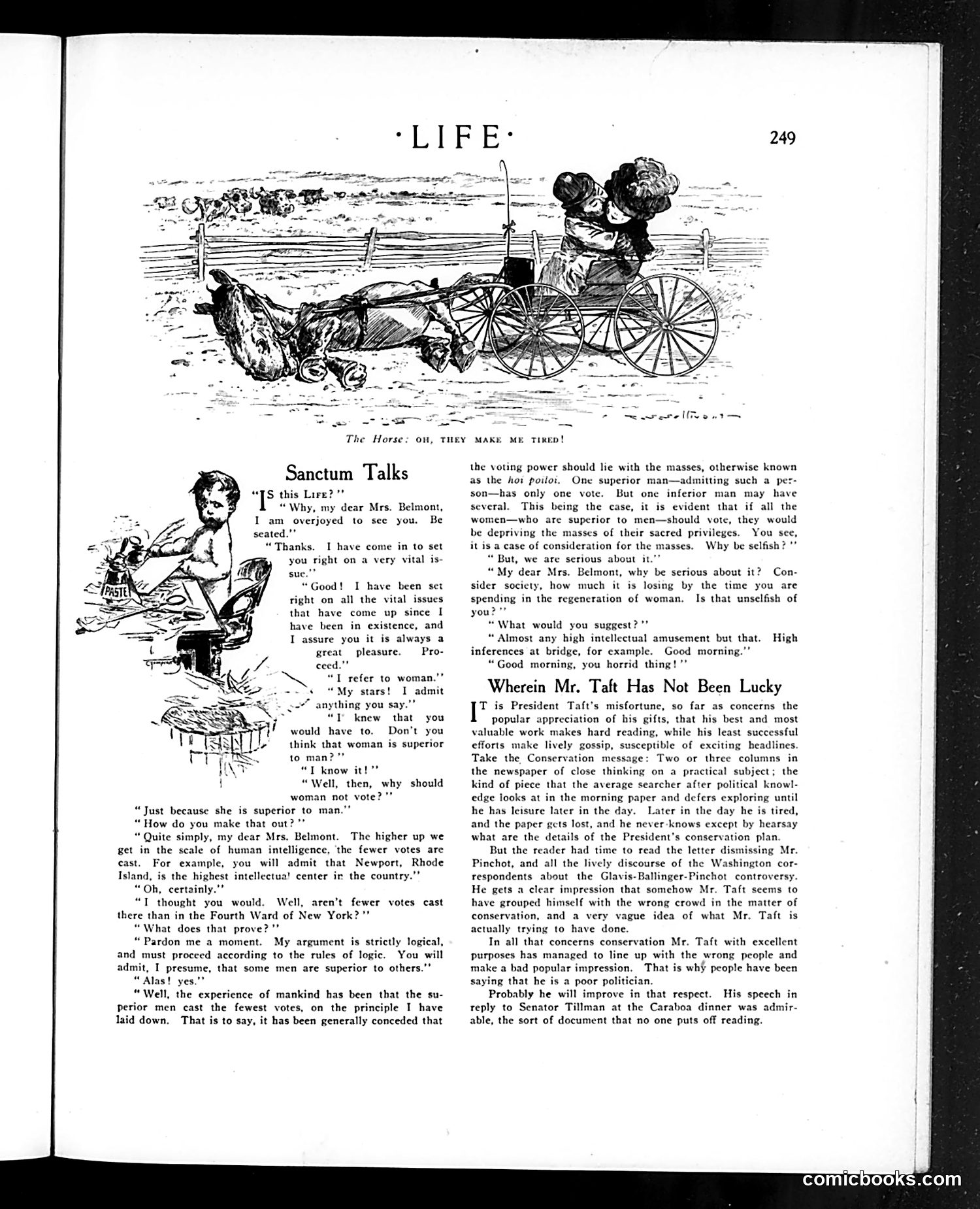
**Top Cartoon:** "The Horse: Oh, They Make Me Tired!" depicts a tired horse pulling a cart with two women. This illustrates exhaustion with women's activist demands—likely referencing the suffrage movement. **"Sanctum Talks" Section:** A satirical dialogue between a Life magazine editor and Mrs. Belmont (likely Alva Vanderbilt Belmont, a prominent suffragist) about women's voting rights. The editor uses absurdist logic: claiming women are intellectually superior to men, therefore—paradoxically—should NOT vote, since superior people vote less. The joke relies on mocking suffragist arguments through circular reasoning, while also suggesting women waste time on activism rather than "high intellectual amusement" like bridge. **"Wherein Mr. Taft Has Not Been Lucky":** Commentary on President William Howard Taft's poor public relations. His serious policy work (conservation) goes unread, while sensational gossip (the Pinchot-Ballinger controversy) generates headlines, making him appear to side with the wrong people despite good intentions.
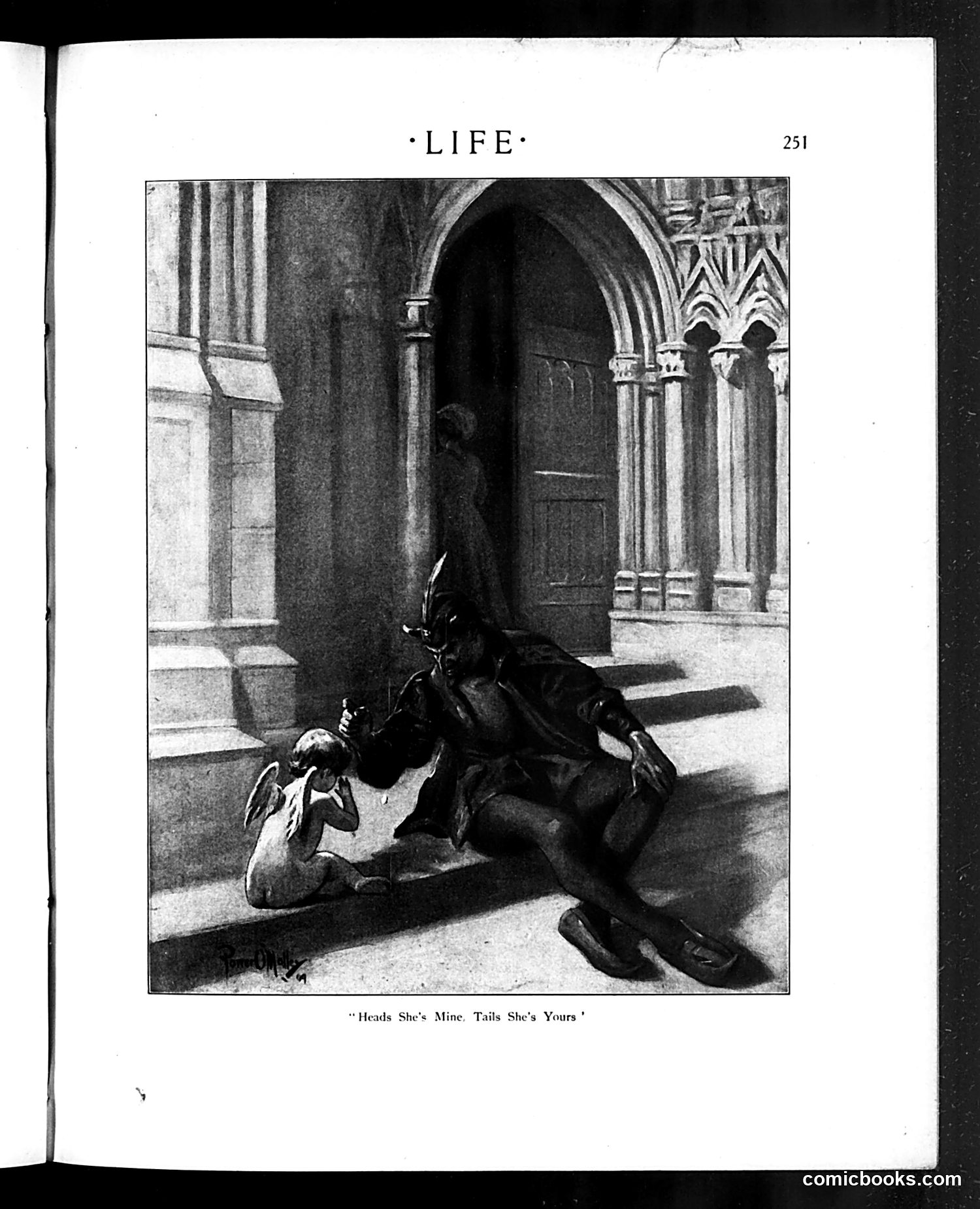
This illustration from *Life* magazine (page 251) depicts a satirical scene set in a Gothic cathedral archway. A figure in dark clothing kneels or crouches while handling what appears to be a coin or similar object. The caption—"Heads She's Mine, Tails She's Yours"—suggests a gambling or wagering scenario, likely a commentary on treating a woman as an object to be won or divided between two parties. The theatrical Gothic setting emphasizes the dramatic, absurd nature of the situation. Without additional context about the publication date, I cannot identify specific historical figures or political references. However, the satire appears to mock the commodification of women or the casual treatment of romantic/relationship matters as mere gambles between men—a critique of social attitudes toward women's agency.
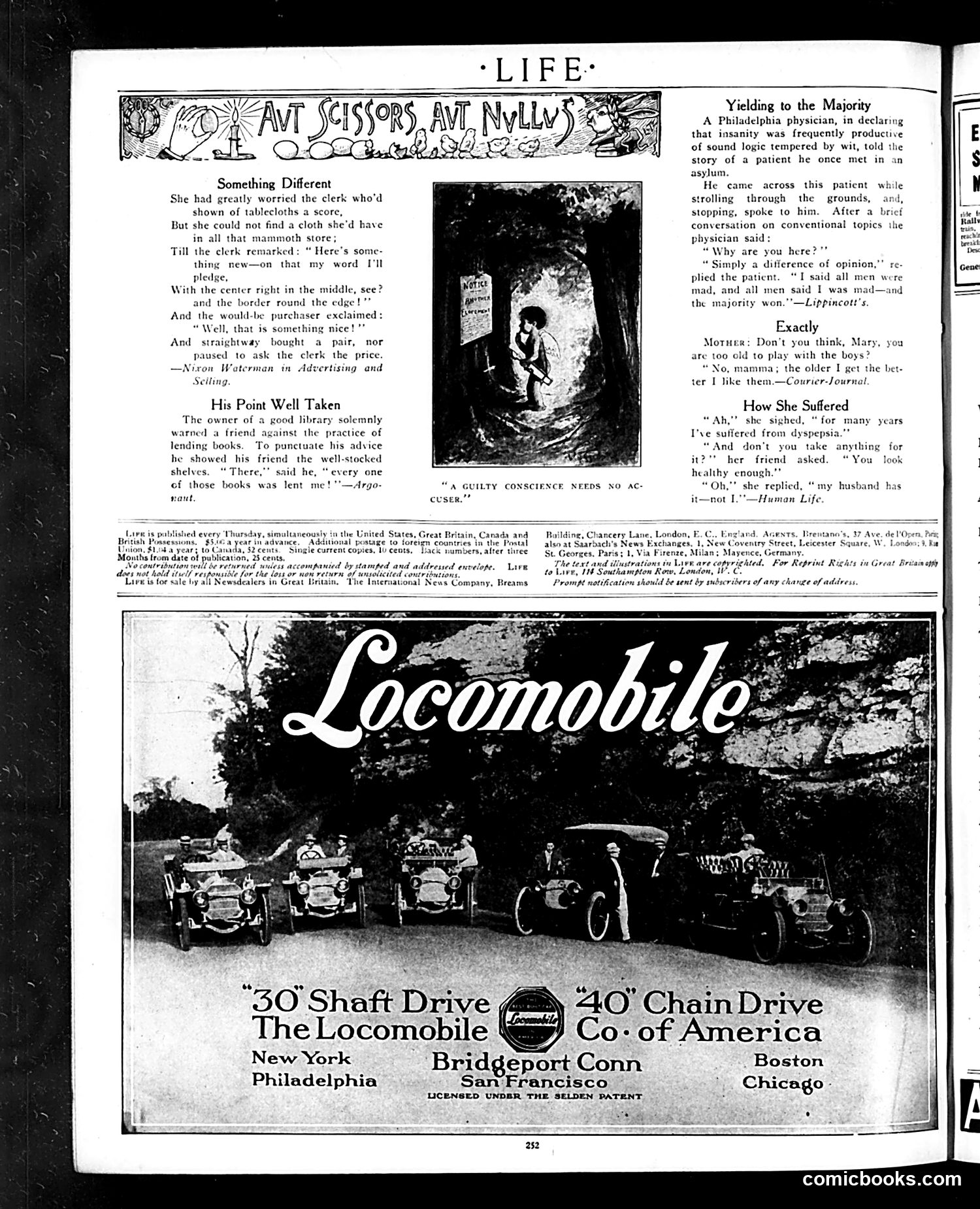
This page contains **three brief humorous anecdotes** and a **Locomobile automobile advertisement**. The jokes employ gentle satire on human nature: 1. **"Something Different"** mocks consumer gullibility—a clerk sells a tablecloth simply by claiming novelty (centering the border), without the customer even asking the price. 2. **"His Point Well Taken"** humorously illustrates the irony of a library owner warning against lending books while his entire collection consists of borrowed volumes—a self-defeating argument. 3. **"Yielding to the Majority"** presents a philosophical joke: a patient claims he's institutionalized merely for disagreeing that "all men are mad," yet the majority's opposite view proves him sane by democratic consensus—satirizing how "truth" becomes majority opinion. The **Locomobile advertisement** showcases early automobiles in various drive configurations, targeting wealthy consumers in major American cities. The tone is light, satirical humor typical of Life magazine's early-20th-century style.
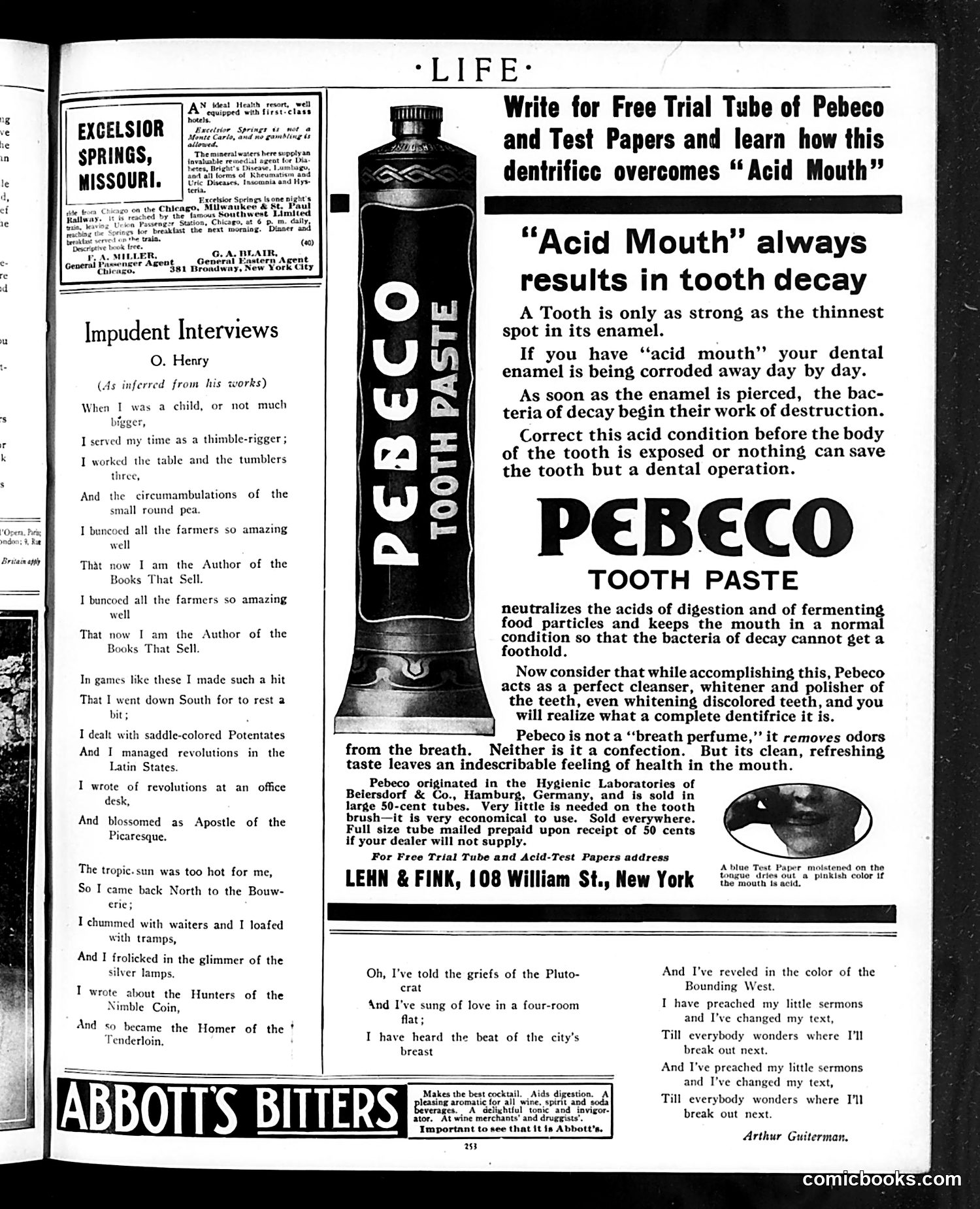
This page is primarily **advertising** rather than satirical content. The dominant feature is a large Pebeco Tooth Paste advertisement promoting a product that claims to cure "Acid Mouth"—a condition the ad warns causes tooth decay. The advertisement uses pseudo-scientific language about neutralizing digestive acids and bacteria, reflecting early 20th-century dental marketing tactics. The left side contains a literary piece titled "Impudent Interviews: O. Henry," presented as a humorous monologue allegedly based on the famous short-story writer's life. It's a pastiche of O. Henry's rags-to-riches narrative voice, referencing his con-man stories and stories about New York's lower-class neighborhoods (the Bowery, Tenderloin). Below appears an Abbott's Bitters advertisement—a patent medicine common to the era. The page represents typical Life magazine content of its period: celebrity parodies mixed with aggressive patent-medicine advertising, targeting readers with health anxieties.
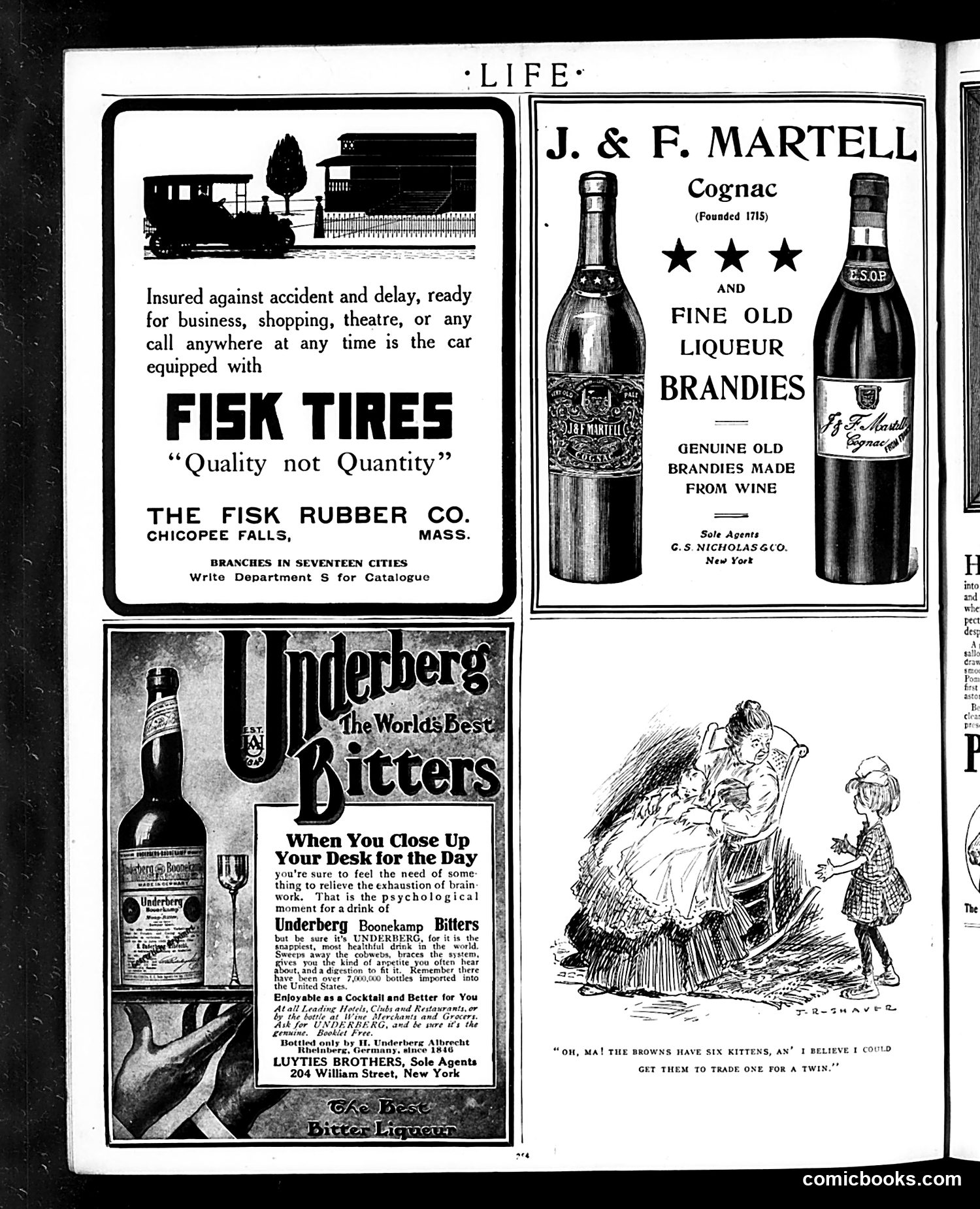
This page is primarily **advertising**, not political satire. It contains four vintage ads from the early 20th century: 1. **Fisk Tires** - promotes automobile tires as reliable for daily errands 2. **J. & F. Martell Cognac** - French brandy advertisement 3. **Underberg Bitters** - a digestive tonic marketed as relief for "brain work exhaustion," emphasizing health benefits 4. **A cartoon sketch** (bottom right) showing a woman with children discussing trading kittens for twins—a domestic humor piece unrelated to the ads above The ads reflect period attitudes: automobiles as luxury conveniences, alcoholic beverages marketed with health claims (common before modern regulations), and patent medicines presented as medicinal tonics rather than recreational drinks. The cartoon is simple domestic humor with no satirical intent. The page demonstrates how early Life magazine mixed advertising revenue with editorial content and light comedy.
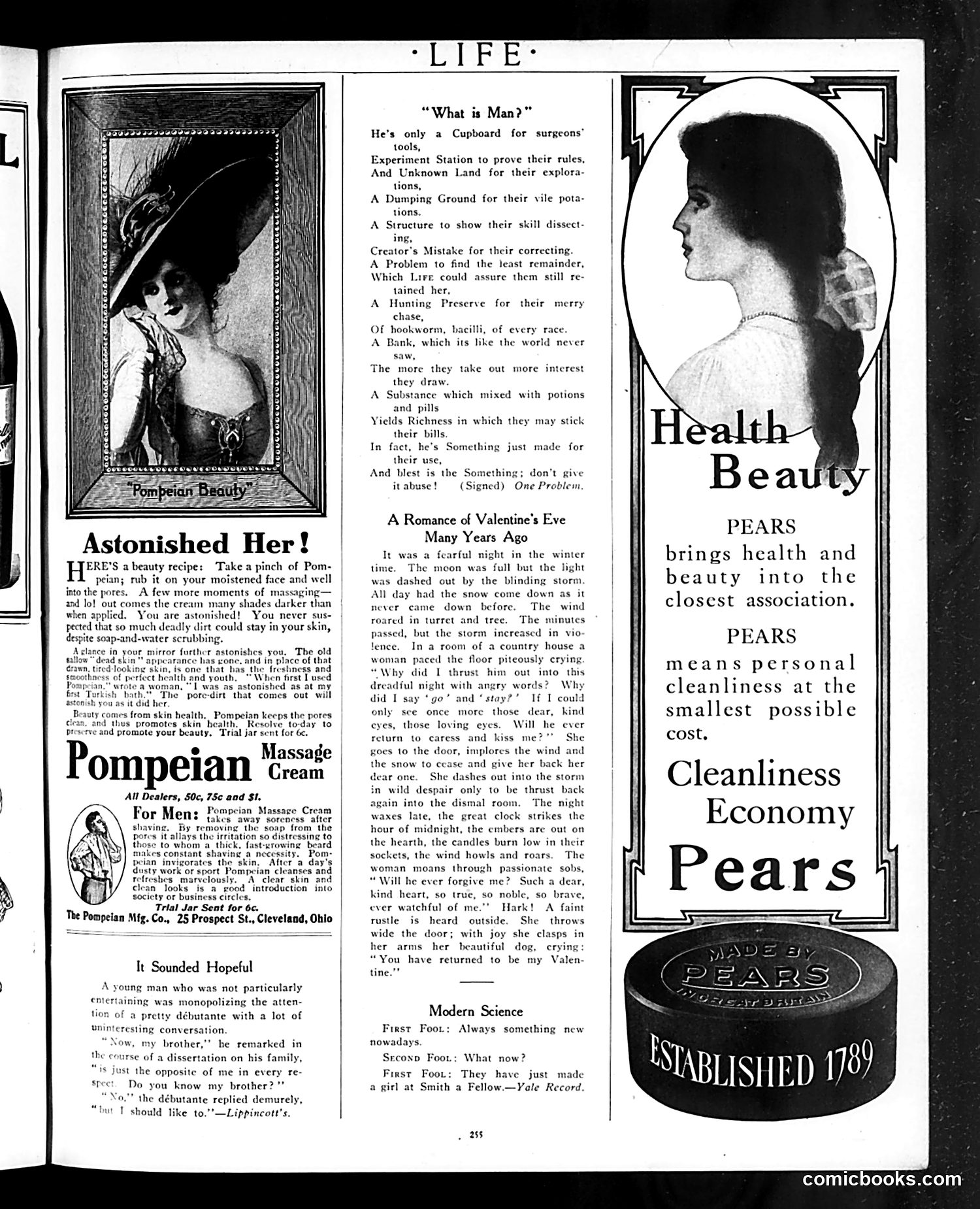
This page's central satirical content is the poem "What is Man?", which takes a cynical view of how the medical profession treats human bodies. Written by "One Problem," it portrays man as merely a collection of tools and subjects for doctors' experiments and financial exploitation. The poem mocks medical practitioners by describing humans as "Cupboards for surgeons' tools," "Experiment Stations," and "dumping grounds" for their work. It criticizes their dissection practices, their focus on diseases (hookworms, bacilli), and—most bitterly—their financial greed, comparing the human body to "a Bank...the more they take out more interest they draw." The satire targets early 20th-century medical science's seemingly callous instrumentalization of patients. The poem suggests doctors view bodies not as people but as problems to solve and profit from, framing medical practice as exploitative rather than healing-oriented.
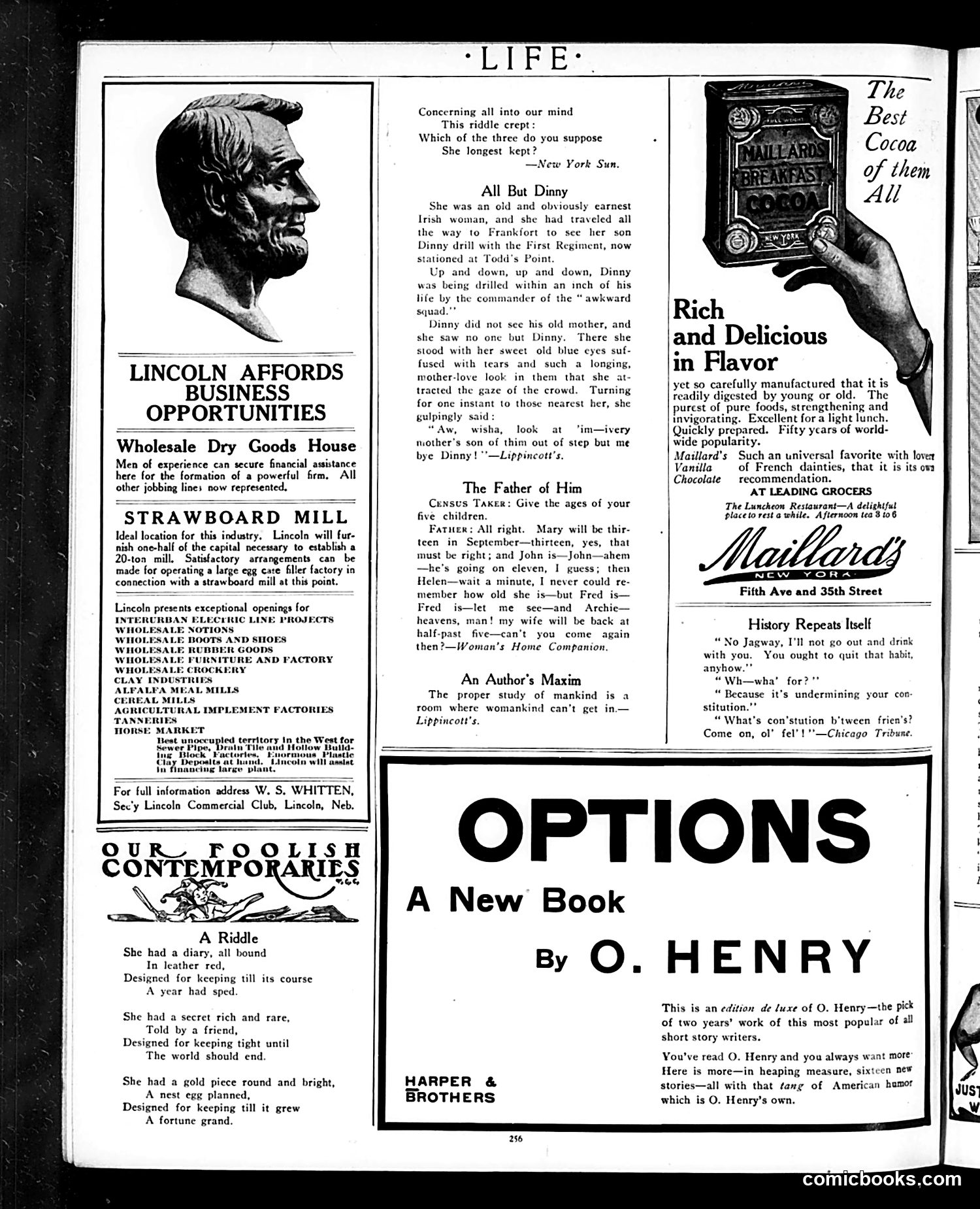
This page is primarily **advertising and literary content** rather than political satire. The dominant feature is a promotional advertisement for Lincoln, Nebraska's business opportunities (wholesale goods, strawboard mill, agricultural implements), positioned alongside humorous short fiction pieces and product advertisements. The page contains three brief **humorous anecdotes** typical of early 20th-century magazines: an Irish mother watching her son drill (the joke being she notices only her son is out of step), a census taker's difficulty remembering his children's ages, and a quip about studying mankind in rooms where women aren't present. These are gentle domestic humor pieces, not political cartoons. The **Lincoln portrait** is literal—promoting the city as a business hub, not satirizing the president. Advertisements for Maillard's cocoa and O. Henry's new book collection complete the page. There is no political satire present; this is a standard commercial/entertainment magazine page from the early 1900s.
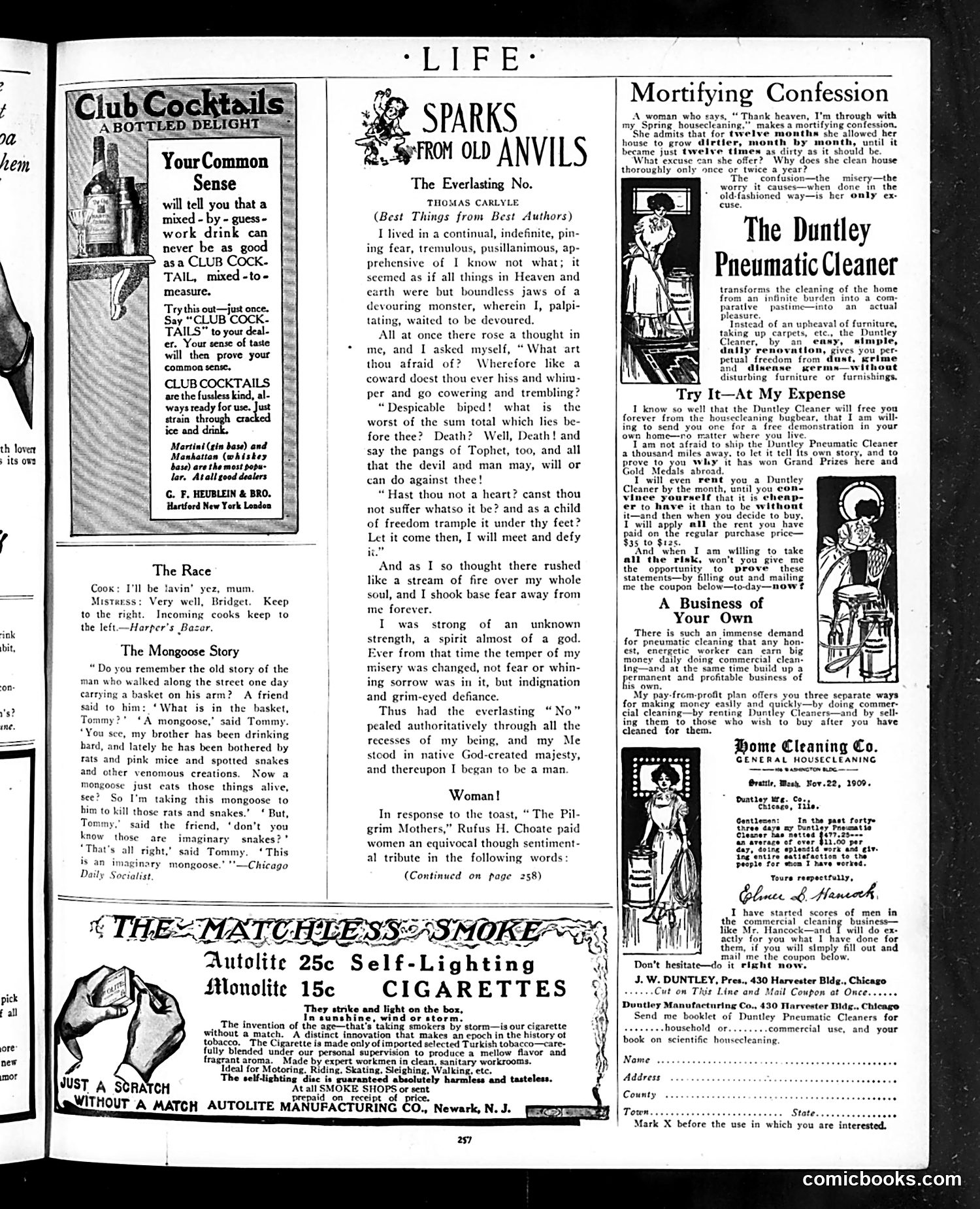
This page contains **three distinct sections**: advertisements, literary excerpts, and two brief humorous anecdotes. The main satirical content appears in the short jokes: **"The Race"** mocks Irish domestic workers, featuring a cook and mistress with exaggerated dialect ("tavin' yez, mum"), playing on period stereotypes about Irish immigrant servants. **"The Mongoose Story"** presents a tall tale about a man claiming his brother became alcoholic after witnessing snakes and mongooses—a joke format common to early 20th-century humor magazines, relying on absurdist escalation for comedic effect. The predominant content is **advertising**: Club Cocktails, the Duntley Pneumatic Cleaner (a vacuum), and Monolite cigarettes. The Duntley ad notably plays on *gender anxiety*, shaming housewives who clean only seasonally, positioning the machine as liberating domestic labor—a selling point reflecting emerging consumer appliance marketing to women.
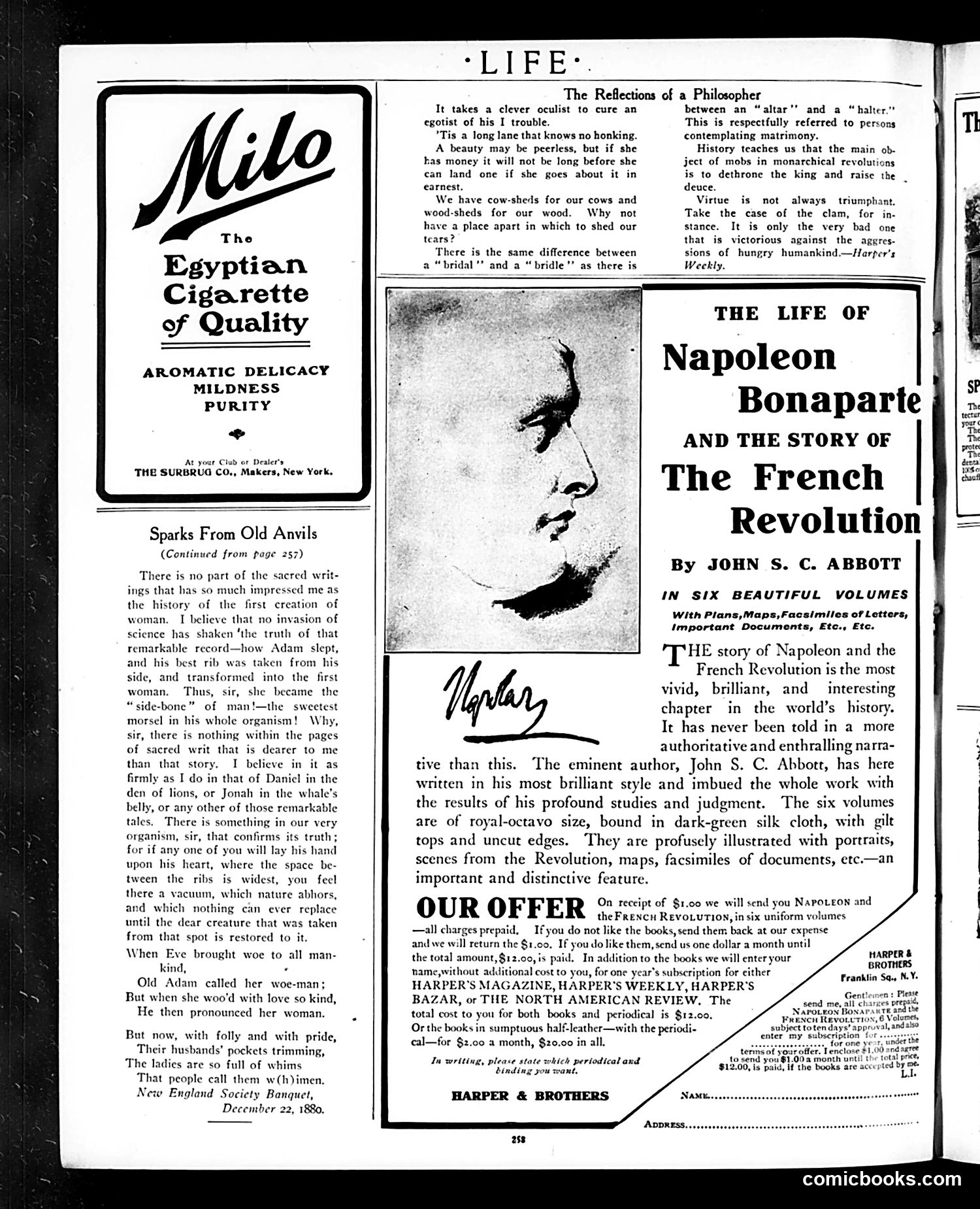
This page combines advertisements with satirical commentary typical of *Life* magazine's format. **The Advertisements:** - **Milo cigarettes** (top left): Standard product ad emphasizing quality - **Napoleon Bonaparte book series** (right): A six-volume set by John S.C. Abbott about Napoleon and the French Revolution, offered at $1.00 initial payment **The Satirical Content:** The left column, "Sparks From Old Anvils," contains pseudo-philosophical jokes mocking Victorian attitudes toward women and marriage. The author ironically celebrates the biblical creation of Eve as woman, calling her "the sweetest morsel in his whole organism," then makes crude wordplay about "woe-man." The satire targets conventional male attitudes—presenting misogynistic views as supposedly profound wisdom to mock them. **The Political Reference:** The Napoleon book placement alongside this anti-marriage satire appears coincidental—both occupy the page's layout, though no direct connection exists between the content and the historical figure advertised.
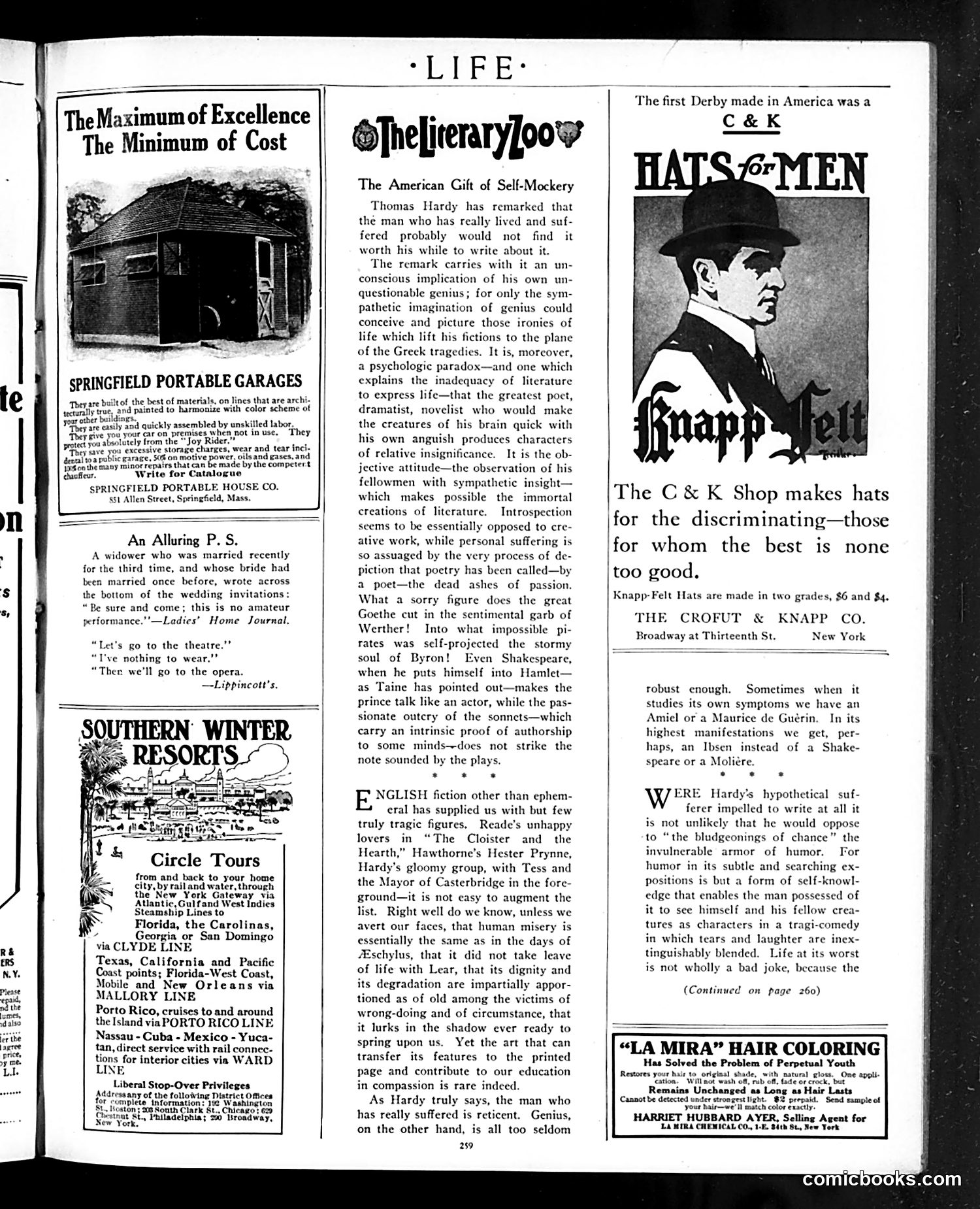
This page features "The Literary Zoo," a satirical essay examining why great literature often emerges from *observation* rather than personal suffering. The text argues that Thomas Hardy was correct: genuinely suffering artists often lack the detachment necessary to create great art. The satire targets a Romantic-era assumption—that authentic genius requires authentic misery. The essay humorously demonstrates this paradox: poets like Byron and Goethe produced their greatest work through *sympathetic imagination*, not autobiographical anguish. Shakespeare, when writing Hamlet from personal experience, made the prince sound like "an actor." The piece mocks the sentimental conflation of artistic authenticity with personal tragedy, suggesting instead that the best literature requires ironic distance—precisely the perspective the suffering artist cannot maintain while experiencing pain. This reflects turn-of-century literary debates about Realism versus Romanticism. The page also contains period advertisements (portable garages, cruise lines, hair coloring) typical of Life's revenue model.
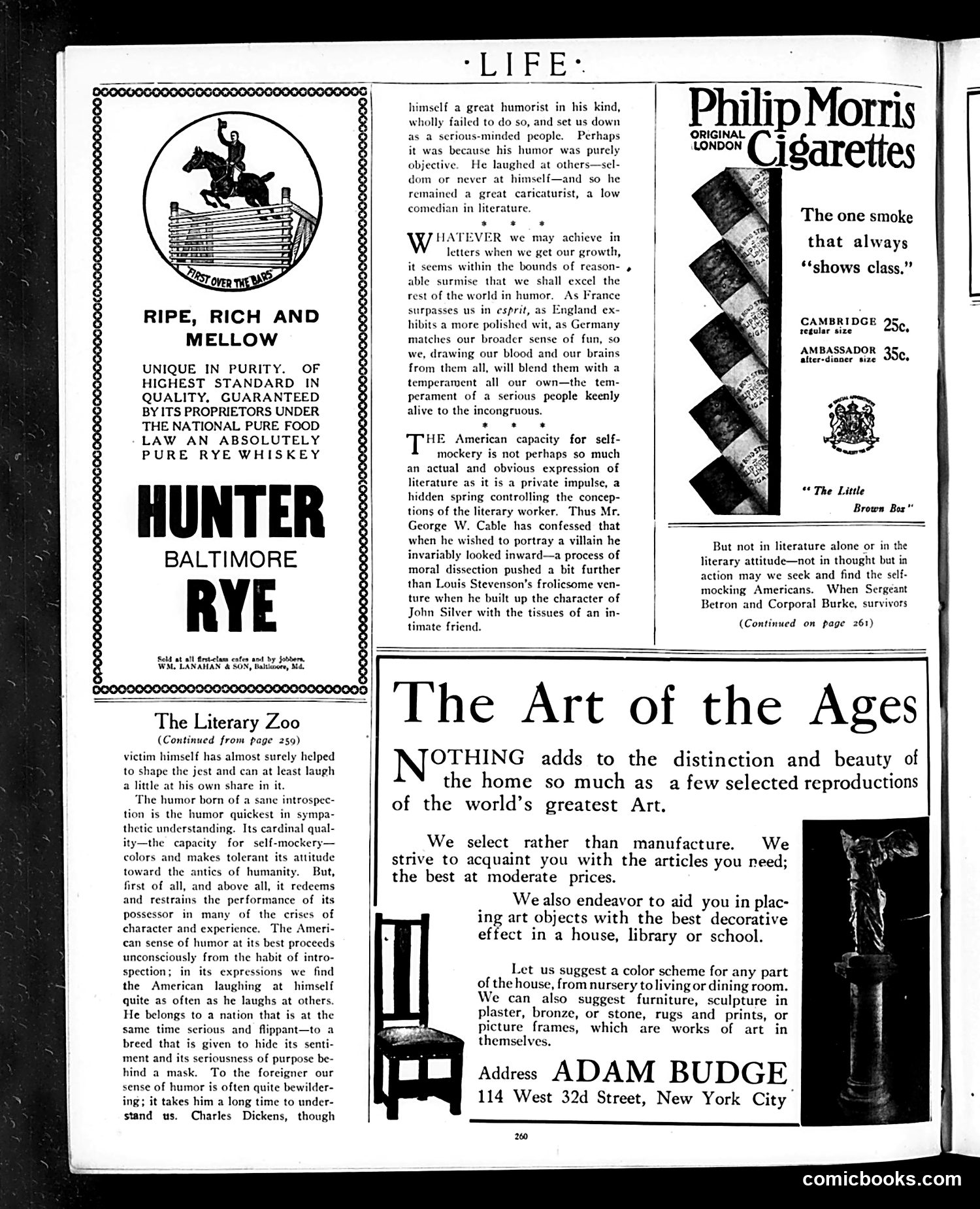
This page contains **mostly advertisements** interspersed with literary commentary, not political cartoons. The main text discusses American humor and self-mockery as a national trait, referencing writers like George W. Cable and Louis Stevenson. The author argues Americans possess a unique capacity for self-directed satire rooted in introspection—they laugh at themselves as readily as others. **The advertisements** include: - Hunter Baltimore Rye whiskey (emphasizing purity under food safety laws) - Philip Morris cigarettes (claiming to "show class") - Adam Budge art reproductions service These ads reflect early 20th-century marketing: appeals to quality standards (new FDA regulations), aspirational messaging about social status, and the growing middle-class market for home art reproduction. The page represents Life magazine's dual function: satirical commentary alongside commercial revenue, typical of American magazines of this era.
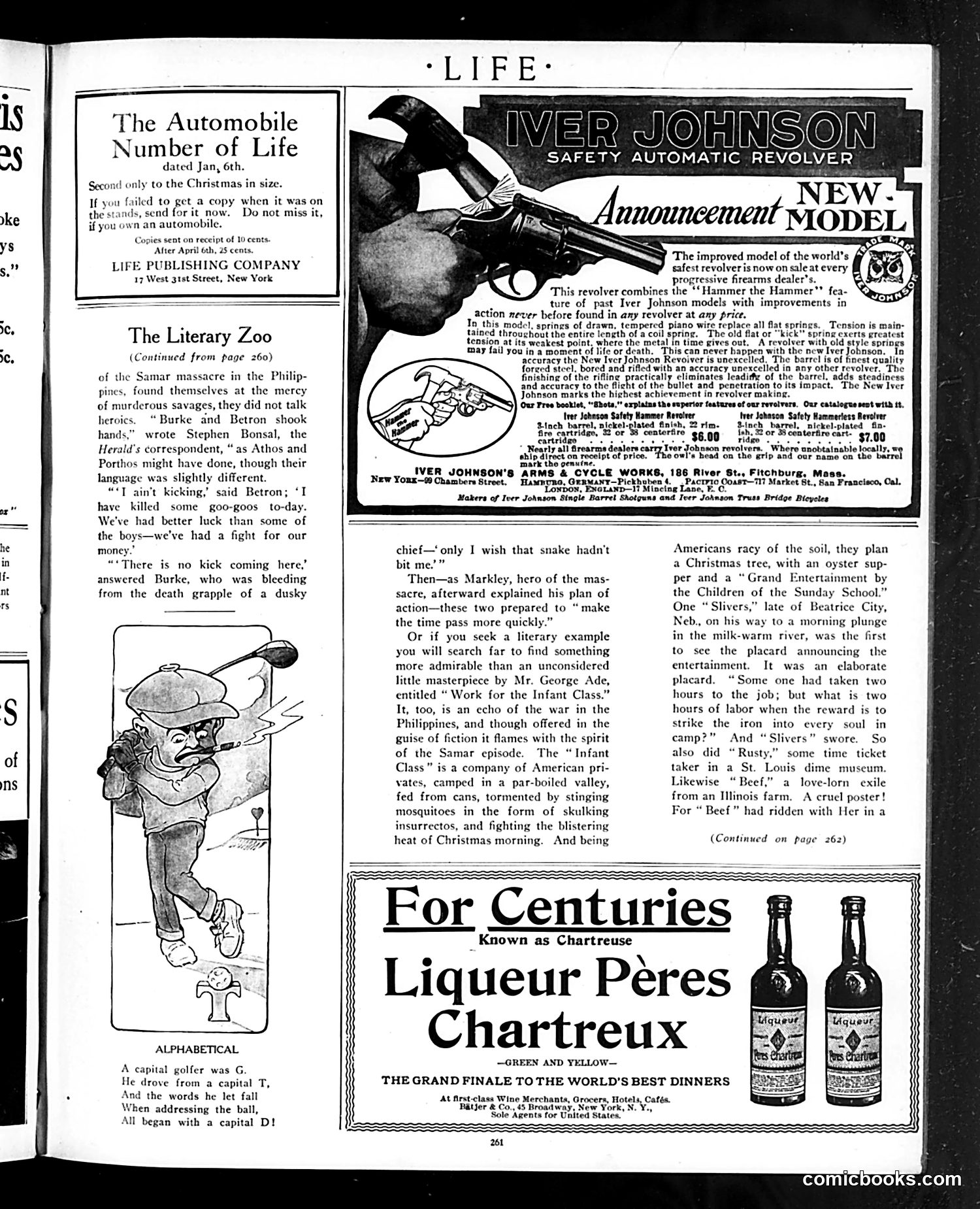
This Life magazine page (dated Jan. 6th) contains mostly **advertisements** alongside brief literary content. The main visual element is a cartoon titled "Alphabetical" showing a figure in military/combat gear—likely referencing **World War I**, given the helmet style and the violent action depicted. The accompanying verse uses "G" and "D" as wordplay ("A capital golfer was G..."). The page features ads for the **Iver Johnson Safety Automatic Revolver** (a firearms manufacturer claiming innovation in revolver design) and **Liqueur Père Chartreaux** (a French liqueur). There's also a brief literary excerpt discussing the "Samar massacre" in the Philippines, suggesting American colonial military conflicts. The cartoon's satirical point appears to reference wartime violence, though without additional context, the specific political message remains unclear.
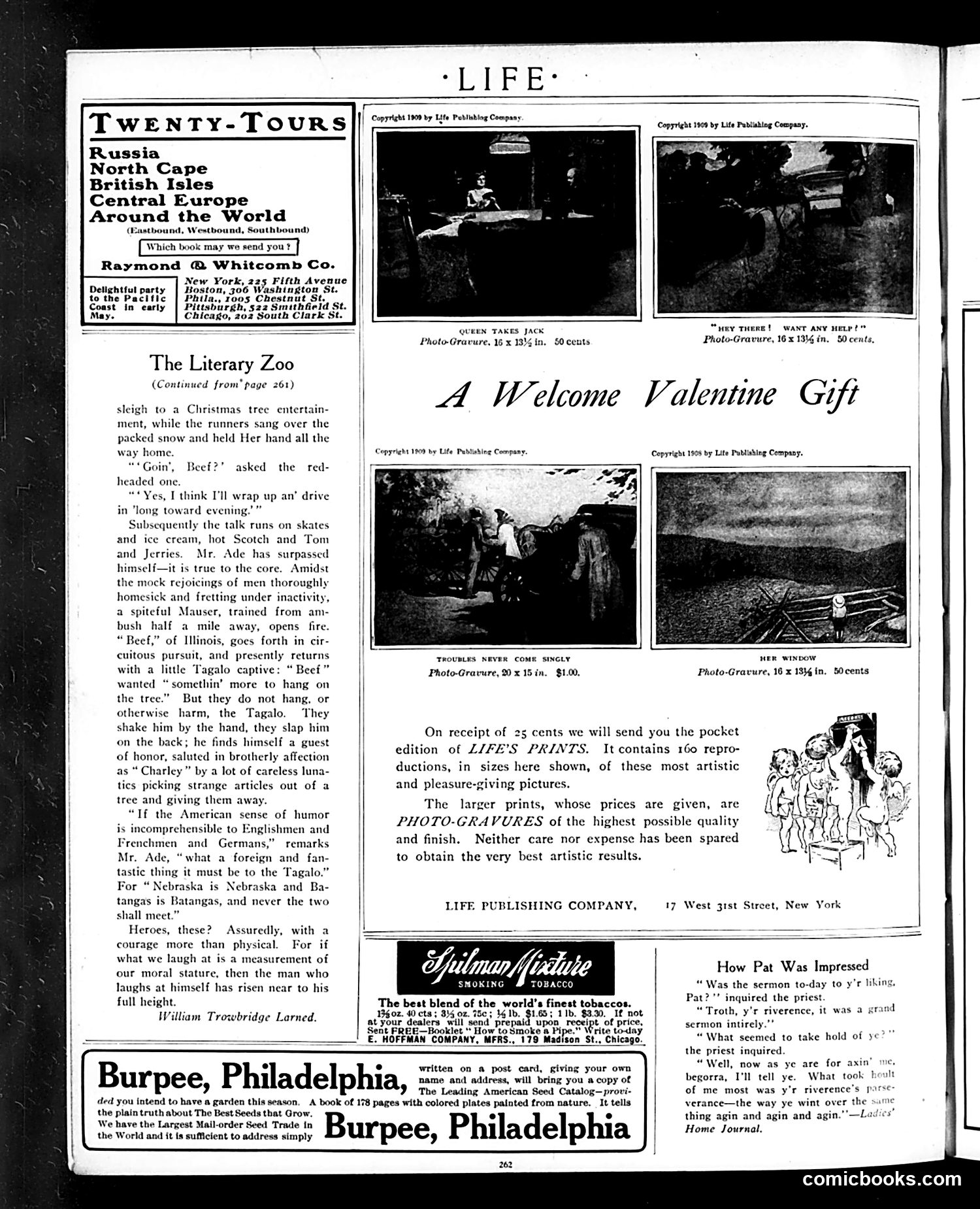
This page is primarily **advertisements and serialized fiction**, not political satire. The main content is "The Literary Zoo," a serialized story by George Ade (indicated by "William Trowbridge Larned" byline at bottom) set during the Philippine-American War. It depicts American soldiers capturing a Filipino ("Tagalo") person and treating him with surprising kindness despite the conflict—attempting to illustrate American "humor" and moral superiority through their restraint. **Historical context**: This reflects early 1900s American attitudes toward the Philippines and colonialism—positioning brutal occupation as civilized and even humorous. The page also features **Valentine's Day gift advertisements** (photo-gravures for sale), travel tour promotions, seed catalogs, and tobacco ads. A small cartoon titled "How Pat Was Impressed" uses Irish dialect humor (common period stereotyping) in dialogue about a priest's sermon. **The satire, if any, is gentle**—mocking Irish accents and wartime sentimentality rather than critiquing policy. Modern readers would find the colonial attitudes more striking than the intended humor.
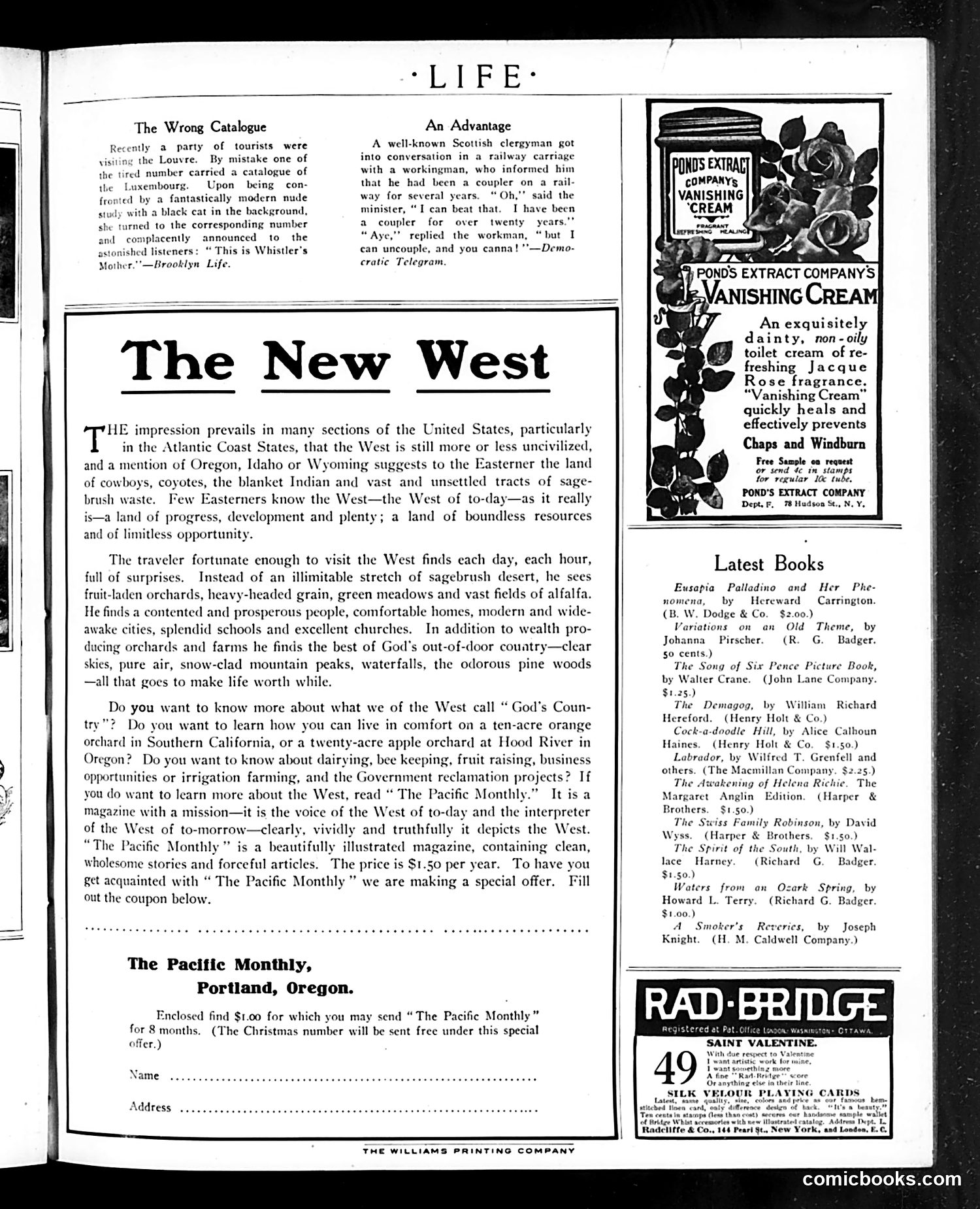
This page contains **two brief satirical anecdotes** and extensive **advertising/editorial content** promoting westward expansion. The two jokes: 1. **"The Wrong Catalogue"**: Tourists at the Louvre museum misidentify a modern nude painting (with a black cat) as Whistler's famous painting "Arrangement in Grey and Black No. 2" (commonly called "Whistler's Mother")—satirizing how people confidently misrecognize modern art. 2. **"An Advantage"**: A Scottish minister and railway worker compare decades of coupling work. The minister claims superiority until the worker notes he can "uncouple" while the minister cannot—a crude joke playing on the double meaning of "coupler" and suggesting the minister is stuck in his vows. The bulk of the page is **promotional material** for "The Pacific Monthly" magazine, depicting the American West not as frontier wilderness but as developed, civilized farmland with orchards and prosperous towns—countering Eastern stereotypes of untamed frontier. This represents early 20th-century boosterism encouraging westward migration and development.
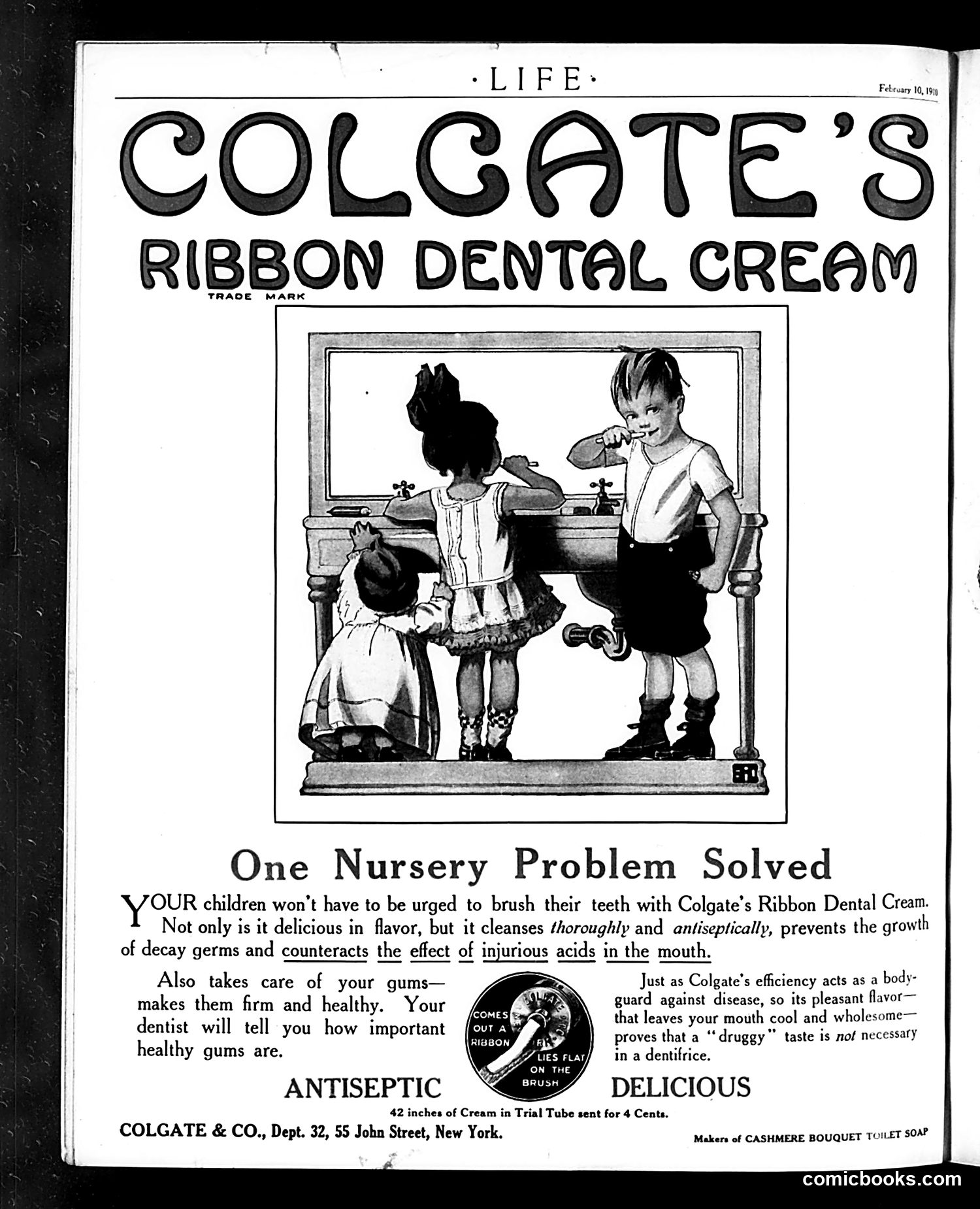
This is a **Colgate toothpaste advertisement**, not satire or political cartoon. The illustration shows three children at a bathroom sink, depicting the product's selling point: unlike other dental creams, Colgate's Ribbon Dental Cream tastes good ("delicious in flavor"), so children won't resist brushing their teeth—solving a common parental frustration of the era. The ad emphasizes practical benefits: thorough cleaning, antiseptic properties, gum health, and prevention of tooth decay. It explicitly contrasts itself with competitor products by claiming it lacks a bitter "druggy" taste. The text promises a trial tube for 4 cents, typical of early 20th-century direct-mail marketing. This is straightforward product marketing addressing genuine household concerns about children's oral hygiene habits.