
Life, 1910-02-10 · page 8 of 36
Life — February 10, 1910 — page 8: what you’re looking at
What you’re looking at
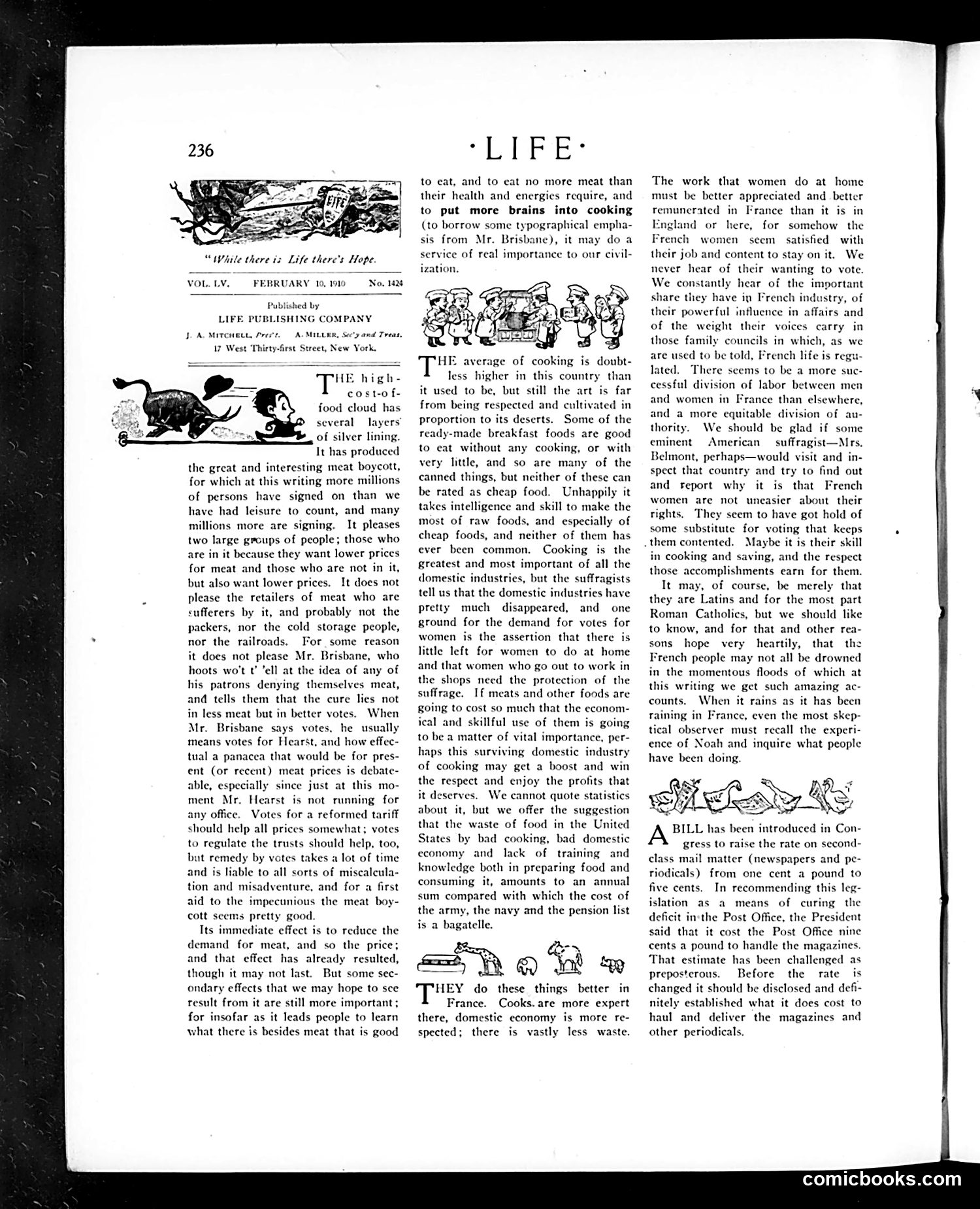
This page contains editorial text debating domestic economics and women's roles, illustrated with small decorative cartoons featuring animals and domestic scenes rather than political caricatures. The main argument critiques the high cost of food and argues that improved cooking skills could reduce waste. It contrasts American and French approaches to domestic economy, praising French women's expertise in making "cheap foods" stretch further. The text advocates better appreciation for women's housework and criticizes meat-price regulation proposals. A notable satirical point addresses the Post Office's expense in distributing magazines—the author challenges claims that rate increases cost nine cents per pound to deliver, calling the estimate "preposterous." The cartoons appear merely decorative rather than satirical commentary on the text itself.
📄 Transcribed text from this page (OCR, searchable)
Machine-transcribed from the original scan — historical spelling and the odd misread are preserved.
“While there iz Life there's Hope. VOL.LY, FEBRUARY 10,1910 No. 1038 Published by LIFE PUBLISHING COMPANY JA MITCHELL, Pret. AL MILLER, Sec'y and Treas, 17 West Thirty-first Street, New York. HE high- cost-o f- food cloud has several layers of silver lining. It has produced the great and interesting meat boycott, for which at this writing more millions of persons have signed on than we have had leisure to count, and many millions more are signing. It pleases two large gecups of people; those who are in it because they want lower price for meat and those who are not in i but also want lower prices. It does not please the retailers of meat who are sufferers by it, and probably not the packers, nor the cold storage people, nor the railroads. For some reason it does not please Mr. Brisbane, who hoots wo't t' 'ell at the idea of any of his patrons denying themselves meat, and tells them that the cure lies not in less meat but in better votes. When Mr. Brisbane says votes, he usually means votes for Hearst, and how effec- tual a panacea that would be for pres- ent (or recent) meat prices is debate- able, especially since just at this mo- ment Mr. Hearst is not running for any office. Votes for a reformed tariff should help all prices somewhat; votes to regulate the trusts should help, too, but remedy by votes takes a lot of time and is liable to all sorts of miscalcula- tion and misadventure, and for a first aid to the impecunious the meat boy- cott scems pretty good. Its immediate effect is to reduce the demand for meat, and so the price; and that effect has already resulted, though it may not last. But some sec- ondary effects that we may hope to sce result from it are still more important; for insofar as it leads people to learn what there is besides meat that is good “LIFE: to cat, and to eat no more meat than their health and energies require, and to put more brains into cooking (to borrow some typographical empha sis from Mr. Brisbane), it may do a ¢ of real importance to our civil- ization. rage of cooking is doubt- less higher in this country than it used to be, but still the art is far from being respected and cultivated in proportion to its deserts. Some of the ready-made breakfast foods are good to eat without any cooking, or with very little, and so are many of the canned things, but neither of these can be rated as cheap food. Unhappily it takes intelligence and skill to make the most of raw foods, and especially of cheap foods, and neither of them has ever been common. Cooking is the greatest and most important of all the domestic industries, but the suffragists tell us that the domestic industries have pretty much disappeared, and one ground for the demand for votes for women is the assertion that there is little left for women to do at home and that women who go out to work in the shops need the protection of the suffrage. If meats and other foods are going to cost so much that the econom- ical and skillful use of them is going to be a matter of vital importance, per- haps this surviving domestic industry of cooking may get a boost and win the respect and enjoy the profits that it deserves. We cannot quote statistics about it, but we offer the suggestion that the waste of food in the United States by bad cooking, bad domestic economy and lack of training and knowledge both in preparing food and consuming it, amounts to an annual sum compared with which the cost of the army, the navy and the pension list a bagatelle. =F eth w HEY do these things better in France. Cooks. are more expert there, domestic economy is more re- spected; there is vastly less waste. The work that women do at home must be better appreciated and better remunerated in France than it is in ngland or here, for somehow the French women seem satisfied with their job and content to stay on it. We never hear of their wanting to vote. We constantly hear of the important share they have iy French industry, of their powerful influence in affairs and of the weight their voices carry in those family councils in which, as we are used to be told, French life is regu- lated. There seems to be a more suc- cessful division of labor between men and women in France than elsewhere, and a more equitable division of au- thority. We should be glad if some eminent American — suffragist—Mrs. Belmont, perhaps—would visit and in- spect that country and try to find out and report why it is that French women are not uneasier about their rights, They seem to have got hold of some substitute for voting that keeps . them contented. Maybe it is their skill in cooking and saving, and the respect those accomplishments earn for them. It may, of course, be merely that they are Latins and for the most part Roman Catholics, but we should like to know, and for that and other rea- sons hope very heartily, that the French people may not all be drowned in the momentous floods of which at this writing we get such amazing ac- counts. When it rains as it has been raining in France, even the most skep- tical observer must recall the experi- ence of Noah and inquire what people have been doing. BILL has been introduced in Con- gress to raise the rate on second- class mail matter (newspapers and pe- riodicals) from one cent a pound to five cents. In recommending this leg- islation as a means of curing the deficit insthe Post Office, the President said that it cost the Post Office nine cents a pound to handle the magazines. That estimate has been challenged as preposterous. Before the rate i: changed it should be disclosed and defi- nitely established what it does cost to haul and deliver the magazines and other periodicals. comicbooks.com