
Life, 1910-02-10 · page 22 of 36
Life — February 10, 1910 — page 22: what you’re looking at
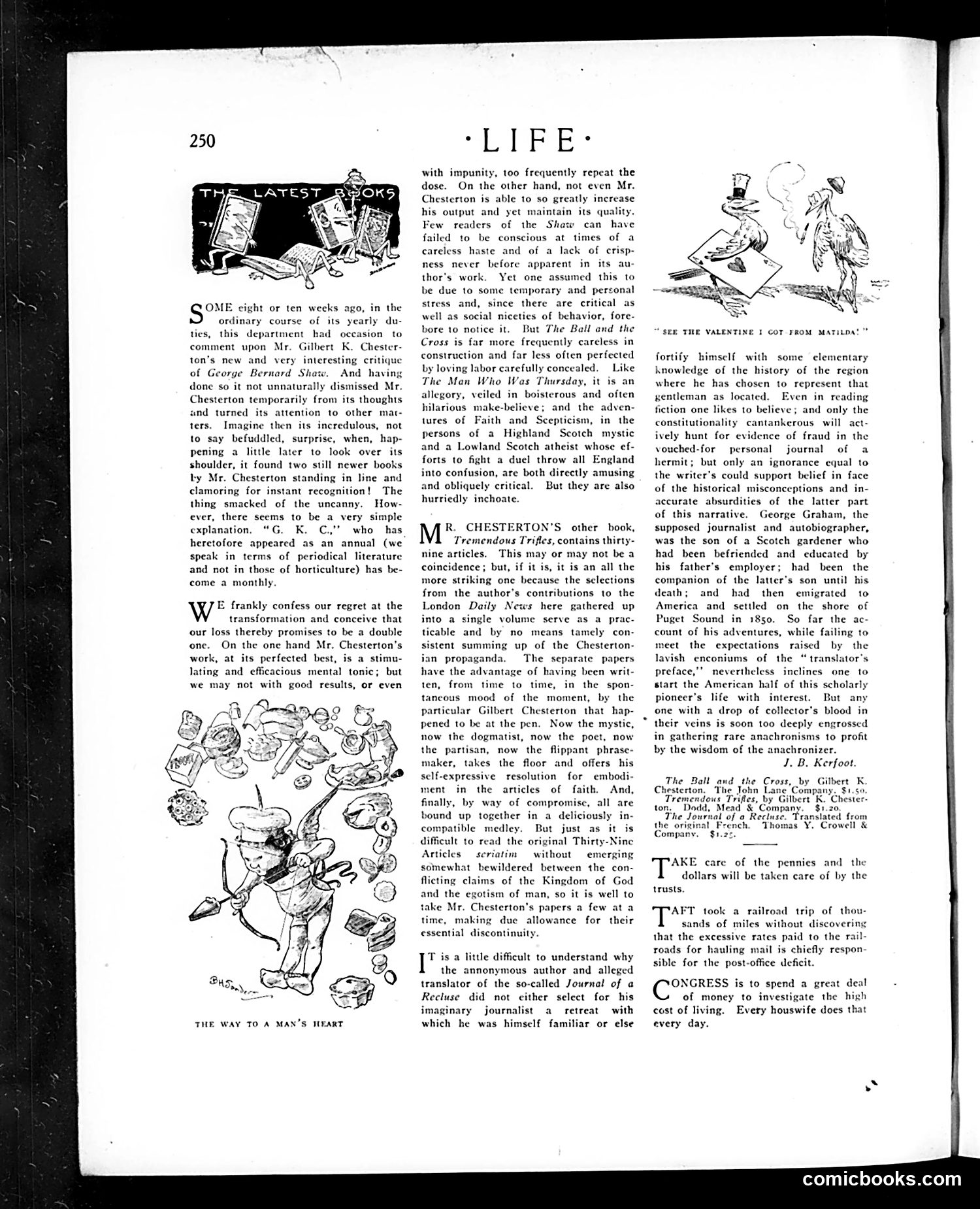
A restored page from Life, 1910-02-10. Page through the whole issue in the reader above.
📄 Transcribed text from this page (OCR, searchable)
Machine-transcribed from the original scan — historical spelling and the odd misread are preserved.
OME cight or ten weeks ago, in the ordinary course of its yearly du- ties, this department had occasion to comment upon Mr. Gilbert K. Chester- ton’s new and very interesting critique of George Bernard Shaw And having done so it not unnaturally dismissed Mr. Chesterton temporarily from its thoughts and turned its attention to other mat- ters. Imagine then its incredulous, not to say befuddled, surprise, when, hap- pening a little later to look over its shoulder, it found two still newer books ly Mr. Chesterton standing in line and clamoring for instant recognition! The thing smacked of the uncanny. How- ever, there seems to be a very simple explanation. “G. K. C.,"" who has heretofore appeared as an annual (we speak in terms of periodical literature and not in those of horticulture) has be- come a monthly. E frankly confess our regret at the transformation and conceive that our loss thereby promises to be a double one. On the one hand Mr. Chesterton's work, at its perfected best, is a stimu- lating and efficacious mental tonic; but we may not with good results, or even THE WAY TO A MAN'S ITEART “LT FE * with impunity, too frequently repeat the dose. On the other hand, not even Mr. Chesterton is able 10 so greatly increase his output and yet maintain its quality. Few readers of the Shaw can have failed to be conscious at times of a careless haste and of a lack of crisp- ness never before apparent in its au- thor’s work. Yet be due to some temporary and personal stress and, since there are critical as well as social niceties of behavior, fore- bore to notice it. But The Ball and the Cross is far more frequently careless in construction and far less often perfected by loving labor carefully concealed. Like he Man Who Was Thursday, it is an allegory, veiled in boisterous and often hilarious make-believe; and the adven- tures of Faith and Scepticism, in the persons of a Highland Scotch mystic and a Lowland Scotch atheist whose ef- forts to fight a duel throw all England into confusion, are both directly amusing and obliquely critical. But they are also hurriedly inchoate. one assumed this to M?’; CHESTERTON’S other book, remendous Trifles, contains thirty- nine articles. This may or may not be a coincidence ; but, if it is, it is an all the more striking one because the selections from the author's contributions to the London Daily News here gathered up into a single volume serve as a prac- ticable and by no means tamely con- sistent summing up of the Chesterton- in propaganda. The separate papers have the advantage of having been writ- ten, from time to time, in the spon- taneous mood of the moment, by the particular Gilbert Chesterton that hap- pened to be at the pen. Now the mystic, now the dogmatist, now the poet, now the partisan, now the flippant phrase- maker, takes the floor and offers his self-expressive resolution for embodi- the articles of faith. And, finally, by way of compromise, all are bound up together in a deliciously in- compatible medley. But just as it is difficult to read the original Thirty-Nine Articles scriatim without emerging somewhat bewildered between the con- flicting claims of the Kingdom of God and the egotism of man, so it is well to take Mr. Chesterton's papers a few ata time, making due allowance for their essential discontinuity. ment in I" is a little difficult to understand why the annonymous author and alleged translator of the so-called Journal of a Recluse did not cither select for his imaginary journalist. a retreat’ with which he was himself familiar or else “SER THE VALENTINE 1 COT FROM MATILDA fortify himself with knowledge of the history of the region where he has chosen to represent that gentleman as located. Even in reading fiction one likes to believe; and only the constitutionality cantankerous. will act- ively hunt for evidence of fraud in the vouched-for personal journal of a hermit; but only an ignorance equal to the writer's could support belief in face of the historical misconceptions and in- accurate absurdities of the latter part of this narrative. George Graham, the supposed journalist and autobiographer, was the son of a Scotch gardener who had been befriended and educated by his father’s employer; had been the companion of the latter's son until his death; and had then emigrated to America and settled on the shore of Puget Sound in 1850. So far the ac- count of his adventures, while failing to meet the expectations raised by the lavish enconiums of the “ translator's preface,” nevertheless inclines one to start the American half of this scholarly pioneer’s life with interest. But any fone with a drop of collector's blood in their veins is soon too deeply engrossed in gathering rare anachronisms to profit by the wisdom of the anachronizer. J.B. Kerfoot. The Ball and the Cross, by bert K. ‘hesterton. The John Lane Company. $1.50. Tremendous Trifles, by bert K. Chester- ton Dodd, Mead & Company. $1.20. The Journal of a Recluse, Translated from the original French. Thomas Y. Crowell & Company. $1.2 some elementary ‘AKE care of the pennies and the dollars will be taken care of by the trusts. AFT took a railroad trip of thou- sands of miles without discovering that the excessive rates paid to the rail- roads for hauling mail is chiefly respon sible for the post-office deficit. ONGRESS is to spend a great deal of money to investigate the high cost of living. Every houswife does that every day. comicbooks.com