
Life, 1910-02-10 · page 17 of 36
Life — February 10, 1910 — page 17: what you’re looking at
What you’re looking at
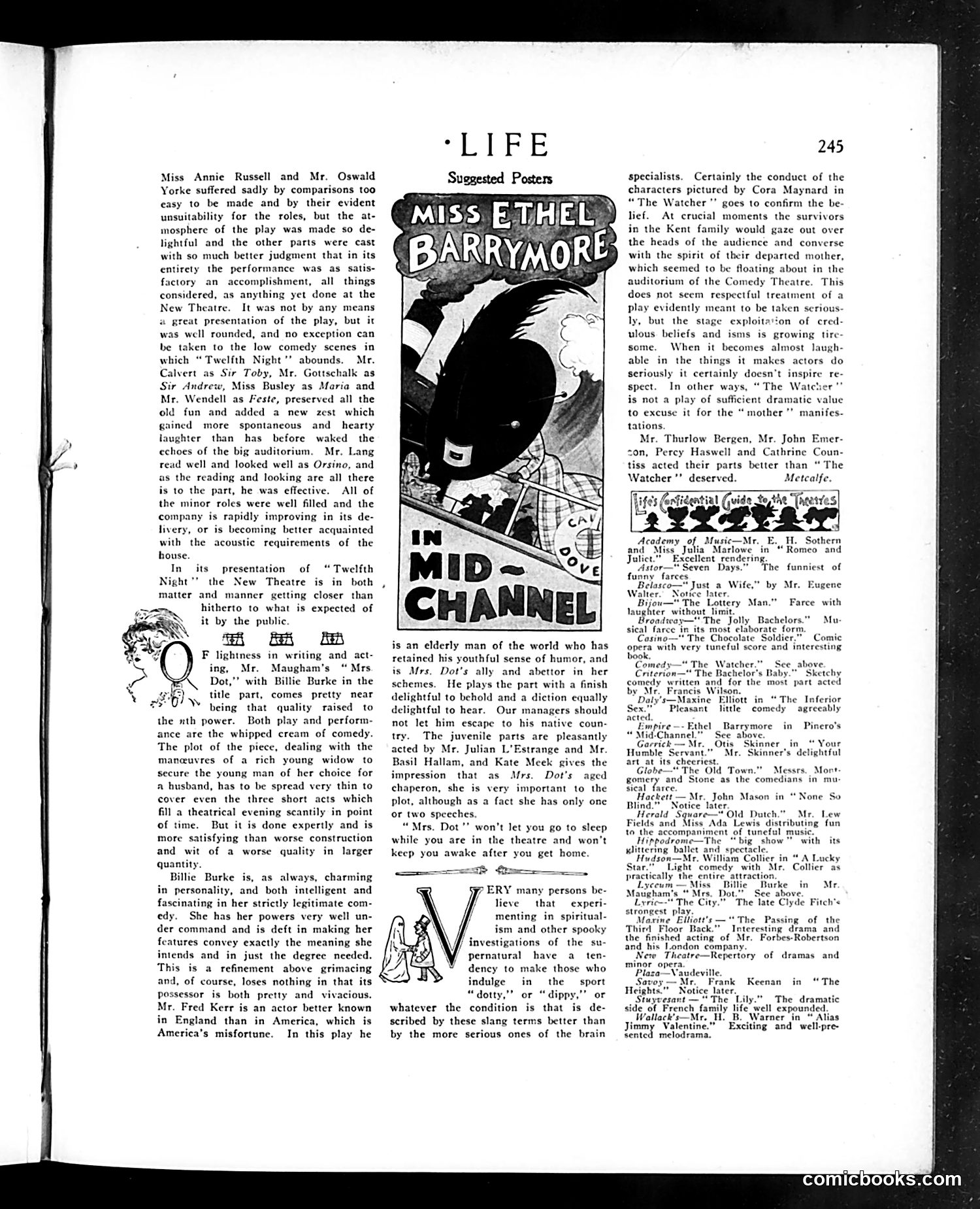
This page is a **theater review section** from Life magazine, primarily text-based with one illustrated poster advertisement for "Miss Ethel Barrymore in Mid-Channel." The reviews discuss stage productions: "Twelfth Night" at the New Theatre (praising supporting performances by Calvert and Gottschalk, though criticizing leads Annie Russell and Oswald Yorke), and "Mrs. Dot" featuring actress Billie Burke, which the critic praises as witty comedy. A brief section at page bottom discusses spiritualism, noting that people who investigate "spooky" supernatural phenomena tend to become "dotty" or "dippy" (mentally unstable). The text references a play called "The Watcher" by Cora Maynard that apparently dramatizes this belief. **The satire**: The spiritualism section gently mocks both spiritualist practices and the popular assumption that such interests cause mental instability—a common early 20th-century prejudice presented as scientific observation. The page reflects Life's role as cultural arbiter of theater and popular beliefs.
📄 Transcribed text from this page (OCR, searchable)
Machine-transcribed from the original scan — historical spelling and the odd misread are preserved.
Miss Annie Russell and Mr. Oswald Yorke suffered sadly by comparisons too easy to be made and by their evident unsuitability for the roles, but the at- mosphere of the play was made so de- lightful and the other parts were cast with so much better judgment that in its entirety the performance was as satis- factory an accomplishment, all things considered, as anything yet done at the New Theatre. It was not by any means a great presentation of the play, but it was well rounded, and no exception can be taken to the low comedy scenes in which “Twelfth Night’ abounds. Mr. Calvert as Sir Toby, Mr. Gottschalk as Sir Andrew, Miss Busley as Maria and Mr. Wendell as Feste, preserved all the old fun and added a new zest which gained more spontaneous and hearty laughter than has before waked the echoes of the big auditorium. Mr. Lang read well and looked well as Orsino, and as the reading and looking are all there to the part, he was effective. All of the minor roles were well filled and the company is rapidly improving in its de- livery, or is becoming better acquainted with the acoustic requirements of the house. In its presentation of “ Twelfth Night’ the New Theatre is in both matter and manner getting closer than hitherto to what is expected of it by the public. a RA A F lightness in writing and act- ing, Mr. Maugham's “ Mrs Dot,”’ with Billie Burke in the title part, comes pretty near being that quality raised to the nth power. Both play and perform- ance are the whipped cream of comedy. The plot of the piece, dealing the manaeuvres of a rich young widow to secure the young man of her choice for a husband, has to be spread very thin to cover even the three short acts which fill a theatrical evening scantily in point of time. But it is done expertly and is more satisfying than worse construction and wit of a worse quality in larger quantity Billie Burke is, as always, charming in personality, and both inte fascinating in her strictly legitimate com- edy, She has her powers very well un- der command and is deft in making her features convey exactly the meaning she intends and in just the degree needed. This is a refinement above grimacing of course, loses nothing in that its possessor is both pretty and vivacious. Mr. Fred Kerr is an actor better known in England than in America, which is America’s misfortune. In this play he — is an elderly man of the world who has retained his youthful sense of humor, and is Mrs, Dot's ally and abettor in her schemes. He plays the part with a finish delightful to behold and a diction equally delightful to hear. Our managers should not let him escape to his native coun- try. The juvenile parts are pleasantly acted by Mr. Julian L’Estrange and Mr. Basil Hallam, and Kate Meek gives the impression that as Mrs. Dot's aged chaperon, she is very important to the plot, although as a fact she has only one or two speeches. Mrs. Dot’ won't let you go to sleep while you are in the theatre and won't keep you awake after you get home. <8 $f. ERY many persons be- lieve that experi- menting in. spiritual f ism and other spooky ff investigations of the su- pernatural have a ten- dency to make those who indulge in the sport “dotty,”” or “dippy,”” or whatever the condition is that is de- scribed by these slang terms better than by the more serious ones of the brain 245 specialists. Certainly the conduct of the characters pictured by Cora Maynard in The Watcher "’ goes to confirm the be- lief. At crucial moments the survivors in the Kent family would gaze out over the heads of the audience and converse with the spirit of their departed mother, which seemed to be floating about in the auditorium of the Comedy Theatre. This does not seem respectful treatment of a play evidently meant to be taken serious- ly, but the stage exploitation of cred- ulous beliefs and isms is growing tire some. When it becomes almost laugh- able in the things it makes actors do seriously it certainly doesn’t inspire re- spect. In other ways, “The Watcher” is not a play of sufficient dramatic v to excuse it for the “ mother" manifes- tations. Mr. Thurlow Bergen, Mr. John Emer- zon, Percy Haswell and Cathrine Coun- tiss acted their parts better than “ The Watcher ’* deserved. Metcalfe. (vise és “[rcetves of H. Sothern and. Miss. Julia Marlowe in “Romeo and Julict.” Excellent rendering. ‘Astor—" Seven Days.” ‘The funniest of funny farces Belasco" Just a Wife,” by Mr. Eugene Walter. ‘otice later. Bijou—" The Lottery Man.” laughter without limit. Broadway—" The Jolly Bachelors.” Mu. sical farce its most elaborate form. Cosino— he Chocolate Soldier.” Comic ith very tuneful score and interesting Farce with Comedy he Watcher.” above. Criterion— The Bachelor's Baby.” Sketchy comedy written and for the most part acted by Mr. Francis Wilson. Di Sex.” Pleasant acted. Empire ~- Ethel little comedy Barrymore in id-Channel.” See ahove Garrick — Mr. Otis Skinner in. “ Your Humble Servant." Mr. Skinner's delightful art_at its cheeriest Globe—" The Old Town.” Messrs. Mort gomery and Stone as the comedians in mu sical farce. Hackett — Mr. John Mason in “None So Blind.” Notice later. Herald Square—"* Old Dutch.” Mr. Lew Fields and Miss Ada Lewis distributing fun to the accompaniment of tuneful music. Hippodrome—The “big show” with its xlittering ballet and spectacle. Hudson—Mr. William Collier in “ A Lucky Star." Light ‘comedy with Mr. Collier as practically the entire attracti Lyceum —Miss Billie Burke Maugham’s “ Mrs. Dot Lyric--* The City.” strongest play. See above. ‘The late Clyde Maxine Elliott's “The Passing of the Third Floor Back.” Interesting drama and the finished acting of Mr. Forbes-Robertson and. his London company. New Theatre—Repertory of minor opera. Plaza—Vaudeville. Savoy — Mr. Frank Heights." Notice later. ‘Stuyvesant —" The Lily.” The dramatic side of French family life well expoun Wallack’s—Mr. H. B. Vi i Jimmy Valentine.” | Exciting and well-pre- sented melodrama. dramas and Keenan in “The comicbooks.com