
Life, 1910-02-10 · page 21 of 36
Life — February 10, 1910 — page 21: what you’re looking at
What you’re looking at
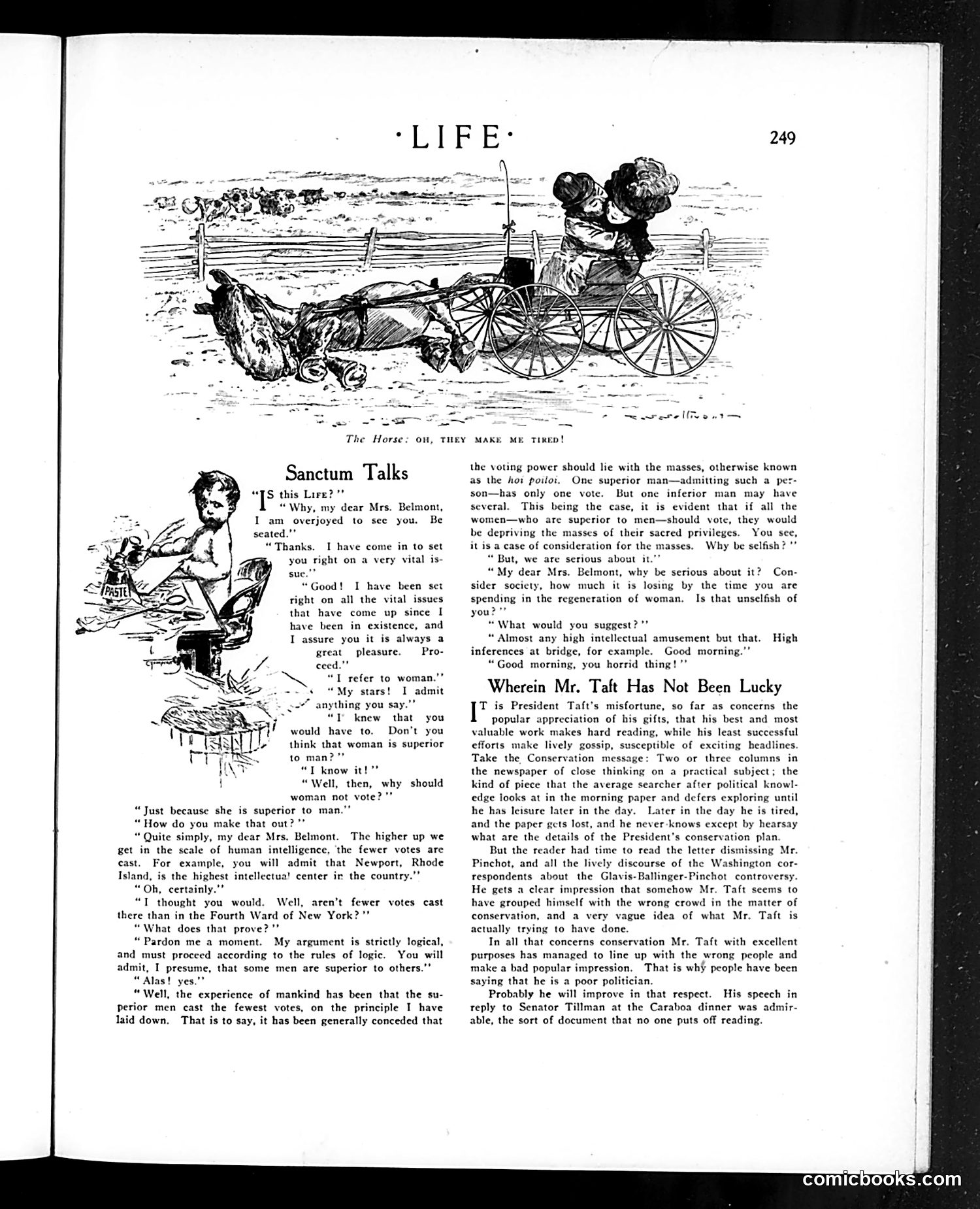
**Top Cartoon:** "The Horse: Oh, They Make Me Tired!" depicts a tired horse pulling a cart with two women. This illustrates exhaustion with women's activist demands—likely referencing the suffrage movement. **"Sanctum Talks" Section:** A satirical dialogue between a Life magazine editor and Mrs. Belmont (likely Alva Vanderbilt Belmont, a prominent suffragist) about women's voting rights. The editor uses absurdist logic: claiming women are intellectually superior to men, therefore—paradoxically—should NOT vote, since superior people vote less. The joke relies on mocking suffragist arguments through circular reasoning, while also suggesting women waste time on activism rather than "high intellectual amusement" like bridge. **"Wherein Mr. Taft Has Not Been Lucky":** Commentary on President William Howard Taft's poor public relations. His serious policy work (conservation) goes unread, while sensational gossip (the Pinchot-Ballinger controversy) generates headlines, making him appear to side with the wrong people despite good intentions.
📄 Transcribed text from this page (OCR, searchable)
Machine-transcribed from the original scan — historical spelling and the odd misread are preserved.
The Sanctum Talks “TS this Lire?” “Why, my dear Mrs. Belmont, I am overjoyed to see you. Be seated.” “Thanks. I have come in to set you right on a very vital is- sue “Good! I have been set ght on all the vital issues that have come up since I have been in existence, and I assure you it is always a great pleasure. — Pro- ceed.” “refer to woman.’” “My stars! I admit anything you say.” “T knew that you would have to. Don't you think that woman is superior to man?” “T know itt”? “Well, then, why should woman not vote? "? “Just because she is superior to man.” “ How do you make that out?" “Quite simply, my dear Mrs. Belmont. The higher up we get in the scale of human intelligence, ‘the fewer votes are cast. For example, you will admit that Newport, Rhode Island, is the highest intellectua! center in the country.” “Oh, certainly.” “T thought you would. Well, aren’t fewer votes cast there than in the Fourth Ward of New York?” “What does that prove? "” “Pardon me a moment. My argument is strictly logical, and must proceed according to the rules of logic. You will admit, I presume, that some men are superior to others.” “Alas! yes.” “Well, the experience of mankind has been that the su- perior men cast the fewest votes, on the principle I have laid down. That is to say, it has been generally conceded that Horse; on, me rere lI ent MAKE ME TIRED! the voting power should lie with the masses, otherwise known as the hot poiloi. One superior man—admitting such a per- son—has only one vote. But one inferior man may have several. This being the case, it is evident that if all the women—who are superior to men—should vote, they would be depriving the masses of their sacred privileges. You see, it is a case of consideration for the masses. Why be selfish? "” “ But, we are serious about it.’’ “My dear Mrs. Belmont, why be serious about it? Con- sider society, how much it is losing by the time you are spending in the regeneration of woman. Is that unselfish of you?"" “What would you suggest?” “ Almost any high intellectual amusement but that. inferences at bridge, for example. Good morning.’” “Good morning, you horrid thing! Wherein Mr. Taft Has Not Been Lucky T is President Taft’s misfortune, so far as concerns the popular appreciation of his gifts, that his best and most valuable work makes hard reading, while his least successful efforts make lively gossip, susceptible of exciting beadlines. Take the, Conservation message: Two or three columns in the newspaper of close thinking on a practical subject; the kind of piece that the average searcher after political know!- edge looks at in the morning paper and defers exploring until he has leisure later in the day. Later in the day he is tired, and the paper gcts lost, and he never-knows except by hearsay what are the details of the President’s conservation plan But the reader had time to read the letter dismissing Mr. Pinchot, and all the lively discourse of the Washington cor- respondents about the Glavis-Ballinger-Pinchot controversy. He gets a clear impression that somehow Mr. Taft seems to have grouped himself with the wrong crowd in the matter of conservation, and a very vague idea of what Mr. Taft is actually trying to have done. In all that concerns conservation Mr. Taft with excellent purposes has managed to line up with the wrong people and make a bad popular impression. That is wh people have been saying that he is a poor politician. Probably he will improve in that respect. His speech in reply to Senator Tillman at the Caraboa dinner was admir- able, the sort of document that no one puts off reading. High comicbooks.com