
Life, 1910-02-10 · page 16 of 36
Life — February 10, 1910 — page 16: what you’re looking at
What you’re looking at
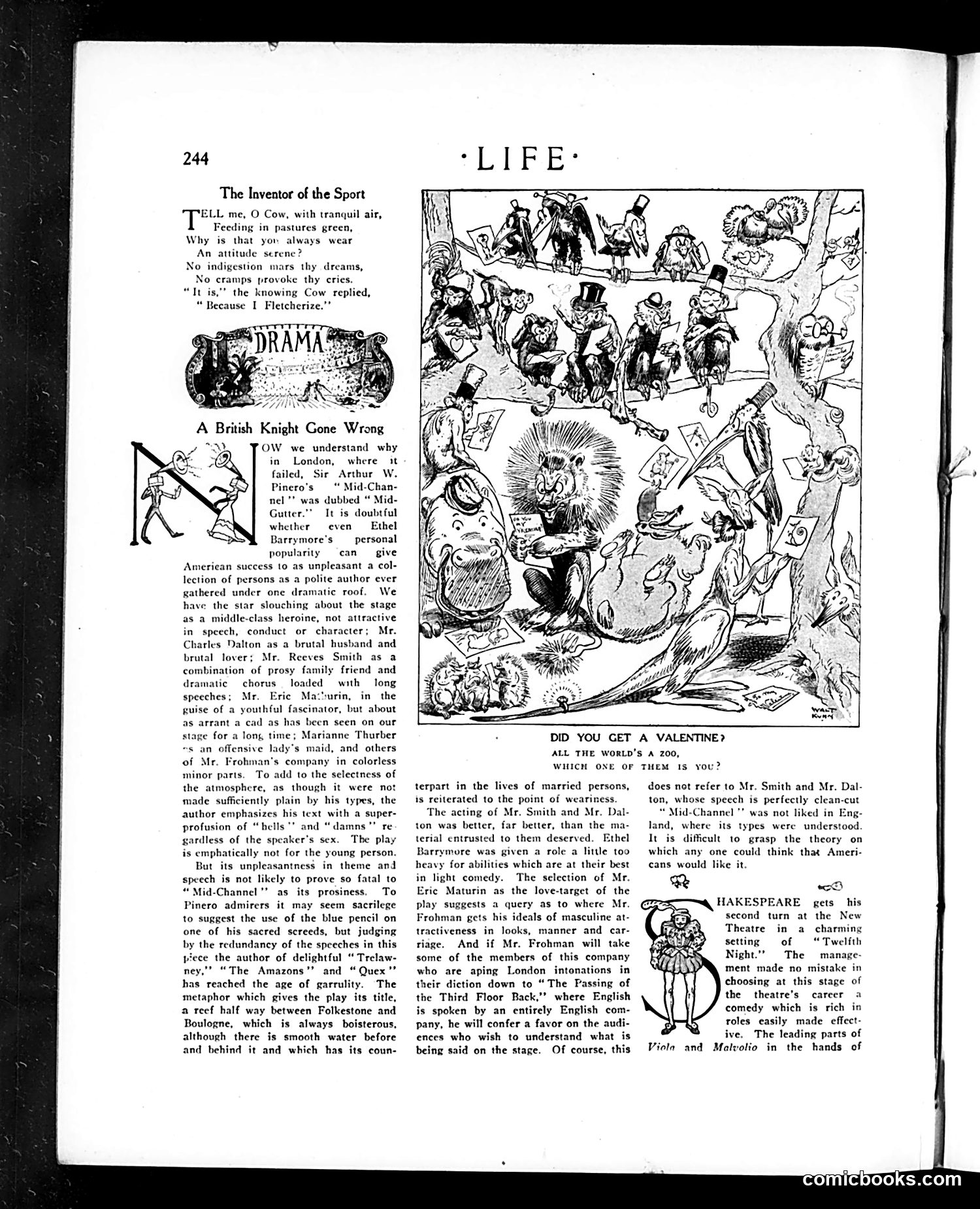
**"The Inventor of the Sport"** (top left): A humorous poem mocking the "Fletcherizing" fad—a dietary practice promoted by Horace Fletcher, who advocated thorough chewing. The cow claims its serene digestion results from this method. This satirizes a genuine health trend of the era that Life considered absurd. **"A British Knight Gone Wrong"** (center): A theater review of Arthur Wing Pinero's play "Mid-Channel." The critic argues the play, though successful in London, will fail in America because its characters are uniformly unlikeable and morally unattractive. The review criticizes the actors' affected English accents and excessive use of profanity. The title puns on the play's metaphor (a dangerous reef) to suggest the play itself is unnavigable. **"Did You Get a Valentine?"** (right): A satirical illustration depicting various animal caricatures, likely representing different human types or social classes. The caption suggests this is a social commentary on romantic relationships and human nature using animal stereotypes—a common satirical device.
📄 Transcribed text from this page (OCR, searchable)
Machine-transcribed from the original scan — historical spelling and the odd misread are preserved.
244 The Inventor of the Sport T L me, O Cow, with tranquil air, Feeding in pastures green, Why is that yon always wear An attitude serene? No indigestion mars thy dreams, No cramps provoke thy cries. “It is,” the knowing Cow replied, “ Because I Fletcherize.”” British Knight Gone Wrong OW we understand why in London, where it failed, Sir Arthur W. Pinero's “ Mid-Chan- nel’ was dubbed “ Mid- Gutter." It is doubtful whether even Ethel Barrymore's _ personal popularity can give Ameriean success to as unpleasant a col- lection of persons as a polite author ever gathered under one dramatic roof. We have the star slouching about the stage as a middle-class heroine, not attractive in speech, conduct or character; Mr. Charles Dalton as a brutal husband and brutal lover; Mr. Reeves Smith as a combination of prosy family friend and dramatic chorus loaded with long speeches; Mr. Eric Mat‘urin, in the guise of a youthful fascinator, but about as arrant a cad as has been seen on our stage for a long time; janne Thurber +s an offensive Jady’s maid, and others of Mr. Frohman's company in colorless minor parts. To add to the selectness of the atmosphere, as though it were not made sufficiently plain by his types, the author emph: is text with a super- profusion of * and “damns"" re gardless of the speaker's sex. The play is emphatically not for the young person. But its unpleasantness in theme and speech is not likely to prove so fatal to “Mid-Channel"’ as its prosiness, To Pinero admirers it may seem sacrilege to suggest the use of the blue pencil on one of his sacred screeds, but judging by the redundancy of the speeches in this piece the author of delightful “ Trelaw- ney,"’ “The Amazons’? and “Quex'’ has reached the age of garrulity. The metaphor which gives the play its title, a reef half way between Folkestone and Boulogne, which is always boisterous, although there is smooth water before and behind it and which has its coun- DID YOU GET A VALENTINE? ALL THE WORLD'S A 200, WHICH ONE OF THEM 1S you? terpart in the lives of married persons, is reiterated to the point of weariness. The acting of Mr. Smith and Mr. D; ton was better, far better, than the ma- terial entrusted to them deserved. Ethel Barrymore was given a role a little too heavy for abilities which are at their best in light comedy. The selection of Mr. Eric Maturin as the love-target of the play suggests a query as to where Mr. Frohman gets his ideals of masculine at- tractiveness in looks, manner and car- riage. And if Mr. Frohman will take some of the members of this company who are aping London intonations in their diction down to “The Passing of the Third Floor Back,’? where English is spoken by an entirely English com- pany, he will confer a favor on the audi- ences who wish to understand what is being said on the stage. Of course, this does not refer to Mr, Smith and Mr. Dal- ton, whose speech is perfectly clean-cut “ Mid-Channel "? was not liked in Eng land, where its types were understood. It is difficult. 10 grasp the theory on which any one could think that Ameri- cans would like it. cD HAKESPEARE gets h second turn at the Ne Theatre in a charming setting of “Twelfth Night.” The —manage- ment made no mistake in choosing at this stage of the theatre’s career a comedy which is rich in roles easily made effect- ive. The leading parts of Viola and Malvolio in the hands of Comicbooks.com