
A complete issue · 32 pages · 1909
Life — December 9, 1909
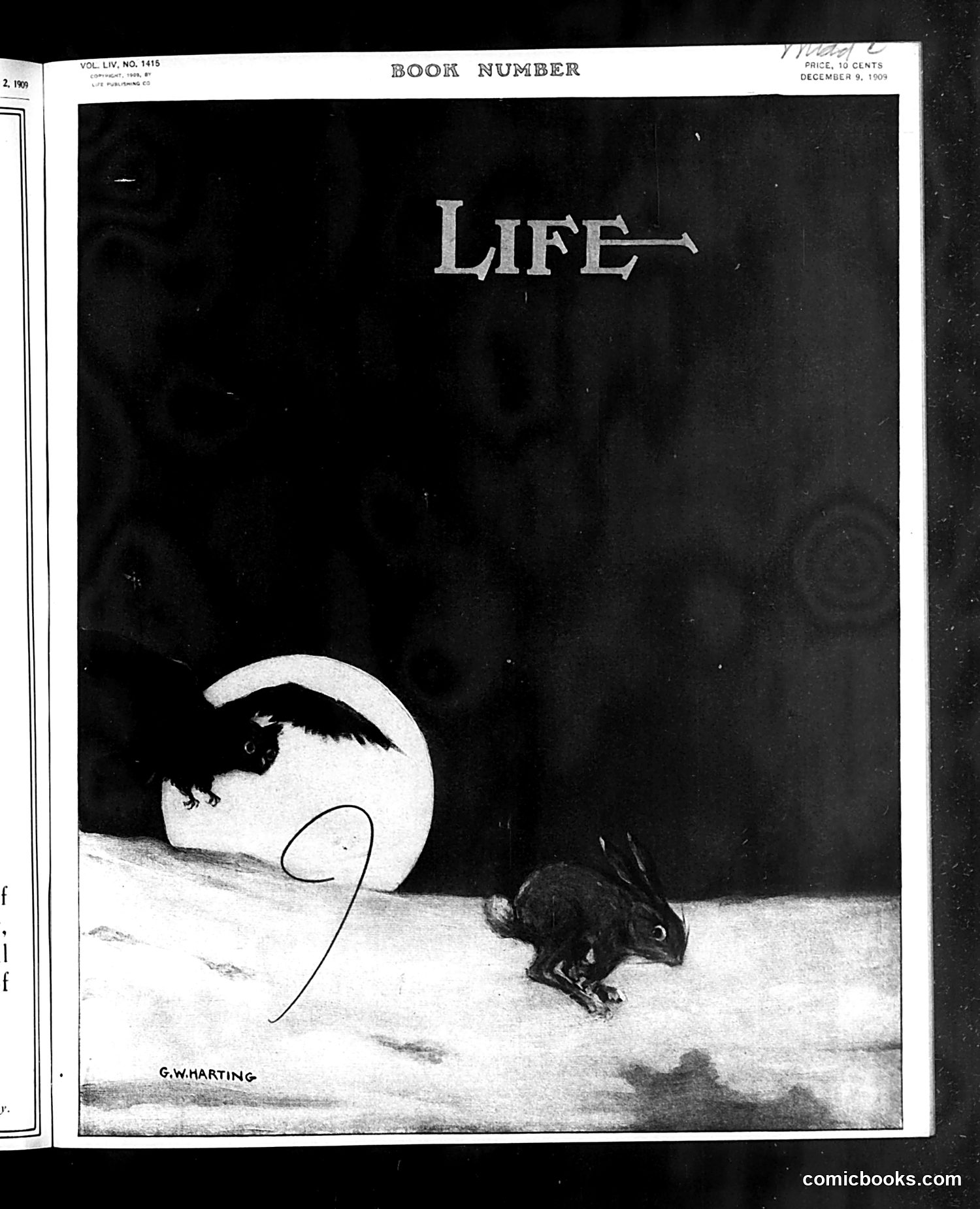
This is the cover of *Life* magazine (Vol. LIV, No. 1415, December 9, 1909), priced at 12 cents. The illustration by G.W. Harting depicts a crescent moon with a small dark figure (possibly a rat or mouse) inside it, positioned above a larger rat or mouse on the ground below. The meaning is unclear without additional context. The image appears to use animal figures symbolically—possibly referencing a political figure or social condition through the contrast between the elevated crescent-moon creature and the ground-level animal. Without the article text or contemporary knowledge of 1909 events, the specific satirical point cannot be definitively determined. The surreal composition suggests commentary on hierarchy, aspiration, or social disparity, but this remains speculative.
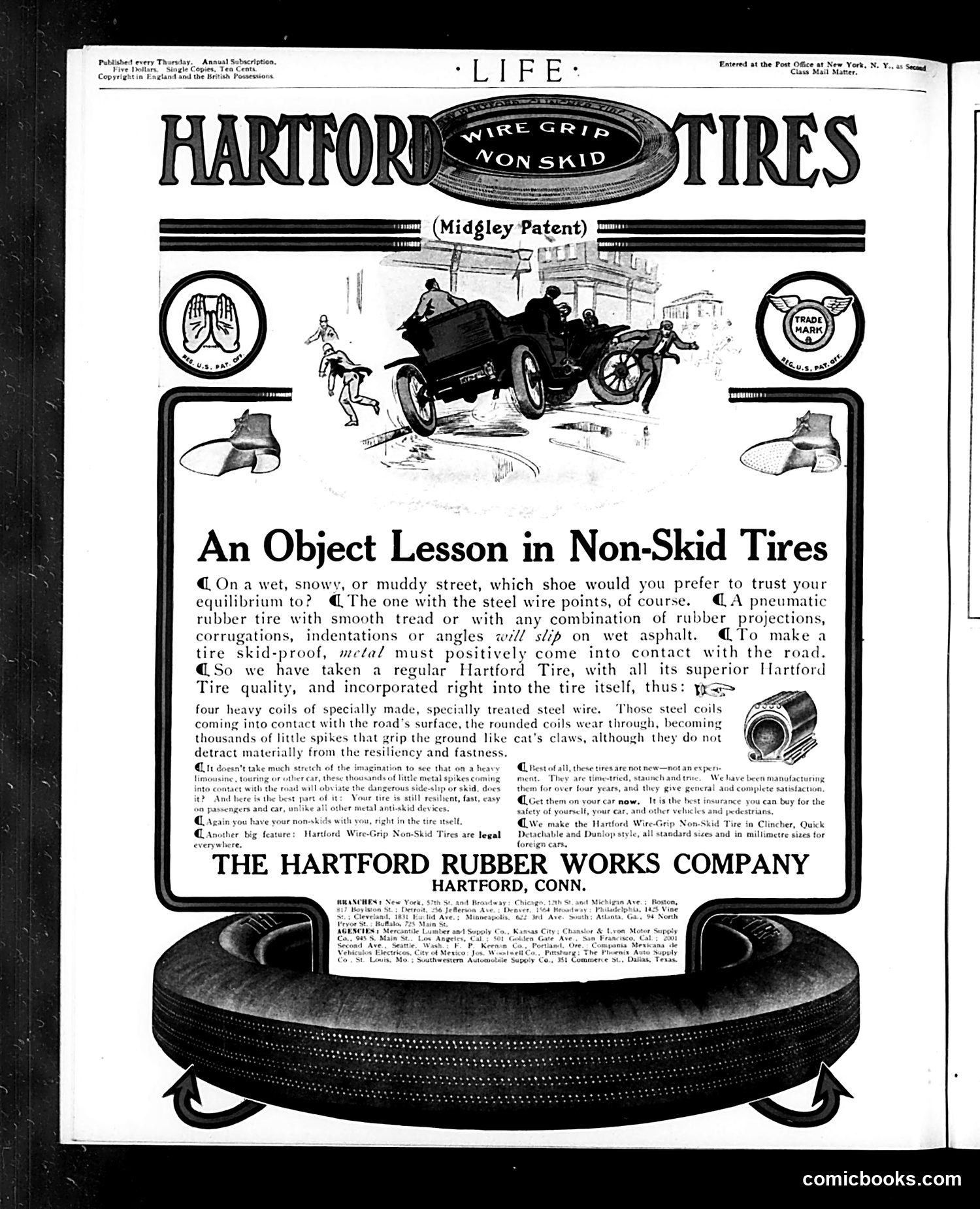
This is **primarily an advertisement**, not satire or political commentary. The Hartford Rubber Works Company is marketing their "Wire Grip Non-Skid" tires (Midgley Patent). The central illustration shows a car skidding dangerously on a wet street while pedestrians scatter—this is the "object lesson" promised in the headline. The ad argues that standard smooth tires cannot grip wet pavement safely, whereas Hartford's embedded steel wire coils provide traction "like cat's claws." The page uses dramatic imagery of near-disaster to sell safety through superior tire design. This reflects early automotive-era concerns about road safety and tire technology. The many branch locations listed indicate Hartford was a major national tire manufacturer of this period.
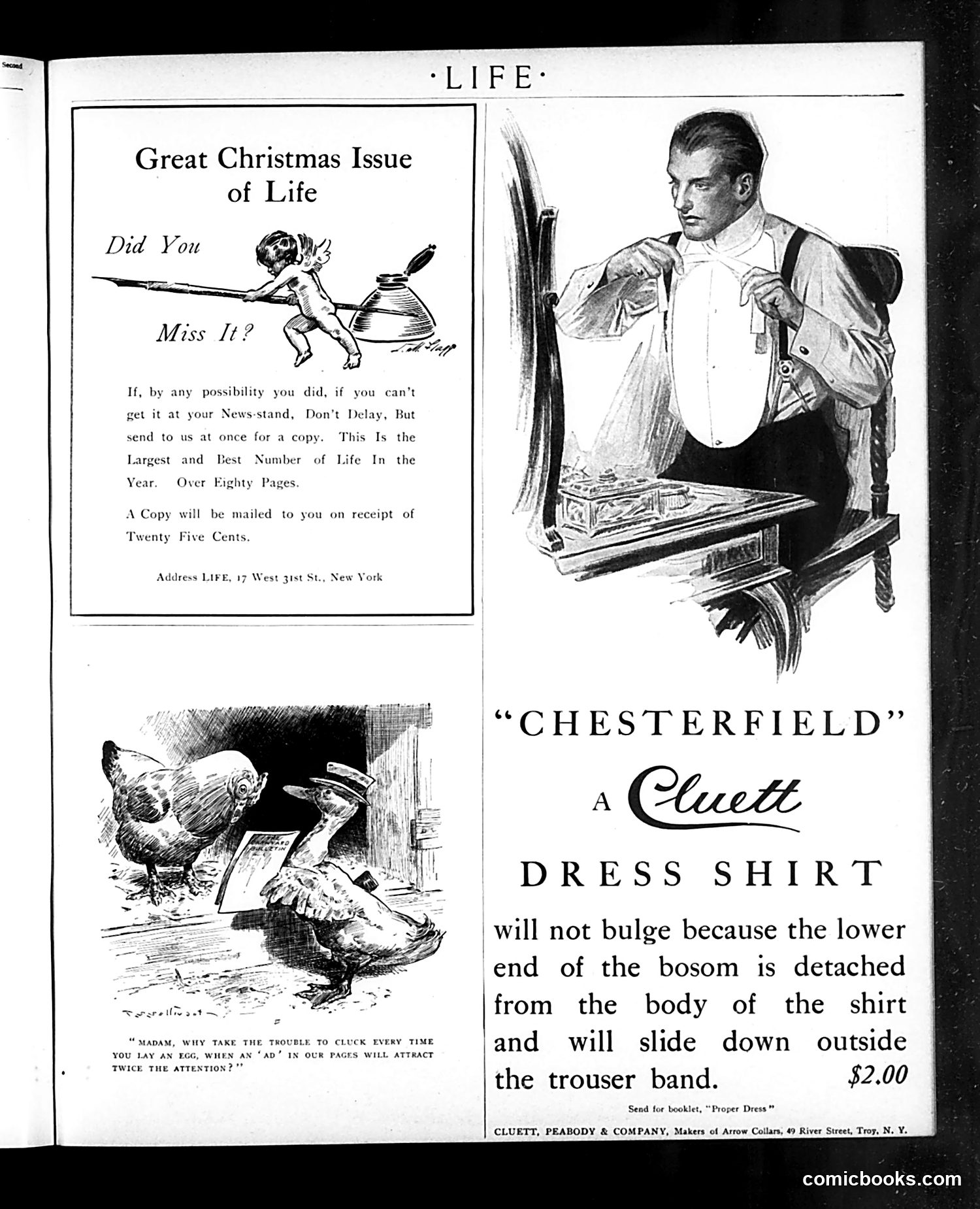
This page is primarily **advertising**, not political satire. The top-left advertisement promotes Life magazine's "Great Christmas Issue," using a cherub illustration in a humorous appeal to readers to purchase the expanded holiday edition (over 80 pages). The bottom-left cartoon appears to be a joke about advertising effectiveness, showing a figure (possibly representing advertisers) concerned that repeated ads ("every time you lay an egg") in Life's pages might annoy readers—but the humor is self-referential, promoting the magazine's reach. The right side contains a straightforward product advertisement for "Chesterfield" dress shirts by Cluett, Peabody & Company, emphasizing the shirt's practical design feature (detachable bosom that won't bulge). This is genuine commercial advertising, not satire.
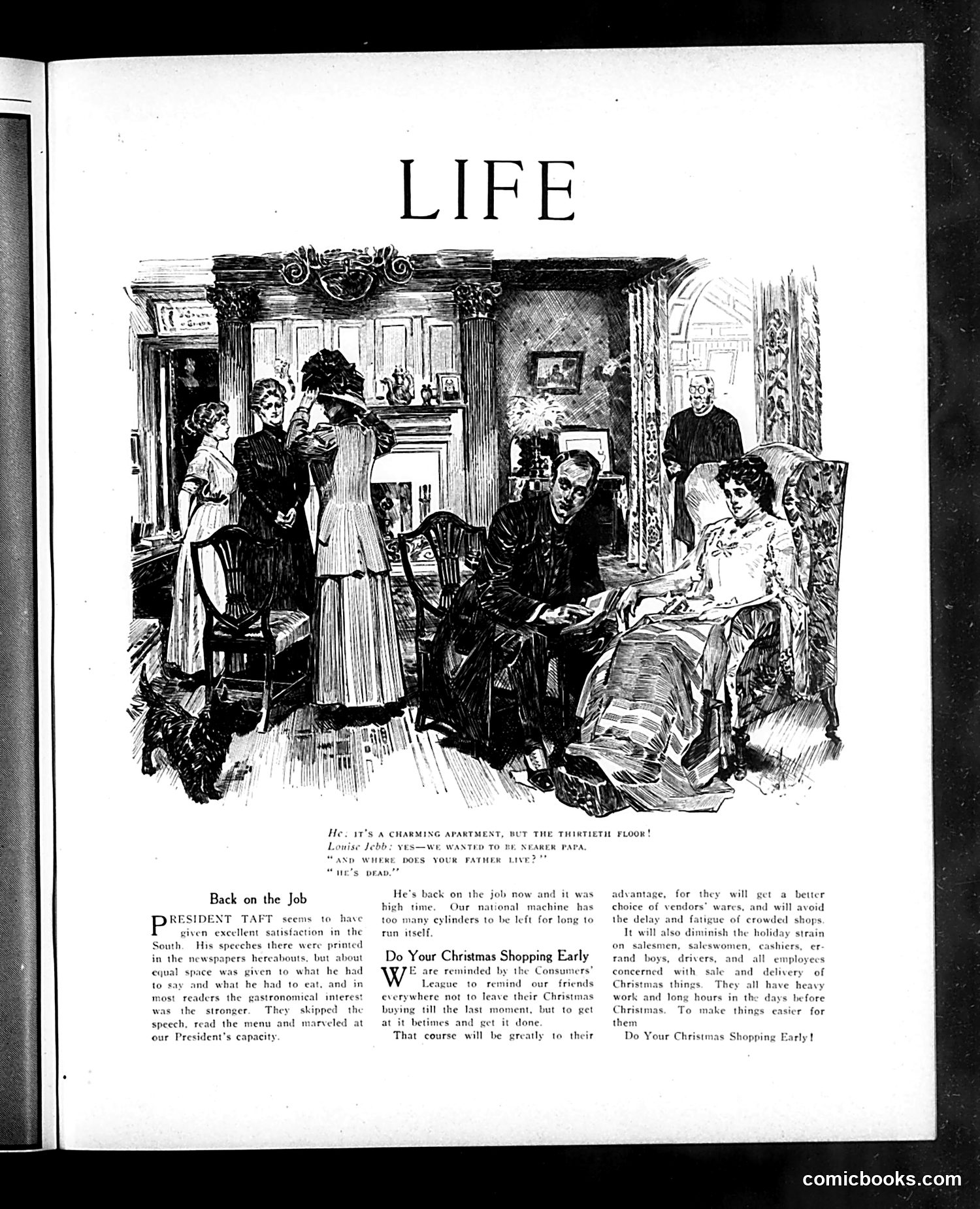
This page contains a satirical illustration titled "Back on the Job" depicting an upper-class domestic scene. The caption references "President" and mentions someone named Papa, suggesting political commentary about returning to work after holiday. Below the illustration are two brief articles: "Back on the Job" discusses satisfaction in the South and mentions newspapers printing a speech; "Do Your Christmas Shopping Early" urges consumers to shop early to ease merchant burdens and reduce holiday strain on workers. The satire appears to contrast leisured upper-class life (the drawing shows well-dressed people in a drawing room) with working-class concerns about holiday labor demands. The articles advocate consumer responsibility toward service workers—a progressive message for the era, though the specific political figure referenced remains unclear from visible text alone.
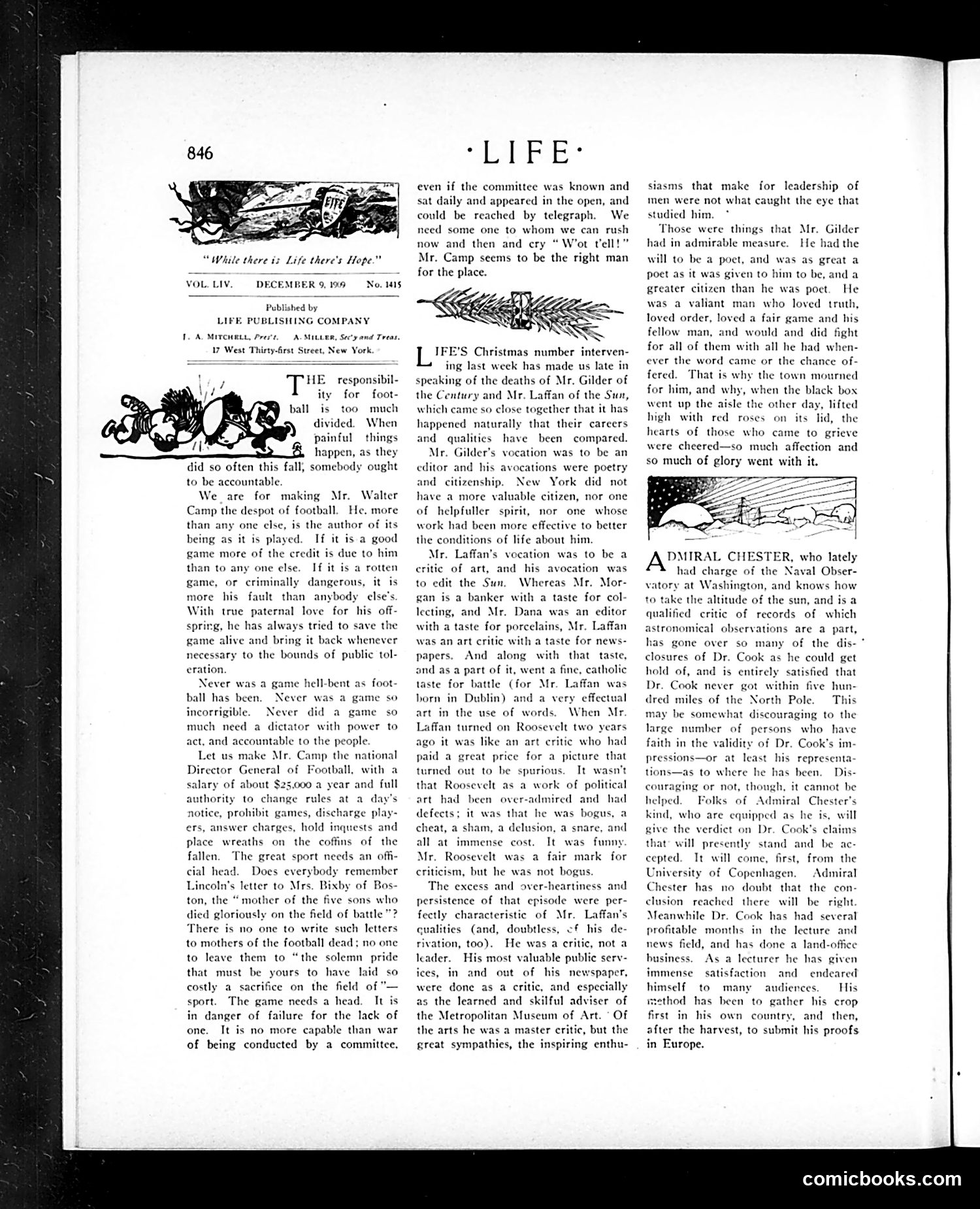
This page contains two editorial cartoons and accompanying text discussing deaths of prominent New Yorkers. **Top cartoon** ("While There is Life there's Hope"): Shows figures in a chaotic scene, likely satirizing football leadership disputes. The accompanying article discusses Mr. Walter Camp's role as football dictator and advocates for stronger central authority in the sport. **Bottom illustration**: Depicts Admiral Chester, who recently directed the Naval Observatory in Washington. The text praises his expertise in astronomical records and suggests he could verify Dr. Cook's claims about reaching the North Pole—a contemporary scandal involving disputed polar exploration claims. The page reflects early 1900s concerns about institutional leadership, scientific credibility, and the famous Cook-Peary North Pole controversy that captivated American public attention.
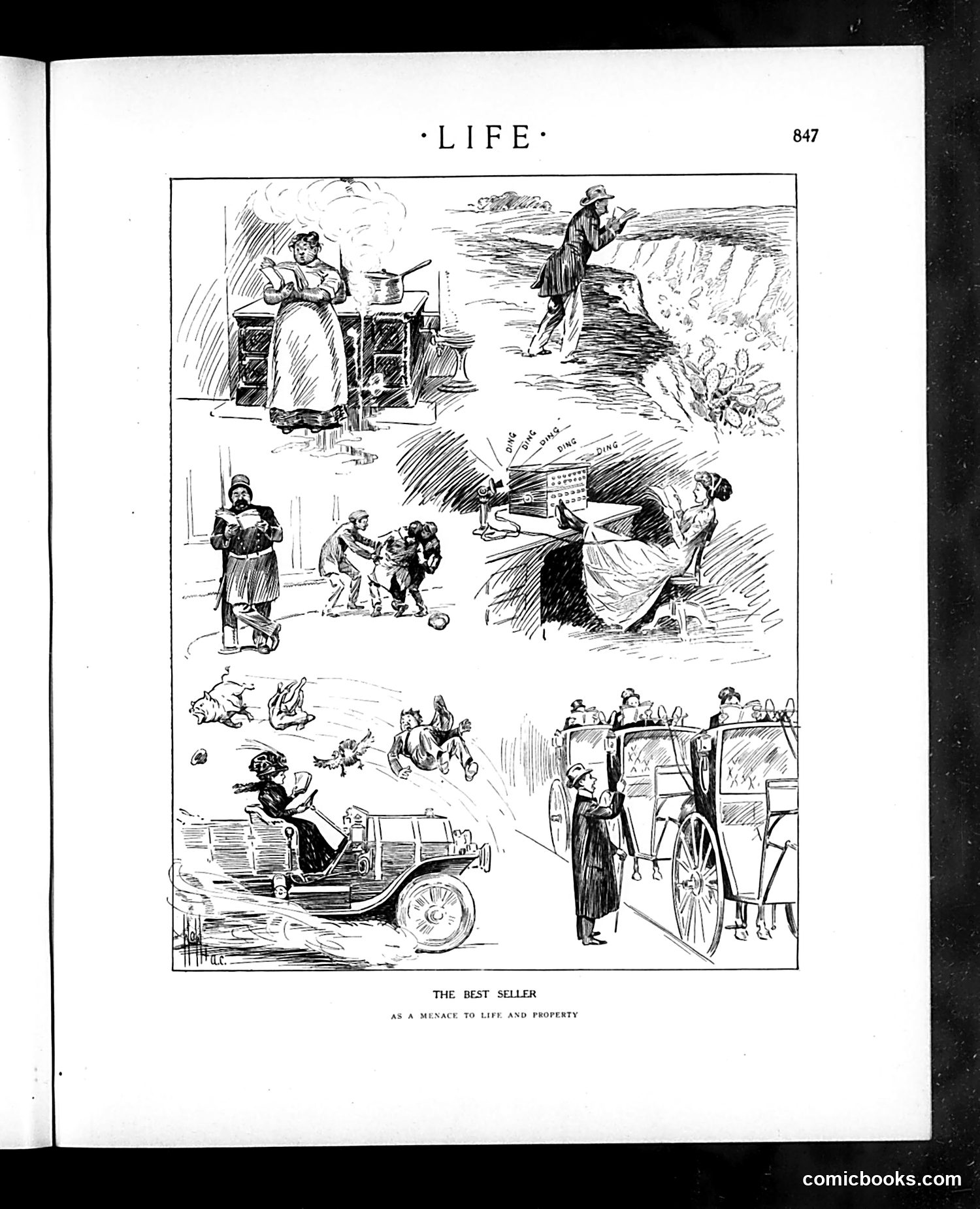
This satirical cartoon page depicts various scenes of danger and chaos caused by automobiles—what appears to be early 20th-century motor cars. The caption's ironic title refers to automobiles as the "best seller," suggesting they were commercially popular consumer products. The six vignettes show cars causing accidents, near-misses, and hazards: a woman cooking struck by a vehicle, pedestrians fleeing, a car nearly hitting children, a woman blown by a car's wind, and vehicles crowded with passengers. The satire criticizes the automobile industry's rapid commercialization and sales success despite genuine public safety dangers—a contemporary concern as cars were newly common and regulation was minimal.
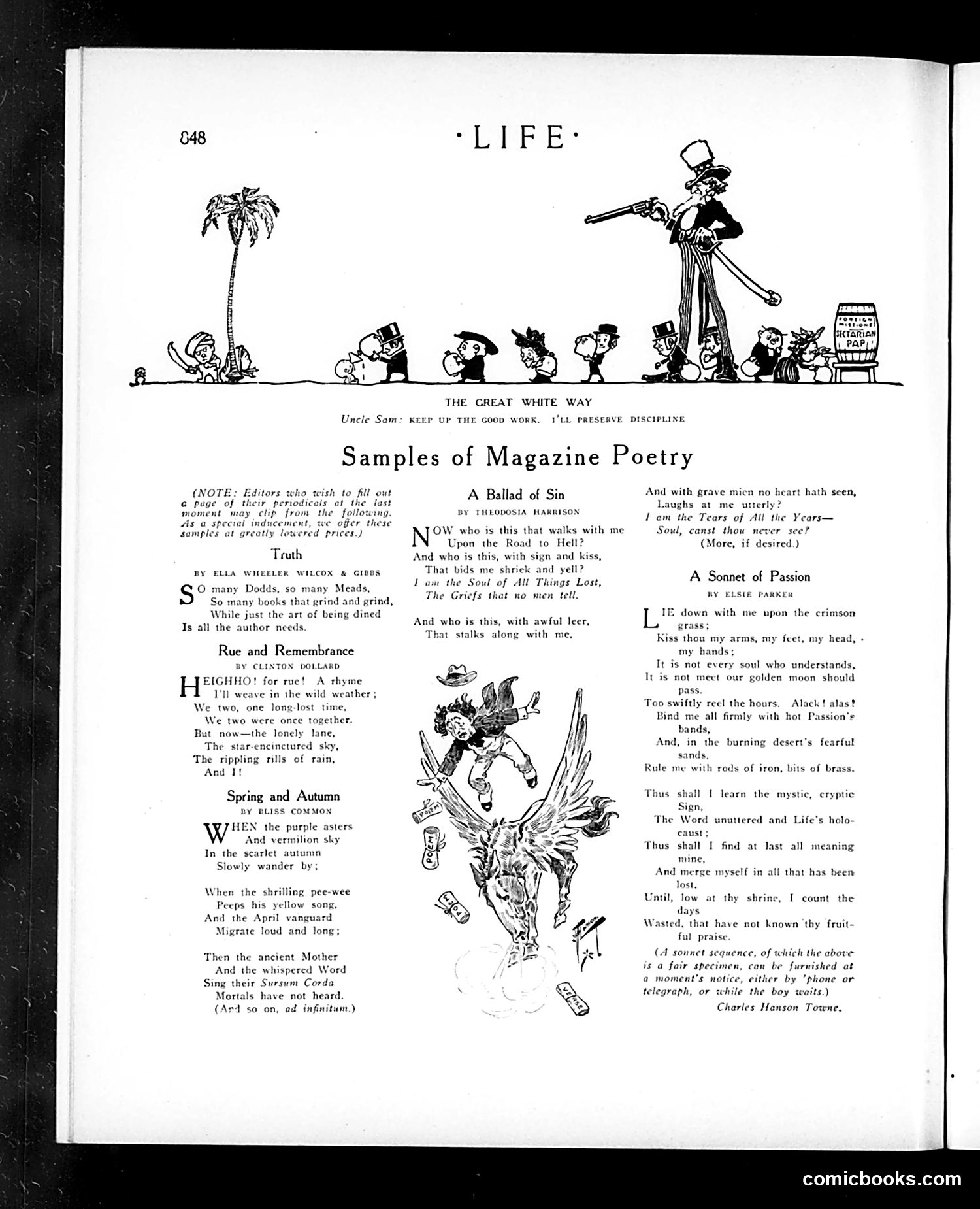
This satirical cartoon depicts **Uncle Sam** (identifiable by his characteristic top hat and star-spangled outfit) as a towering figure wielding a telescope, overlooking a procession of smaller figures. The caption reads: "KEEP UP THE GOOD WORK. I'LL PRESERVE DISCIPLINE." The cartoon appears to comment on American imperialism or foreign policy intervention. Uncle Sam supervises what seems to be colonial subjects or nations under U.S. control, using the telescope as a symbol of surveillance and oversight. The phrase "preserve discipline" suggests the U.S. maintaining control over subordinate territories or peoples through watchful authority. The overall message critiques America's imperial posture and paternalistic attitude toward other nations or peoples, presenting it as heavy-handed supervision rather than genuine partnership.
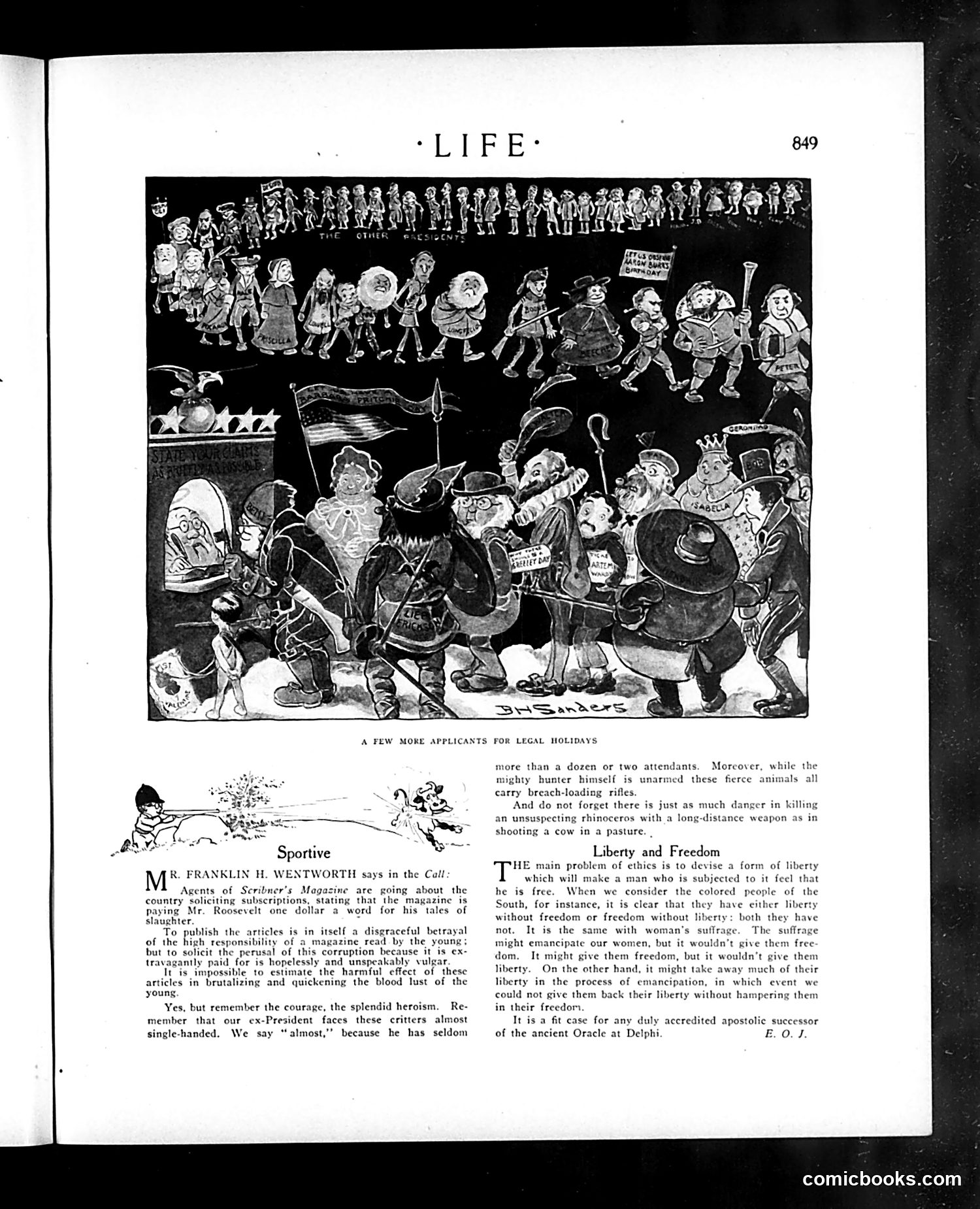
The main cartoon, titled "A Few More Applicants for Legal Holidays," satirizes efforts to establish new national holidays. The image shows various figures in period costume (appearing to represent different groups or interests) lined up to petition for recognition—suggesting that if various groups received official holidays, the calendar would become absurdly crowded. The bottom section contains two articles: "Sportive" by Franklin H. Wentworth criticizing *Collier's* and *Saturday's Magazine* for publishing sensationalist hunting stories that glorify killing animals, and "Liberty and Freedom," discussing emancipation and women's rights, contrasting different regional perspectives on freedom. The satire mocks the proliferation of holiday requests while the articles address serious social and editorial concerns of the period.
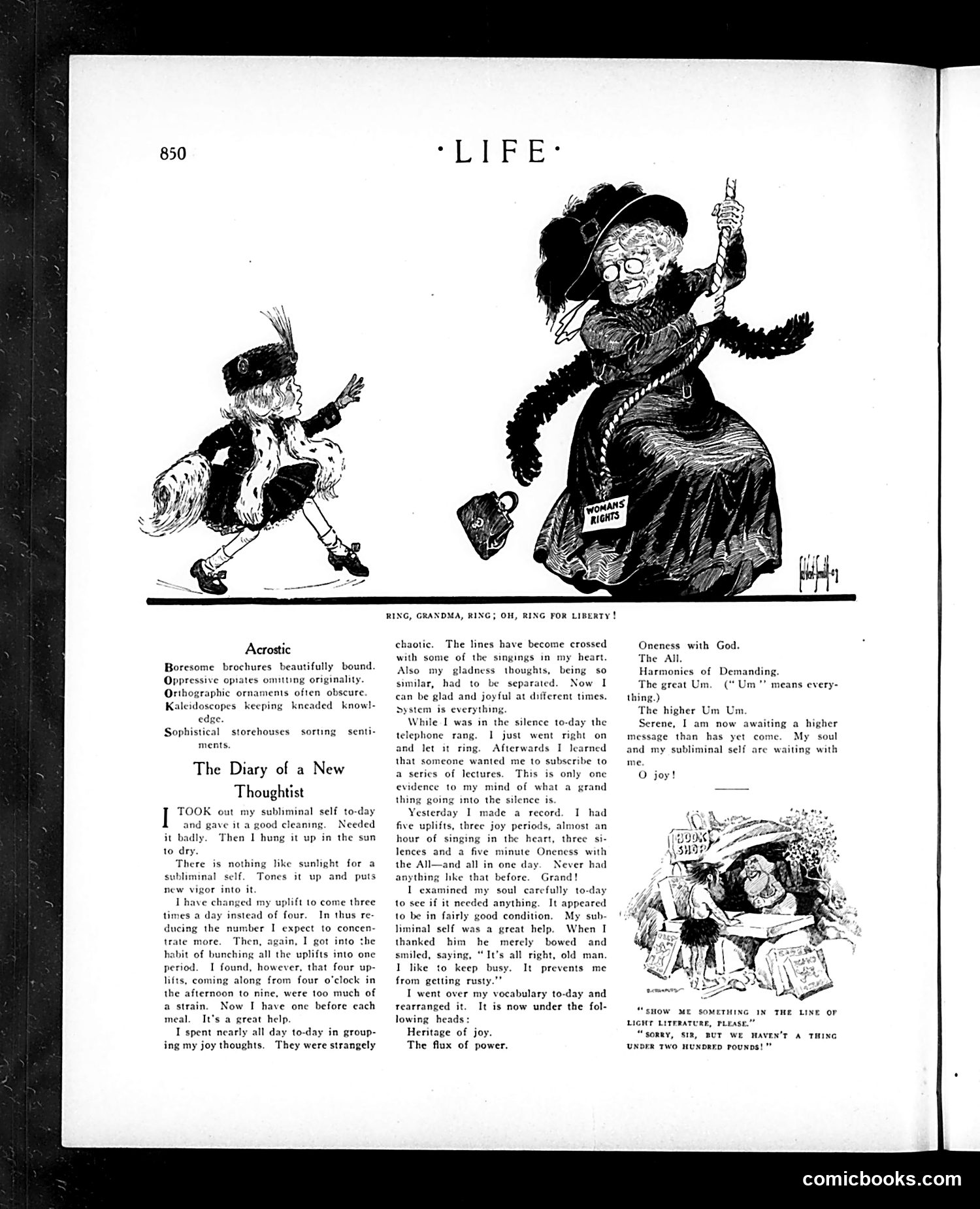
The main cartoon depicts two figures dancing: a small man labeled "RING, GRANDMA, RING; OH, RING FOR LIBERTY!" and a larger woman wearing a "WOMAN'S RIGHTS" sash. This appears to satirize the women's suffrage movement of the early 20th century. The exaggerated caricatures—the woman as domineering and the man as diminished—suggests the cartoonist mocks women's rights advocates, implying that granting women voting rights would reverse gender power dynamics and emasculate men. The caption's plea for "liberty" is ironic, suggesting the cartoonist viewed women's enfranchisement as tyranny rather than liberation. This reflects widespread anti-suffrage sentiment that portrayed voting women as threats to traditional male authority and social order.
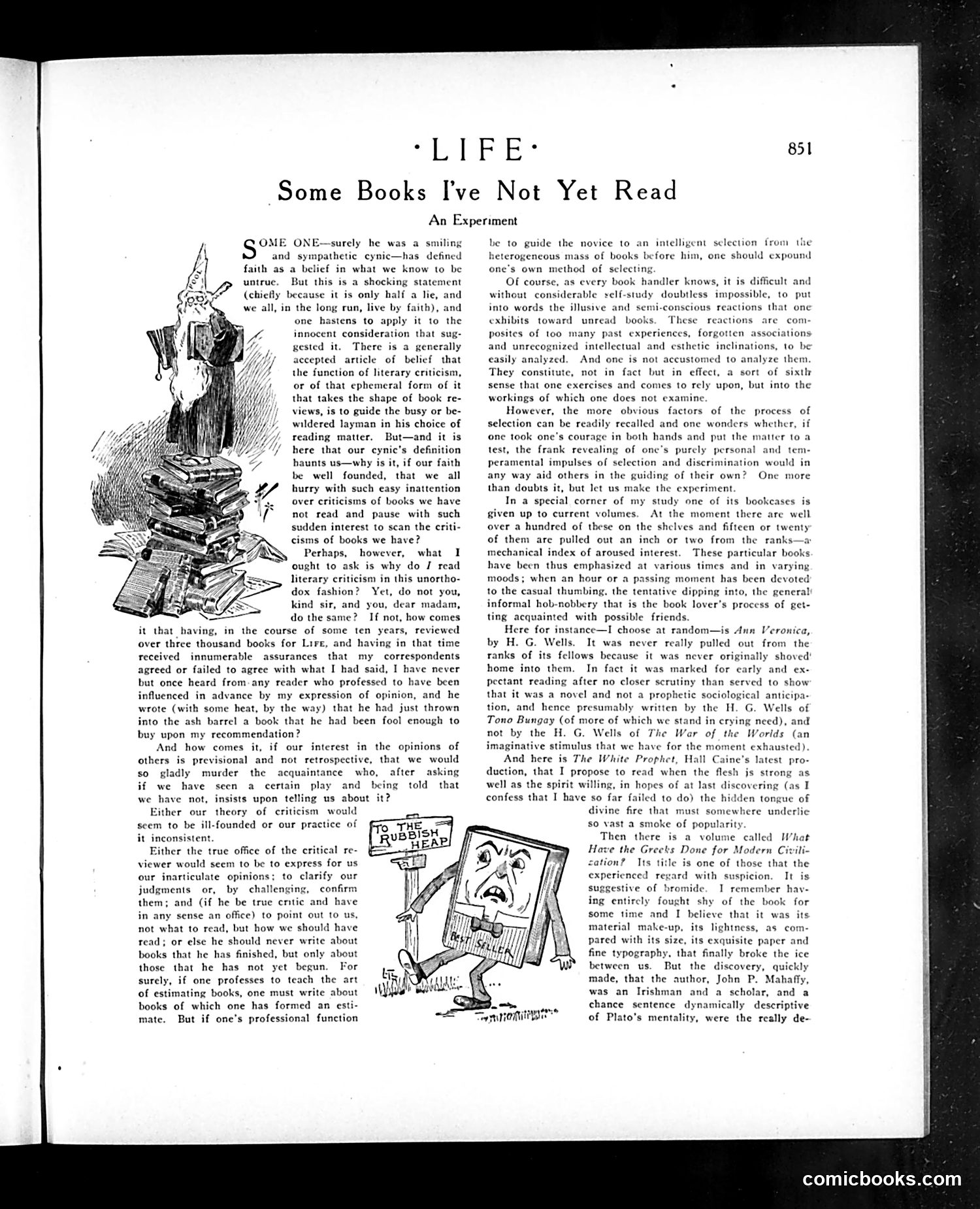
This is a literary criticism essay titled "Some Books I've Not Yet Read: An Experiment" (page 851). The main cartoon depicts a frustrated figure labeled "TO THE LITERARY HEAD" being struck or overwhelmed by a large book—a visual pun on the phrase about books hitting one's head. The essay discusses the author's method for selecting books to read and critiquing unread literature. It's satirizing literary critics who write reviews and opinions about books without actually reading them—a common practice the author observes among book reviewers of the era. The cartoon humorously illustrates this absurdity: a critic literally being "hit" by a book they haven't read, suggesting the pretension and danger of pontificating about literature without genuine engagement.
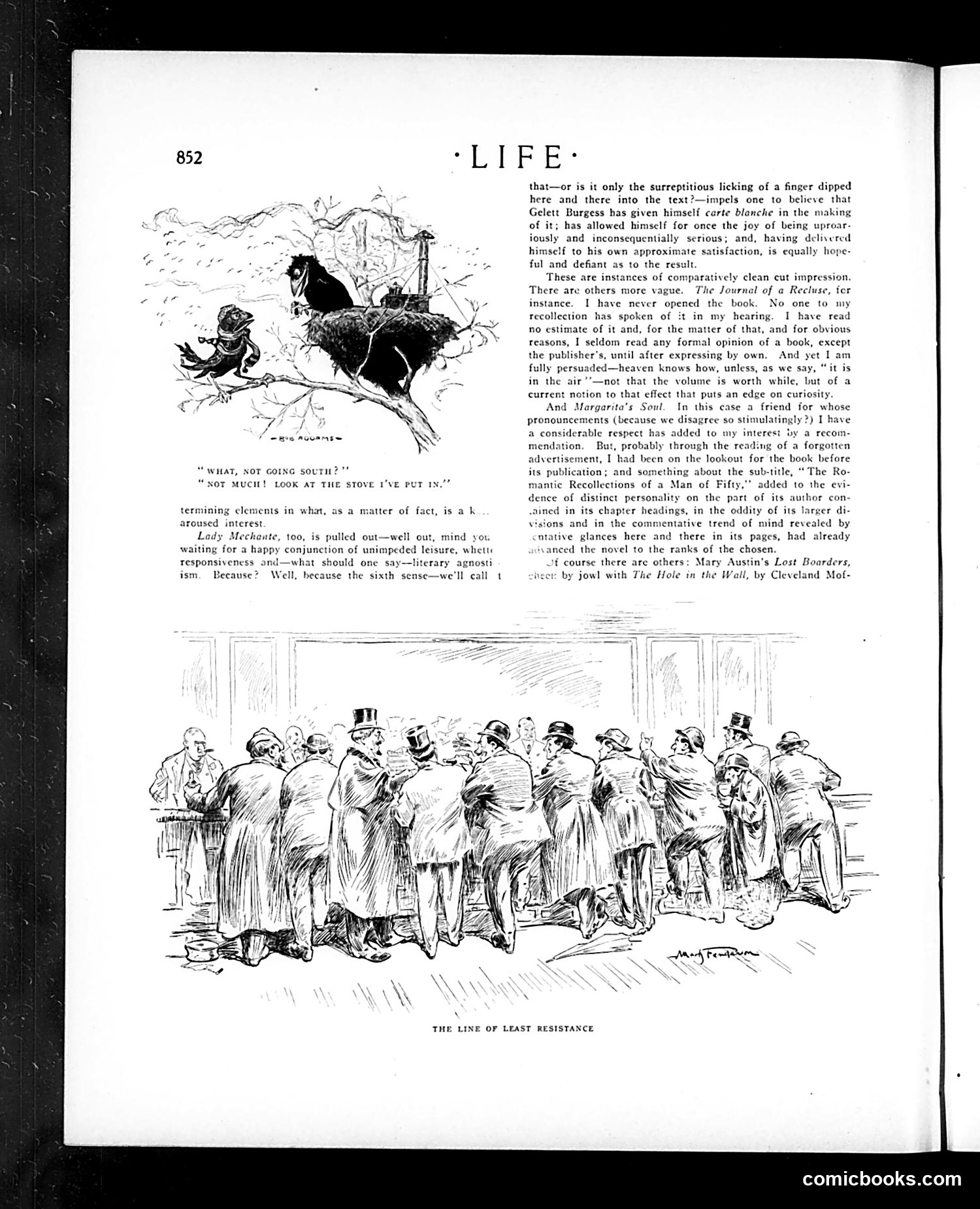
This political cartoon depicts a group of well-dressed men in formal attire (top hats and coats) standing together in what appears to be a queue or gathering. The caption "The Line of Least Resistance" suggests social or political conformity—the figures represent people following the path of least conflict rather than taking principled stands. The upper illustration shows figures in a tree, with dialogue about "going south" and a stove, appearing unrelated or possibly illustrating a separate anecdote. The text discusses literary criticism and book reviews, mentioning *The Journal of a Recluse* and *Margaretta's Soul*. Without additional context about the specific date and political climate, the exact targets of satire remain unclear, though the cartoon likely criticizes institutional conformity or political cowardice.
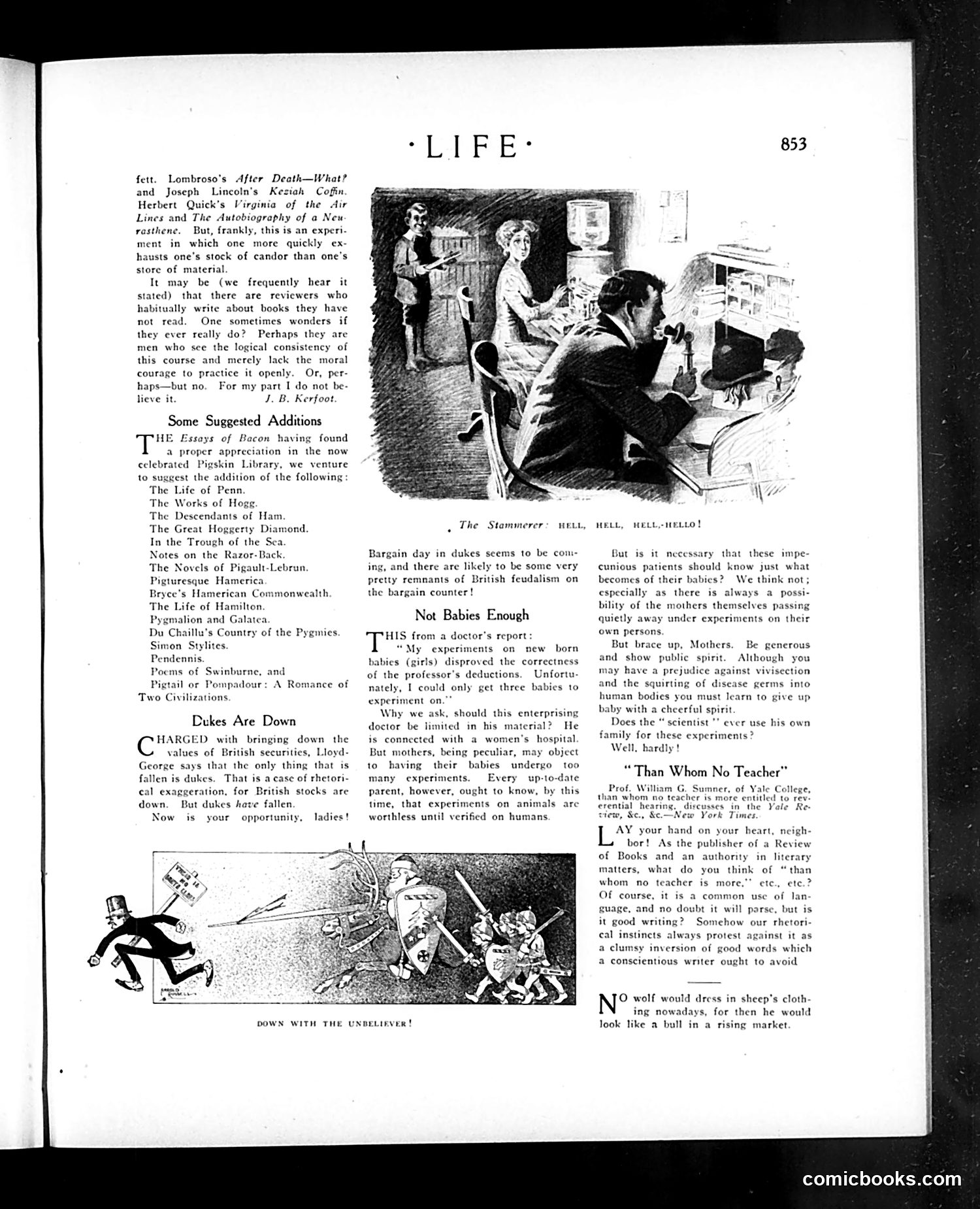
This page contains three satirical sections: **"The Stammerer"** (top cartoon): Shows a woman at what appears to be a bargain counter, with the caption "HELL, HELL, HELL—HELLO!" The joke mocks upper-class women's affected speech patterns—particularly their exaggerated stammering or affected mannerisms during bargain shopping. **"Coles Are Down"** (middle cartoon, captioned "DOWN WITH THE UNBELIEVER!"): Shows a figure being knocked down, likely satirizing stock market fluctuations or economic downturns. The reference to "coles" (coal stocks) suggests this mocks market volatility and financial speculation of the era. **"Than Whom No Teacher"** (right section): A written satirical commentary critiquing the phrase "than whom no teacher" as clumsy language usage, suggesting even educated reviewers resort to awkward constructions. The page reflects early 20th-century satirical humor targeting class affectations, market instability, and linguistic pretension.
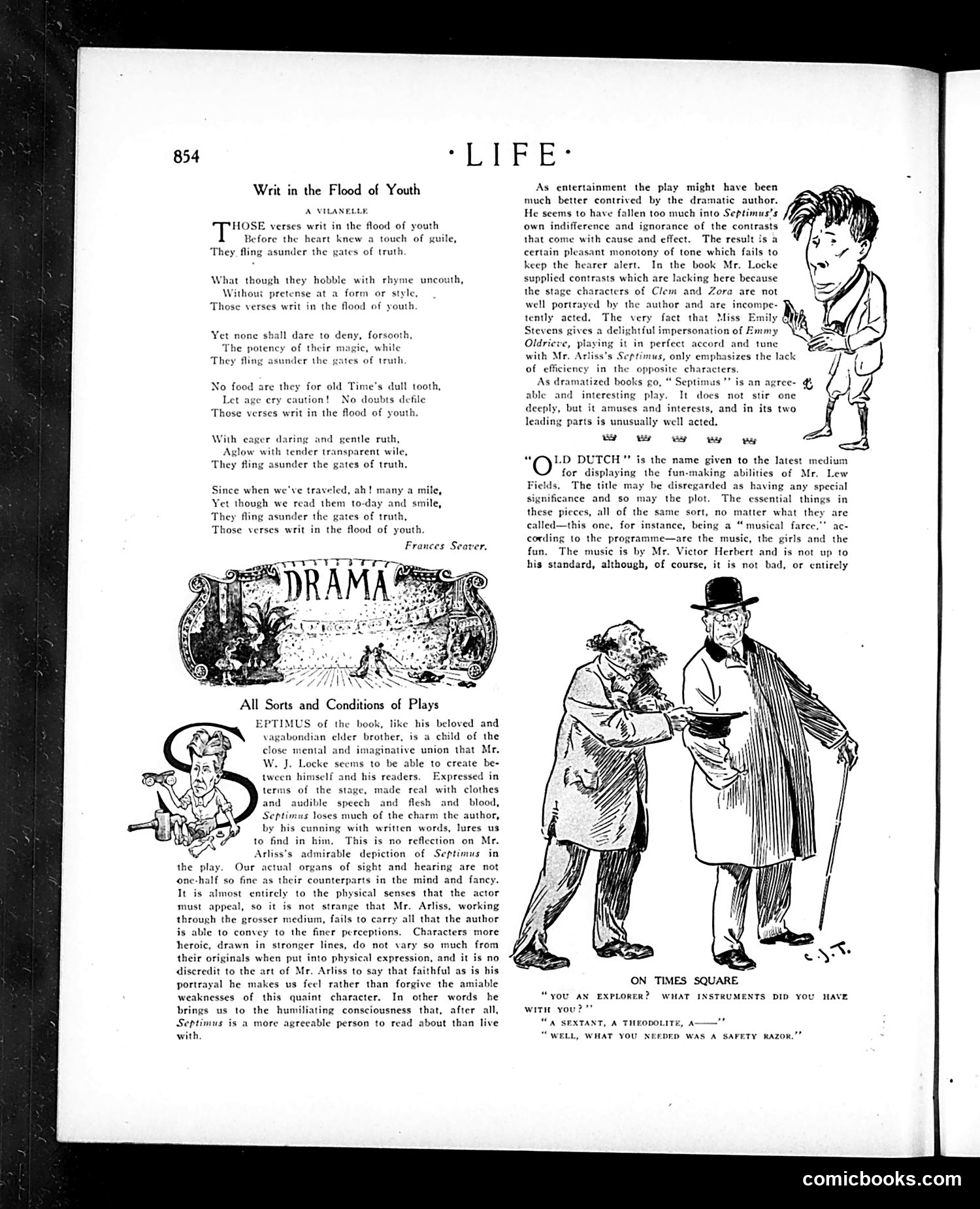
This page contains theatrical reviews from an early 20th-century American magazine. The main content critiques stage adaptations of literary works. The primary review discusses "Septimus," a play based on W.J. Locke's novel, starring actor George Arliss. The critic argues that while Arliss's performance is competent and faithful, the character loses charm in theatrical translation. The review suggests that actors must rely on physical presence and audible speech, which cannot match the imagination readers employ with written prose. Supporting actress Miss Emily Stevens receives praise for her portrayal of Emmy Oldrieve. A secondary review mentions "Old Dutch," a musical farce by Lew Fields featuring music by Victor Herbert. The critic dismisses the plot as unimportant, noting such productions prioritize music, girls, and entertainment over narrative substance. The page also includes a poem, "Writ in the Flood of Youth," a villanelle by Frances Seaver celebrating youthful, unpolished verse.
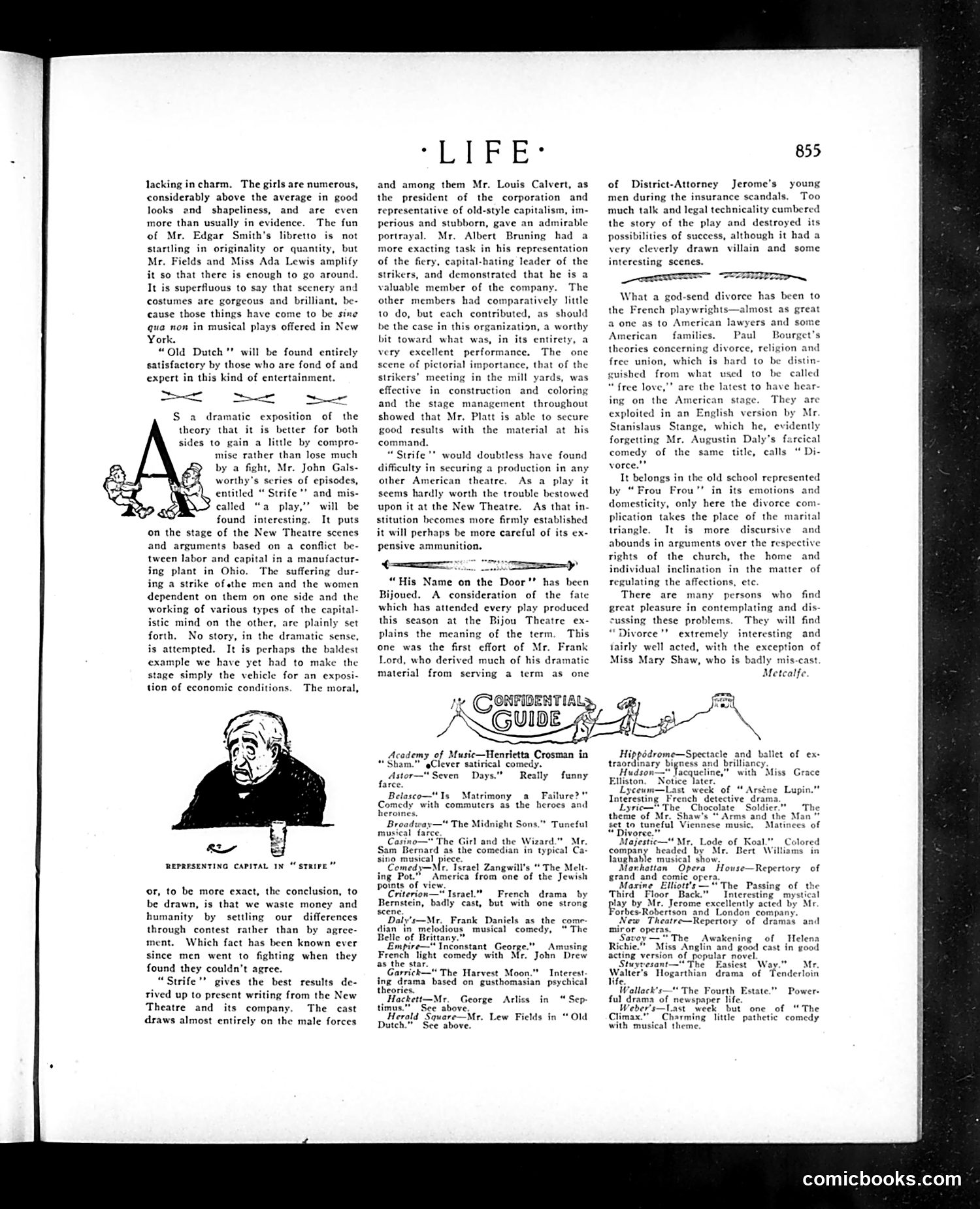
This page reviews theatrical productions, including John Galsworthy's "Strife"—a play about labor-versus-capital conflict in an Ohio manufacturing plant. The accompanying cartoon depicts a stern, older male figure labeled "REPRESENTING CAPITAL IN 'STRIFE.'" This caricatures **Louis Calvert**, who played the corporation president in the production. The exaggerated facial features and severe expression satirize capitalist rigidity and cold indifference to workers' suffering. The review itself critiques the play as more a political **exposition than drama**—essentially a stage debate about economic compromise. The critic notes "Strife" advances no original argument, merely staging the tired moral that violence and conflict waste "money and humanity" compared to negotiation. The satire targets both the play's earnestness and the New Theatre's ambitious but ultimately didactic approach to using drama for social commentary on contemporary class struggle.
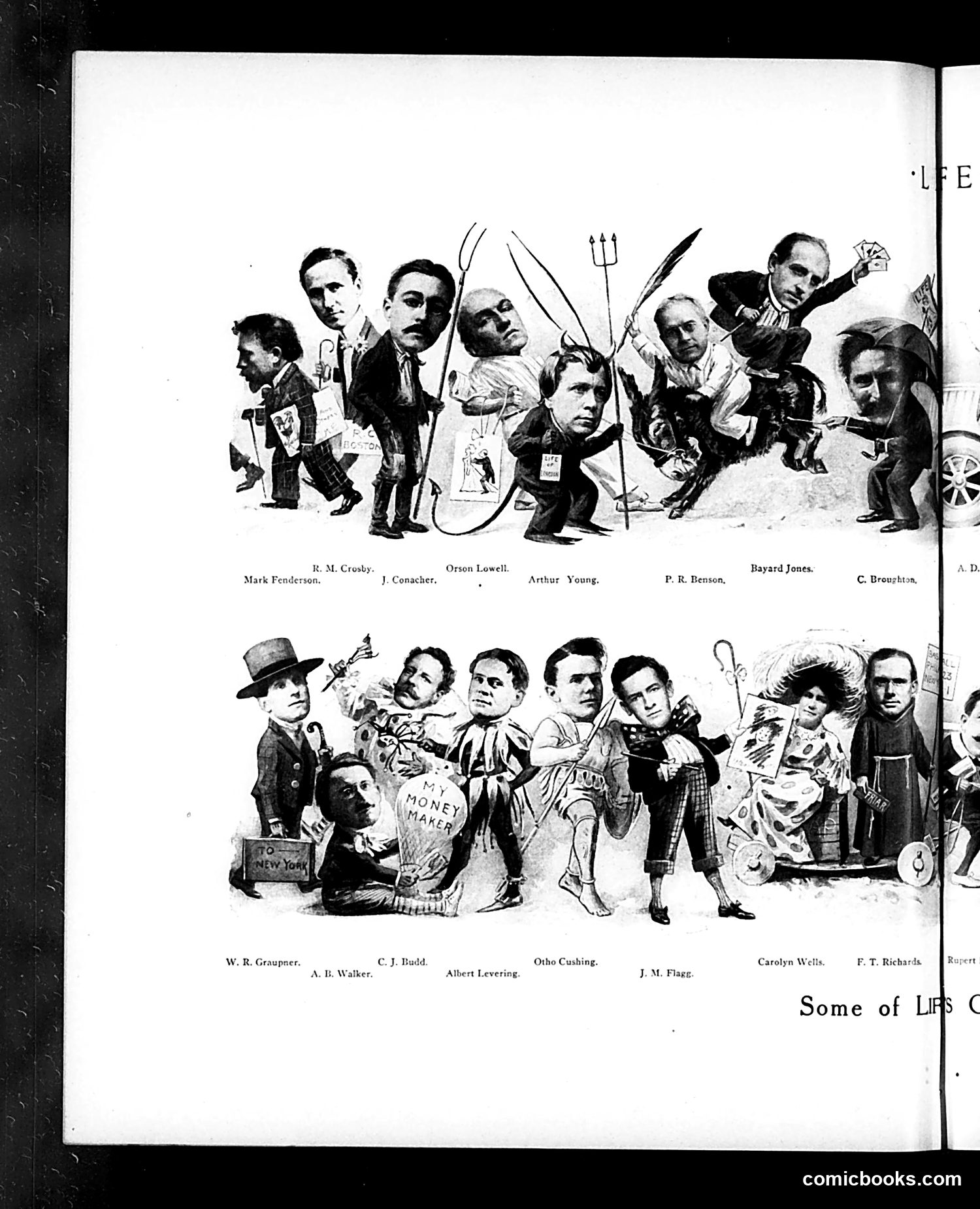
This page from *Life* magazine presents **caricatures of contributors or artists** associated with the publication. The two groups of exaggerated figure drawings show men and women in satirical poses—holding art supplies, money-making implements, and theatrical props—suggesting they represent cartoonists, writers, and illustrators. The caption "Some of LIFE's..." (text cut off) indicates these are portraits of magazine staff or regular contributors. The style is typical of early 20th-century *Life* magazine, which was known for sharp political and social satire. Without the complete caption or publication date visible, the specific satirical point is unclear—whether this celebrates contributors, mocks their pretensions, or comments on the magazine's editorial direction. The theatrical poses and exaggerated features suggest gentle mockery of artistic types, common in *Life's* self-referential humor.
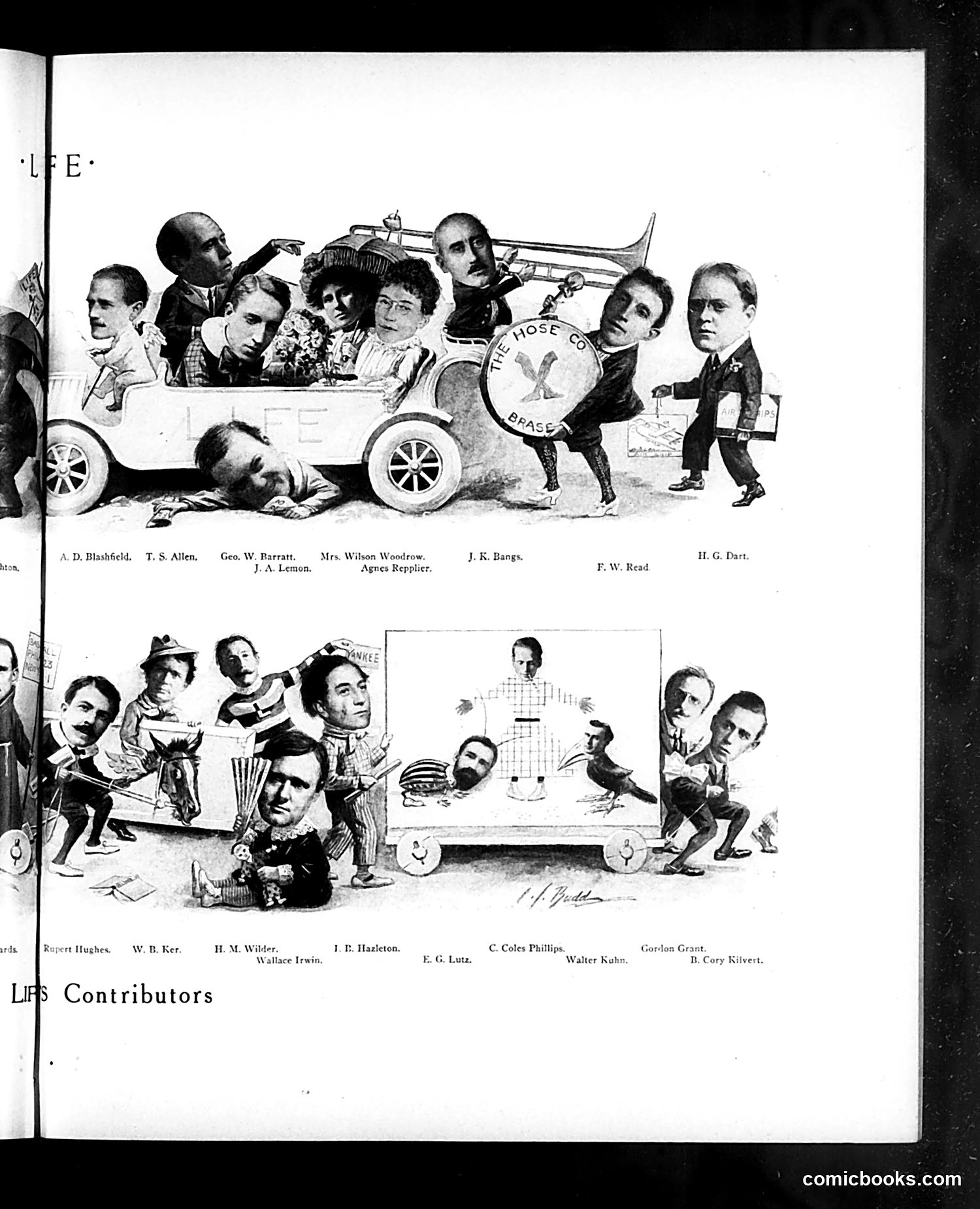
This is a masthead page identifying contributors to *Life* magazine. The cartoons are caricatures of the listed writers, artists, and editors—likely from the early 1900s based on style. The top cartoon shows contributors cramped into a vehicle labeled "Fire Hose Co. Brass," satirizing the chaotic creative process of producing the magazine. The bottom illustration depicts them in various poses around what appears to be a printing or editorial setup. The humor derives from exaggerating these real people's distinctive features and personalities, presenting them as a chaotic collective enterprise. This was typical of *Life's* self-referential satire about its own staff and operations. The specific individuals named are contributors and editors whose work appeared in the magazine, though most are not widely remembered today.
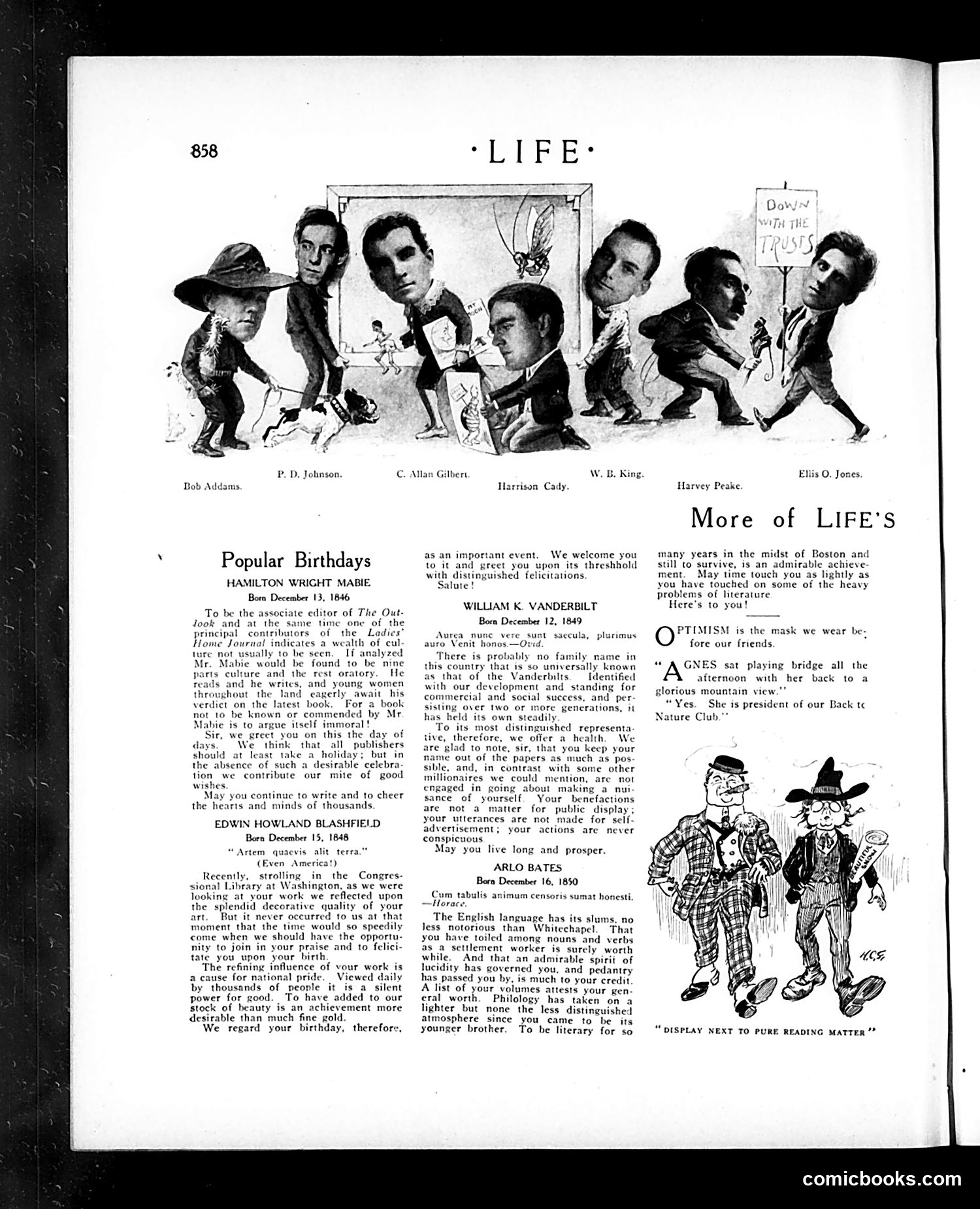
This page celebrates notable American cultural figures' birthdays through satirical birthday greetings and caricatures. The top shows exaggerated cartoon portraits of seven men identified as Bob Addams, P.D. Johnson, C. Allan Gilbert, Harrison Cady, W.B. King, Harvey Peake, and Ellis O. Jones—likely prominent illustrators or cultural figures of the era. The main text offers mock-formal birthday tributes to Hamilton Wright Mabie (editor/literary critic), Edwin Howland Blashfield (muralist/decorator), William K. Vanderbilt (wealthy industrialist), and Arlo Bates (professor/philologist). The humor lies in inflated, reverent language applied to these men—praising their cultural refinement, taste-making power, and moral influence while subtly mocking their pretensions. The bottom includes two satirical observations about contemporary life: one criticizing women who ignore nature for social activities, the other—an inside joke about someone named Agnes who leads a "Back to Nature Club" while actively avoiding natural scenery.
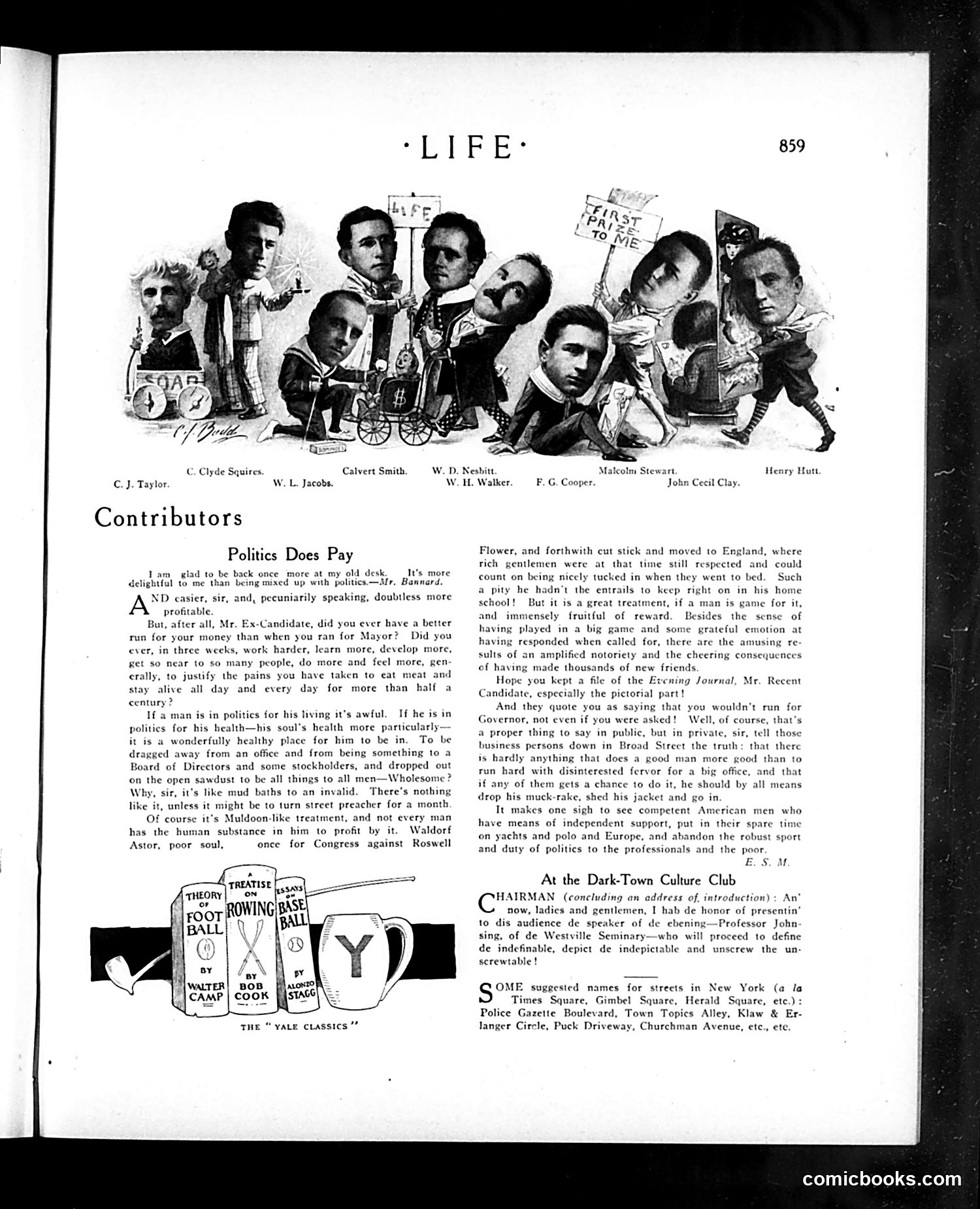
This page contains two satirical pieces: **"Politics Does Pay"** critiques a recent mayoral candidate (likely NYC, given references to Broad Street). The dialogue mocks the candidate's public virtue-signaling—claiming he wouldn't run for Governor—while the author suggests wealthy, idle men should actually engage in politics rather than leisure pursuits. The piece sarcastically praises political campaigns as character-building, contrasting the candidate's dignified retreat with the "robust sport" of public service. It's social commentary on wealthy Americans avoiding civic duty. **"At the Dark-Town Culture Club"** uses racist dialect humor (common in 1910s publications) featuring a Black chairman introducing a professor who will explain "de indefinable" and "unscrew the unscrewable"—mocking pseudo-intellectual pretension through exaggerated language and malapropism. The bottom section humorously proposes New York street names after publications (Police Gazette Boulevard, Puck Driveway), satirizing commercialism and media culture.
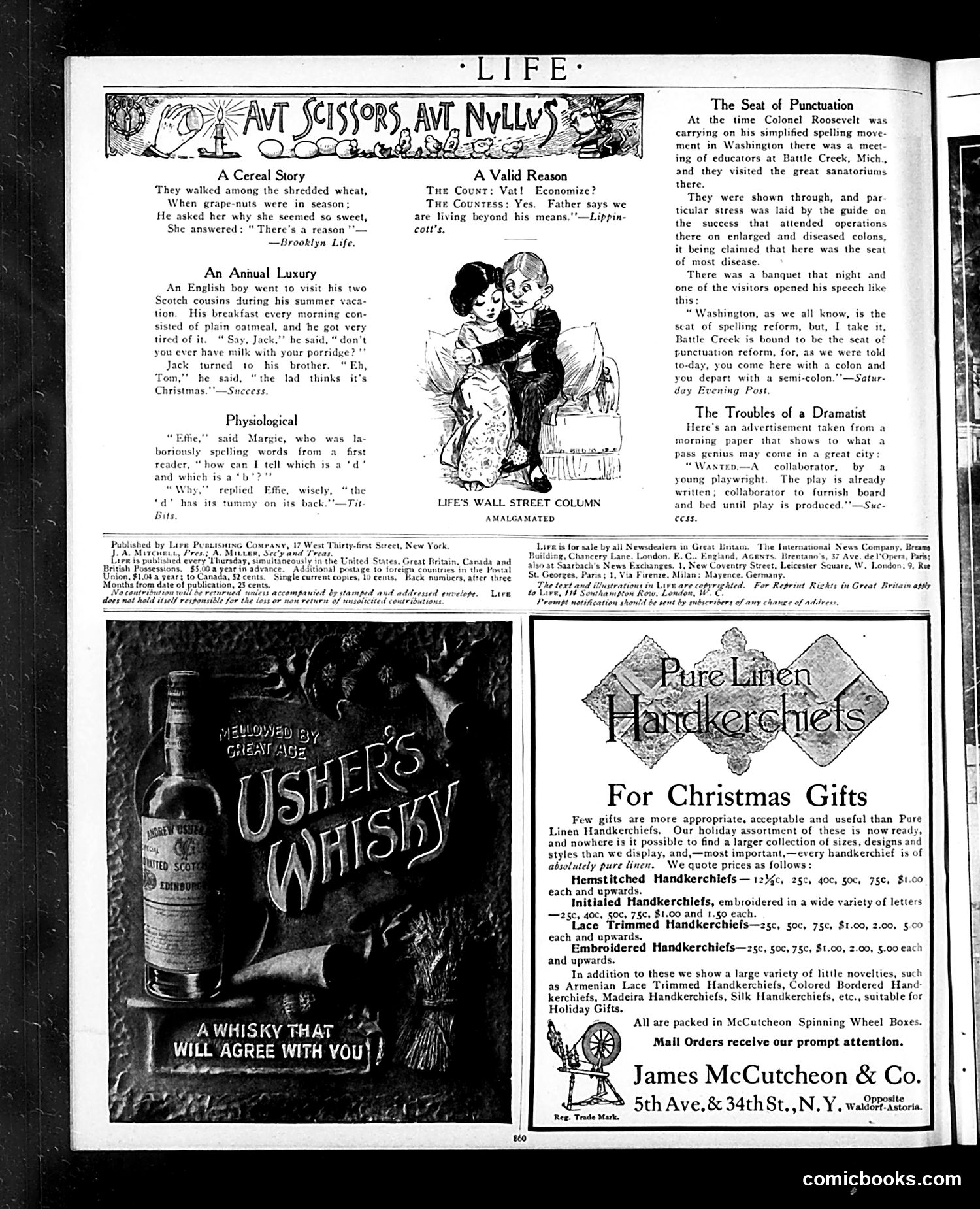
This page from Life magazine contains several short humorous pieces satirizing American society around the Progressive Era (early 1900s). **Main Content:** The cartoons and jokes mock contemporary absurdities: grain cereal marketing ("There's a reason"), class pretension among European nobility, Scottish frugality, and spelling reform—likely referencing President **Theodore Roosevelt's actual push for simplified spelling** in Washington. **Key Social References:** "The Seat of Punctuation" directly satirizes Roosevelt's spelling reform movement by suggesting Battle Creek sanitarium's focus on treating colons becomes metaphorically the "seat of punctuation reform"—a pun linking bodily and grammatical correction. Other pieces humorously contrast British and Scottish culture, children's literacy, and even mock theatrical desperation (a playwright seeking free room-and-board from a collaborator). **The Satire:** Life uses these brief anecdotes to gently ridicule contemporary fads, political initiatives (spelling reform), social pretension, and economic anxiety—typical of early 20th-century satirical magazines targeting educated middle-class readers. The advertisements for handkerchiefs anchor the page commercially.
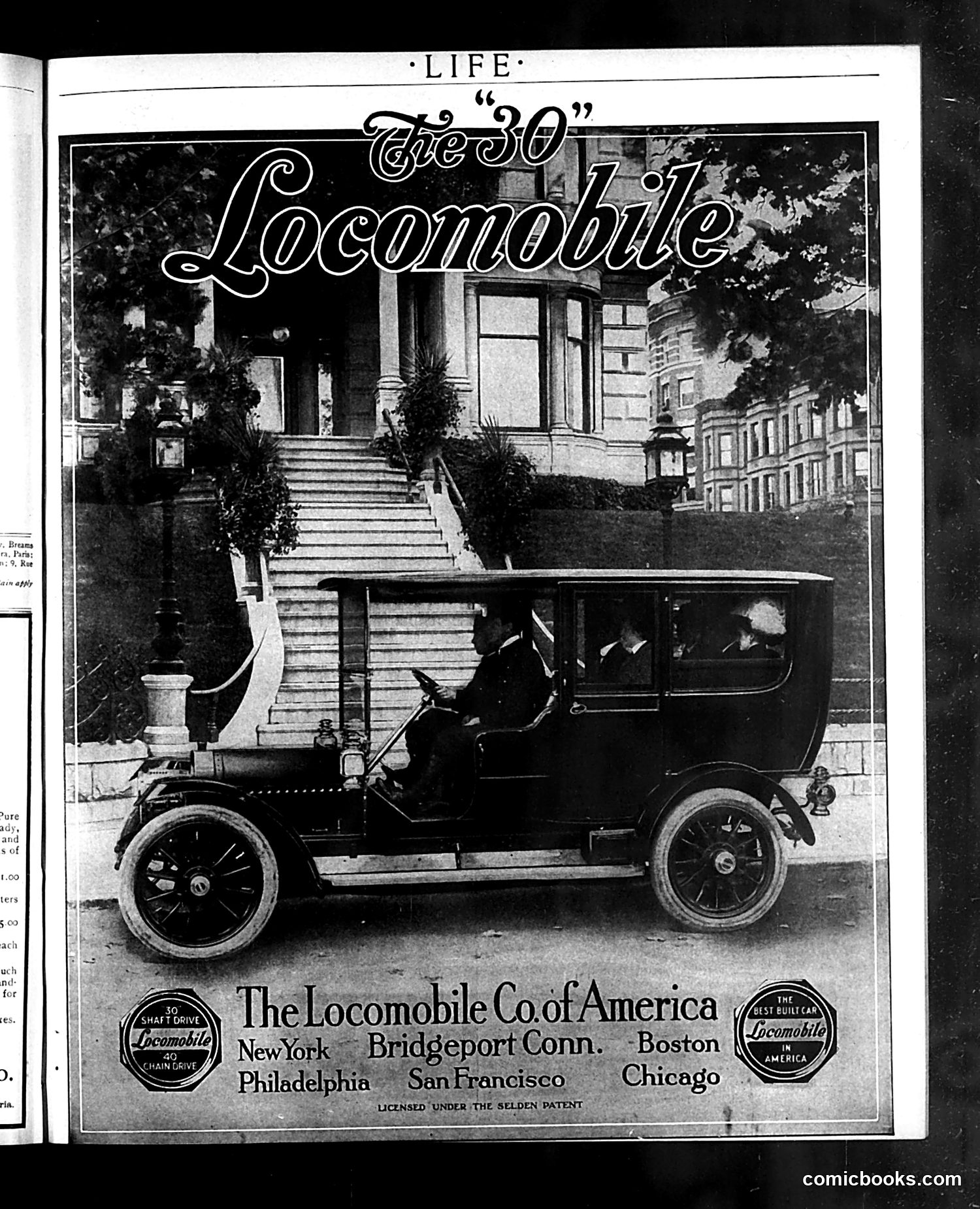
This is a full-page advertisement for the Locomobile Company of America, not political satire. The image shows a "30" model automobile parked before an elegant mansion with grand steps, driven by well-dressed passengers. The advertisement emphasizes luxury and status—the car is presented as an upper-class vehicle suitable for the wealthy. Text lists the company's offices in major cities: New York, Bridgeport Connecticut, Boston, Philadelphia, San Francisco, and Chicago. The decorative badges reference "Shaft Drive" and "Best Built Car in America," highlighting mechanical features meant to appeal to affluent buyers. This appears from a period when automobiles were luxury goods, and advertising focused on elegance and exclusivity rather than mass-market appeal.
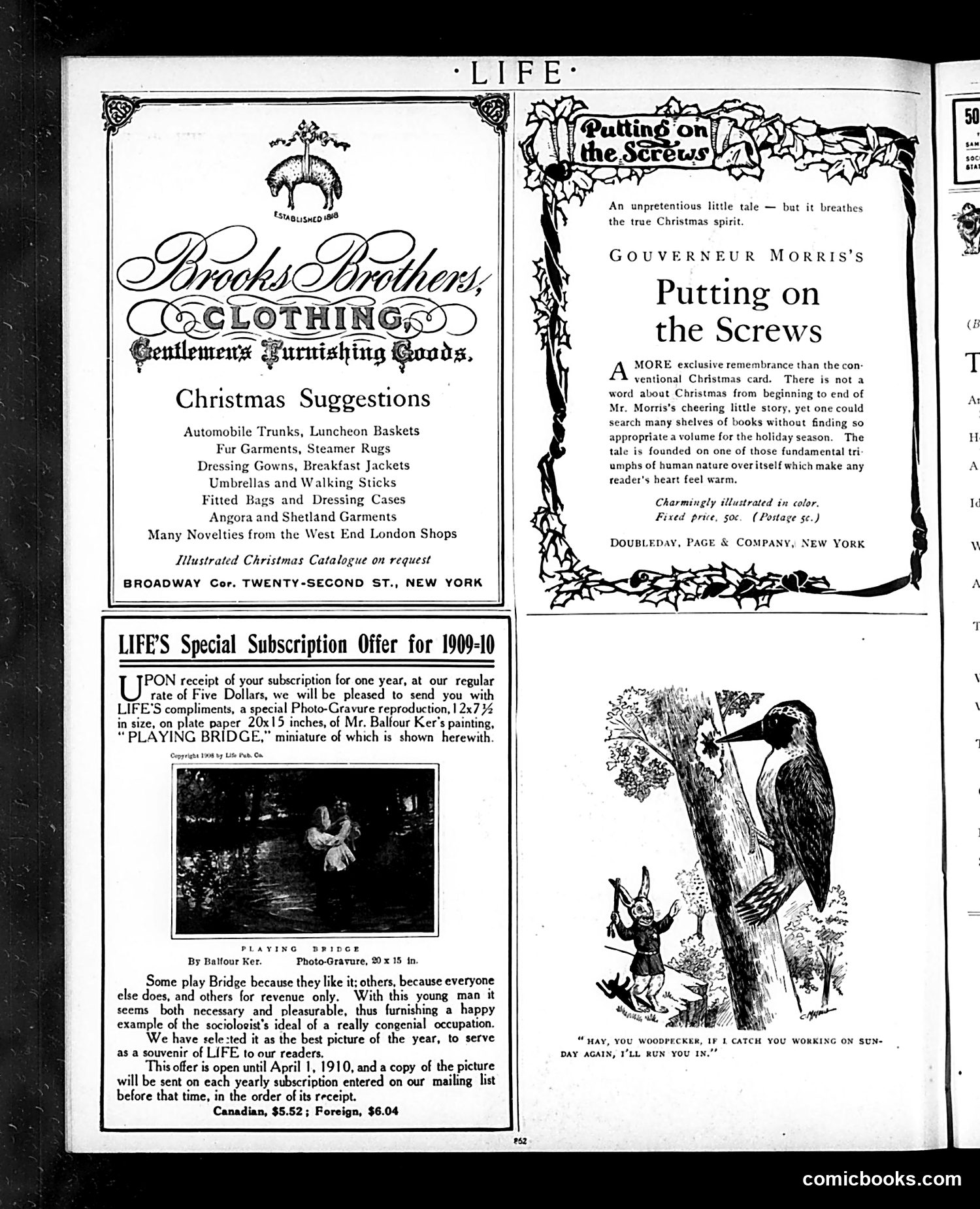
This page is primarily **advertising and promotional content** rather than political satire. The main elements are: 1. **Brooks Brothers ad** for Christmas gifts (top left) — straightforward luxury goods advertising. 2. **Life's subscription offer** (center) — promoting a year's subscription at $5 for 1909-10, with a free photogravure reproduction of a painting titled "Playing Bridge" by Balfour Ker. The accompanying text humorously notes the young man in the painting plays bridge because it's both "necessary and pleasurable." 3. **Book promotion** (right) — advertising Gouverneur Morris's story "Putting on the Screws," described as appropriate Christmas reading despite containing no Christmas references. 4. **Cartoon** (bottom right) — a small, unclear humorous illustration showing a woodpecker being threatened by someone claiming they'll "run you in" for working on Sunday. This appears to be a joke about labor laws or religious observance, but the specific reference is unclear from the image alone. The page reflects early 1900s consumer culture and leisure activities among the affluent.
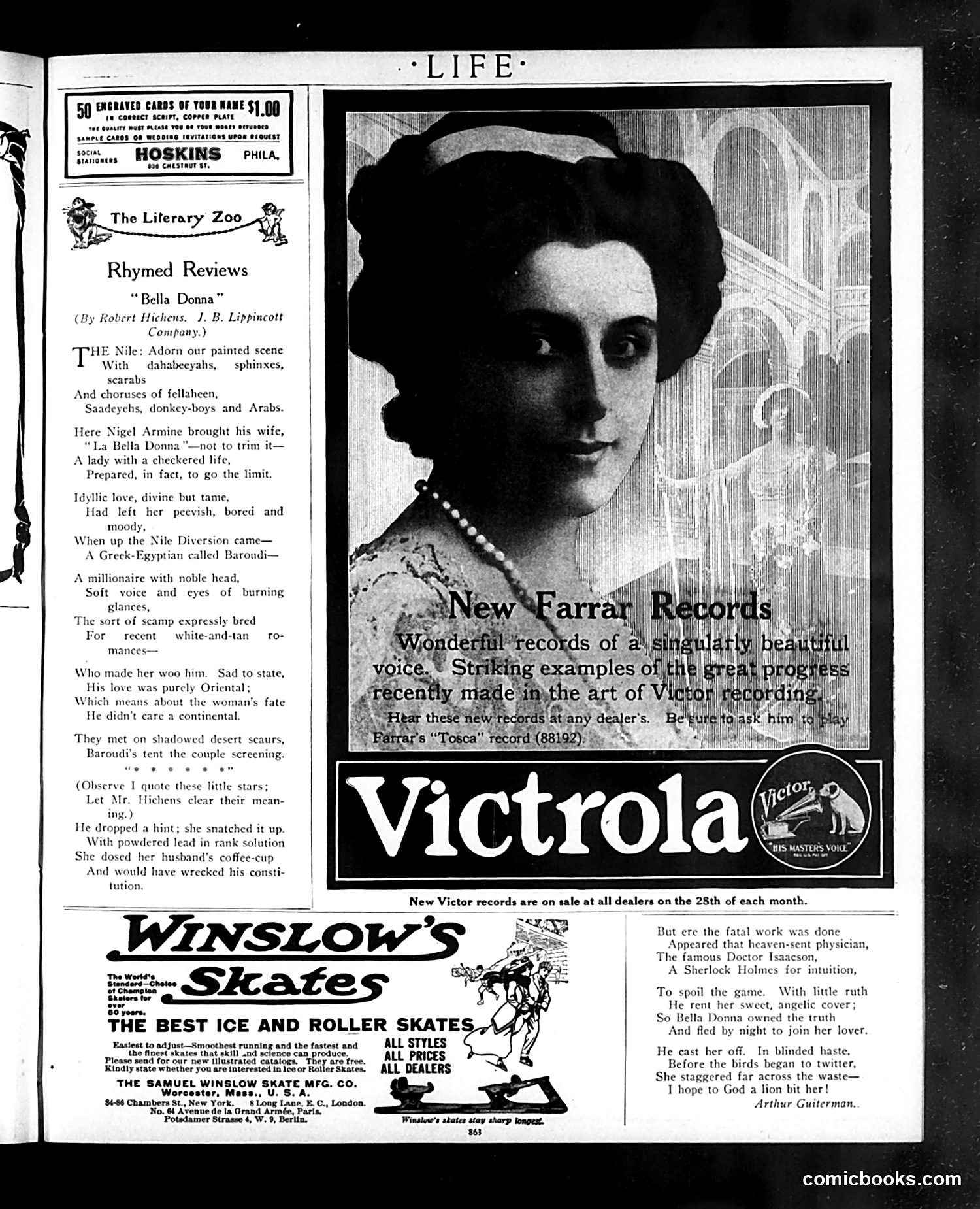
This page is primarily **advertising and literary content**, not political satire. The main feature is a **rhymed book review** of "Bella Donna" by Robert Hichens, a novel set on the Nile River. The reviewer, Arthur Guiterman, summarizes the melodramatic plot in verse: a bored English wife (Bella Donna) travels to Egypt, meets a wealthy Greek-Egyptian man named Baroudi, poisons her husband's coffee, but is thwarted by a clever doctor (Dr. Isaacson). She flees into the desert, and the reviewer wickedly hopes a lion kills her. The satire here targets the **popular romantic novel itself**—its exotic colonial setting, morally compromised characters, and overwrought drama. Guiterman's cynical ending mocks the book's sensationalism. The page also contains period **product advertisements**: Hoskins business cards, Victrola records (featuring an operatic singer), and Winslow skating equipment. These reflect early 20th-century consumer marketing. There is no political commentary visible on this page.
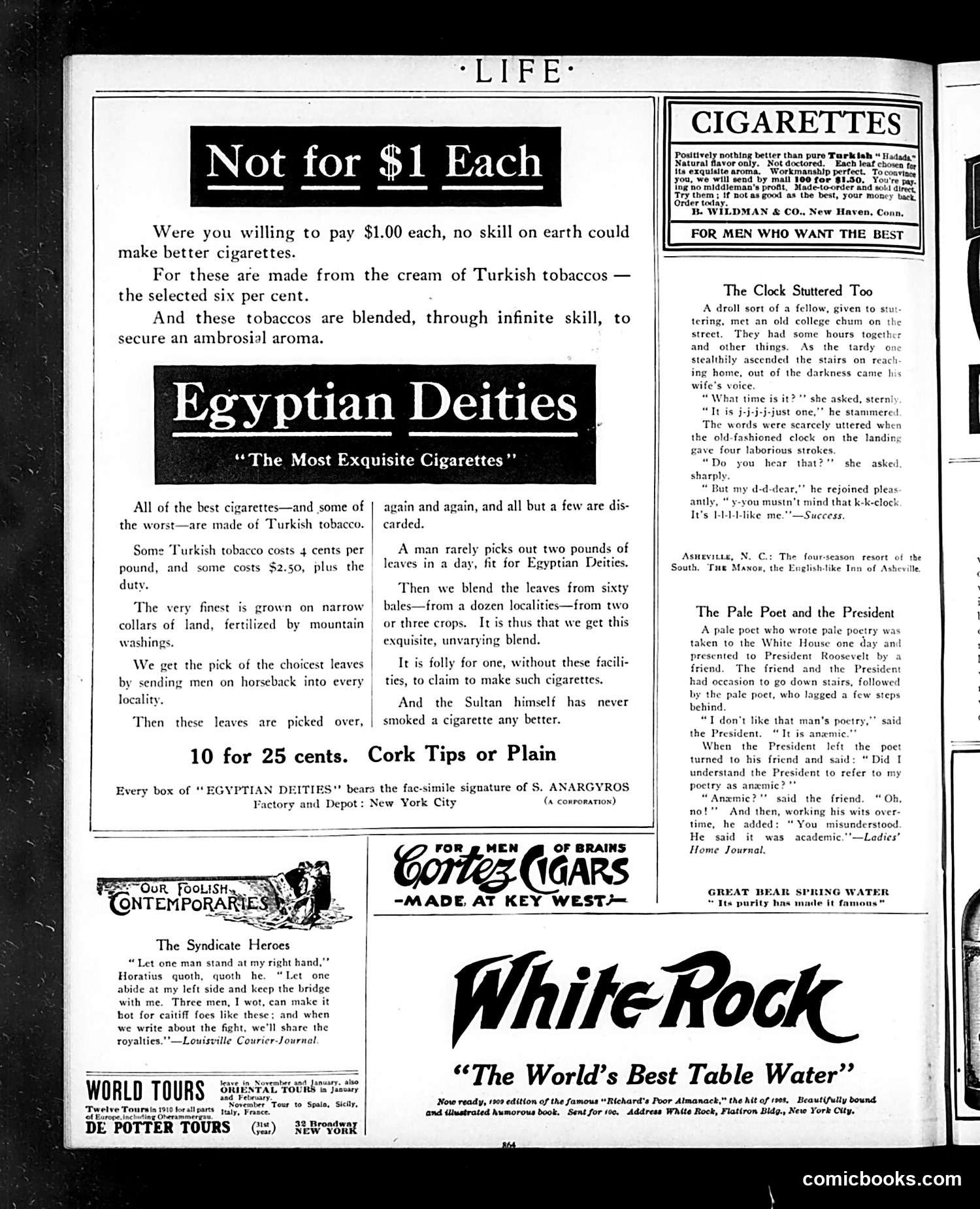
This page is primarily **advertisements** interspersed with humorous short stories, typical of Life magazine's format. The main content advertises **Egyptian Deities cigarettes**, emphasizing their superior quality from Turkish tobacco and handcrafted blending—a sales pitch common in early 1900s advertising before health warnings existed. The cartoons/stories are brief satirical anecdotes: 1. **"The Clock Stuttered Too"**: A husband who stutters comes home late; his wife complains about a stuttering clock. The joke plays on the homophone/rhythm of his stutter matching the clock's chimes. 2. **"The Pale Poet and the President"**: A pale poet meets President Roosevelt (likely Theodore Roosevelt, given the era). When TR dismisses the poetry as "anaemic," the friend reinterprets it as "academic" to save face—satirizing both pretentious poetry and diplomatic smoothing-over. 3. **"The Syndicate Heroes"**: References Horatius from Roman legend, joking that modern writers would demand royalty shares for heroic stories—commentary on commercialism. These are lightweight humor pieces typical of the era's magazine entertainment.
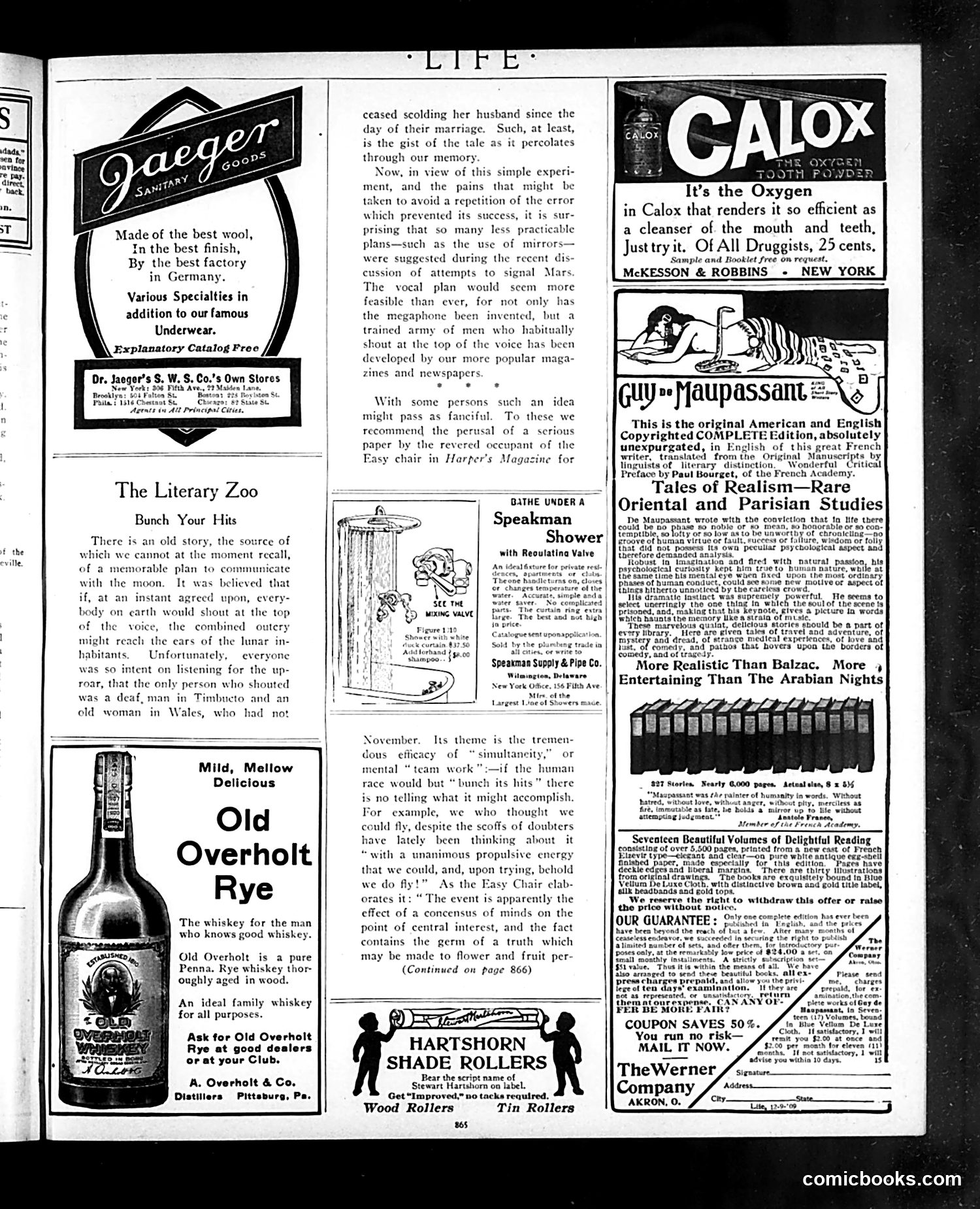
This page is primarily **advertising and literary promotion** rather than political satire. Key content includes: **"The Literary Zoo" article**: A humorous piece about an old legend where people attempt to communicate with the moon by having everyone shout simultaneously. The joke critiques the implausibility of such plans—only a deaf man in Timbuktu and an old Welsh woman actually shout. It's lighthearted satire on human foolishness and impractical schemes. **Advertisements dominate**: Jaeger underwear, Old Overholt Rye whiskey, Calox tooth powder, Hartshorn Shade Rollers, and notably a lengthy promotion for Guy de Maupassant's complete works, emphasizing his "realistic" French literary approach to human nature. **Social context**: Early 20th-century consumer culture mixed with highbrow literary aspirations—readers could buy both practical goods and claim sophistication through owning "unexpurgated" French literature. The page reflects period attitudes toward morality (marketing "complete" Maupassant as daring) and consumerism rather than political commentary.
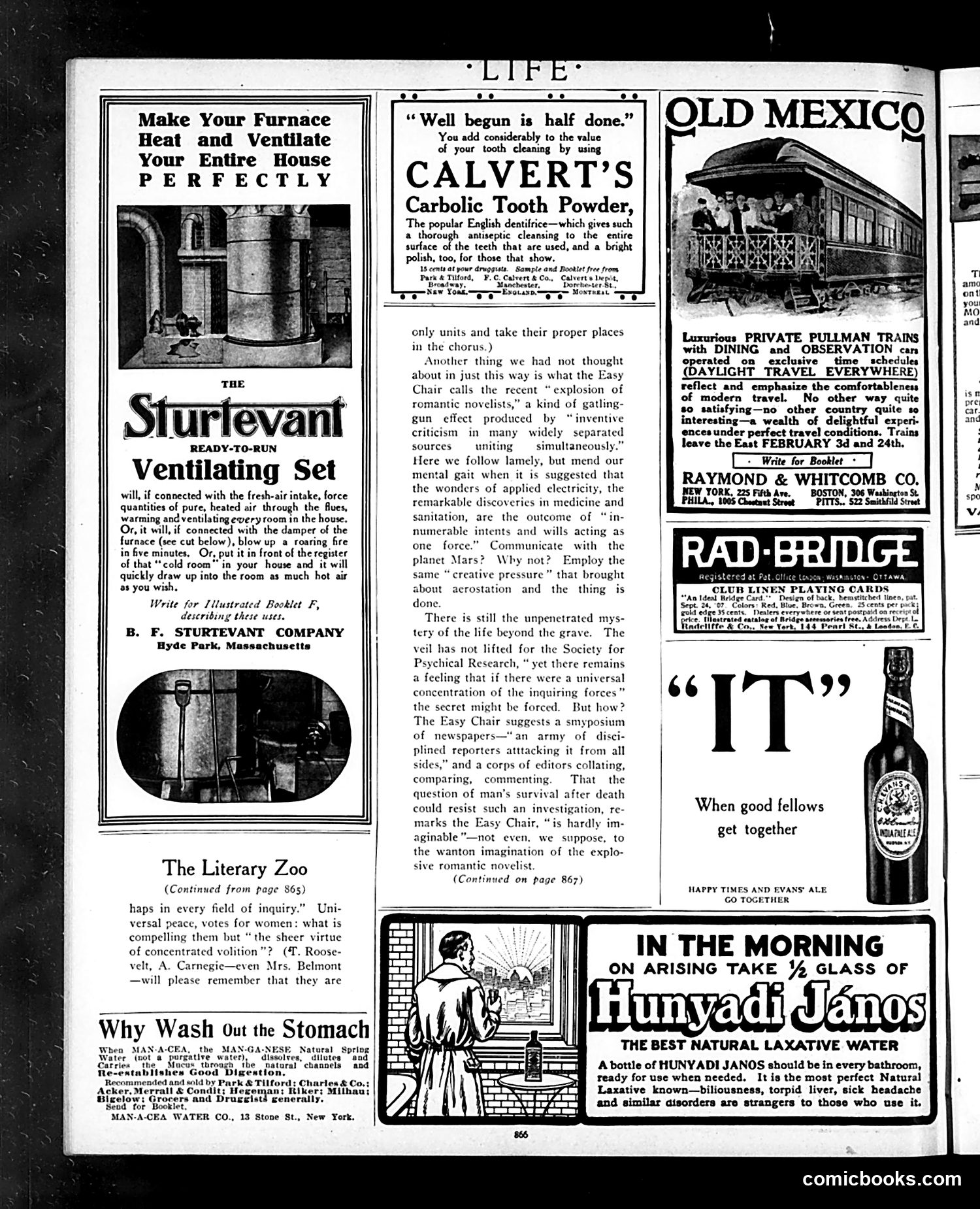
This is primarily an **advertising page** from Life magazine, circa early 1900s. The content consists almost entirely of commercial advertisements with minimal editorial material. The only substantive editorial text is "The Literary Zoo" (continued from page 865), which satirizes contemporary intellectual trends. The Easy Chair column mocks the "explosion of romantic novelists" and facetiously suggests that newspapers could solve the mystery of life after death through coordinated investigative effort—a jab at both sensationalist journalism and the Society for Psychical Research's earnest spiritualist investigations. The advertisements reflect period concerns: furnace ventilation systems, tooth powder (antiseptic cleaning was novel), Pullman train travel, and natural laxatives. These ads offer historical insight into early 20th-century consumer anxieties about hygiene, comfort, and digestive health. The page contains no political cartoons or caricatures—it is fundamentally a commercial publication.
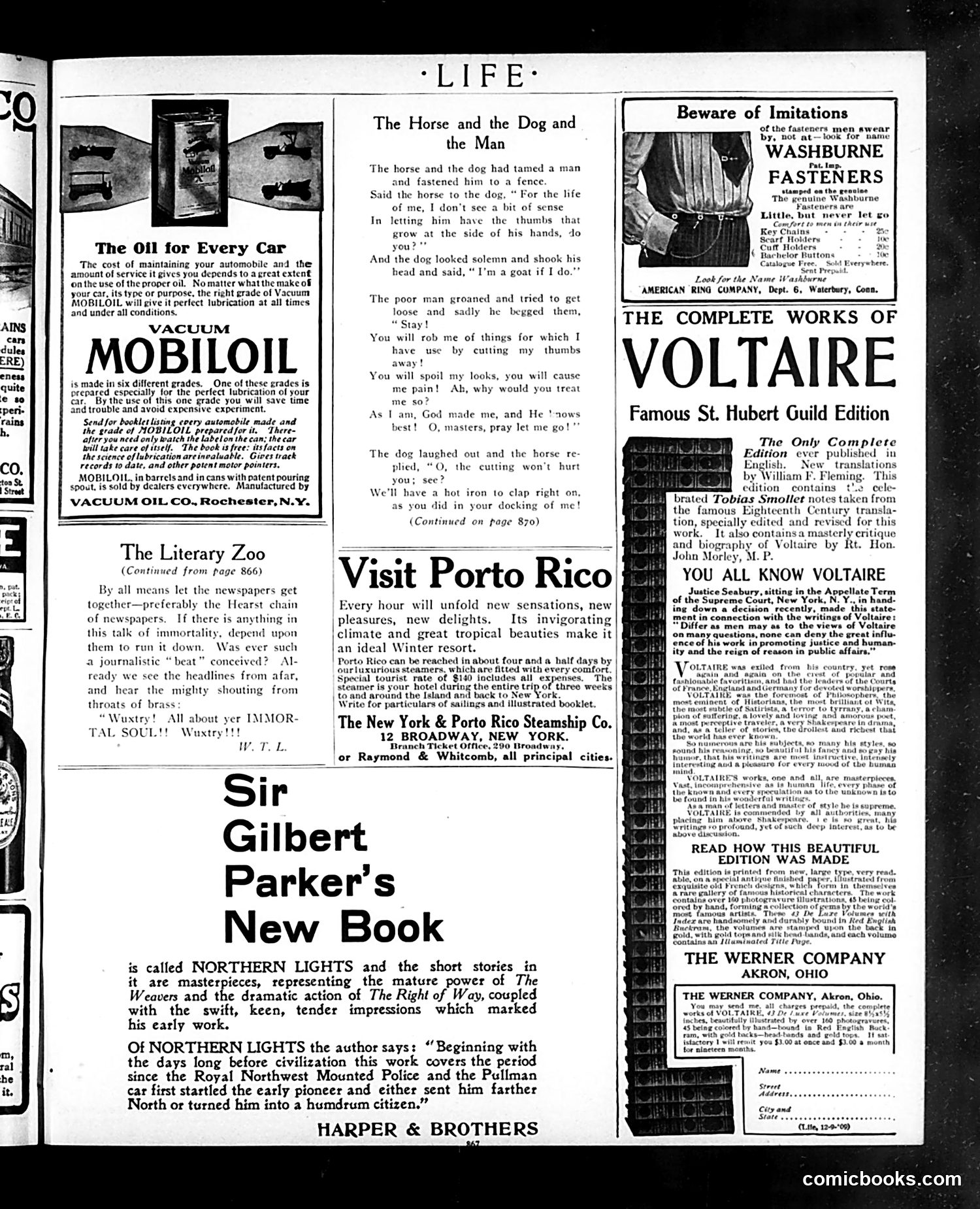
This page is primarily **advertising and book promotion** rather than political satire or comics. The main content includes: **"The Horse and the Dog and the Man"** (top center): A fable-style narrative where two animals debate removing a man's thumbs as revenge for his species docking their tails. The moral appears to satirize **hypocrisy and revenge cycles**—the animals justify cruelty by citing prior mistreatment, suggesting the absurdity of perpetual retaliation. **"The Literary Zoo"** (left side): A brief satirical piece mocking sensationalist journalism, specifically the Hearst newspaper chain, for chasing stories about immortality with exaggerated headlines ("Wuxtry!"). **Advertisements dominate the page**: promoting Vacuum Mobiloil motor oil, Porto Rico tourism, Washburne fasteners, and notably, the "Complete Works of Voltaire" in a St. Hubert Guild Edition. The Voltaire advertisement emphasizes this as the only complete English translation, suggesting early-20th-century literary marketing to educated middle-class readers.
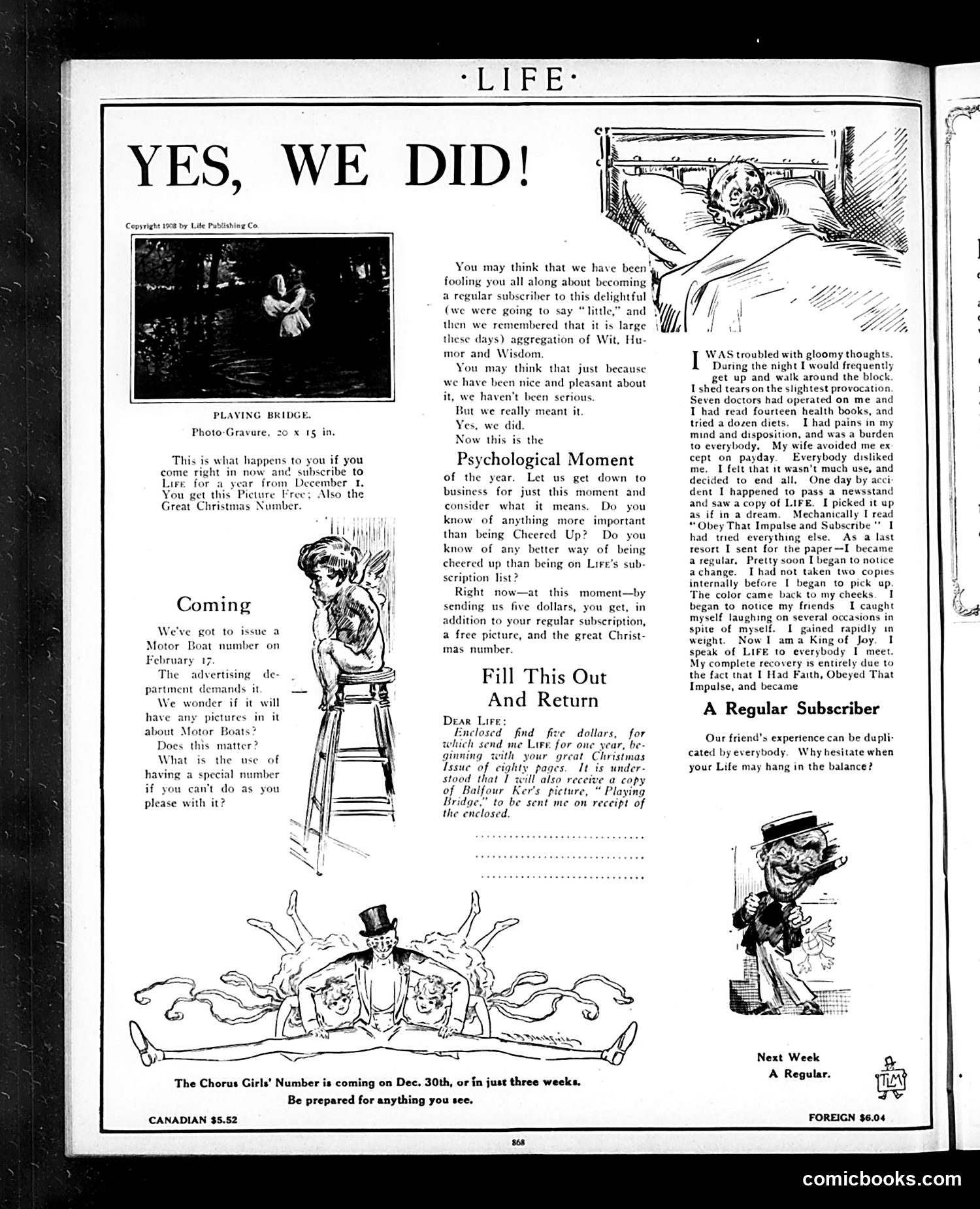
This page is a satirical advertisement disguised as editorial content. The masthead "YES, WE DID!" announces Life's subscription campaign, offering a free photogravure artwork titled "Playing Bridge" (showing a woman in bed) to new subscribers paying five dollars for a year's subscription, beginning with the Christmas issue. The humor operates on multiple levels: Life mocks its own aggressive advertising while simultaneously executing that very campaign. The "Psychological Moment" section sarcastically positions subscription as a cure for depression—a parody of exaggerated medical advertising of the era. The testimonial from a supposed "Regular Subscriber" describing how reading Life cured his suicidal thoughts and gloomy disposition is absurdist satire, explicitly mocking the testimonial advertising style common in contemporary publications. The page also teases upcoming special issues (Motor Boat, Chorus Girls' Number), maintaining reader interest. Overall, this exemplifies Life's satirical house style: self-aware, tongue-in-cheek mockery of commercial culture while participating in it.
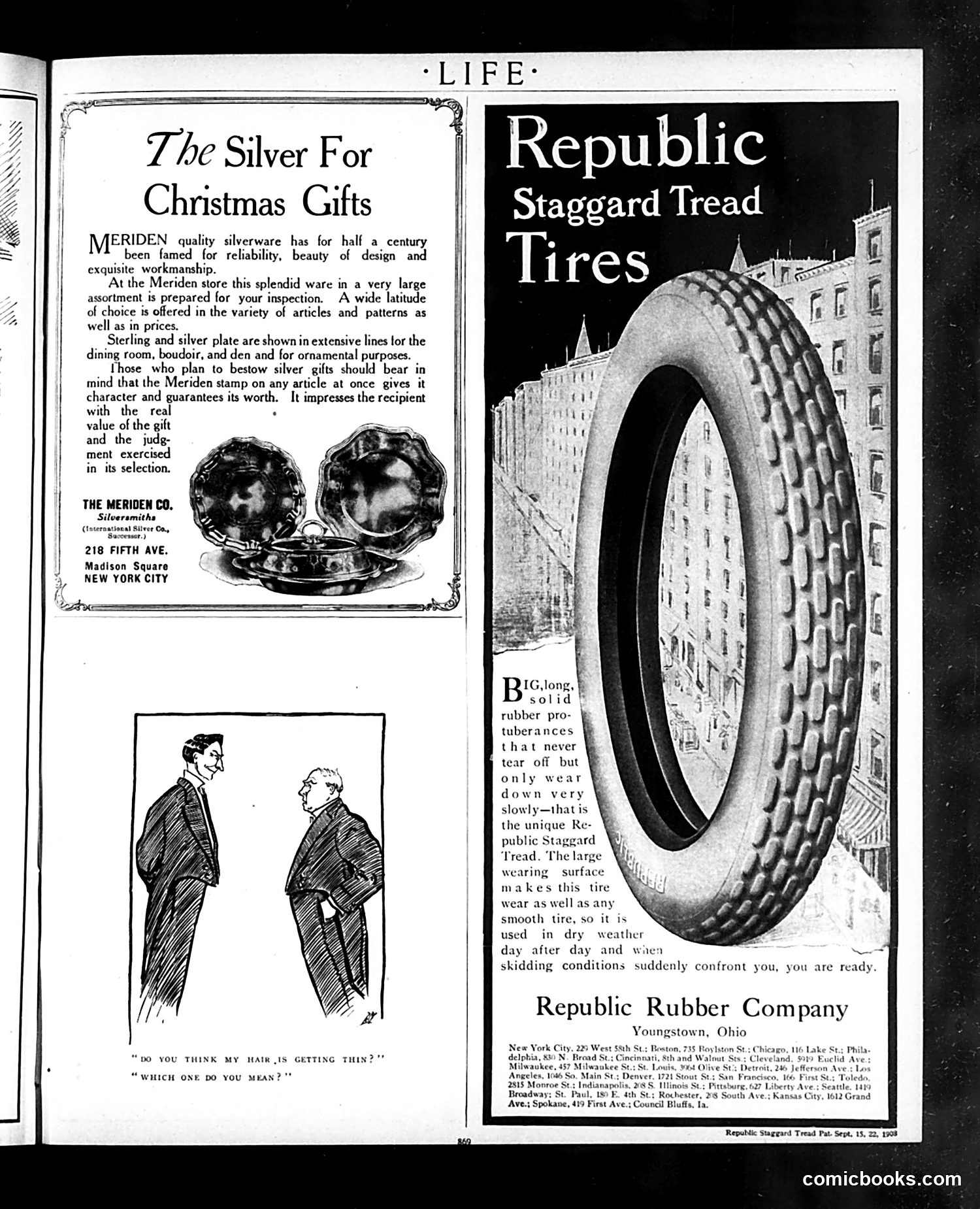
This page contains two separate advertisements and one small cartoon. **The Cartoon (center-left):** Two men face each other in profile. One asks, "Do you think my hair is getting thin?" The other replies, "Which one do you mean?"—implying the first man's hair loss is so severe it's ambiguous which area he's referring to. This is straightforward hair-loss humor, common in early 20th-century publications. **The Advertisements:** The left side promotes Meriden silverware as Christmas gifts, emphasizing quality and the prestige of the maker's stamp. The right side advertises Republic Staggard Tread Tires, highlighting their durable rubber treads that resist tearing and provide safety in various weather conditions. Both ads represent typical early-1900s consumer marketing, targeting middle-class gift-givers and automobile owners. The satire magazine *Life* intermixed such advertisements with humorous content.
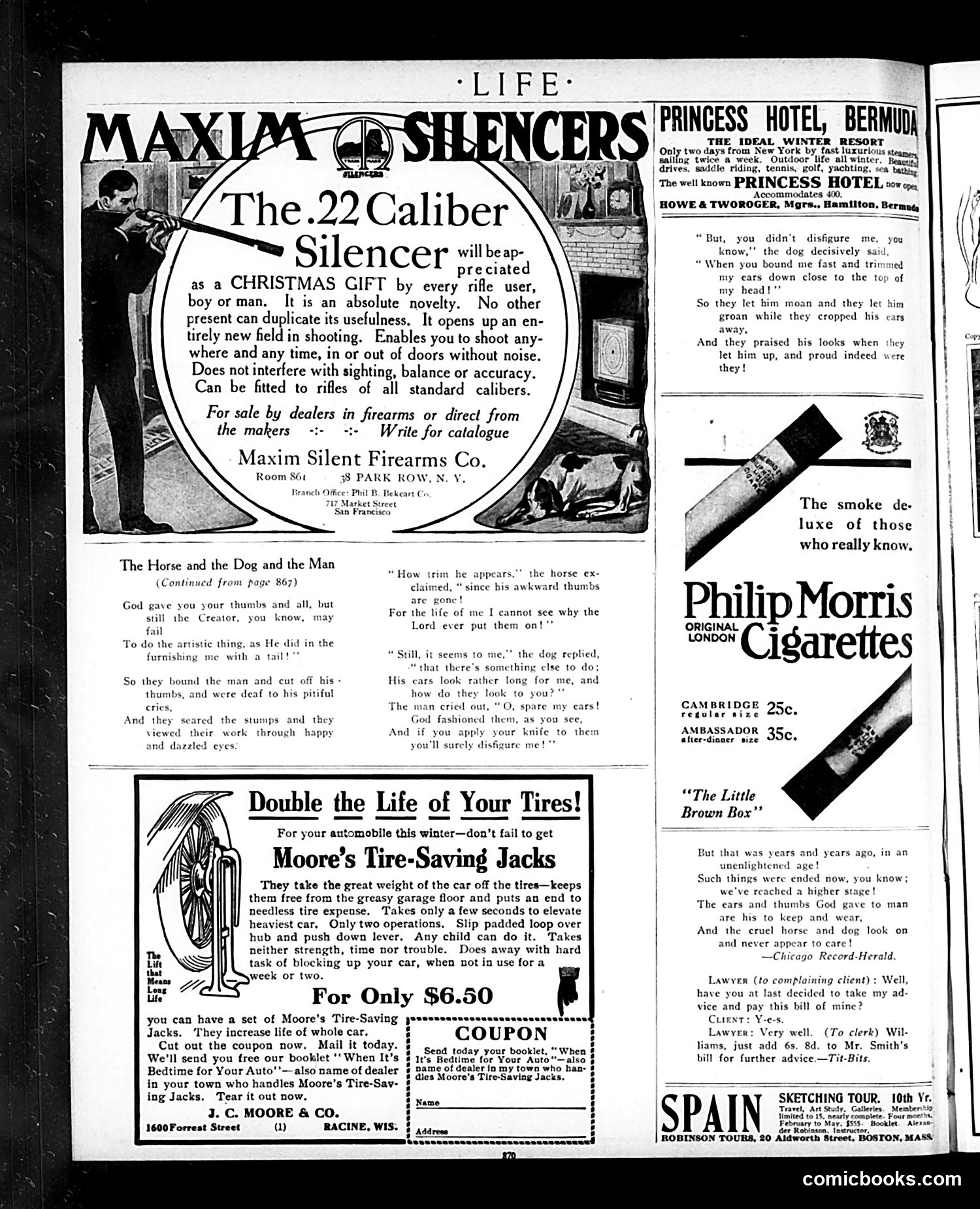
This is a moral fable presented as verse, illustrated with a narrative cartoon. The story depicts three creatures—a horse, dog, and man—who decide to "improve" human anatomy by removing the man's thumbs and ears, which they view as awkward or unnecessary. The satire critiques misguided "progress" and interventionism. Each animal questions God's design: the horse dislikes the man's thumbs, the dog finds his ears too long. They mutilate him accordingly, viewing their destructive work with satisfaction. The moral (attributed to *Chicago Record-Herald*) concludes that such "enlightened" interference is now supposedly ended—yet society continues ignoring divine purpose, with indifferent observers ("cruel horse and dog") watching without protest. This appears to be social commentary on early 20th-century "reform" movements, possibly critiquing eugenics, social engineering, or other interventionist ideologies gaining traction at the time, using religious language about God's design to argue against tampering with nature or human form.
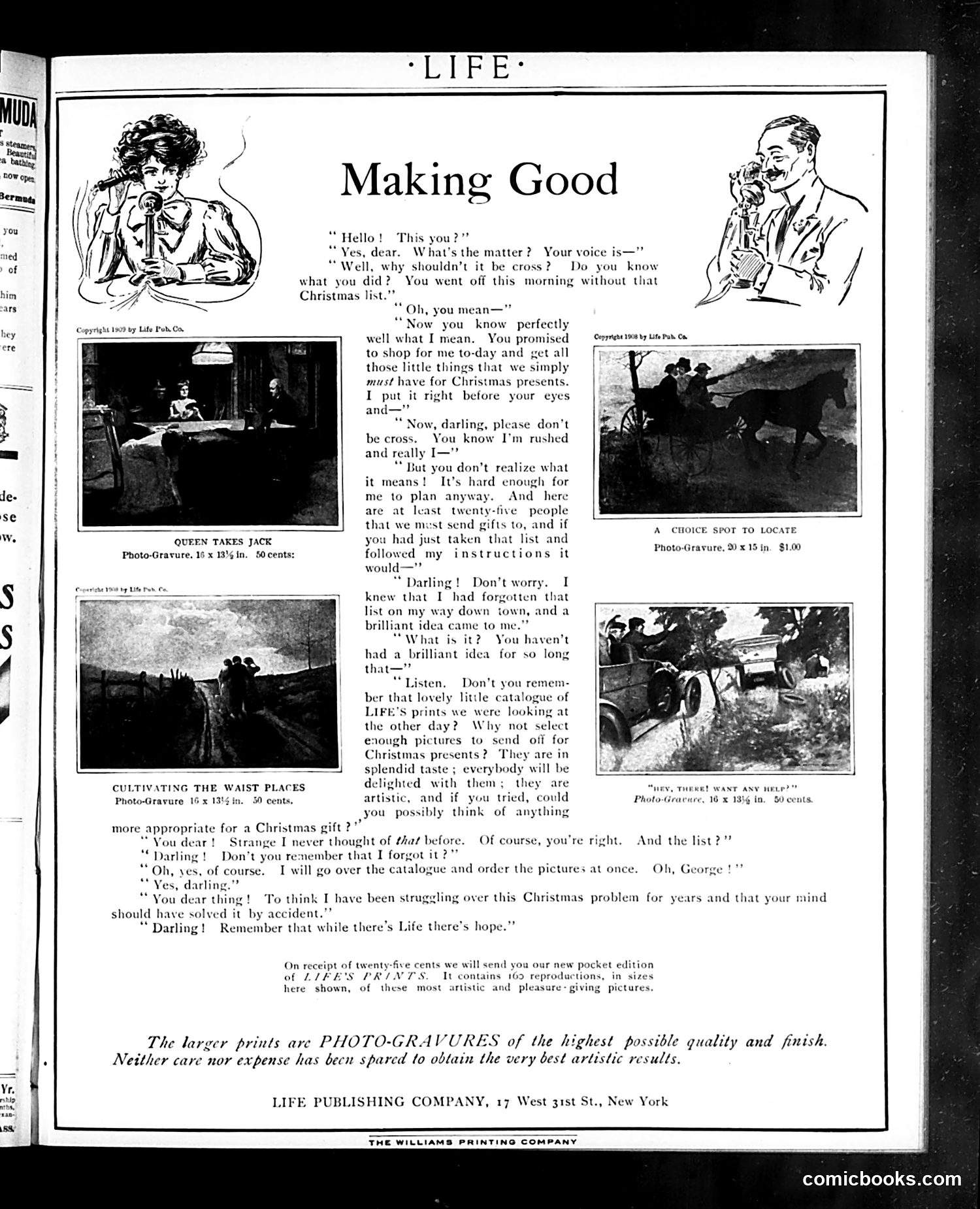
This page is primarily **advertising disguised as humor**. The dialogue depicts a domestic quarrel: a husband forgets his wife's Christmas shopping list, but cleverly proposes that LIFE magazine's art prints serve as gifts instead—solving both the shopping problem and promoting the product. The satire targets **early 20th-century consumer culture and marital dynamics**. The wife is portrayed as anxious, detail-obsessed, and burdened by Christmas obligations (25 people to buy for), while the husband is forgetful yet charming enough to redirect her frustration. His solution—that art prints are "appropriate" gifts—reflects the magazine's positioning of reproductions as cultured, tasteful alternatives to material goods. The accompanying photographs illustrate photogravure quality. The tagline "while there's Life there's hope" is a pun playing on both the magazine's name and a common aphorism. This is **product placement dressed as marital comedy**, targeting middle-class readers who valued both artistic sophistication and practical solutions to holiday stress.
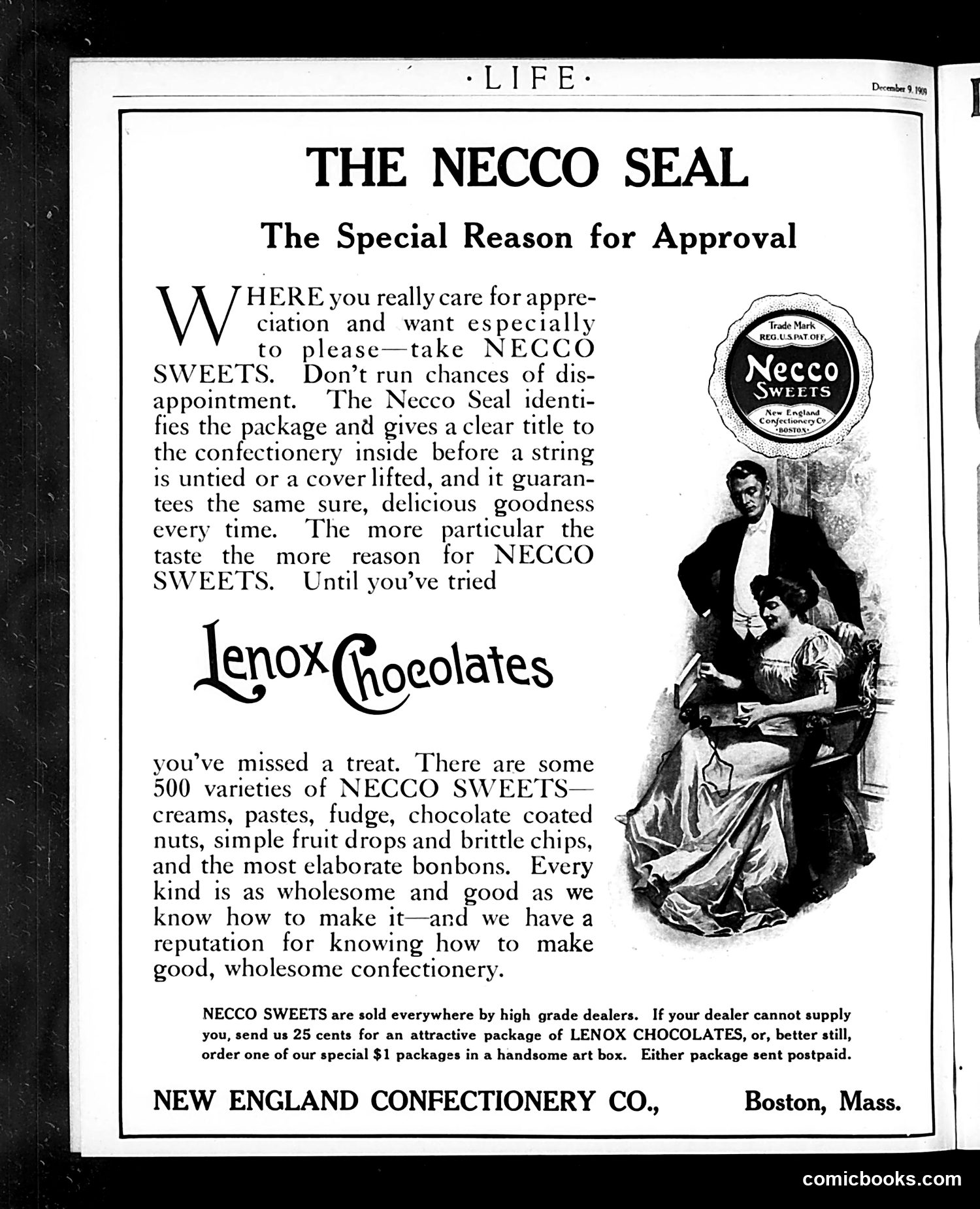
This is a **candy advertisement**, not satire or political commentary. The New England Confectionery Company promotes NECCO Sweets and Lenox Chocolates through Life magazine (December 9, 1920). The illustration shows a well-dressed man and woman in early 1920s clothing examining a box of chocolates—a genteel domestic scene emphasizing gift-giving as a sign of appreciation and good taste. The "NECCO Seal" (a trade mark visible on the package) serves as a quality guarantee. The advertisement's appeal to "particular taste" and the detailed listing of 500 varieties (creams, fudges, bonbons) targets middle-to-upper-class readers who valued refinement. The modest pricing (25 cents to $1) and mail-order option made premium confectionery accessible to the target demographic. This reflects 1920s consumer culture where branded packaged goods with visible seals represented trustworthiness and social respectability.