
Life, 1909-12-09 · page 14 of 32
Life — December 9, 1909 — page 14: what you’re looking at
What you’re looking at
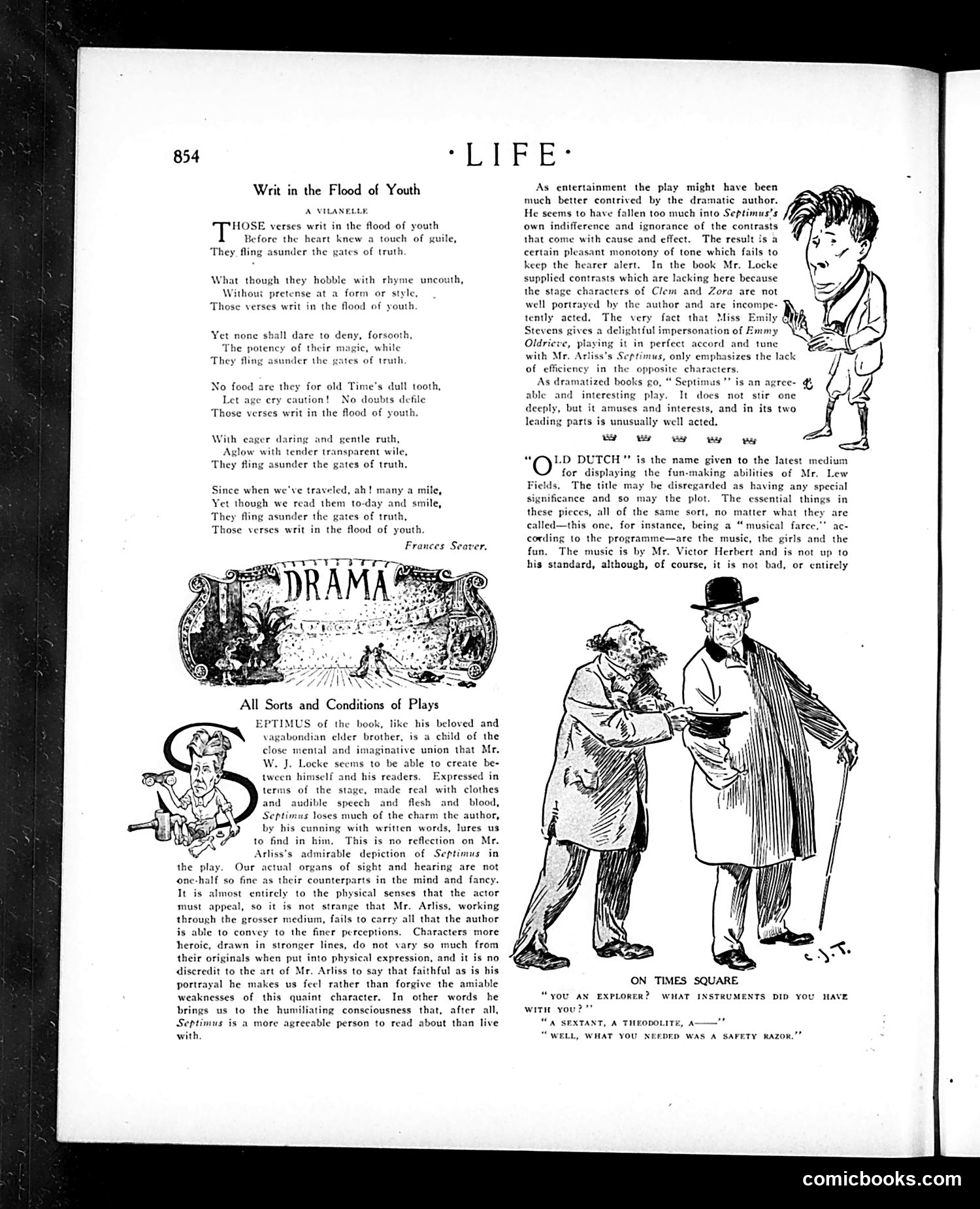
This page contains theatrical reviews from an early 20th-century American magazine. The main content critiques stage adaptations of literary works. The primary review discusses "Septimus," a play based on W.J. Locke's novel, starring actor George Arliss. The critic argues that while Arliss's performance is competent and faithful, the character loses charm in theatrical translation. The review suggests that actors must rely on physical presence and audible speech, which cannot match the imagination readers employ with written prose. Supporting actress Miss Emily Stevens receives praise for her portrayal of Emmy Oldrieve. A secondary review mentions "Old Dutch," a musical farce by Lew Fields featuring music by Victor Herbert. The critic dismisses the plot as unimportant, noting such productions prioritize music, girls, and entertainment over narrative substance. The page also includes a poem, "Writ in the Flood of Youth," a villanelle by Frances Seaver celebrating youthful, unpolished verse.
📄 Transcribed text from this page (OCR, searchable)
Machine-transcribed from the original scan — historical spelling and the odd misread are preserved.
a ie Writ in the Flood of Youth A VILANELLE HOSE verses writ in the flood of youth Before the heart knew a touch of guile, They fling asunder the gates of truth, What though they hobble with rhyme uncouth, Without pretense at a form or style, Those verses writ in the flood of youth Yet none shall dare to deny, forsoo The potency of their magic, while They fling asunder the gates of truth y for old Time's dull tooth, No doubts de Those verses writ in the flood of youth. No food are th Let age cry caution! With cager daring and gentle ruth, Aglow with tender transparent wile, hey fling asunder the gates of truth, nce when we've traveled, ah! many a mile, Yet though we read them to-day and smile, fling asunder the gates of truth, Those verses writ in the flood of youth. Frances Seaver. Alll Sorts and Conditions of Plays EPTIMUS of the book, like his beloved and vagabondian elder brother, is a child of the close mental and imaginative union that Mr. W. J. Locke seems to be able to create be- tween himself and his readers. Expressed in terms of the stage, made real with clothes and audible speech and flesh and blood, Septimus loses much of the charm the author, by his cunning with written words, lures us to find in him. This is no reflection on Mr. admirable depiction of Septimus in the play. Our actual organs of sight and hearing are not ‘one-half so fine as their counterparts in the mind and fancy. It is almost entirely to the physical senses that the actor must appeal, so it is not strange that Mr. Arliss, working through the grosser medium, fails to carry all that the author is able to convey to the finer perceptions. Characters more heroic, drawn in stronger lines, do not vary so much from their originals when put into physical expression, and it is no discredit to the art of Mr. Arliss to say that faithful as is his portrayal he makes us feel rather than forgive the amiable weaknesses of this quaint character. In other words he brings us to the humiliating consciousness that, after all, Sep 3 agreeable person to read about than live with As entertainment the play might have been much better contrived by the dramatic author. He seems to have fallen too much into Septimus’s own indifference and ignorance of the contrasts that come with cause and effect. The result is a certain pleasant monotony of tone which fails to keep the hearer alert. In the book Mr. Locke supplied contrasts which are lacking here because the stage characters of Clem and Zora are not well portrayed by the author and are incompe- tently acted. The very fact that Miss Emily Stevens gives a delightful impersonation of Emmy Oldrieve, playing it in perfect accord and tune with Mr. Arliss’s Septimus, only emphasizes the lack of efficiency in the opposite characters. As dramatized books go, “ Septimas’” is an agree- @% able and interesting play. It does not stir one and interests, and in its two leading parts is unusually well acted. wow ow ss deeply, but it amuses ee oy 7 1.D DUTCH "’ is the name given to the latest medium for displaying the fun-making abilities of Mr. Lew ids, The title may be disregarded as having any special significance and so may the plot. The essential things in these pieces, all of the same sort, no matter what they are called—this one, for instance, being a “ musical farce,’ ac- cording to the programme—are the music, the girls and the fun, The music is by Mr. Victor Herbert and is not up to his standard, although, of course, it is not bad, or entirely ON TIMES SQUARE “YOU AN EXPLORER? witit you? “(Aq SEXTANT, A THEODOLITE, A—— “WELL, WHAT YOU NEEDED WAS A SAFETY RAZOR.”? WHAT INSTRUMENTS DID YOU HAVE comicbooks.com