
Life, 1909-12-09 · page 11 of 32
Life — December 9, 1909 — page 11: what you’re looking at
What you’re looking at
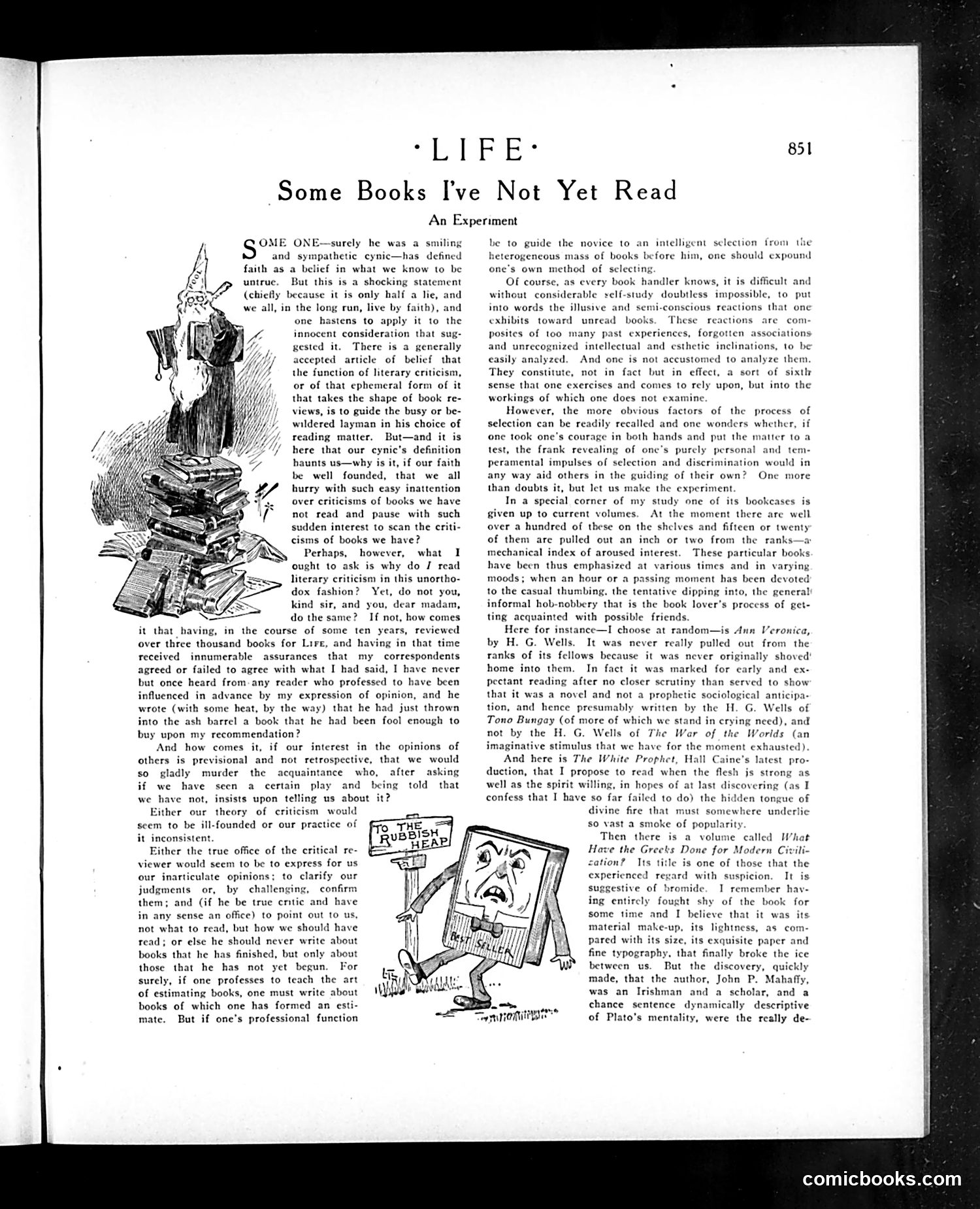
This is a literary criticism essay titled "Some Books I've Not Yet Read: An Experiment" (page 851). The main cartoon depicts a frustrated figure labeled "TO THE LITERARY HEAD" being struck or overwhelmed by a large book—a visual pun on the phrase about books hitting one's head. The essay discusses the author's method for selecting books to read and critiquing unread literature. It's satirizing literary critics who write reviews and opinions about books without actually reading them—a common practice the author observes among book reviewers of the era. The cartoon humorously illustrates this absurdity: a critic literally being "hit" by a book they haven't read, suggesting the pretension and danger of pontificating about literature without genuine engagement.
📄 Transcribed text from this page (OCR, searchable)
Machine-transcribed from the original scan — historical spelling and the odd misread are preserved.
“LIFE: Some Books I’ve Not Yet Read An Experiment OME ONE—surely he was a smiling and sympathetic cynic—has defined faith as a belief in what we know to be untrue. But this is a shocking statement (chiefly because it is only half a lie, and we all, in the long run, live by faith), and one hastens to apply it to the innocent consideration that sug- gested it. There is a generally accepted article of belief that the function of literary criticism, or of that ephemeral form of it that takes the shape of book re- views, is to guide the busy or be- wildered layman in his choice of reading matter. But—and it is here that our cynic’s definition haunts us—why is it, if our faith be well founded, that we all hurry with such easy inattention over criticisms of books we have not read and pause with such sudden interest to scan the criti- cisms of books we have? Perhaps, however, what I ought to ask is why do J read literary criticism in this unortho- dox fashion? Yet, do not you, kind sir, and you, dear madam, do the same? If not, how comes it that having, in the course of some ten years, reviewed over three thousand books for Lire, and having in that time received innumerable assurances that my correspondents agreed or failed to agree with what I had said, I have never but once heard from-any reader who professed to have been influenced in advance by my expression of opinion, and he wrote (with some heat, by the way) that he had just thrown into the ash barrel a book that he had been fool enough to buy upon my recommendation ? And how comes it, if our interest in the opinions of others is previsional and not retrospective, that we would so gladly murder the acquaintance who, after asking if we have seen a certain play and told that we have not, insists upon telling us about it? fither our theory of criticism would scem to be ill-founded or our practice of it inconsistent Either the true office of the critical re- viewer would seem to be to express for us our inarticulate opinions: to clarify our judgments or, by challenging, confirm them; and (if he be true entice and have in any sense an office) to point out to us, not what to read, but how we should have read; or else he should never write about books that he has finished, but only about those that he has not yet begun. For surely, if one professes to teach the art of estimating books, one must write about books of which one has formed an esti- But if one’s professional function yy Wii) i being mate. be to guide the novice to an intelligent selection from the terogencous mass of books before him, one should expound one’s own method of selecting Of course, as every book handler knows, it is difficult and without considerable self-study doubtless impossible, to put into words the illusive and semi-conse exhibits toward unread books. posites of too many past experiences, forgotte and unrecognized intellectual and esthetic inclinations, to be easily analyzed. And one is not accustomed to analyze them They constitute, not in fact but in effect, a sort of sixth sense that one exercises and comes to rely upon, but into the workings of which one does not examine However, the more obvious factors of the selection can be readily recalled and one wonders whether, if one took one’s courage in both hands and put the matter to a test, the frank revealing of one’s purely personal and tem- peramental impulses of selection and discrimination would in any way aid others in the guiding of their own? One more than doubts it, but let us make the experiment In a special corner of my study one of its bookcases is given up to current volumes. At the moment there are well over a hundred of these on the shelves and fifteen or twenty of them are pulled out an inch or two from the ranks—a mechanical index of aroused interest. These particular books have been thus emphasized at various times and in varying moods; when an hour or a passing moment has been devoted to the casual thumbing. the tentative dipping into, the general informal hob-nobbery that is the book lover's process of get- ting acquainted with possible friends. Here for instance—I choose at random—is Ann Veronica, by H. G. Wells. It was never really pulled out from the ranks of its fellows because it was never originally shoved home into them. In fact it was marked for carly and ex- pectant reading after no closer scrutiny than served to show that it was a novel and not a prophetic sociological anticipa- tion, and hence presumably written by the H. G. Wells of Tono Bungay (of more of which we stand in crying need), and not by the H. G. Wells of The War of the Worlds (an imaginative stimulus that we have for the moment exhausted). And here is The White Prophet, Hall est pro- duction, that I propose to read when the flesh js strong as well as the spirit willing, in hopes of at last discovering (as I confess that I have so far failed to do) the hidden tongue of divine fire that must 50 vast a smoke of popularity Then there is a volume called What Have the Greets Done for Modern Civili- zation? Its title is one of those that the experienced regard with suspicion. It is suggestive of bromide. I remember hav- ing entircly fought shy of the book for some time and I believe that it was its material make-up, its lightness, as co pared with its size, its exquisite paper and fine typography, that finally broke the ice between us. But the discovery, quick made, that the author, John P. Mahaffy, was an Irishman and a scholar, and a chance sentence dynamically descriptive of Plato’s mentality, were the really de- pus reactions that one These reactions are com- associations process of somewhere underlie oe andes Teo miriomityye” comicbooks.com