
Life, 1909-12-09 · page 15 of 32
Life — December 9, 1909 — page 15: what you’re looking at
What you’re looking at
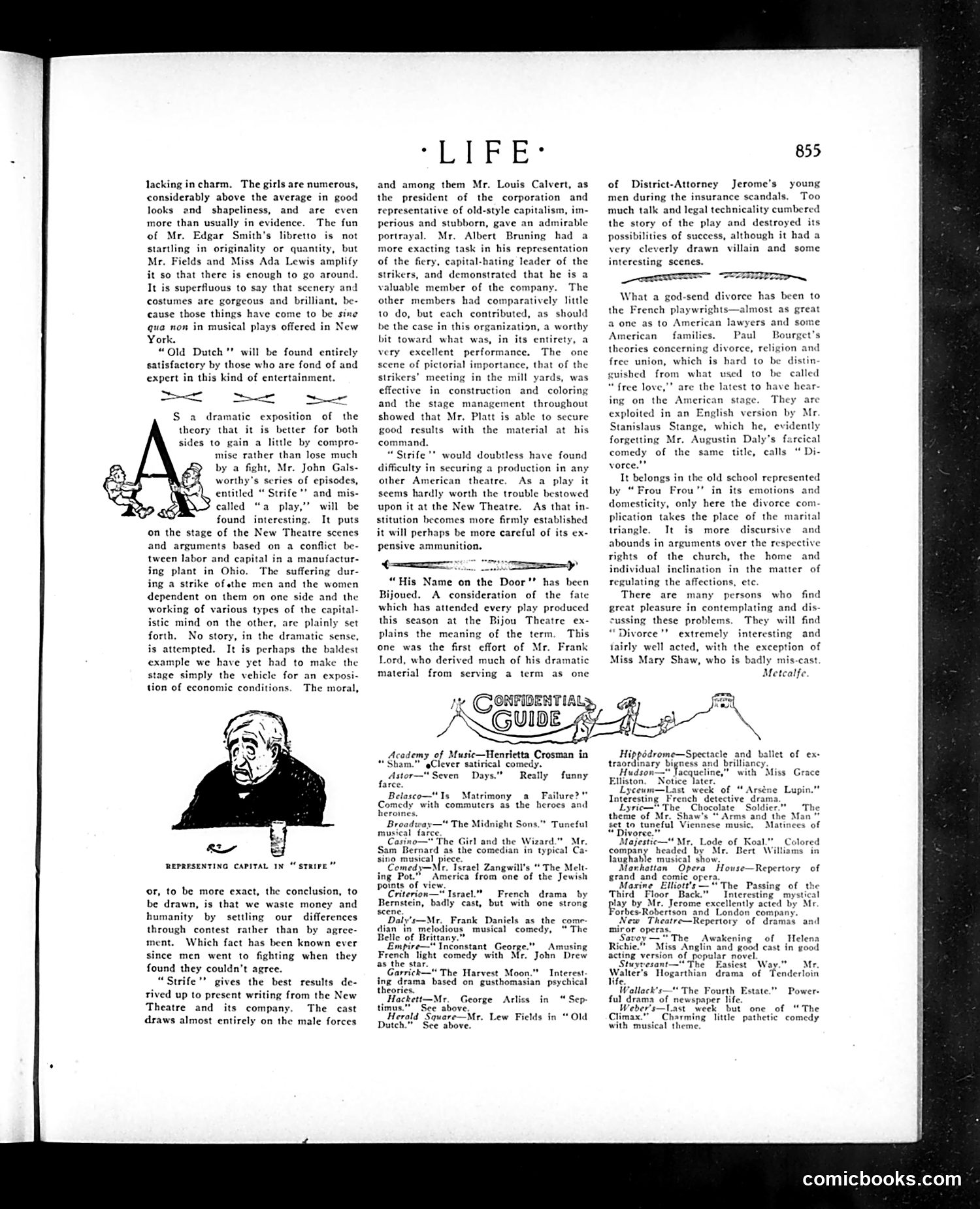
This page reviews theatrical productions, including John Galsworthy's "Strife"—a play about labor-versus-capital conflict in an Ohio manufacturing plant. The accompanying cartoon depicts a stern, older male figure labeled "REPRESENTING CAPITAL IN 'STRIFE.'" This caricatures **Louis Calvert**, who played the corporation president in the production. The exaggerated facial features and severe expression satirize capitalist rigidity and cold indifference to workers' suffering. The review itself critiques the play as more a political **exposition than drama**—essentially a stage debate about economic compromise. The critic notes "Strife" advances no original argument, merely staging the tired moral that violence and conflict waste "money and humanity" compared to negotiation. The satire targets both the play's earnestness and the New Theatre's ambitious but ultimately didactic approach to using drama for social commentary on contemporary class struggle.
📄 Transcribed text from this page (OCR, searchable)
Machine-transcribed from the original scan — historical spelling and the odd misread are preserved.
lacking in charm. The girls are numerous, considerably above the average in good looks and shapeliness, and are even more than usually in evidence. The fun of Mr. Edgar Smith's libretto is not startling in originality or quantity, but Mr. Fields and Miss Ada Lewis amplify it so that there is enough to go around. It is superfluous to say that scenery and costumes are gorgeous and brilliant, be- cause those things have come to be sine qua non in musical plays offered in New York. “Old Dutch’? will be found entirely satisfactory by those who are fond of and expert in this kind of entertainment. Sa dramatic exposition of the theory that it is better for both sides to gain a little by compro- mise rather than lose much by a fight, Mr. John Gals- worthy’s scries of episodes, , entitled “ Strife” and mis- called “a play,’ will be found interesting. It puts on the stage of the New Theatre scenes and arguments based on a conflict be- tween labor and capital in a manufactur- ing plant in Ohio. The suffering dur- ing a strike ofthe men and the women dependent on them on one side and the working of various types of the capital- istic mind on the other, are plainly set forth. No story, in the dramatic sense, is attempted. It is perhaps the baldest example we have yet had to make the stage simply the vehicle for an exposi- tion of economic conditions. The moral, ~ St REPRESENTING CAPITAL IN “ STRIFE” or, to be more exact, the conclusion, to be drawn, is that we waste money and humanity by settling our differences through contest rather than by agree- ment. Which fact has been known ever since men went to fighting when they found they couldn’t agree. “Surife' gives the best results de- rived up to present writing from the New Theatre and its company. The cast draws almost entirely on the male forces LIFE and among them Mr. Louis Calvert, as the president of the corporation and representative of old-style capitalism, im- perious and stubborn, gave an admirable portrayal. Mr. Albert Bruning had a more exacting task in his representation of the fiery, capital-hating leader of the strikers, and demonstrated that he is a valuable member of the company. The other members had comparatively little to do, but each contributed, as should be the case in this organization, a worthy bit toward what was, in its entirety, a very excellent performance. The one scene of pictorial importance, that of the strikers’ meeting in the mill yards, was effective in construction and coloring and the stage management throughout showed that Mr. Platt is able to secure good results with the material at his command. “ Strife’ would doubtless have found difficulty in securing a production in an: other American theatre. As a_ pla scems hardly worth the trouble bestowed upon it at the New Theatre. As that in stitution becomes more firmly established it will perhaps be more careful of its ex- pensive ammunition. “His Name on the Door’? has been Bijoued. A consideration of the fate which has attended every play produced this season at the Bijou Theatre ex- plains the meaning of the term. This one was the first effort of Mr. Frank Lord, who derived much of his dramatic material from serving a term as one ONFIDENTIAL CG uiog Academy of Music—Henrietta Crosman in Sham.” @Clever satirical comedy. Astor—" Seven Days.” Really farce. Belasco" Is Matrimony a Failure? Comedy with commuters as the herocs and heroines. Broadway—" The Midnight Sons.” musical far Casino—" The Girl and the Wizard.” Mr. Sam Bernard as the comedian in typical Ca: sing musical piece. Comedy—Mr, Israel Zangwill’s " The Melt- ing Pot.” America from one of the Jewish points of vie Criterion—" Israel.” | French drama_ by Bernstein, badly cast, but with one strong scene. Daly's—Mr. dian in, melodious, Belle of Brittar Empire—""Inconstant George." Amusing French light comedy with Mr. John Drew as the star. Garrick—* The Harvest Moon." Interest. ing drama based on gusthomasian psychical theories. _Hackett—Mr. George timus.” See above Herald Square—Mr. Dutch." See above. funny Tuneful Frank Daniels as the come- musical comedy, “ The Arliss in“ Sep: Lew Fields in “Old 855 of District-Attorney Jerome's young men during the insurance scandals. Too much talk and legal technicality cumbered the story of the play and destroyed its possibilities of success, although it had a very cleverly drawn villain and some interesting scenes. ES SOR What a god-send divorce has been to the French playwrights—almost as great a one as to American lawyers and some American families. Paul Bourget’ theories concerning divorce, religion and free union, which is hard to be disti from what used to be called * free love,”” to have hear- ing on the American They are exploited in an English version by Mr. Stanislaus Stange, which he, evidently forgetting Mr. Augustin Daly's farcical comedy of the same title, calls “ Di- vorce.”” It belongs in the old school represented by “Frou Frou’ in its emotions and domesticity, only here the divorce com plication takes the place of the marital triangle. It is more abounds in arguments over the respective rights of the church, the home and individual inclination in the matter of regulating the affections, etc. There are many persons who find great pleasure in contemplating and dis- cussing these problems. They will find Divorce’? extremely interesting and Jairly well acted, with the exception of Miss Mary Shaw, who is badly mis-cast Metcalf guished are the late: stage. discursive and Hippédrome—Spectacle and ballet of ex traordinary bigness and brilliar Hudson—" Jacqueline,” with Elliston. Notice later. Lyceum—Last week of “ Arséne Lupin.” Interesting French detective drama Lyric—" The Chocolate Soldier.” The theme of Mr. Shaw's “Arms and the Man " set to tuneful Viennese music, Matinees of “Divoree.” . Majestic—" Mr, Lode of Koal.” Colored company headed ‘by Mr. Bert Williams in laughable musical show. Marhattan Opera House—Repertory of grand and comic opera Maxine Elliott's —"The Passing of the Third Floor Back.” Interesting mystical play, by Mr. Jerome excellently acted by Mr ‘orbes-Robertson and London company New Theatre—Repertory minor operas "The Awakening of Helena Richie.” Miss Anglin and goed cast in good acting version of popular novel Stuyresant—"The Easiest’ Way.” Mr. Walter's Hogarthian drama of Tenderloin ife. Wallack's—"* The Fourth Estate.” ful drama of newspaper life. Weber week but one of i ng little pathetic with musical theme "Miss Grace of dramas a Powers “The comedy comicbooks.com