
Life, 1909-12-09 · page 13 of 32
Life — December 9, 1909 — page 13: what you’re looking at
What you’re looking at
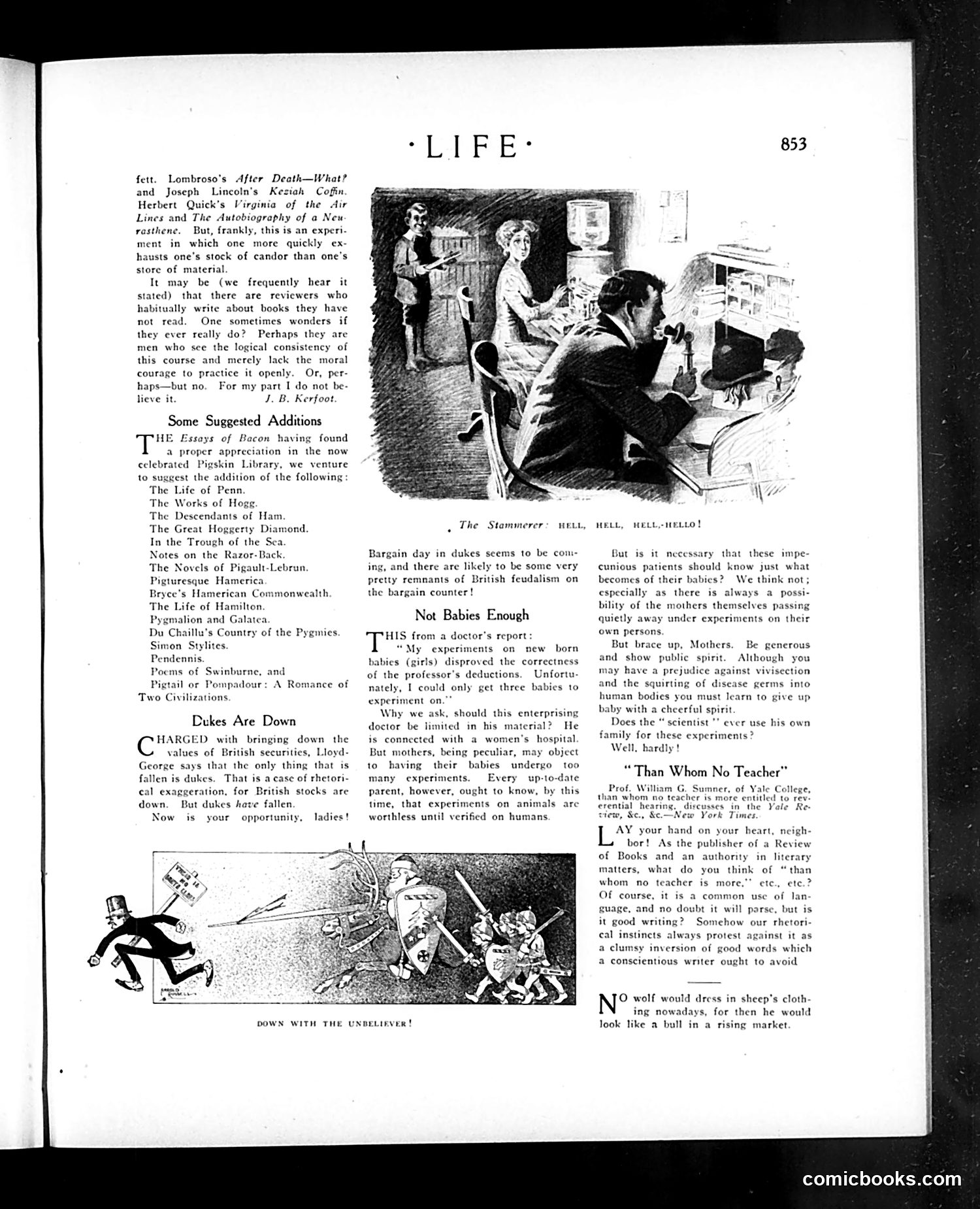
This page contains three satirical sections: **"The Stammerer"** (top cartoon): Shows a woman at what appears to be a bargain counter, with the caption "HELL, HELL, HELL—HELLO!" The joke mocks upper-class women's affected speech patterns—particularly their exaggerated stammering or affected mannerisms during bargain shopping. **"Coles Are Down"** (middle cartoon, captioned "DOWN WITH THE UNBELIEVER!"): Shows a figure being knocked down, likely satirizing stock market fluctuations or economic downturns. The reference to "coles" (coal stocks) suggests this mocks market volatility and financial speculation of the era. **"Than Whom No Teacher"** (right section): A written satirical commentary critiquing the phrase "than whom no teacher" as clumsy language usage, suggesting even educated reviewers resort to awkward constructions. The page reflects early 20th-century satirical humor targeting class affectations, market instability, and linguistic pretension.
📄 Transcribed text from this page (OCR, searchable)
Machine-transcribed from the original scan — historical spelling and the odd misread are preserved.
fett. Lombroso’s After Death—What? and Joseph Lincoln's Keziah Coffin Herbert Quick’s Virginia of the Air Lines and The Autobiography of a Neu rasthene. But, frankly, this is an experi- ment in which one more quickly ex- hausts one’s stock of candor than one's store of material It may be (we frequently hear it stated) that there are reviewers who habitually write about books they have not read. One sometimes wonders if they ever really do? Perhaps they are men who sce the logical consistency of this course and merely lack the moral courage to practice it openly. Or, per- haps—but no. For my part I do not be- lieve it. J. B. Kerfoot Some Suggested Additions HE Essays of Bacon having found a proper appreciation in the now celebrated Pigskin Library, we venture to suggest the addition of the following The Life of Penn The Works of Hogg. The Descendants of Ham. The Great Hoggerty Diamond. In the Trough of the Sea. Notes on the Razor-Back The Novels of Pigault-Lebrun. Pigturesque Hamerica Bryce’s Hamerican Commonwealth. The Life of Hamilton. Pygmalion and Galatea Du Chaillu’s Country of the Pygmies Simon Stylites. Pendennis Poems of Swinburne, and Pigtail or Pompadour: A Romance of Two Civilizations Dukes Are Down HARGED with bringing down the values of British securities, Lloyd- George says that the only thing that is fallen is dukes, That is a case of rhetor: cal exaggeration, for British stocks are down. But dukes have fallen. Now is ladies! your opportunity, The Stammerer> new, Bargain day in dukes seems to be com- ing, and there are likely to be some very pretty remnants of British feudalism on the bargain counter! Not Babies Enough HIS from a doctor's report: “My experiments on new born babies (girls) disproved the correctness of the professor's deductions. Unfortu- nately, I could only get three babies 10 experiment on.” Why we ask, should this enterprisir doctor be limited in his material? He is connected with a women's hospital But mothers, being peculiar, may object to having their babies undergo too many experiments. Every up-to-date parent, however, ought to know, by this time, that experiments on animals are worthless until verified on humans DOWN WITH THE UNDELIEVER! HELL, HELL, MELLO! But is it cunious patients should know just what becomes of their babies? We think not; especially as there is always a possi- bility of the mothers themselves passing quietly away under experiments on their own persons. But brace up, Be generous and show Although you may have a prejudice against vivisection and the squirting of disease germs into human bodies you must learn to give up baby with a cheerful spirit Does the “ scientist "’ ever use his own family for these experiments? Well, hardly! “Than Whom No Teacher” Prof, William G. Sumner, of Yale College, than whom no teacher is more entitled to rev: erential hearing, discusses in the Yale Re- view, &e., &.—New York Times necessary that these impe- Mothers. public spirit. AY your hand on your heart, neigh- bor! As the publisher of a Review of Books and an authority in literary matters, what do you think of “than whom no teacher is ete., ete.? Of course, it is a common use of Ian guage, and no doubt it will parse, but is it good writing? cal instincts a clur more," Somehow our rhetori- always protest against it as inversion of good words which a conscientious writer ought to av O wolf would dress in sheep's cloth- ing nowadays, for then he would look like a bull in a rising market comicbooks.com