
Life, 1909-12-09 · page 6 of 32
Life — December 9, 1909 — page 6: what you’re looking at
What you’re looking at
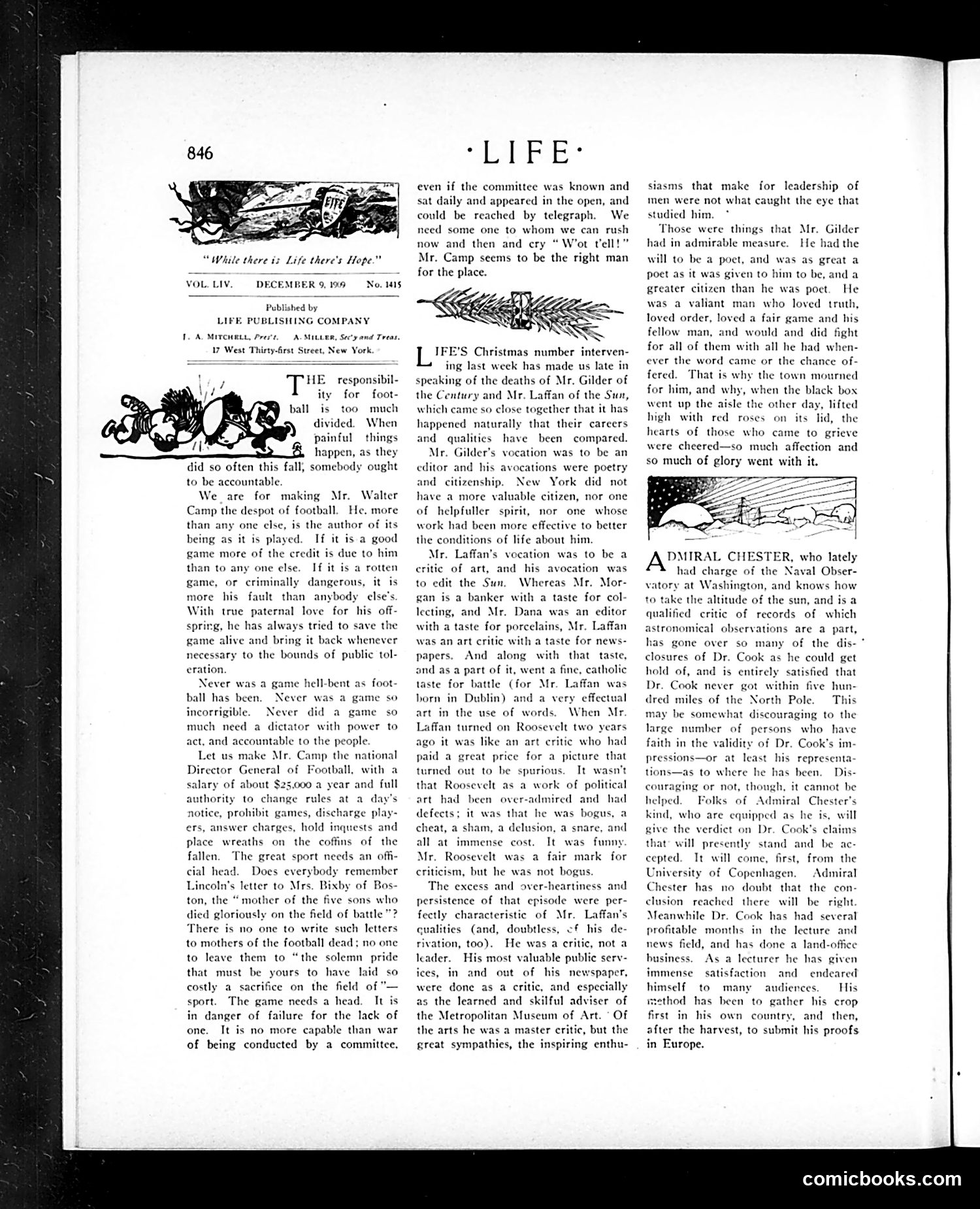
This page contains two editorial cartoons and accompanying text discussing deaths of prominent New Yorkers. **Top cartoon** ("While There is Life there's Hope"): Shows figures in a chaotic scene, likely satirizing football leadership disputes. The accompanying article discusses Mr. Walter Camp's role as football dictator and advocates for stronger central authority in the sport. **Bottom illustration**: Depicts Admiral Chester, who recently directed the Naval Observatory in Washington. The text praises his expertise in astronomical records and suggests he could verify Dr. Cook's claims about reaching the North Pole—a contemporary scandal involving disputed polar exploration claims. The page reflects early 1900s concerns about institutional leadership, scientific credibility, and the famous Cook-Peary North Pole controversy that captivated American public attention.
📄 Transcribed text from this page (OCR, searchable)
Machine-transcribed from the original scan — historical spelling and the odd misread are preserved.
“While there iz Life there's Hope.” VOL. LIV. DECEMBER 9, 199 Published by LIFE PUBLISHING COMPAD TOA. Miron mts, Pree 17 West Thirty-frst Street, New York, A. MILLER, Sec’y and Treas, HE_ responsibil- ity for foot- ball is too much divided. When painful things happen, as they did so often this fall, somebody ought to be accountable. We are for making Mr. Walter Camp the despot of football. He. more than any one else, is the author of its being as it is played. If it is a good game more of the credit is due to him than to any one else. If it is a rotten game, or criminally dangerous, it is more his fault than anybody else's With true paternal love for his off- spring, he has always tried to save the game alive and bring it back whenever necessary to the bounds of public tol- eration. Never was a game hell-bent as foot- ball has been. Never was a game so incorrigible. Never did a game so much need a dictator with power to act, and accountable to the people. Let us make Mr. Camp the national Director General of Football, with a salary of about $23,000 a year and full authority to change rules at a day's notice, prohibit games, discharge play ers, answer charges, hold inquests and place wreaths on the fallen. The great sport needs an offi- cial head. Does everybody remember Lincoln's letter to Mrs. Bixby of Bos- ton, the “mother of the five sons who died gloriously on the field of battle”? There is no one to write such letters to mothers of the football dead; no one to leave them to “the solemn pride that must be yours to have laid so costly a sacrifice on the field of "— sport, he game needs a head. It is in danger of failure for the lack of one. It is no more capable than war of being conducted by a committee, coffins of the No. 1415 “VEE even if the committee was known and sat daily and appeared in the open, and could be reached by telegraph. We need some one to whom we can rush now and then and cry “ W'ot tell!” Mr. Camp seems to be the right man for the place. ='S Christmas number interven- ing last week has made us late in speaking of the deaths of Mr. Gilder of the Century and Mr. Laffan of the Sun, which came so close together that it has happened naturally that their careers and qualities have been compared. Mr. Gilder’s vocation was to be an editor and his avocations were poetry and citizenship. New York did not have a more valuable citizen, nor one of helpfuller spirit, nor one whose work had been more effective to better the conditions of life about him. Mr. Laffan’s vocation was to be a critic of art, and his avocation was to edit the Sun. Whereas Mr. Mor- gan is a banker with a taste for col- lecting, and Mr. Dana was an editor with a taste for porcelains, Mr. Laffan was an art critic with a taste for news- papers. And along with that taste, and as a part of it, went a fine, catholic taste for battle (for Mr. Laffan was born in Dublin) and a very effectual art in the use of words. When Mr Laffan turned on Roosevelt two years ago it was like an art critic who had paid a great price for a picture that turned out to be spurious. It wasn't that Roosevelt as a work of political art had been over-admired and had defects; it was that he was bogus, a cheat, a sham, a delusion, a snare, and all at immense cost. It Mr. Roosevelt was a fair mark for criticism, but he was not bogus. The excess and over-heartiness and persistence of that episode were per- fectly characteristic of Mr. Laffan's qualities (and, doubtless, cf his de- rivation, too). He was a critic, not a leader. His most valuable public serv- ices, in and out of his newspaper, were done as a critic, and especially as the learned and skilful adviser of the Metropolitan Museum of Art.’ Of the arts he was a master critic, but the great sympathies, the inspiring enthu- was funny ms that make for leadership of men were not what caught the eye that studied him. Those were things that Mr. Gilder had in admirable measure. He had the will to be a poet, and was as great a poet as it was given to him to be, and a greater citizen than he was poct. He was a valiant man who loved truth, loved order, loved a fair game and his fellow man, and would and did fight for all of them with all he had when- ever the word came or the chance of- fered. That is why the town mourned for him, and why, when the black box went up the aisle the other day, lifted high with red roses on its lid, the hearts of those who came to grieve were cheered—so much affection and so much of glory went with it. DMIRAL CHESTER, who lately had charge of the Naval Obser- vatory at Washington, and knows how to take the altitude of the sun, and is a qualified critic of records of which astronomical observations are a part, has many of the dis- closures of Dr. Cook as he could get hold of, and is entirely satisfied that Dr. Cook never got within five hun- dred miles of the North Pole. This may be somewhat discouraging to the larg who have faith in the validity of Dr. Cook's im- pressions—or at least his representa- tions—as to where he has been. Dis- couraging or not, though, it cannot be helped. Folks of Admiral Chester's kind, who are equipped as he is, will give the verdict on Dr. Cook's claims that’ will presently stand and. be ac- cepted. It will come, first, from the University of Copenhagen. Admiral Chester has no doubt that the con clusion reached there will be right Meanwhile Dr. Cook has had several profitable months in the lecture and news field, and has done a land-office business, As a lecturer he has given satisfaction and endeared himself to audiences. His method has been to gather his crop first in his own country, and then, after the harvest, to submit his proofs in Europe. gone over so number of persons immense many comicbooks.com