
A complete issue · 32 pages · 1909
Life — October 21, 1909
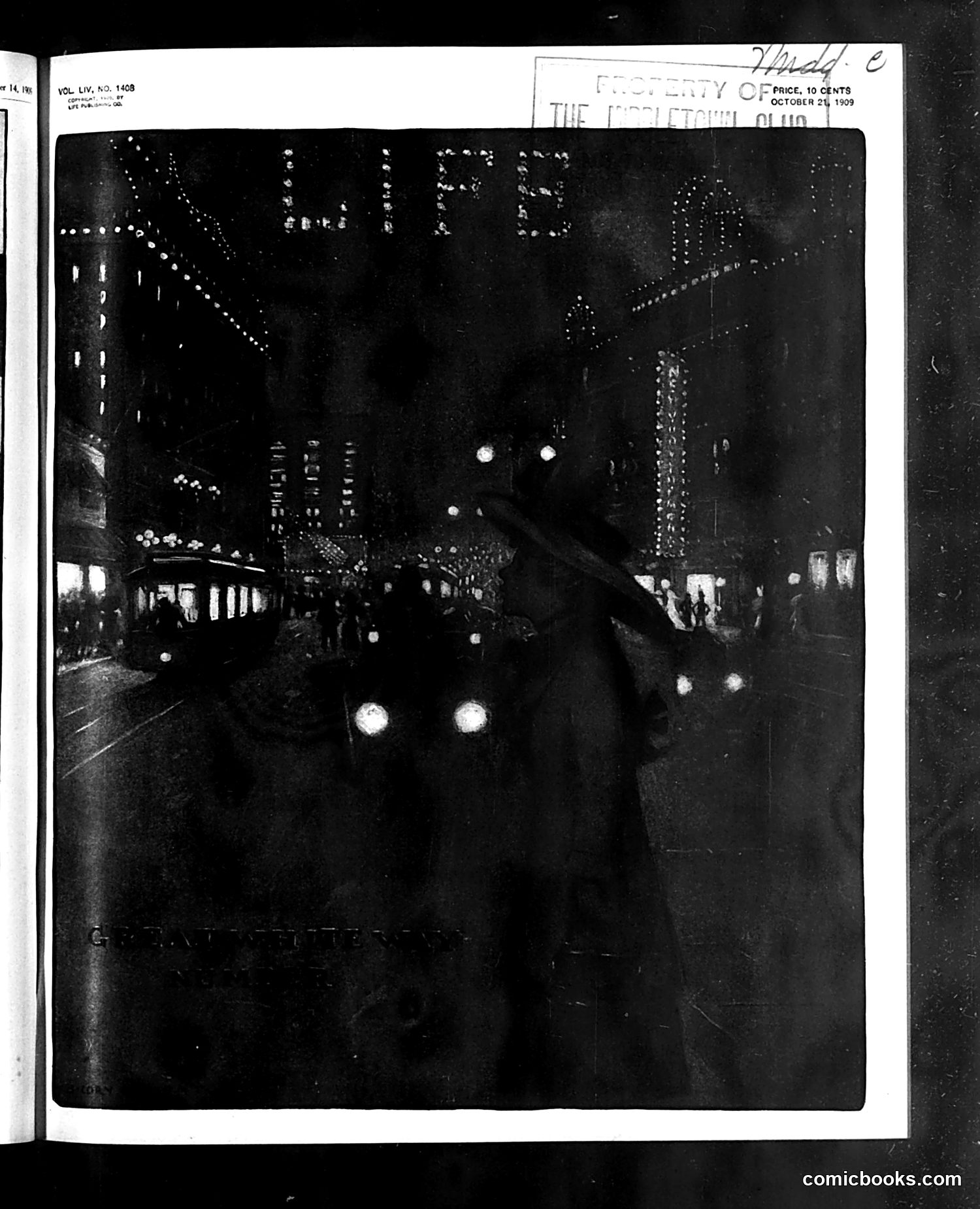
I can see this is a nighttime urban street scene with illuminated signage and lights, dated October 29, 1909 based on the header marking. The image shows what appears to be a major commercial district with elaborate electric lighting displays—prominent lights outline buildings and signs overhead. There are streetcars and pedestrians visible. However, the image quality and contrast make it difficult to read specific text on the signs or identify particular figures clearly enough to determine the cartoon's satirical target. The heavy electrical illumination suggests this may be commentary on urban electrification or commercial development during the early 1900s, but I cannot confidently identify the specific political or social satire intended without clearer visibility of text or caricatured figures.
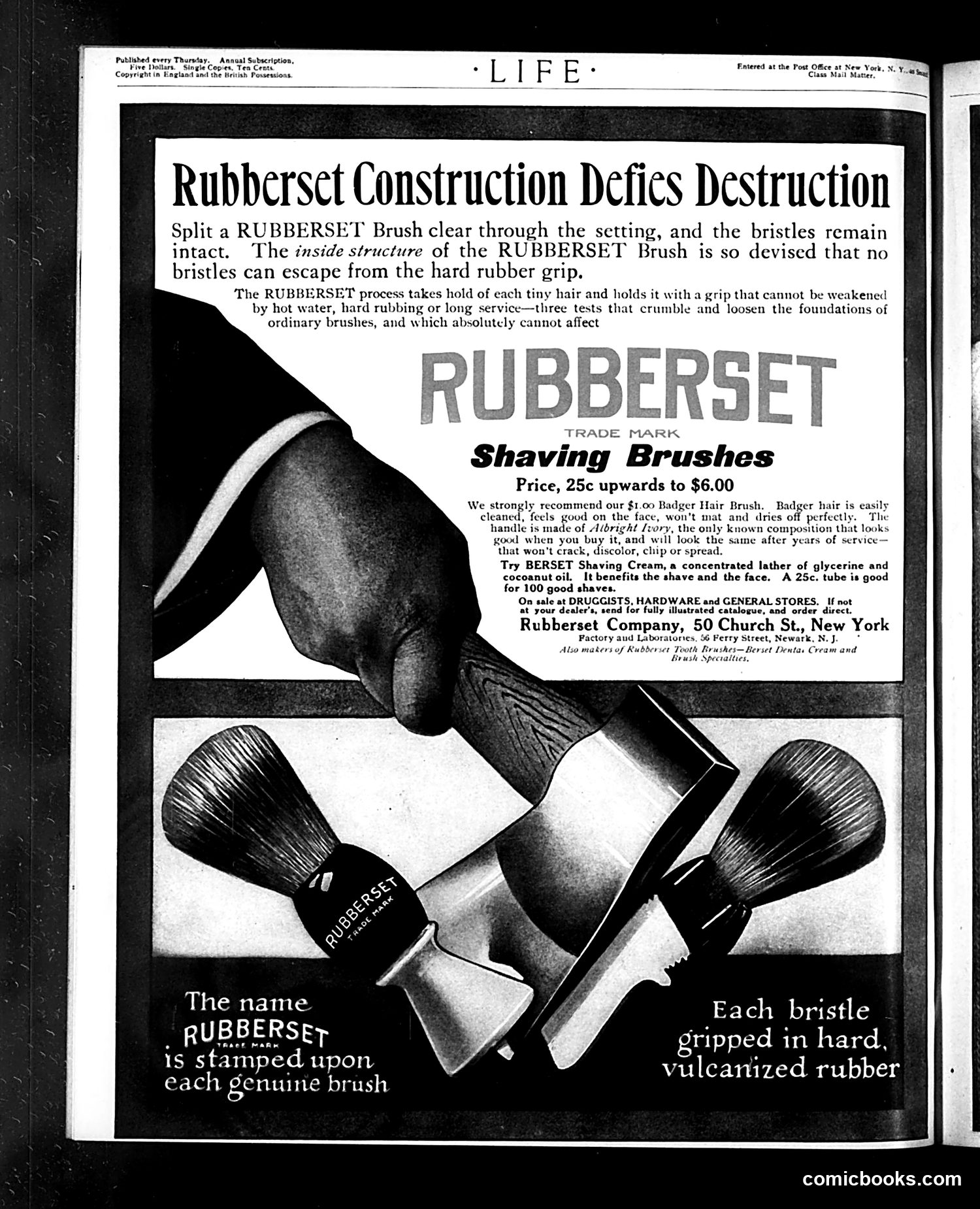
This page is **primarily an advertisement**, not satire or political commentary. It's a vintage ad for Rubberset brand shaving brushes, published in Life magazine. The ad emphasizes the brush's durability through its trademarked "Rubberset process," which allegedly grips each hair in vulcanized rubber so firmly that bristles won't escape even when split or stressed by hot water and hard use. The imagery shows the brush being dramatically split lengthwise—a dramatic demonstration of its claimed indestructibility. The ad promises brushes at prices from 25 cents to $6.00, recommends accompanying Berset shaving cream, and notes availability at drugstores and hardware stores. There is no political or social satire present; this is straightforward product advertising from the early-to-mid 20th century.
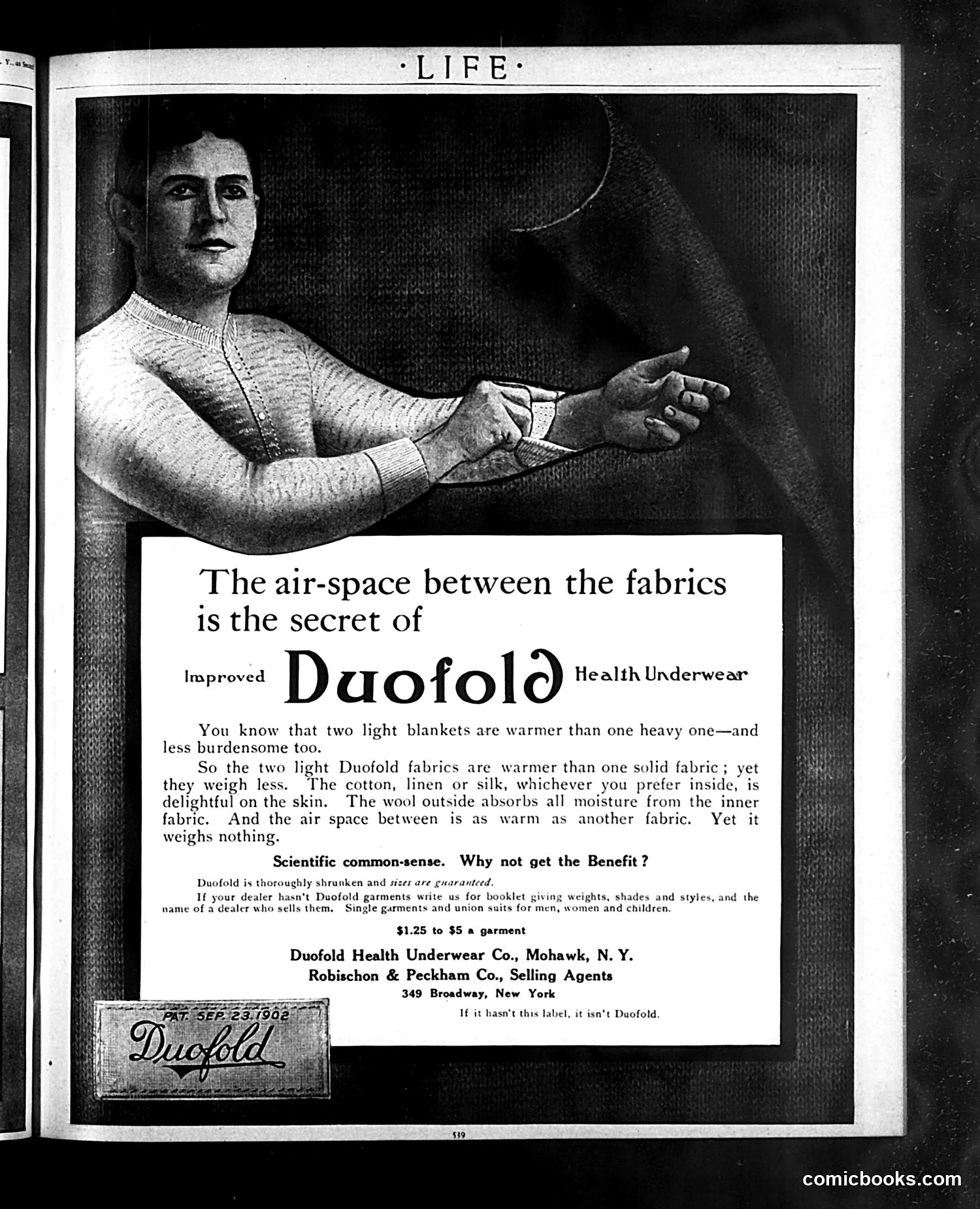
This page is **not a cartoon or satire**—it's a straightforward advertisement for Duofold Health Underwear, published in *Life* magazine. The ad features a photograph of a man demonstrating the product by pulling at his sleeve to show the fabric layers. The marketing pitch uses a scientific analogy: just as two thin blankets trap air and provide more warmth than one heavy blanket, Duofold's two-layer construction creates insulating air space while remaining lightweight. The advertisement emphasizes comfort, practicality, and "scientific common-sense" design—a typical early 20th-century sales approach that combined pseudo-scientific reasoning with health-conscious messaging to appeal to consumers. Prices ranged from $1.25 to $5 per garment.
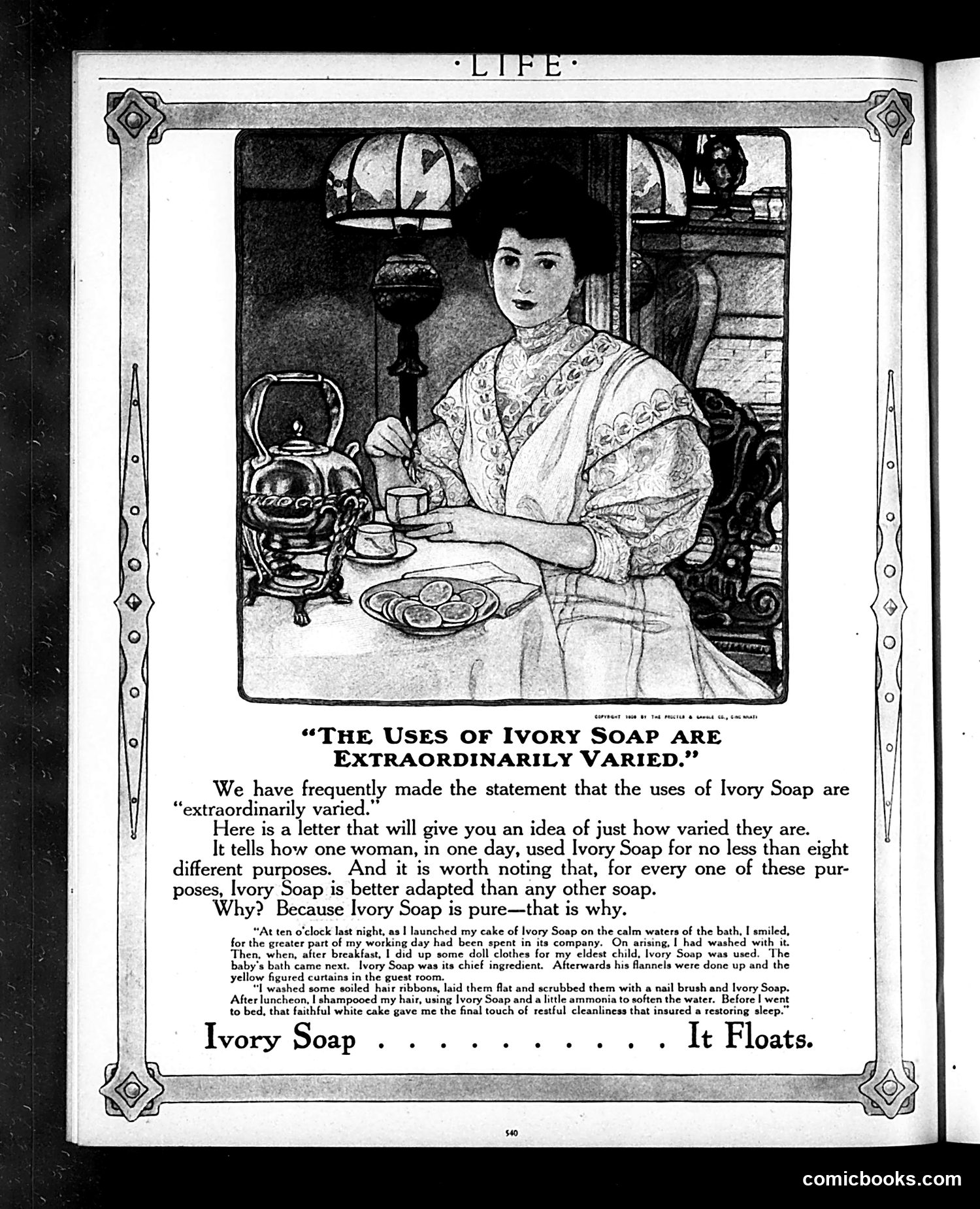
This is a **vintage advertisement, not satire or political commentary**. The page promotes Ivory Soap, a Procter & Gamble product, using a testimonial format common in early 20th-century advertising. The image shows a well-dressed woman at her toilette, and the text describes how one woman allegedly used Ivory Soap for eight different purposes in a single day—bathing, cleaning clothes, washing hair ribbons, and general household cleaning. The advertisement emphasizes the soap's purity and versatility as its selling point. The phrase "It Floats" is Ivory's famous slogan, referring to the soap's unique buoyancy. This appears to be standard product advertising aimed at middle-class housewives, highlighting practical domestic applications rather than containing any satirical or political message.
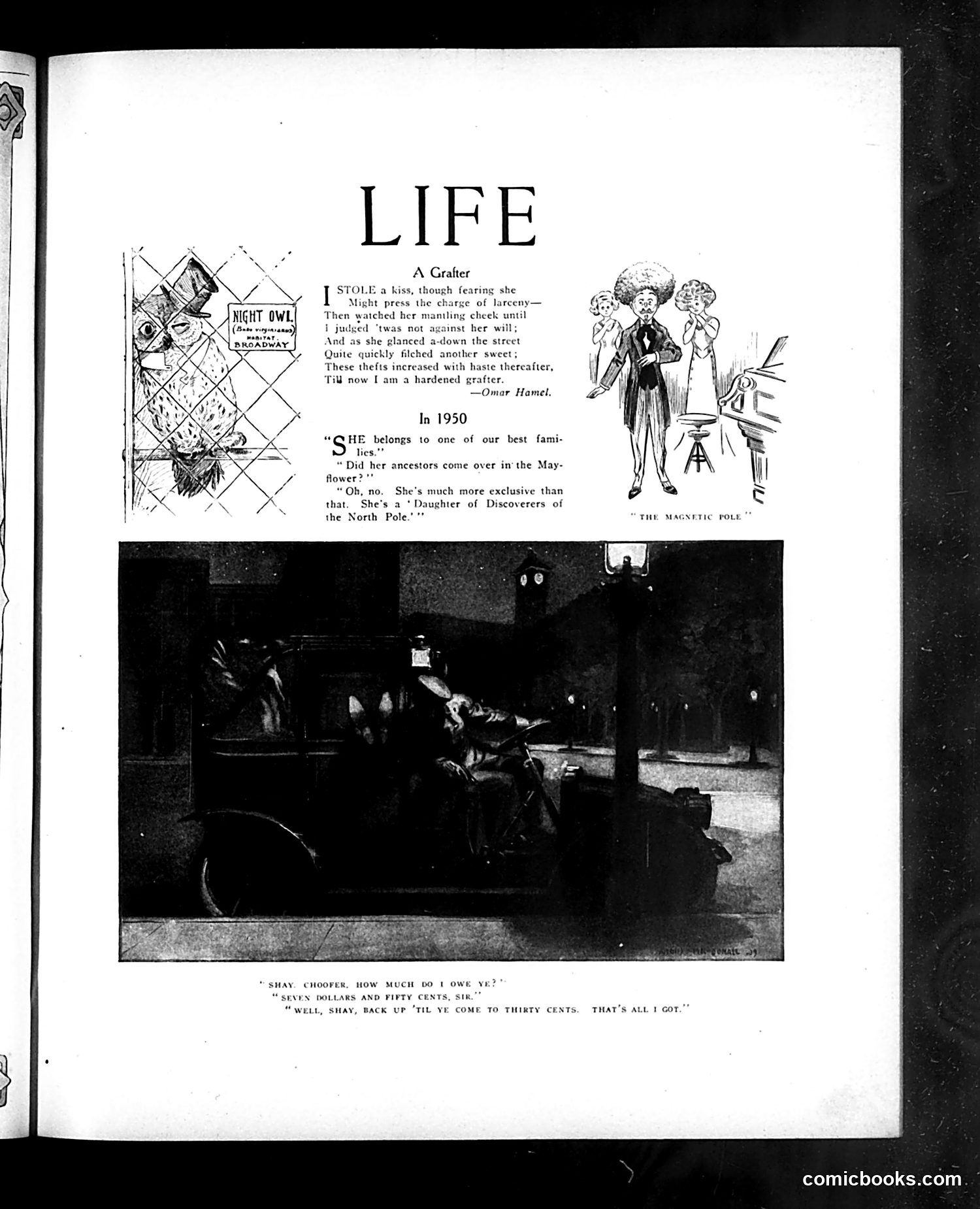
This page contains satirical commentary on social status and ancestry. "A Grafier" presents a poem by Omar Hamel about a man who stole a kiss and is now considered a "hardened grafter" (con artist/swindler) by society. The "In 1950" section mocks social pretension, featuring a woman of humble origins claiming exclusive ancestry—specifically boasting descent from "Discoverers of the North Pole." The accompanying illustration labeled "The Magnetic Pole" shows her with a telescope, satirizing how people fabricate or exaggerate family lineage for social respectability. The photograph below depicts what appears to be a street scene with dialogue about debt repayment ("seven dollars and fifty cents"), using common people's financial struggles for comedic effect. The satire targets American class consciousness and genealogical snobbery.
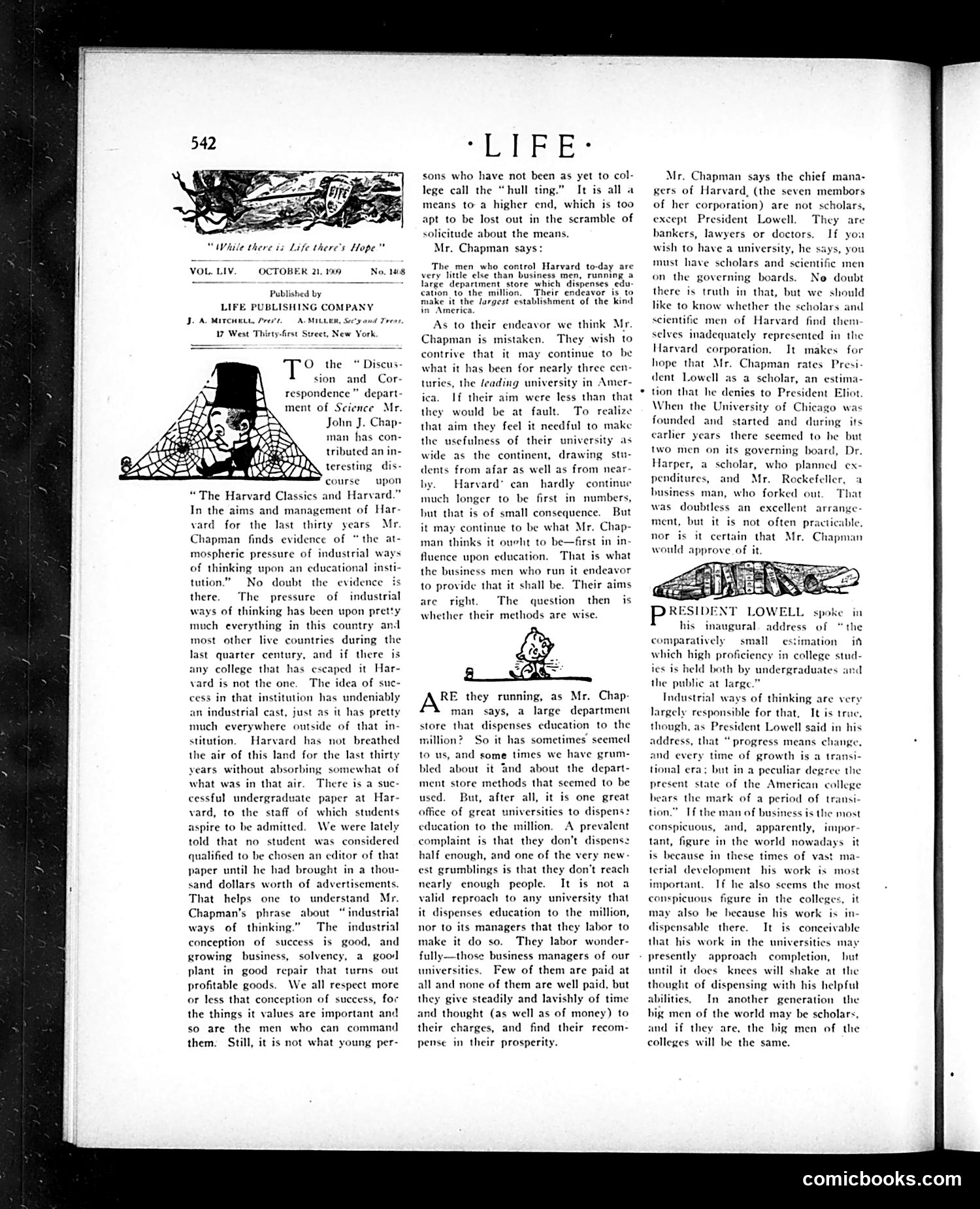
This Life magazine page from October 21, 1909 (Vol. LIV, No. 1468) contains editorial commentary about Harvard University's management and direction, primarily criticizing John J. Chapman's views on the institution's purpose. The text argues that Harvard's leaders are "business men" rather than scholars, and defends the university's broad educational mission against Chapman's apparent criticism that it should prioritize becoming "first in numbers" nationally. The editorial suggests Chapman misunderstands that universities serve multiple constituencies and that their success involves more than scholarly metrics alone. The small decorative illustrations (the stylized initial letters and ornamental vignettes) are typical period design elements, not political cartoons. This page represents serious editorial debate about higher education's role and governance during the Progressive Era.
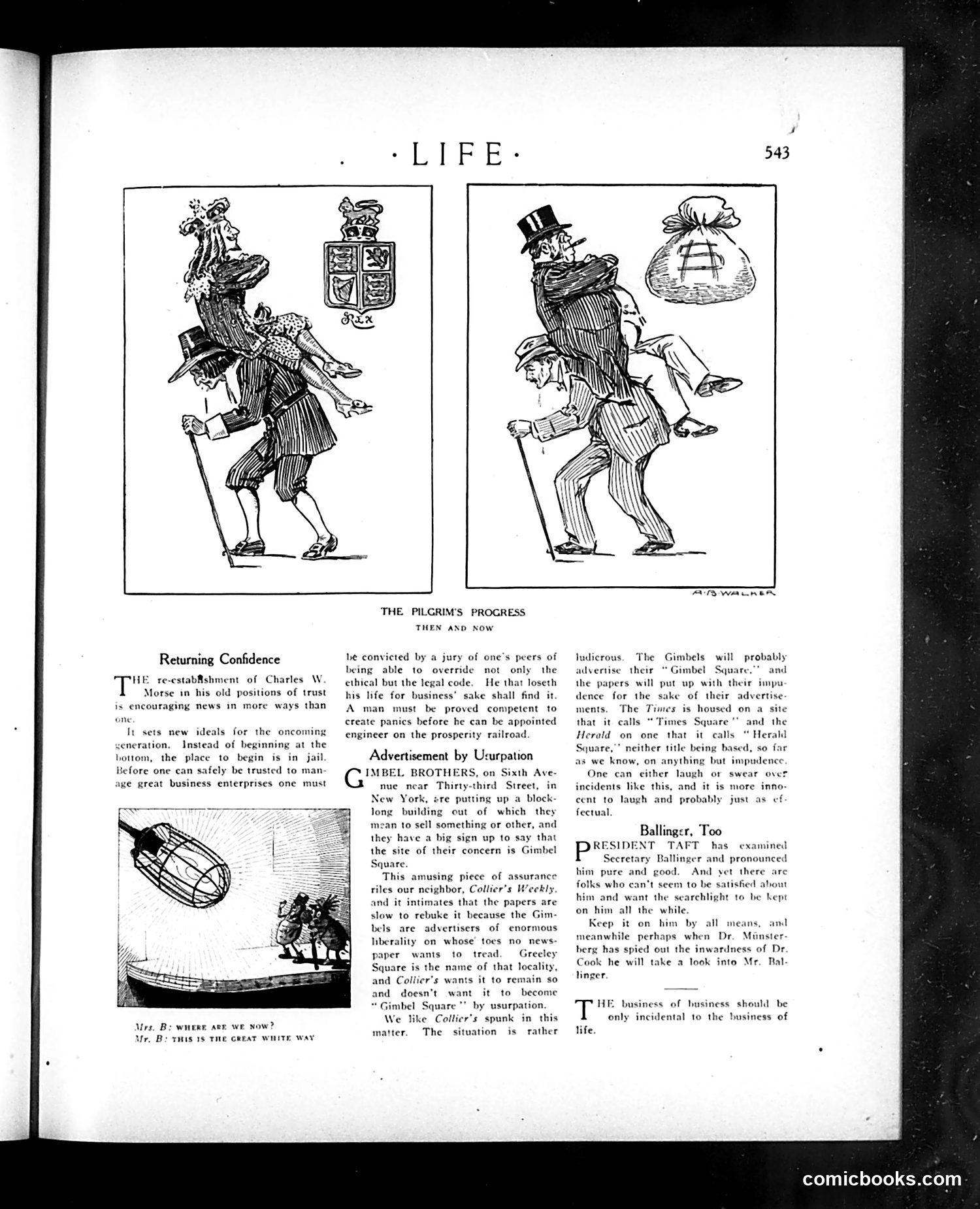
This two-panel cartoon compares past and present versions of "success" or ambition. The left panel shows a figure in formal 18th-century dress, apparently confident and established. The right panel depicts a modern (early 20th-century) businessman in a suit, similarly posed but now juggling multiple burdens—a crying baby, a woman, and other obligations—while still maintaining his top hat and cane. The satire critiques how "progress" has complicated rather than simplified life. While both figures aspire to respectability and status, the modern man carries far more domestic and social pressures. The cartoon suggests that advancement brings not freedom but accumulated responsibilities, mocking the era's notion that contemporary life represented genuine improvement.
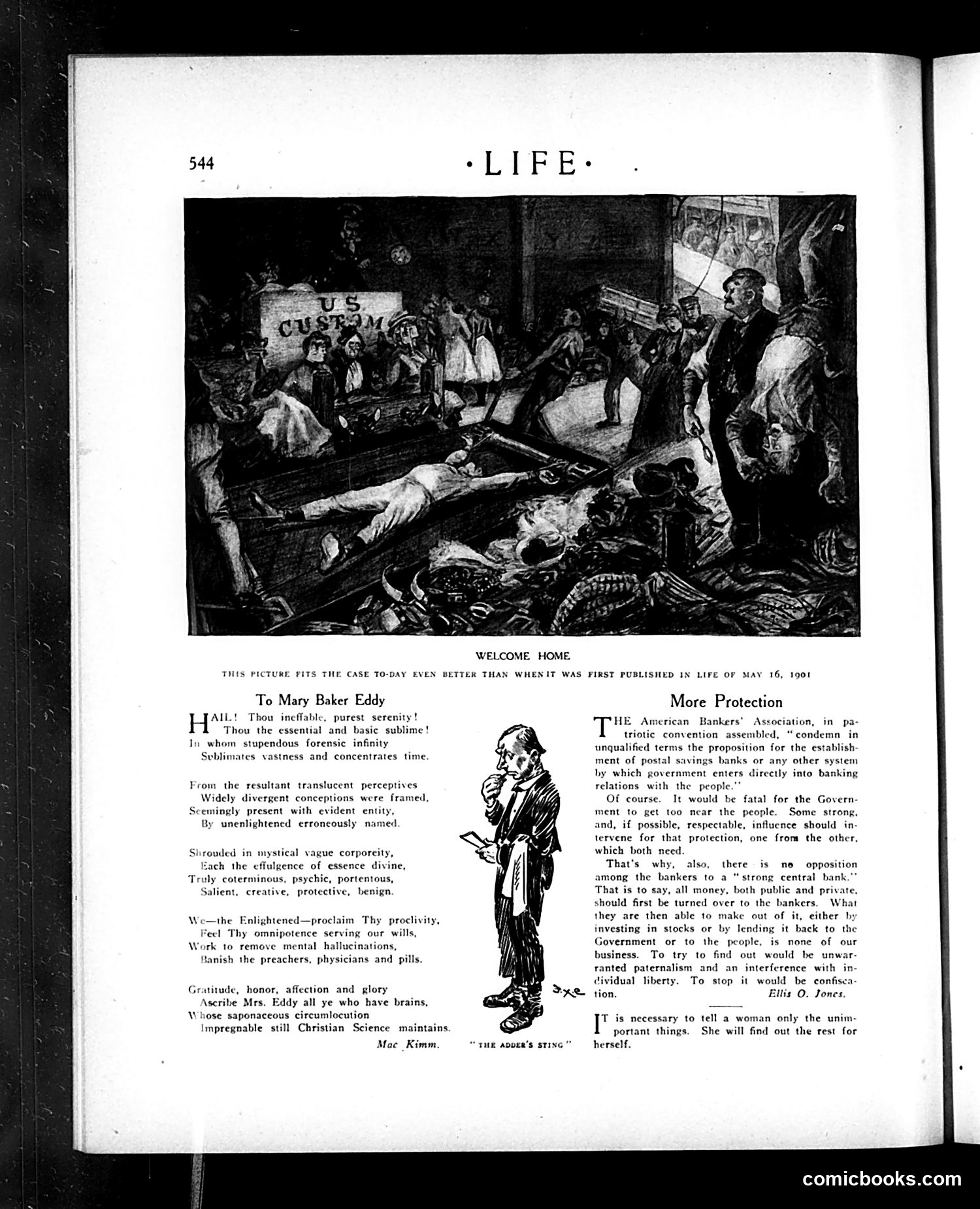
This page combines a dramatic illustration titled "Welcome Home" with accompanying poetry and commentary. The main image depicts a chaotic scene with figures and what appears to be customs or dock activity, suggesting a returning traveler's experience. The accompanying articles include a poem addressed "To Mary Baker Eddy" (founder of Christian Science) praising her spiritual teachings, and a piece titled "More Protection" discussing banking regulation and postal savings banks. The cartoon labeled "The Adder's Sting" (bottom right) appears to be a satirical drawing of a thin figure, likely critiquing some social or political target, though the specific reference is unclear without additional context. The overall page mixes spiritual commentary with economic/regulatory criticism typical of early 1900s satirical journalism.
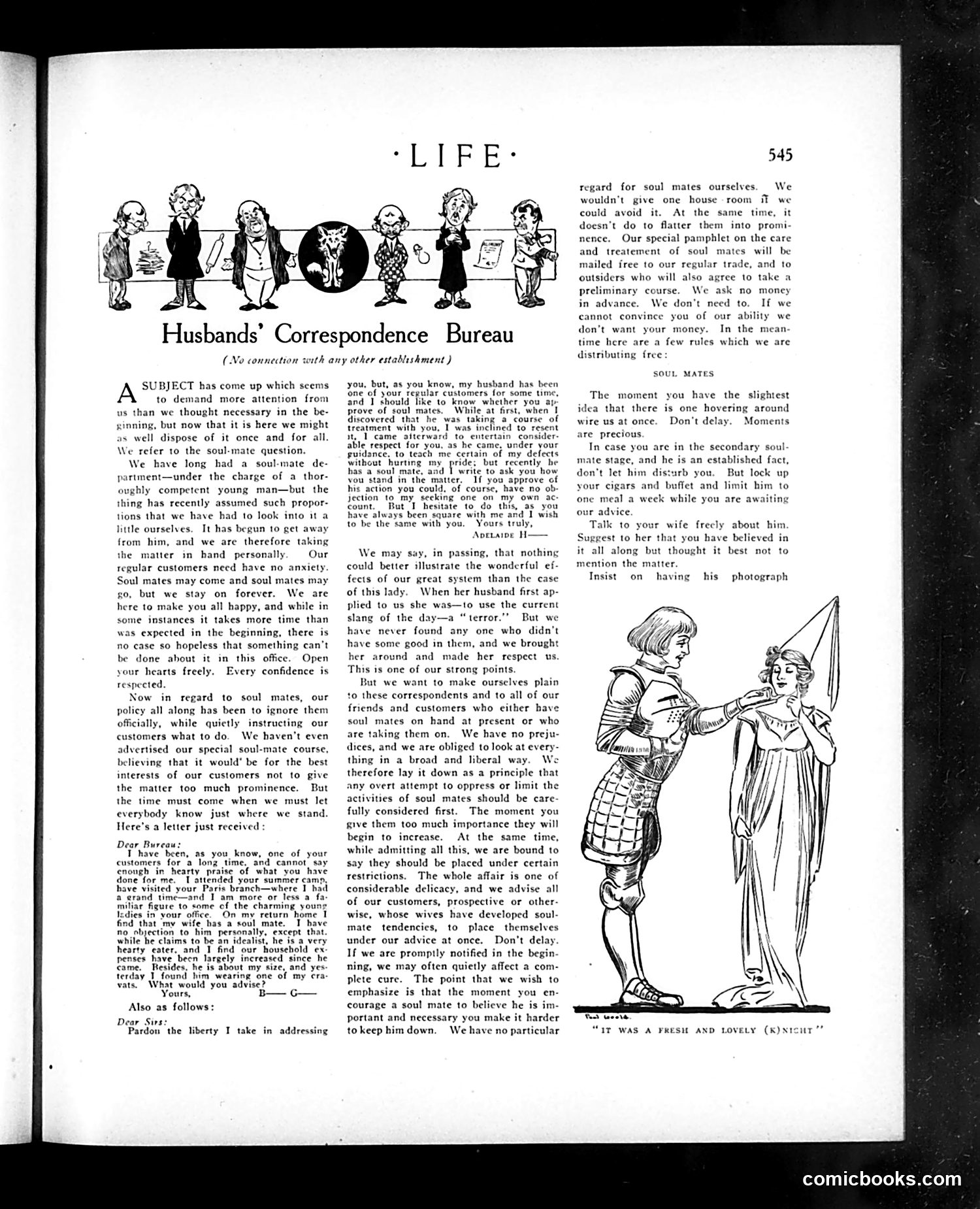
This page satirizes a marital advice service that claims to help women manage their husbands. The cartoon at top shows six caricatured figures representing different husband "types." The satirical premise: the Bureau offers guidance on handling husband defects and misbehavior, claiming special expertise in "soul mate" compatibility. The text mockingly presents advice letters from women complaining about husbands' behavior—excessive drinking, inattention, and financial irresponsibility appear among the issues. The satire targets both the notion that husbands require professional "management" and the era's emerging advice-column industry. By framing marriage as requiring specialized institutional intervention, Life ridicules both naive marital expectations and commercialized relationship guidance. The illustration of a woman presenting her husband like a product reinforces this commodification critique.
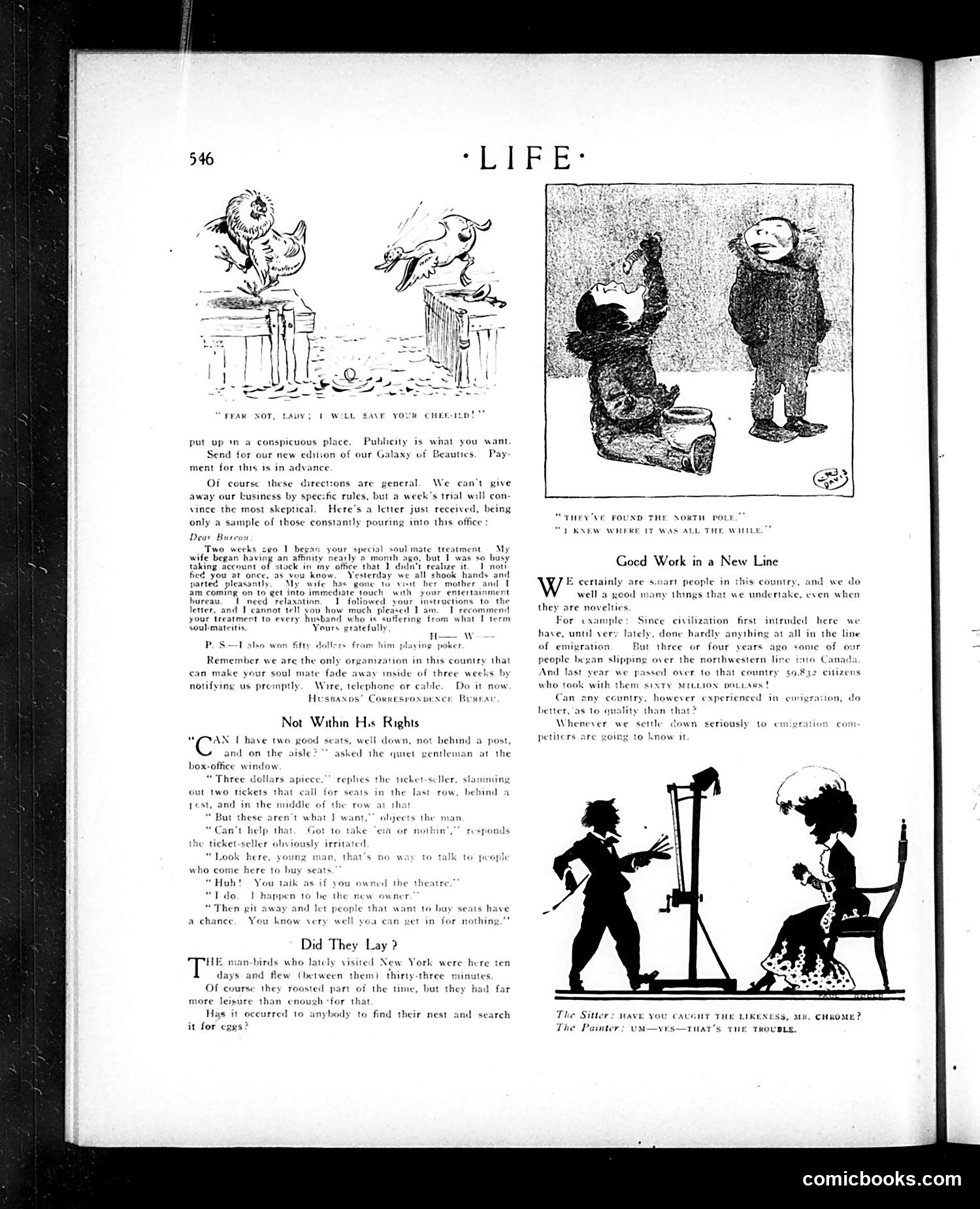
This page contains three satirical pieces: 1. **Top left cartoon**: Two birds on posts discussing saving a "chick"—a visual pun about courtship and marriage prospects. 2. **Top right photograph**: Two children in winter clothing with the caption "They've found the North Pole / I knew where it was all the winter"—likely mocking explorers' claims of polar discovery during the early 20th century. 3. **Main articles**: - "Not Within His Rights" satirizes theater ticket-seller disputes, portraying conflicts between customers demanding specific seating - "Did They Lay?" appears to mock New York bird-watchers searching for bird nests 4. **Bottom cartoon**: Shows a sitter and painter in conflict over a portrait—the painter claims he's captured the "likeness," but the sitter disputes this, suggesting commentary on artistic pretension or unflattering portraiture.
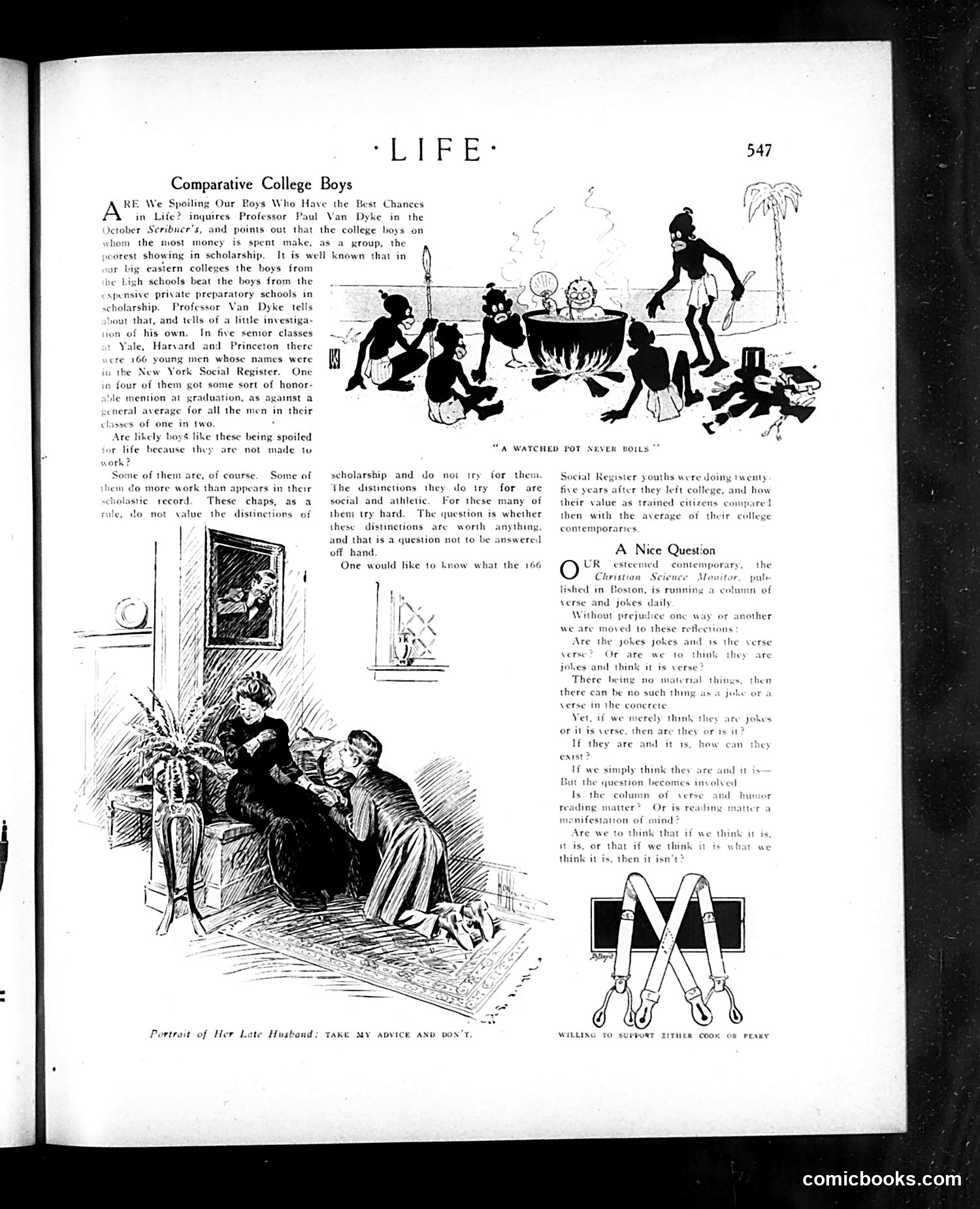
This page satirizes wealthy college students at elite institutions (Yale, Harvard, Princeton). The article criticizes how these boys receive financial support despite poor academic performance, contrasting them with scholarship students who must work harder. The top cartoon shows privileged boys at leisure ("A watched pot never boils"), contrasting their idle behavior with the text's argument that they're "not made to work." The lower illustration ("Portrait of Her Late Husband: Take My Advice and Don't") appears to mock a woman receiving counsel, likely satirizing social pretension or marriage dynamics among the upper classes. The "Nice Question" section debates whether a new Christian Science Monitor column is "verse" or "jokes"—questioning whether it's serious literature or satire itself.
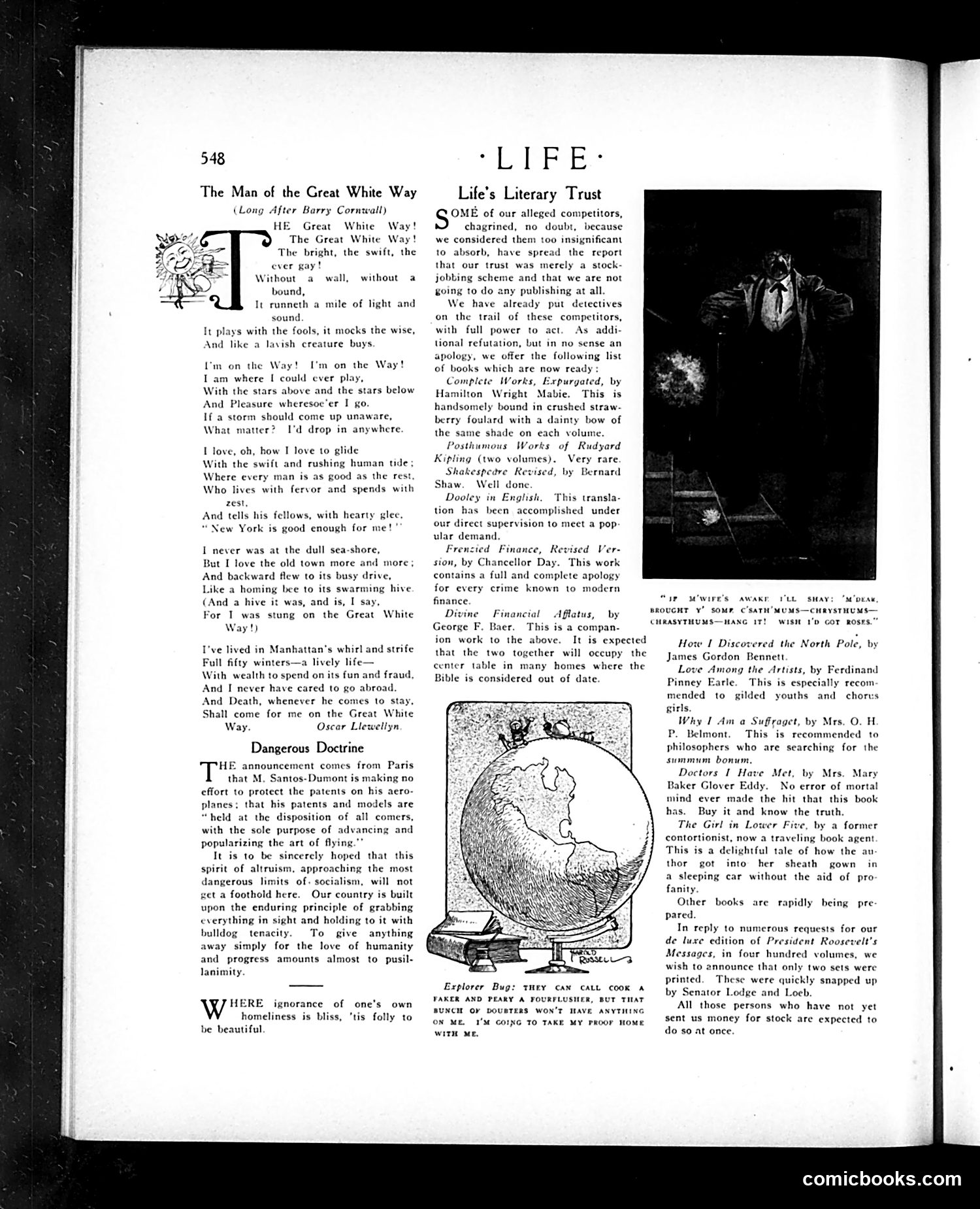
This page contains a poem "The Man of the Great White Way" (about Broadway) and a section called "Life's Literary Trust" recommending books. The main cartoon shows an **Explorer's Bag** — a round, bulbous pouch depicted as a globe or sphere. The caption reads: "THEY CAN CALL A FAKIR AND PESKY A FOURSLUSHER, BUT THAT BUNCH OF DOUBTERS WON'T HAVE ANYTHING ON ME. I'M GOING TO TAKE MY PROOF HOME WITH ME." This appears to satirize **explorers who claim fantastic discoveries** but lack credible evidence. The joke mocks the gap between grand adventuring claims and actual verification — the explorer carries a vague "bag of proof" that's visually absurd and unconvincing. It's a jab at popular exploration narratives and the public's gullibility regarding unsubstantiated discoveries.
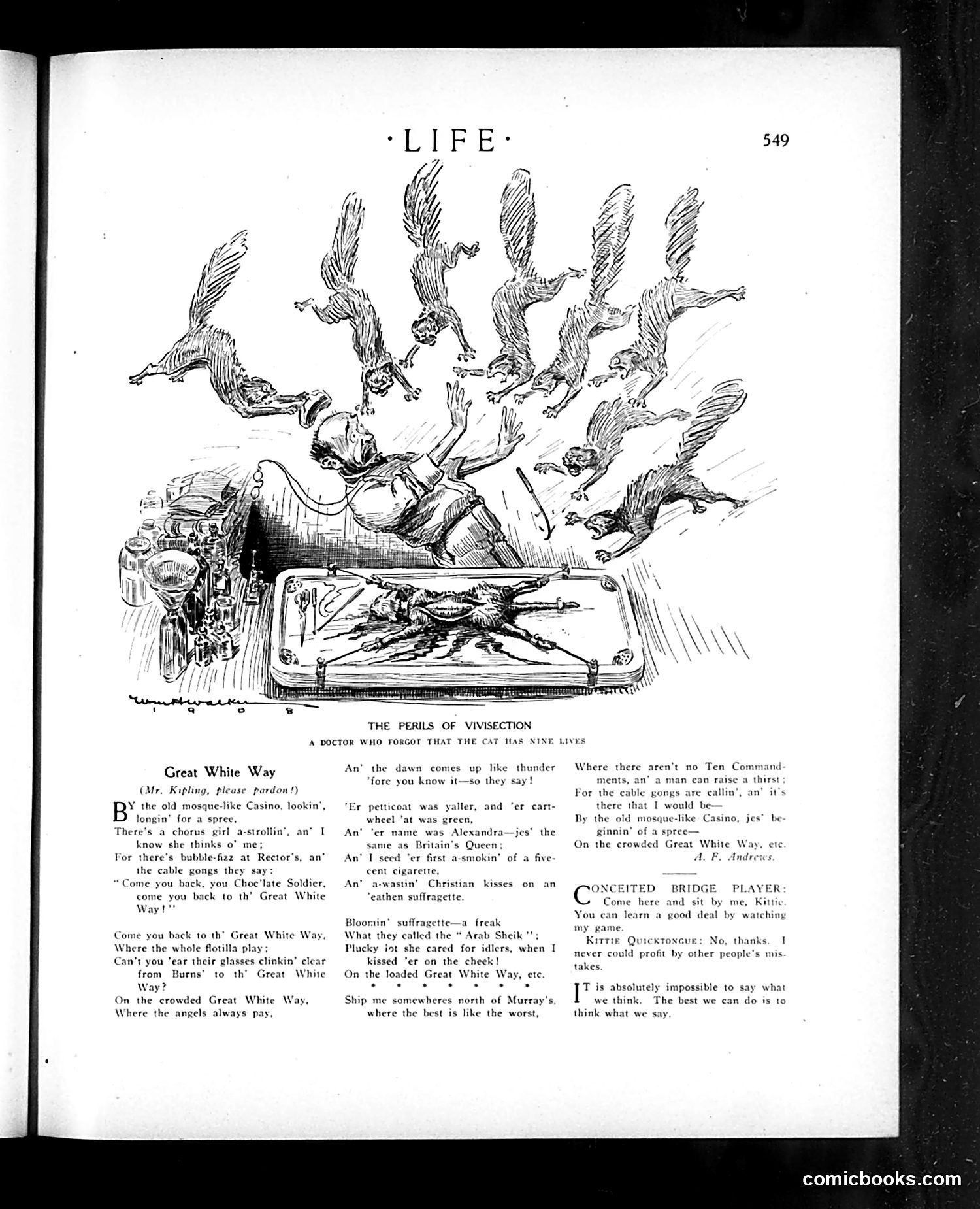
This cartoon satirizes medical vivissection (operating on living animals) through a humorous visual pun. The illustration shows a cat knocked backward by what appears to be a explosion of smaller cats or cat-like creatures bursting upward from an operating table—a literal interpretation of the old saying that "the cat has nine lives." The caption reads: "A doctor who forgot that the cat has nine lives," suggesting the doctor underestimated his subject's resilience or vitality. The accompanying text pieces ("Great White Way" and "Conceited Bridge Player") appear unrelated jokes from the same magazine page. This cartoon likely mocked both animal research practices and the superstition about cats' multiple lives.
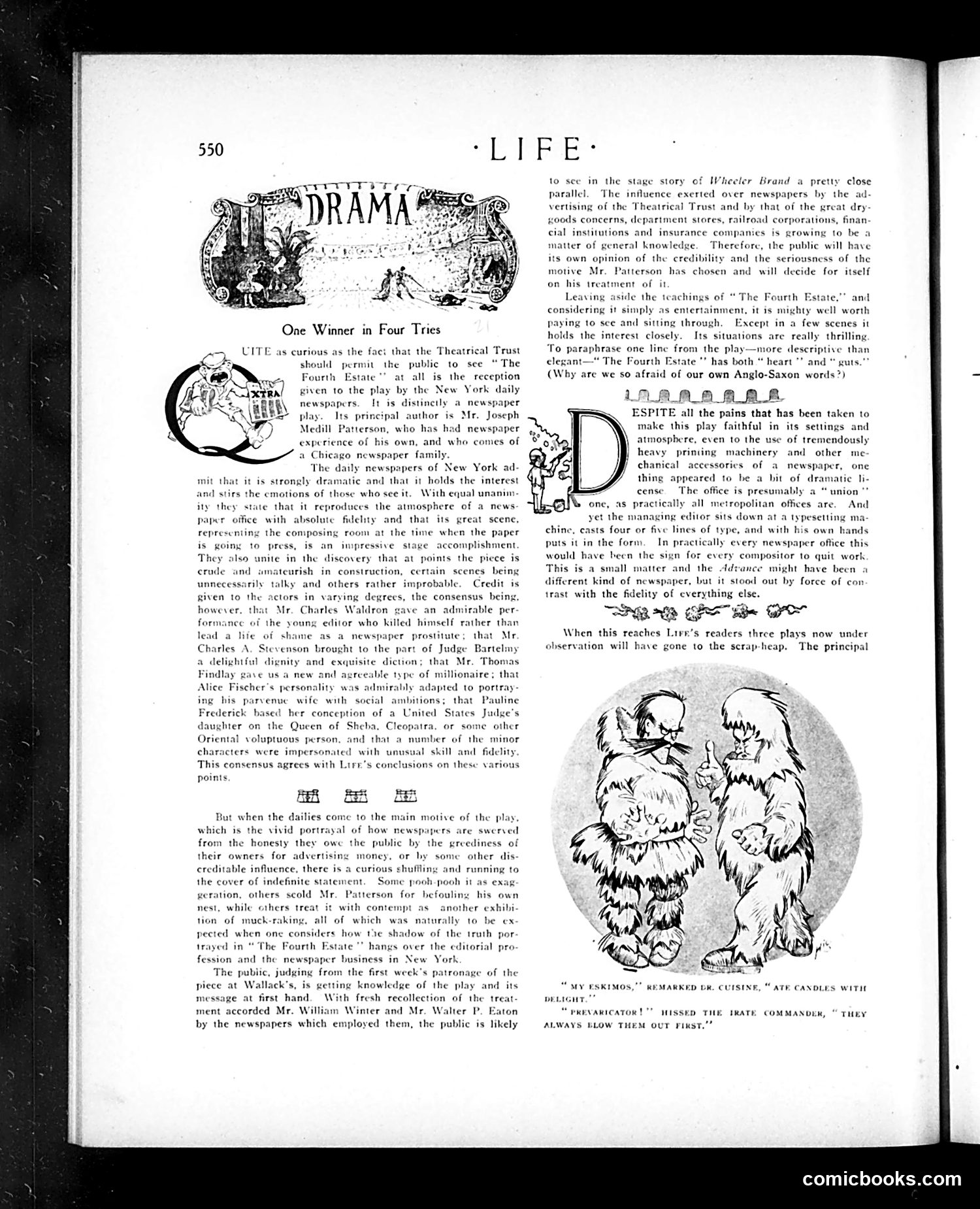
This page reviews Joseph Medill Patterson's play *"The Fourth Estate,"* which dramatizes corruption in New York newspapers. The central satire concerns how newspapers—supposedly guardians of public truth—actually serve corporate interests through advertiser pressure and owner greed. The play's protagonist, Wheeler Brand, is an editor who kills himself rather than compromise journalistic integrity. The reviewer notes that New York dailies unanimously praised the play's technical merit and atmospheric accuracy but conspicuously avoided discussing its central critique: that newspapers betray public trust for advertising revenue from department stores, railroads, and insurance companies. The cartoon (lower right, caption partially visible) appears to satirize newspaper hypocrisy—praising the play while implicitly defending the very corruption it exposes. The reference to critics William Winter and Walter P. Eaton suggests real journalists suffered professionally for criticizing their employers, supporting the play's premise that American newspapers prioritized profits over truth.
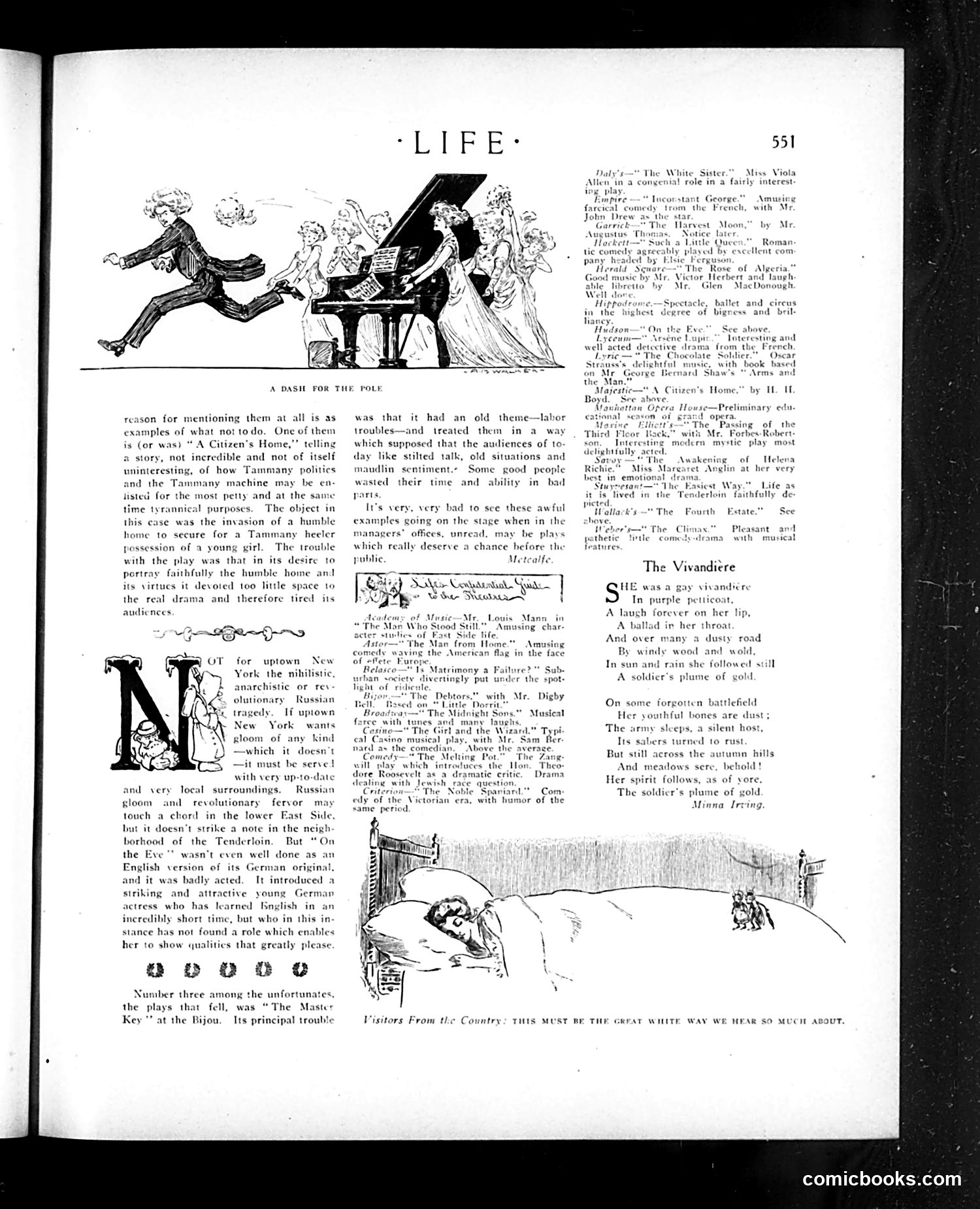
This page critiques several Broadway plays of the early 1900s. The top cartoon depicts a performer frantically fleeing from a grand piano—likely satirizing overambitious or poorly-executed theatrical productions. The text mocks specific plays for their failures. "A Citizen's Home" (about Tammany Hall political corruption) is criticized for dull execution despite serious subject matter. "On the Eve," a Russian revolutionary tragedy, is dismissed as pretentious—appealing to "uptown" sophisticated audiences but poorly acted and irrelevant to working-class neighborhoods like the Tenderloin. The author laments that theatre managers reject worthy scripts while staging tired, outdated productions with "stilted talk" and "maudlin sentiment." The reviews suggest Life's readers were sophisticated enough to appreciate both socially conscious drama and well-crafted entertainment—but expected competent execution regardless of a play's ambitions. The accompanying illustration shows "Visitors From the Country," contrasting rural visitors with urban theatre culture.
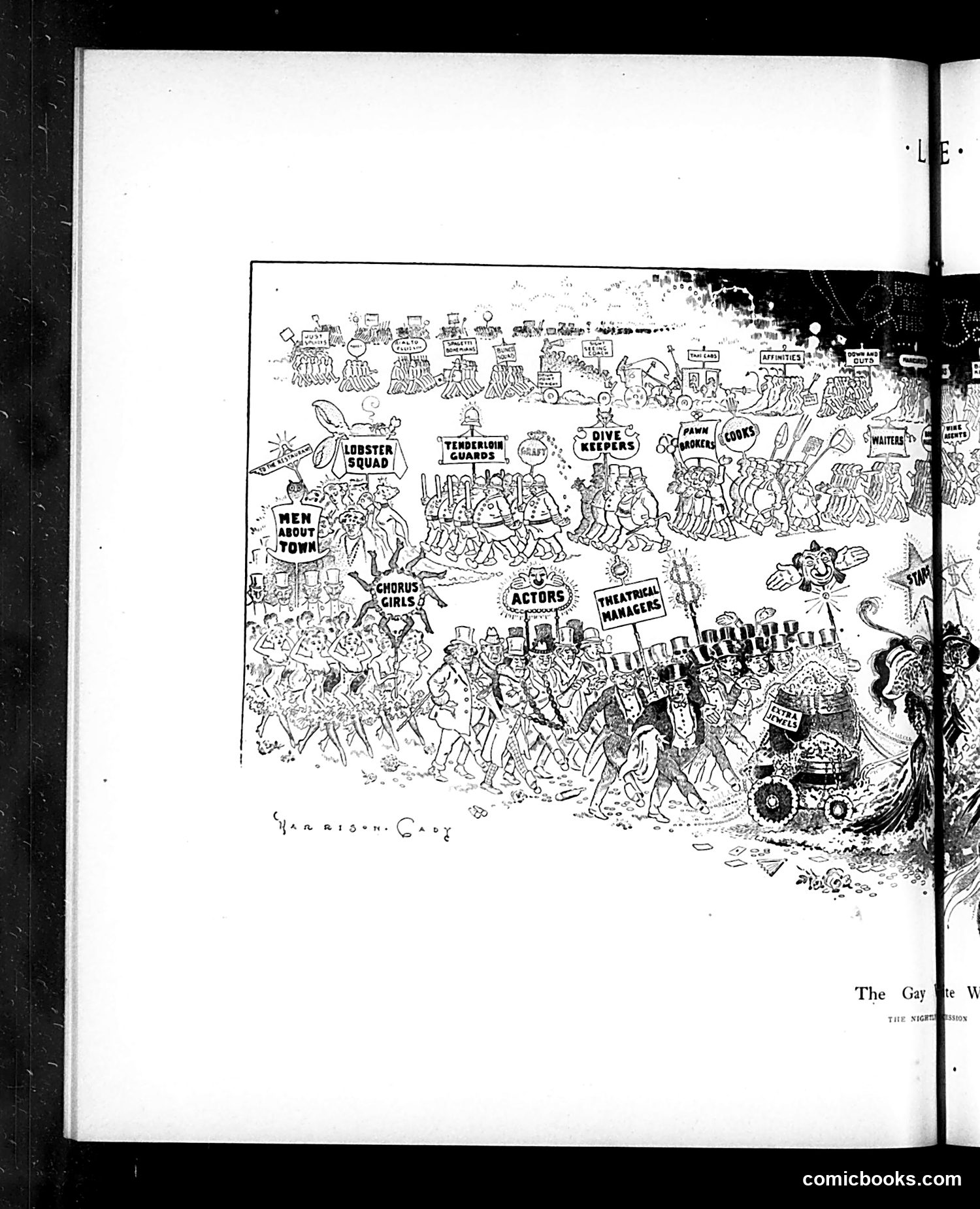
This is a densely-packed satirical cartoon depicting the theatrical world, signed by what appears to be "Harrison Cady." The illustration shows a chaotic crowd scene labeled with various theater industry roles and positions: "Lobster Squad," "Dive Keepers," "Pawn Brokers," "Chorus Girls," "Actors," and "Theatrical Managers" among others. The cartoon satirizes the Broadway/theatrical ecosystem—mocking the various hangers-on, hustlers, and supporting characters that surrounded professional theater. Labels like "Lobster Squad" (likely referring to well-dressed patrons) and the mix of performers, financial operators, and various types suggest social commentary on theater's commercial aspects and the diverse characters profiting from or involved in the entertainment industry. The chaotic composition itself reinforces the satire: organized chaos representing the theatrical world's complexity and sometimes dubious dealings.
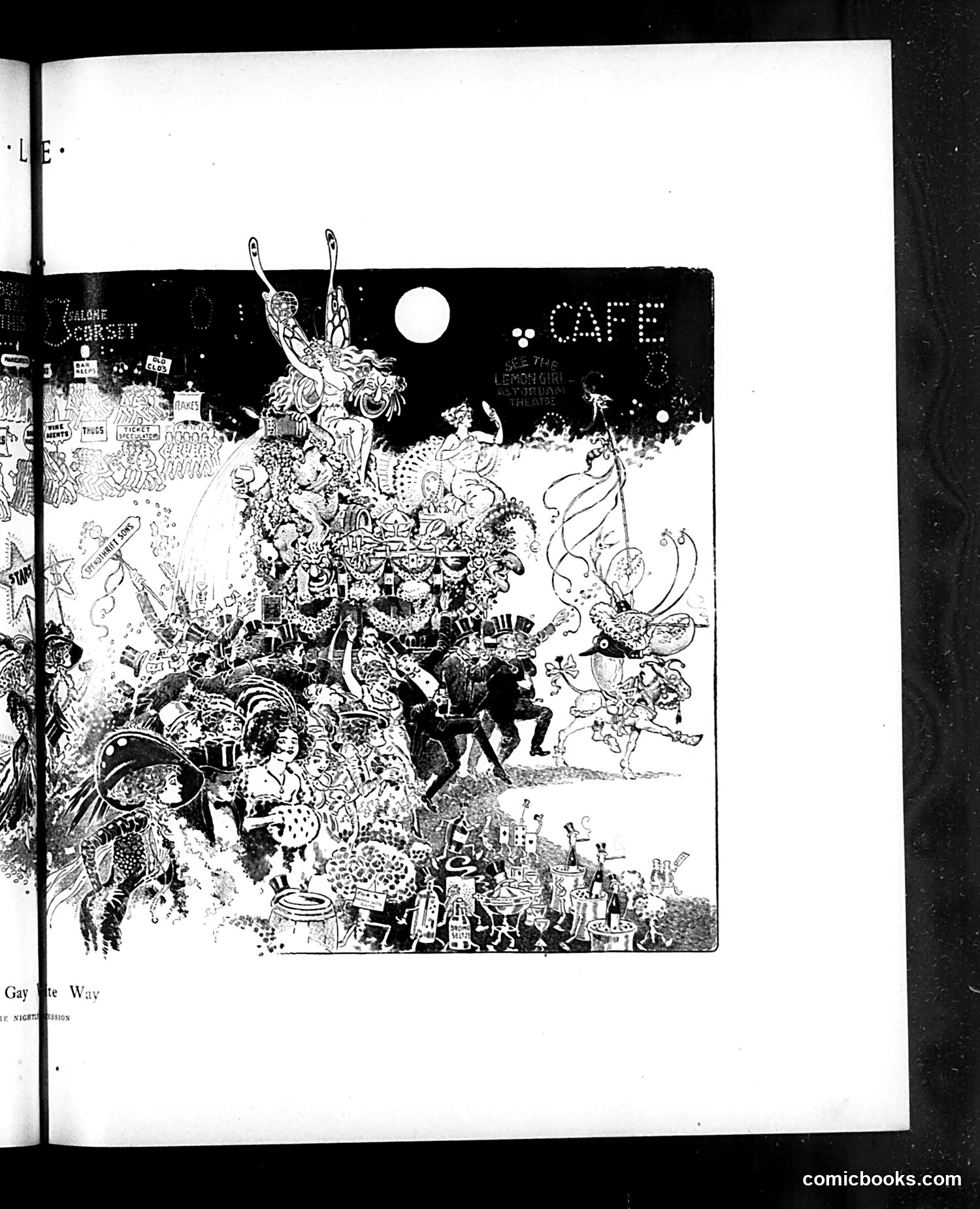
This elaborate satirical illustration depicts a chaotic nightclub or cabaret scene labeled "CAFÉ." The composition is densely packed with caricatured figures engaged in revelry, drinking, and dancing beneath a full moon. The style suggests early-to-mid 20th century bohemian nightlife satire. The cartoon appears to mock Jazz Age excess and urban entertainment culture—likely targeting speakeasy culture or the perceived moral decay of city nightlife. The grotesque character caricatures and frenzied activity suggest social commentary on modern decadence. Specific identifications of individual figures are unclear from the image alone. The overall point seems to be satirizing the exuberant, chaotic nature of contemporary nightclub society, though without clearer text or historical context, the precise political or social targets remain ambiguous.
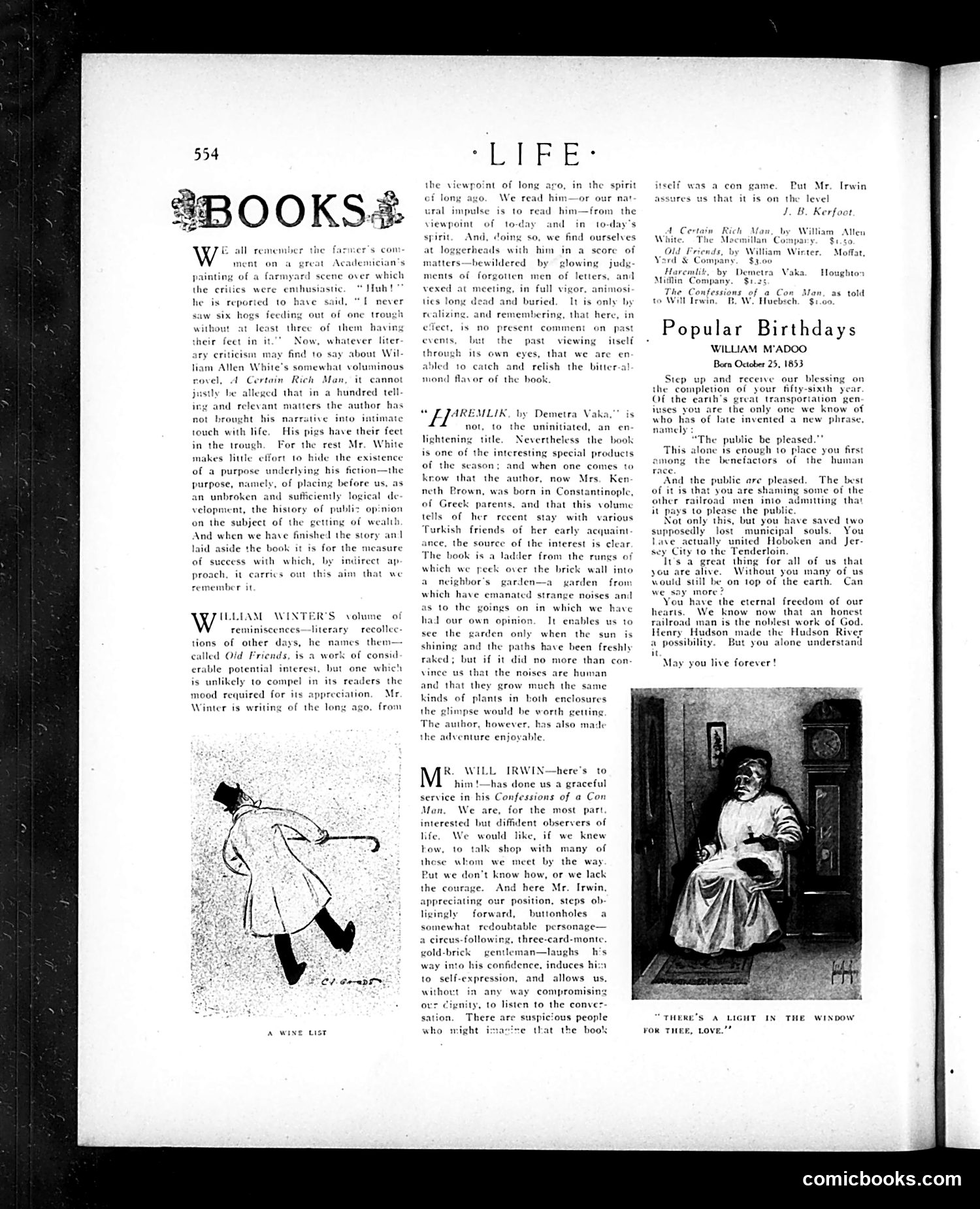
This is a **books review section** from Life magazine, featuring literary criticism rather than political cartoons. The page discusses several works: **William Allen White's "A Certain Rich Man"** is critiqued for its transparent moral purpose—depicting how public opinion shapes wealth accumulation. The reviewer notes White doesn't hide his didactic intent, comparing it to a farmyard painting where pigs' feet visibly touch the trough. **William Winter's "Old Friends"** (reminiscences) is faulted for presenting outdated literary judgments and long-dead feuds without modern context, making it difficult for contemporary readers. **"Haremlick" by Demetra Vaka** is praised as an interesting insider's perspective on Constantinople domestic life—allowing readers to glimpse behind garden walls into unfamiliar cultural spaces. **Will Irwin's "Confessions of a Con Man"** is commended for gracefully introducing readers to colorful characters (circus followers, con artists) in an accessible, entertaining manner. The single cartoon ("A Wine List") appears to be decorative rather than satirical.
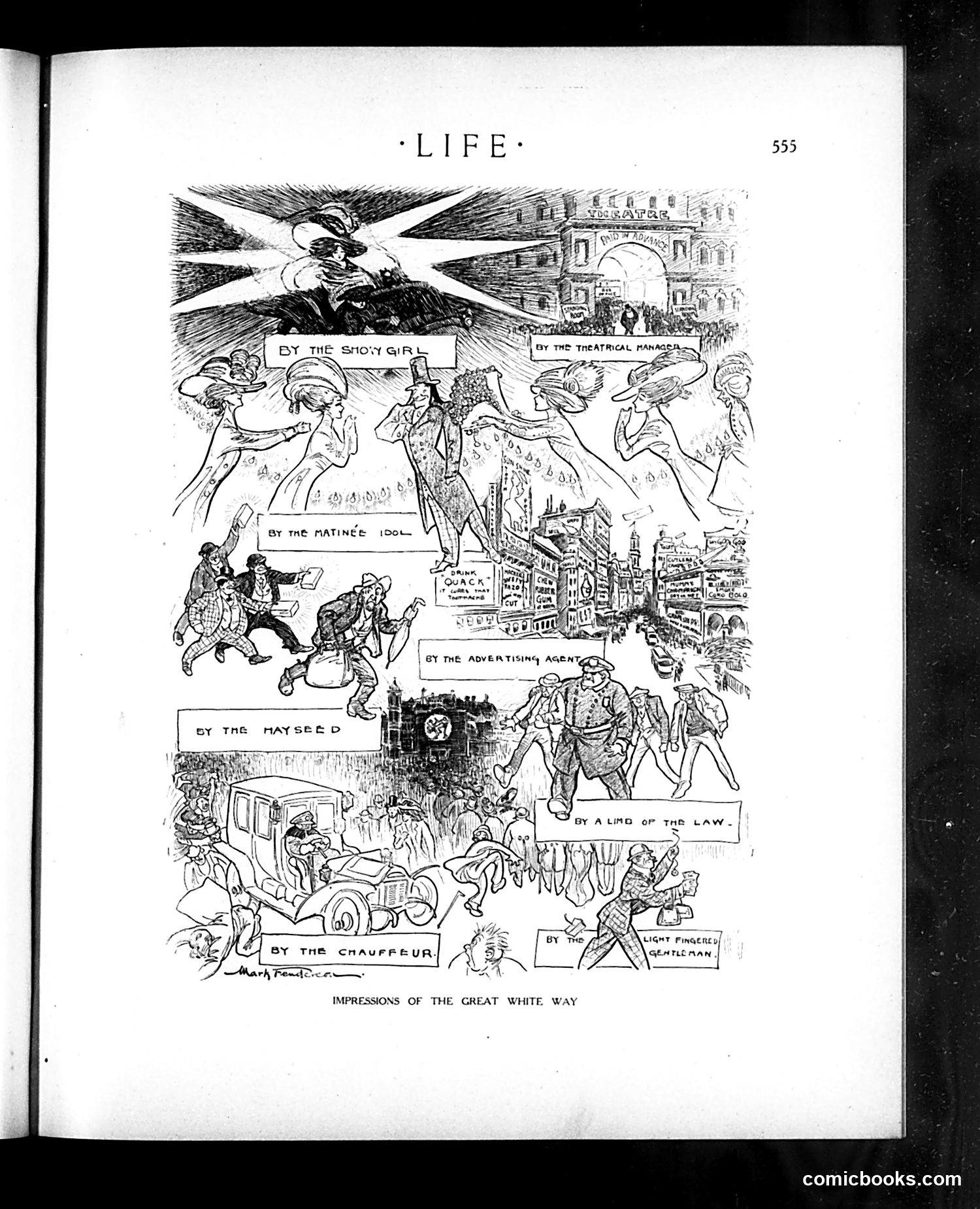
This satirical illustration depicts various figures who influence Broadway theater productions, labeled with their roles: "By the Showy Girl," "By the Theatrical Manager," "By the Matinee Idol," "By the Advertising Agent," "By the Maybe'd," "By the Chauffeur," "By a Limb of the Law," and "By the Light Fingered Gentleman." The cartoon mocks how different Broadway personalities and professions—from performers to managers to police to petty criminals—shape the theater district's character and reputation. "The Great White Way" refers to Broadway's famous bright lights. The satirical point appears to be that Broadway's glamorous image results from contributions by diverse, sometimes questionable figures, including theatrical folk, advertising people, and even criminals ("light fingered gentleman" likely refers to pickpockets). The crowded, chaotic composition emphasizes the district's bustling, morally complex nature.
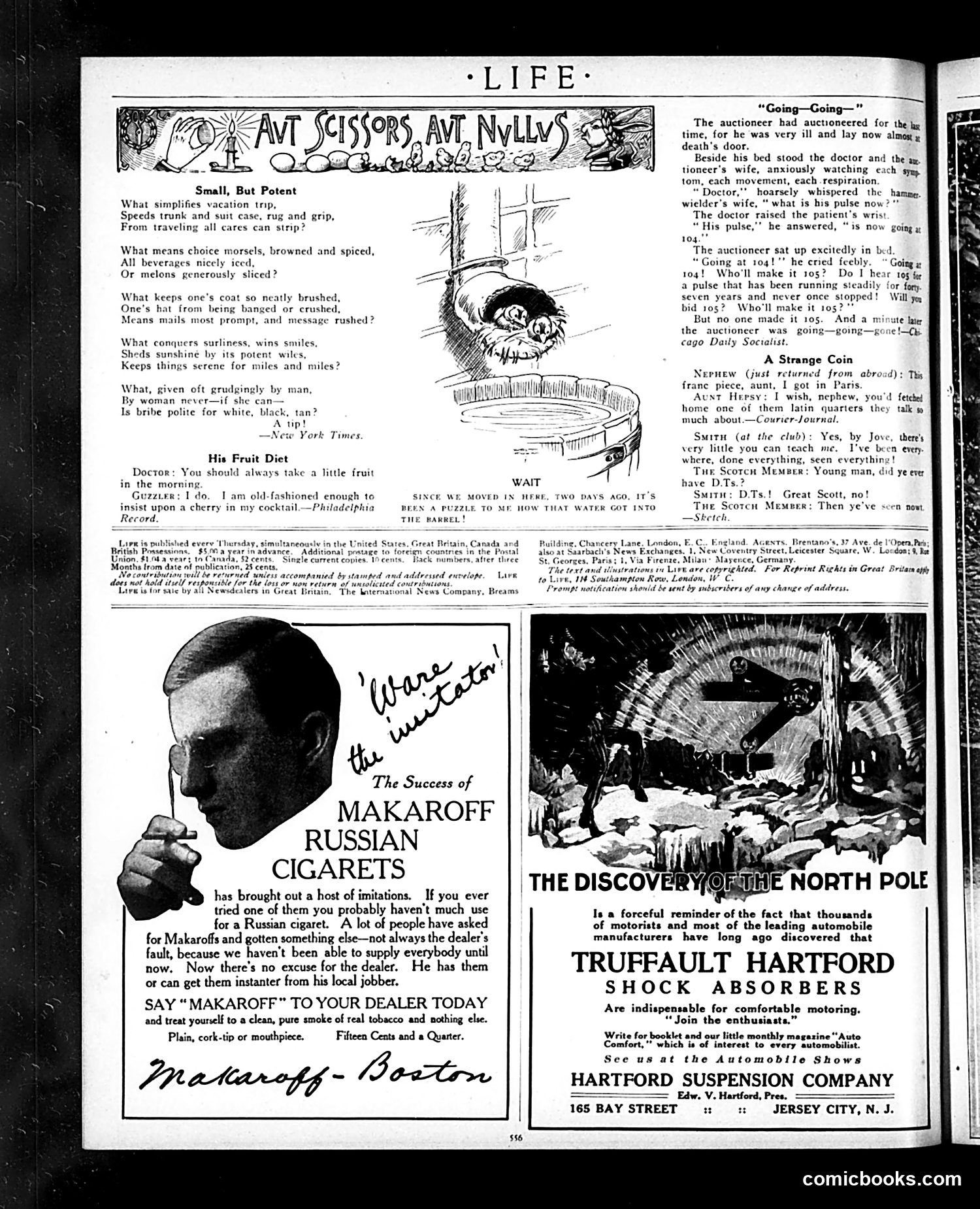
This page from *Life* magazine (a satirical publication) contains humor pieces and advertisements typical of the early 20th century. **The Cartoons/Jokes:** The main content includes several short humorous pieces: "Small, But Potent" (a riddle about bribes), "His Fruit Diet" (a doctor/patient joke about cherries in cocktails), and several anecdotes including "Going—Going—" (a darkly comic story about a dying auctioneer whose pulse becomes an auction item) and "A Strange Coin" (travel-related humor). **The Advertisements:** The page features ads for Makaroff Russian Cigarettes (positioning them as superior to imitations) and Truffault Hartford Shock Absorbers for automobiles, framing them as essential for "comfortable motoring." **Context for Modern Readers:** The humor relies on wordplay and social observations about early 1900s life—vacation packing, dining, bribery norms, and motoring. The cigarette ad assumes smoking as normal; the auto ads target an emerging automobile culture. The overall tone is genteel satirical humor aimed at middle-class readers.
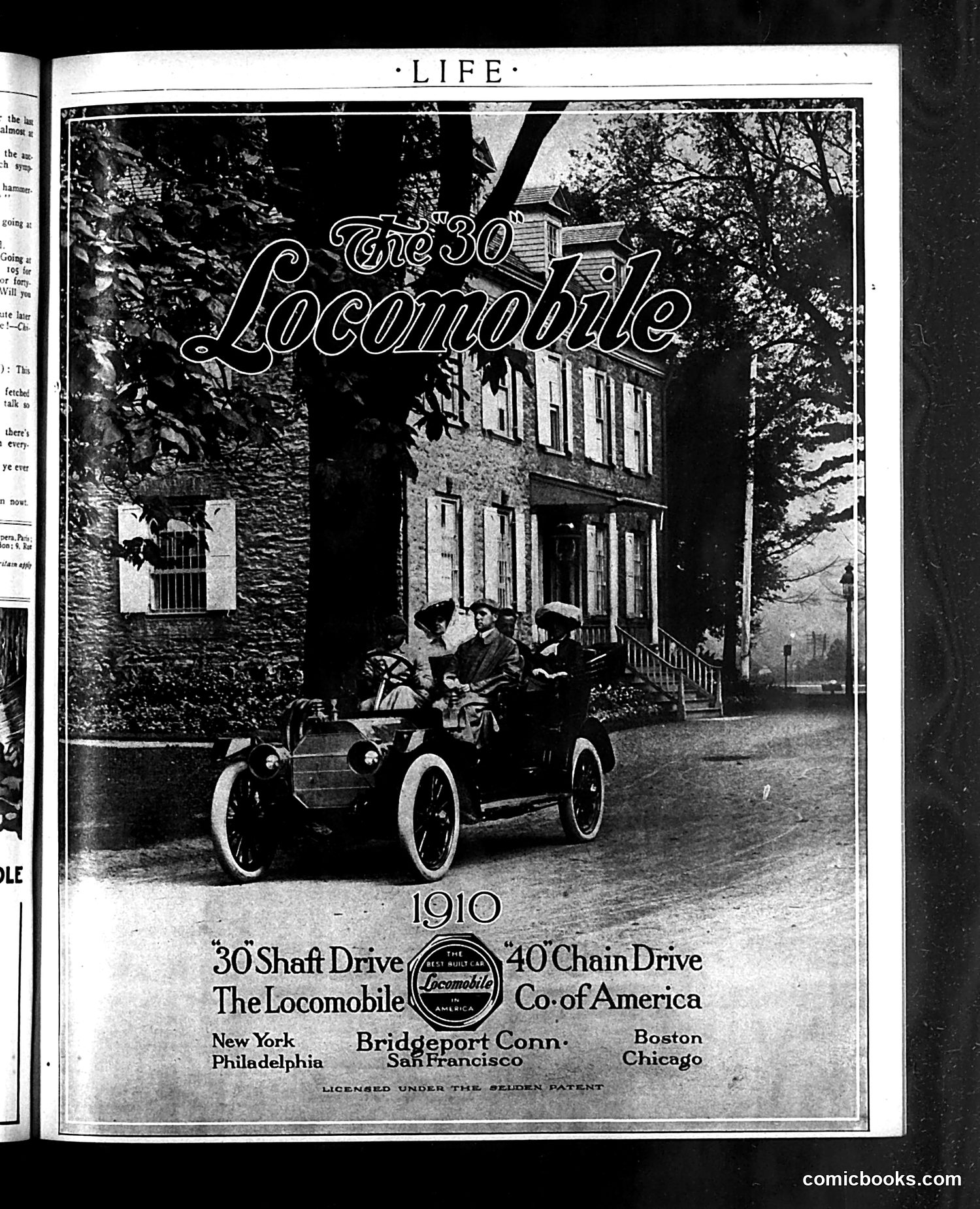
This is primarily an **advertisement**, not a political cartoon. It's a full-page ad for the 1910 Locomobile automobile, placed in *Life* magazine. The image shows a early motorcar with several passengers driving past an elegant mansion, framed by large trees. The ad emphasizes the vehicle's features: "30' Shaft Drive" and "40' Chain Drive." The Locomobile Company of America lists multiple cities where the car is available (New York, Philadelphia, Bridgeport, San Francisco, Boston, Chicago). This represents early 1910s automotive advertising—the car itself is the novelty being sold to wealthy readers, positioned as a luxury good for the affluent. No political satire is present; this is straightforward commercial promotion in a magazine known for humor and social commentary.
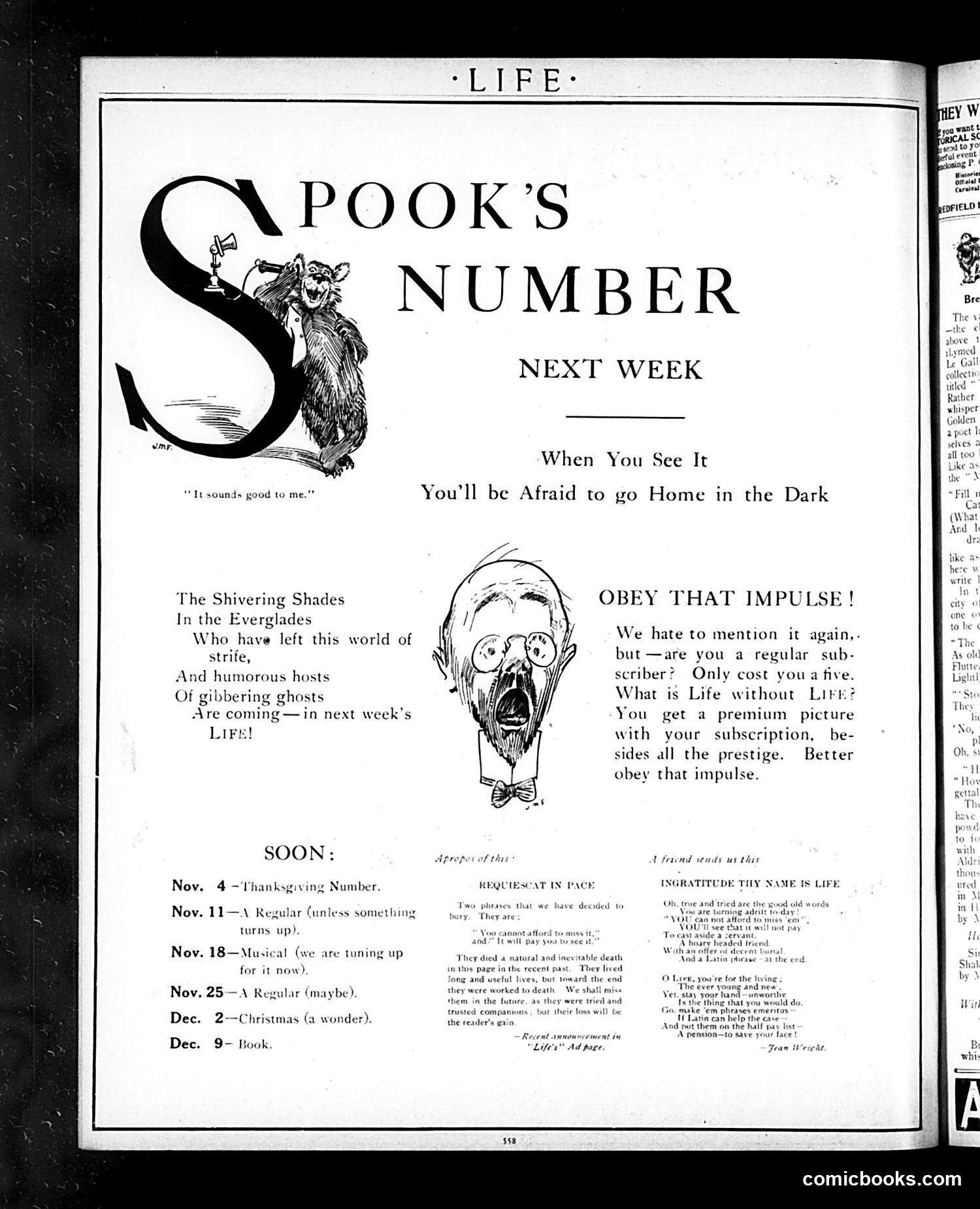
This is a **promotional page** for Life magazine's upcoming Halloween-themed issue. The centerpiece features a large decorative "S" with a rat climbing it, announcing a "Spook's Number" coming the following week. The satire works on two levels: 1. **Halloween Promotion**: The page teases a special Halloween issue featuring ghost stories ("Shivering Shades / In the Everglades") designed to frighten readers—the tagline promises "You'll be Afraid to go Home in the Dark." 2. **Subscription Pitch**: Disguised within the spooky theme is a direct sales appeal ("OBEY THAT IMPULSE!"), pressuring readers to subscribe by claiming they get premium pictures and prestige. The phrase itself is somewhat mocking—the magazine is self-aware about its aggressive marketing tactics. The lower section humorously "buries" overused phrases from Life's advertising copy, poking fun at their own editorial clichés. This is primarily a **sales-focused advertising page** rather than political satire, using Halloween theatricality to drive subscriptions.
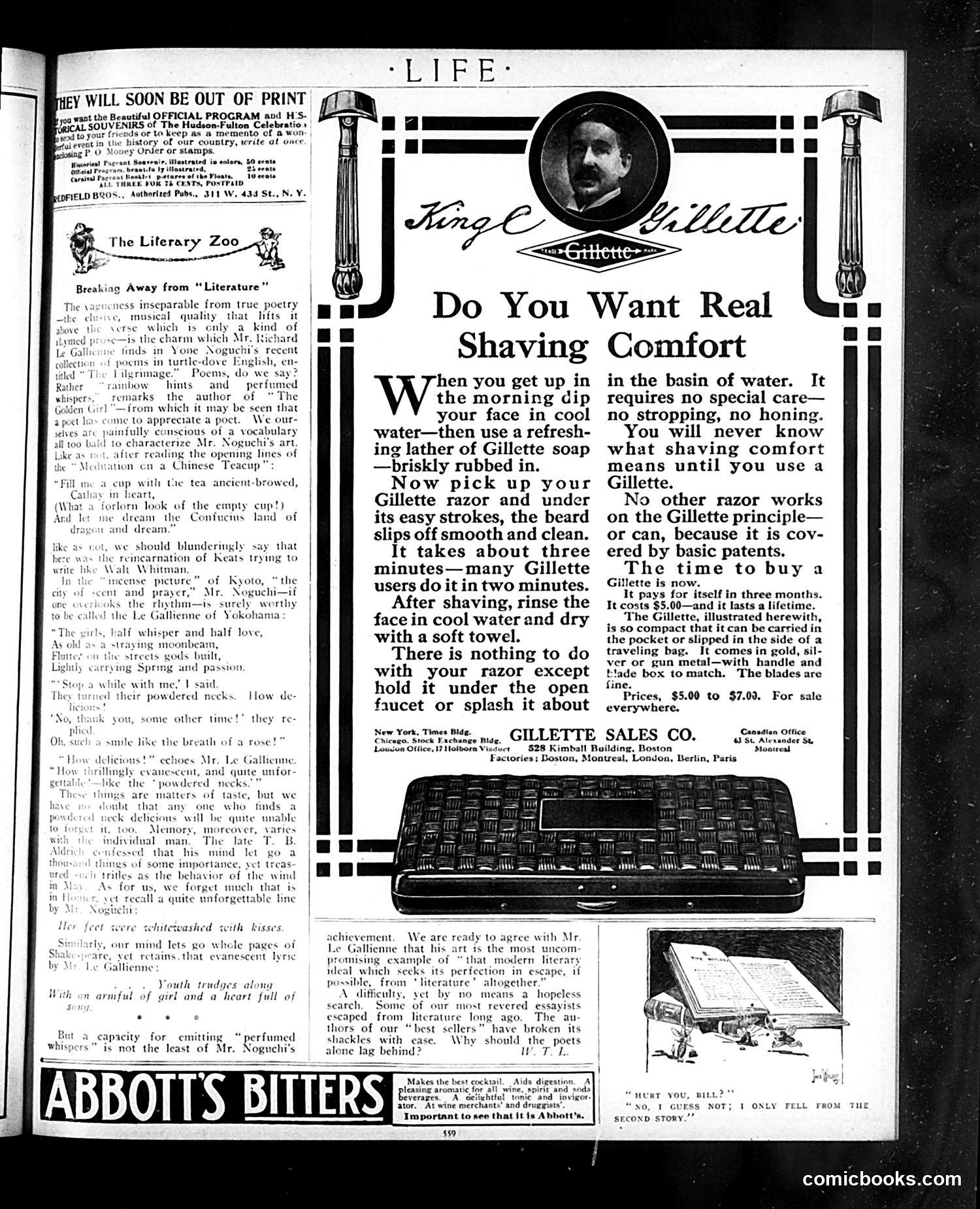
This page juxtaposes literary criticism with commercial advertising—a typical Life magazine format. **"The Literary Zoo" section** satirizes poet Yone Noguchi and critic Richard Le Gallienne's pretentious aestheticism. The critic uses flowery, overwrought language to praise Noguchi's verse ("feet were whitewashed with kisses"), which Life mocks as absurdly affected. The satire suggests that both poet and critic are breaking from genuine literature into self-indulgent affectation—hence "breaking away from 'Literature.'" **The Gillette ad** occupies most of the page with straightforward product copy promoting the safety razor's convenience and durability. It's positioned as practical, modern, and economical—the antithesis of the precious literary world above. The juxtaposition is the joke: Life contrasts overwrought "literary" pretension with unadorned commercial pragmatism, implicitly suggesting the ad copy is more honest than Le Gallienne's purple prose.
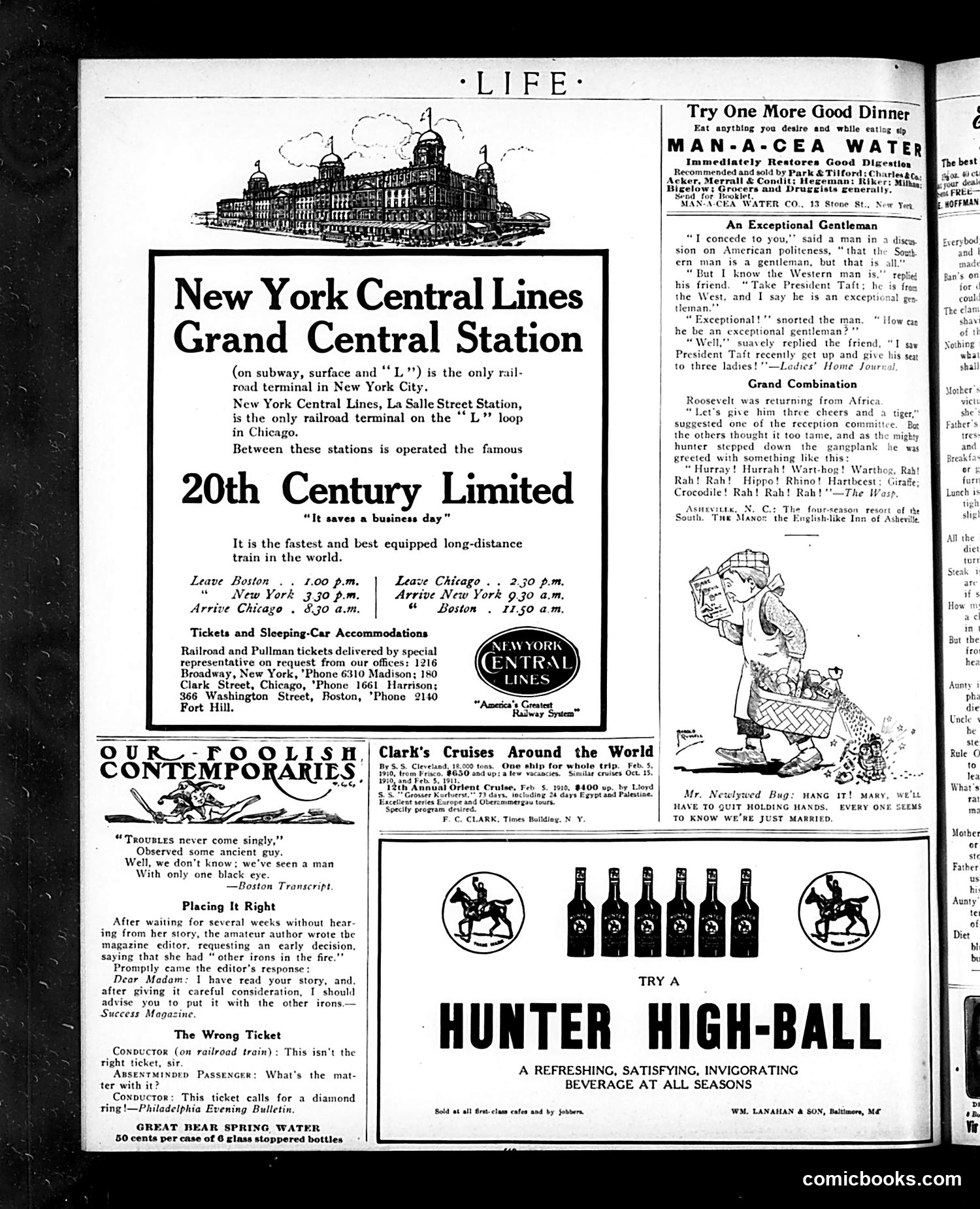
This page is primarily **advertising with light satirical humor pieces**—typical of Life magazine's format. The main cartoons and jokes include: 1. **"An Exceptional Gentleman"**: A brief anecdote mocking President Taft's Western manners. The joke suggests Taft, though from New York, is considered "exceptional" because he gave up his seat to three ladies—implying this was notable behavior for a Western gentleman. 2. **"Grand Combination"**: A joke about Roosevelt's Africa return, where a reception committee greets him with animal sounds ("Hippo! Rhino! Hartbeest! Crocodile!") instead of traditional cheers—satirizing both the safari expedition and absurd welcomes. 3. **Minor humor pieces** about editorial rejection, conductors, and single troubles—standard period comedy. The page is **dominated by railroad and product advertisements** (20th Century Limited train, Man-a-cea Water, Hunter High-Ball whiskey, cruises). These ads, not the humor, represent the page's primary content and commercial purpose.
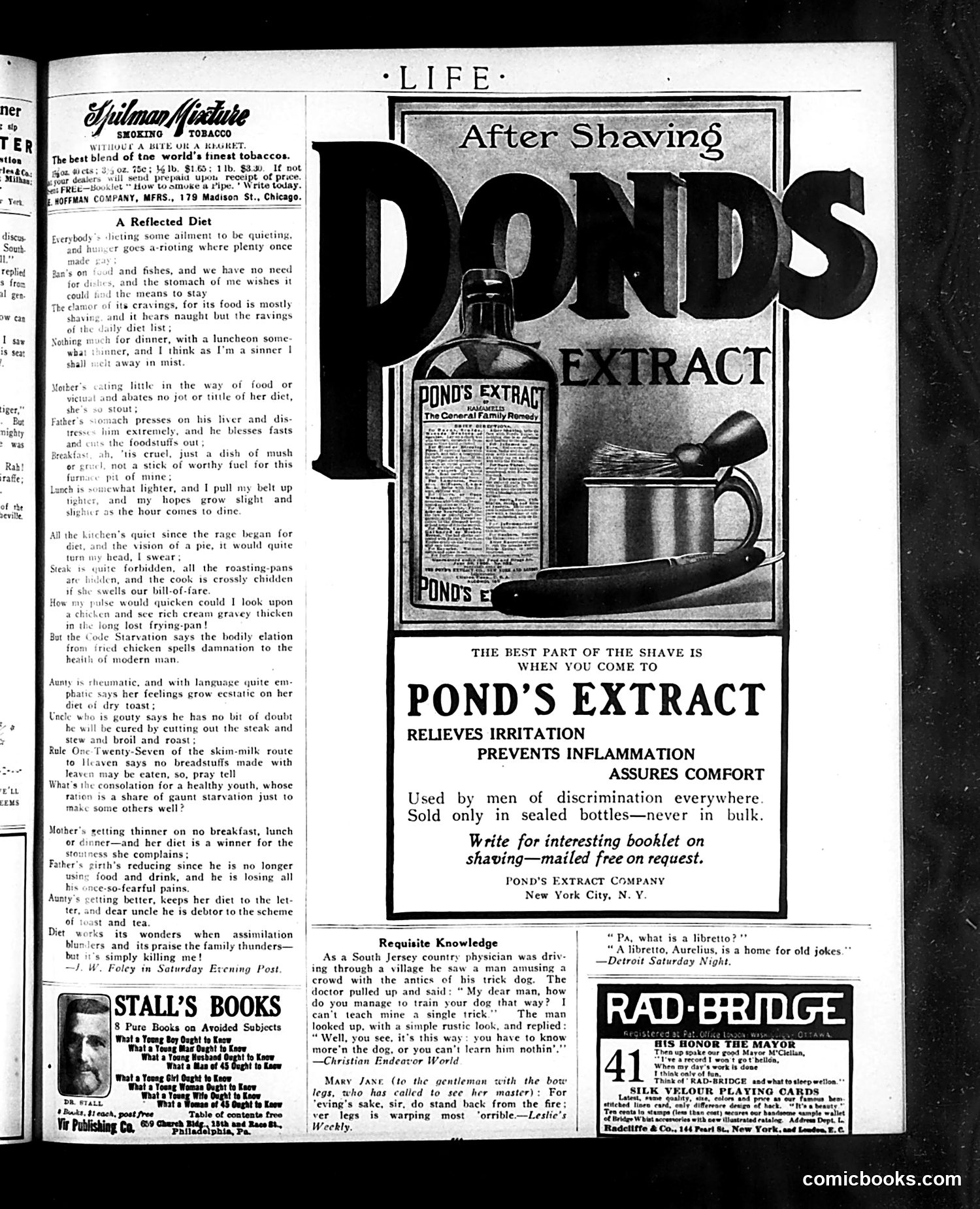
This page combines advertisements with a satirical poem titled "A Reflected Diet" by J.W. Foley. The satire mocks the era's dietary fad culture—specifically restrictive eating regimens promoted for health. The poem humorously depicts family members suffering through various self-imposed starvation diets (skim milk, dry toast, cutting out meats and breadstuffs) based on popular health doctrines of the time. The satire's point: these fashionable diets are absurd and torturous, leaving people perpetually hungry while claiming to cure ailments like gout and rheumatism. The poem's refrain—"it's simply killing me!"—emphasizes the irony that health fads cause misery rather than wellness. The page also includes period advertisements for Pond's Extract (a shaving product), Stall's Books on "avoided subjects" (euphemistic health/sex education), and a brief anecdote about dog training. These advertisements reflect early-1900s consumer culture and social anxieties.
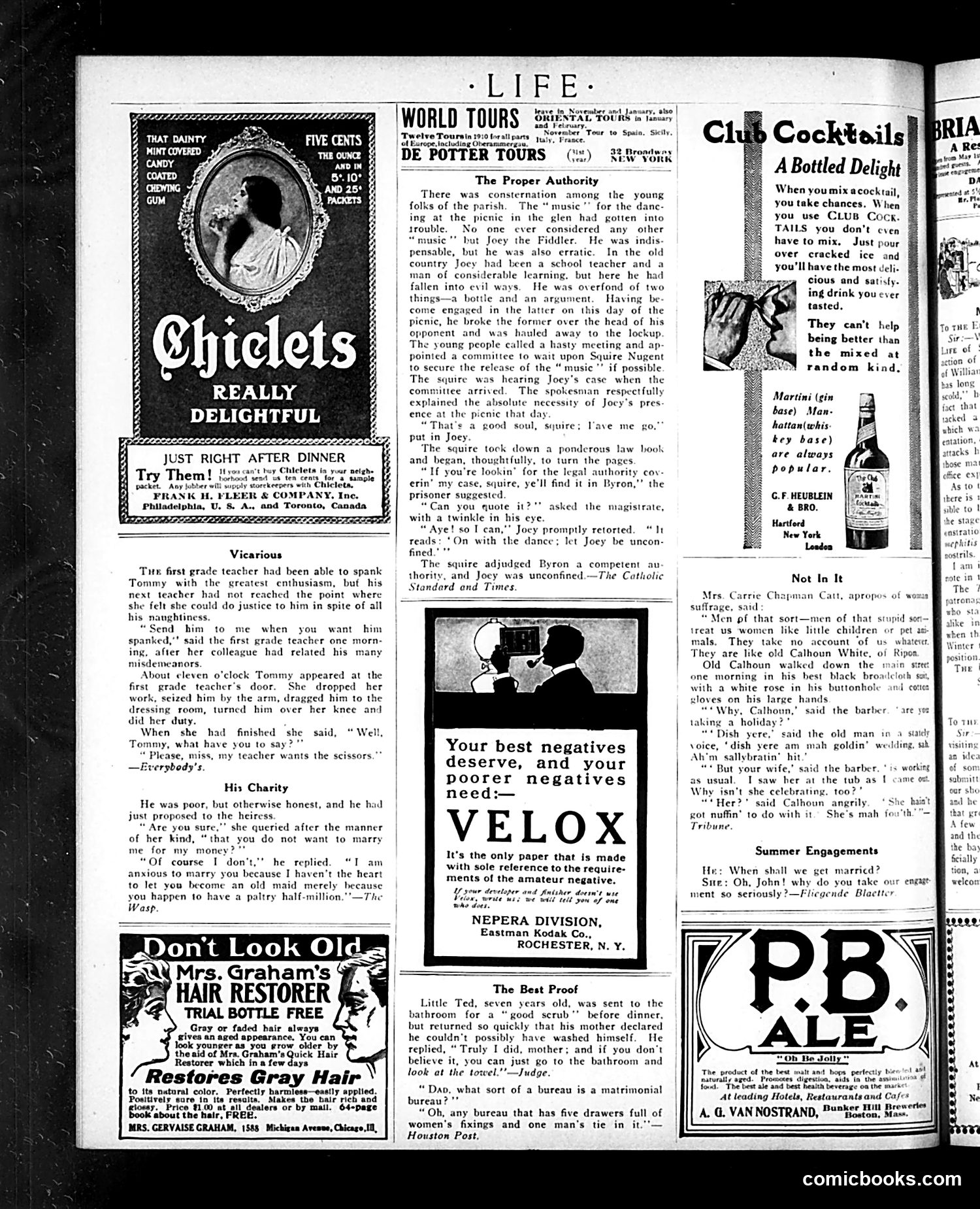
This page contains primarily **advertisements and humorous short stories** rather than political cartoons. The main content includes three comic anecdotes: 1. **"Vicarious"** — A teacher discipline story where a first-grader is sent to an older teacher for spanking, then returns asking for scissors (implying the punishment was more severe than expected). 2. **"His Charity"** — A satirical piece about a poor man proposing to an heiress, claiming he wants to marry her not for money but out of pity that "a paltry half-million" would make her an old maid. 3. **"The Proper Authority"** — An Irish dialect story where a jailed fiddler named Joey quotes Byron ("On with the dance; let Joey be unconfined") to convince a magistrate to release him for a parish dance. The remaining space features **product advertisements** for Chiclets gum, hair restorer, Velox photographic paper, and travel tours — typical of 1920s Life magazine's revenue model. No specific political figures or satirical commentary are present on this page.
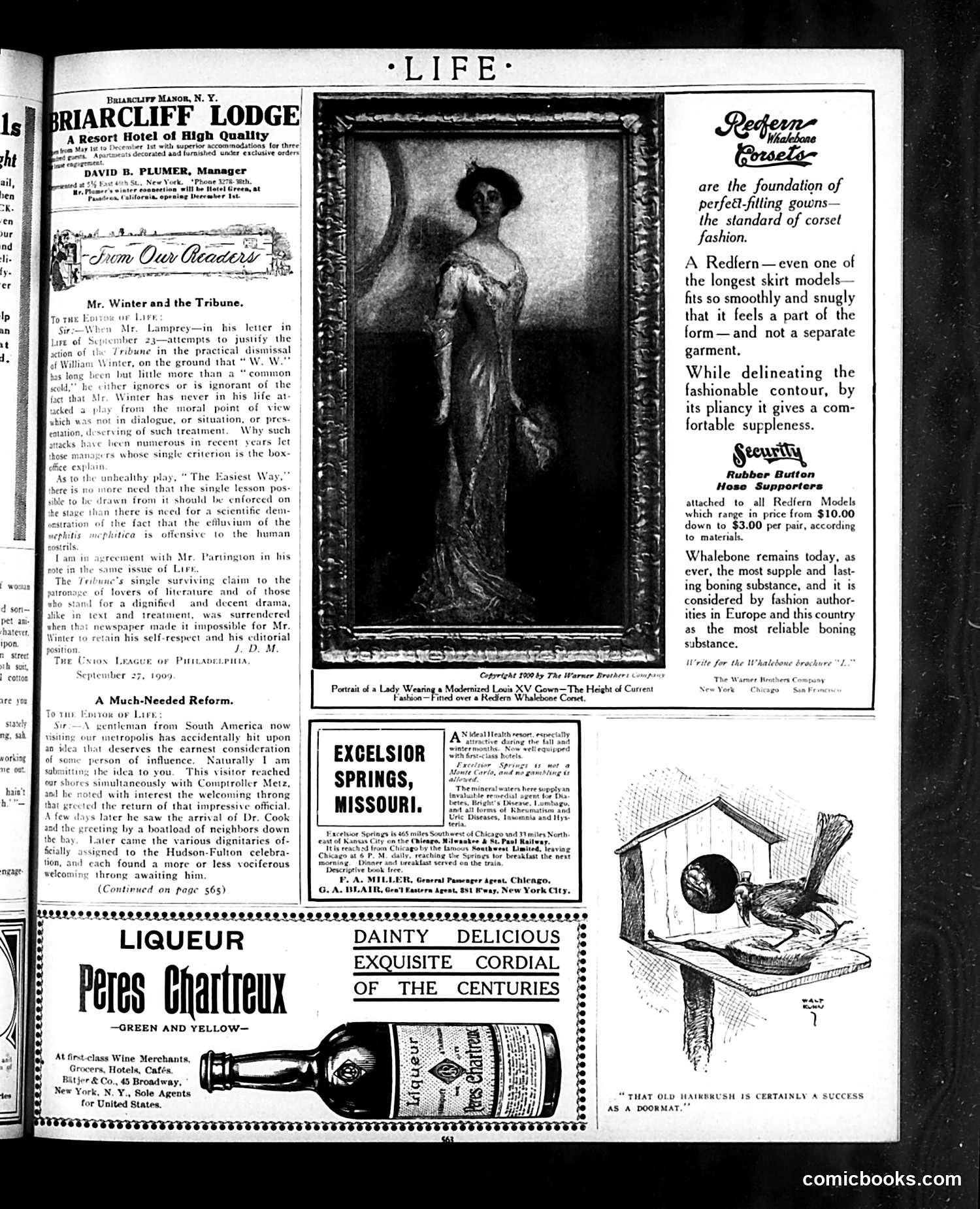
This page mixes advertisements with a cultural criticism piece titled "Mr. Winter and the Tribune." The editorial defends playwright William Winter against criticism from the *Tribune* newspaper regarding his dismissal of a play called "The Easiest Way" as morally offensive. The Union League of Philadelphia's letter argues that Winter was justified in maintaining theatrical standards and that the *Tribune* was wrong to pressure him to recant. The central image is a fashion advertisement for Redfern corsets, featuring a woman in an elaborate Edwardian gown—exemplifying the elaborate corseted silhouettes of the period. Lower advertisements promote Excelsior Springs, Missouri (a health resort), Peres Chartreux liqueur, and a hairbrush product. The small cartoon captioned "That Old Hairbrush Is Certainly a Success as a Doormat" depicts a hairbrush being used as a doormat—a visual pun on domestic utility rather than satire of public figures.
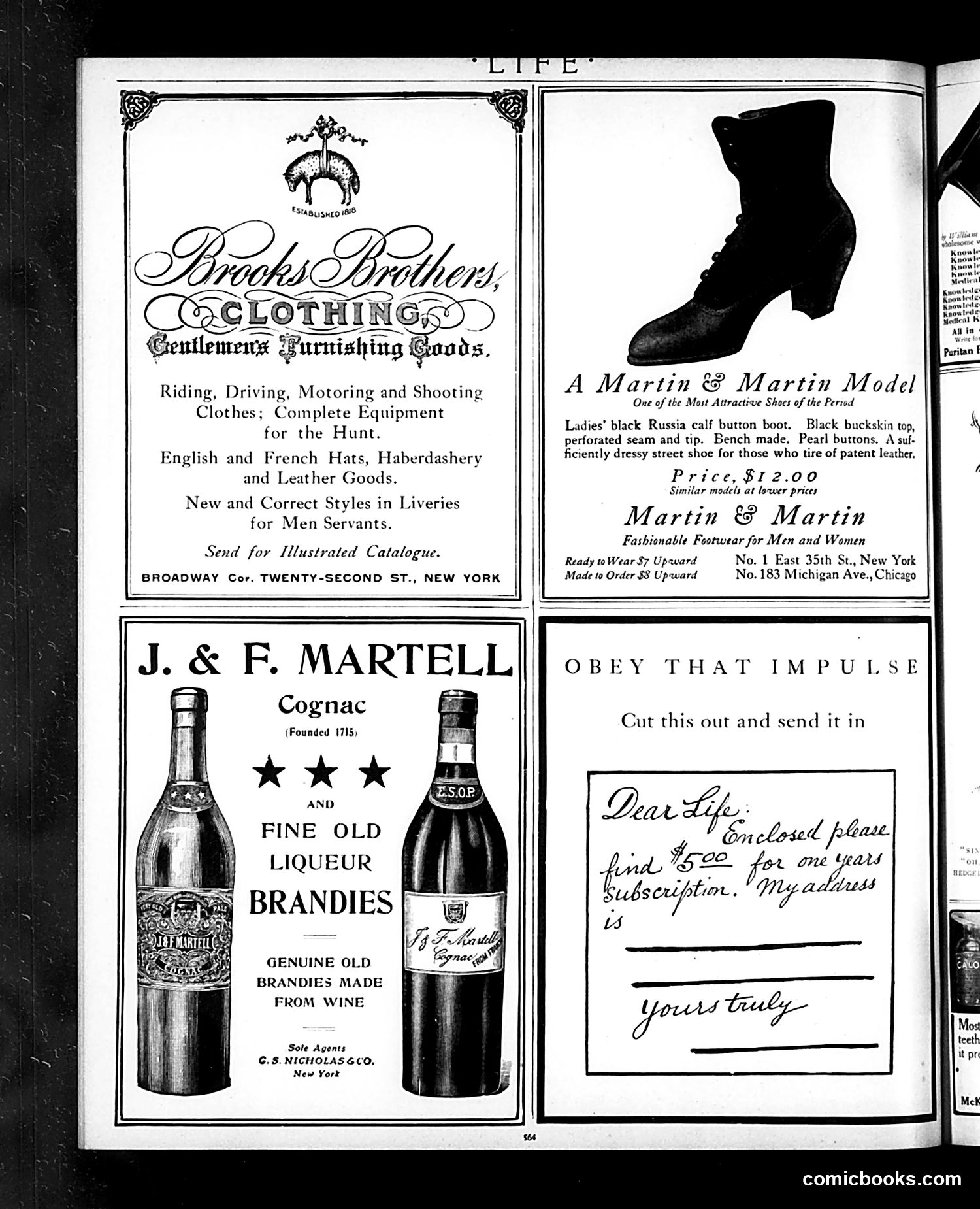
This page is primarily **advertisements**, not political satire or editorial content. It contains four ads typical of early 20th-century Life magazine: 1. **Brooks Brothers** clothing for gentlemen (hunting, riding, formal wear) 2. **Martin & Martin** women's shoes priced at $12.00 3. **J. & F. Martell** Cognac and brandies (founded 1715) 4. **"Obey That Impulse"** — a Life magazine subscription solicitation with a tear-out coupon The subscription ad's phrase "Obey That Impulse" is humorous, encouraging readers to spontaneously subscribe by cutting and mailing the form. This represents typical early-1900s magazine marketing targeting affluent readers who could afford luxury goods. There are no political cartoons or satirical commentary visible on this page.
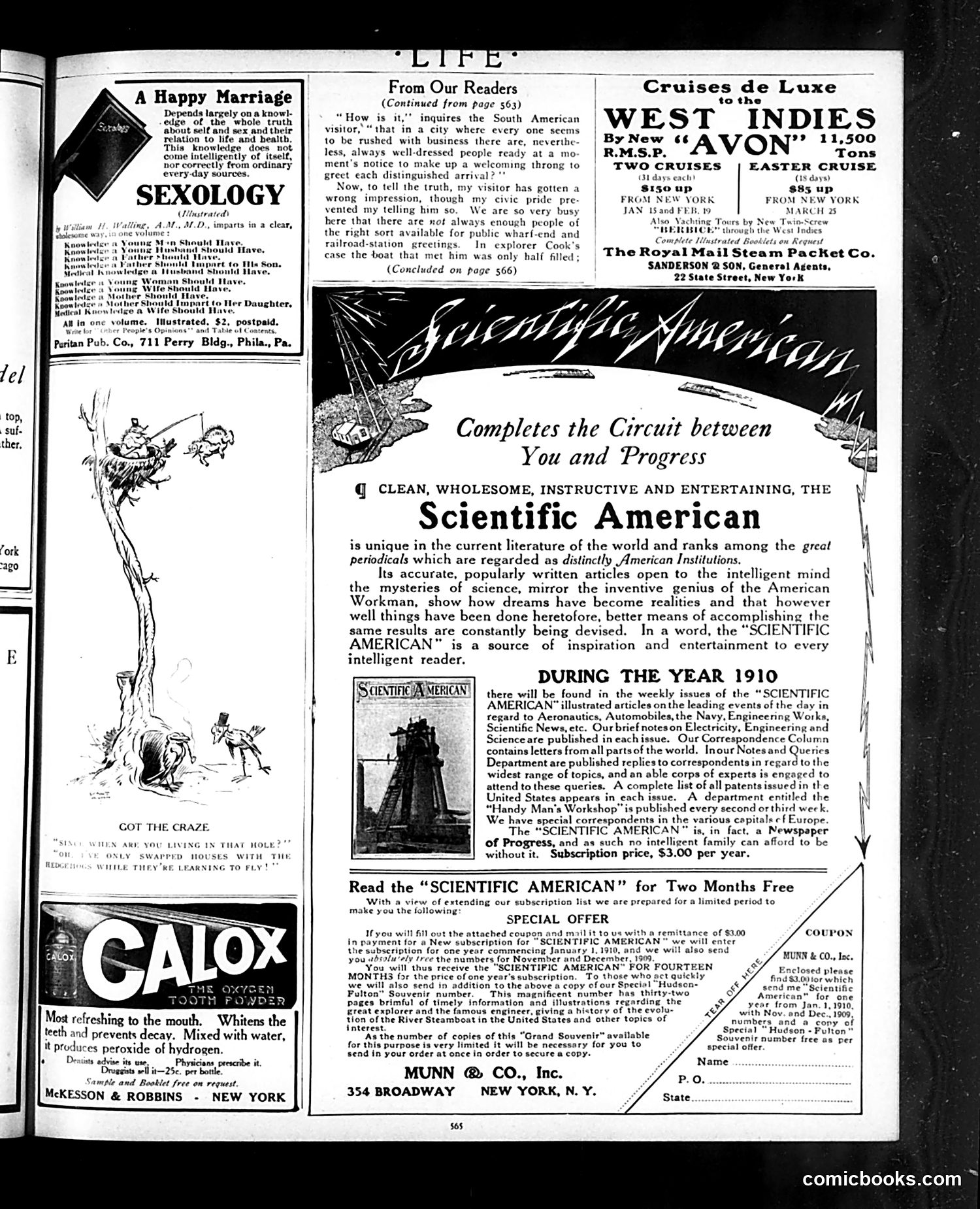
This page is primarily **advertising and reader correspondence**, not political satire requiring historical context. The main cartoon, "Got the Craze," depicts a humorous domestic situation: a couple has swapped houses with neighbors while "learning to fly"—a reference to the early aviation craze of 1910. The joke is straightforward: people are so obsessed with the new flying technology that they're willing to uproot their living arrangements to pursue it. The cartoon satirizes **faddishness and the public's fascination with aviation**, which was genuinely novel and sensational at this time. The page also includes: - A "Sexology" book advertisement (a common educational title of the era) - Cruise ship advertisements to the West Indies - A lengthy advertisement for *Scientific American* magazine The "From Our Readers" section contains a letter about visiting a South American city—ordinary correspondence. No significant political figures or events are referenced. This is essentially a magazine advertisement page with light social humor about contemporary technology enthusiasm.
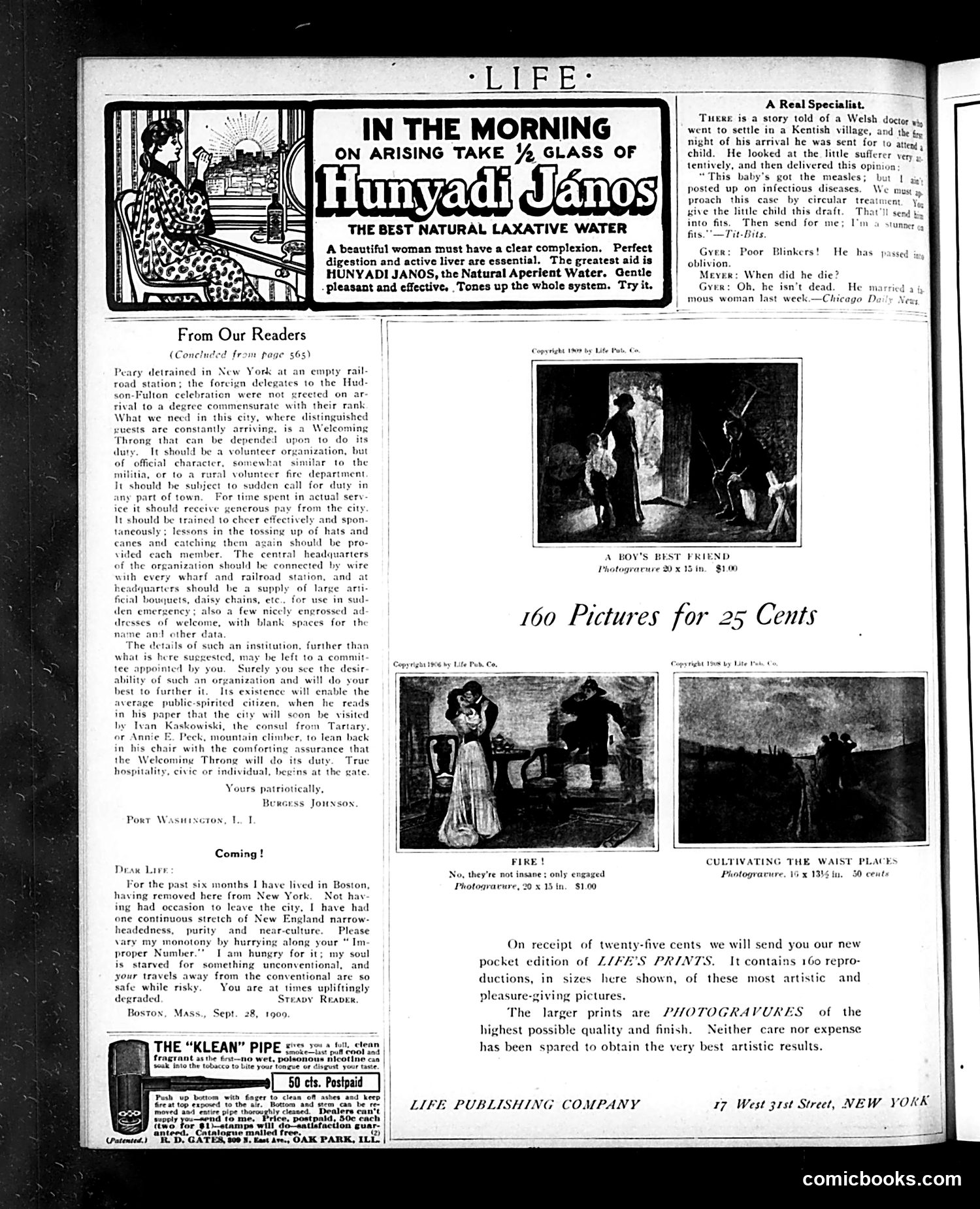
This page combines advertisements and reader correspondence typical of early 1900s Life magazine. **Main Advertisement:** Hunyadi Járos laxative water, marketed to women as essential for beauty and digestion—reflecting period beliefs linking internal health to complexion. **Reader Letters Section:** Two humorous anecdotes appear: 1. A Welsh doctor's misdiagnosis of measles, mocking medical pretension 2. A joke about someone named Meyer/Blinkers losing identity after marriage **Significant Proposal:** A lengthy letter from "Burgess Johnson" (Port Washington, L.I.) proposes a "Welcoming Throng"—a civic volunteer organization to greet distinguished visitors arriving in New York. This references the 1909 Hudson-Fulton Celebration and Admiral Peary's arrival, suggesting satirical commentary on civic pageantry and New York's reception of notable figures. **Picture Advertisement:** Life Publishing Company offers 160 photogravure reproductions for 25 cents, showcasing artistic photographs. The page reflects early 1900s concerns: women's health, civic pride, and emerging consumer culture.
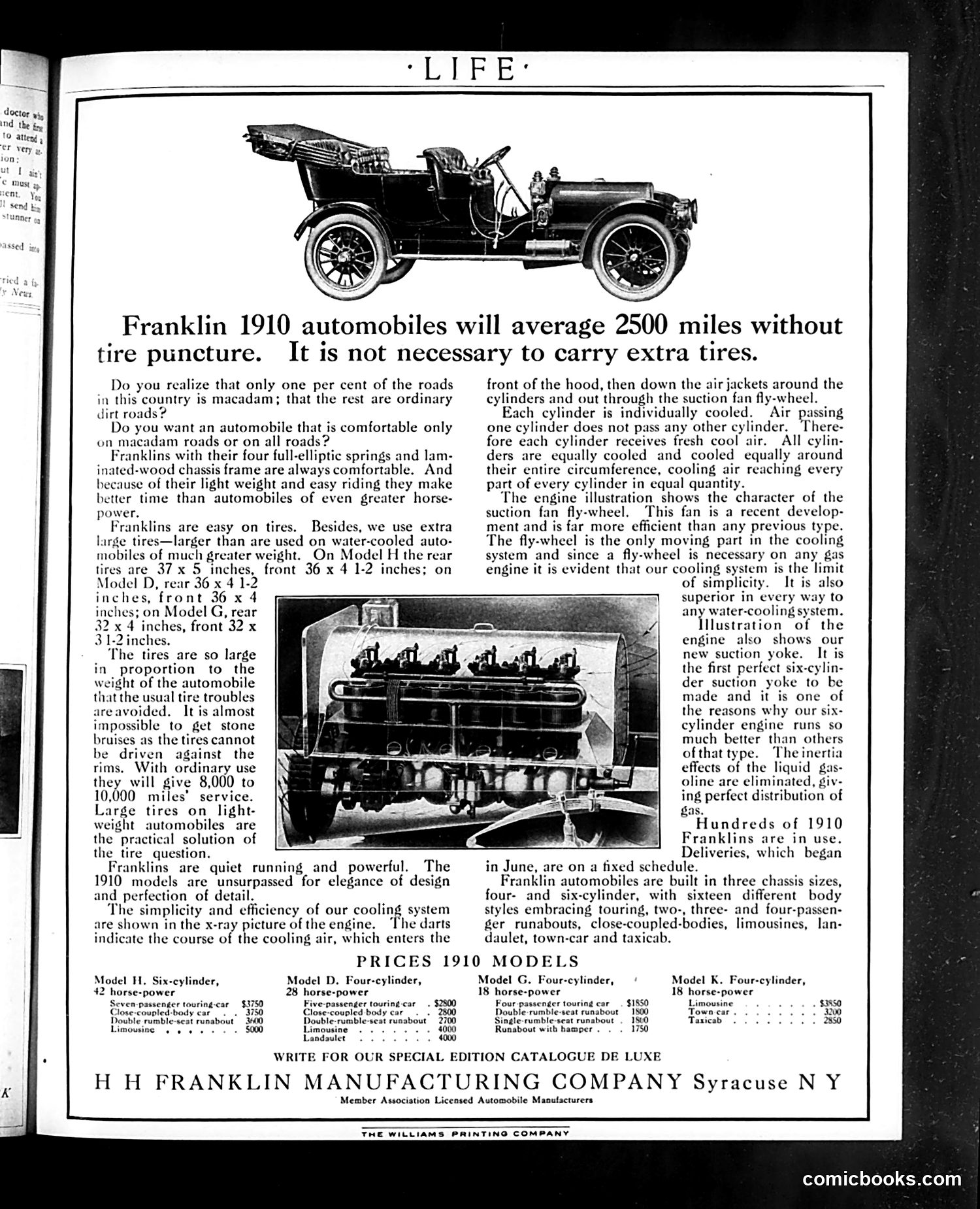
This is primarily a full-page advertisement for Franklin automobiles, not satirical content. The ad addresses practical concerns of early 1900s car owners: most American roads were unpaved dirt roads, not macadam (paved surfaces), making tire punctures a common problem. Franklin's sales pitch emphasizes durability: their cars will run 2,500 miles without tire punctures and require no spare tires. They highlight engineering innovations—large oversized tires proportional to the vehicle's light weight, an air-cooling system with a suction fan fly-wheel (rather than water cooling), and a new "suction yoke" for six-cylinder engines. The accompanying engine illustration demonstrates their cooling system's efficiency. Pricing ranges from $1,750 to $4,000 depending on model and body style. This reflects the early automotive era when reliability and durability were primary selling points, not style or speed.
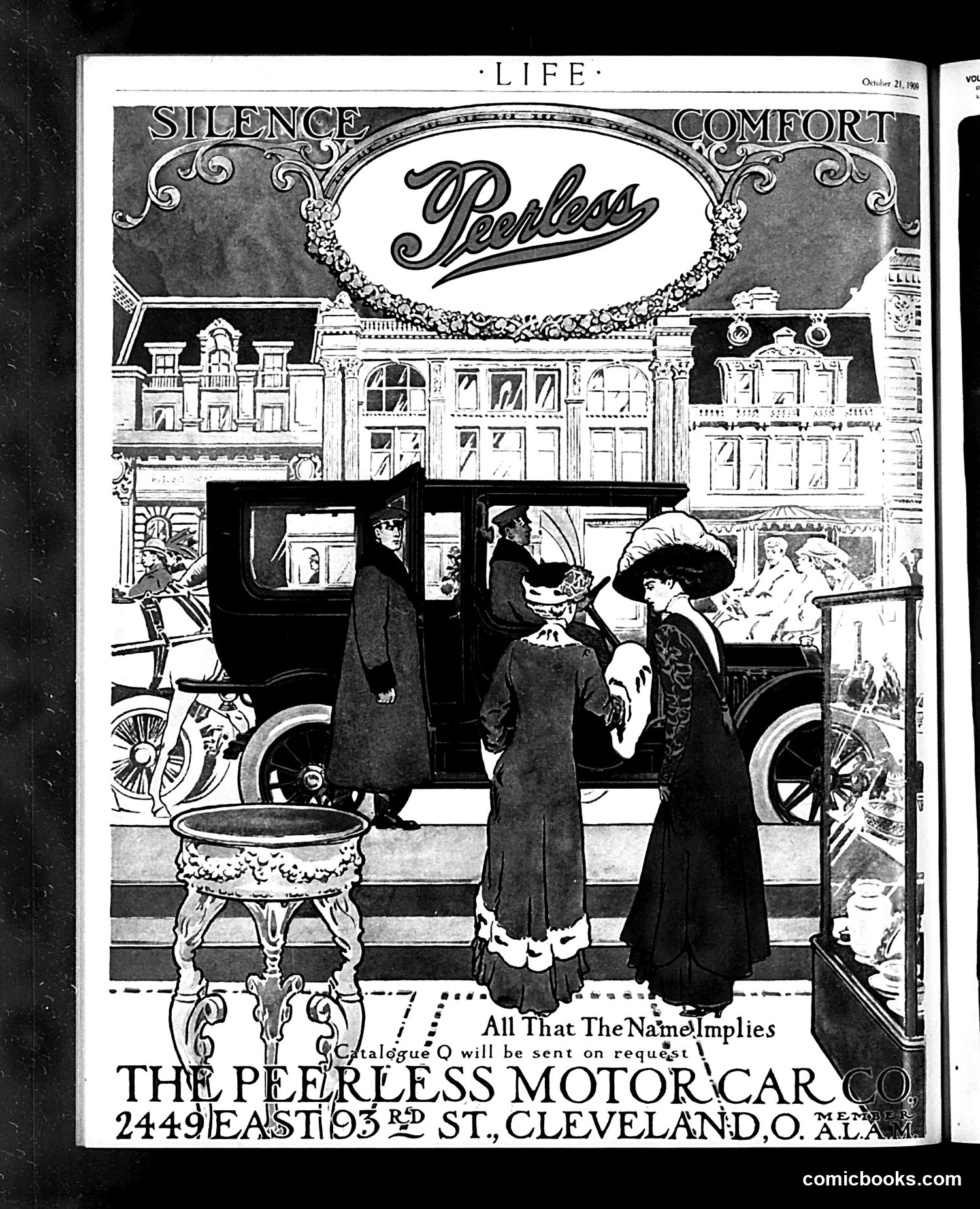
This is a **full-page advertisement**, not political satire. It promotes the Peerless Motor Car Company of Cleveland, Ohio, using the tagline "Silence and Comfort." The image depicts **well-dressed women in early 1900s attire** (long coats, large hats) examining or entering an automobile outside an elegant storefront. The "Peerless" nameplate appears prominently in an ornate oval frame at the top. The ad's appeal targets **affluent female consumers**—unusual for automotive advertising of this era, which typically emphasized masculine virtues. By featuring fashionable women in a refined shopping district, the advertiser positions the Peerless as a luxury good offering comfort and social status rather than mechanical performance. The phrase "All That The Name Implies" suggests the brand's established reputation for quality.