
Life, 1909-10-21 · page 14 of 32
Life — October 21, 1909 — page 14: what you’re looking at
What you’re looking at
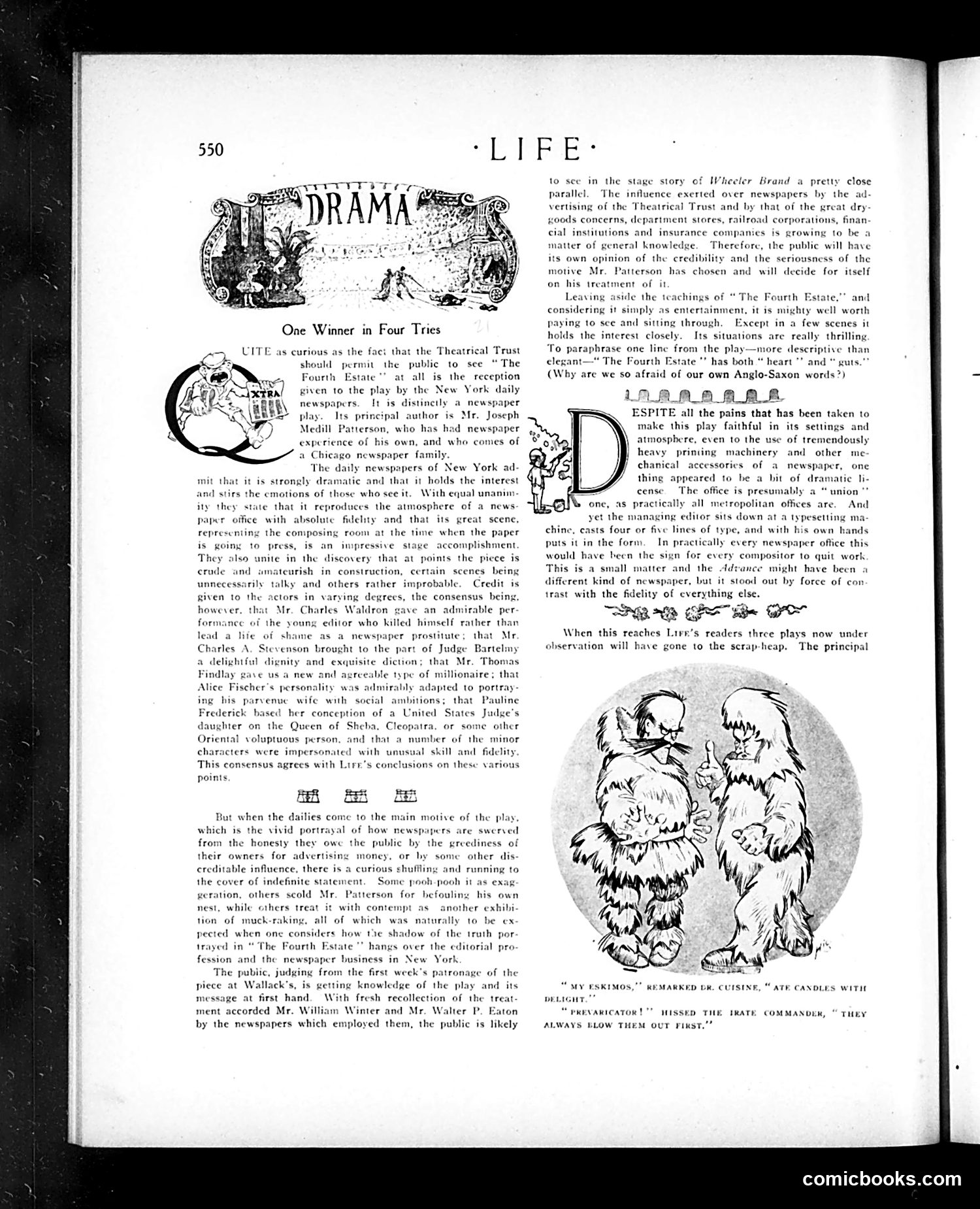
This page reviews Joseph Medill Patterson's play *"The Fourth Estate,"* which dramatizes corruption in New York newspapers. The central satire concerns how newspapers—supposedly guardians of public truth—actually serve corporate interests through advertiser pressure and owner greed. The play's protagonist, Wheeler Brand, is an editor who kills himself rather than compromise journalistic integrity. The reviewer notes that New York dailies unanimously praised the play's technical merit and atmospheric accuracy but conspicuously avoided discussing its central critique: that newspapers betray public trust for advertising revenue from department stores, railroads, and insurance companies. The cartoon (lower right, caption partially visible) appears to satirize newspaper hypocrisy—praising the play while implicitly defending the very corruption it exposes. The reference to critics William Winter and Walter P. Eaton suggests real journalists suffered professionally for criticizing their employers, supporting the play's premise that American newspapers prioritized profits over truth.
📄 Transcribed text from this page (OCR, searchable)
Machine-transcribed from the original scan — historical spelling and the odd misread are preserved.
gate) yl oo) a VV IT 8 “DRAMA! One Winner in Four Tries 1s curious as the faci that the Theatrical Trust I permit the public to see “The Fourth Estate" at all is the reception given to the play by the New York daily newspapers. It is distinctly a newspaper play. Its principal author is Mr. Joseph Medill Patterson, who has had newspaper experience of his own, and who comes of a Chicago newspaper famil i ers of New York ad holds the interest The daily news it is strongly dramatic and that nd stirs the emotions of those who see it. With equal unanin ity they state that it reproduces the atmosphere of a news paper office with absolute fidelity and that its great scene, representing the composing room at the time when the paper is going to press, is an impressive stage accomplishment They also unite in the discovery that at points the piece is crude and amateurish in construction, certain scenes being Credit is given to the actors in varying degrees, the consensus being, however, that Mr. Charles Waldron gave an admirable per formanee of the young editor who killed himself rather than lead a lie of sh as a newspaper prostitute; that Mr Charles A. Stevenson brought to the part of Judge Bartelmy a delightful dignity and exquisite diction; that Mr. Thomas Findlay gave us a new and agreeable type of millionaire; that Alice Fischer's personality was admirably adapted to portray- nbitions; that Pauline unnecessarily talky and others rather improbable his parvenue wife with social Frederick based her conception of a United States Judge's daughter on the Queen of Sh Oriental voluptuous person, and that a number of the minor characters were impersonated with unusual skill and fidelity . Cleopatra, or some other This consensus agrees with Lire’s conclusions on these various oi Si BA But when the dailies come to the which is the vivid portrayal of how from the honesty they owe the public by the greediness of money, or by some other dis- ain motive of the play wspapers are swerved their owners for advertis creditable influence, there is a curious shuffli and running to the cover of indefinite statement. Some pooh-pooh it as exag geration, others scold Mr. Patterson for hefouling his own nest, while others treat with another exhibi- tion of muck-raking, pected when one considers how te shadow of the truth por. pntempt as all of which was naturally 10 be ex trayed in “The Fourth Estate“ hangs over the editorial pro: fession and the newspaper business in New York The public, judging from the first week's patronage of the piece at W. s getting knowledge of the play and its message at first hand. With fresh recollection of the treat ment accorded Mr. William Winter and Mr. Walter P. Eaton by the newspapers which employed them, the public is likely to sce in the stage story of Wheeler Brand a pretty close parallel vertising of the Theatrical Trust ‘The influence exerted over newspapers by the ad nd by that of the great dry- soods concerns, department stores, railroad corporations, finan cial institutions and insurance companies is growing to be a matter of general knowledge. Therefore, the public will have its own opinion of the credibility and the seriousness of the motive Mr. Patterson has chosen and will decide for itself on his treatment of it The Fourth Estate," and Leaving aside the teachings considering it simply as entertainment, it is mighty well worth paying to sce and sitting through. Except in a few scenes it holds the interest closely. Its situations are really. thrilling To paraphrase one line from the play— “ The Fourth Estate’ has both “ heart ”* and * guts.” raid of our own Anglo-Saxon words?) PITE all the pains that has been taken to make this play faithful in its settings and atmosphere, even to the use of tremendously heavy printing machinery and other me chanical accessories of a newspaper, one thing appeared to be a bit of dramatic li- cense The offi “union one, as practically all metropolitan offices are. And yet the chine, casts four or five lines of type, puts it in the form. In practically every newspaper office this would have been the sign for every compositor to quit: work This is a small matter and the Advance might have been a different kind of newspaper, but it stood out by force of con irast with the fidelity of everything else. aang gene SARE ORR Go When this reaches Lirr’s readers three plays now under observation will have gone to the scrap-heap. The principal re descriptive than elegan is presumably ing editor sits down ata typesetting ma. and with his own hands “OMY ESKIMOS," REMARKED DK. CUISINE, “ATE CANDLES WITHT DELIGHT “PREVARICATOR!"" MISSED THE IRATE COMMANDER, “THEY ALWAYS BLOW THEM OUT FiKsT.’? comicbooks.com