
Life, 1909-10-21 · page 31 of 32
Life — October 21, 1909 — page 31: what you’re looking at
What you’re looking at
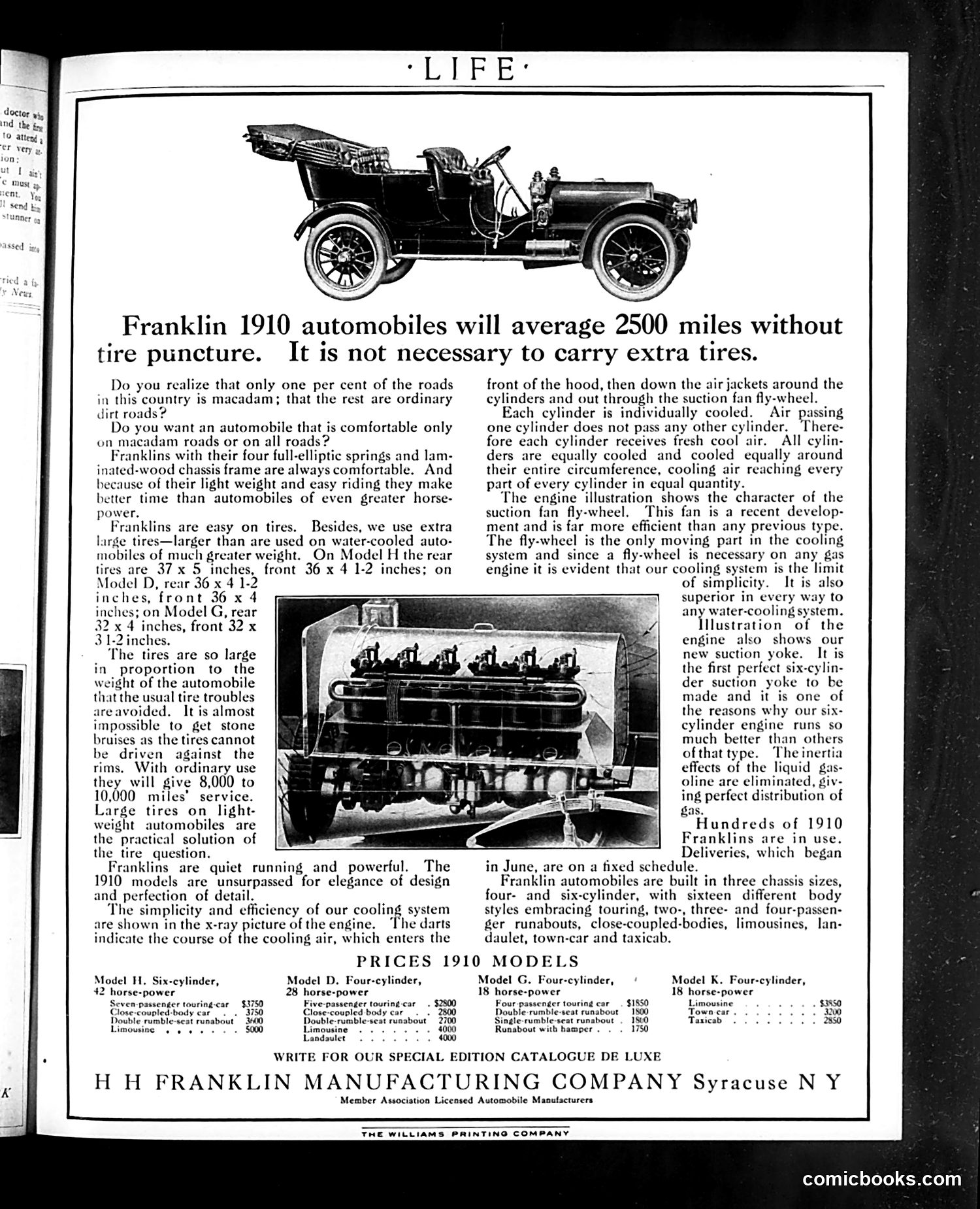
This is primarily a full-page advertisement for Franklin automobiles, not satirical content. The ad addresses practical concerns of early 1900s car owners: most American roads were unpaved dirt roads, not macadam (paved surfaces), making tire punctures a common problem. Franklin's sales pitch emphasizes durability: their cars will run 2,500 miles without tire punctures and require no spare tires. They highlight engineering innovations—large oversized tires proportional to the vehicle's light weight, an air-cooling system with a suction fan fly-wheel (rather than water cooling), and a new "suction yoke" for six-cylinder engines. The accompanying engine illustration demonstrates their cooling system's efficiency. Pricing ranges from $1,750 to $4,000 depending on model and body style. This reflects the early automotive era when reliability and durability were primary selling points, not style or speed.
📄 Transcribed text from this page (OCR, searchable)
Machine-transcribed from the original scan — historical spelling and the odd misread are preserved.
Franklin 1910 automobiles will average 2500 miles without tire puncture. Do you realize that only one per cent of the roads in this country is macadam; that the rest are ordinary dirt roads? Do you want an automobile that is comfortable only on macadam roads or on all roads? Franklins with their four full-elliptic springs and lam- inated-wood chassis frame are always comfortable. And se of their light weight and easy riding they make better time than automobiles of even greater horse- power. Franklins are easy on tires. Besides, we use extra large tires—larger than are used on water-cooled auto- of much greater weight. On Model H the rear tires are 37 x 5 inches, front 36 x 4 1-2 inches; on Model D, rear 36 x 4 1-2 It is not necessary to carry extra tires. front of the hood, then down the air jackets around the cylinders and out through the suction fan fly-wheel. Each cylinder is individually cooled. Air passing one cylinder does not pass any other cylinder. There- fore each cylinder receives fresh cool air. All cylin- ders are equally cooled and cooled equally around their entire circumference, cooling air reaching every part of every cylinder in equal quantity. The engine illustration shows the character of the suction fan fly-wheel. This fan is a recent develop- ment and is far more efficient than any previous type. The fly-wheel is the only moving part in the cooling system and since a fly-wheel is necessary on any engine it is evident that our cooling system is the limit of simplicity. It S| inches, front 36 x 4 inches; on Model G, rear 32 x 4 inches, front 32 x 31-2 inches. The tires are so large in proportion to the weight of the automobile that the usual tire troubles areavoided. It is almost i ble to get stone st the rims. With ordinary use they will give 8,000 to 10,000 miles’ service. Large tires on light- weight automobiles are the practical solution of the tire question. Franklins are quiet running and powerful. The 1910 models are unsurpassed for elegance of design and perfection of detail. The simplicity and efficiency of our cooling system are shown in the x-ray picture of the engine. ‘The darts indicate the course of the cooling air, which enters the superior in every way to any water-cooling system. Inustration of the engine also shows our new suction yoke. It is the first perfect si i der suction yok made and it is one of the reasons why our six- cylinder engine runs much better than others ofthat type. The inertia effects of the liquid gas- oline are eliminated, giv- ing perfect distribution of gas. Hundreds of 1910 Franklins are in use. Deliveries, which began in June, are on a fixed schedule. Franklin automobiles are built in three chassis sizes, four- and six-cylinder, with sixteen different body styles embracing touring, two-, three- and four-passen- ger runabouts, close-coupled-bodies, limousines, lan- daulet, town-car and taxica PRICES 1910 MODELS Model D, Four-cylinder, 28 horse-power Five-passenger touring car. $2800 Close-coupled body car ‘ Double-rumble-seat runabout 2700 Limousine. see + 4000 Landaulet + 4000 Model H. Six-cylinder, 42 horse-power Giore-coupled:body cat. Trouble ruble-seat rusabcut Limousine 4466s Model K. Four-cylinder, 18 horse-power Limousine Town car . Taxicab Model G. Four-cylinder, 18 horse-power Four-passenger touring car Double-rumble-seat runabout Single-rumble-seat runabout Runabout with hamper . WRITE FOR OUR SPECIAL EDITION CATALOGUE DE LUXE H H FRANKLIN MANUFACTURING COMPANY Syracuse N Y Member Association Licensed Automobile Manutacturers THE WILLIAMS PRINTING COMPANY comicbooks.com