
Life, 1909-10-21 · page 18 of 32
Life — October 21, 1909 — page 18: what you’re looking at
What you’re looking at
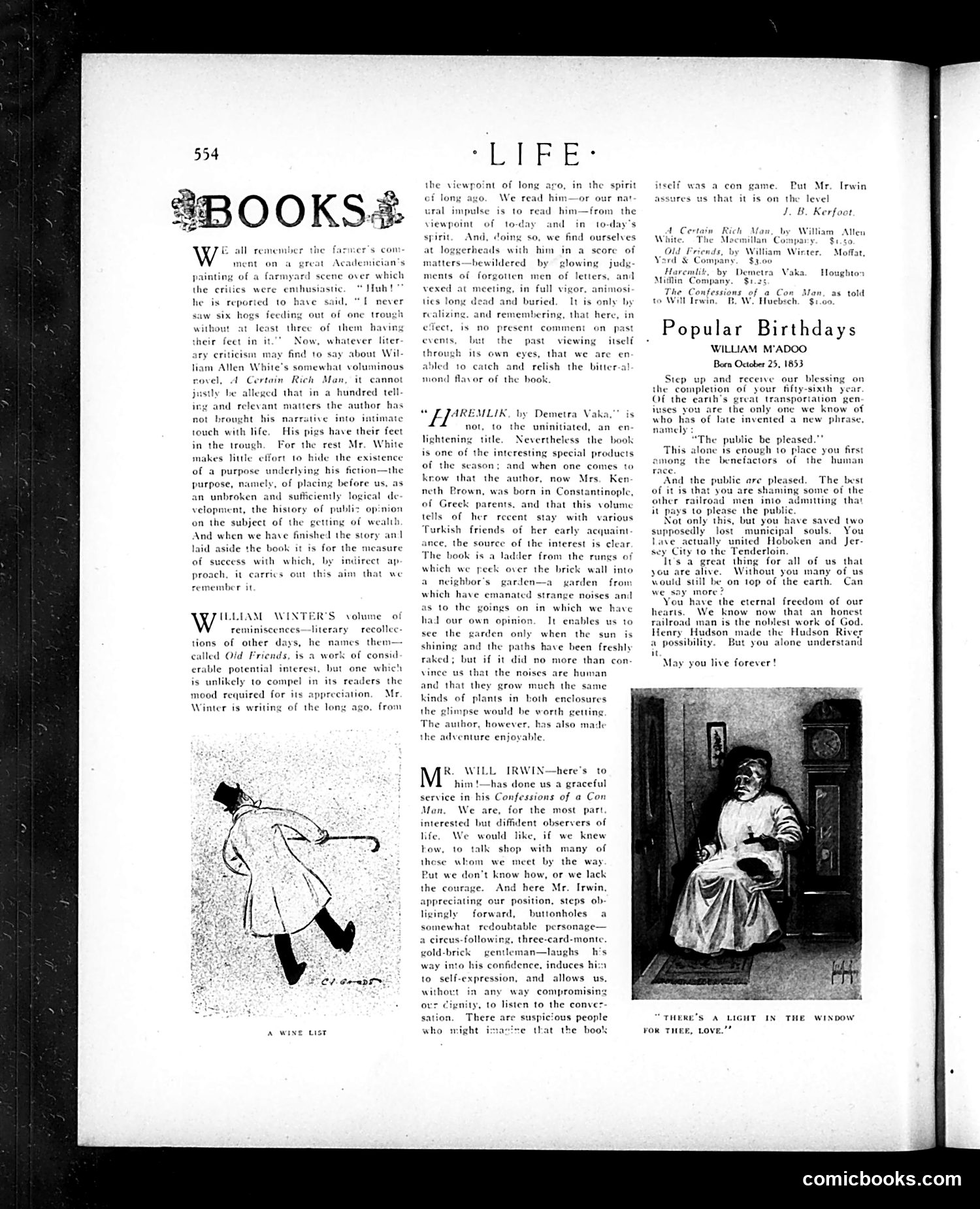
This is a **books review section** from Life magazine, featuring literary criticism rather than political cartoons. The page discusses several works: **William Allen White's "A Certain Rich Man"** is critiqued for its transparent moral purpose—depicting how public opinion shapes wealth accumulation. The reviewer notes White doesn't hide his didactic intent, comparing it to a farmyard painting where pigs' feet visibly touch the trough. **William Winter's "Old Friends"** (reminiscences) is faulted for presenting outdated literary judgments and long-dead feuds without modern context, making it difficult for contemporary readers. **"Haremlick" by Demetra Vaka** is praised as an interesting insider's perspective on Constantinople domestic life—allowing readers to glimpse behind garden walls into unfamiliar cultural spaces. **Will Irwin's "Confessions of a Con Man"** is commended for gracefully introducing readers to colorful characters (circus followers, con artists) in an accessible, entertaining manner. The single cartoon ("A Wine List") appears to be decorative rather than satirical.
📄 Transcribed text from this page (OCR, searchable)
Machine-transcribed from the original scan — historical spelling and the odd misread are preserved.
554 remember the farmer's cow on a great Academician’s a farmyard scene over which enthusiastic. “Huh! said, “1 never of one painting of the crilies were he is reported to have saw six hogs feeding out trough three of Now, find 10 say without at least them having whatever liter ry criticism may about Wil liam Allen White’s somewhat voluminous . A Certain Rich Man, it leged that in a hundred tell heir feet in it cannot justly be ing and relevant matters the author has yght his narrative into intimate His pigs have their feet White the existence not I touch with life in the trough. For the rest Mr makes little effort to bide of a purpose underlying his fiction—the purpose, namely, of placing before us, as an unbroken and sufficiently logical de velopment, the history of publiz opinion on the subject of the And when we have finished the story an! laid aside the book it is for the measure getting of wealth. of success with which, by indirect proach, it carries out this aim that remember it ERS literary ILLEAM WIN reminiscences tions of other days, he called Old Friends, is a work of 1 one Volume oo! recollec- names them— consid erable potential interest, bu which is unlikely to compel in its readers the mood required for its appreciation, Mr ng of the from Winter is writ long ago. 2°00. goabe~: wine tist EES: of long aro, We re: impulse is to read the viewpoint in the spiri ef lon ad him—or our nat ural him—from the Viewpoint of to-day and in to-day’s spirit. And, doing so, we find ourselves t loggerheads with him in a score of matters—bewildered by glowing judy ments of forgotten men of letters, anil vexed at meeting, in full vigor, animosi ties long dead and buried. It is only by realizing, and remembering, that here, in effect, is no present comment on past events, but the past viewing itself that we are en relish the bitter hook. through its own eyes, abled 10 catch and mond flavor of the Demetra Vaka,”" is “E AREMLIK, by not, to the uninitiated, an en lightening title. Nevertheless the book is one of the resting special products season; and when one comes to that the author, now Mrs. Ken neth Brown, was born in Constantinople, and stay of the know of Greek of her kish ance, the source The book is peek over the brick parents, that this volume with her early of the ladder from the rungs of recent various friends of acquaint interest is clear which we wall into frow anated strange noises anid goings on in a neighbor's garden— arden which have which we have opinion. It as to the enables us to when the had our own see the garden only sun is shining and the paths have been freshly raked; but if it did no more than con Vince us that the noises are human 2 that they grow much the same kinds of plants in both enclosures the glimpse would be worth getting The the adventure enjoyab’ ME WILL IRWIN—here's to him !—has done us a graceful service in his Confessions of a Con Mon, We are, for the most part rested but diffident observers of We would like, if we knew bow, 10 talk shop with many of wkom we meet by the way author, however, has also made these Put we don't know how, or we lack age. And here Mr. Irwin, ting our position, steps ob: the ¢ forward, buttonholes a redoubtable personage— a circus-following, three-card-monte. entleman—laughs h’s fidence, induces hi: and way compromising somewhat gold-brick way into his ¢ to self-expression, allows us, without in snity, to listen to the conver There a might imacine any ovr ¢ suspicious people that the bool sation, Put Mr, is on the level J.B. Ke Irwin Man. by ne Mocmillan ‘Company Friends, by William Wirter. S& Company, $3 Haremlit, by Deme Mita Company. $1 The Confes to Will Tew William Allen $1.50 Moffat, Vaka. Ho fa Con Huebsch. Popular Birthdays WILLIAM M'ADOO Born October 25, 1853 Step up and receive our blessing on the completion of your fifty-sixth y Of the earth’s great transportation gen iuses you are the only one we know of who has of late invented a new phra namely : “The public be pleased.” This alone 1s enough to place you first among the benefactors of the huma And the public are pleased. The best of it is that you are shaming some of the other railroad men into admitting that it pays to please the public. Not only this, but you have saved two supposedly lost municipal souls. You Tave actually united Hoboken and Jer- sey City to the Tenderloin. Its a great thing for all of us that you are alive. Without you many of us would still be on top of the earth. Can we say more? You have the eternal freedom of our hearts. We know now that an honest railroad man is the noblest work of God Henry Hudson made the Hudson River a possibility. But you alone understanil it May you live forever! “THERE'S A winpow FOR THEE, LOVE. LiGuT IN THE comicbooks.com