
Life, 1909-10-21 · page 6 of 32
Life — October 21, 1909 — page 6: what you’re looking at
What you’re looking at
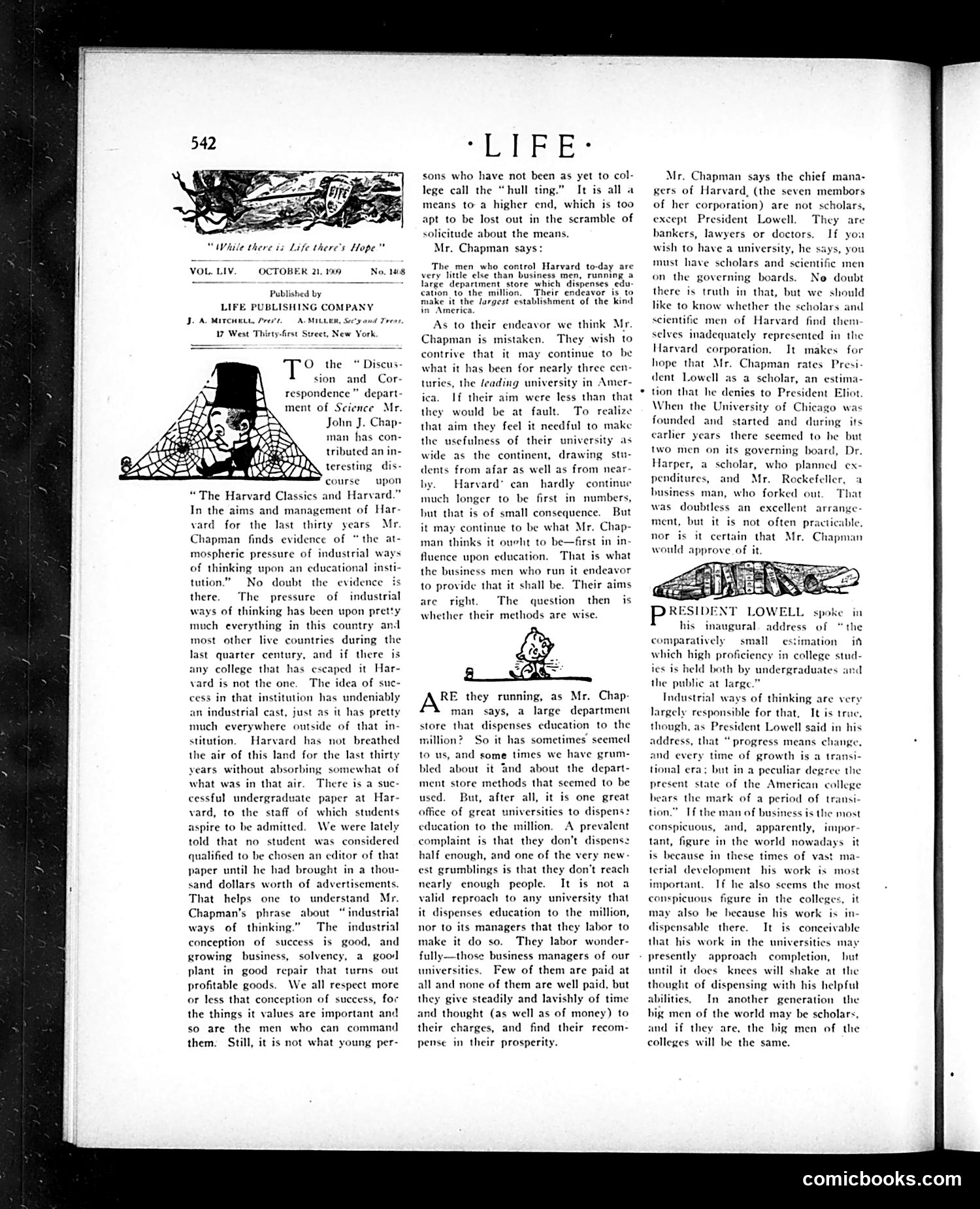
This Life magazine page from October 21, 1909 (Vol. LIV, No. 1468) contains editorial commentary about Harvard University's management and direction, primarily criticizing John J. Chapman's views on the institution's purpose. The text argues that Harvard's leaders are "business men" rather than scholars, and defends the university's broad educational mission against Chapman's apparent criticism that it should prioritize becoming "first in numbers" nationally. The editorial suggests Chapman misunderstands that universities serve multiple constituencies and that their success involves more than scholarly metrics alone. The small decorative illustrations (the stylized initial letters and ornamental vignettes) are typical period design elements, not political cartoons. This page represents serious editorial debate about higher education's role and governance during the Progressive Era.
📄 Transcribed text from this page (OCR, searchable)
Machine-transcribed from the original scan — historical spelling and the odd misread are preserved.
“While there is Life there's Hope” VOL. LIV. — OCTOBER 21, 199 LIFE PUBLISHING COMPANY JOA MITCHELL Pree A MILLER, nud Trent. v West T T°? the sion and Cor- respondence " depart- ment of Science Mr. John J. Chap- man has con- tributed an in- i fi teresting dis- we course upon “The Harvard Classics and Harvard.” In the aims and management of Har- vard for the last thirty years Mr. Chapman finds evidence of “the at- mospherie pressure of industrial ways of thinking upon an education: insti- tution.” No doubt the evidence is there. The pressure of industrial ways of thinking has been upon pre much everything in this country and most other live countries during the last quarter century, and if there is any college that has escaped it Har- vard is not the one. The idea of suc- cess in that institution has undeniably an industrial cast, just as it has pretty much everywhere outside of that in- stitution. Harvard has not breathed the air of this land for the last thirty years without absorbing somewhat of what was in that air. There is a suc- cessful undergraduate paper at Har- vard, to the staff of which students We were lately was considered aspire to be admitted. told that no student qualified to be chosen an cditor of that paper until he had brought in a thou- sand dollars worth of advertisements. That helps one to understand Mr. Chapman’s phrase about “ industrial ways of thinking.” The industrial conception of success is good, and growing business, solvency, a goo plant in good repair that turns out profitable goods. We all respect more or less that conception of success, for the things it values are important and so are the men who can command them: Still, it is not what young per- ALE Ne? sons who have not been as yet to col- lege call the “hull ting.” It is all a means to a higher end, which is too apt to be lost out in the scramble of solicitude about the means. Mr. Chapman say The men who control Harvard to-day are very little else than business men, running a large department. store which dispenses edu cation to the million. Their endeavor is to niake it the largest establishment of the kind in America. As to their endeavor we think Mr. Chapman is mistaken. They wish to contrive that it may continue to be what it has been for nearly three cen- turies, the leading university in Amer- i If their aim were less than that they would be at fault. To realize that aim they feel it needful to make the usefulness of their university as wide as the continent, drawing stu- dents from afar as well as from near- hy Harvard’ can hardly much longer to be first in numbers, but that is of small consequence. But it may continue to be what Mr. Chap- man thinks it oueht to be—first in in- fluence upon education. That is what the business men who run it endeavor Their aims then is continue to provide that it shall be. are right. The question whether their methods are wise. RE they running, as Mr. Chap- man says, a large department store that dispenses education to the million? So it has sometimes seemed to us, and some times we have grum- bled about it ‘and about the depart- ment store methods that seemed to be used. But, after all, it is one great office of great universities to dispens: education to the million. A prevalent complaint is that they don’t dispense half enough, and one of the very new- est grumblings is that they don’t reach nearly enough people. It is not a valid reproach to any university that it dispenses education to the million, nor to its managers that they labor to make it do so. They labor wonder- fully—those business managers of our universities. Few of them are paid at all and none of them are well paid, but they give steadily and lavishly of time and thought (as well as of money) to their charges, and find their recom- pense in their prosperit: Mr. Chapman says the chief mana- gers of Harvard, (the seven membors of her corporation) are not scholars, except President Lowell. They are bankers, lawyers or doctors. If you wish to have a university, he must have scholars and scientific men on the governing boards. Ne doubt there is truth in that, but we should like to know whether the scholars and men of Harvard find them selves inadequately represented in the Harvard corporation, It makes for hope that Mr. Chapman rates Presi- dent Lowell as a scholar, an estima tion that he denies to President Eliot. When the University of Chicago was founded and started and during its lier years there seemed to be but two men on its governing board, Dr. Harper, a scholar, who planned ex- penditures, and Mr. Rockefeller, business man, who forked out. 1 was doubtless an excellent ment, but it is not often practicable, nor is it certain that Mr. Chapman uild approve of it s, YOu arrange- RESIDENT LOWELL spoke in his inaugural addre of “the comparatively small estimation if which high proficiency in college stud- ies is held both by undergraduates and the public at large.” Industrial ways of thinking are very largely responsible for that, It is trac, though, as President Lowell said in his address, that “ progress means change, nd every time of growth transi- tional era: but in a peculiar de present state of the American college bears the mark of a period of transi- tion.” 1f the man of business is the conspicuous, and, apparently, impor. tant, figure in the world nowadays it is because in these times of vast ma- terial development his work is most important. If he also scems the most conspicuous figure in the colleges, it may also be because his work dispensable there. It is conceivable that his work in the universities may presently approach completion, but until it does knees will shake at the thought of dispensing with his helpful tbilities, In another generation the big men of the world may be scholars, and if they are, the big men of the colleges will be the same. the most is in- comicbooks.com