
A complete issue · 28 pages · 1909
Life — July 15, 1909
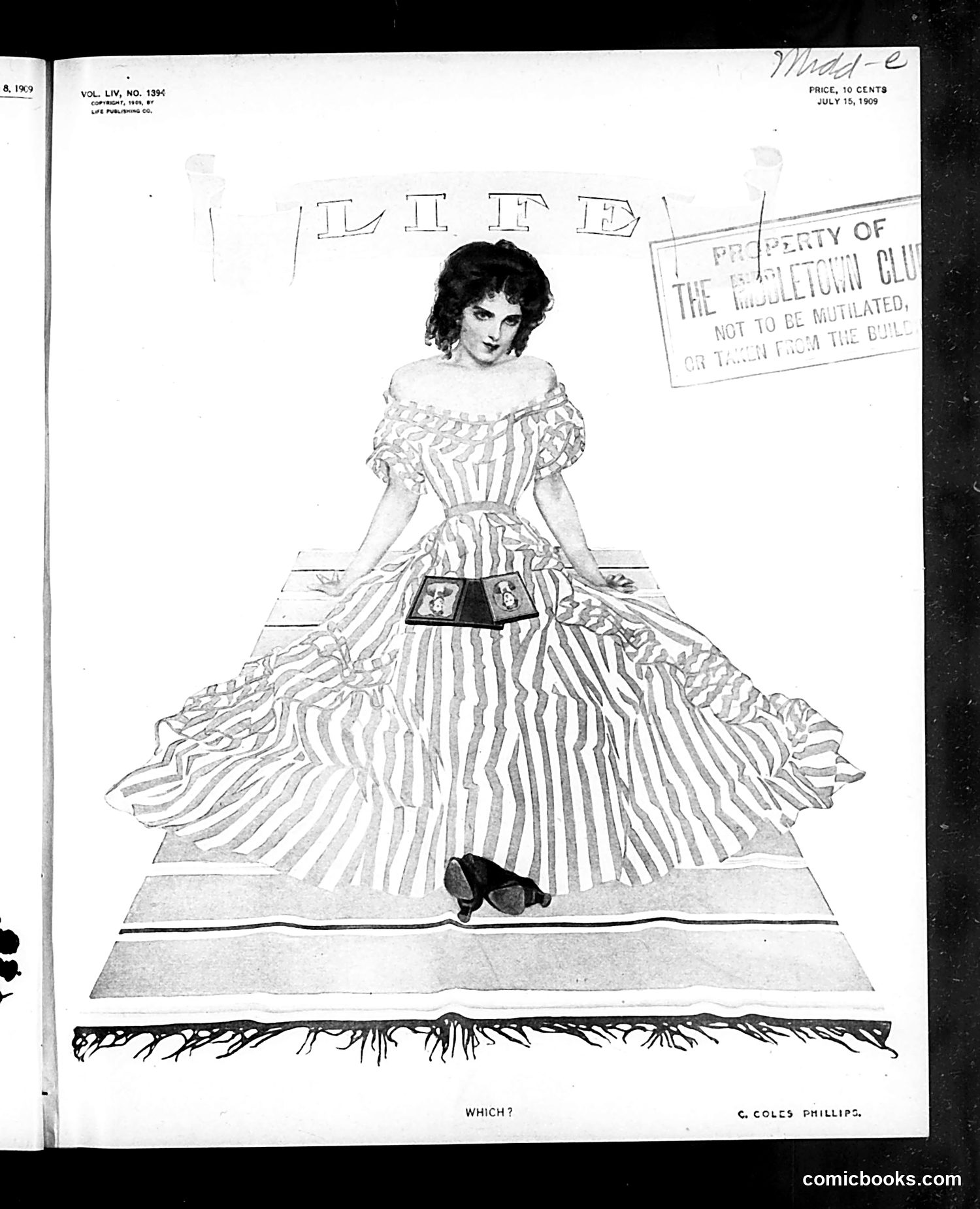
This cover illustrates a satirical fashion commentary titled "WHICH?" by artist C. Coles Phillips. The drawing depicts a woman in an elaborate striped gown with an off-shoulder design, cinched waist, and dramatic train—representing fashionable evening wear of the Edwardian era. The title "WHICH?" appears to pose a question about women's fashion choices of the period. The satire likely critiques the impracticality or absurdity of such elaborate, restrictive clothing styles that were fashionable among wealthy women circa 1909. The exaggerated proportions and dramatic presentation emphasize how constraining and unwieldy these garments were for actual movement and daily life, a common source of humor in period fashion commentary.
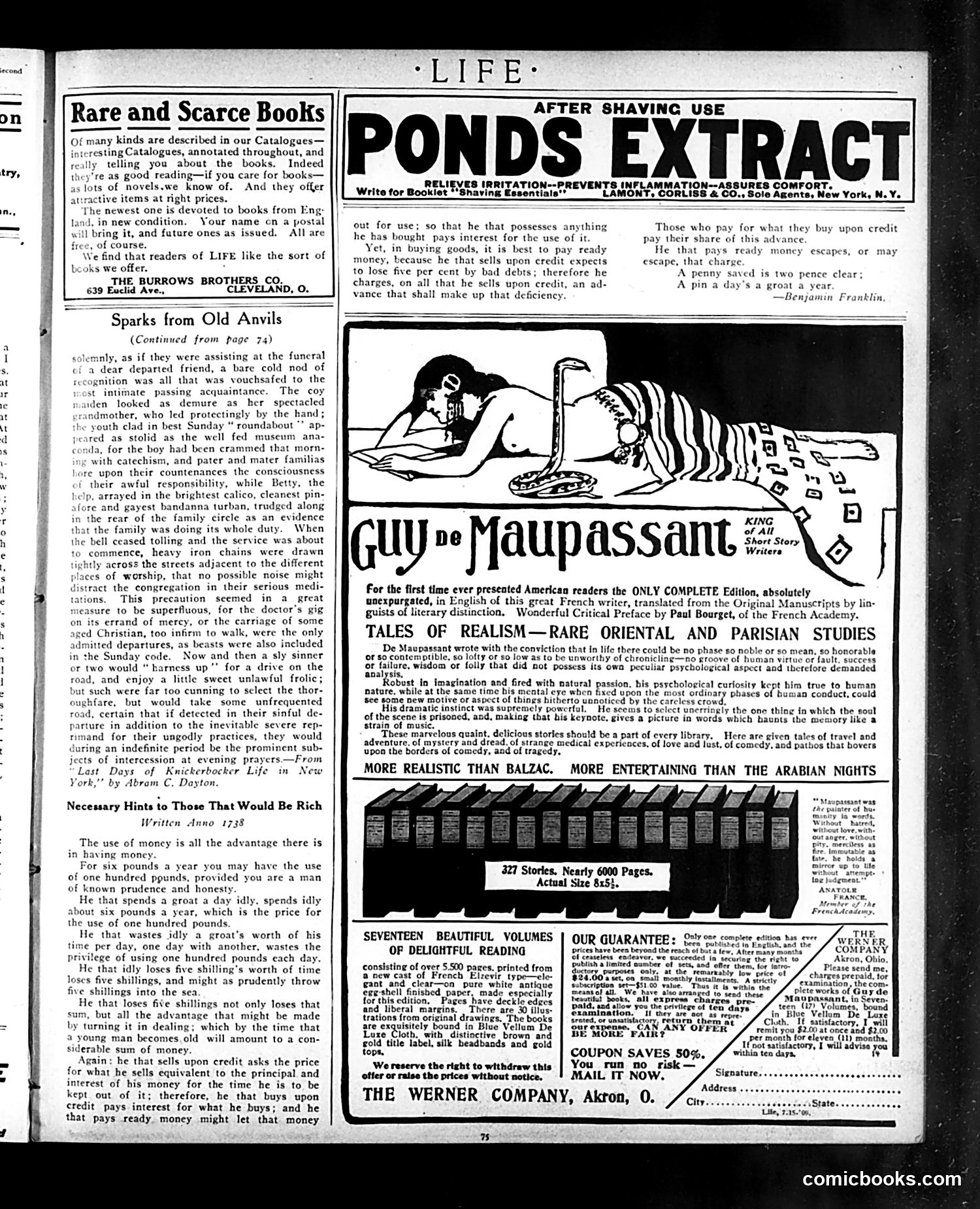
This page is primarily **advertising**, not political satire. The dominant content includes: 1. **Pond's Extract advertisement** (top right) - a post-shaving product claiming to relieve irritation and prevent inflammation 2. **Guy de Maupassant book promotion** (center) - advertising a complete edition of the French writer's works, emphasizing it contains 227 stories across 17 volumes 3. **The Werner Company advertisement** (bottom) - promoting a complete encyclopedia set The left column contains a literary piece titled "Sparks from Old Anvils" and a Benjamin Franklin quote about thrift. This appears to be a typical **early 20th-century Life magazine page**, mixing editorial content with commercial advertisements—there is no political cartoon or satirical commentary present.
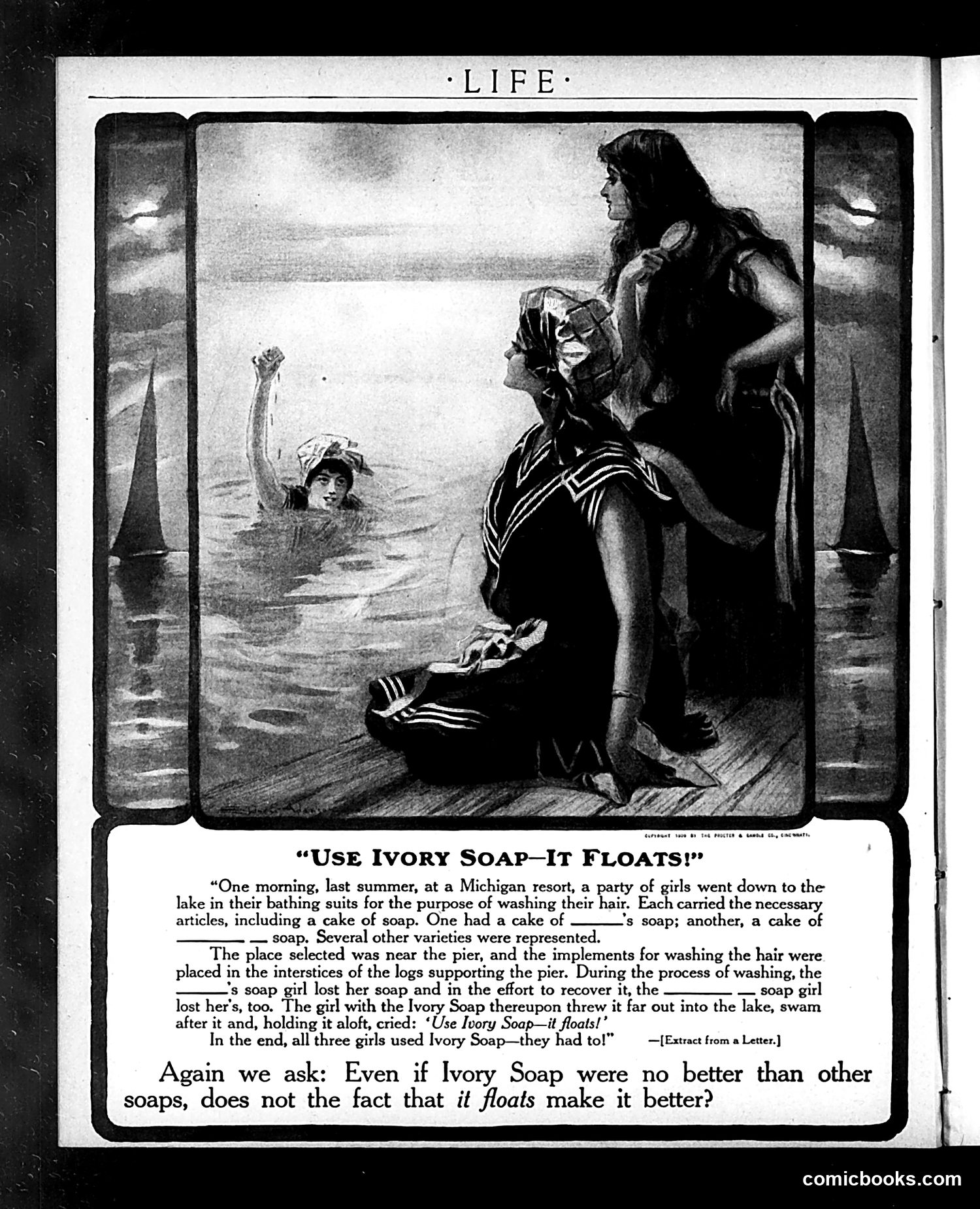
This is an **advertisement for Ivory Soap**, not political satire. The page depicts a humorous anecdote about girls washing their hair at a Michigan resort in summer. The narrative describes how one girl's Ivory Soap bar floated away in the lake, prompting another girl with a different soap brand to retrieve it by swimming. The story concludes that all three girls subsequently switched to Ivory Soap. The advertisement's central claim is that Ivory Soap's buoyancy—"it floats"—provides practical advantage over competing soaps. The illustration shows two women on a dock observing a third in the water, visualizing this scenario. This represents early-20th-century product marketing strategy: establishing brand superiority through seemingly authentic consumer testimonials rather than direct product comparison.
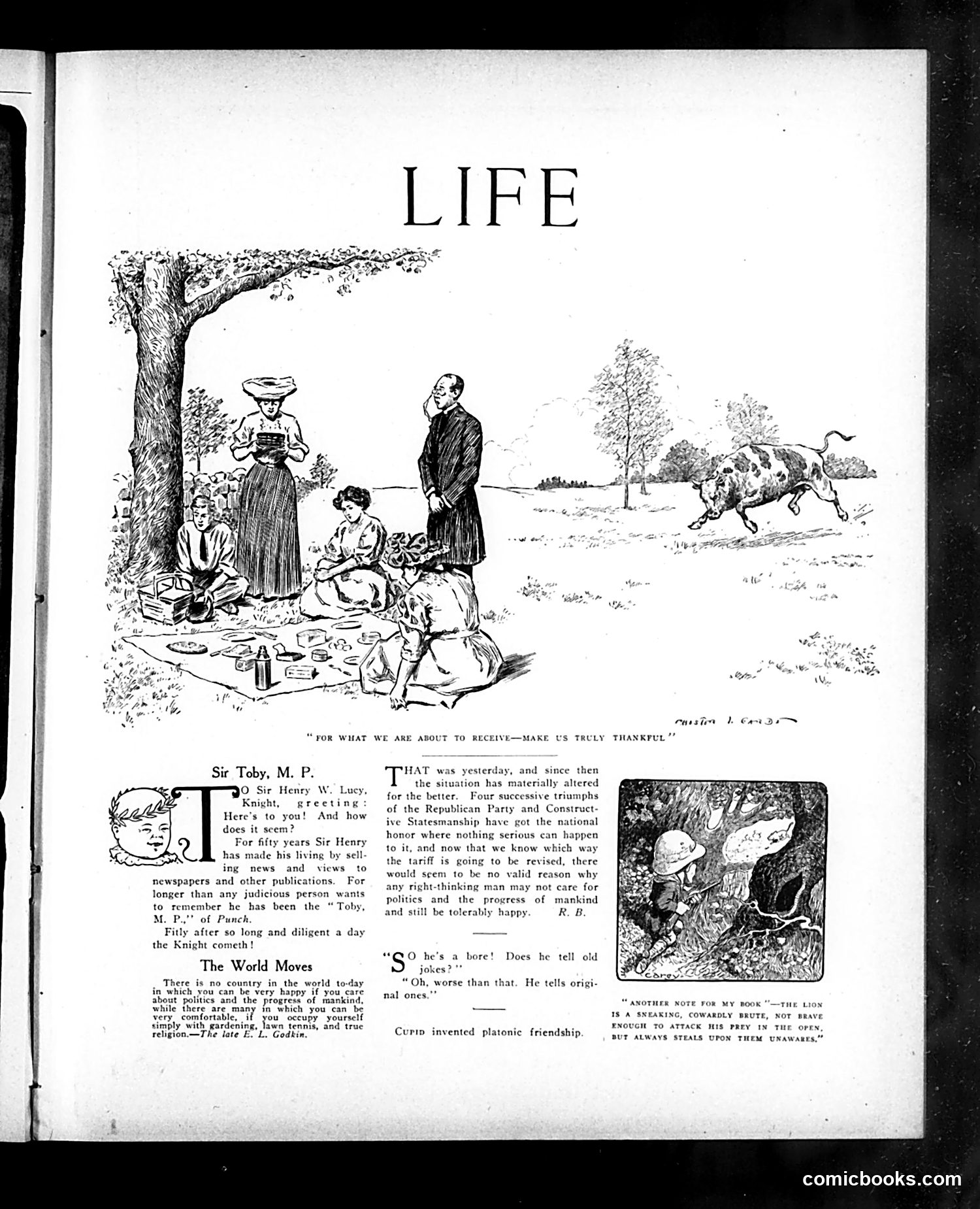
The main illustration depicts a family picnic with the caption "FOR WHAT WE ARE ABOUT TO RECEIVE—MAKE US TRULY THANKFUL," satirizing gratitude during uncertain times. The accompanying text discusses Sir Toby, M.P. (a Member of Parliament), noting fifty years of his publishing news and views. The article "The World Moves" addresses political anxiety, stating there's "no country in the world today in which you can be very happy if you care very much about politics." This reflects early 20th-century concerns about political instability and social change. A separate anecdote jokes about someone being "a bore" who "tells original ones"—criticizing tedious joke-telling. The sidebar photo includes a nature note about lions, unrelated to the political commentary.
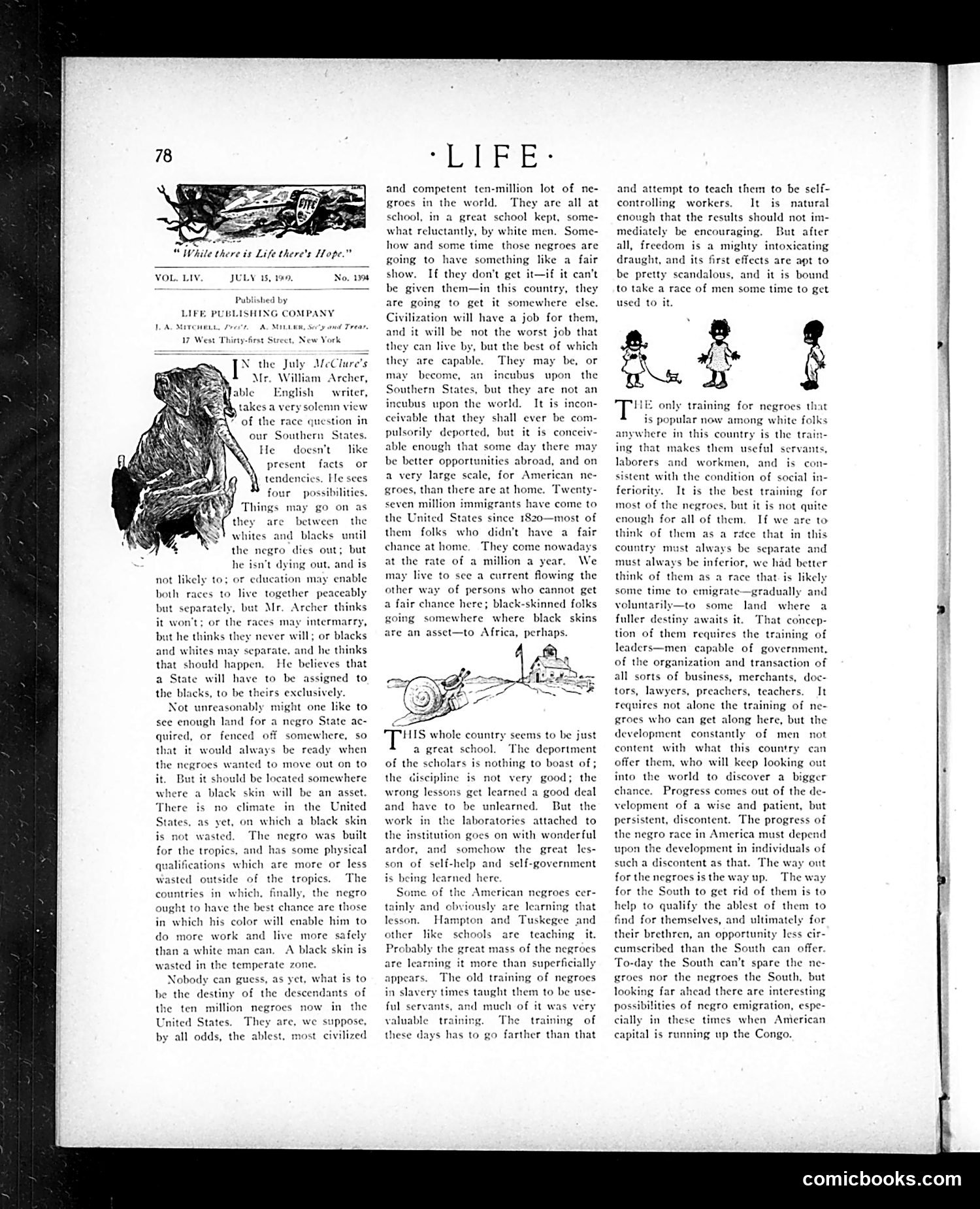
**Content:** This page contains a serious editorial article about racial training and education of African Americans, accompanied by illustrations of Black children. **The Cartoons:** Three simple line drawings show Black children in various poses—sitting, standing, playing with a toy—depicting everyday childhood activities. **The Message:** The article argues that African Americans should receive vocational and self-improvement training to become "useful servants, laborers and workmen" while remaining subordinate due to "social inferiority." It suggests emigration as preferable to integration, referencing potential opportunities in Africa or the Congo. **Historical Context:** This reflects early-1900s racist ideology that viewed segregation and controlled vocational education as "benevolent" solutions while opposing genuine equality or social advancement for Black Americans.
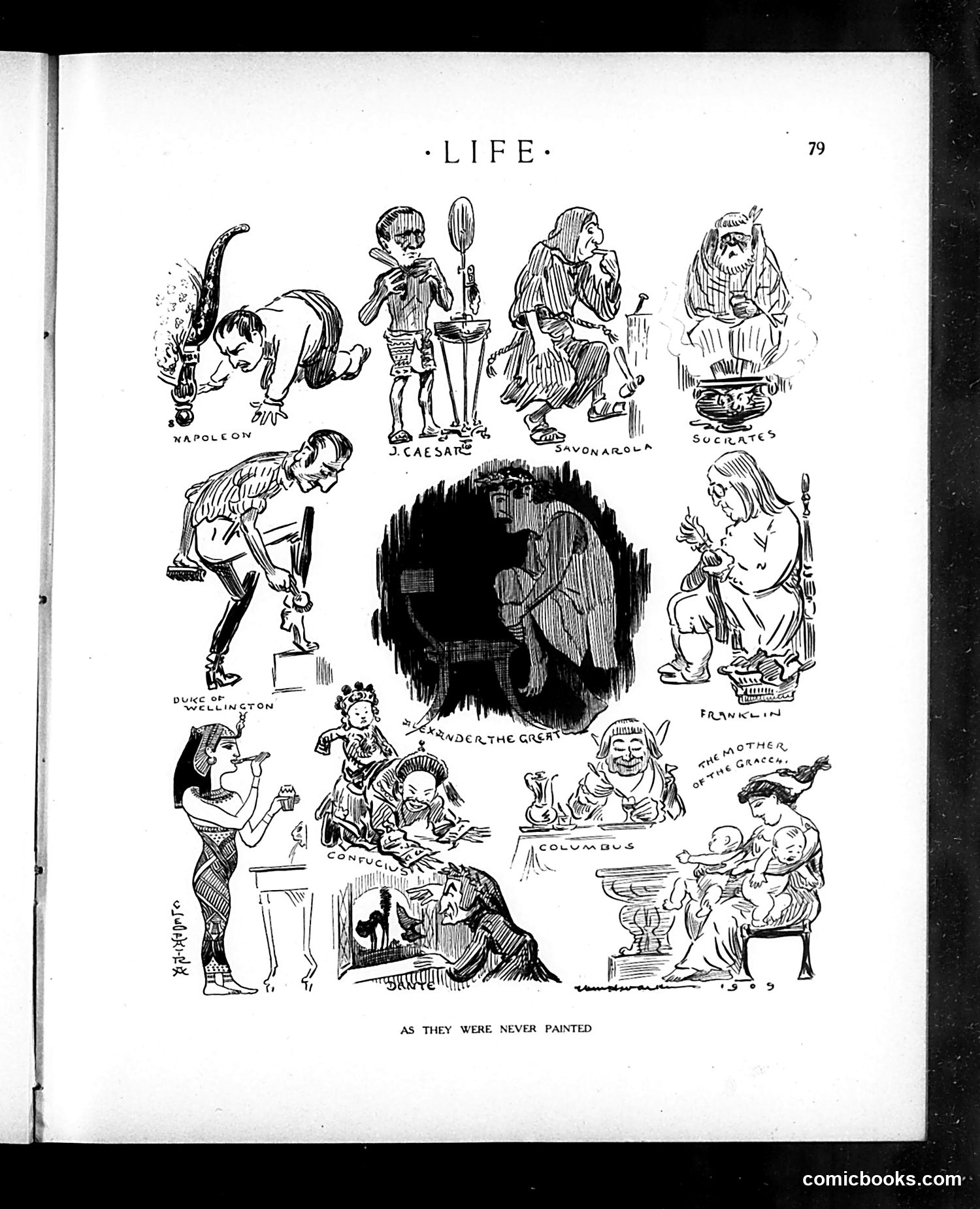
This satirical illustration presents famous historical figures reimagined as caricatures in exaggerated, unflattering poses. The labeled figures include Napoleon (shown hunched), J. Caesar, Savonarola, Socrates, Dante of Wellington, Alexander the Great, Franklin, Columbus, Cleopatra, and "The Mother of the Graces." The central dark mass—likely a classical painting—contrasts with the grotesque sketches surrounding it, suggesting these dignified historical figures would look ridiculous if depicted honestly rather than idealized in traditional art. The page's title, "As They Were Never Painted," indicates the satire: it mocks how history sanitizes and romanticizes great figures through conventional portraiture, when candid reality would reveal them as ordinary or even absurd humans rather than monuments.
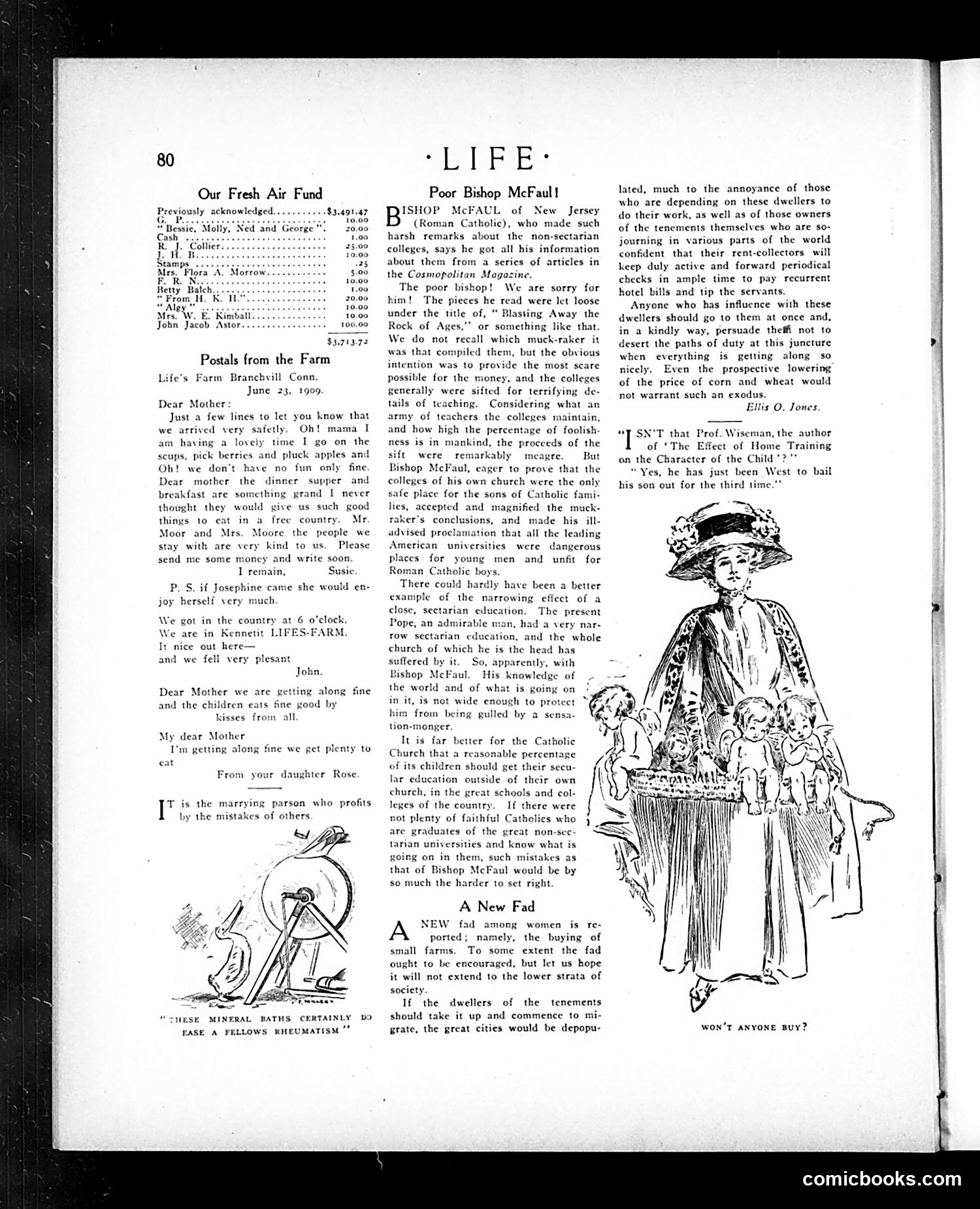
This page contains two distinct pieces: **"Poor Bishop McFaul"** - An article criticizing Bishop James McFaul of the Roman Catholic Church for writing alarmist articles in *Cosmopolitan Magazine* about dangers to Catholic youth in secular universities. The author mocks McFaul's narrow sectarian views and argues that Catholic children would benefit from education at prestigious non-sectarian institutions alongside faithful Catholic graduates. **"A New Fad"** - A brief social commentary satirizing wealthy women's recent trend of buying small farms. The piece humorously suggests this fad might solve urban overcrowding if tenement dwellers also migrated to farmland. **The Cartoon** (bottom left) depicts mineral baths, captioned "These mineral baths certainly do ease a fellow's rheumatism" — a straightforward advertisement or health-related humor, unrelated to the articles. The right illustration appears to be a fashion or social commentary sketch, captioned "Won't anyone buy?"
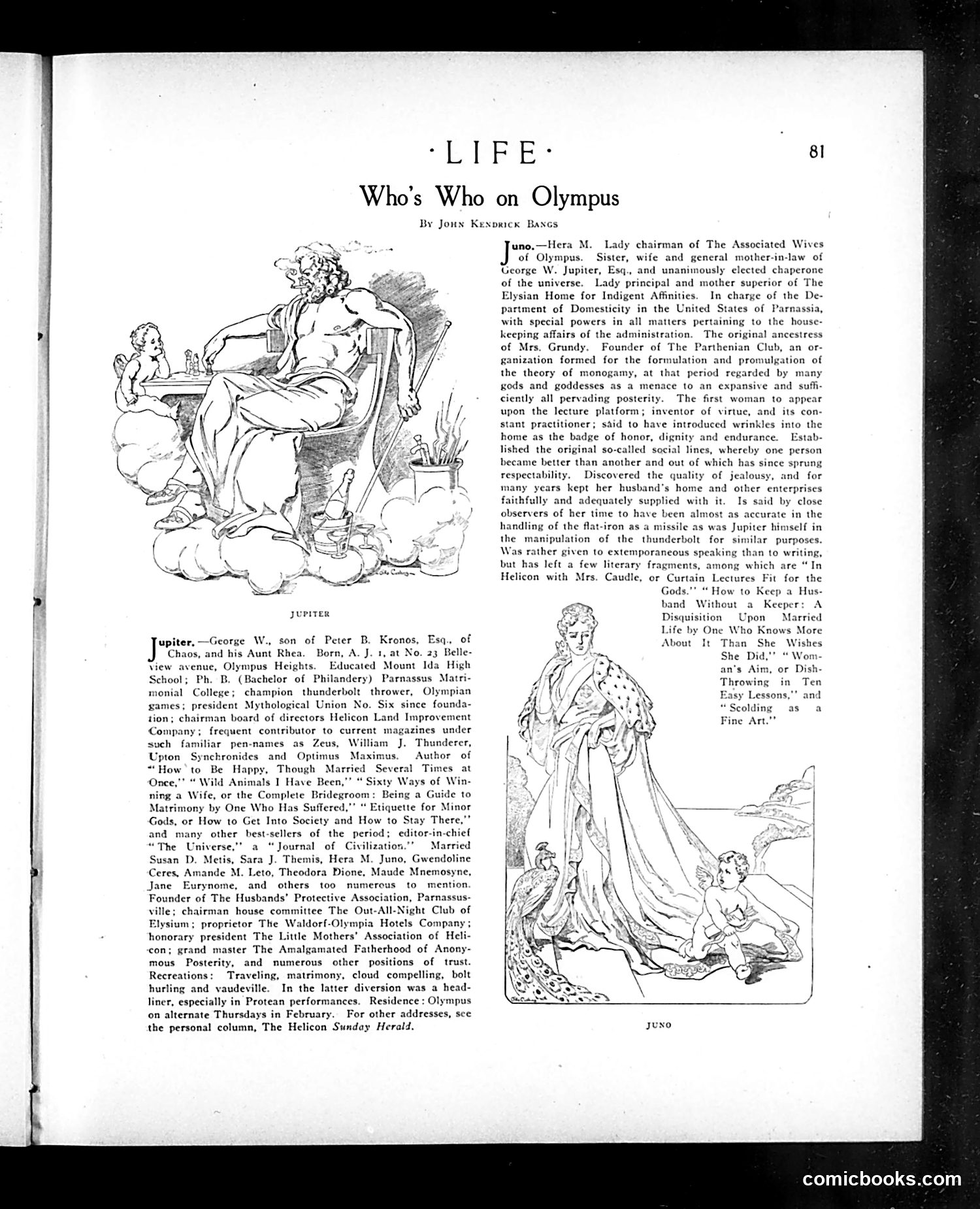
This page presents satirical biographical sketches of prominent society figures, humorously casting them as Greek gods. The text describes "Juno" (identified as Hera M., chairwoman of The Associated Wives of Olympus) and "Jupiter" (Peter B. Kronos, Esq.), treating real people's social accomplishments and organizational roles as mythological divine attributes. The cartoons depict these figures in classical Greek style—Juno as an enthroned matron, Jupiter as a bearded patriarch—visually parodying their social prominence by elevating ordinary domestic and civic achievements to mock-divine status. This is satirical commentary on elite society's self-importance, suggesting these wealthy socialites conduct themselves with unwarranted grandiosity. The joke relies on readers recognizing these actual society figures.
This page is an advice column by Harry Graham satirizing the social conventions of formal invitation writing. The left side contains verse mocking common mistakes in invitation composition—awkward phrasing, misspellings, poor ink choices, and unclear dates that confuse guests. The right side offers three humorous "examples" of poorly-worded invitations where hosts create situations they didn't intend. For instance, one invitation's vague wording inadvertently excludes someone's aunt; another creates scheduling conflicts. The decorative initial letter suggests early 20th-century publication. The satire targets upper-class etiquette anxieties—the fear that improper invitations damage social standing. Graham's humor lies in showing how small writing errors cascade into social embarrassment, a concern particularly acute among those aspiring to "Upper Classes" respectability.
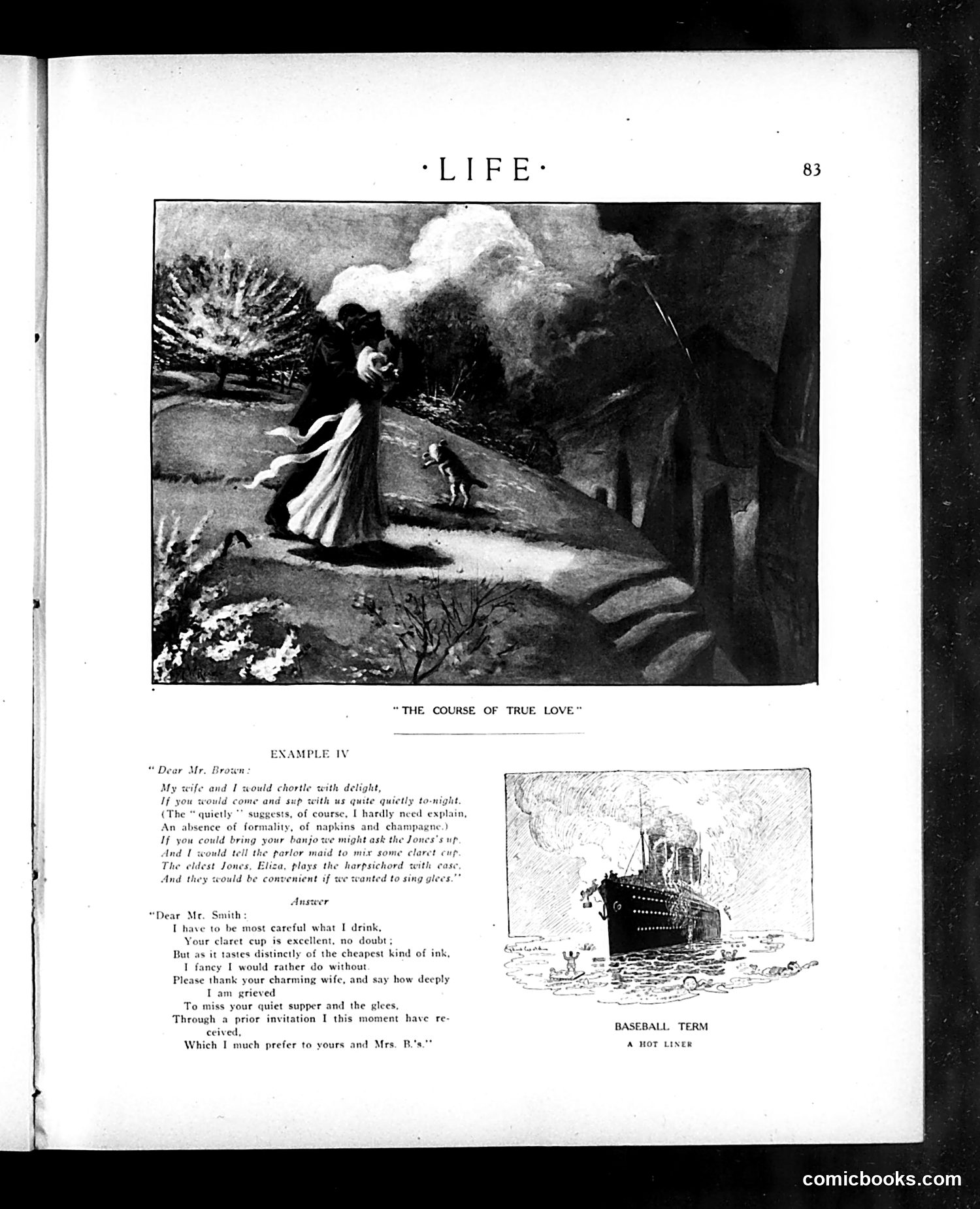
This page contains **Example IV**, a humorous advice column exchange. A correspondent ("Mr. Brown") requests etiquette guidance for hosting a quiet supper with his wife, mentioning champagne and asking a musician named Eliza to play the harpsichord discreetly. The response from "Mr. Smith" satirizes overly cautious social behavior, joking that he must be careful about what he drinks because even the cheapest ink stains clothing, and he'd "rather do without" than risk damage. He then thanks Brown's wife and requests an invitation, ending with "Which I much prefer to yours and Mrs. B's." The humor lies in the absurdist non-sequiturs and the implication that the advice-giver is more interested in the wife's company than the husband's hospitality. The accompanying illustration titled "Baseball Term—A Hot Liner" shows an unrelated maritime scene.
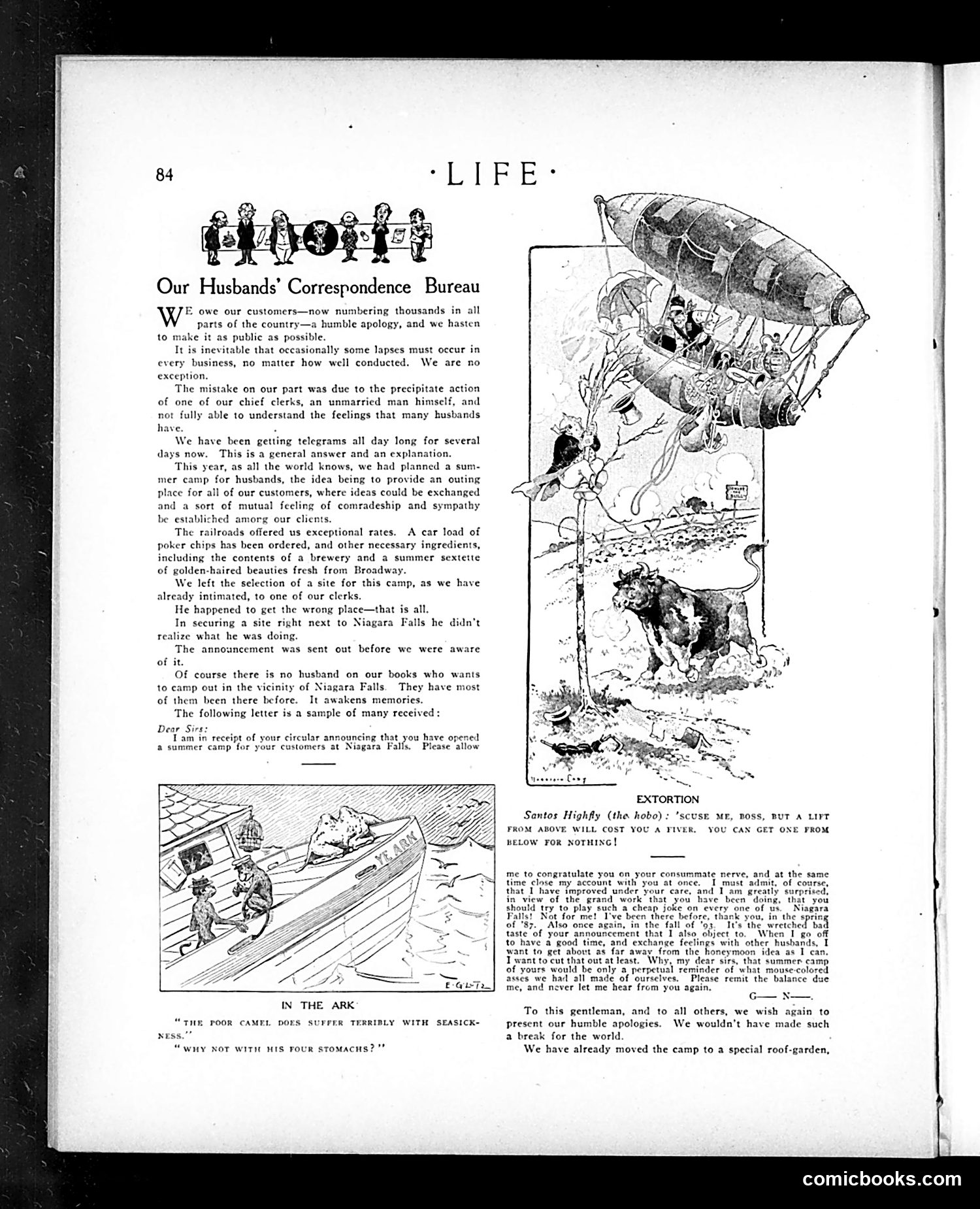
This page satirizes a summer camp for husbands organized by Life magazine, apparently near Niagara Falls. The text describes how the magazine opened this facility to provide husbands an escape where they could exchange ideas and enjoy "mutual feeling of comradeship and sympathy." The cartoons mock the concept: "In the Ark" shows a man seasick in a boat (captioned with a joke about a camel's poor digestion), while "Extortion" depicts a hobo literally suspending a trapped businessman from above, demanding money—suggesting that even at this supposedly relaxing retreat, husbands face exploitation and discomfort. The accompanying letters express mock gratitude and complaints, satirizing the gap between the camp's promised benefits and its actual miserable reality.
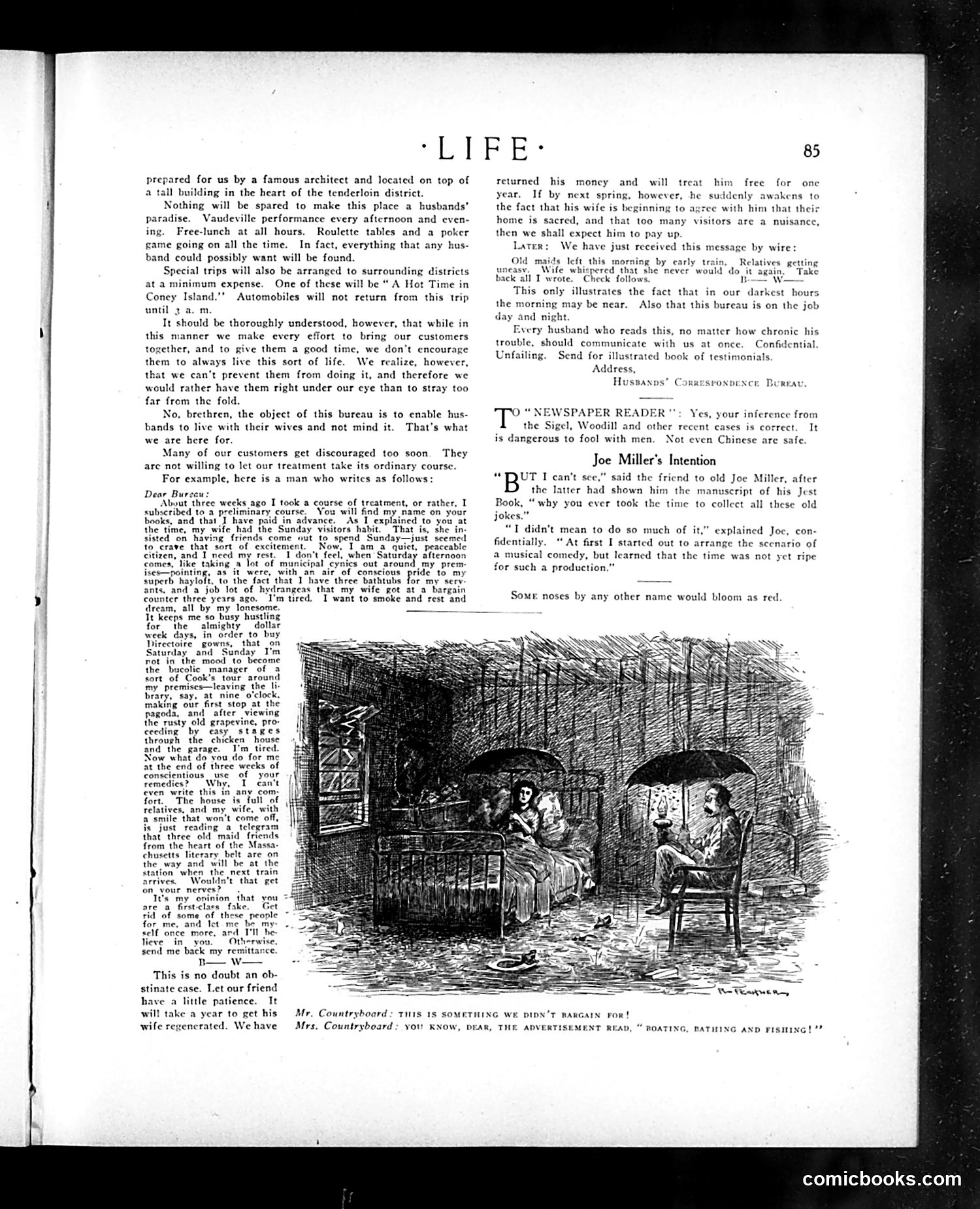
This page contains a satirical section titled "Joe Miller's Intention" featuring a humorous illustration and dialogue. The cartoon depicts what appears to be a bedroom scene with a couple, where a man is showing his friend a collected set of old jokes, explaining he initially attempted to arrange them into a musical comedy but found the material outdated. The satire targets the recycling of stale humor and the difficulty of reviving old comedic material for modern audiences. The caption quotes dialogue between Mr. and Mrs. Countreboard discussing a newspaper advertisement promising "boating, bathing and fishing," suggesting ironic commentary on unrealistic vacation promises. The page also includes reader correspondence sections addressing marital and domestic topics, typical of Life's satirical advice-column format.
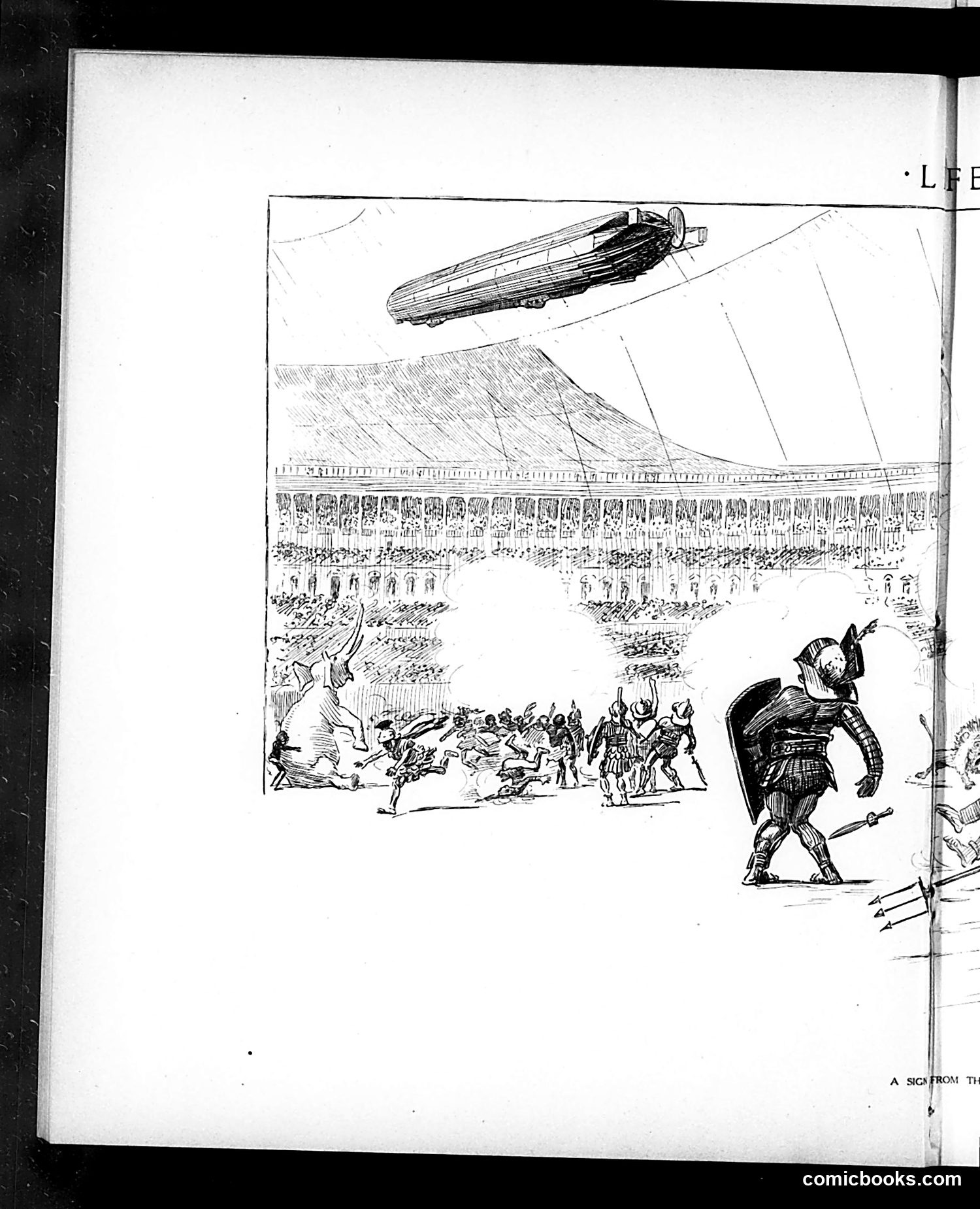
This appears to be a satirical illustration depicting an airship or dirigible hovering over a large stadium or amphitheater filled with crowds. A military or authoritarian figure stands prominently in the foreground (right side), gesturing upward at the aerial vessel. The cartoon likely satirizes early 20th-century militarism and the rise of aerial warfare technology, possibly referencing German zeppelin development or military posturing. The massive crowd gathering suggests either mass mobilization or public spectacle around military might. The caption fragment "A SIGN FROM TH[E]..." (incomplete in the OCR) would clarify the specific political commentary. Without the full caption or publication date visible, the exact historical event or political figure referenced remains unclear, though the imagery suggests anxiety about modern weaponry and authoritarian power.
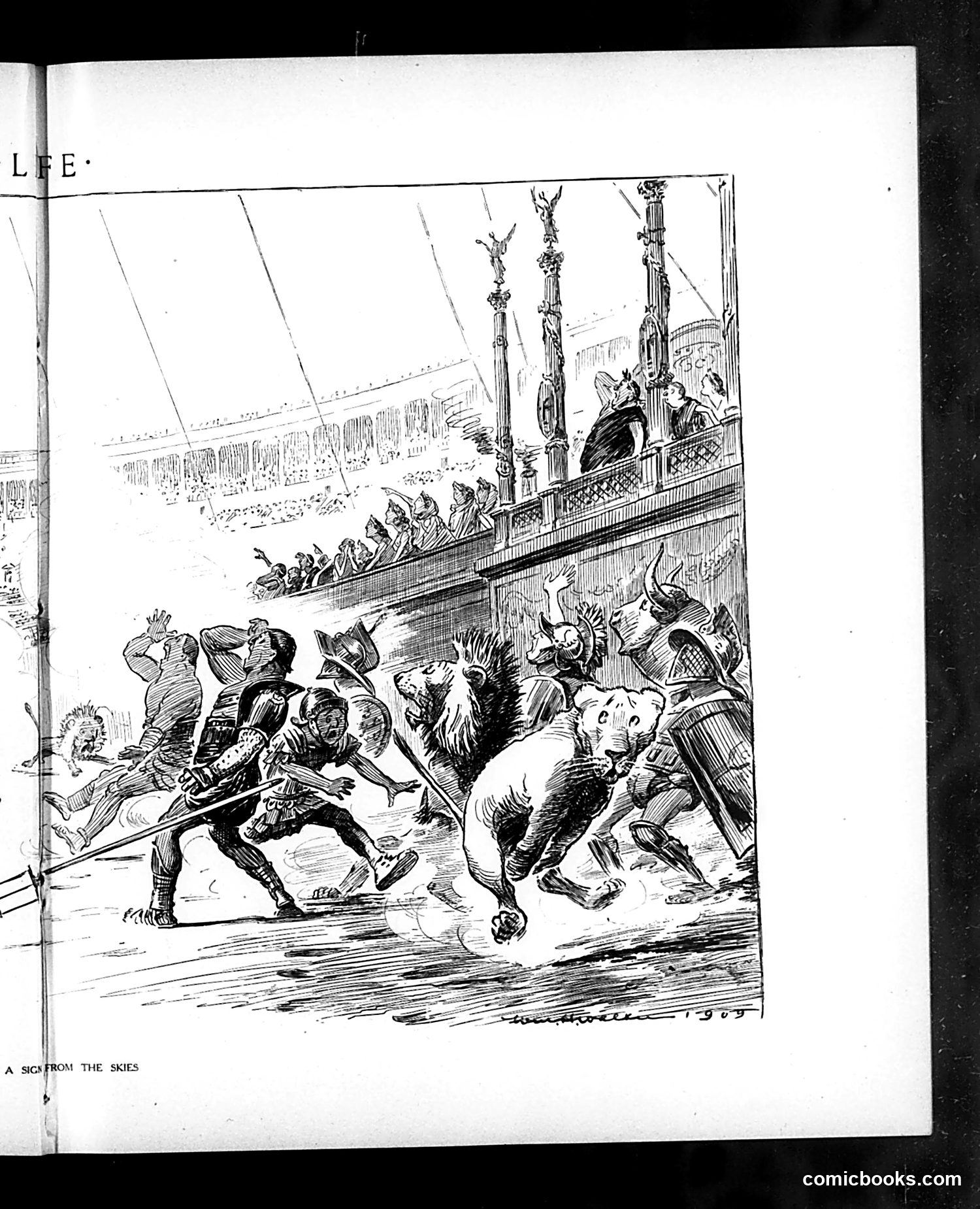
This satirical illustration depicts a chaotic scene at what appears to be a public gathering or arena, with spectators watching from an upper balcony while figures below engage in violent combat. The title suggests an airborne affliction or plague affecting the crowd. The cartoon likely comments on social disorder, disease, or moral corruption spreading through society—depicted metaphorically through the violent chaos below. The contrast between the composed observers above and the frenzied action below may critique indifference to widespread problems or the class divisions in witnessing public suffering. Without publication date context visible on this page, the specific historical event or scandal referenced remains unclear. The style and aesthetic suggest early-to-mid 20th century American satirical commentary on social upheaval.
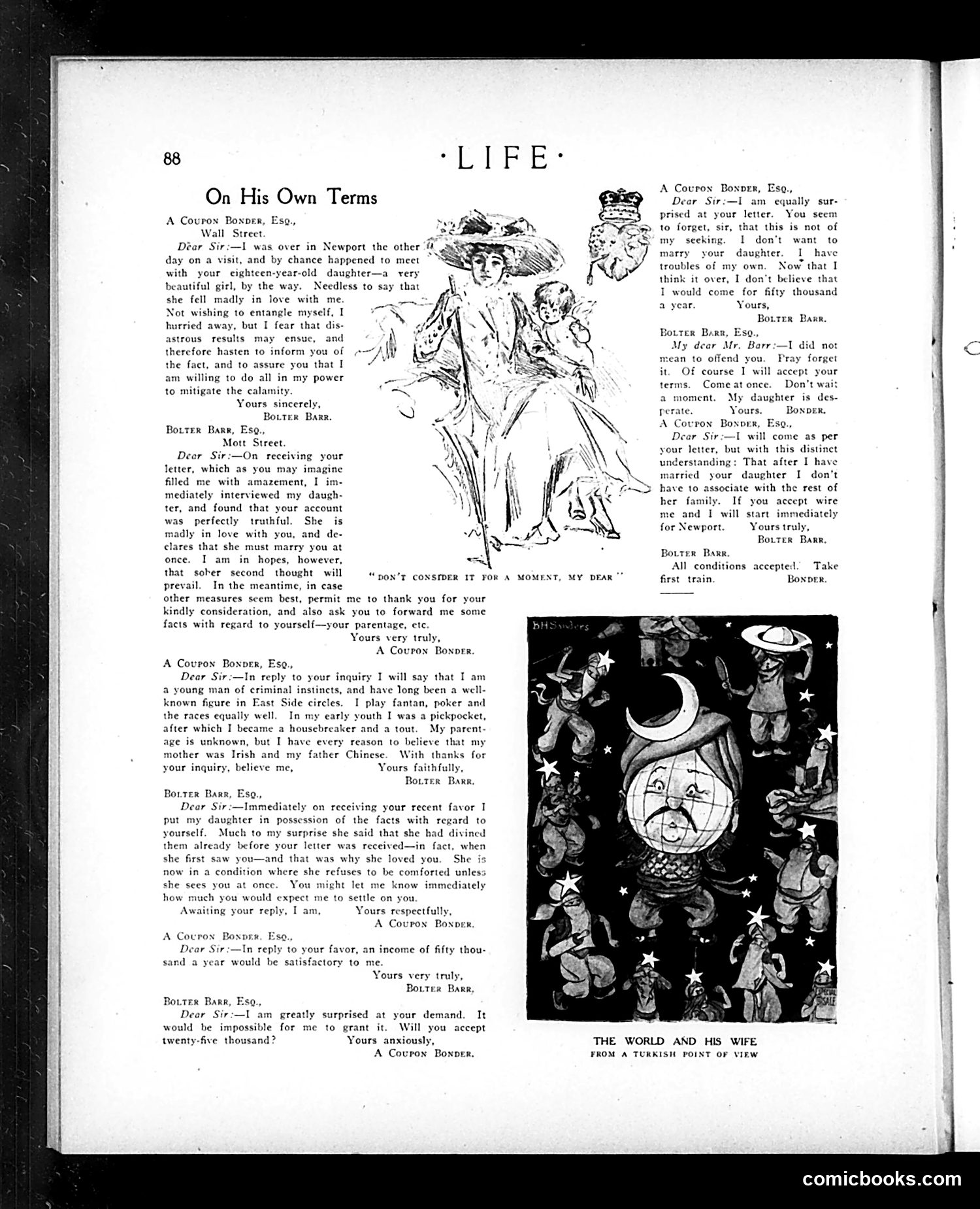
This multi-panel letter-exchange satire mocks both wealthy industrialists and fortune hunters. A Wall Street tycoon ("Coupon Bonder") meets a charming stranger in Newport who charms his daughter. The suitor—a self-described criminal from the East Side with a dubious mixed-race heritage (Irish mother, Chinese father), who admits to being a pickpocket and housebreaker—writes back with refreshing honesty. The joke inverts class expectations: the morally corrupt poor man becomes more honorable than the wealthy father. When the daughter inexplicably loves him *because* of his criminal background, her desperate father negotiates a dowry. The suitor's final condition—refusing to associate with the girl's family after marriage—reveals his authentic contempt, contrasting sharply with the father's mercenary desperation. The satire targets both aristocratic pretense and the transactional nature of Gilded Age marriages.
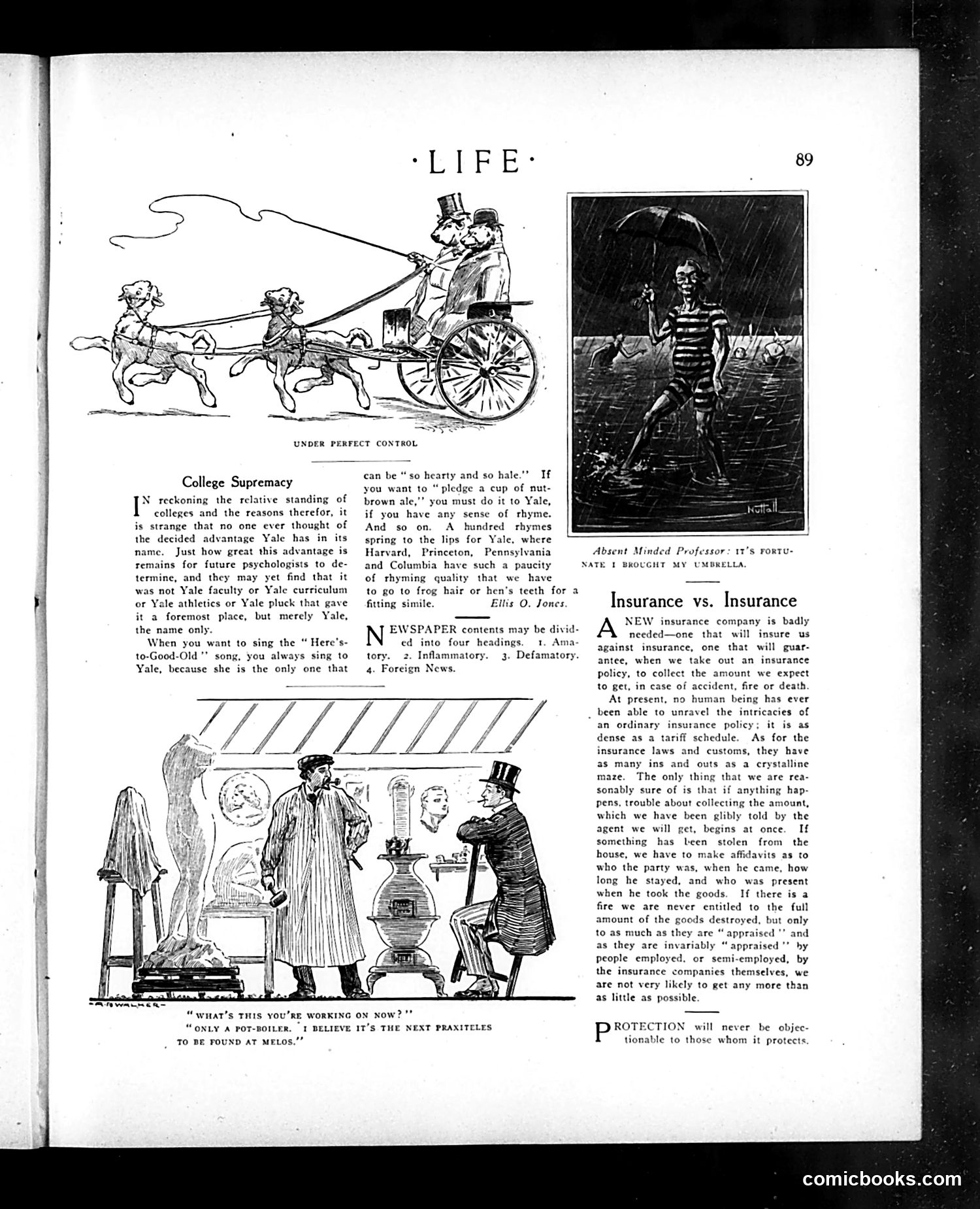
This page contains three satirical pieces targeting American institutions: **"College Supremacy"** mocks Yale University's prestige, arguing its advantage derives not from faculty or athletics but merely from its name's superior rhyming qualities in college songs. The satire critiques how institutional reputation can rest on superficialities rather than genuine merit. **The cartoon "Under Perfect Control"** depicts a figure in a pot-boiler (cheap commercial artwork) being presented as the "next Praxiteles"—comparing hack work to the famous ancient Greek sculptor. It satirizes art world pretension and the marketing of mediocre art. **"Insurance vs. Insurance"** attacks the insurance industry's opacity and bad-faith practices. The piece argues that insurance policies are incomprehensibly complex, claims processes deliberately obstructive, and appraisals systematically undervalued. It proposes satirically that customers need "insurance against insurance" itself—a sharp critique of corporate deception targeting ordinary citizens. The "Absent Minded Professor" cartoon offers lighter humor about forgetfulness.
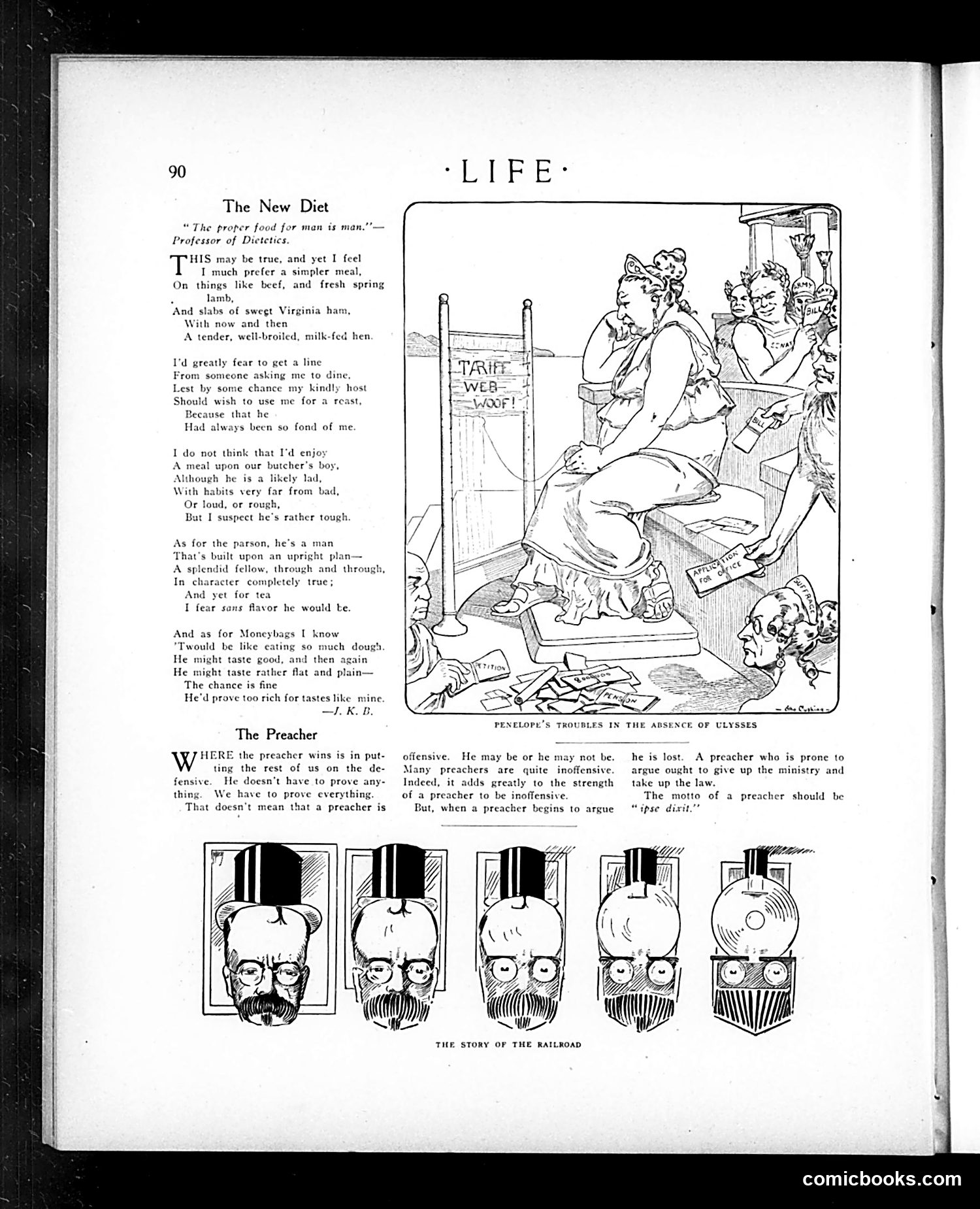
**"The New Diet"** (upper section): A humorous poem mocking dietary advice. The speaker rejects Professor of Dietetics' recommendations for "proper food for man," preferring simpler fare (beef, ham, chicken). The satire targets early 20th-century nutrition fads and experts prescribing overly complicated eating regimens. The illustration shows a woman serving food while cherubs observe—a tongue-in-cheek take on elevated dietary theories. **"The Preacher"** (lower section): Criticizes ineffective clergy. The text argues preachers prone to argumentative debate lose credibility and ability to lead morally. The accompanying illustration titled "The Story of the Railroad" shows five head profiles with progressively changing expressions and hats—likely depicting how a preacher's verbose argumentation changes (or damages) his authority over time. Both pieces satirize contemporary institutional experts.
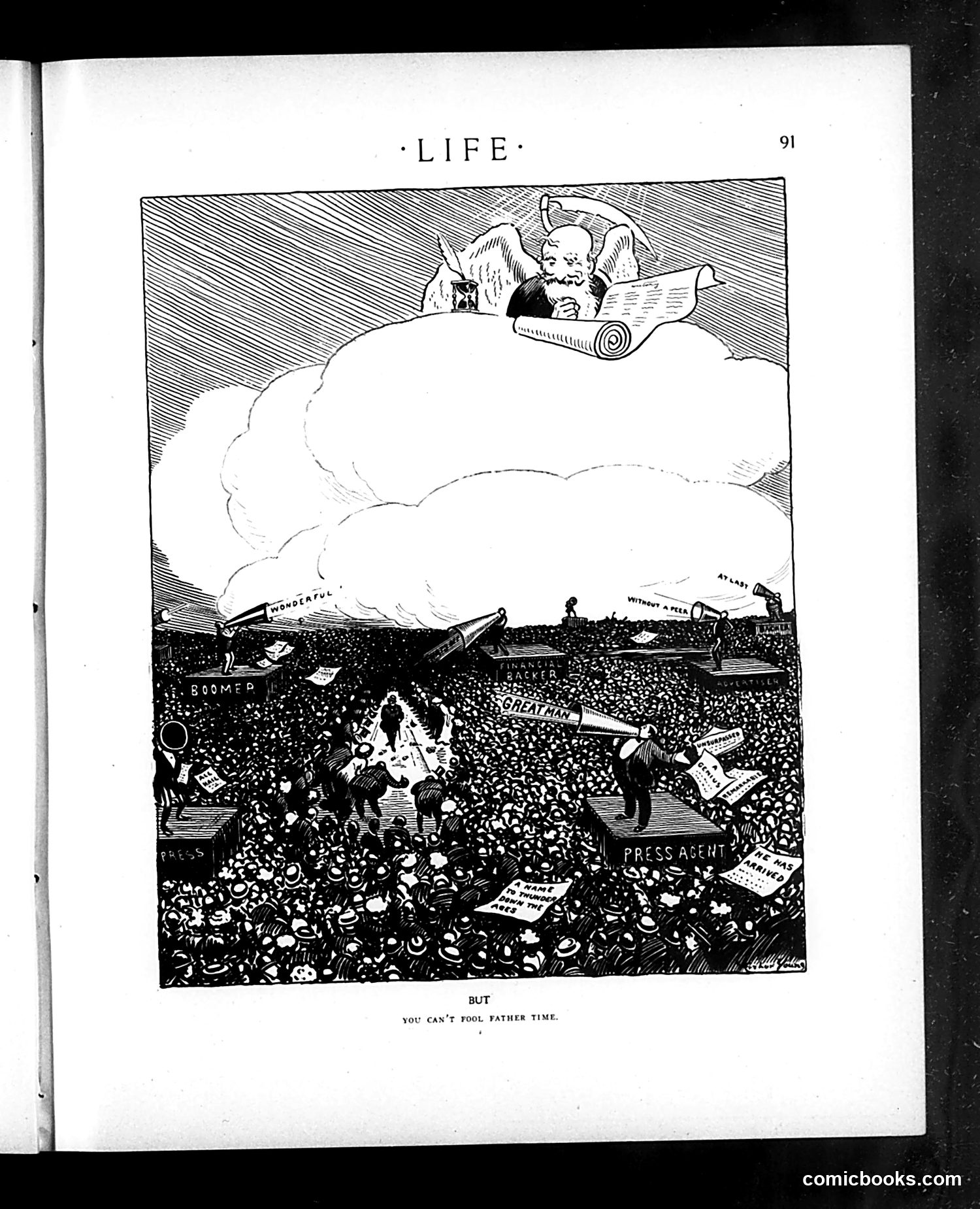
This cartoon satirizes efforts to manipulate or control time itself through modern innovations. The bottom half shows a chaotic crowd of people (labeled "BOOMER," "PRESS AGENT," and other identifiable figures) attempting to manage time with various tools and contraptions. Above them, Father Time—depicted as a bearded angel figure on clouds reading a scroll—observes from heaven. The caption "BUT YOU CAN'T FOOL FATHER TIME" delivers the moral: despite humanity's schemes, inventions, and PR efforts, the passage of time remains unstoppable and inevitable. This appears to mock the era's optimism about technological progress and publicity-driven solutions to human problems. The satire suggests that certain universal forces—aging, mortality, natural consequences—cannot be manipulated by modern gimmicks or media management.
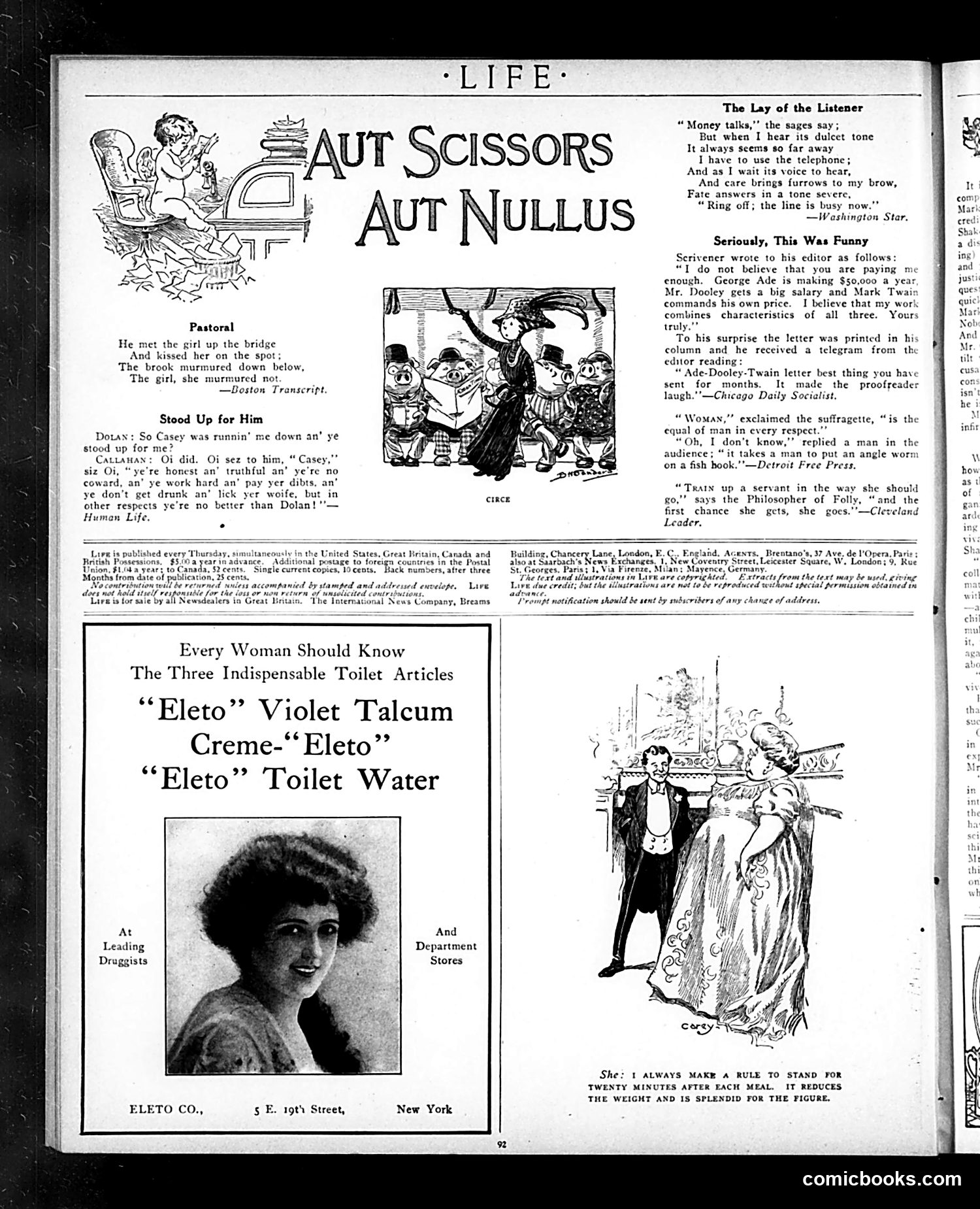
This page from *Life* magazine (early 1900s) contains several satirical pieces typical of the era's humor: **Top cartoon ("Aut Scissors, Aut Nullus")**: Shows a woman at a desk with scissors, illustrating domestic/office life humor—likely poking fun at women's limited professional roles or domestic decision-making power. **Humorous anecdotes**: Include jokes about telephone frustration, romantic encounters, workplace loyalty, and writer compensation. One piece mocks a scrivener's complaint that he deserves pay equal to George Ade and Mark Twain—the editor's response (printing the letter and praising it as funny) is the satire: the writer's self-aggrandizement becomes the joke itself. **Suffragette joke**: References women's equality debates by having a man claim women aren't equal to men—then makes a crude fishing joke, exemplifying period sexism presented as humor. **Bottom section**: Primarily advertising for "Eleto" beauty products, with an illustration of a woman standing after meals for figure maintenance—reflecting era beauty standards. The page blends satire, period sexism, and advertising typical of early 20th-century American magazines.
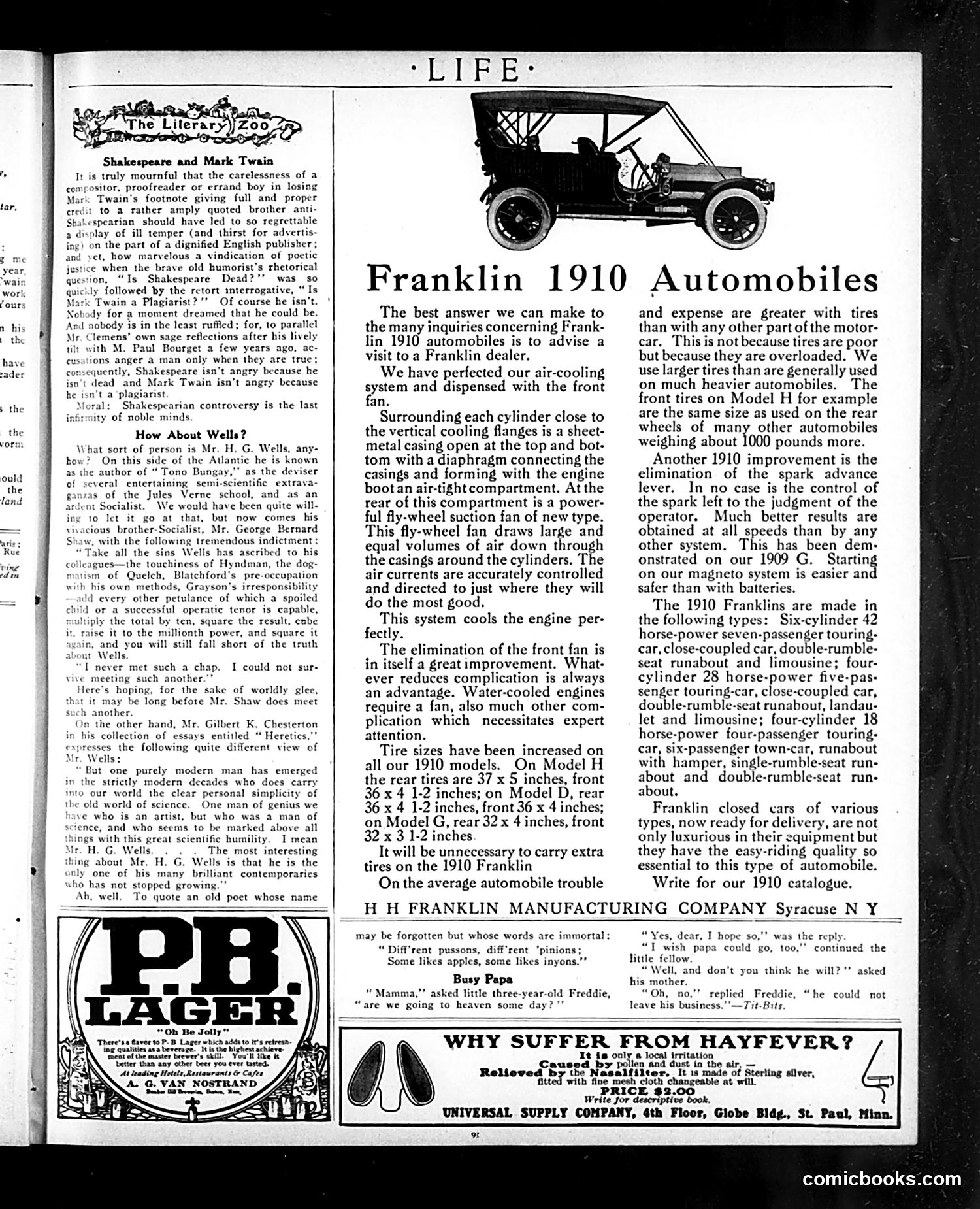
This page mixes literary criticism with automobile advertising. The editorial content discusses two contemporary figures: **Mark Twain vs. H.G. Wells debate**: The text defends Mark Twain against plagiarism accusations following a footnote controversy with a British publisher. It then pivots to H.G. Wells, presenting conflicting assessments—George Bernard Shaw's scathing critique of Wells as temperamental and self-absorbed, versus G.K. Chesterton's praise of Wells as a uniquely humble, still-growing modern intellect. The piece's tone suggests Life finds both perspectives amusing. **The main illustration** depicts a 1910 Franklin automobile with detailed technical specifications about its cooling system innovations, particularly the elimination of front fans. The page demonstrates *Life*'s typical format: satirical commentary on current intellectual figures paired with advertisements, all reflecting early 1900s preoccupations with both literary merit and technological progress.
This is primarily an **advertising page** from Life magazine, with several small humorous anecdotes interspersed among advertisements. The page contains no political cartoons. Instead, it features vintage ads for Chiclets gum, Havoline Oil, Liqueur Pères Chartreux (liquor), and other products typical of early 1900s marketing. The small jokes scattered throughout are domestic humor pieces common to the era: - "She Was Too Quick" plays on romantic mishaps - "Summer Board" jokes about a farm landlord charging extra for dialect-speak, reflecting class attitudes - "A Never Failing Supply" uses marital humor (wife ignoring husband) - Other brief anecdotes rely on wordplay and social observations These are lightweight, genteel pieces reflecting Edwardian-era magazine humor—no significant political or social satire. The page primarily serves as a revenue vehicle through advertising, with filler humor to make it entertaining.
This is primarily an **advertising page** with some humor content rather than political satire. **Main Advertisement:** Morgan & Wright Tires claims 28 years of tire manufacturing expertise, emphasizing quality control and durability. The copy appeals to early automobile owners concerned with tire reliability and cost. **Humor Stories:** The page includes three brief anecdotes: - A stage manager who romanticizes rain (wants to nurture grass like flowers) but isn't actually a flower himself—mocking sentimental pretension - A Cincinnati stagecoach passenger wanting to "buy" a specific horse with his $5 bill—humor about rural poverty - College boys arrested for loud victory celebration, with a stutter-joke about the name "Ro-Robert Ro-rollins" These are gentle, non-political jokes typical of early 1900s Life magazine. **Other Advertisements:** John Jameson Whiskey and Raymond & Whitcomb travel services round out the page. The content reflects middle-class American concerns: automobile ownership, travel, humor about rural/urban contrasts, and student pranks—no apparent political commentary.
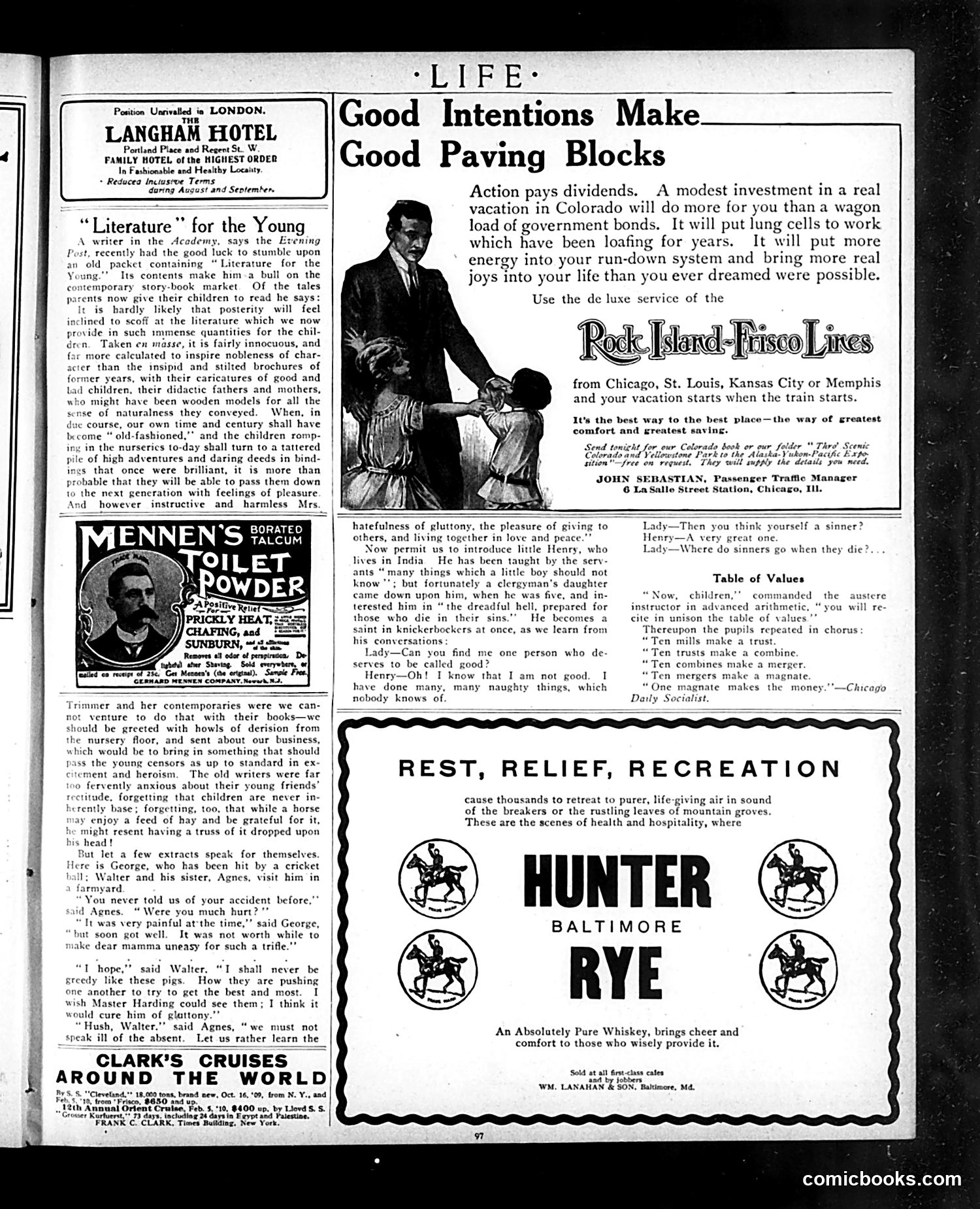
This page is primarily **advertising and light satirical commentary** rather than political cartoons. The main content includes: 1. **"Good Intentions Make Good Paving Blocks"** — An advertisement for Rock Island-Frisco railroad lines using the idiom that good intentions don't guarantee results; similarly, a Colorado vacation provides more real benefit than government bonds. 2. **"Literature for the Young"** — A brief essay praising contemporary children's books as superior to "old-fashioned" didactic Victorian literature, suggesting modern stories inspire "nobleness of character" better than their stilted predecessors. 3. **"Table of Values"** — A satirical joke where a teacher recites economic units: "ten trusts make a combine, ten combines make a merger," etc., mocking the consolidation of American business into monopolies. The humor lies in treating corporate mergers like mathematical units. 4. **Multiple advertisements** for Mennen's talcum powder, Clark's cruises, and Hunter Baltimore Rye whiskey. The page reflects early 20th-century concerns about monopolistic business practices and nostalgia for simpler children's literature.
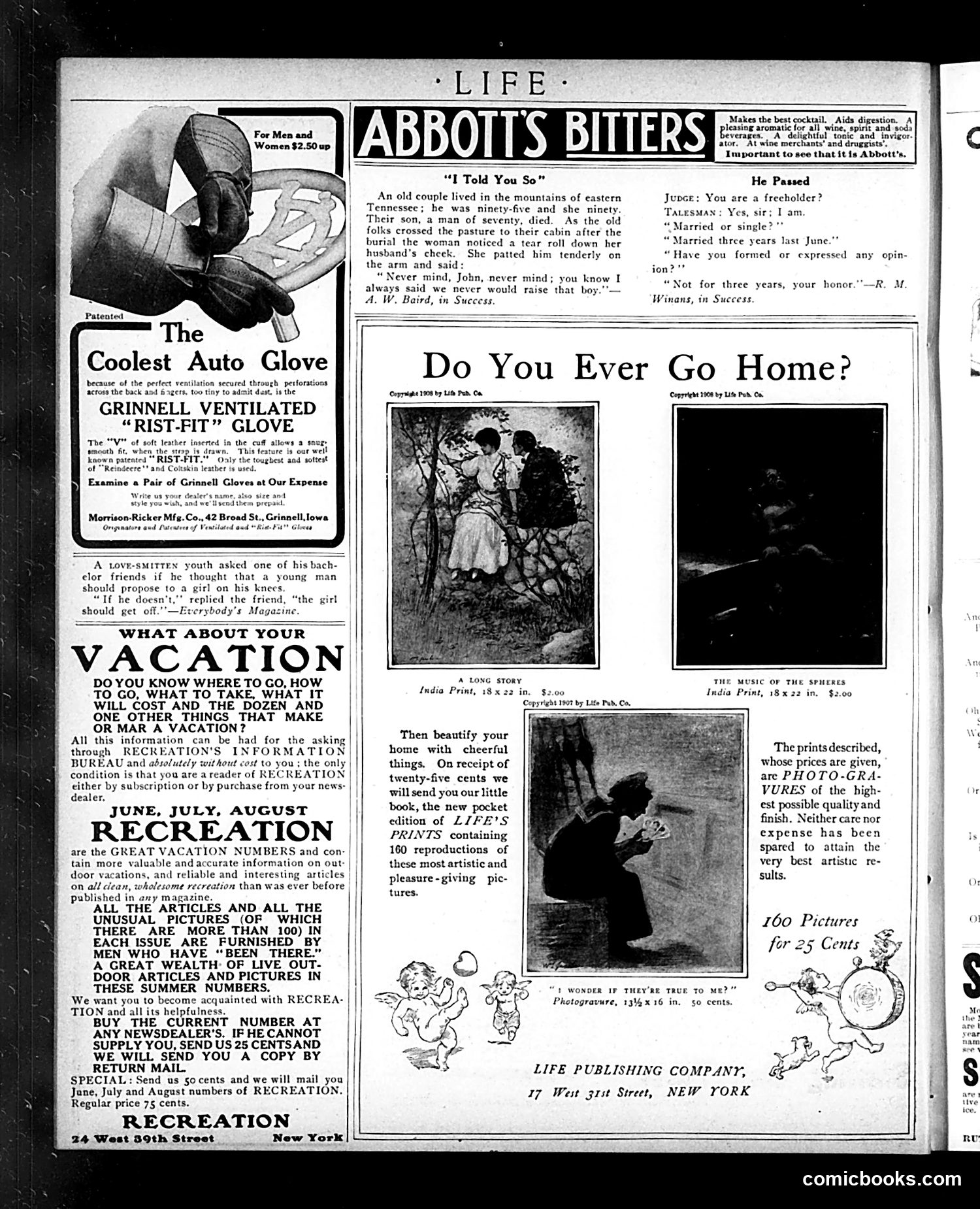
This page from *Life* magazine (circa 1908) is primarily **advertisements and filler content** rather than political satire. The main elements include: **Advertisements:** - Grinnell "Rist-Fit" auto gloves - Abbott's Bitters (a medicinal alcohol product) - *Recreation* magazine's vacation guide service - *Life*'s photogravure prints collection **Humorous anecdotes** (not cartoons): - A brief joke about marriage proposals - "I Told You So": An elderly Tennessee couple whose 70-year-old son dies; the wife reminds her husband she always predicted he'd be a problem - "He Passed": A juror admits he hasn't formed opinions in three years of marriage—satirizing marital submission **Artwork section:** Photogravure reproductions titled "Do You Ever Go Home?" and "The Music of the Spurs" (depicting rural/frontier scenes). The page reflects early-1900s consumer culture and genteel humor rather than sharp political commentary. The marriage jokes subtly mock both male weakness and female dominance within relationships—common tropes of the era.
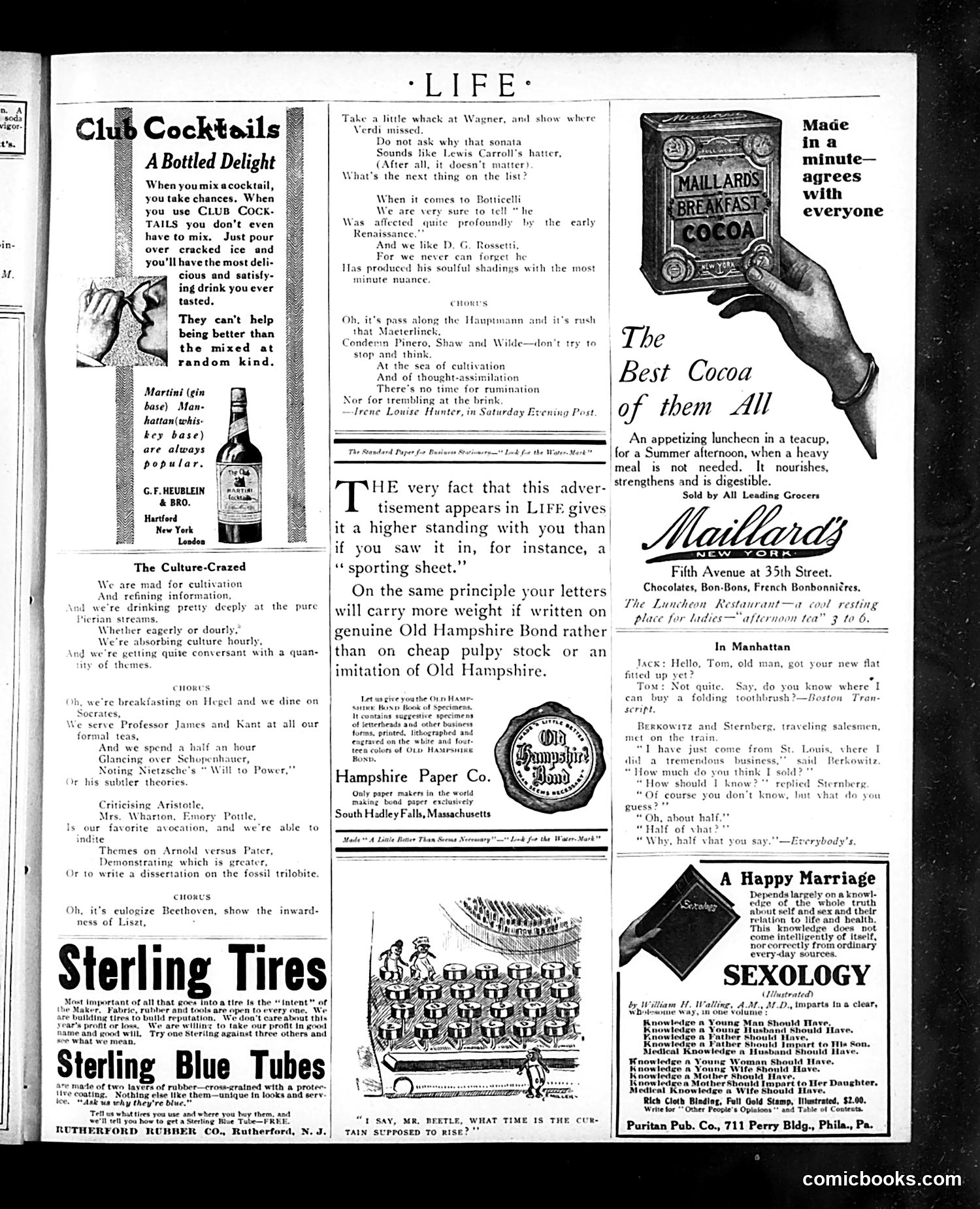
This poem satirizes early-20th-century American intellectual pretension. The speaker boasts of casually consuming high culture—breakfast on "Hegel," dinner on "Socrates," leisure reading of Schopenhauer and Nietzsche—while demonstrating they understand none of it deeply. The joke is that this person treats serious philosophy and art as fashionable status symbols to be displayed rather than genuinely studied. They rush from topic to topic ("What's the next thing on the list?") with no time for actual "rumination," dropping names of composers (Wagner, Beethoven), authors (Mrs. Wharton), and philosophers as cultural currency. The satire targets the "culture-crazed" American who equates name-dropping with genuine intellectual engagement—a timeless critique of performative intellectualism masquerading as education.
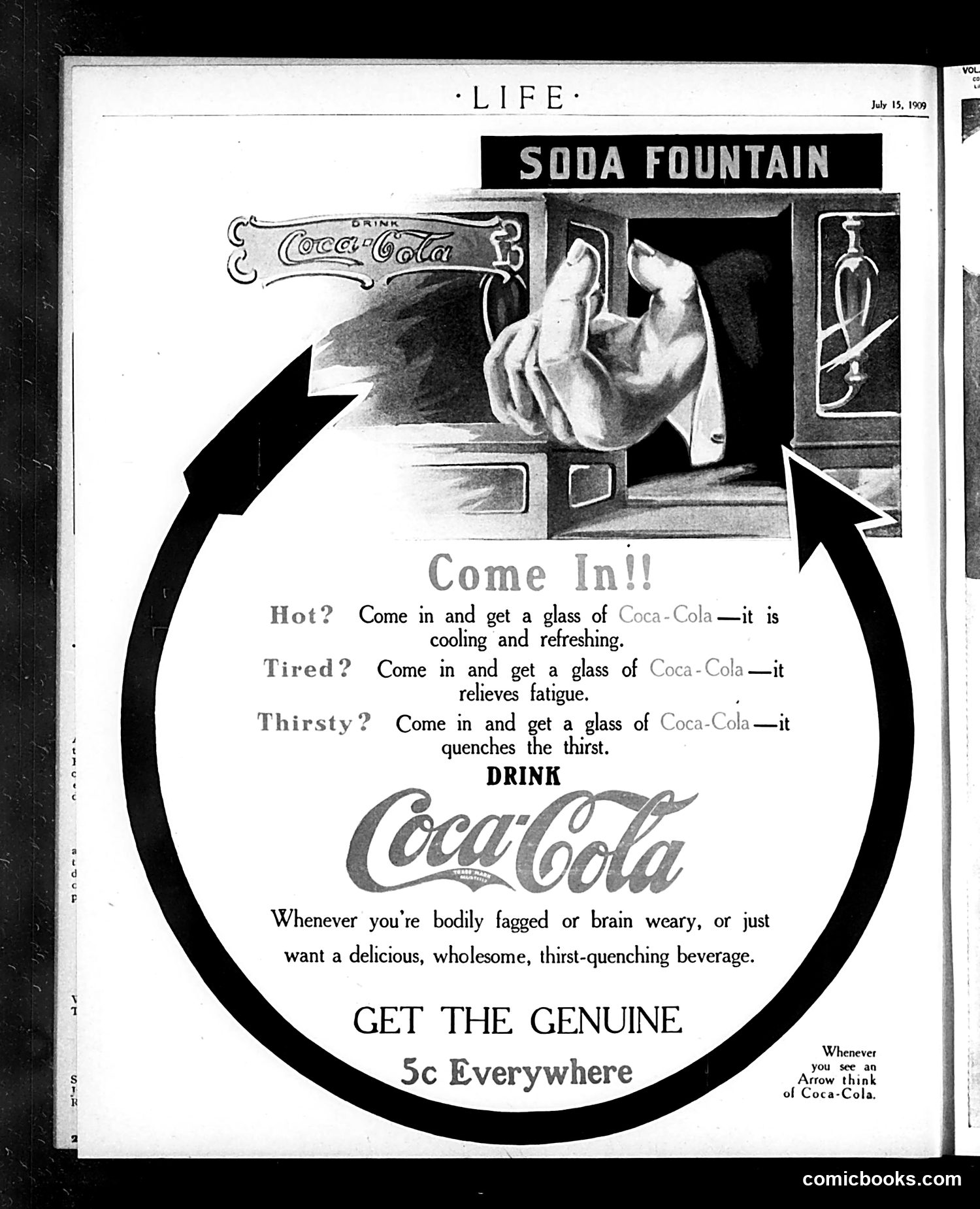
This page is **primarily a Coca-Cola advertisement**, not satire or political commentary. It dates to July 15, 1909, appearing in *Life* magazine. The ad features a soda fountain scene with a server dispensing Coca-Cola. The design uses a large circular frame with arrows directing readers' attention to the product message. The advertisement's claims reflect early 20th-century patent medicine marketing conventions—Coca-Cola was marketed as having medicinal properties that could address fatigue, thirst, and general malaise. The ad promises the drink relieves various physical conditions ("bodily fagged or brain weary"), a common advertising approach before modern consumer protection regulations. The price point of "5c Everywhere" indicates this was accessible mass-market product placement. This represents straightforward commercial advertising rather than editorial satire or cartoon commentary.