
Life, 1909-07-15 · page 6 of 28
Life — July 15, 1909 — page 6: what you’re looking at
What you’re looking at
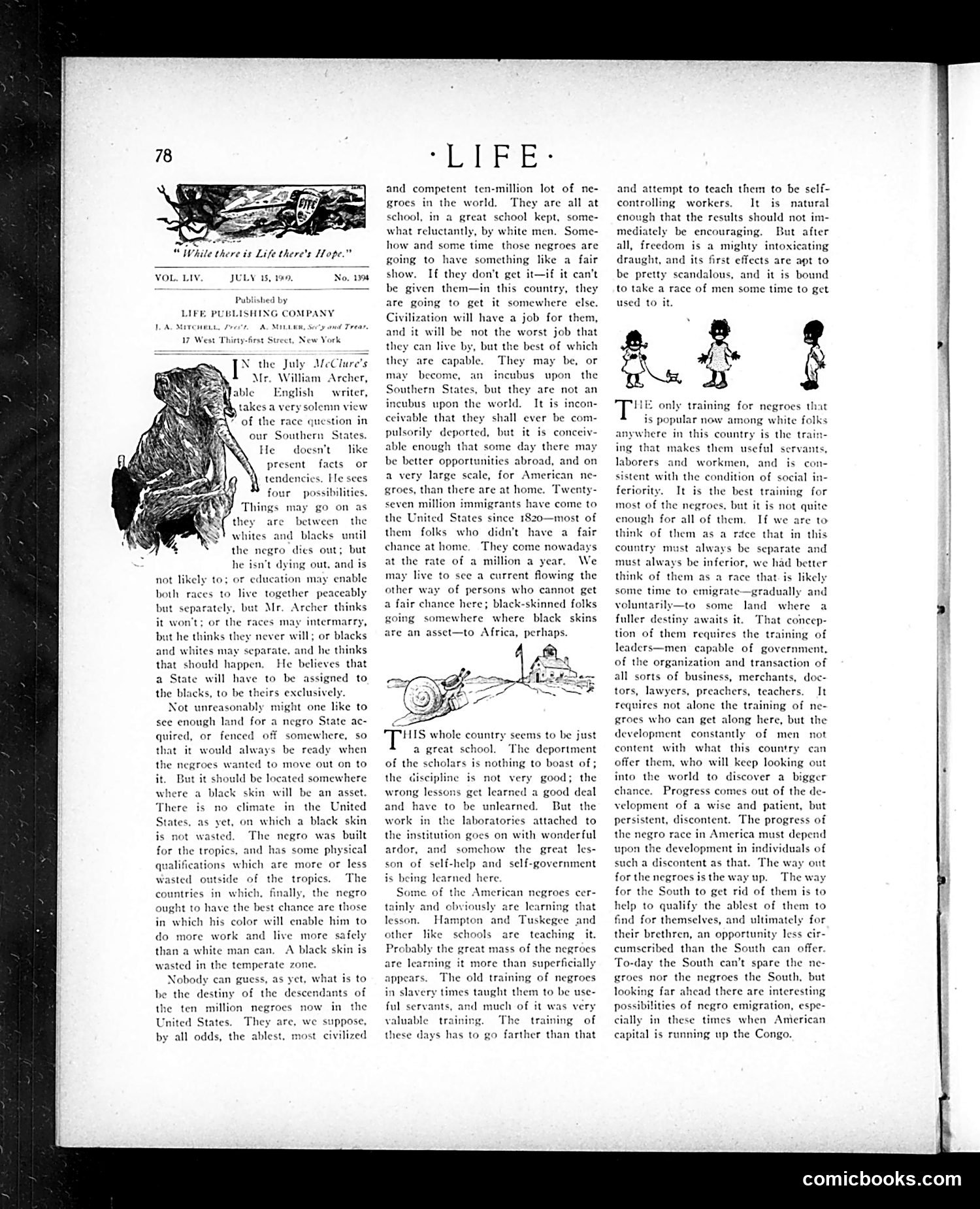
**Content:** This page contains a serious editorial article about racial training and education of African Americans, accompanied by illustrations of Black children. **The Cartoons:** Three simple line drawings show Black children in various poses—sitting, standing, playing with a toy—depicting everyday childhood activities. **The Message:** The article argues that African Americans should receive vocational and self-improvement training to become "useful servants, laborers and workmen" while remaining subordinate due to "social inferiority." It suggests emigration as preferable to integration, referencing potential opportunities in Africa or the Congo. **Historical Context:** This reflects early-1900s racist ideology that viewed segregation and controlled vocational education as "benevolent" solutions while opposing genuine equality or social advancement for Black Americans.
📄 Transcribed text from this page (OCR, searchable)
Machine-transcribed from the original scan — historical spelling and the odd misread are preserved.
VOL. LIV JULY 15, 199, No. 1398 hed by LIFE, PUBLISHING COMPANY JA MITCHELL, Preece AL MILLER, Sorty wont Treas 17 West Thirty-first Sect, New York N the July MeClure’s Mr. William Archer, English — writer, akes a very solemn view of the race question in our Southern Si He — doesn’t lik: facts or able es, present tendencies. He sees four possibili Things may go on as they are between the whites and blacks until the negro dics out; but he isn't dying out, and is not likely to; or educ both races to live together peaceably but separately, but Mr. Archer think it won't; of the races may intermarry, but he thinks they never will; or blacks and whites may separate, and he thinks that should happen. He believes that a State will have to be assigned to the blacks, to be theirs exclusively. Not unreasonably might one like to see enough land for a negro State ac- quired, or fenced off somewhere, so t it would always be ready when the negroes wanted to move out on to it. But Id be located somewhere where a black skin will be an asset. There is no climate in the United States, as yet, on which a black skin is The negro was built for the tropics, and has some physical qualifications which are more or less wasted outside of the tropics. The countries in which, finally, the negro ought to have the best chance are those in which his color will enable him to do more work and live more safely than a white man can, A black skin is wasted in the temperate zone. Nobody can guess, as yet, what is to be the destiny of the descendants of the ten million negroes now in the United States. They are, we suppose, by all odds, the ablest, most civ ion may enable she wasted. ized aR ESES and competent ten-million lot of ne- groes in the world. They are all at school, in a great school kept, some- what reluctantly, by white men, Some- how and some time those negroes are going to have something like a fair show. If they don’t get it—if it can’t be given them—in this country, they re going to get it somewhere else. Civilization will have a job for them, and it will be not the worst job that they can live by, but the best of which they are capable. They may be, or may become, an incubus upon the Southern States, but they are not an cubus upon the world. It is incon- ble that they shall ever be com- pulsorily deported, but it is conceiv- able enough that some day there may be better opportunities abroad, and on a very large scale, for American ne- groes, than there are at home. Twe seven million immigrants have come to the United States since 1820—most of them folks who didn’t have a fair chance at home. They come nowadays at the e of a million a year. We may live to see a current flowing the other way of persons who cannot get a fair chance here; black-skinned folks going somewhere where black skins are an asset—to Africa, perhaps. HIS whole country seems to be just a great school. The deportment of the scholars is nothing to boast of ; the discipline is not very good; the wrong lessons get learned a good deal and have to be unlearned. But th work in the laboratories attached to the institution goes on with wonderful ardor, and somehow the great les- son of self-help and self-government is being learned here Se tainly and c of he American negroes cer- yiously are learning that lesson. Hampton a Tuskegee and other like schools are teaching it. Probably the great mass of the negroes ing it more than superficially appears, The old training of negroes in slavery times taught them to be use- ful servants, and much of it was very valuable training. The training of these days has to go farther than t are learn’ and attempt to teach them to be self- controlling workers. It is natural enough that the results should not im- mediately be encouraging. But after all, freedom is a mighty intoxicating draught, and its first effects are apt to be pretty scandalous, and it is bound to take a race of men some time to get used to it. T! for negroes that is popular now among white folks anywhere in this country is the train- ing that makes them useful servants, laborers and workmen, and is with the condition of social in- feriority. It is the best training for most of the negroes, but it is not quite enough for all of them. If we a think of them as a race that in this country must always be separate and must always be inferior, we had better think of them as a race that. is likely some time to emigrate—gradually and voluntarily—to some land where a fuller destiny awaits it. That concep- tion of them requires the training of leaders—men capable of government, of the organization and transaction of all sorts of business, merchants, doc- tors, lawyers, preachers, teachers. It requires not alone the training of ne- groes who can get along here, but the constantly of men not what can con- sist development content with this country offer them, who will keep looking out into the world to discover a bigger char Progress comes out of the de- velopment of a wise and patient, but persistent, discontent. The progress of the negro race in America must depend upon the development in individuals of such a discontent as that. The way out for the negroes is the way up. for the South to get rid of them is to help to qualify the ablest of them to find for themselves, and ultimately for their brethren, an opportunity less cir- cumscribed than the South can offer. To-day the South can’t spare the ne- groes nor the negroes the South, but looking far ahead there are interesting possibilities of negro emigration, espe- cially in these times when American nning up the Congo. capital is 4 comicbooks.com