
Life, 1909-07-15 · page 21 of 28
Life — July 15, 1909 — page 21: what you’re looking at
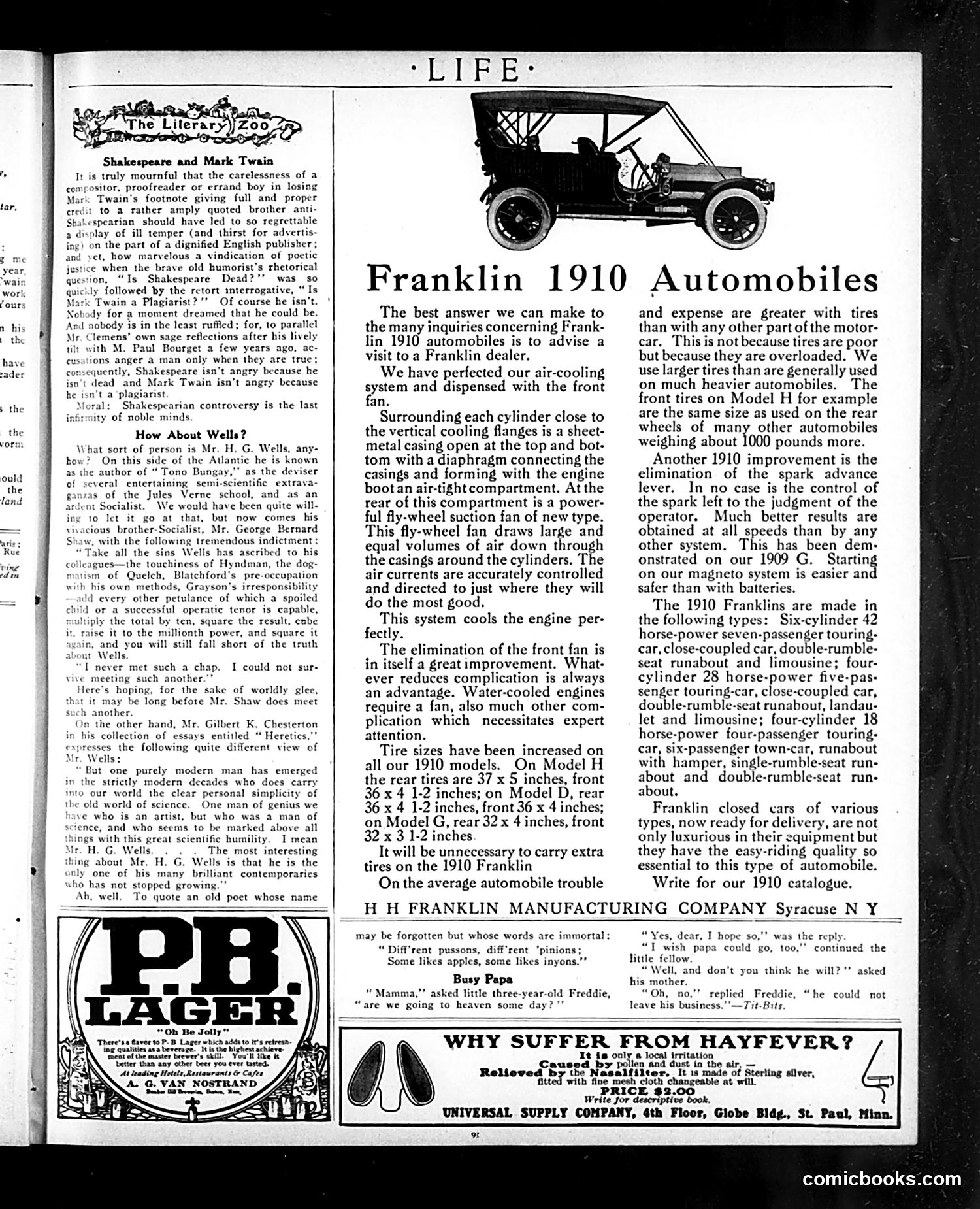
What you’re looking at
This page mixes literary criticism with automobile advertising. The editorial content discusses two contemporary figures: **Mark Twain vs. H.G. Wells debate**: The text defends Mark Twain against plagiarism accusations following a footnote controversy with a British publisher. It then pivots to H.G. Wells, presenting conflicting assessments—George Bernard Shaw's scathing critique of Wells as temperamental and self-absorbed, versus G.K. Chesterton's praise of Wells as a uniquely humble, still-growing modern intellect. The piece's tone suggests Life finds both perspectives amusing. **The main illustration** depicts a 1910 Franklin automobile with detailed technical specifications about its cooling system innovations, particularly the elimination of front fans. The page demonstrates *Life*'s typical format: satirical commentary on current intellectual figures paired with advertisements, all reflecting early 1900s preoccupations with both literary merit and technological progress.
📄 Transcribed text from this page (OCR, searchable)
Machine-transcribed from the original scan — historical spelling and the odd misread are preserved.
It is truly mournful that the carelessness of a positor, proofreader or errand boy in losing Twain's footnote giving full and proper credit to a rather amply quoted brother anti- espearian should have led to so regrettable slay of ill temper (and thirst for advertis- ing) on the part of a dignified English publisher ; and yet, how marvelous a vindication of poetic justice when the brave old humorist’s rhetorical question, “Is Shakespeare Dead?" was quickly followed by the retort interrogative, “ Twain a Plagiarist?’? Of course he isn’t. Nobody for a moment dreamed that he could be. And nobody is in the least ruffled ; for, to parallel Mr. Clemens’ own sage reflections after his lively with M. Paul Bourget a few years ago, ac- ions anger a man only when they are true; equently, Shakespeare isn’t angry because he dead and Mark Twain isn’t angry because n't a plagiarist. 1: Shakespearian controversy is the last of noble minds. How About Wells? What sort of person is Mr. H. G. Wells, any- On this side of the Atlantic he is known * as the deviser of several entertaining semi-scientific extrava- ganzas of the Jules Verne school, and as an cat Socialist. We would have been quite will- to let it go at that, but now comes his cious brother-Socialist, Mr. George Bernard w, with the following tremendous indictment : “Take all the sins Wells has ascribed to his swes—the touchiness of Hyndman, the dog- n of Quelch, Blatchford’s pre-occupation h his own methods, Grayson’s irresponsibility dd every other petulance of which a spoited child oF a successful operatic tenor is capable, y the total by ten, square the result, cabe aise it to the millionth power, and square it in, and you will still fall short of the truth t Wells, such a chap. I could not sur- ceting such another.’” Here’s hoping, for the sake of worldly glee, that it may be long before Mr. Shaw does meet h another. On the other hand, Mr. Gilbert K. Chesterton in his collection of essays entitled “ Heretics,’ expresses the following quite different view of Mr. Wells: But one purely modern man has emerged in the strictly modern decades who does carry into our world the clear personal simplicity of the old world of science. One man of genius we ve who is an artist, but who was a man of science, and who seems to be marked above all s with this great scientific humility. I mean H. G. Wells. The most interesting ng about Mr. H. G. Wells is that he is the only one of his many brilliant contemporaries sho has not stopped growing.”” Ah, well. To quote an old poet whose name Franklin 1910 Automobiles The best answer we can make to the many inquiries concerning Frank- lin 1910 automobiles is to advise a visit toa Franklin dealer. We have perfected our air-cooling system and dispensed with the front fan. Surrounding each cylinder close to the vertical cooling flanges is a sheet- metal casing open at the top and bot- tom with a diaphragm connecting the casings and forming with the engine boot an air-tight compartment. At the rear of this compartment is a power- ful fly-wheel suction fan of new type. This fly-wheel fan draws large and equal volumes of air down through the casings around the cylinders. The air currents are accurately controlled and directed to just where they will do the most good. This system cools the engine per- fectly. The elimination of the front fan is in itself a great improvement. What- ever reduces complication is always an advantage. Water-cooled engines require a fan, also much other com- plication which necessitates expert attention. Tire sizes have been increased on all our 1910 models. On Model H the rear tires are 37 x S inches, front 36 x 4 1-2 inches; on Model D, rear 36 x 4 1-2 inches, front 36 x 4 inches; on Model G, rear 32 x 4 inches, front 32 x 3 1-2 inches It will be unnecessary to carry extra tires on the 1910 Franklin On the average automobile trouble and expense are greater with tires than with any other part of the motor- car. This is not because tires are poor but because they are overloaded. We use larger tires than are generally used on much heavier automobiles. The front tires on Model H for example are the same size as used on the rear wheels of many other automobiles weighing about 1000 pounds more. Another 1910 improvement is the elimination of the spark advance lever. In no case is the control of the spark left to the judgment of the operator. Much better results are obtained at all speeds than by any other system. This has been dem- onstrated on our 1909 G. Starting on our magneto system is easier an safer than with batteries. The 1910 Franklins are made in the following types: Six-cylinder 42 horse-power seven-passenger touring- car, close-coupled car, double-rumble- seat runabout and limousine; four- cylinder 28 horse-power five-pas- senger touring-car, close-coupled car, double-rumbl it runabout, landau- let and limousine; four-cylinder 18 horse-power four-passenger touring- car, six-passenger town-car, runabout with hamper, single-rumble-seat run- about and double-rumble-seat run- about. Franklin closed cars of various types, now ready for delivery, are not only luxurious in their equipment but they have the easy-riding quality so essential to this type of automobile. Write for our 1910 catalogue. =|__H H FRANKLIN MANUFACTURING COMPANY Syracuse N Y may be forgotten but whose words are immortal: “ Diff’rent pussons, diff'rent " Some likes apples, some likes inyons. Busy Papa “ Mamma,”” asked little three-year-old Freddie, “are we going to heaven some day?" WHY SUFFER FROM Relieved by ths 2 PRICE $2. Write for descriptive ‘ UNIVERSAL SUPPLY COMPANY, 4th Floor, Globe Bldg., St. Paul, Minn. “ Yes, dear, I hope so,” was the reply. “I wish papa could go, too," continued the little fellow. “Well, and don't you think he will?’ asked his mother. “Oh, no,'’ replied Freddie, “he could leave his business.""—Tit-Bits. not HAYFEVER? 5A local irritation A leading Hotes, Restaurants Cafes A. G. VAN NOSTRAND Rete Ed Brewin, Date, Han, comicbooks.com