
A complete issue · 29 pages · 1909
Life — June 24, 1909
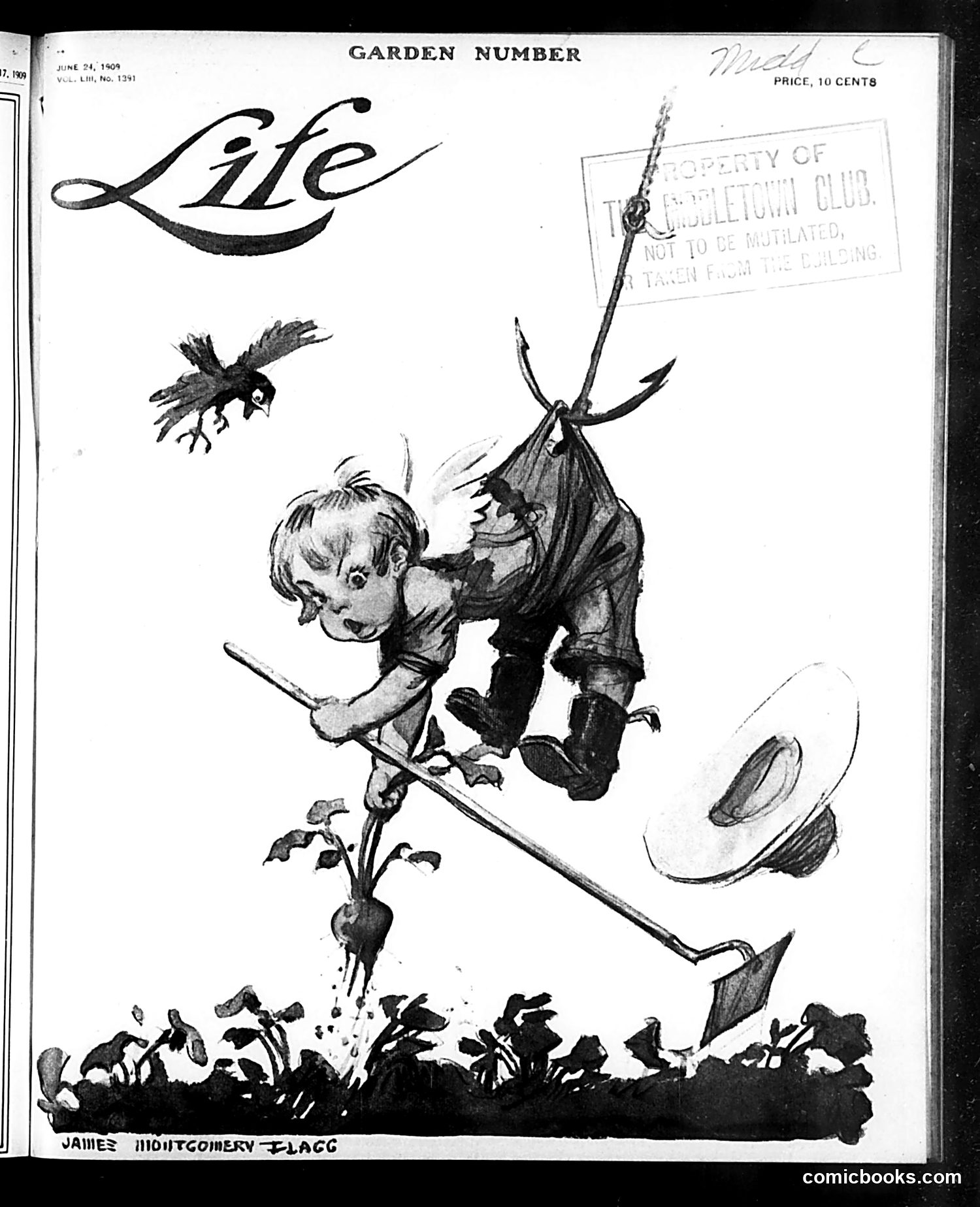
This is the cover of Life's "Garden Number" issue, priced at 10 cents. The cartoon, credited to James Montgomery Flagg, depicts two caricatured figures engaged in gardening activities. One appears to be a child or young person with an exaggerated face holding a spade, while the other is a grotesque demon or devil-like creature also wielding garden tools. A bee or wasp flies above them. The satire likely plays on the popular early-1900s American enthusiasm for amateur gardening as a genteel hobby. By contrasting refined gardening culture with monstrous or chaotic figures, Flagg probably mocks either incompetent gardeners, the pretentiousness of the hobby, or uses gardening as metaphor for social disorder. The exact target remains somewhat unclear without additional period context.
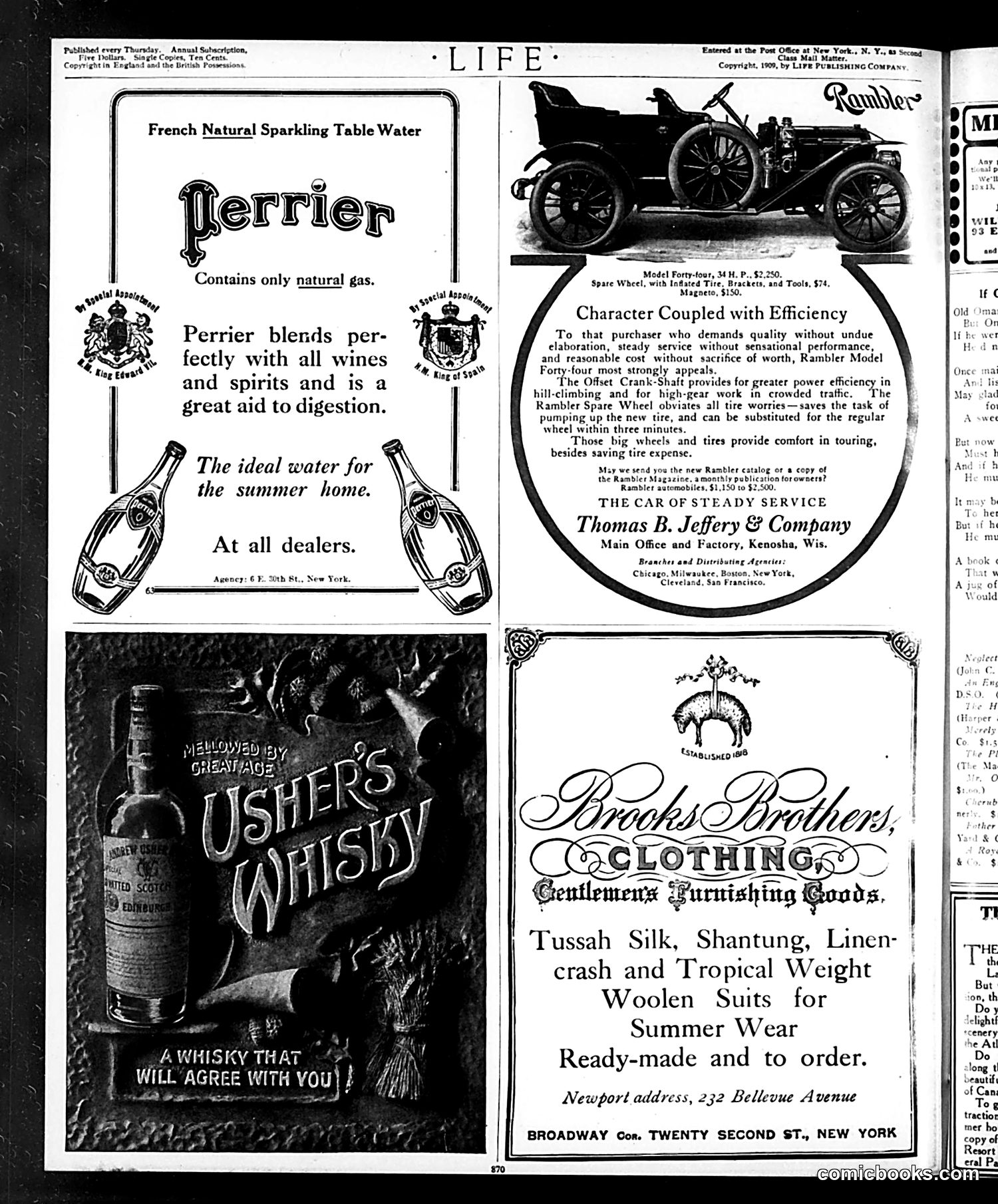
This page is primarily **advertising**, not editorial content or satire. The advertisements include: 1. **Perrier water** - emphasizing its natural carbonation and digestive benefits 2. **Rambler automobile** - highlighting the Model Forty-four's reliability and efficiency features 3. **Usher's whisky** - a Scottish product marketed as agreeable 4. **Brooks Brothers clothing** - promoting summer-weight fabrics There are no political cartoons or satirical content visible. This appears to be a standard commercial advertising page from Life magazine circa 1908 (based on the copyright visible). The ads reflect early 20th-century consumer products and the magazine's role as a vehicle for brand promotion alongside its editorial content.
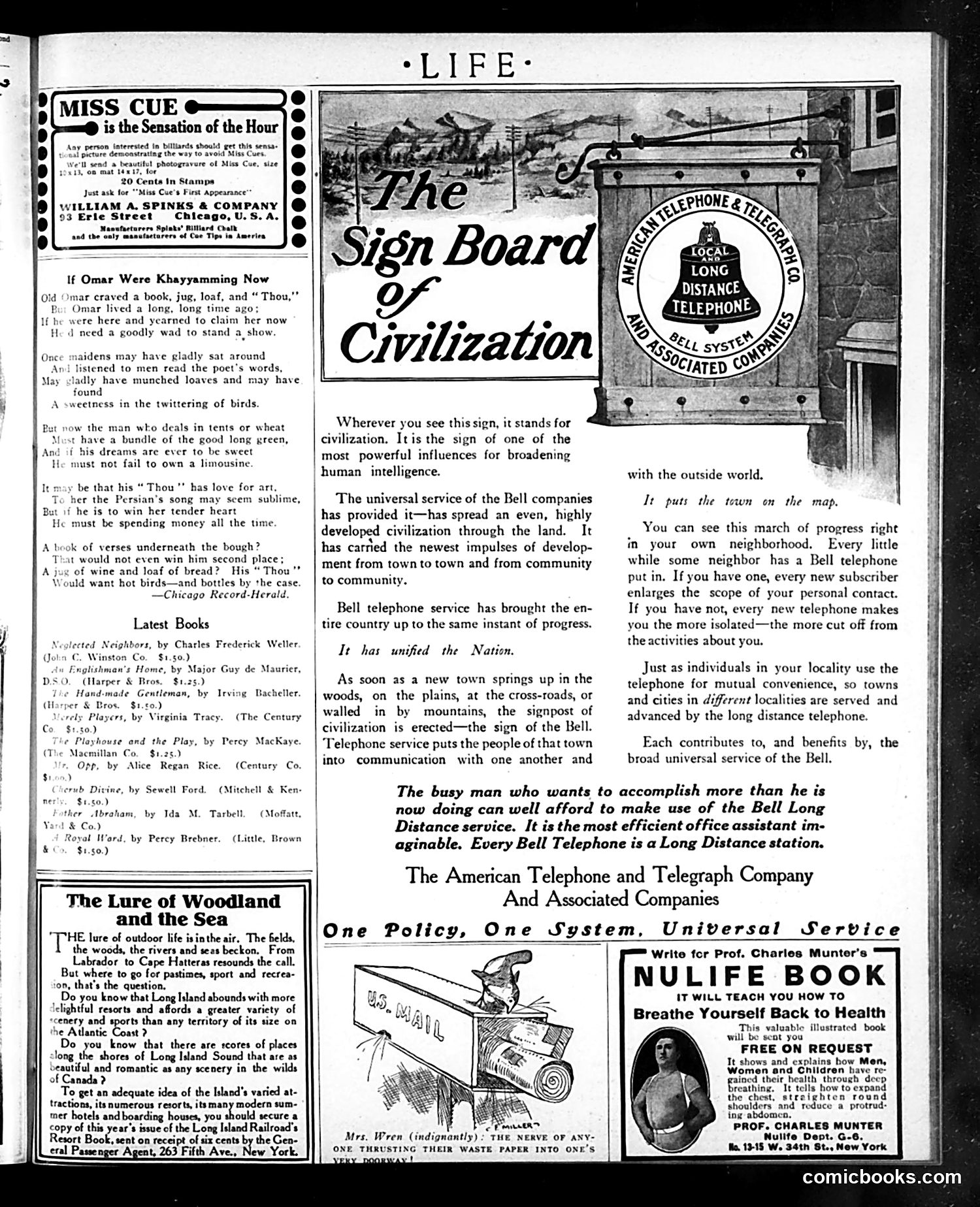
This page is primarily **advertising content** rather than political satire. The dominant feature is "The Sign Board of Civilization," a large advertisement for Bell Telephone companies. The ad argues that telephone service represents progress and civilization, using the metaphor of a sign marking developed towns. The smaller cartoon at bottom left shows a mailbox labeled "U.S. MAIL" with a woman frantically stuffing waste paper into it—captioned as "THE NERVE OF ANYONE TRUSTING THEIR WASTE PAPER INTO ONE'S WASTE TODAY." This appears to be gentle social satire about post-war paper shortages or waste management concerns, though the exact historical context is unclear. The page also includes book reviews and a separate advertisement for a health manual. The overall tone is promotional rather than politically satirical.
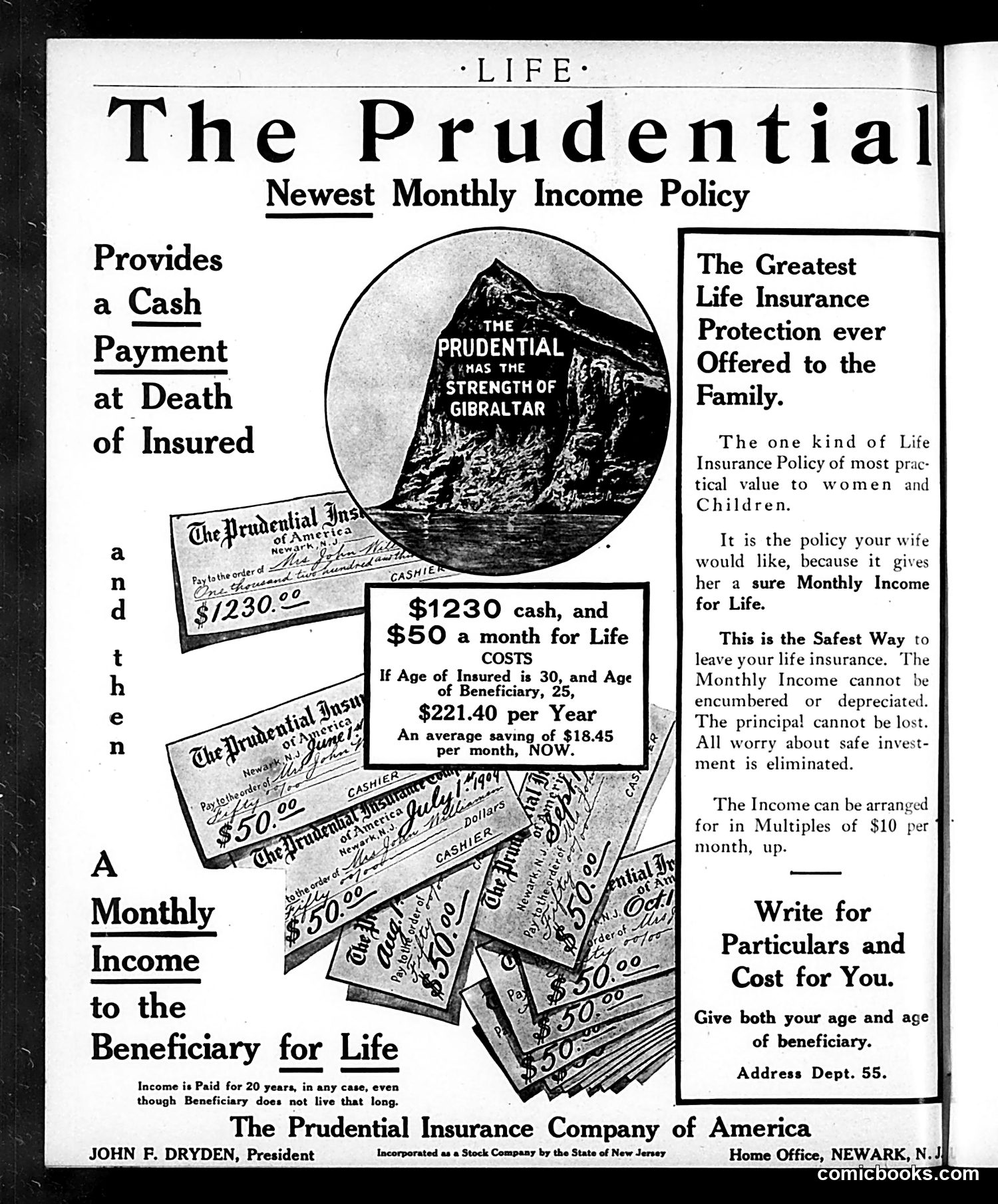
This page is **primarily advertising**, not satire or political commentary. It promotes The Prudential Insurance Company's "Monthly Income Policy" — a life insurance product. The advertisement features: - **The Rock of Gibraltar** (Prudential's famous logo/symbol), representing strength and stability - **Cash payment examples**: $1,230 at death, plus $50/month lifetime income for the beneficiary - **Target audience**: Women and children, reflecting early-20th-century assumptions that wives needed ongoing financial support after a husband's death The "safest way to leave your life insurance" claim emphasizes that monthly payments cannot be "encumbered or depreciated" — addressing concerns that lump-sum payments might be mismanaged or lost. This is straightforward commercial advertising reflecting period insurance marketing and gender expectations, not editorial commentary.
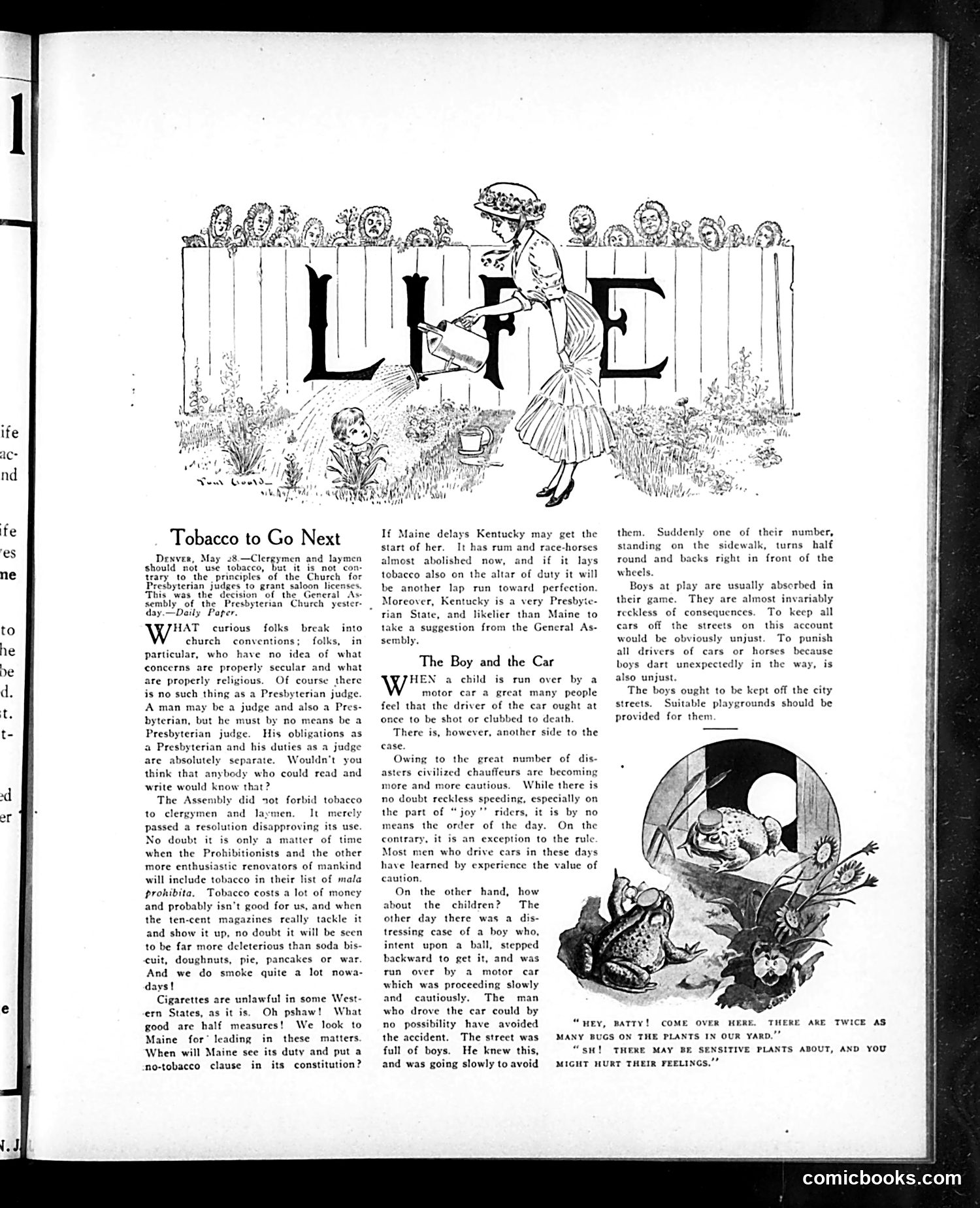
**Main Illustration:** The decorative header "LIFE" features a woman tending a garden fence where neighbors observe. This appears to relate to the article "Tobacco to Go Next," which discusses efforts to prohibit tobacco use. **Political Context:** The article critiques a curious contradiction: religious-minded politicians who oppose tobacco but lack similar conviction about alcohol prohibition. It references the Presbyterian Church's decision and a General Assembly debate, sarcastically noting that "half measures" won't work—either prohibition advances or retreats entirely. **"The Boy and the Car" Section:** A separate illustrated article depicts a child nearly struck by a motor car, arguing for better traffic safety and supervised playgrounds. It critiques careless drivers and emphasizes protecting children from automotive dangers. Both pieces reflect early 20th-century Progressive Era concerns about social regulation and public safety.
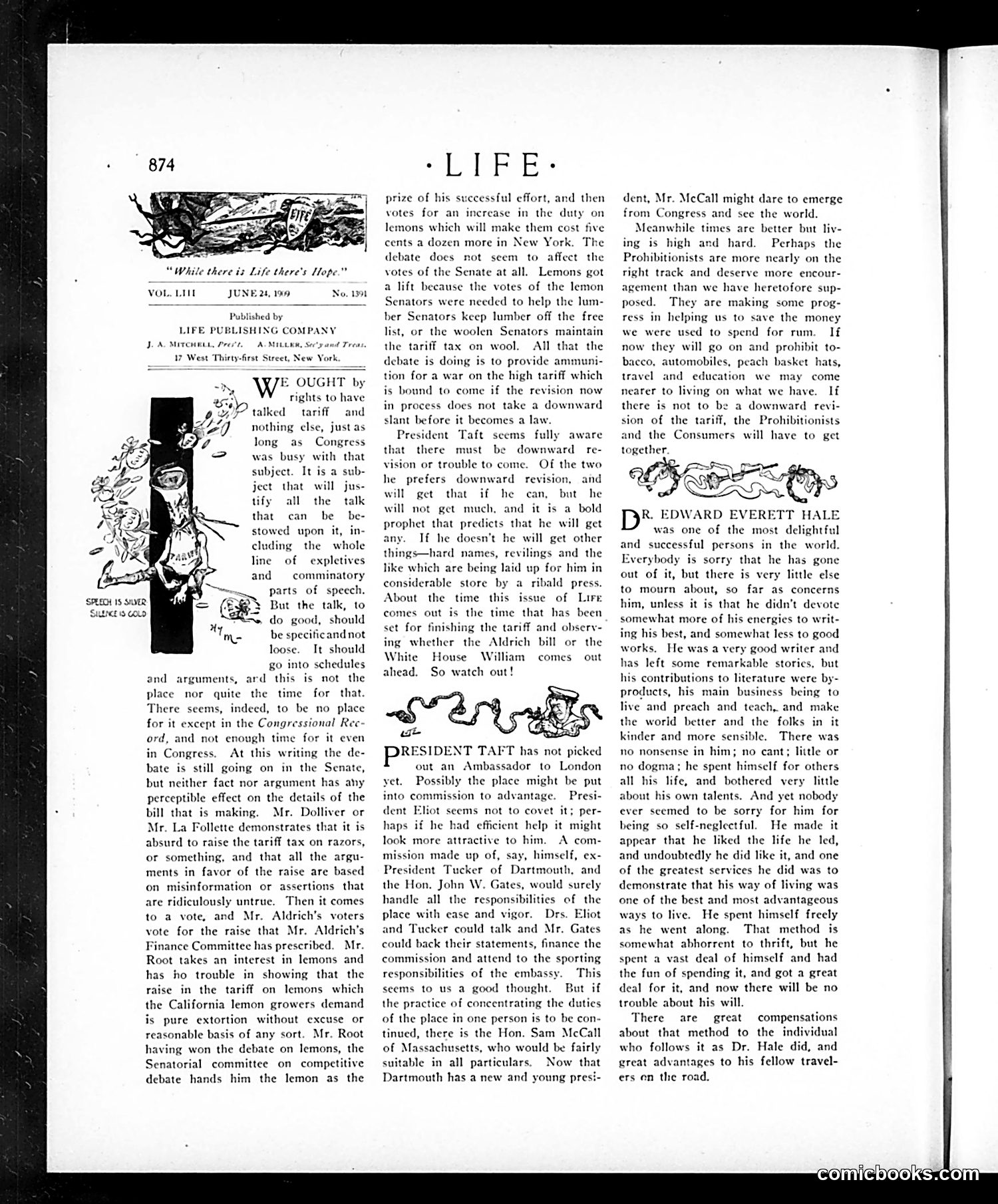
The main cartoon, titled "While there is Life there's Hope," depicts a figure labeled "SKETCH IN SATAN'S SKETCH BOOK" — likely representing a political opponent or satirical target — being stabbed or attacked. The surrounding text discusses President Taft's tariff debates and Congressional politics. The editorial content addresses tensions over the Aldrich bill and tariff revision, critiquing Mr. Dolliver and others for their positions. The page also eulogizes Dr. Edward Everett Hale, a notable writer and moral figure. The satire appears to mock political figures involved in contentious tariff negotiations, suggesting their political fates hang precariously. Without clearer image resolution of the specific caricature details, precise identification of the "victim" remains uncertain.
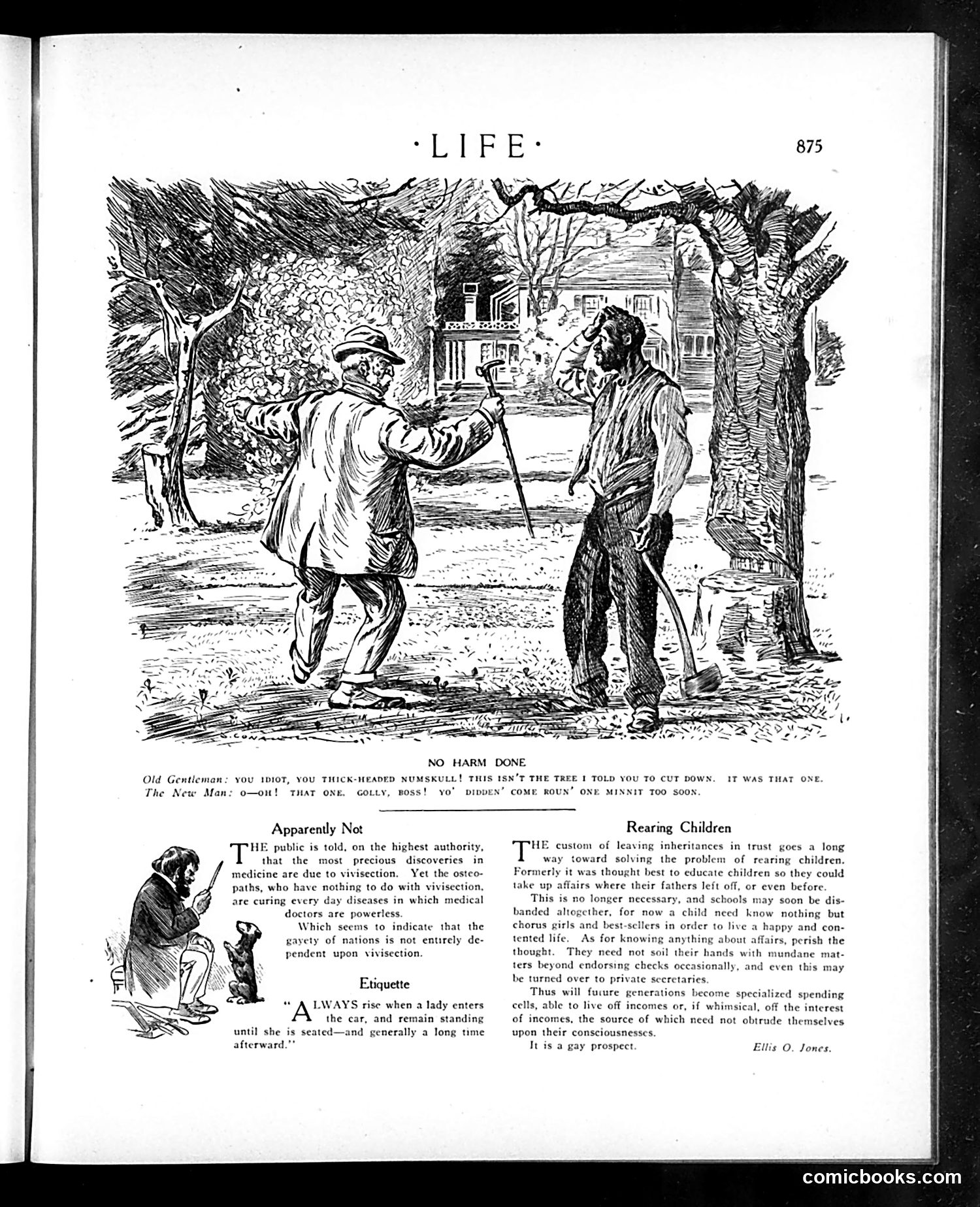
The main cartoon depicts two men in a wooded area near a house. An older gentleman accuses a younger man ("The New Man") of being a "thick-headed numskull" for cutting down the wrong tree. The younger man's response—"that one...yo' didn't come 'round one minit too soon"—suggests he was about to make another mistake. This appears to satirize generational differences and competence, likely mocking the "New Man" (possibly a social or political figure of the era) as incompetent. The surrounding text discusses visectionist medical practices, child-rearing philosophy, and etiquette rules. The overall page reflects late 19th/early 20th-century social commentary on changing social norms and values.
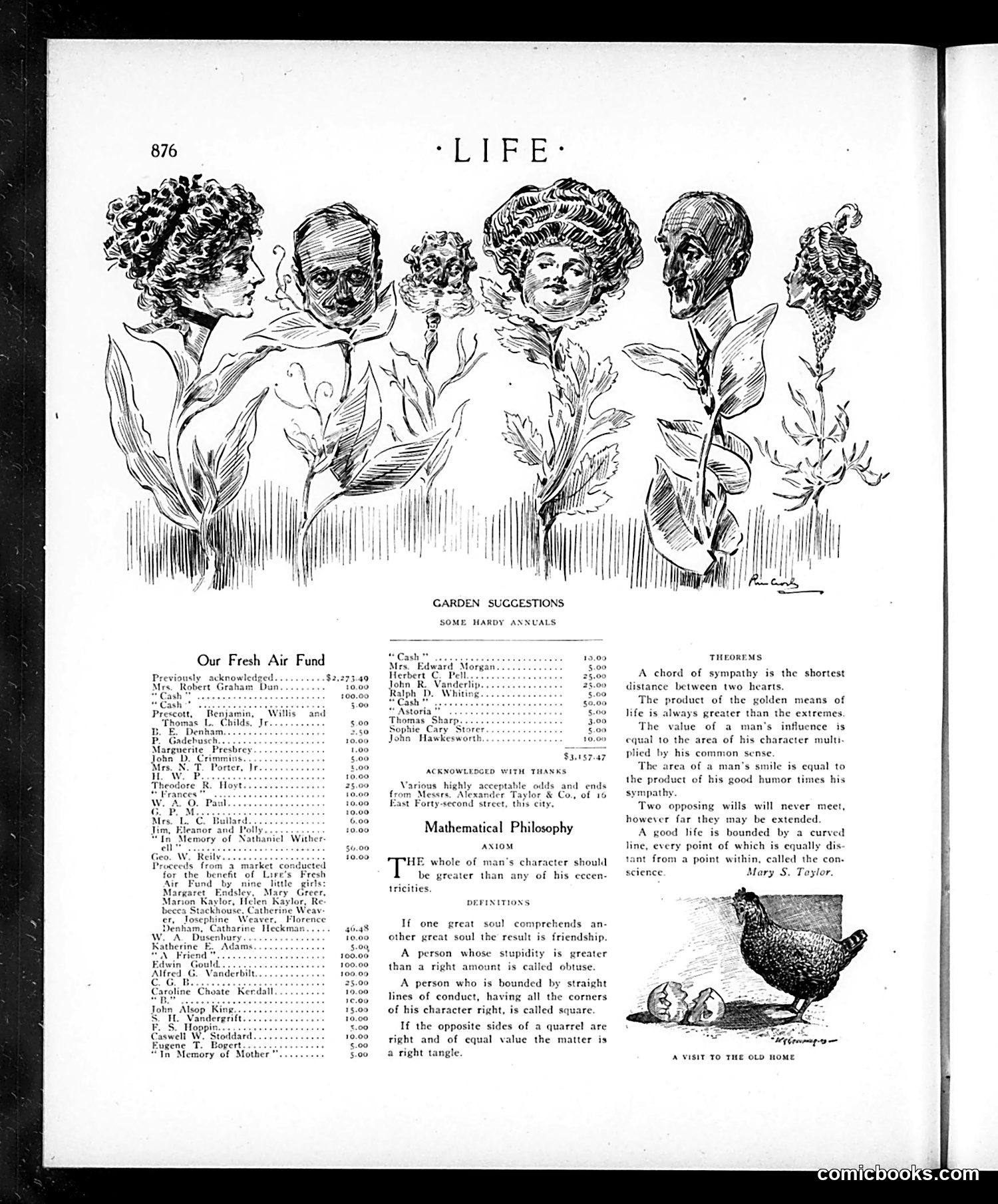
This page from *Life* magazine features a satirical illustration titled "Garden Suggestions: Some Hardy Annuals" at the top. The cartoon depicts six human heads growing on plant stems like flowers, a visual metaphor commenting on society. The illustration appears to be social satire, likely mocking prominent public figures or types of people through the "human flower" device—a common technique in period satire. However, without clear labels identifying specific individuals, the exact targets remain unclear from the image alone. Below the cartoon are sections including "Our Fresh Air Fund" (a charity donations list), "Theorems" (philosophical aphorisms), and "Mathematical Philosophy" with humorous definitions. The page layout is typical of *Life's* mix of visual satire, fundraising appeals, and witty commentary on contemporary society.
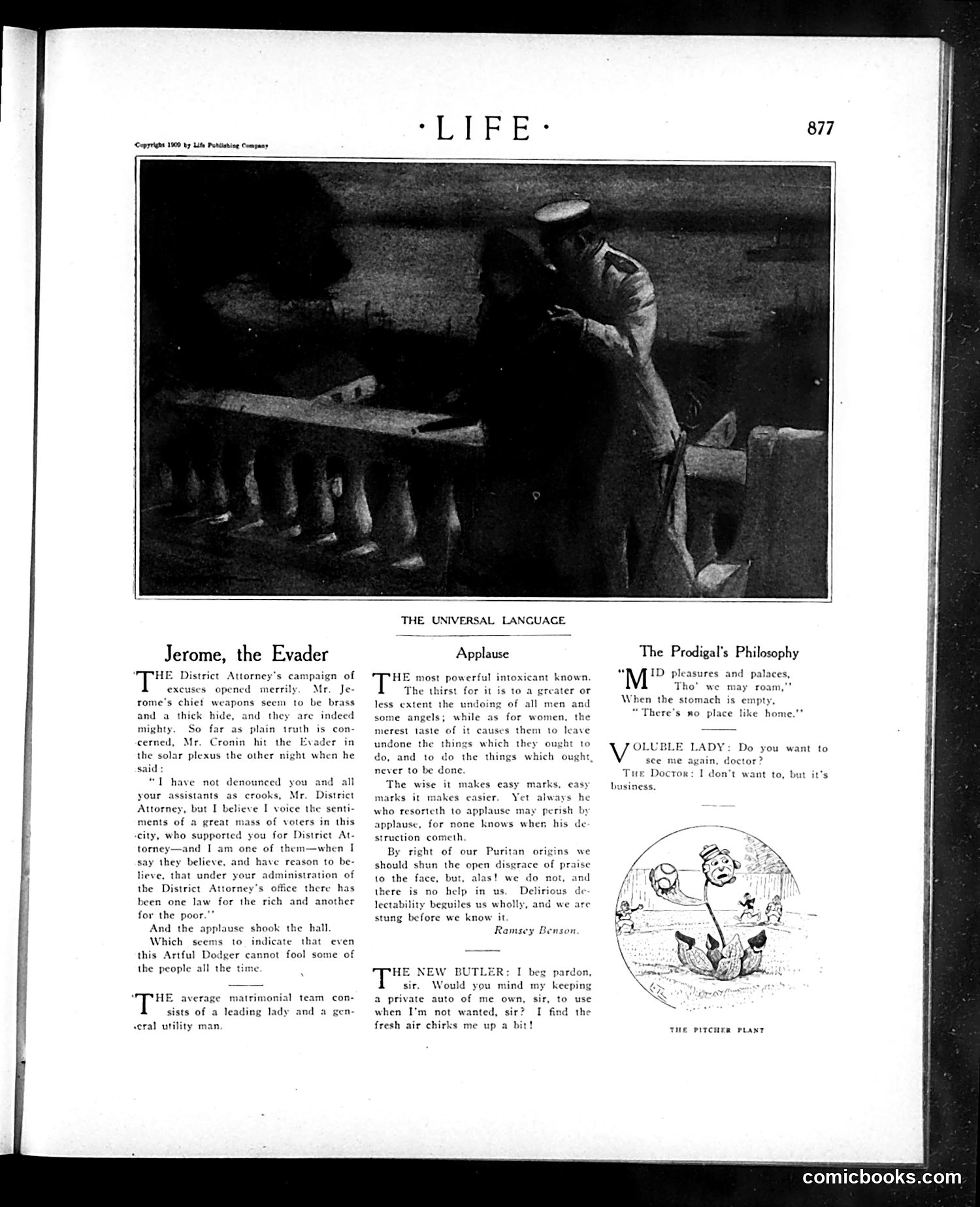
This page contains three separate satirical pieces labeled "The Universal Language": 1. **"Jerome, the Evader"**: A District Attorney character criticizes his opponent for using "brass and bluster" while evading substantive issues. The satire targets evasive political rhetoric. 2. **"Applause"**: A commentary on how public praise corrupts judgment. It notes that applause makes "easy marks" of people and warns against those who seek validation through crowd approval—a critique of populism or demagoguery. 3. **"The Prodigal's Philosophy"**: A brief comic dialogue where a doctor visits a patient avoiding housework, joking about using a private car to escape domestic duties. **"The Pitcher Plant"**: A small illustrated cartoon (bottom right) appears to be a nature-based visual pun, though details are unclear. The page uses humor to critique political dishonesty, mob mentality, and social evasion.
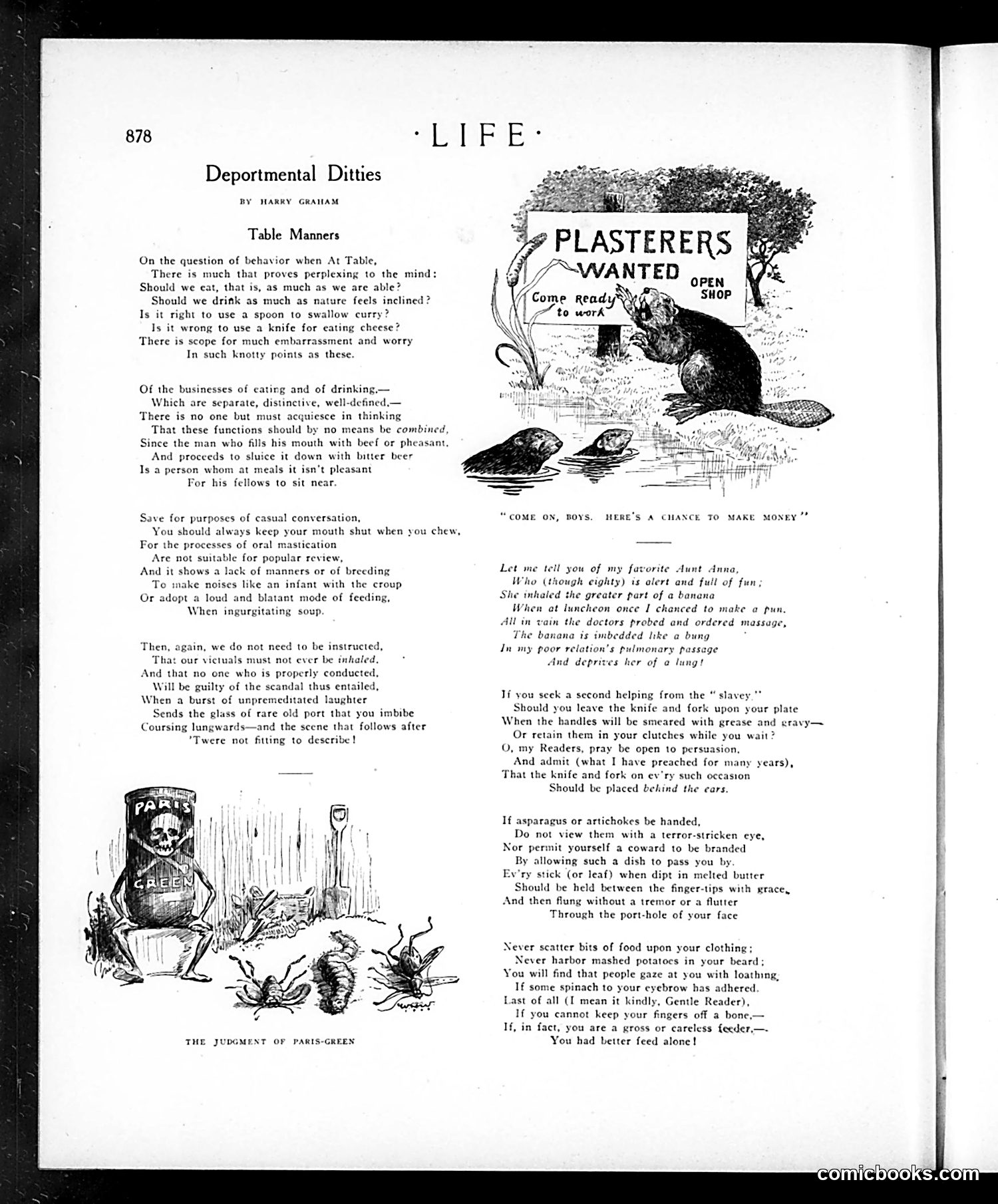
This page from *Life* magazine contains two main elements: **Left side:** A humorous poem titled "Departmental Ditties" by Harry Graham about table manners—covering topics like eating noisily, combining eating and drinking, chewing with mouth open, and improper handling of asparagus and bones. It's satirizing Victorian etiquette rules through exaggeration. **Illustrations:** - Top right: A recruitment advertisement showing beavers with "PLASTERERS WANTED—OPEN SHOP" sign, captioning "Come on, boys. Here's a chance to make money." This appears to be labor-related satire, possibly about union disputes or working conditions. - Bottom left: "The Judgment of Paris-Green" depicts a figure examining vegetables, likely punning on the classical myth while commenting on food quality or safety concerns. The overall theme addresses dining decorum and working-class economic issues through humorous verse and visual gags typical of early 20th-century satirical journalism.
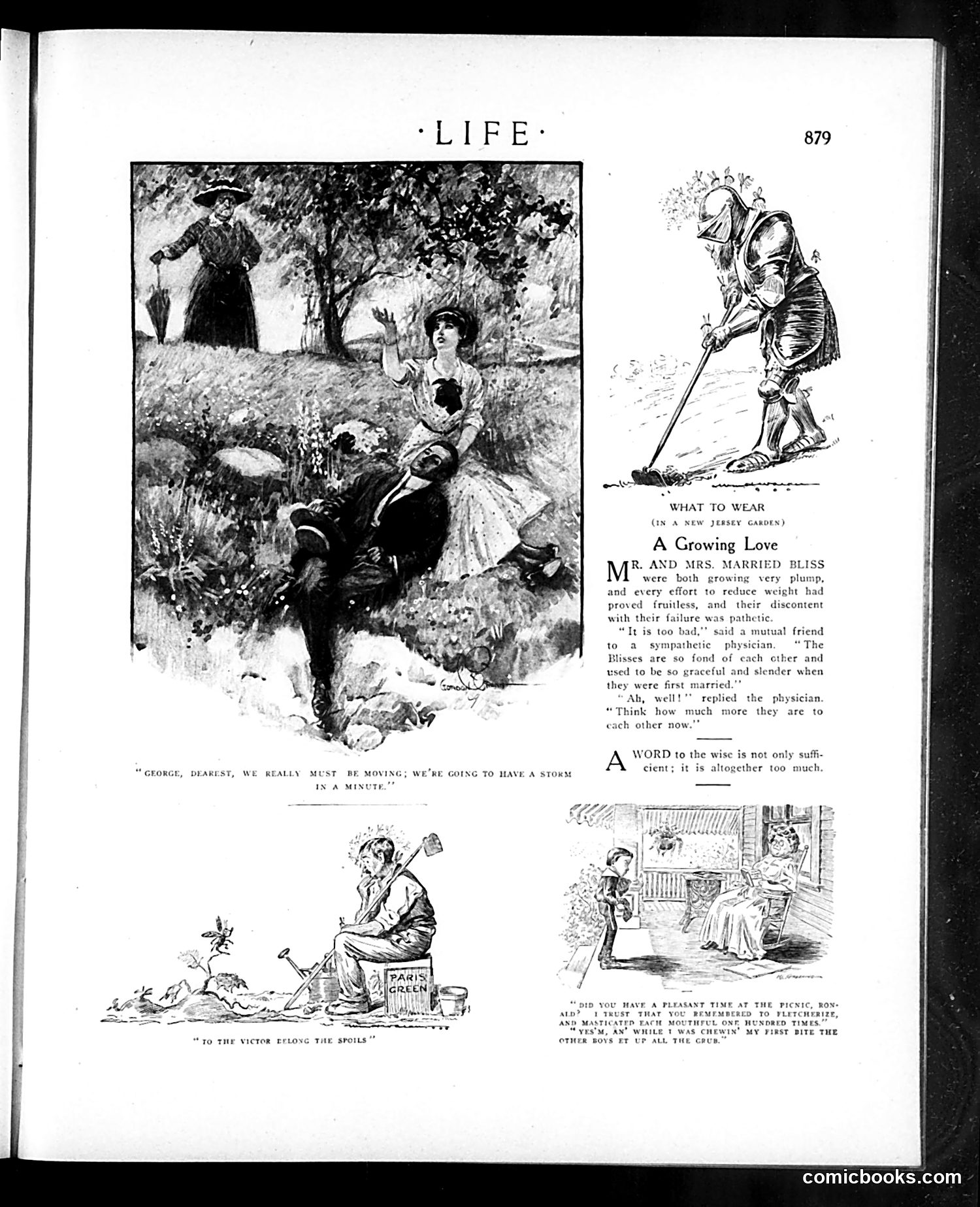
This page from *Life* magazine contains humorous illustrations about marriage and weight gain. The main story "A Growing Love" satirizes Mr. and Mrs. Married Bliss, a couple depicted as increasingly overweight despite their efforts to lose weight. The physician character notes they were once "graceful and slender" but have grown plump together. The accompanying cartoons mock their physical deterioration: one shows a man digging in a garden labeled "Paris Green" (pesticide), captioned "to the victor belong the spoils"; another depicts a woman at a picnic. The humor relies on period-appropriate commentary about marital domesticity leading to weight gain and physical decline—a common satirical theme in early 20th-century American humor magazines that used exaggeration and caricature to critique social behaviors.
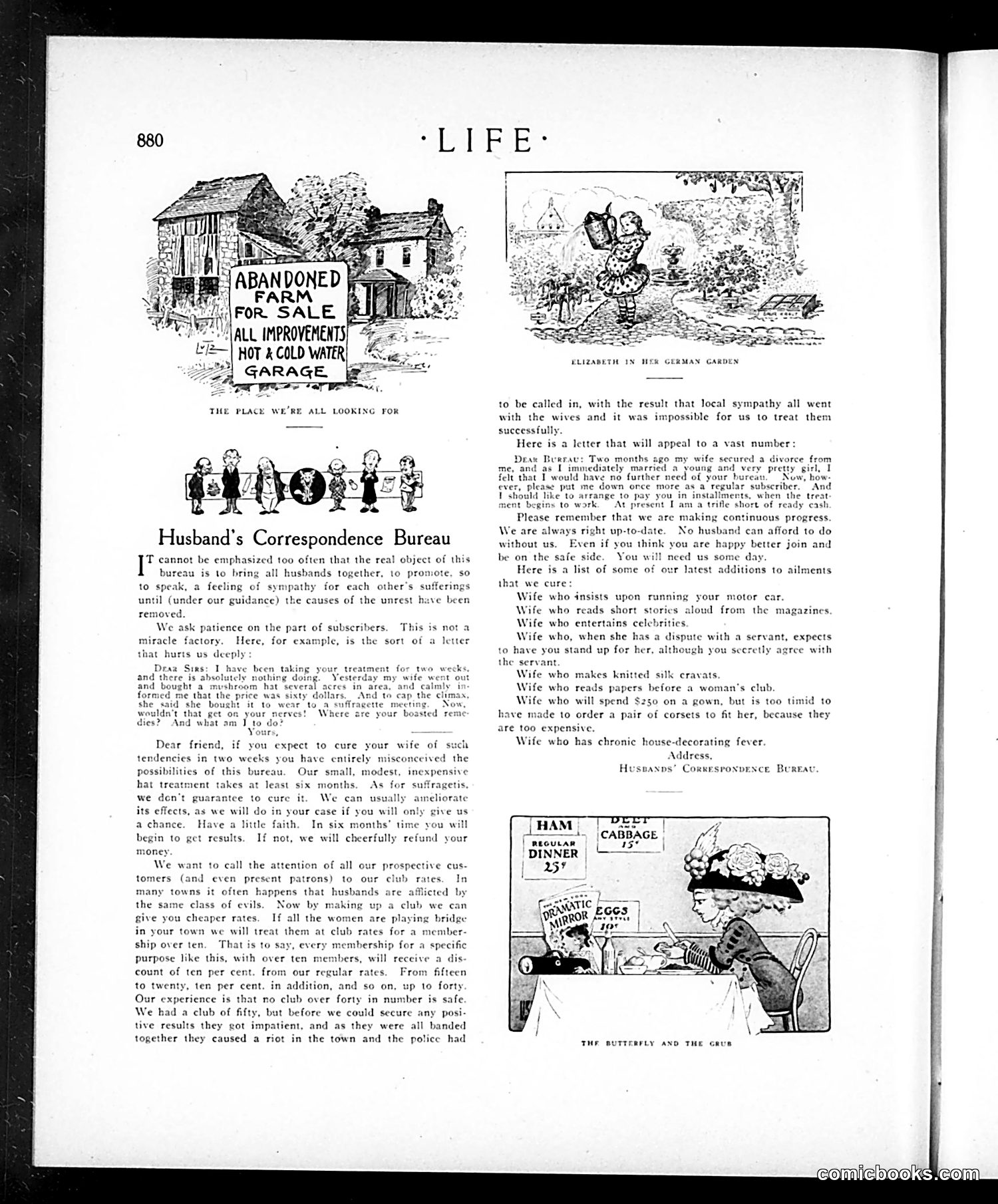
This page contains three distinct satirical pieces: 1. **"The Place We're All Looking For"** (top left): An abandoned farm advertised for sale with "all improvements / not a cold water garage." This mocks the post-WWI trend of wealthy urbanites seeking rural retreats while expecting modern conveniences—satirizing unrealistic expectations about country living. 2. **"Husband's Correspondence Bureau"** (center): A advice column responding to marital complaints, particularly about wives' spending habits and social activities. The bureau humorously promises to "cure" problematic wives, reflecting period tensions over women's increasing independence and consumer spending. 3. **"The Butterfly and the Grub"** (bottom right): An illustrated joke about food prices, featuring a woman comparing expensive items (ham, beef, eggs) to a character labeled "the grub," likely satirizing post-war inflation and food costs.
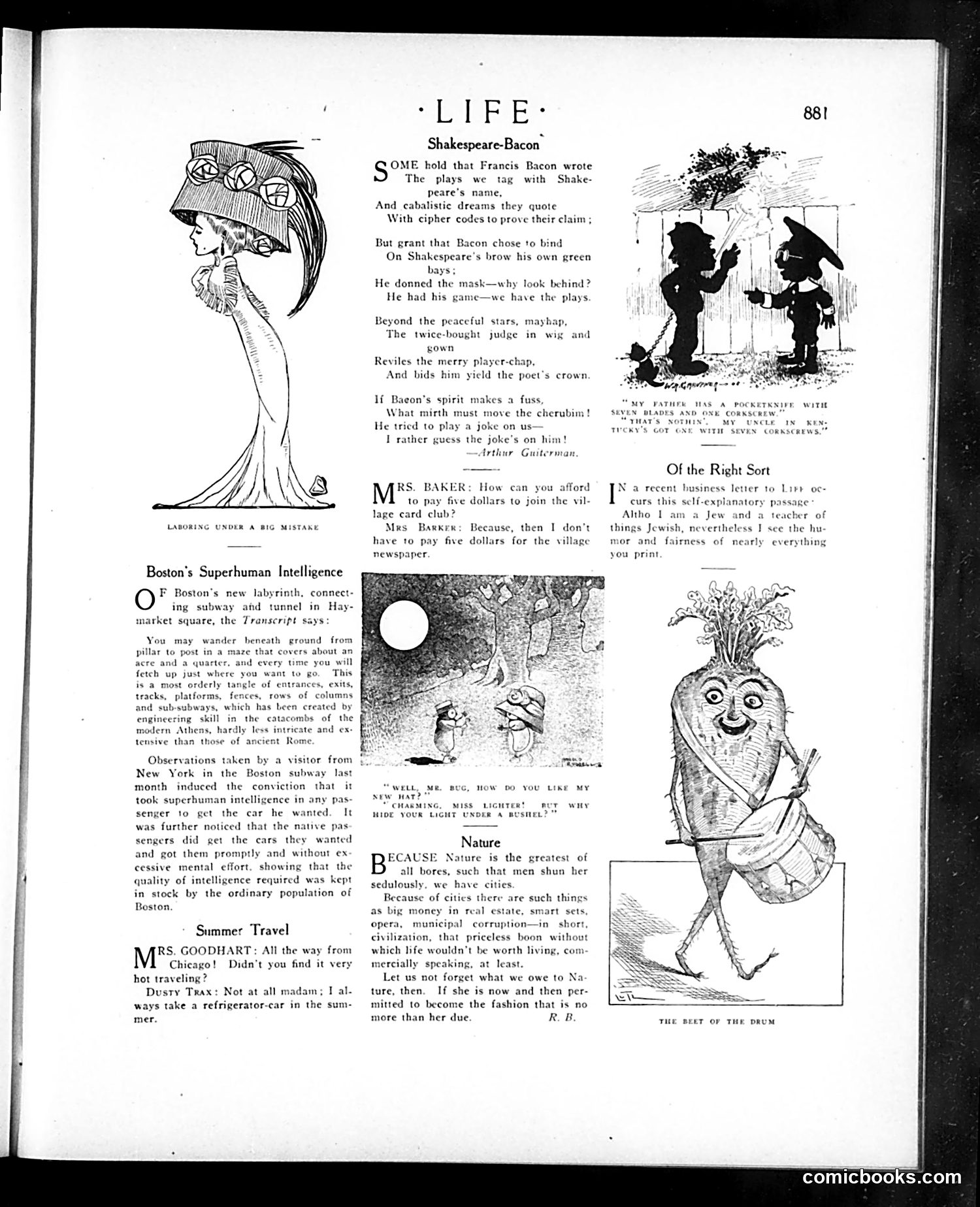
This page contains **literary and humorous commentary** rather than political cartoons. The top section discusses the **Shakespeare-Bacon authorship controversy**—the historical debate over whether Francis Bacon wrote Shakespeare's plays. The poem playfully addresses this, suggesting Bacon chose to hide behind Shakespeare's name rather than claim credit. Below are three brief **humorous anecdotes**: one about a village card club membership fee, one about Boston's subway system (praising its logical design), and one about summer travel using refrigerated cars. The illustrations are **whimsical drawings** accompanying these jokes—including a figure with an elaborate hat labeled "laboring under a big mistake," children discussing pocket knives, and an insect character called "the beet of the drum." These are **light social commentary and humor**, not serious political satire.
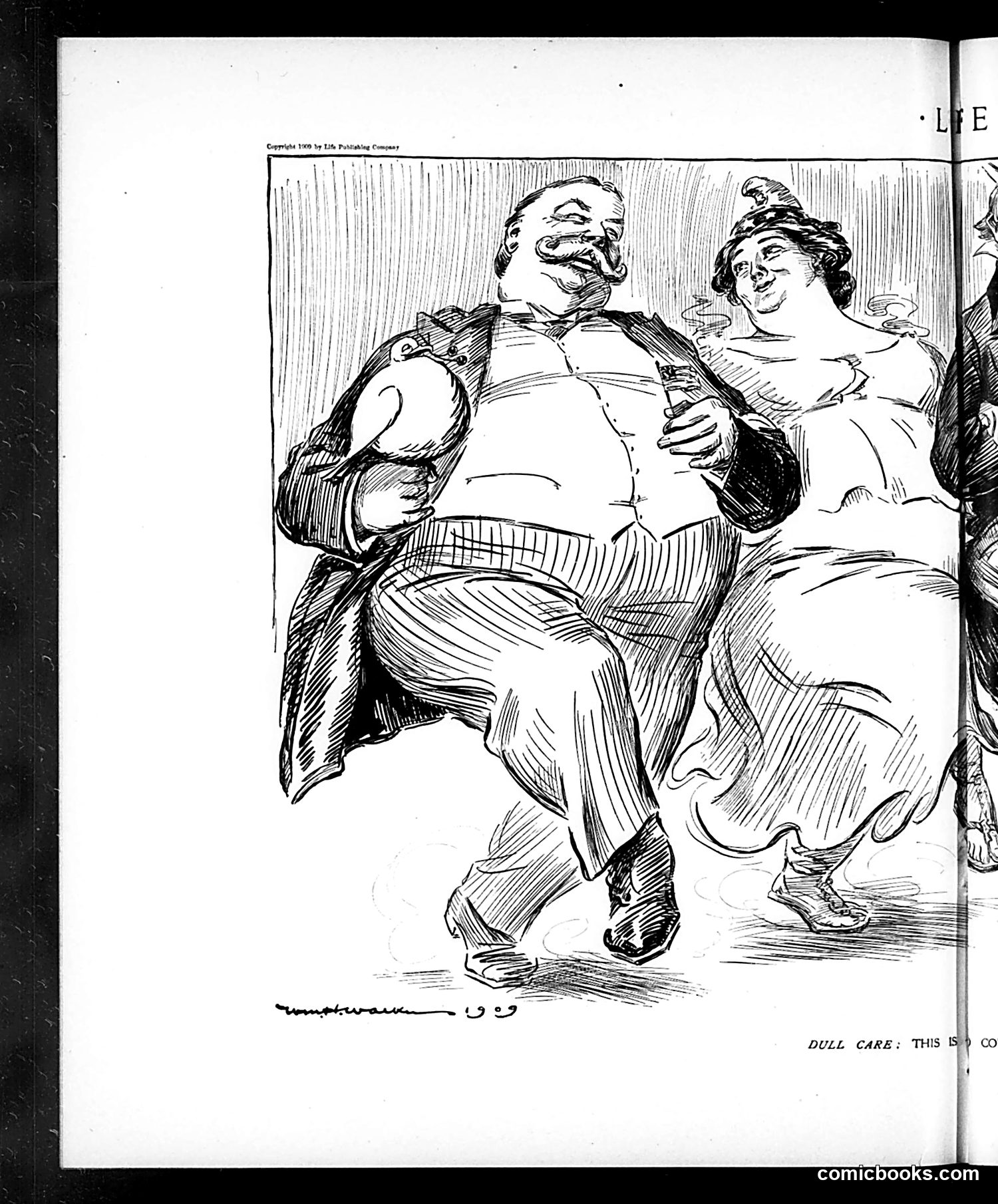
This is a satirical cartoon from *Life* magazine titled "DULL CARE: THIS IS CO[MPANY]" (text cut off). The illustration depicts a rotund, well-fed man in formal attire being entertained by a woman in a hat. The man's exaggerated corpulence and satisfied expression suggest mockery of wealth, excess, or self-indulgence. The cartoon appears to satirize upper-class leisure and frivolous entertainment—the idea that wealthy, comfortable men are distracted from serious matters by female company and pleasure-seeking. The term "dull care" suggests the man is deliberately avoiding or escaping tedious responsibilities through indulgence. Without the complete title or publication date visible, the specific social or political target remains unclear, though the satire targets class attitudes and male behavior among the elite.
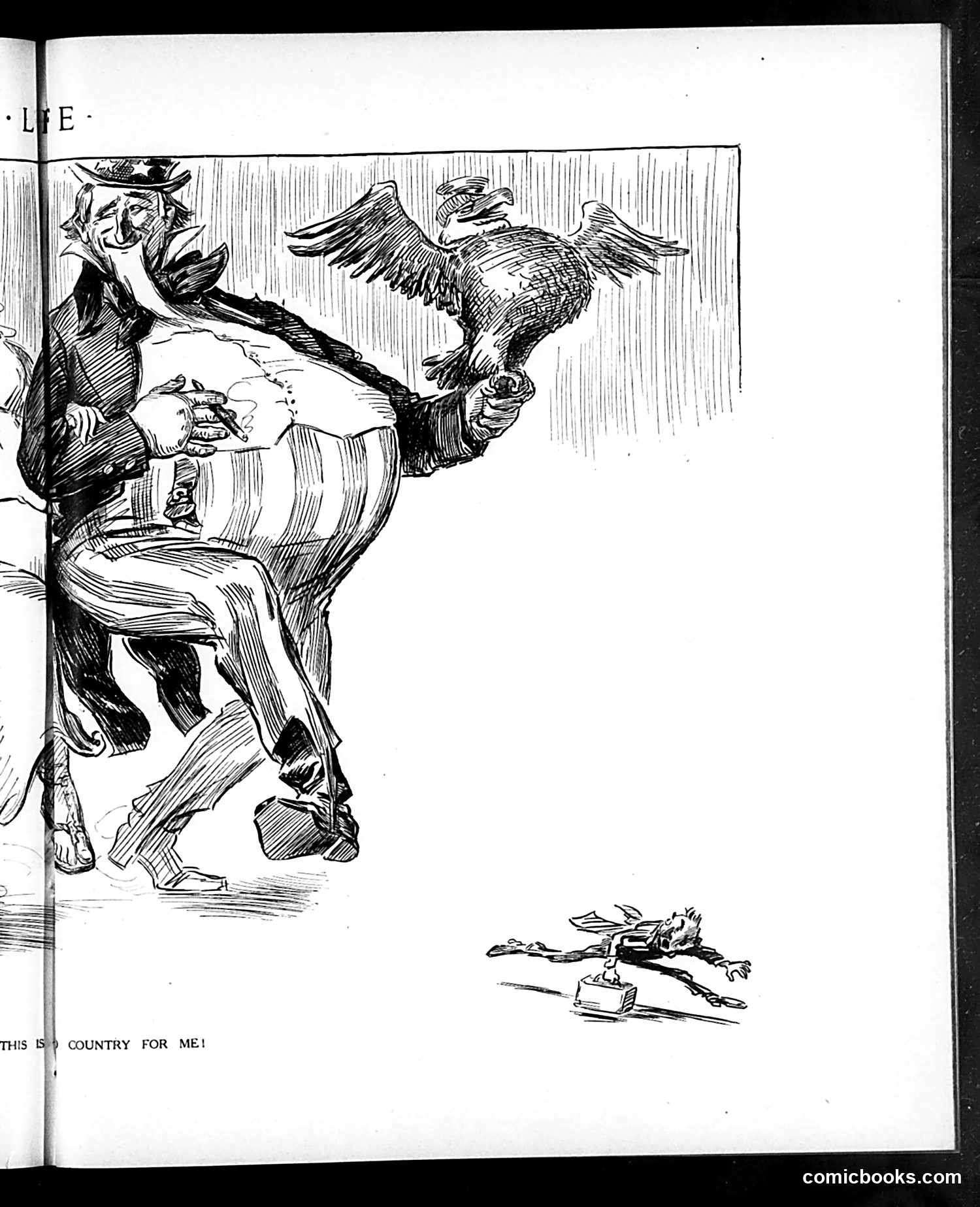
This is a satirical cartoon from *Life* magazine showing a portly, well-dressed figure holding an American eagle while declaring "THIS COUNTRY FOR ME!" The cartoon appears to be commentary on **economic inequality or wealth hoarding**. The well-fed gentleman in formal dress—likely representing a wealthy businessman or plutocrat—clutches both the eagle (symbol of America) and what appears to be money or resources, suggesting he's claiming the nation for personal benefit rather than the public good. The small, starving figure lying on the ground in the lower right reinforces the satire: while the wealthy monopolize America's prosperity and symbols, ordinary citizens are left destitute. This likely critiques **Gilded Age or Progressive Era** wealth concentration and the tension between individual enrichment and national welfare.
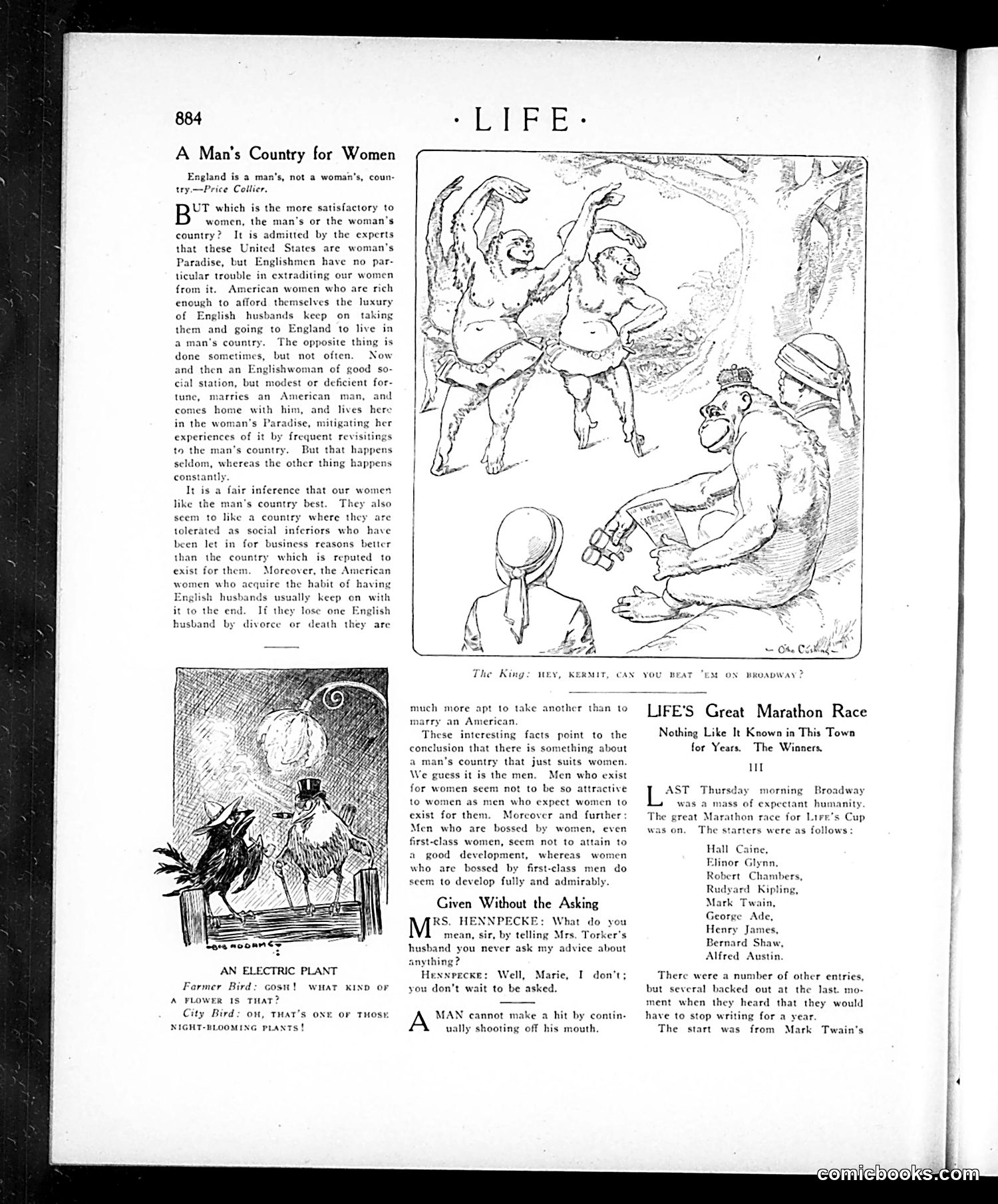
This page contains social satire comparing American and English attitudes toward women and marriage. The main article argues that wealthy American women prefer "man's countries" (England) where they occupy subordinate social positions, suggesting women are happier under male dominance than equality. The piece cynically concludes that women who are "bossed by first-class men" develop better than those who boss men. The cartoons reinforce this theme: one shows cherubs asking a man (likely representing English masculinity) if he can "beat 'em on Broadway"—suggesting English male superiority. Another depicts a conversation where a henpecked husband admits he never asks his domineering wife's advice, implying she needs no asking because she dominates anyway. The "Marathon Race" section appears to announce a literary competition among famous writers (Mark Twain, Henry James, George Bernard Shaw, etc.), with the humorous caveat that entrants must stop writing for a year—several withdrew upon hearing this requirement. The page reflects early 20th-century attitudes about gender roles, presented through satirical commentary on transatlantic differences.
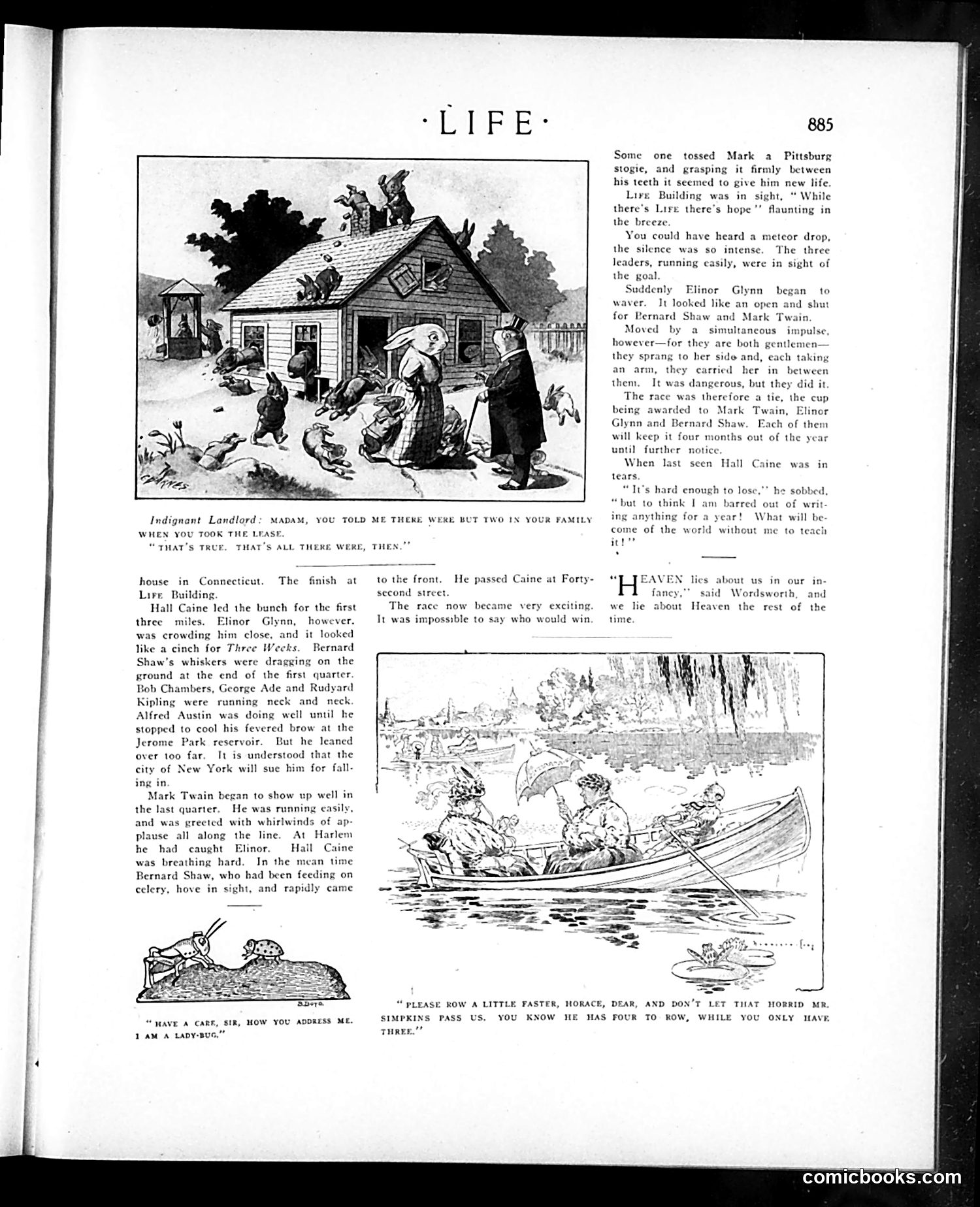
This page satirizes famous literary figures of the era in a fictional "race" to the Life Building. The competitors include **Mark Twain, Bernard Shaw, Elinor Glynn, Hall Caine, Rudyard Kipling, George Ade, Bob Chambers, and Alfred Austin**—all prominent writers of the early 1900s. The joke mocks their literary reputations: Elinor Glynn (author of *Three Weeks*, a risqué novel) nearly collapses; Alfred Austin stops to cool himself (suggesting pretension); Bernard Shaw's distinctive whiskers drag the ground. The race culminates as a three-way tie, with Shaw and Twain gallantly supporting the faltering Glynn. The subplot about a landlord's tenant (bottom left) appears unrelated social humor about dishonesty. The satire's broader point: these celebrated authors are absurdly competitive and self-important, reduced to physical comedy. The "Heaven" quote references Wordsworth, suggesting even literary giants engage in exaggeration about life's meaning.
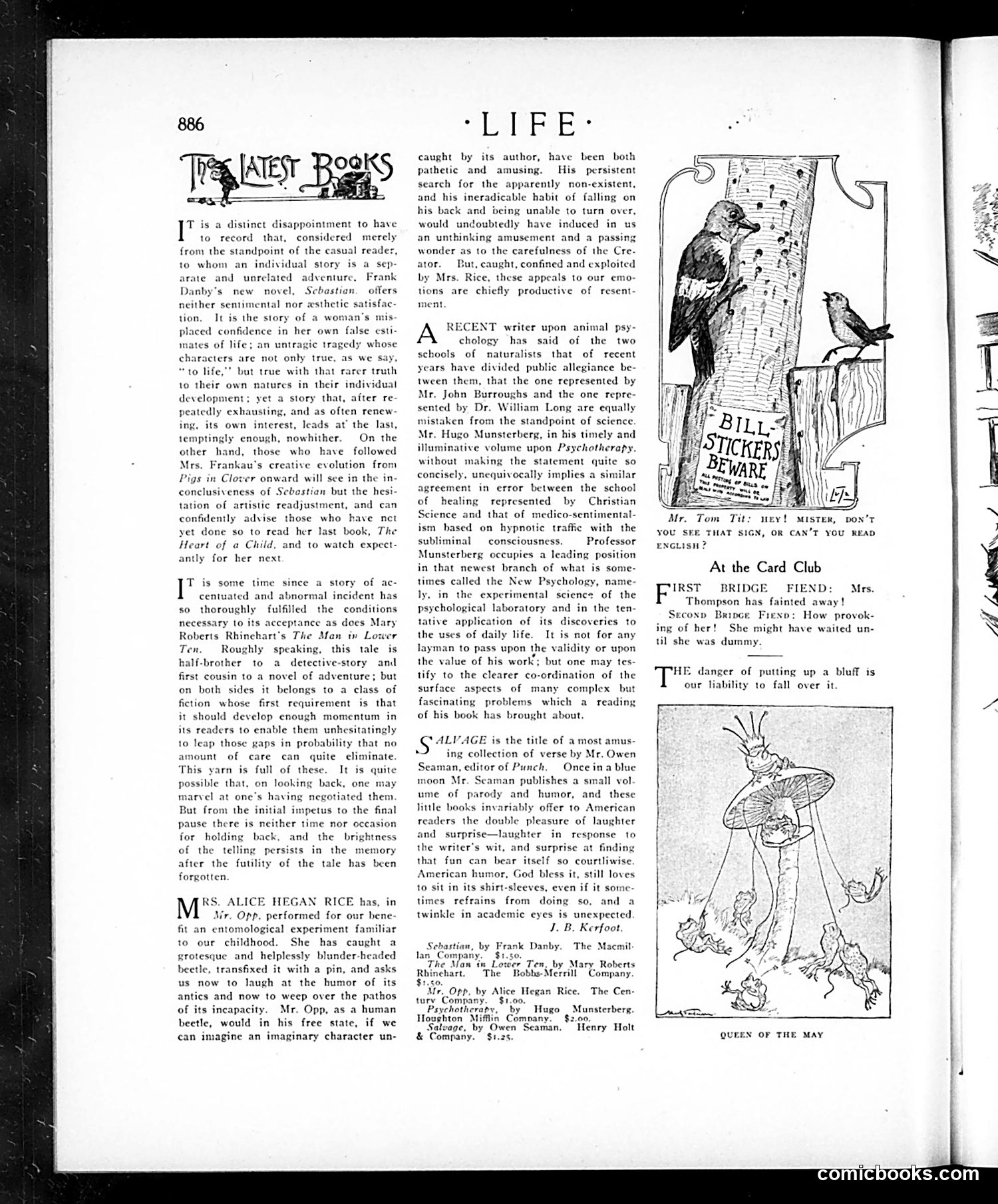
This Life magazine page from 1909 reviews contemporary novels, with two illustrated cartoons mocking literary and social trends. **"Bill-Stickers' Repair"** (top right): Shows a woodpecker working on a bill-sticker poster. The joke satirizes sloppy advertising and poor maintenance of public notices—common urban eyesores of the era. The cartoonist suggests even birds must "repair" the neglected posted bills. **"Queen of the May"** (bottom): Depicts a grotesque insect figure. This likely references the text's discussion of Mrs. Alice Hegan Rice's novel *Mr. Opp*, which the reviewer criticizes as presenting a pitiful, helpless character (compared to a blundering beetle pinned down). The satire mocks sentimentalized portrayals of pathetic characters that exploit readers' pity rather than genuine emotion. Both cartoons critique artificial or manipulative artistic presentation—whether in advertising or literature—reflecting early 20th-century intellectual concerns about authenticity versus commercial exploitation.
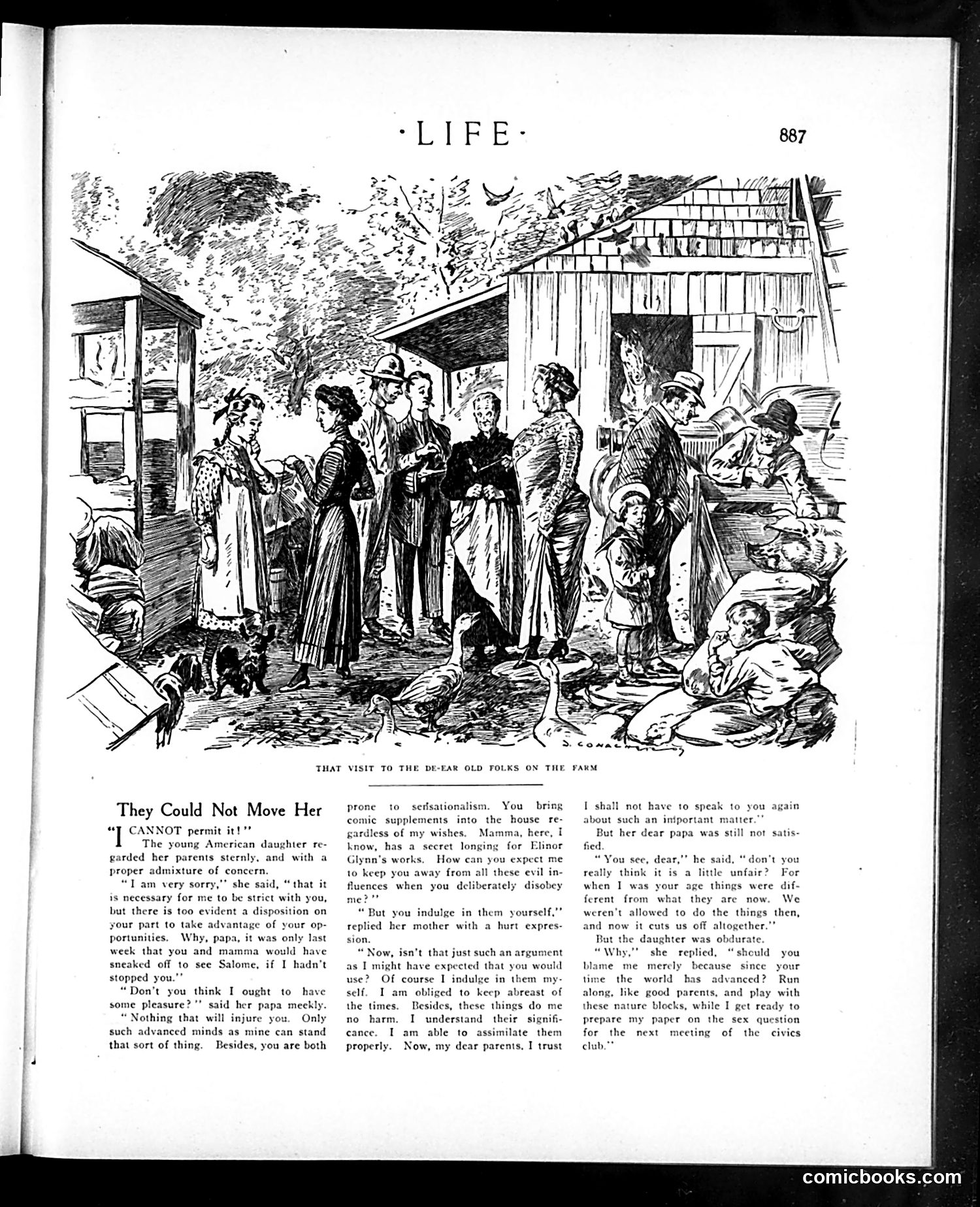
This satirical cartoon mocks the turn-of-the-century "New Woman"—the educated, progressive young American daughter who condescendingly lectures her parents on morality and intellectual superiority. The joke: the daughter forbids her parents from reading "comic supplements" (newspaper comics) and attending theatrical productions like *Salome* (likely referring to Oscar Wilde's scandalous play), claiming such entertainments are beneath her advanced mind. Yet she hypocritically indulges in the same material herself, justifying it as necessary "to keep abreast of the times." She patronizes them like children—offering them "nature blocks" to play with—while preparing papers on sophisticated topics like sex for her civics club. The satire targets the pretentious, self-righteous progressivism of educated young women of that era, highlighting the absurd double standards and generational conflict between "advanced" youth and their bewildered, traditional parents.
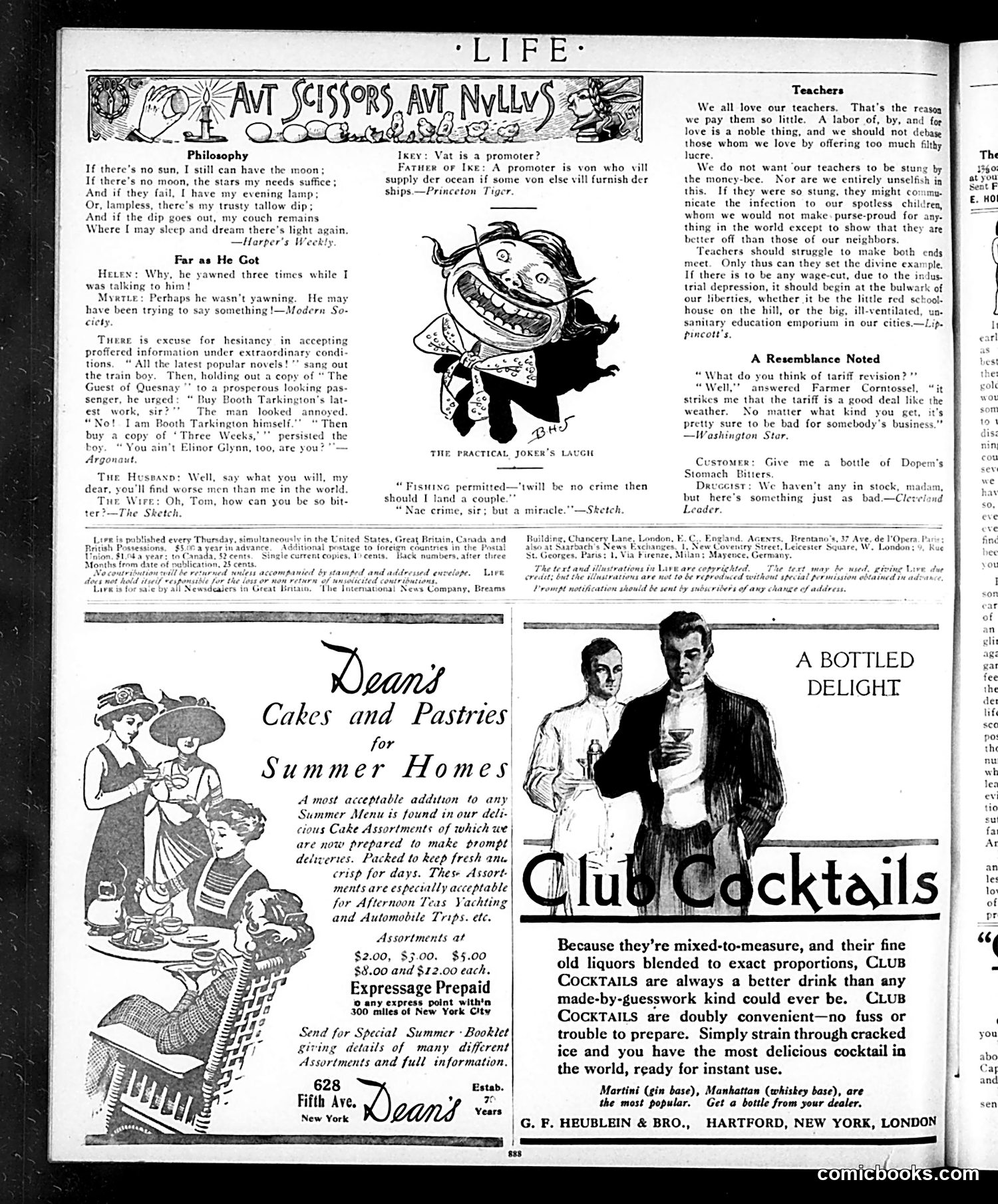
This page from *Life* magazine (a satirical publication, not the photography magazine) contains several short humorous pieces typical of early 20th-century American humor: **"The Practical Joker's Laugh"** shows a grinning character—this appears to be a general "practical joker" type rather than a specific person. **Short jokes** mock various targets: a father's Yiddish-accented definition of a "promoter" (someone offering impossible deals), a husband defending himself to his wife, and commentary on teachers' low wages presented as noble self-sacrifice (the satire being that society underpays teachers while claiming to "love" them). **"A Resemblance Noted"** compares tariff policy to weather—both unpredictable and bad for somebody's business—mocking political debate as ultimately meaningless. The page also contains period advertisements for Dean's pastries and Club Cocktails, reflecting Prohibition-era pre-mixed cocktails marketed as convenient and superior to homemade versions. The humor is gentle, domestic, and social rather than overtly political.
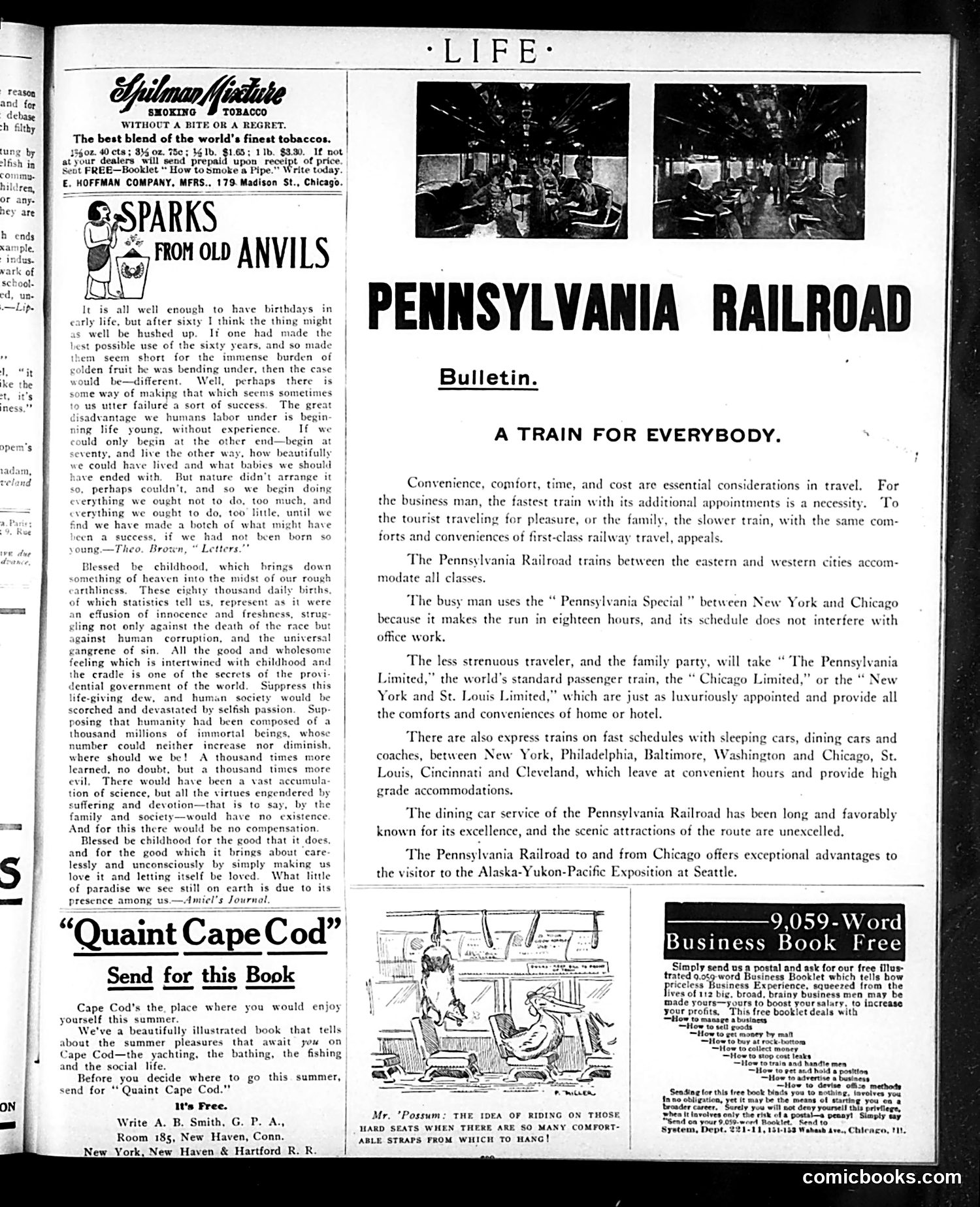
This page contains three distinct elements: advertisements and editorial content, not political cartoons. **Top left:** Spilman Mixture tobacco ad and "Sparks from Old Anvils"—a philosophical column (attributed to Théo. Brown's "Letters" and Amiel's Journal) reflecting on childhood and human development. No satire or caricature present. **Bottom left:** "Quaint Cape Cod" travel advertisement for the New York, New Haven & Hartford Railroad, promoting summer vacation tourism. **Right side:** Pennsylvania Railroad advertisement bulletin promoting passenger trains for different travelers—"the busy man," tourists, and families. It highlights various train services (the "Pennsylvania Special," "Pennsylvania Limited," etc.) between eastern and western cities, and notes advantages for visitors to the Alaska-Yukon-Pacific Exposition in Seattle. The cartoon shows a man uncomfortably squeezed among passengers, captioned about needing comfortable seating straps. **Overall:** This is primarily an advertising page with light editorial content—no political satire or social commentary requiring historical context.
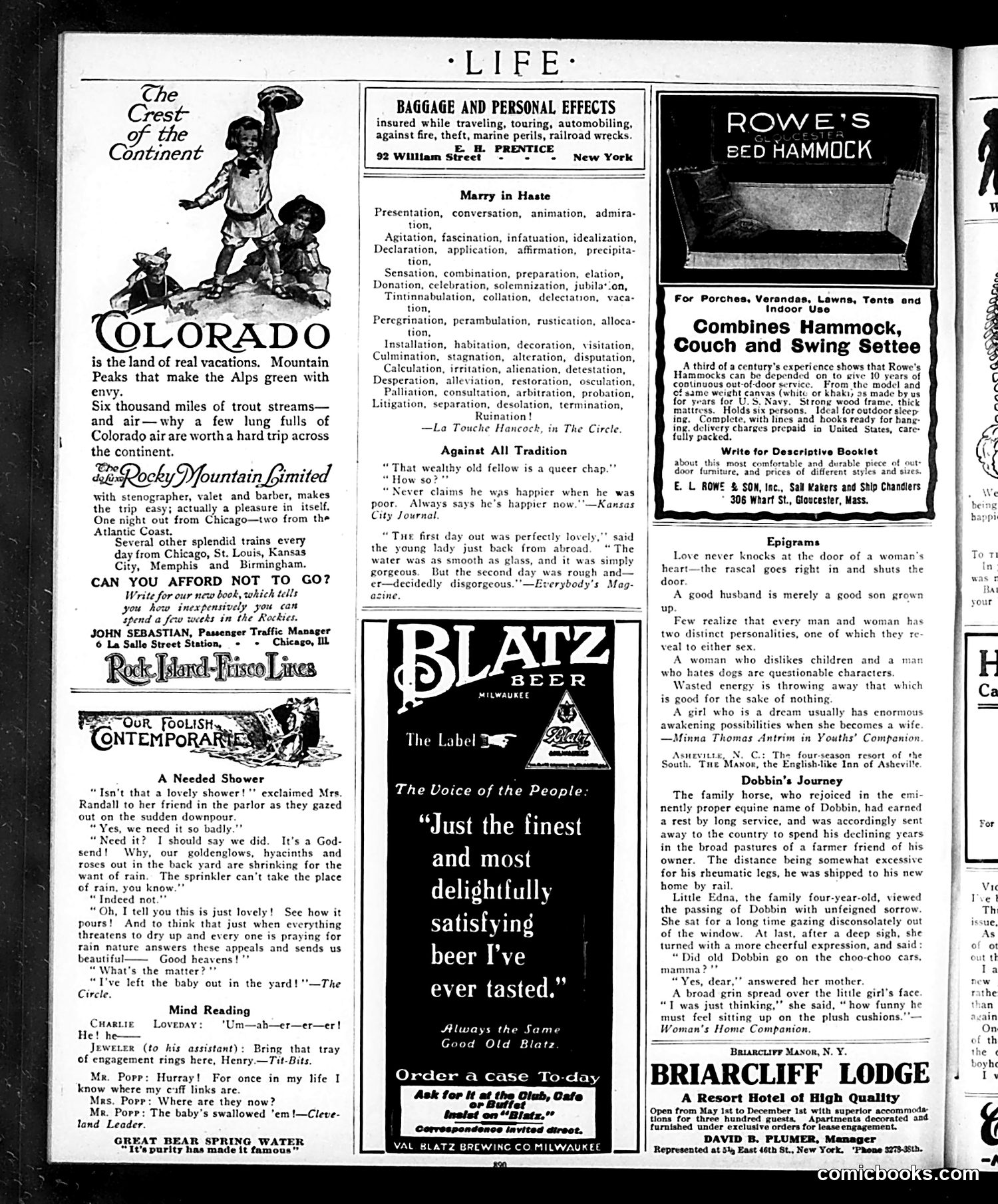
This page is primarily **advertisements and short humorous pieces** rather than political cartoons. The main visual content includes: 1. **"A Needed Shower"** — A domestic humor sketch about a woman praising rain for her garden, then realizing she left her baby outside in the downpour. This is gentle satire of absent-minded parenting and maternal priorities. 2. **"Mind Reading"** — Brief comic snippets about a jeweler correctly guessing a customer wants engagement rings, and a man whose cufflinks were swallowed by a baby. These play on domestic situations and assumptions. 3. **Colorado tourism advertisement** — Promotes Rocky Mountain vacations with imagery of wealthy travelers. The page is dominated by **product advertising**: Blatz Beer, Rowe's Bed Hammock, Briarcliff Lodge, and insurance services. The Blatz ad features testimonial copy about beer quality. The **"Marry in Haste"** section appears to be a verbose literary joke using increasingly absurd rhyming words ending in "-tion." Overall, this reflects early 20th-century *Life* magazine's mix of satirical domestic humor and commercial advertising targeting middle-to-upper-class readers.
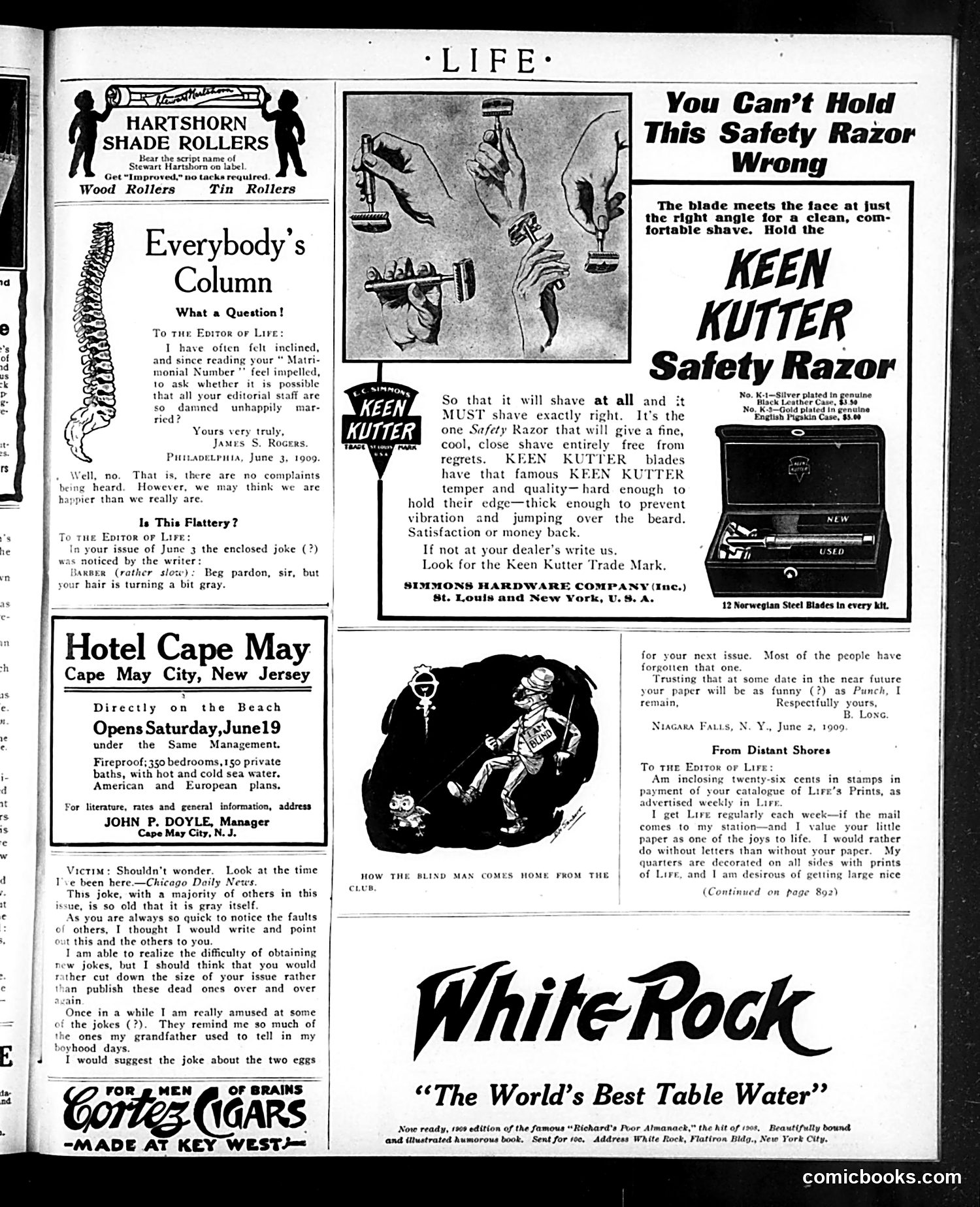
This page is primarily **reader letters and advertisements** rather than editorial cartoons. The content includes: **"Everybody's Column"** features letters to the editor discussing the magazine's quality. Readers complain that Life's jokes are stale and recycled—one correspondent notes a joke "is so old that it is gray itself" and compares them to "ones my grandfather used to tell." Another sarcastically hopes the magazine will become "as funny as Punch." These letters satirize Life's declining humor by praising it with exaggerated politeness while actually criticizing its worn-out material. **The cartoon** (center) shows "How the Blind Man Comes Home from the Club"—appears to depict a drunk man stumbling, using a cane like a blind person would, suggesting inebriation makes one as uncoordinated as blindness. **Advertisements** for Keen Kutter razors, Hotel Cape May, Cortez cigars, and White Rock water fill the remaining space. The page demonstrates how Life balanced satire with commercial content.
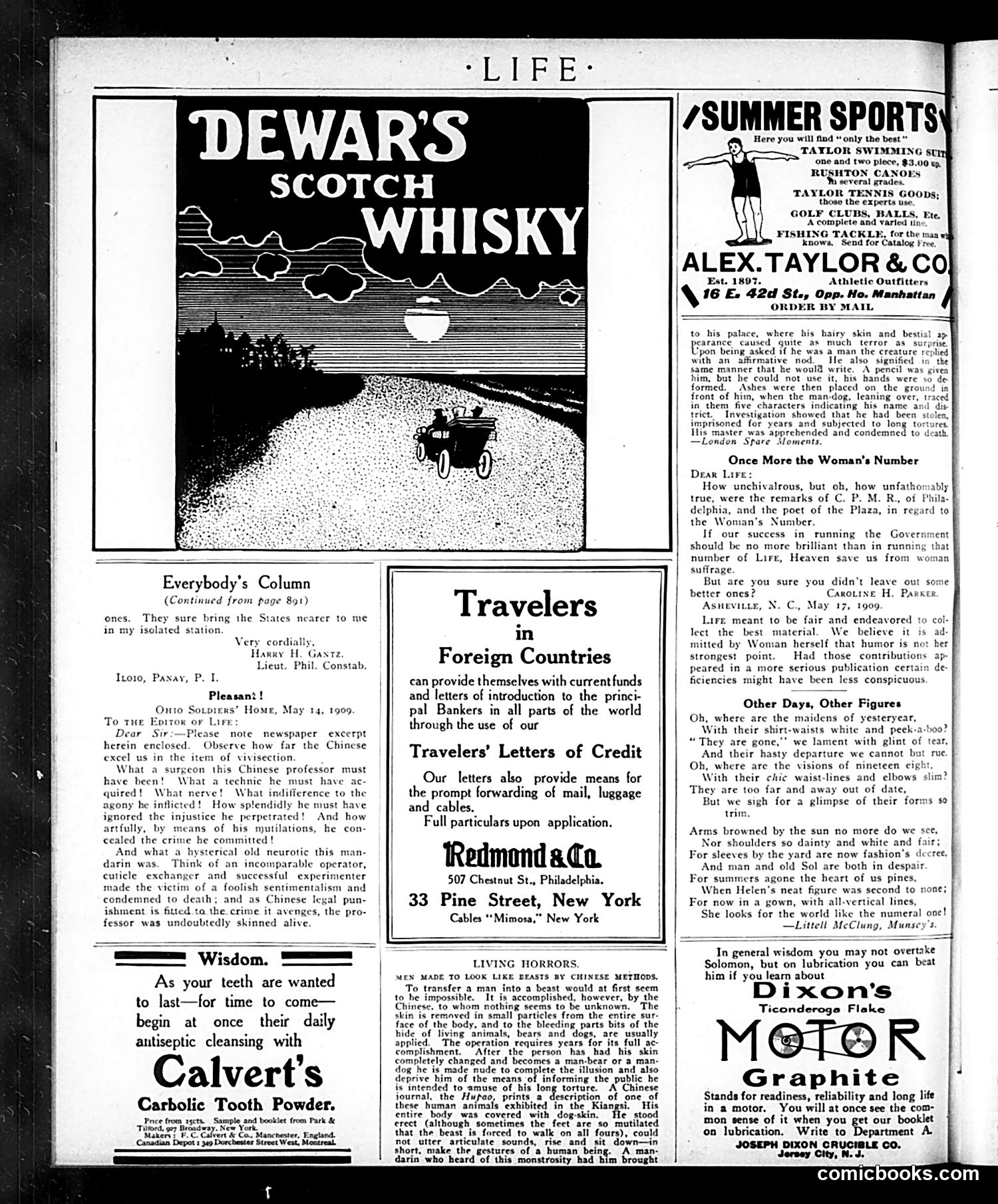
This page is primarily **advertising and reader correspondence**, not political satire. The main content includes: **Advertisements**: Dewar's Scotch Whisky (featuring a romantic driving scene), Calvert's Carbolic Tooth Powder, Redmond & Co. traveler's credit letters, Alex. Taylor & Co. sporting goods, and Dixon's Motor Graphite. **Reader Letters ("Everybody's Column")**: Correspondents discuss a Chinese surgeon's vivisection experiments and the ethics involved—one writer sarcastically praises the surgeon's skill while condemning his cruelty. Another defends *Life*'s "Woman's Number" against complaints about its humor quality. **Poetry Section**: "Other Days, Other Figures" nostalgically laments the disappearance of Victorian-era fashions (white shirtwaists, peek-a-boo details). The page reflects early-1900s concerns: medical ethics, women's fashion changes, and genteel debate about propriety. No clear political cartoon or satire dominates—it's a typical magazine page mixing commerce with reader engagement.
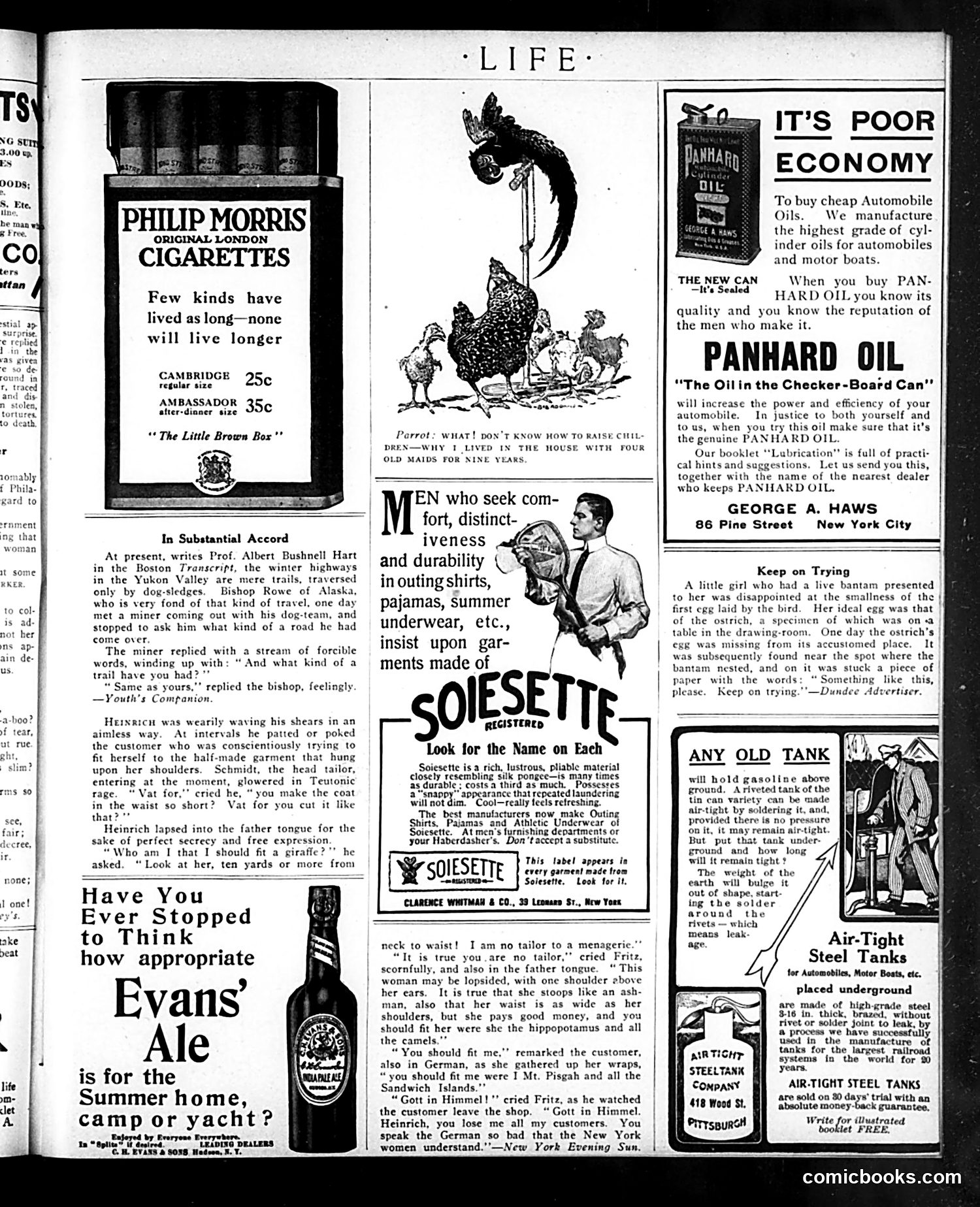
This page from Life magazine (likely early 1900s) is primarily **advertising with one humorous anecdote**. The main cartoon/joke depicts a tailor named Heinrich complaining to his coworker Schmidt about fitting a customer's garment. Heinrich asks in German (for "secrecy"): "Who am I that I should fit a giraffe?"—the humor relies on the customer being unusually tall or disproportionate. The ethnic characterization (German-accented speech from tailors named Schmidt and Heinrich) was typical period humor, relying on immigrant stereotypes common in American publications. A separate anecdote about a parrot and a bishop traveling in the Yukon demonstrates early-1900s frontier humor. The rest consists of period product advertisements: Philip Morris cigarettes, Soiesette fabric, Panhard Oil, Evans' Ale, and Air-Tight Steel Tanks—representing typical consumer goods marketed to middle-class readers. The ads emphasize quality, durability, and economy—values that would appeal to contemporary consumers during the industrial era.
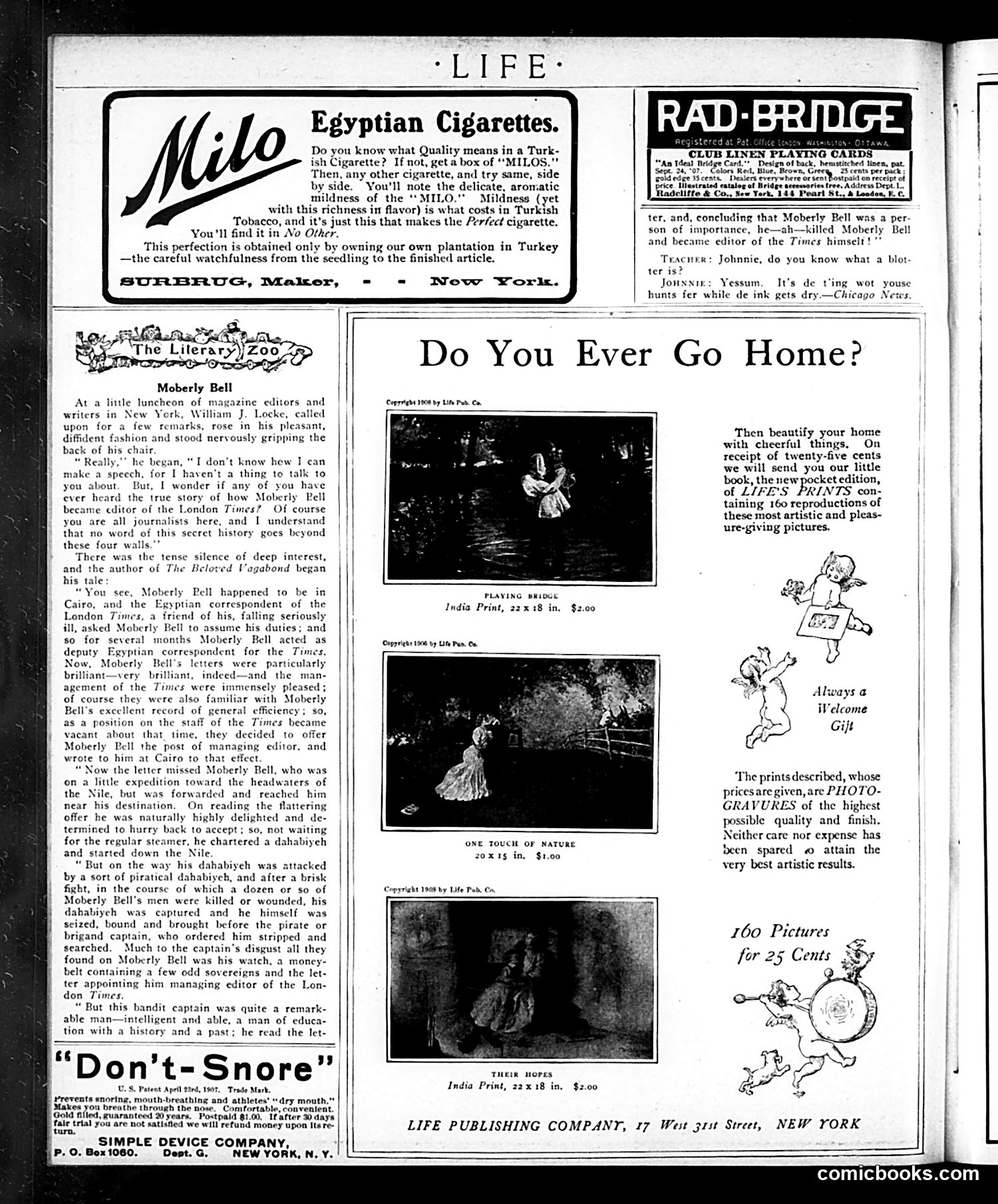
This page is primarily **advertising and promotional content** rather than political satire. The dominant feature is a lengthy anecdotal narrative by William J. Locke explaining how Moberly Bell became editor of the London *Times*. The story—told at a luncheon of New York editors—describes Bell's adventurous path: he temporarily covered Egypt for the *Times*, impressed management, received a promotion letter while on a Nile expedition, survived a piratical attack on his boat, and was captured by a brigand captain who, upon reading Bell's appointment letter, recognized its significance. The narrative appears designed to entertain and humanize Bell's rise at a prestigious publication through a dramatic (likely embellished) tale of adventure and fortunate circumstance. The page also contains **period advertisements**: Milo Egyptian cigarettes, a "Don't-Snore" anti-snoring device, Rad-Bridge playing cards, and Life Publishing Company's promotional offerings of photographic prints and a picture book. No clear political cartoon or satire is evident on this page—it's primarily a celebrity anecdote wrapped around commercial advertisements typical of early 20th-century magazine publishing.
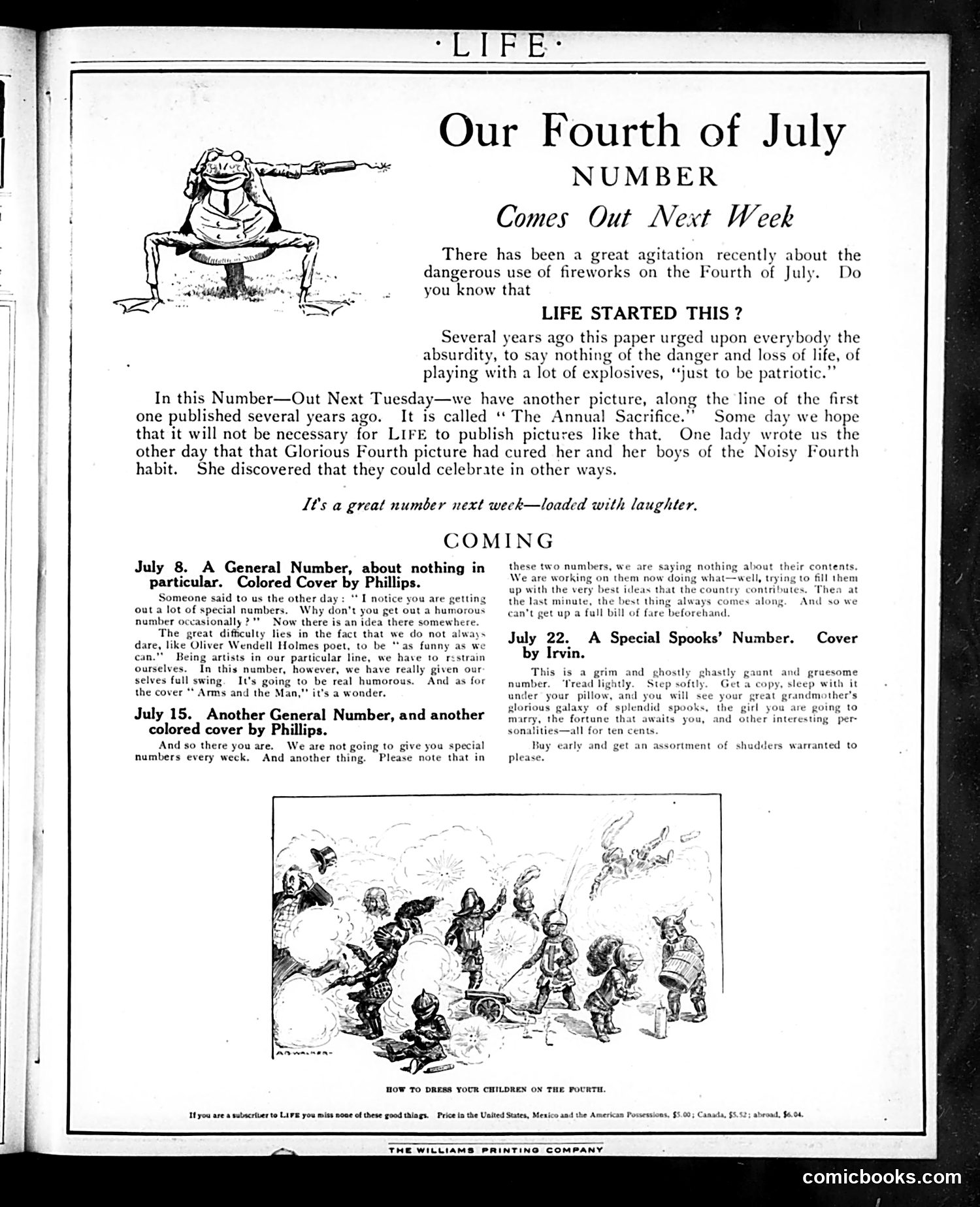
This is a promotional page advertising Life magazine's upcoming Fourth of July issue. The main cartoon depicts children in period dress playing with fireworks and explosives, illustrating dangerous Independence Day celebrations. The text reveals Life's **social advocacy campaign against fireworks safety hazards**. Life claims credit for starting this crusade "several years ago," urging readers that celebrating patriotically doesn't require "playing with explosives." A reader reportedly wrote that Life's previous cautionary illustration had reformed her family's dangerous Fourth of July habits. The page promotes upcoming special issues, including a "Spooks' Number" by illustrator Irvin (featuring ghosts and supernatural content for entertainment). The tone is self-congratulatory about Life's role in public safety education while maintaining the magazine's satirical, humorous approach to serious social issues. This reflects Progressive Era concerns about public safety and reformist messaging through popular media.
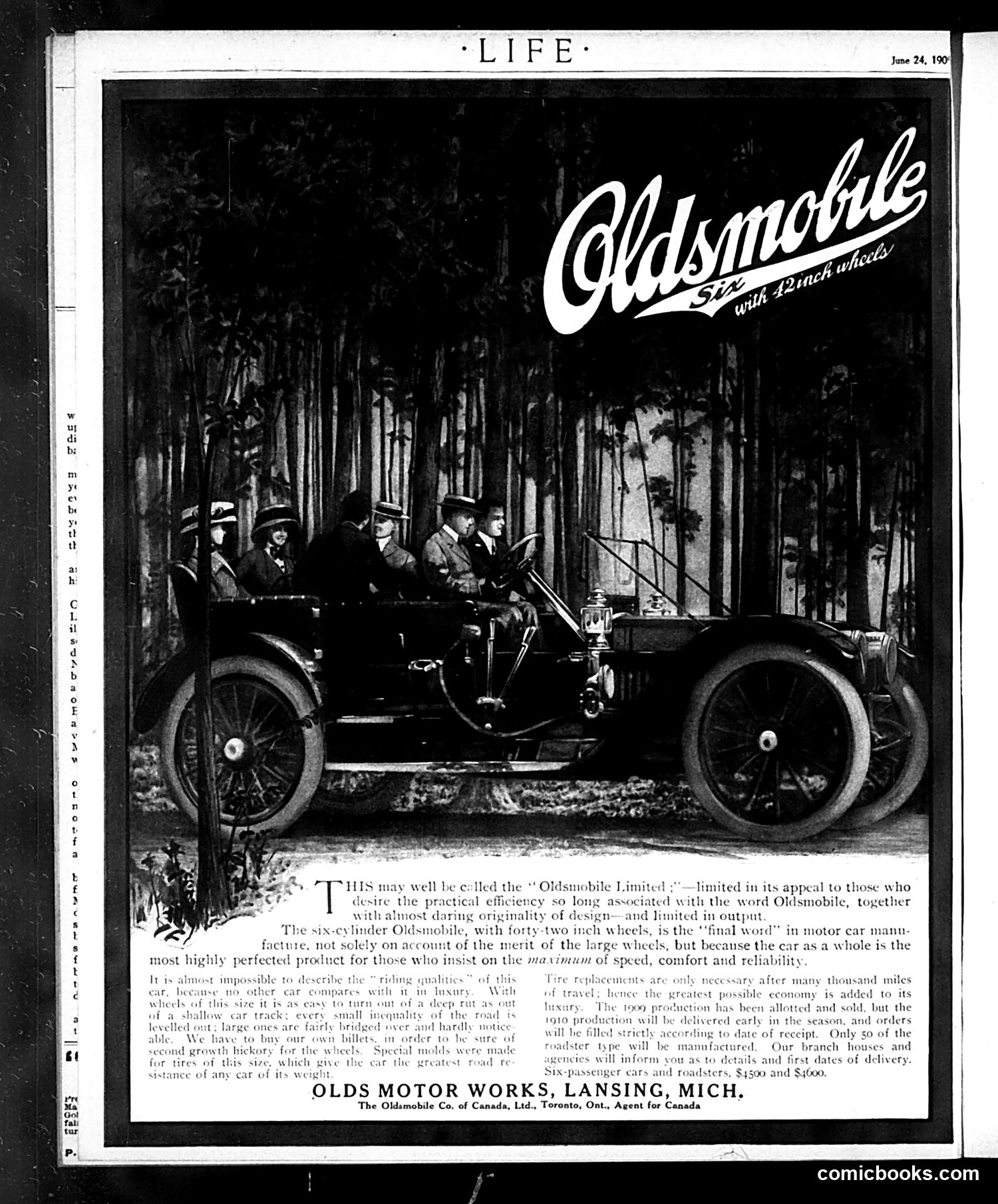
This is **not a cartoon or satire**—it's a full-page **automobile advertisement** for Oldsmobile, dated June 24, 190[2]. The image shows a luxury touring car with six passengers driving through a tree-lined road. The ad copy emphasizes the car's exclusivity ("limited in its appeal"), technical features (42-inch wheels, six-cylinder engine), and premium positioning as "the final word in motor car manufacture." The appeal is to wealthy consumers seeking "maximum speed, comfort and reliability." Prices listed ($1,500 and $1,600) indicate this was a luxury product for the affluent. **Why it appears in Life magazine**: *Life* was a general-interest publication that carried upscale advertising alongside humor and commentary. This reflects early 1900s automotive marketing targeting the leisure class who could afford such vehicles. There is no satire here—simply period advertising for a prestige automobile brand.

This appears to be a blank or nearly blank page from Life magazine, with only a watermark reading "comicbooks.com" visible at the bottom. There is no discernible cartoon, illustration, text content, or satirical imagery that can be analyzed from this image. The page shows minimal marks or content beyond the watermark attribution. Without visible cartoons, captions, or substantive text, I cannot identify any political figures, social references, or satirical points that would explain historical context to a modern reader. This may be a blank page from the magazine's interior, a scan error, or a page from advertising content.