
Life, 1909-06-24 · page 18 of 29
Life — June 24, 1909 — page 18: what you’re looking at
What you’re looking at
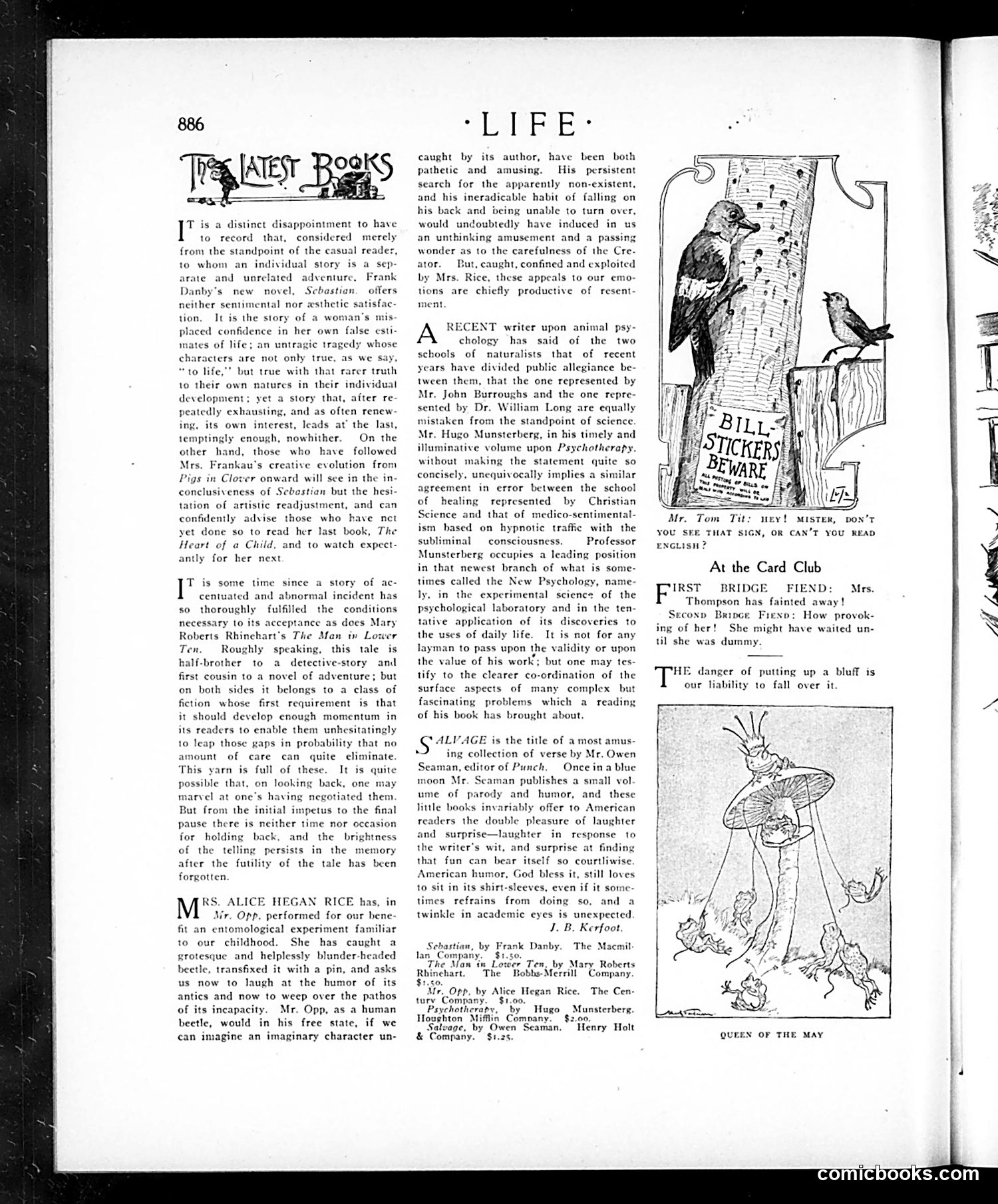
This Life magazine page from 1909 reviews contemporary novels, with two illustrated cartoons mocking literary and social trends. **"Bill-Stickers' Repair"** (top right): Shows a woodpecker working on a bill-sticker poster. The joke satirizes sloppy advertising and poor maintenance of public notices—common urban eyesores of the era. The cartoonist suggests even birds must "repair" the neglected posted bills. **"Queen of the May"** (bottom): Depicts a grotesque insect figure. This likely references the text's discussion of Mrs. Alice Hegan Rice's novel *Mr. Opp*, which the reviewer criticizes as presenting a pitiful, helpless character (compared to a blundering beetle pinned down). The satire mocks sentimentalized portrayals of pathetic characters that exploit readers' pity rather than genuine emotion. Both cartoons critique artificial or manipulative artistic presentation—whether in advertising or literature—reflecting early 20th-century intellectual concerns about authenticity versus commercial exploitation.
📄 Transcribed text from this page (OCR, searchable)
Machine-transcribed from the original scan — historical spelling and the odd misread are preserved.
886 LE: ls Se Be KS is a distinct disappointment to have to record that, considered merel: from the standpoint of the casual reader, to whom an individual story is a sep arate and unrelated adventure, Frank Danby’s new novel, Sebastian, offers ither sentimental nor wsthetic satisfac- s mis tion. It is the story of a woma placed confidence in her own false esti- of life; an untragic traged: clers are not only true, as we say, “to life”? but true with that rarer truth to their own natures in their individual after re whose development; yet a story th and as often renew ing, its own interest, leads at’ the last, peatedly exhaustin; temptingly enough, nowhither. On the other hand, those who have followed Mrs. Frankau's creative evolution from Pigs in Clover onward will see in the in- Sebastian but the hesi- conclusiveness o tation of artistic readjustment, and can confidently advise those who have net yet done so to read her last book, Th Heart of a Child, and to watch expect- for her next I’ is some time since a story of centuated and abnorr incident has so thoroughly fulfilled the conditions necessary to its acceptance as docs M Roberts Rhinehart's The Man iv L Ten. Roughly speaking, this tale is half-brother to a detective-story and first cousin to a novel of adventure; but on both sides it belongs to a class of fiction whose first requirement is that it should develop enough momentum in ple them unhesitatingly p those gaps in probability that no y its readers to e} to} amount of care can quite climinate This yarn is full of these. It is quite possible that, on looking back, one n marvel at one’s having negotiated them But from the initial impetus to the fina pause there is neither time nor occasion for holding back, and the brig of the telling persists in th emory after the futility of the tale has been forgotten RS. ALICE HEGAN RICE has, in Mir. Opp. performed for our bene fit an entomological experiment familiar to our childhood. She has caught a grotesque and helplessly blunder-headed beetle, transfixed it with a pin, and asks us now to laugh at the humor of its antics and now to weep over the pathos of its incapacity. Mr. Opp, as a human beetle, would in his free state, if we can imagine an imaginary character un- ETRE caught by its author, have been both pathetic and amusing. His persistent search for the apparently non-existent, and his ineradicable habit of falling on his back and being unable to turn over. would undoubtedly have induced in us an unthinking amusement and a passing wonder as to the carefulness of the Cre- ator. But, caught, confined and exploited by Mrs. Rice, these appeals to our emo tions are chiefly productive of resent- ment. A RECENT writer upon animal psy- chology has said of the two pools of naturalists that of recent years have divided public allegiance be- tween them, that the one represented by Mr. John Burroughs and the one repre- sented by Dr. William Long are equally mistaken from the standpoint of science Mr. Hugo Munsterberg, in his timely and iluminative volume upon Psychotherapy. without making the statement quite so concisely, unequivocally implies a similar agreement in error between the school of healing represented by Christian Science and that of edico-sentimental- ism based on hypnotic traffic with the subliminal consciousness. Professor Munsterberg occupies a leading position in that newest branch of what is some- times called the New Psychology, name y. in the experimental science of the psychological laboratory and in the ten- tative application of its discoveries to the uses of daily life. It is not for any layman to pass upon the validity or upon the value of his work; but one may tes- tify to the clearer co-ordination of the surface fascinating problems which a reading of his book has brought about. pects of many complex t gaLvac 2 is the title of a most amus- & ing collection of verse by Mr. Owen Seaman, editor of Punch. Once ina blue moon Mr. Seaman publishes a small yol ume of parody and humor, and these little books invariably offer to American readers the double pleasure of laughter and surprise—laughter in response to the writer's wit, and surprise at finding that fun can bear itself so courtliwise. American humor, God bless it, still loves to sit in its shirt-sleeves, even if it some- times refrains from doing so, and a twinkle in academic eyes is unexpected J.B. Kerfoot. Schastian, by Frank Danby. The Macmil lan ‘Cor $1.50. The Man in Lower Ten, by Mary, Roberts nchart. The Bobbs-Merrill Compa Ob by Alice Hegan Rice. The Cen- tury Comp: 1.00. Psychotherapy, by Hugo | Munsterberg. Houghton Mifflin Company. $2.00. Salvage, by Owen Seaman. Henry Holt & Compariy. | $1.25. Mr. Tom Tit: ue MISTER, DON’T YOU SEE THAT SIGN, OR CAN’T YOU READ ENGLISH ? At the Card Club IRST BRIDGE FIEND: Mrs. Thompson has fainted awa: Secoxn Brivce Fiexp: How provok- ing of her! She might have waited un- til she was dummy. HE danger of putting up a bluff is our liability to fall over it. THE MAY comicbooks.com Cee W/ iA