
Life, 1909-06-24 · page 6 of 29
Life — June 24, 1909 — page 6: what you’re looking at
What you’re looking at
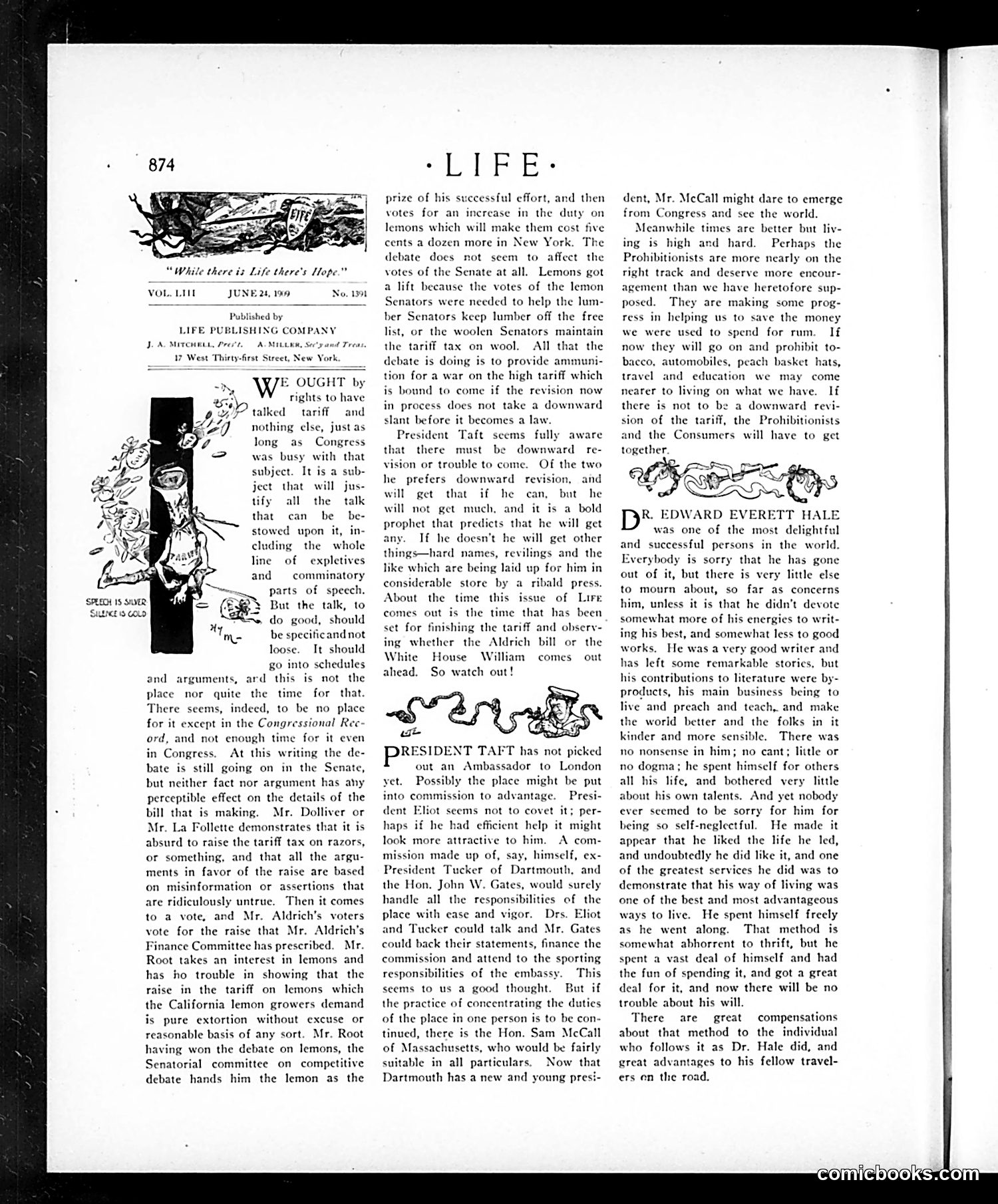
The main cartoon, titled "While there is Life there's Hope," depicts a figure labeled "SKETCH IN SATAN'S SKETCH BOOK" — likely representing a political opponent or satirical target — being stabbed or attacked. The surrounding text discusses President Taft's tariff debates and Congressional politics. The editorial content addresses tensions over the Aldrich bill and tariff revision, critiquing Mr. Dolliver and others for their positions. The page also eulogizes Dr. Edward Everett Hale, a notable writer and moral figure. The satire appears to mock political figures involved in contentious tariff negotiations, suggesting their political fates hang precariously. Without clearer image resolution of the specific caricature details, precise identification of the "victim" remains uncertain.
📄 Transcribed text from this page (OCR, searchable)
Machine-transcribed from the original scan — historical spelling and the odd misread are preserved.
SPLEDH 15 SER Suet s CUD “While there iz Life there's lH VOL. LIE JUNE 2, 199 Published by LIFE PUBLISHING COMPANY DLA MITCHELL, Pret, ALAMLURR, Ser'y amd Treas, West Thirty-first Street, New York. 2 OUGHT by rights to have tariff and nothing else, just as long as Congress was busy with that subject. It is a sub- ject that will jus- tify all the talk that can be be- stowed upon it, in- cluding the whole line of expletives and = comminatory parts of speech. 2: But the talk, to ~. do good, should be specificand not loose. It should go into schedules arguments, ard this is not the place nor quite the that. There seems, indeed, to be no place for it except in the Congressional Rec- ord, and not enough time for it even in Congress. At this writing the de- bate is still going on in the Senat but neither fact nor argument has any perceptible effect on the details of the bill that is making. Mr. Dolliver or Mr. La Follette demonstrates that it is absurd to raise the tariff tax on razors, or something, and that all the argu- ments in favor of the raise are based on misinformation or assertions that are ridiculously untrue. Then it comes to a vote, and Mr. Aldrich’s voters vote for the raise that Mr. Aldrich’s Finance Committee has prescribed. Mr. Root takes an interest in lemons and has ho trouble in showing that the raise in the tariff on lemons which the California lemon growers demand pure extortion without excuse or reasonable basis of any sort. Mr. Root having won the debate on lemons, the Senatorial committee on competitive debate hands him the lemon as the and time for ee ee prize of his successful effort, and then votes for an increase in the duty on lemons which will make them cost five cents a dozen more in New York. The debate docs not affect the votes of the Senate at all. Lemons got a lift because the votes of the lemon Senators were needed to help the lum- ber Senators keep lumber off the free list, or the woolen Senators maintain the tariff tax on wool. All that the debate is doing is to provide ammuni tion for a war on the high tariff which is bound to come if the revision now in process does not take a downward slant before it becomes a law. President Taft seems fully that there must be downward re- vision or trouble to come. Of the two he prefers downward revision, aid will get that if he can, but he will not get much, and it is a bold prophet that predicts that he will get any. If he doesn’t he will get other things—hard names, revilings and the like which are being laid up for him in considerable store by a ribald press. About the time this of Lire comes out is the time that has been set for finishing the tariff and observ- ing whether the Aldrich bill or the White House William comes out ahead. So watch out! seem to aware issue wt PRES!D NT TAFT has not picked out an Ambassador to London Possibly the place might be put Presi- yet. into commission to advantage. dent Eliot seems not to covet it haps if he had efficient help it might look more attractive to him. A com- mission made up of, say, himself, ex- President Tucker of Dartmouth, and the Hon, John W. Gates, would surely handle all the responsibilities of the place with ease and vigor. Drs. Eliot and Tucker could talk and Mr. Gates could back their statements, finance the commission and attend to the sporting responsibilities of the embassy. This seems to us a good thought. But if the practice of concentrating the duties of the place in one person is to be con- tinued, there is the Hon. Sam McCall of Massachusetts, who would be fairly suitable in all particulars, Now that Dartmouth has a new and young presi- per- dent, Mr. McCall might dare to emerge from Congress and see the world. Meanwhile times are better but liv- ing is high and hard. Perhaps the Prohibitionists are more nearly on the right track and deserve more encour- agement than we have heretofore sup- posed. They are making some prog- ress in helping us to save the money we were used to spend for rum. If now they will go on and prohibit to- co, automobiles, peach basket hats, travel and come nearer to living on what we have. If there is not to be a downward revi- sion of the tariff, the Prohibitionists and the Consumers will have to get together. education we may =~ Pe ie R. EDWARD EVERETT HALE was one of the most delightful and successful persons in the world. Everybody is sorry that he has gone out of it, but there is very little else to mourn about, so far as concerns him, unless it is that he didn't devote somewhat more of his energies to writ- ing his best, and somewhat less to good works. He was a very good writer and has left some remarkable stories, but his contributions to literature were by- products, his main business being to live and preach and teach, and make the world better and the folks in it kinder and more sensible. There was no nonsense in him; no cant; little or no dogma; he spent himself for others all his life, and bothered very little about his own talents. And yet nobody ever seemed to be sorry for him for being so self-neglectful. He made it appear that he liked the life he led, and undoubtedly he did like it, and one of the greatest services he did was to demonstrate that his way of living was one of the best and most advantageous ways to live. He spent himself freely as he went along. That method is somewhat abhorrent to thrift, but he spent a vast deal of himself and had the fun of spending it, and got a great deal for it, and now there will be no trouble about his will. There are great compensations about that method to the individual who follows it as Dr. Hale did, and great advantages to his fellow travel- ers on the road. URS