
Life, 1909-06-24 · page 5 of 29
Life — June 24, 1909 — page 5: what you’re looking at
What you’re looking at
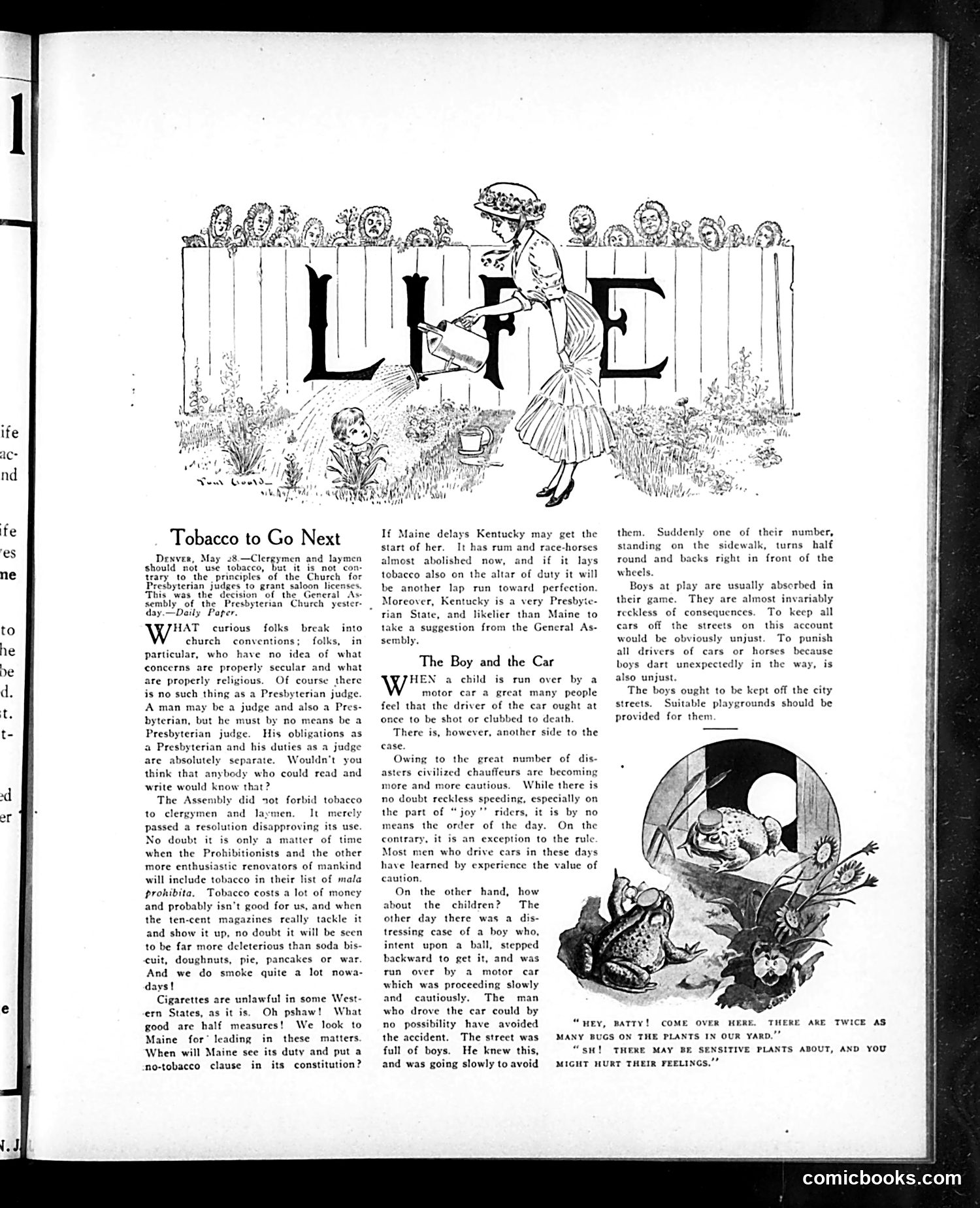
**Main Illustration:** The decorative header "LIFE" features a woman tending a garden fence where neighbors observe. This appears to relate to the article "Tobacco to Go Next," which discusses efforts to prohibit tobacco use. **Political Context:** The article critiques a curious contradiction: religious-minded politicians who oppose tobacco but lack similar conviction about alcohol prohibition. It references the Presbyterian Church's decision and a General Assembly debate, sarcastically noting that "half measures" won't work—either prohibition advances or retreats entirely. **"The Boy and the Car" Section:** A separate illustrated article depicts a child nearly struck by a motor car, arguing for better traffic safety and supervised playgrounds. It critiques careless drivers and emphasizes protecting children from automotive dangers. Both pieces reflect early 20th-century Progressive Era concerns about social regulation and public safety.
📄 Transcribed text from this page (OCR, searchable)
Machine-transcribed from the original scan — historical spelling and the odd misread are preserved.
Tobacco to Go Next Denver, May 28—Clergymen and laymen should not use tobacco, but it is not con: trary to the principles of the Church for Presbyterian judges to grant saloon licenses. ‘This was the decision of the General As sembly of the Presbyterian Church yester- day.—Daeily Pape HAT curious folks break into church conventions; folks, in particular, who have no idea of what concerns are properly secular and what are properly religious. Of course there is no such thing as a Presbyterian judge A man may be a judge and also a Pr byterian, but he must by no means be a Presbyterian judge. His obligations as a Presbyterian and his duties as a judge Wouldn't you are absolutely think that anybody who could read and write would know that? The Assembly did rot forbid tobacco to clergymen and laymen. It on disapproving its use. eparate. merely passed a resol No doubt it is only a matter of time when the Prohibitionists and the other more enthusiastic renovators of mankind will include tobacco in their list of mala prohibita, Tobacco costs a lot of money and probably isn’t good for us, and when the ten-cent magazines really tackle it and show it up, no doubt it will be seen to be far more deleterious than soda bis- cuit, doughnuts, pie, pancakes or war And we do smoke quite a lot nowa- days! Cigarettes are unlawful in some West- ern States, as it is, Oh pshaw! What good are half measures! We look to Maine for’ leading in these matters When will Maine see its duty and put a no-tobacco clause in its constitution? If Maine delays Kentucky may get the start of her. It almost abolished now, and if it lays tobacco also on the altar of duty it will be another lap run toward perfection Moreover, Kentucky is a very Presbyte- rian State, and likelier than Maine to take a suggestion from the General As- sembly. The Boy and the Car HEN a child is run over by a motor car a great many people feel that the driver of the car ought at once to be shot or clubbed to death There is, however, another side to the case. Owing to the great number of dis- asters civilized chauffeurs are becoming more and more cautious. While there is no doubt reckless speeding, especially on the part of “ joy’? riders, it is by no means the order of the day. On the contrary, it is an exception to the rule Most men who drive cars in these days have learned by experience the value of caution, On the other hand, how about the children? The other day there was a dis- tressing case of a hoy who, intent upon a ball, stepped backward to get it, and was run over by a motor car which was proceeding slowly and cautiously, The man who drove the car could by no possibility have avoided tev, the accident. The street was full of boys. He knew this, and was going slowly to avoid $s rum and race-horses su! them. Suddenly one of their number, standing on the sidewalk, turns half round and backs right in front of the wheels. Boys at play are usually absorbed in their game. They are almost invariably reckless of consequences. To keep all cars off the streets on this account would be obviously unjust. To punish all drivers of cars or horses because boys dart unexpectedly in the way, is also unjust. The boys ought to be kept off the city streets. Suitable playgrounds should be provided for them BATTY! COME OVER HERE. THERE ARE TWICE AS Y BUGS ON THE PLANTS IN OUR YARD.’” THERE MAY BE SENSITIVE PLANTS ABOUT, AND YOU MIGHT MURT THEIR FEELINGS.” comicbooks.com