
Life, 1909-06-24 · page 16 of 29
Life — June 24, 1909 — page 16: what you’re looking at
What you’re looking at
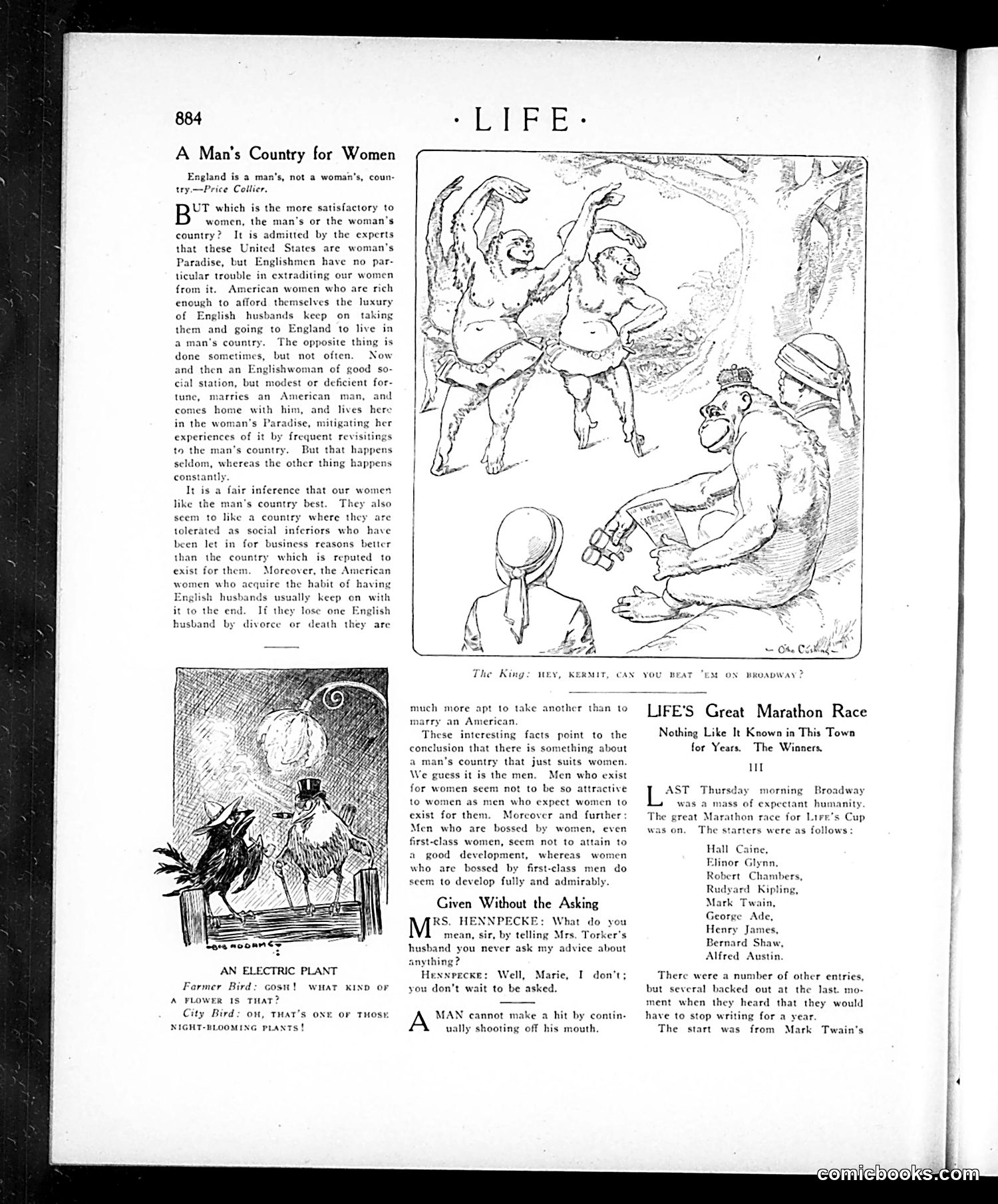
This page contains social satire comparing American and English attitudes toward women and marriage. The main article argues that wealthy American women prefer "man's countries" (England) where they occupy subordinate social positions, suggesting women are happier under male dominance than equality. The piece cynically concludes that women who are "bossed by first-class men" develop better than those who boss men. The cartoons reinforce this theme: one shows cherubs asking a man (likely representing English masculinity) if he can "beat 'em on Broadway"—suggesting English male superiority. Another depicts a conversation where a henpecked husband admits he never asks his domineering wife's advice, implying she needs no asking because she dominates anyway. The "Marathon Race" section appears to announce a literary competition among famous writers (Mark Twain, Henry James, George Bernard Shaw, etc.), with the humorous caveat that entrants must stop writing for a year—several withdrew upon hearing this requirement. The page reflects early 20th-century attitudes about gender roles, presented through satirical commentary on transatlantic differences.
📄 Transcribed text from this page (OCR, searchable)
Machine-transcribed from the original scan — historical spelling and the odd misread are preserved.
884 A Man’s Country for Women England is a man’s, not a woman's, coun- try.—Price Collier. UT which is the more satisfactory to women, the man’s or the woman's country? It is admitted by the experts that these United States are woman's Paradise, but Englishmen have no par- ticular trouble in extraditing our women from it. American women who are rich enough to afford themselves the luxury of English husbands keep on taking them and going to England to live in a man’s country. The opposite thing is done sometimes, but not often. Now and then an Englishwoman of good so- cial station, but modest or deficient for- American . and lives here ing her ent _revisitings rries an ne with him, and in’s Paradise, miti, by freq to the man’s country, But that happen seldom, whereas the other thing happens constantly It is a fair inference that our women like the man's country best. They also seem to like a country where they tolerated as social inferiors who have been let in for business reasons better than the country which is reputed to Moreover, the American re the habit of having English husbands usually keep on with If they lose or death wor experiences of i exist for them. women who it to the end. one English husband by divorce SDAA = Ot Ciatad The King: wey, KERMIT, CAN YOU BEAT ‘Est ON ROADWAY? Lars wooanes AN ELECTRIC PLANT Farmer Bird: cosw! A FLOWER IS THAT? City Bird: om, THAT's oxE oF THOSE NIGHT-BLOOMING PLANTS! WHAT KIND OF much more a to take another marry an American. These interesting facts point to the conclusion that there is something abo a man’s country that just suits women: We guess it is the men. Men who exist for women seem not to be so attractive to women as men who expect women to exist for them. Morcover and further: Men who are bossed by women, first-class women, seem not to a a good development, whereas who are bossed by first-class men do seem to develop fully and admirably. Given Without the Asking RS. HENNPECKE: What do you mean, sir, by telling Mrs, Torker’s husband you never ask my advice about women Hexxrecke: Well, Marie, I don't; ait to be asked. you don’t MAN cannot make a hit by contin. ually shooting off his mouth. nto LIFE’S Great Marathon Race Nothing Like It Known in This Town for Years. The Winners, MI Broadway anity AST Thursday was a mass of expectant hut The great Marathon race for Live The starters were as follows Hall Caine, Elinor Glynn, Robert C€ morning Cup was on. mbers, J Kipling, Mark Twain, George Ade, Henry James, Bernard Shaw, Alfred Austin. There were a number of other entries, but several backed out at the last. mo- ment when they heard that they would have to stop writing for a year. The start was from Mark Twain's