
A complete issue · 32 pages · 1909
Life — April 8, 1909
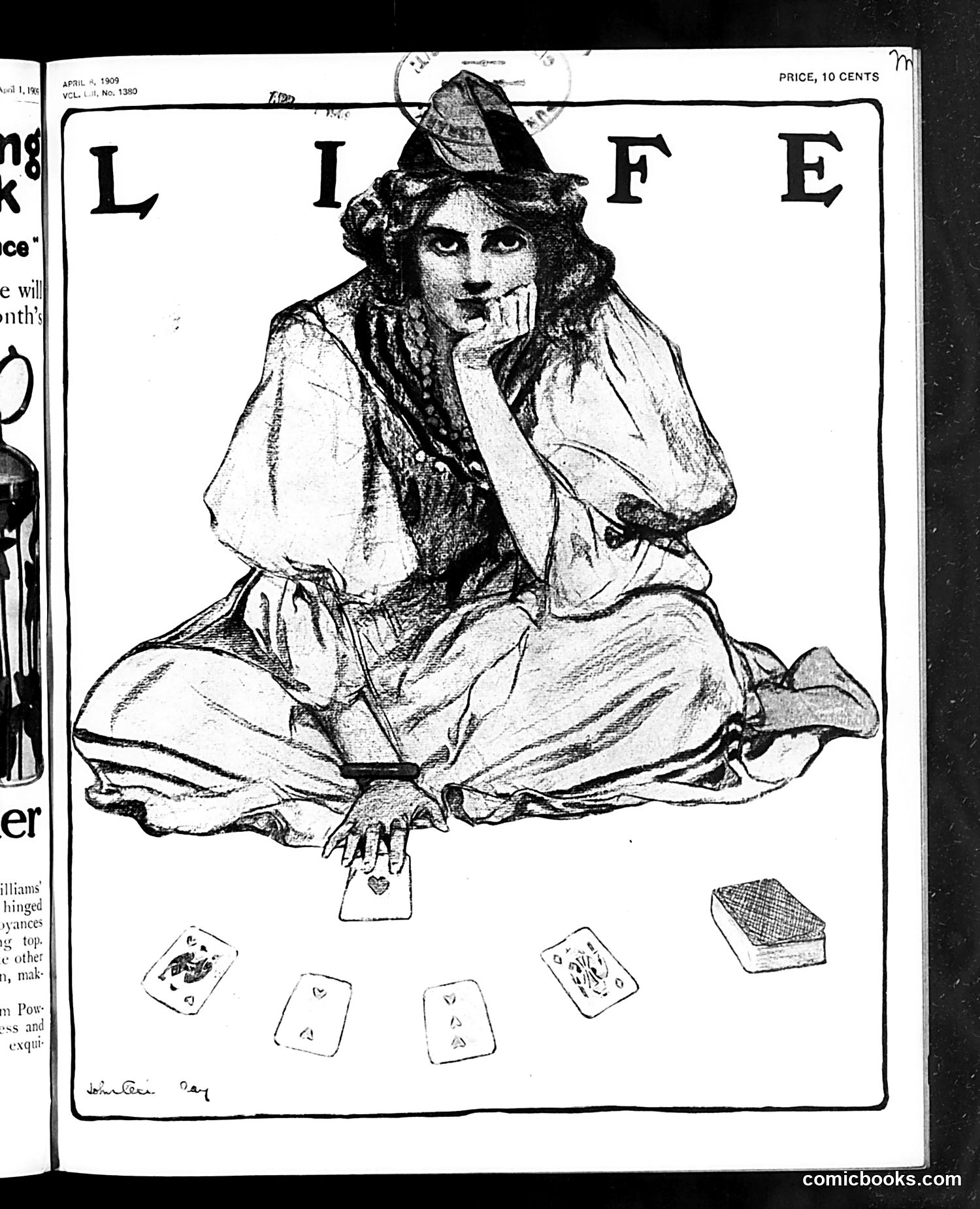
This appears to be a **Life magazine cover from April 1909** (price 10 cents). The central illustration depicts a woman in fortune-telling pose, seated cross-legged with playing cards spread before her. She wears a head wrap and exotic clothing typical of stereotypical "gypsy" fortune-teller depictions of the era. The title "LIFE" frames the image. The satirical point likely mocks either popular fortune-telling practices or perhaps comments on women's fascination with such entertainments during the Gilded Age. The playing cards and theatrical costume suggest the magazine is satirizing the appeal of mysticism and chance-based entertainment among American society. Without additional OCR text from the article, the specific satirical target remains unclear, though it appears commentary on contemporary social trends or foibles.
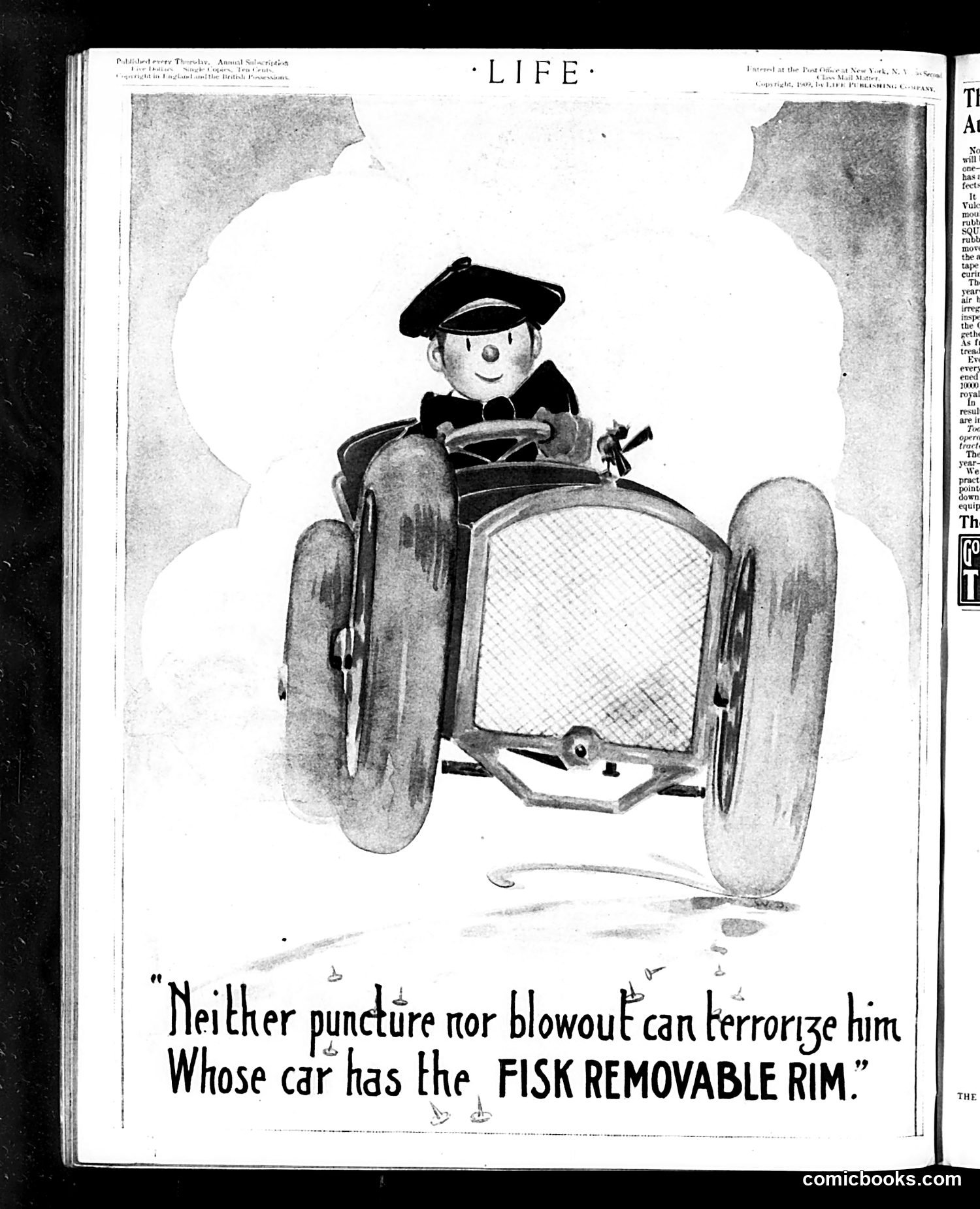
This is a **product advertisement**, not political satire. The image shows a cheerful cartoon character driving an early automobile with oversized wheels, wearing a flat cap and casual clothing typical of the early 1900s. The advertisement promotes the "**Fisk Removable Rim**" — a automotive innovation allowing car wheels to be quickly removed and replaced without tools. The tagline claims this feature prevents both punctures and "blowouts" (tire failures) from terrorizing drivers. This reflects genuine early automotive concerns: tire problems were common and dangerous on primitive roads. The removable rim made repairs practical for ordinary drivers, representing genuine mechanical progress. The playful cartoon style was typical advertising for the era. This is product promotion rather than social commentary.
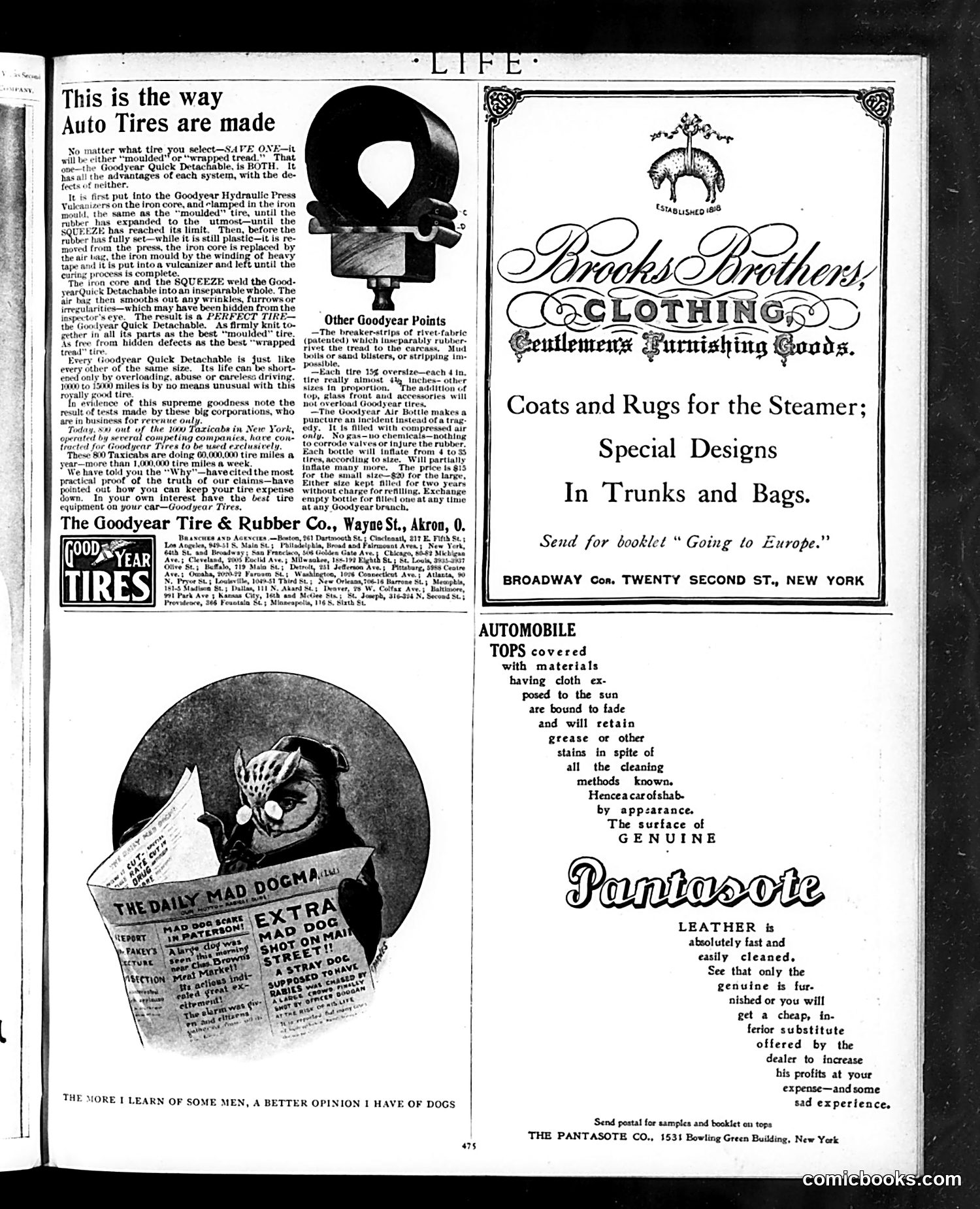
This page is primarily **advertising**, not satire or political commentary. The main content includes: 1. **Goodyear Tires advertisement** (left) explaining tire manufacturing processes 2. **Brooks Brothers clothing ad** (right) promoting steamship travel outfits 3. **A humorous illustration** (bottom left) showing a dog reading "The Daily Mad Dog" newspaper, captioned "The more I learn of some men, a better opinion I have of dogs" The dog cartoon is mild social satire—a common early-20th-century trope suggesting dogs are more trustworthy than certain men. It's not targeting a specific person or event, but rather making a general misanthropic joke. The **Pantasote leather advertisement** (right) completes the page. This is a straightforward commercial publication with minimal satirical content.
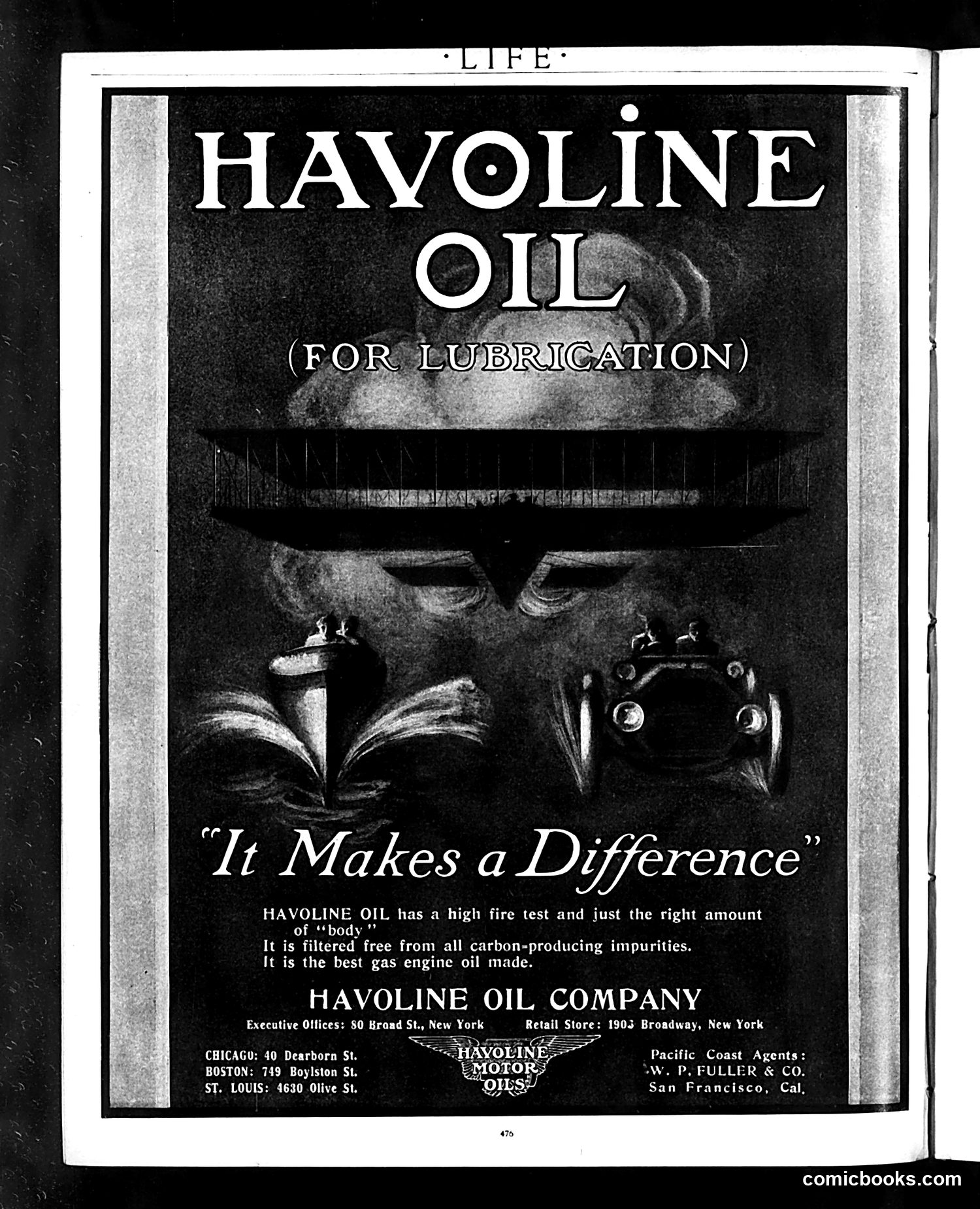
This is a **straightforward product advertisement**, not political satire. The Havoline Oil Company promotes their motor oil with the slogan "It Makes a Difference." The imagery shows a man's head tilted back with an oil can pouring into it—a visual metaphor suggesting the oil provides mental clarity or improved thinking for automobile owners. Below are two engine components (possibly carburetors or fuel systems) representing the mechanical benefits. The ad emphasizes Havoline's superior qualities: high fire-test rating, freedom from carbon-producing impurities, and suitability as "the best gas engine oil made." This represents early-1900s automotive advertising, when motor oil quality significantly affected vehicle performance. The anthropomorphic imagery was common advertising technique of the era.
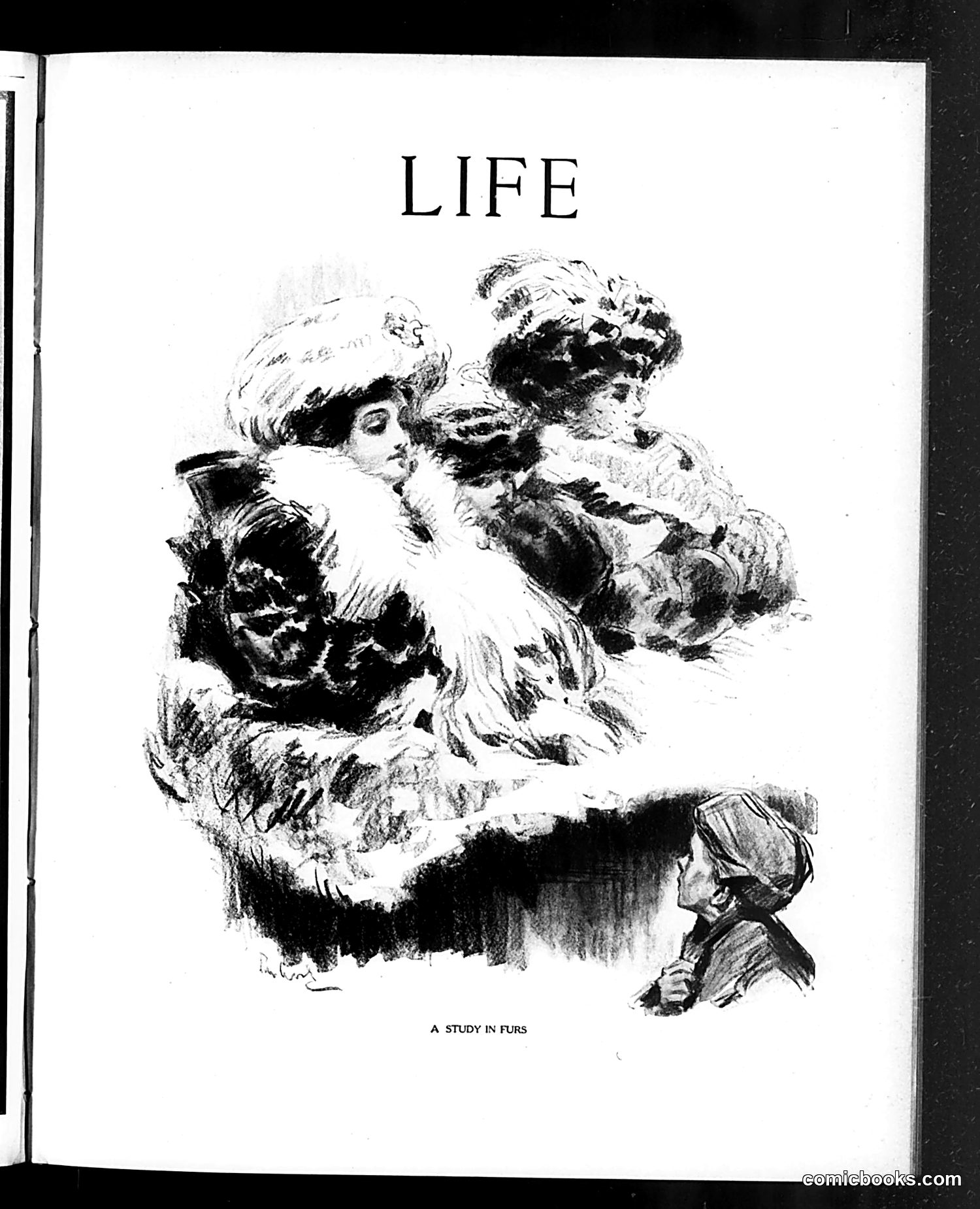
This satirical illustration is titled "A Study in Furs" and depicts fashionable women wearing elaborate fur garments—a luxury good that was a status symbol in the early 20th century. The small figure on the lower right, shown in contrast and simpler dress, appears to represent either a working-class observer or potentially a commentary on economic inequality. The satire likely critiques the extravagance and vanity of wealthy women preoccupied with expensive fashion, while implying indifference to those of lower economic status. The "study" format suggests this is examining fashion trends of the era, a common target of *Life* magazine's social commentary. The specific individuals depicted are unclear from the image alone.
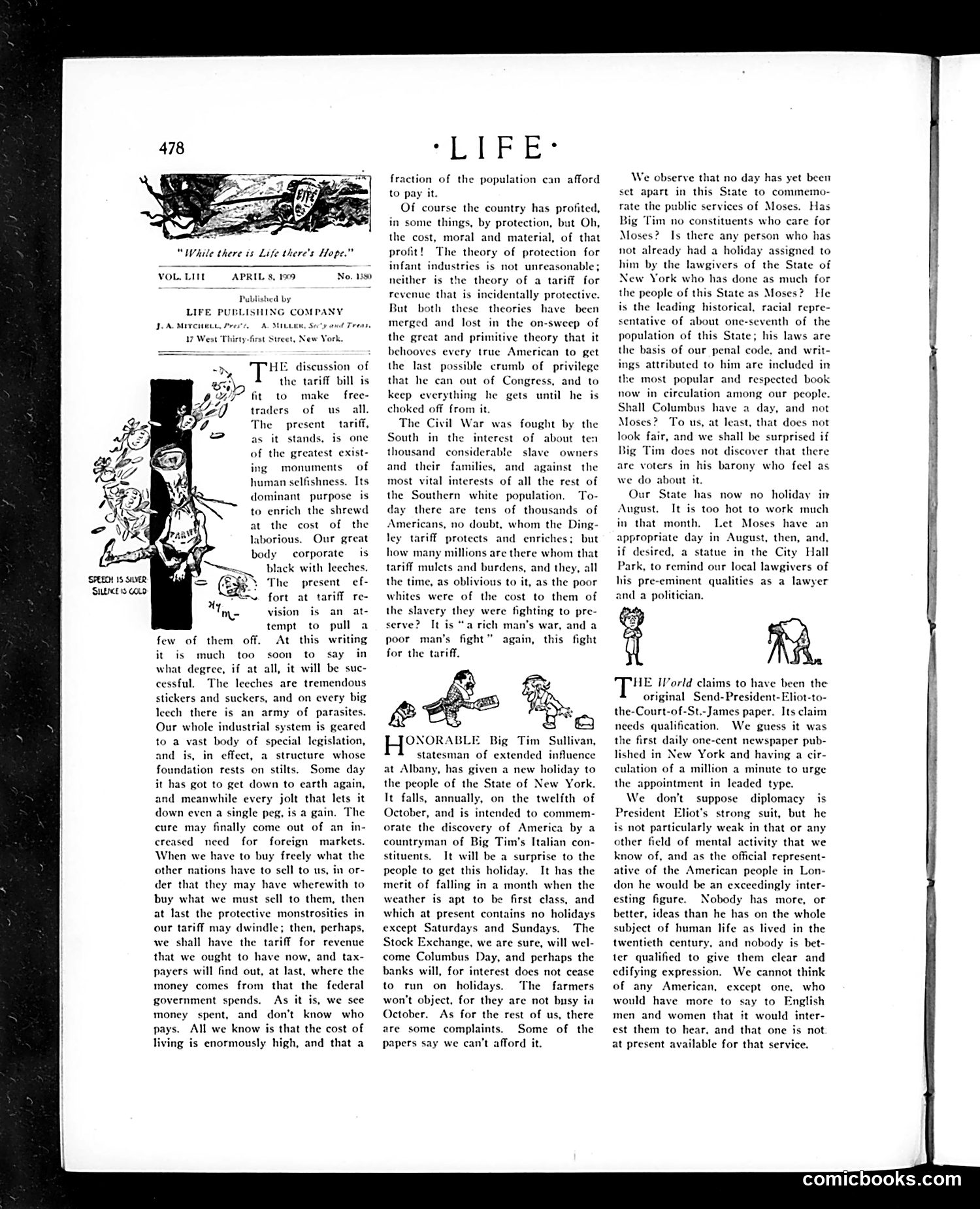
This page contains political commentary on American tariff policy and labor issues. The left sidebar features a cartoon labeled "GREED IS SOME SILENT & GOLD" depicting a grotesque figure—likely representing industrial monopoly or corporate greed—devouring resources. The main text discusses the tariff debate, referencing the Civil War's origins in conflicts over slavery and suggesting the current tariff fight is similarly a "rich man's war, and a poor man's fight." The right column mentions "Big Tim Sullivan," an Albany politician, proposing a new October holiday to commemorate Columbus Day—apparently a satire on political opportunism and the tendency to create holidays for dubious purposes. The overall thrust critiques protective tariffs as benefiting the wealthy while burdening ordinary Americans.
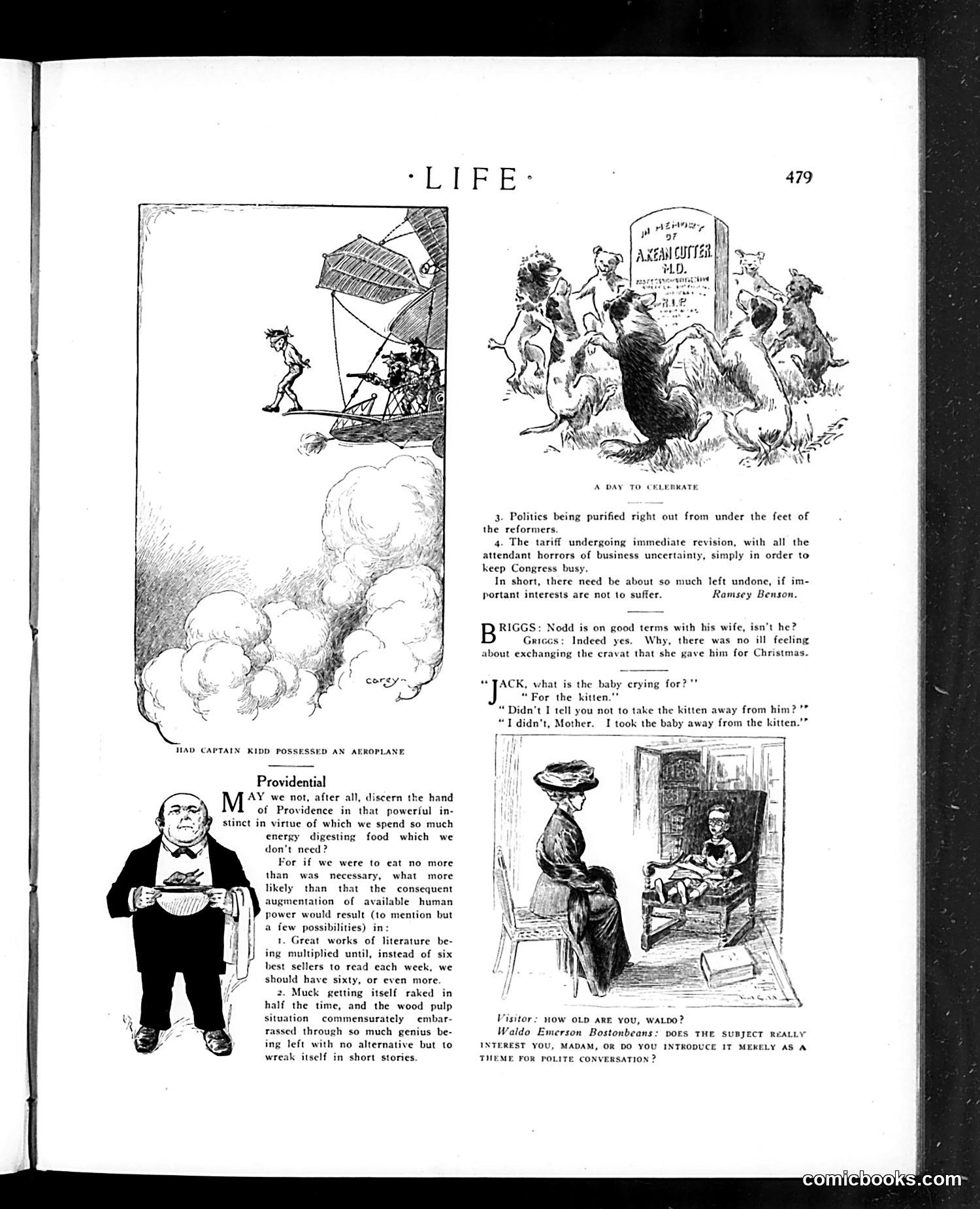
**Main Cartoon:** "Had Captain Kidd Possessed an Aeroplane" depicts a historical pirate with an early aircraft, satirizing modern warfare technology's destructive potential—suggesting even historical villains would be more dangerous with contemporary weapons. **"Providential" Section:** A rotund figure holding a bowl discusses food rationing and conservation. The text advocates eating less to increase "available human power," arguing that reducing consumption could free up resources and labor for more productive purposes—likely WWI-era propaganda promoting sacrifice for the war effort. **Lower Dialogue:** A visitor and "Waldo" (Emerson Houghton) discuss whether to introduce a topic for "polite conversation," suggesting social awkwardness about current events or difficult subjects. **Overall Theme:** Wartime concerns about technology, resources, and maintaining civility during crisis.
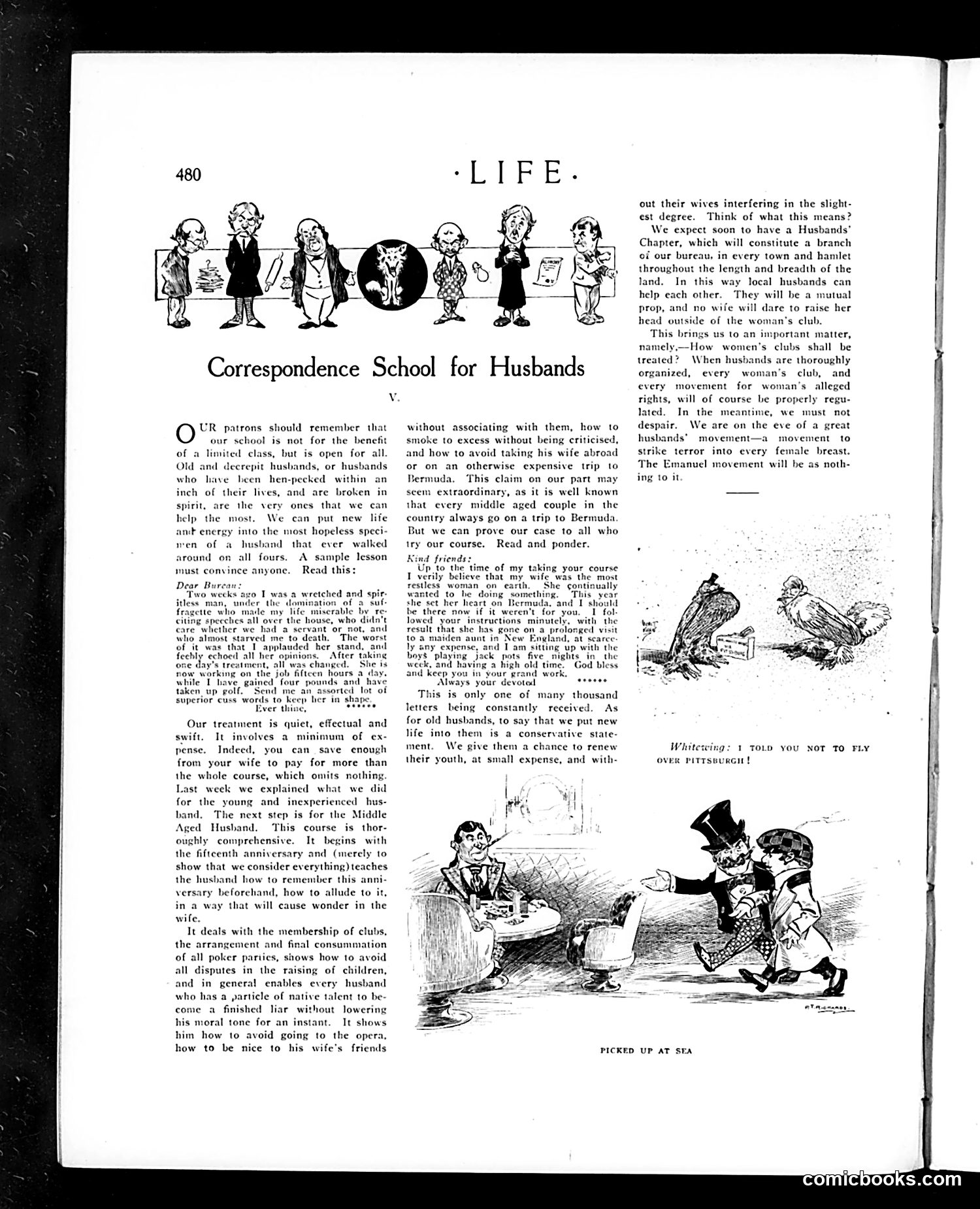
This satirical piece mocks a purported mail-order course teaching husbands how to manage domestic life and wives. The text humorously presents "lessons" on controlling expenses, avoiding opera trips, and remembering anniversaries—framed as serious instruction for hopelessly incompetent men. The cartoons illustrate marital mishaps: one shows a wife scolding her husband about Pittsburgh (likely a reference to an unwanted trip), another depicts a man being "picked up at sea," suggesting domestic chaos. The satire targets early 20th-century anxieties about gender roles and wives' growing independence through women's clubs. By presenting husbands as requiring formal education in basic marital competence, the piece ridicules male authority while ironically supporting traditional domestic hierarchies—a common tension in period satire.
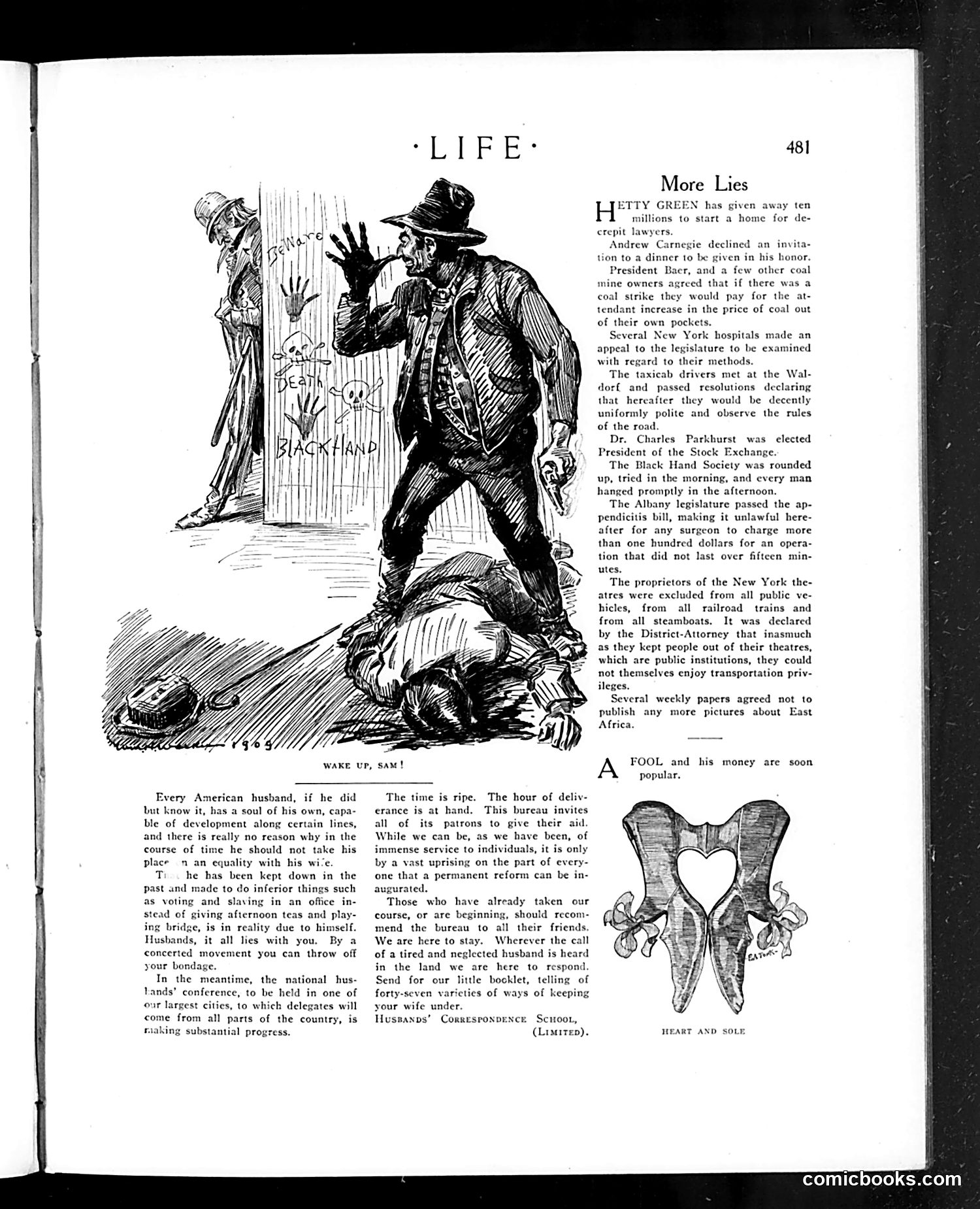
This cartoon satirizes corruption and moral decay in American institutions. A skeletal "Death" figure labeled "BLACKHAND" stands over a sleeping man (presumably "Sam," representing America or an American institution), while a ghostly hand labeled "DEATH" reaches from a door. The accompanying "More Lies" column criticizes various American scandals: corrupt lawyers receiving payoffs, coal mine owners profiting from strikes, hospital corruption, taxi driver collusion, stock exchange fraud ("Black Hand Society"), theater owners excluding the public from transportation, and suppressed news about East Africa. The cartoon warns that America must "wake up" to organized crime, institutional corruption, and the "Black Hand" (likely referencing organized crime syndicates), or face moral and societal collapse.
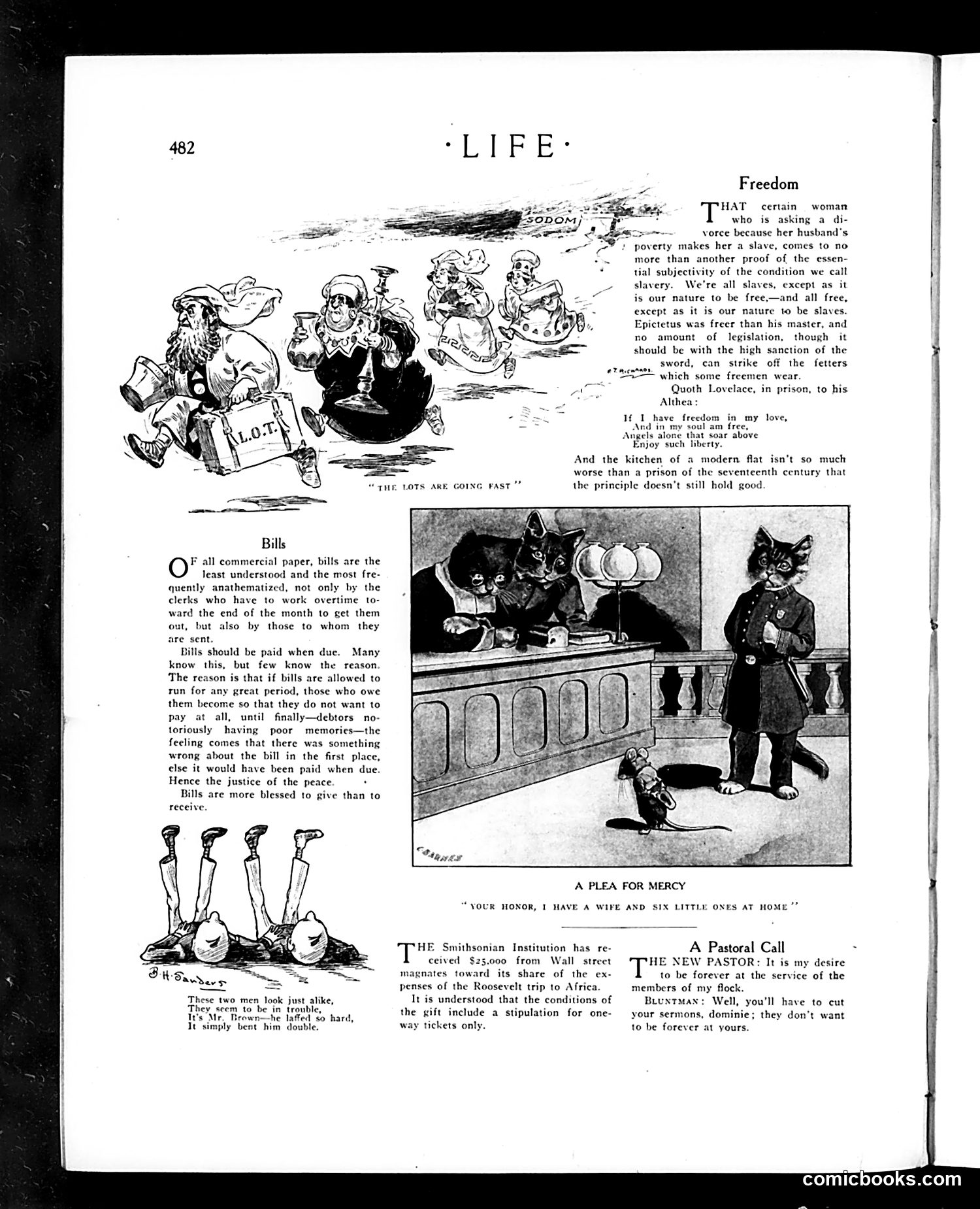
This page contains three distinct satirical pieces: 1. **"The Lots Are Going Fast"** (top cartoon): Depicts figures labeled "SLOT" rushing or fleeing, likely satirizing rapid financial speculation or gambling, with the word "LOTS" suggesting real estate or stock market deals. 2. **"Bills"** (middle section): A prose piece criticizing how commercial bills accumulate and burden debtors. The accompanying cartoon shows upside-down legs, suggesting financial ruin or people being overwhelmed by debt obligations. 3. **"A Plea for Mercy"** (photograph): Shows cats and a kitten with caption "YOUR HONOR, I HAVE A WIFE AND SIX LITTLE ONES AT HOME"—anthropomorphizing animals to humorously appeal to sympathy, likely mocking sentimental courtroom pleas. The page blends financial and social commentary typical of Life's satirical approach to American society.
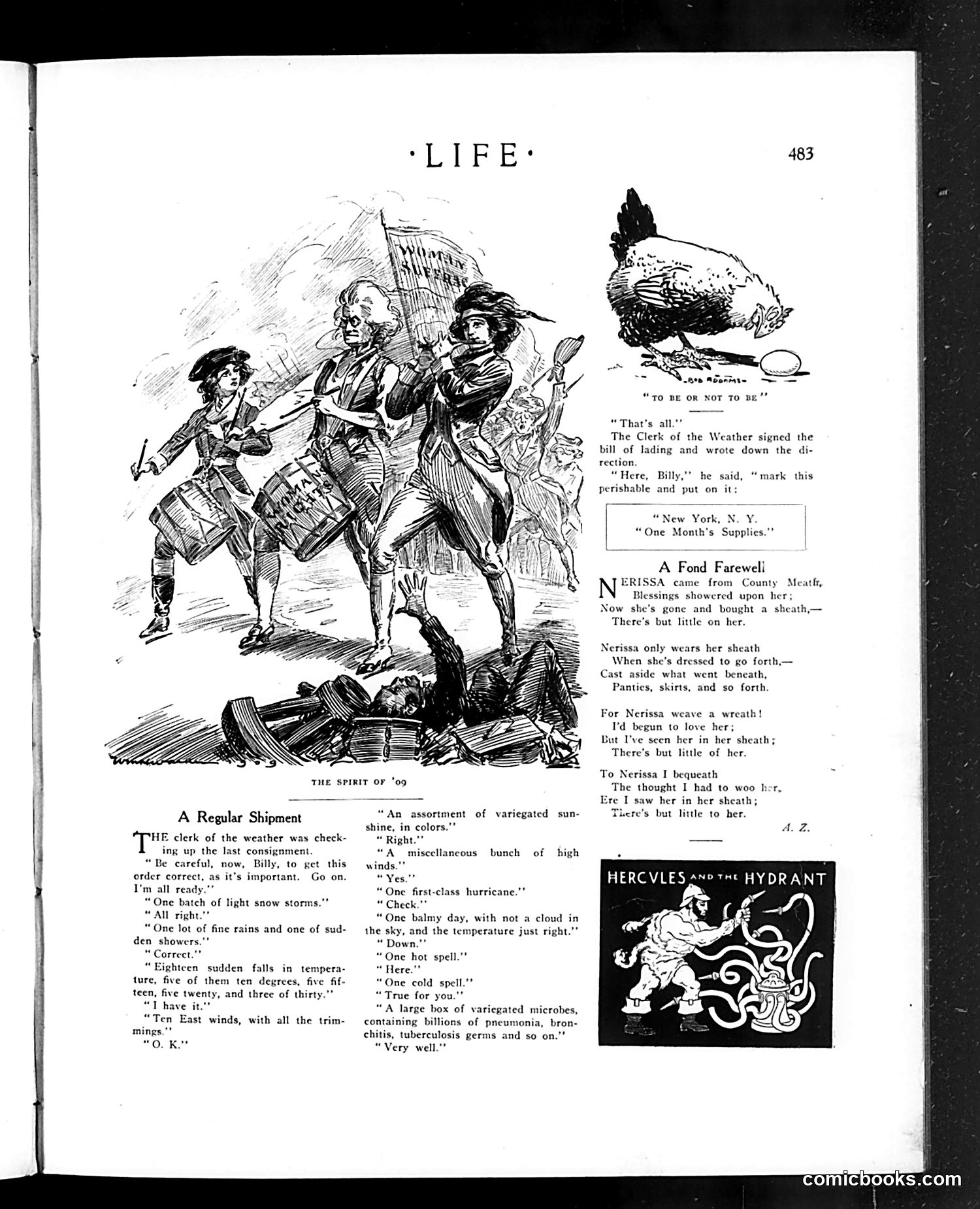
**"The Spirit of '09"** (left cartoon): This satirical sketch depicts three figures carrying various supplies and provisions, representing a shipment or inventory check. The caption "A Regular Shipment" suggests commentary on commercial ordering practices. The figures appear to be laborers or delivery workers managing goods, likely satirizing bureaucratic inefficiency or the absurdity of detailed inventory procedures. **"To Be or Not to Be"** (top right): Shows a hen with an egg, referencing Hamlet's famous soliloquy. This is wordplay humor—the chicken's existential dilemma parallels Shakespeare's philosophical question, creating comedic absurdity. The page also includes poetry titled "A Fond Farewell" and an advertisement for "Hercules and the Hydrant," suggesting mixed editorial and advertising content typical of Life magazine's format.
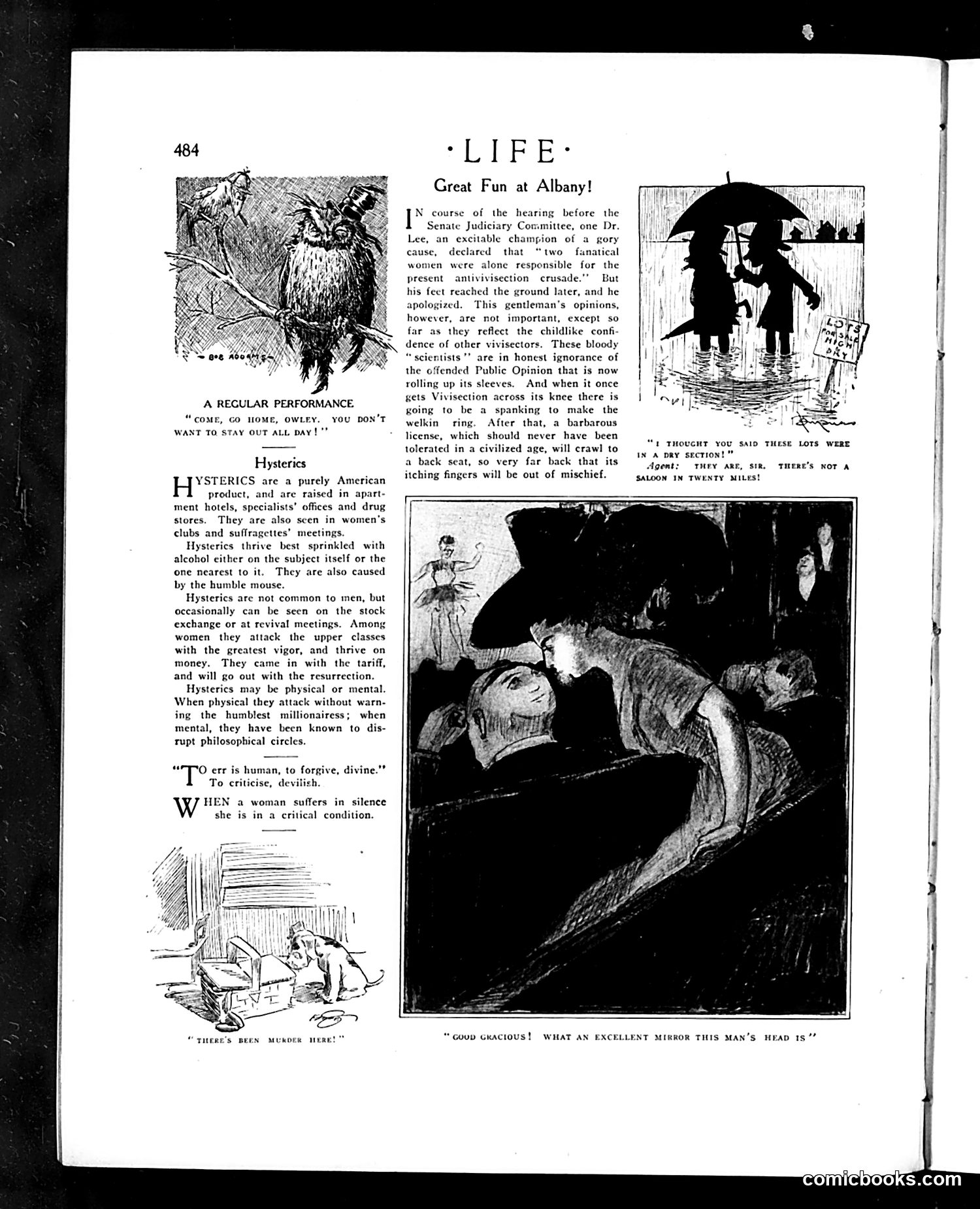
This page satirizes two distinct topics: **"Great Fun at Albany!"** critiques a Senate Judiciary Committee hearing where Dr. Lee testified about "two fanatical women" causing an "anti-vivisection crusade." The satire mocks both the sensationalism of the hearing and the dismissive attitude toward women activists concerned about animal testing—portraying the proceedings as theatrical spectacle rather than serious policy debate. **"Hysterics"** is a piece on the phenomenon of female hysteria in early 20th-century America. It describes hysterical episodes as "purely American" and notes they occur in women's clubs and meetings, often triggered by alcohol or emotional excitement. The text suggests such outbursts attack "upper classes" and occur at "stock exchanges" and "revival meetings." This reflects period medical attitudes viewing women's emotional expression as pathological and comedic.
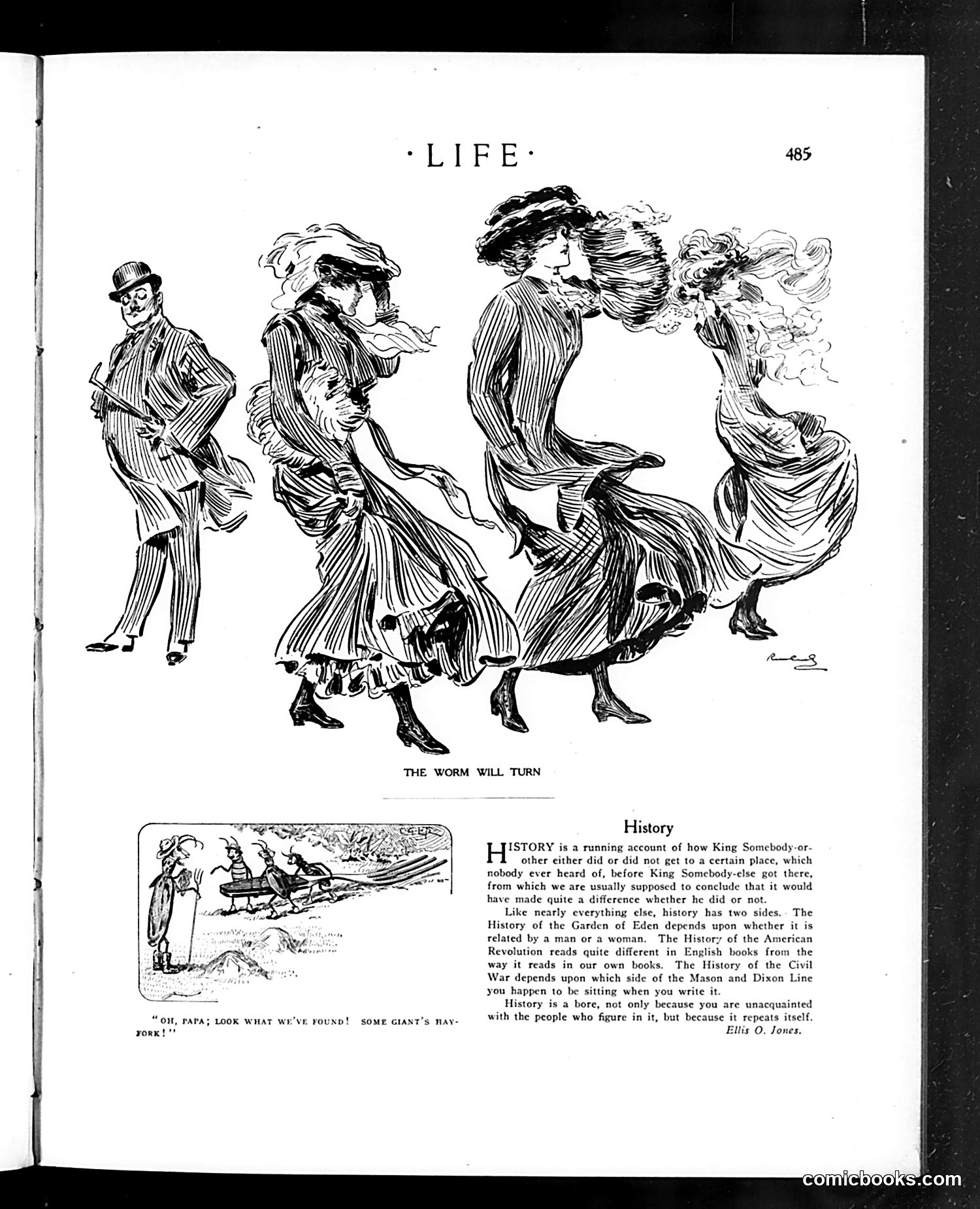
This page from *Life* magazine satirizes social dynamics through the phrase "The Worm Will Turn," a proverb meaning even the meek will eventually rebel. The main cartoon depicts five figures in sequence: a man in a suit (left) observing women in increasingly animated states of agitation or movement, their dresses and hair swirling dramatically. The progression suggests escalating female assertiveness or resistance to male authority. The accompanying illustration shows a figure discovering a giant's pitchfork, with the caption "Oh, Papa; Look What We've Found! Some Giant's Hay-Fork!" The page's definition of "History" below critiques how historical accounts depend on perspective and repeatability rather than objective truth—suggesting the cartoon comments on shifting power dynamics and how narratives change depending on who tells them.
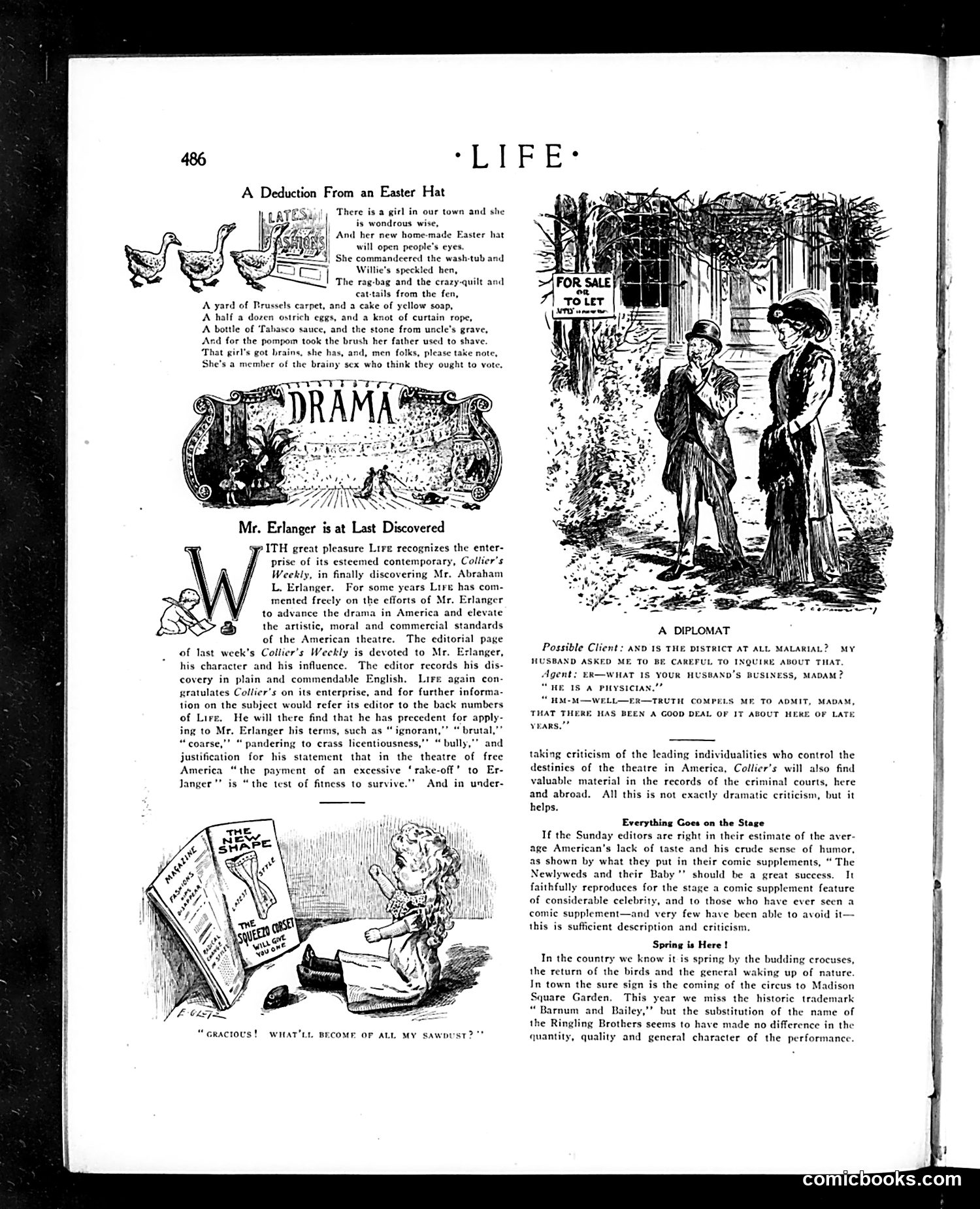
**"A Deduction From an Easter Hat"** (top left): This poem satirizes women's suffrage. It describes a clever girl assembling an Easter hat from absurdly mismatched household items (carpet, Tabasco sauce, her father's shaving brush, a gravestone). The punchline reveals she's "a member of the brainy sex who think they ought to vote"—sarcastically suggesting that women who support voting rights are as ridiculous as this hat-maker, implying their intelligence is foolishly misplaced. **"A Diplomat"** (right illustration): A real estate agent admits to a prospective client that malaria is prevalent in the district—but only because her husband is a physician and "truth compels" honesty. The satire mocks how professionals (here, diplomats/salesmen) might otherwise deceive customers. The page represents Life's editorial positions: opposing women's suffrage while mocking evasive business practices. These were typical satirical targets for the early 20th-century magazine.
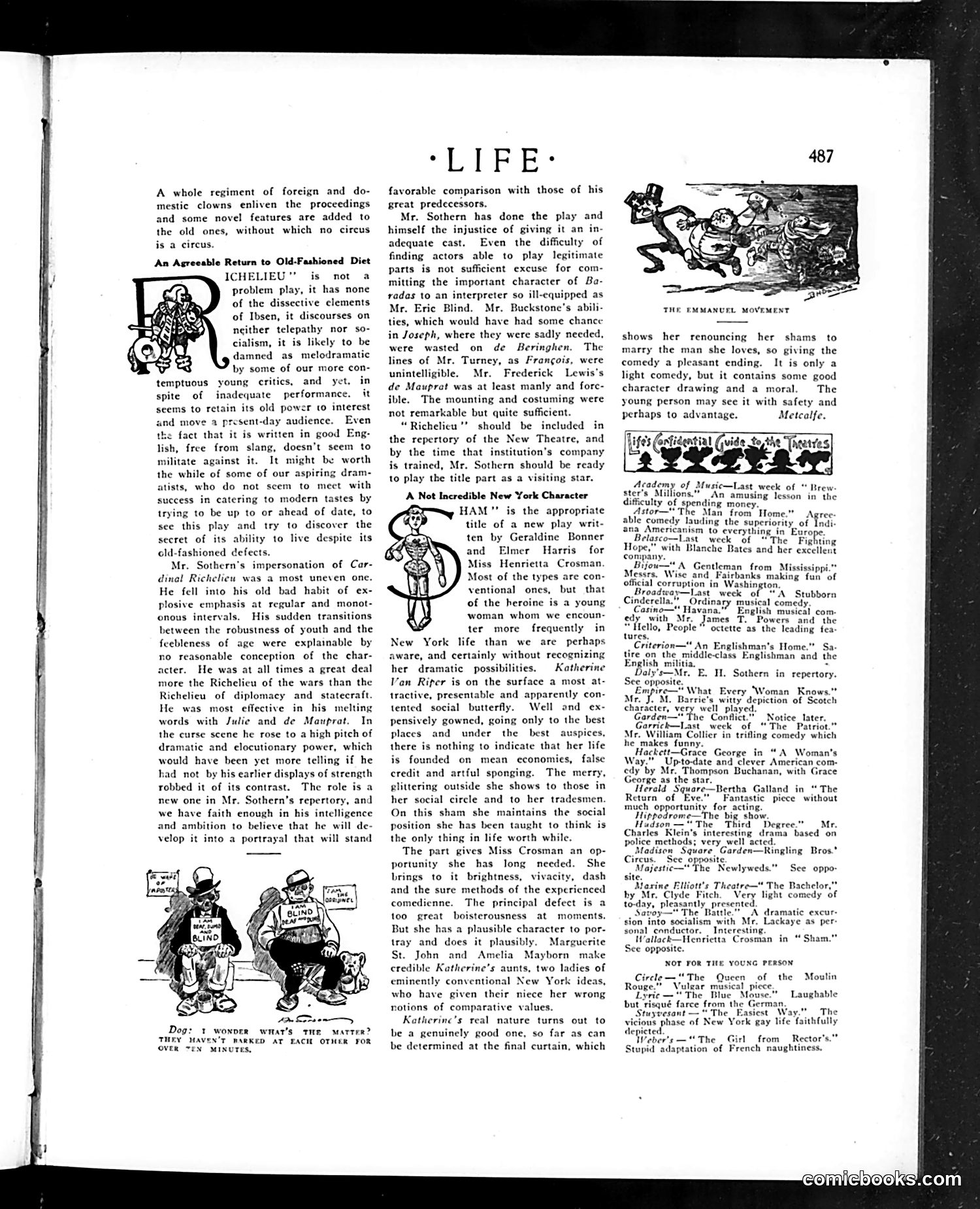
This page contains theater criticism and a single cartoon. The main reviews discuss productions of "Richelieu" (starring Mr. Sothern) and a new play called "Ham" featuring Miss Henrietta Crosman. The critic praises the enduring appeal of the classical play "Richelieu" while critiquing Sothern's uneven performance and inadequate supporting cast. The small cartoon at the bottom depicts two dogs who haven't barked at each other in ten minutes, with one asking "I wonder what's the matter?" This is a lighthearted observation about canine behavior—dogs typically bark frequently, so their unusual silence prompts concern. It's gentle humor about animal habits rather than political satire. The page represents Life's dual focus: serious cultural commentary on theater alongside humorous observational cartoons about everyday life.
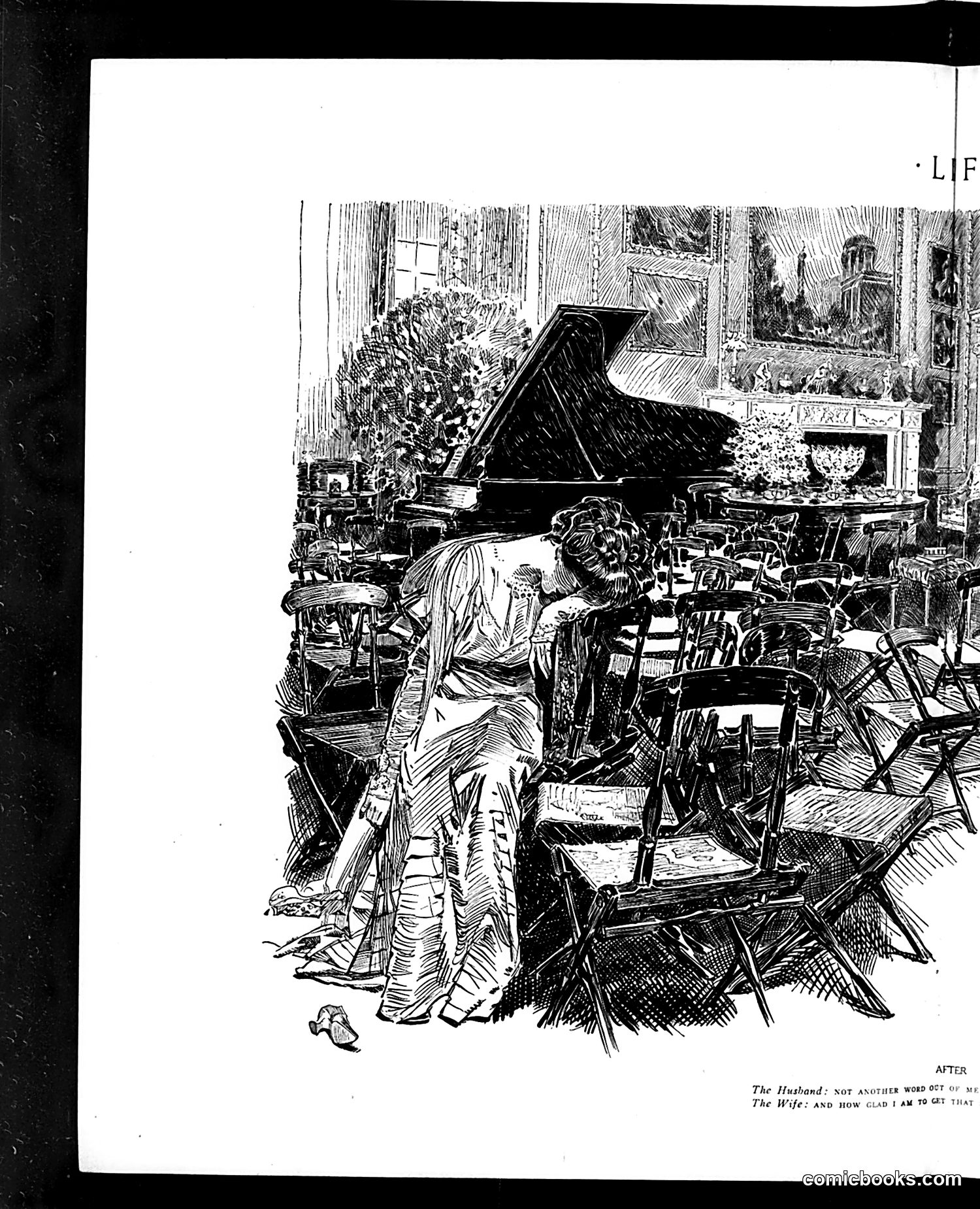
This appears to be a satirical illustration titled "AFTER," showing a domestic scene in an elegant parlor. A woman in a long dress stands among numerous empty chairs facing a grand piano, with elaborate windows and furnishings visible in the background. The caption reads: "The Husband: 'NOT ANOTHER WORD OUT OF ME / The Wife: AND HOW GLAD I AM TO GET THAT!" The humor targets marital dynamics—specifically the wife's relief at her husband's silence. The empty chairs suggest a formal recital or gathering has just concluded. This satirizes the common complaint in early 20th-century domestic comedy that husbands talk too much, and wives prefer their silence. The joke assumes contemporary readers would recognize this as a relatable marital stereotype of the era.
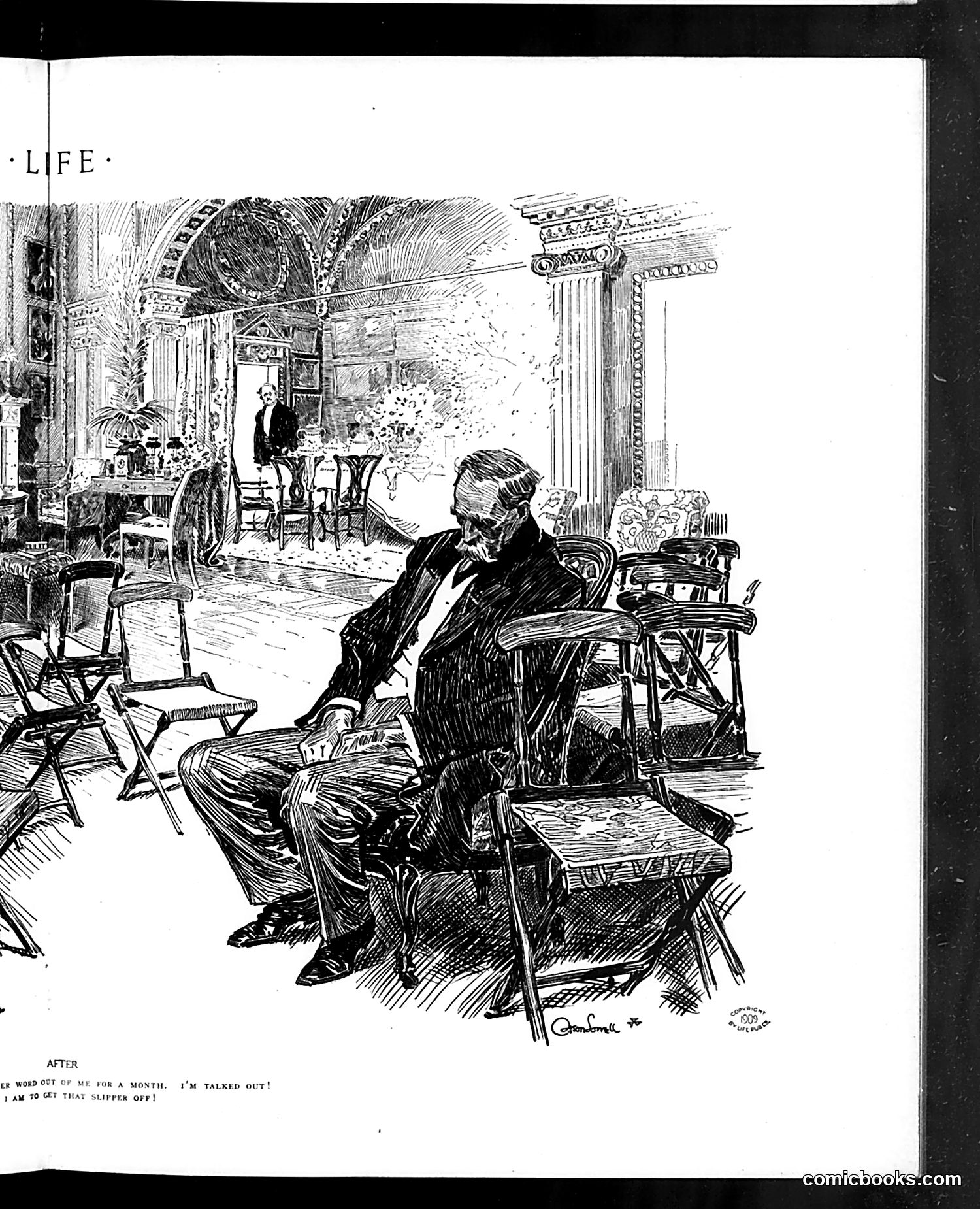
This is a single-panel cartoon from *Life* magazine titled "AFTER." The sketch shows a well-dressed man seated indoors in an ornate room with classical columns, appearing exhausted and slumped in his chair. The caption reads: "After [being] out of me for a month, I'm talked out! I am to get that slipper off!" The joke satirizes a nagging spouse—specifically, a woman who has been constantly talking at her husband for a month. His desperate plea to "get that slipper off" suggests he fears physical punishment (a humorous reference to wives hitting husbands with slippers, a period comic trope). The cartoon mocks both marital exhaustion and the husband's fear of his wife's irritation, reflecting common early 20th-century domestic humor about marriage and communication dynamics.
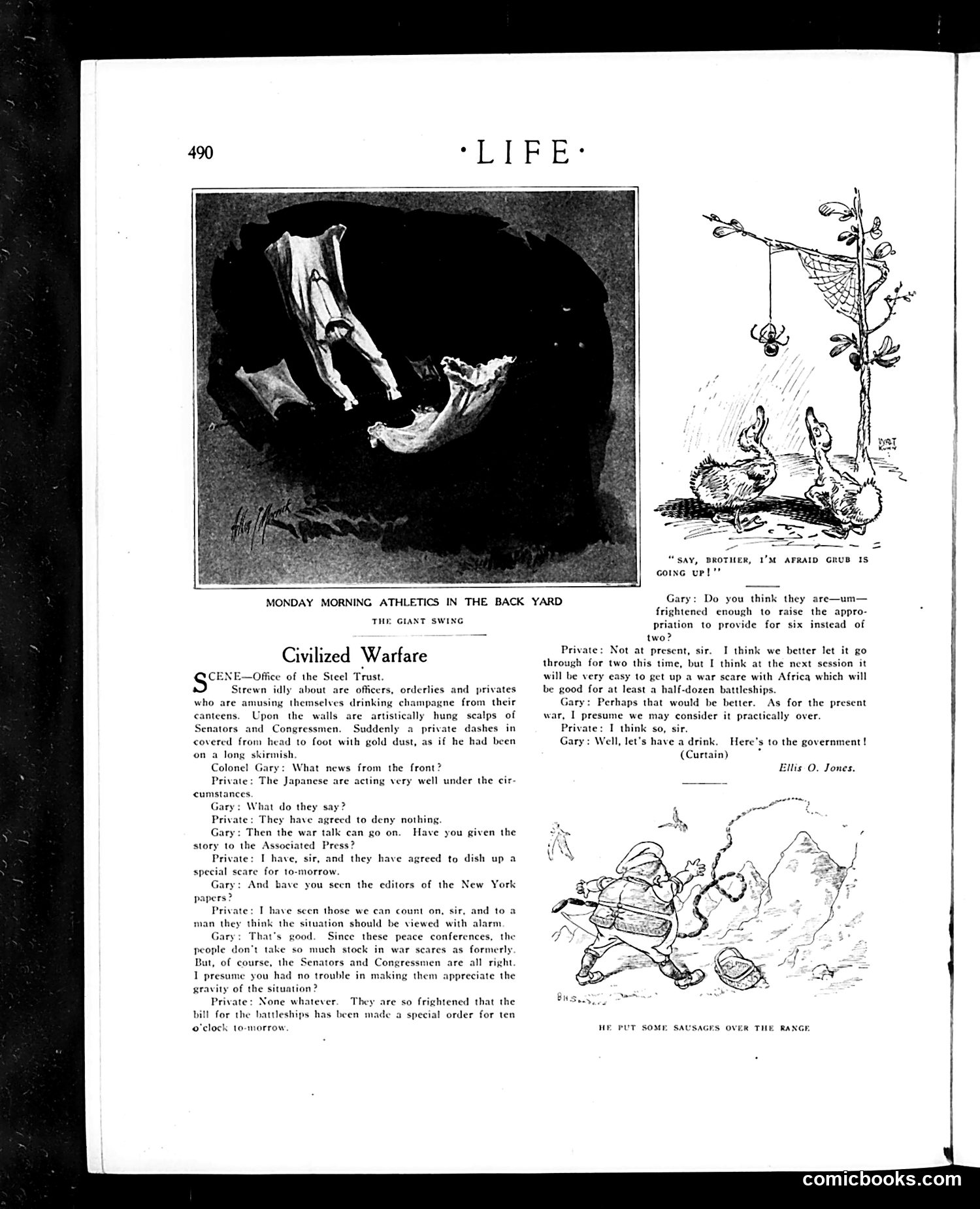
This satirical piece mocks the influence of wealthy industrialists on American foreign policy and military spending during the Russo-Japanese War era. **The Setup:** A scene in the office of "Colonel Gary" (appears to reference a steel industry figure), where officers discuss the war as a manufactured propaganda tool rather than genuine conflict. **The Satire:** The dialogue reveals a cynical system where: - War news is deliberately coordinated with newspapers to manipulate public opinion - Congressional "scalps" decorate the walls, symbolizing political control - Legislators are easily frightened into approving military expenditures (battleships) - The war itself is essentially "over" once its propaganda value is exhausted - Future conflicts (Africa) are already being planned to justify continued defense spending **The Point:** Life attacks the collusion between industrial elites, press, and politicians to manufacture war scares that serve financial interests rather than genuine national security needs. The casual tone—ending with "let's have a drink"—emphasizes how cynically removed this elite circle is from actual warfare's human costs.
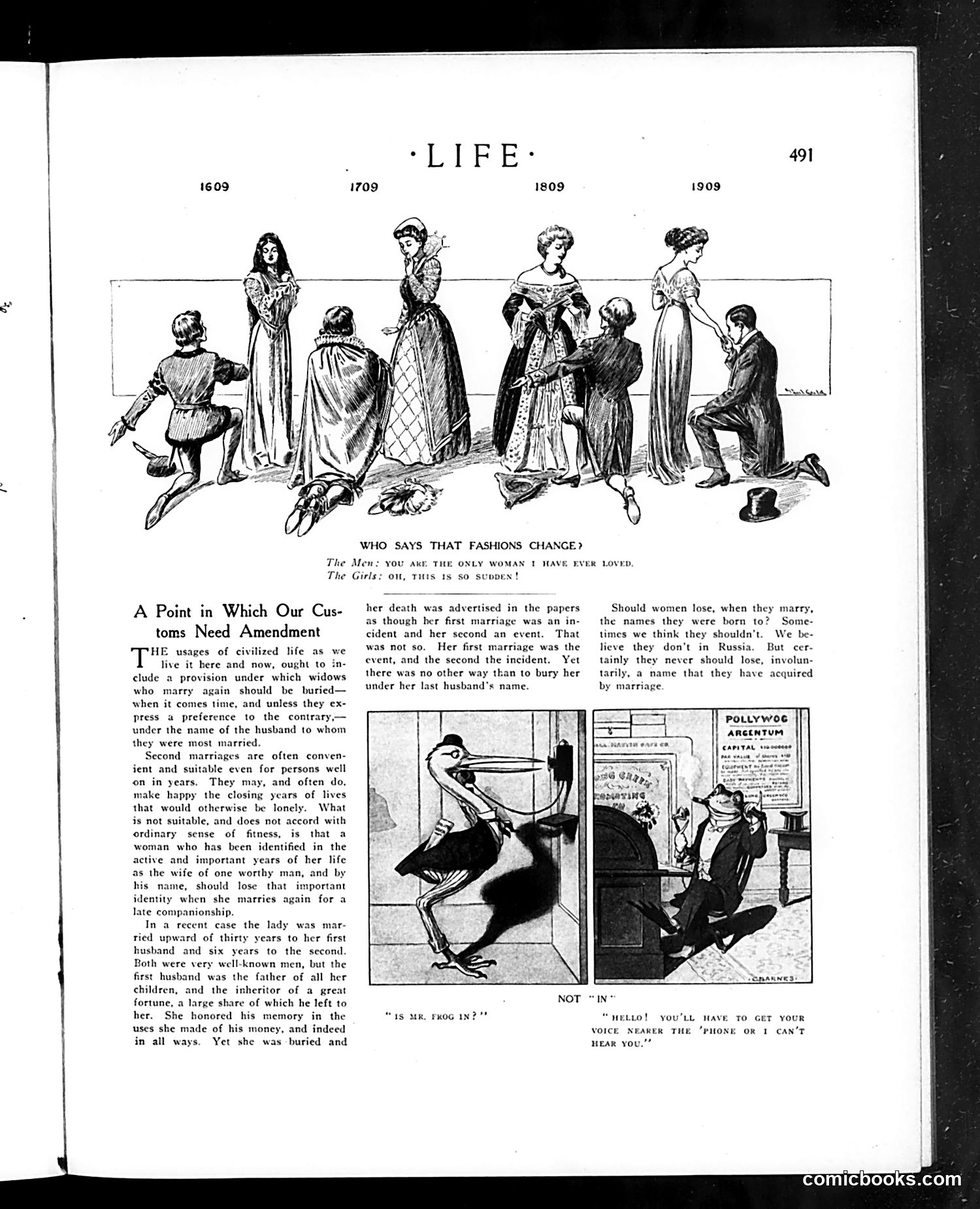
This page addresses women's legal identity upon remarriage, specifically whether widows should retain their first husband's name or adopt their second husband's surname. **The Main Article** argues that when a widow remarries late in life, she should be buried under the name of her *first* husband—the man with whom she spent her most significant years, bore children, and built her identity. The article cites a recent case where a woman married 30+ years to her first husband (who fathered all her children and left her his fortune) was buried under her second husband's name after only 6 years of marriage. The author finds this unjust, as it erases her primary identity and life achievement. **The Top Cartoon** shows fashion evolution across four centuries (1609-1909), with the caption "Who says that fashions change?" The joke is ironic: despite radically different clothing styles, male attitudes toward women remain unchanged—men still claim women are "the only woman I have ever loved." **The Bottom Cartoons** appear to be unrelated humorous sketches about telephone miscommunication and mistaken identity, likely filler content typical of satirical magazines.
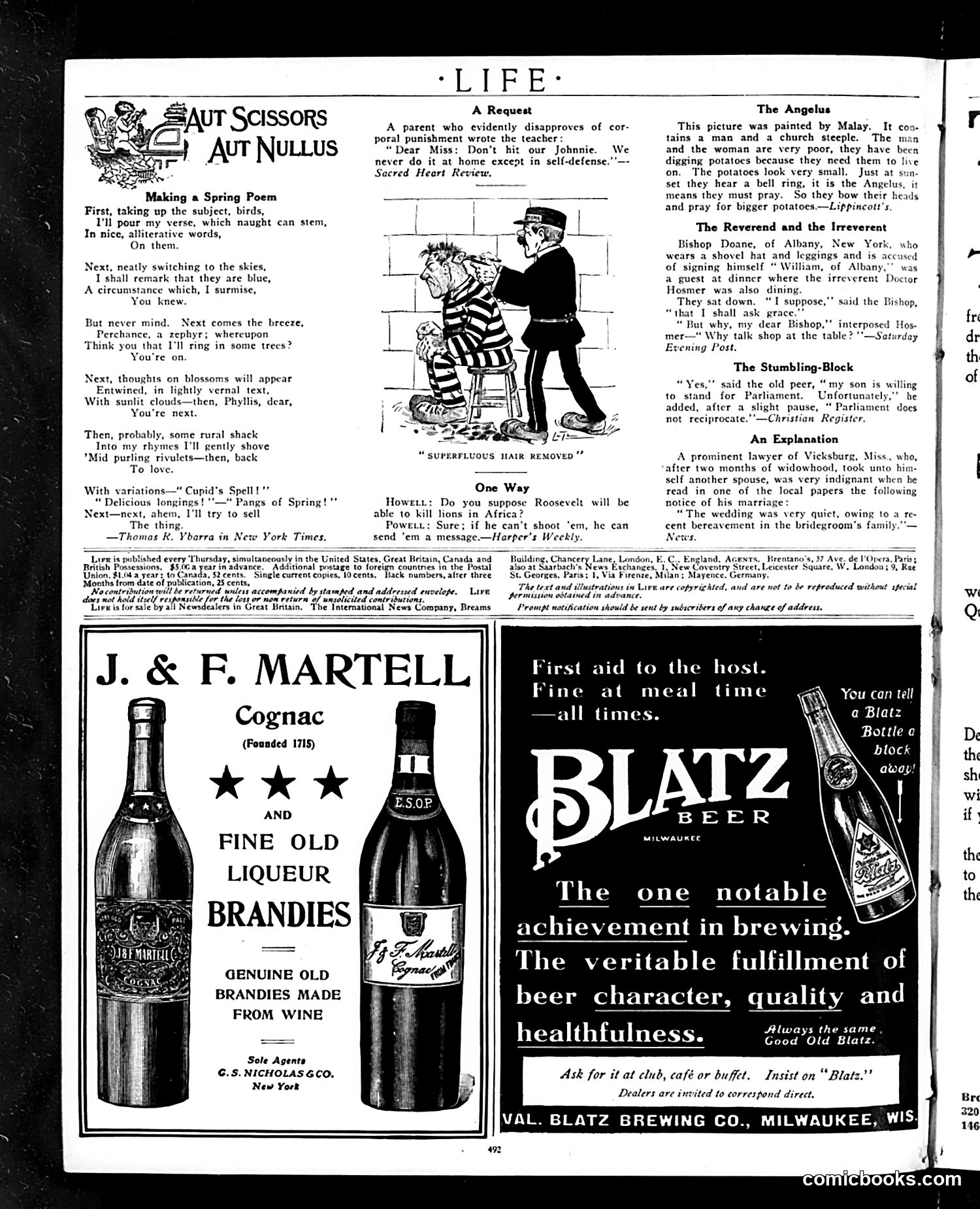
This page contains several brief humorous anecdotes and a poem, plus advertisements—typical satirical magazine content of the early 20th century. **Key content:** The cartoons illustrate short jokes: one shows a barber removing "superfluous hair" from a striped-prison-suited man, captioned "One Way"—a joke about Roosevelt's African hunting expedition. **Social satire includes:** - A parent's letter opposing corporal punishment, reflecting evolving parenting debates - Bishop Doane's awkwardness when a irreverent doctor (Hosmer) suggests discussing religion at dinner is "talking shop"—mocking ecclesiastical pretension - A peer's son unable to enter Parliament despite willingness—commentary on political barriers - A widower's remarriage notice tactlessly mentioning his "recent bereavement"—dark humor about social proprieties The page reflects early 1900s concerns: child discipline, clergy pomposity, class and political access, and social embarrassment. Advertisements for J. & F. Martell Cognac and Blatz Beer fill the lower section.
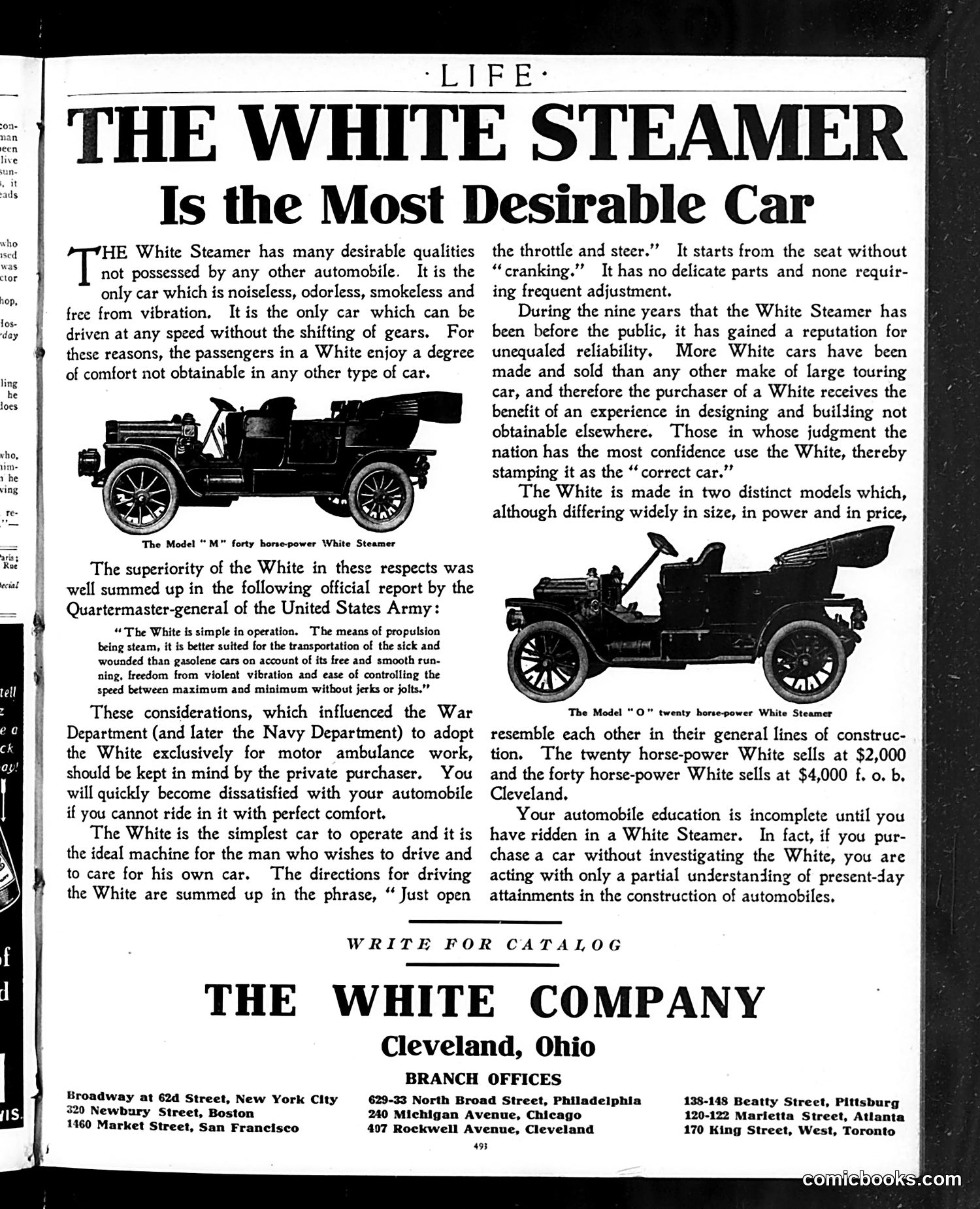
This is not satire but **earnest advertising** for the White Motor Company's steam-powered automobiles. The page promotes the White Steamer as superior to gasoline cars, emphasizing its silence, smoothness, and lack of vibration—genuine advantages of steam over early internal-combustion engines. The ad leverages military endorsement: it quotes the U.S. Army Quartermaster-General praising the White for ambulance use due to its smooth operation and reliability. This appeals to civilian buyers by suggesting that if the government trusts it, so should they. Two car models are shown with their prices ($2,000 and $4,000). The copy argues that understanding automobiles requires test-driving a White, positioning it as the "correct car" for discerning purchasers. This reflects the early automotive era (likely pre-1920s) when steam and gasoline technologies competed directly, before gasoline engines ultimately dominated the market.
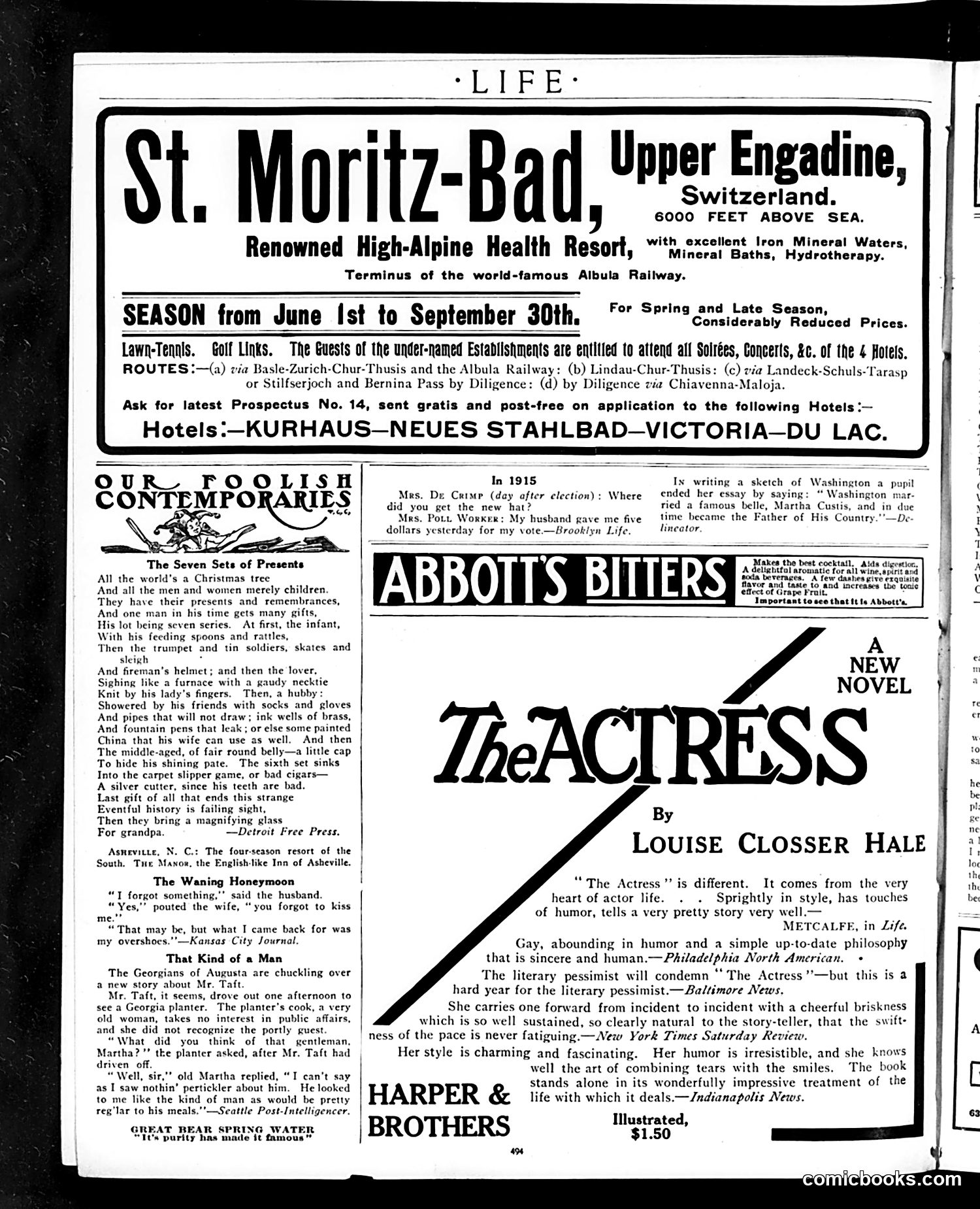
This page is primarily **advertisements and literary reviews** with minimal political cartoons. The notable satirical content is **"Our Foolish Contemporaries,"** a poem about Christmas gift-giving that uses Shakespeare's "Seven Ages of Man" structure to mock contemporary consumer culture and life stages—from infants receiving rattles to elderly grandparents needing magnifying glasses. Below that are three brief **anecdotes mocking politicians and gender relations**: one about women selling votes for hats (post-suffrage era commentary), one about President Taft being so unremarkable a cook only remembers his appetite, and one about newlywed disillusionment. The bulk of the page advertises a Swiss alpine health resort, Abbott's Bitters patent medicine, and reviews Louise Closser Hale's novel *The Actress*. The overall tone reflects early 20th-century upper-class concerns: leisure travel, consumer goods, and literary sophistication.
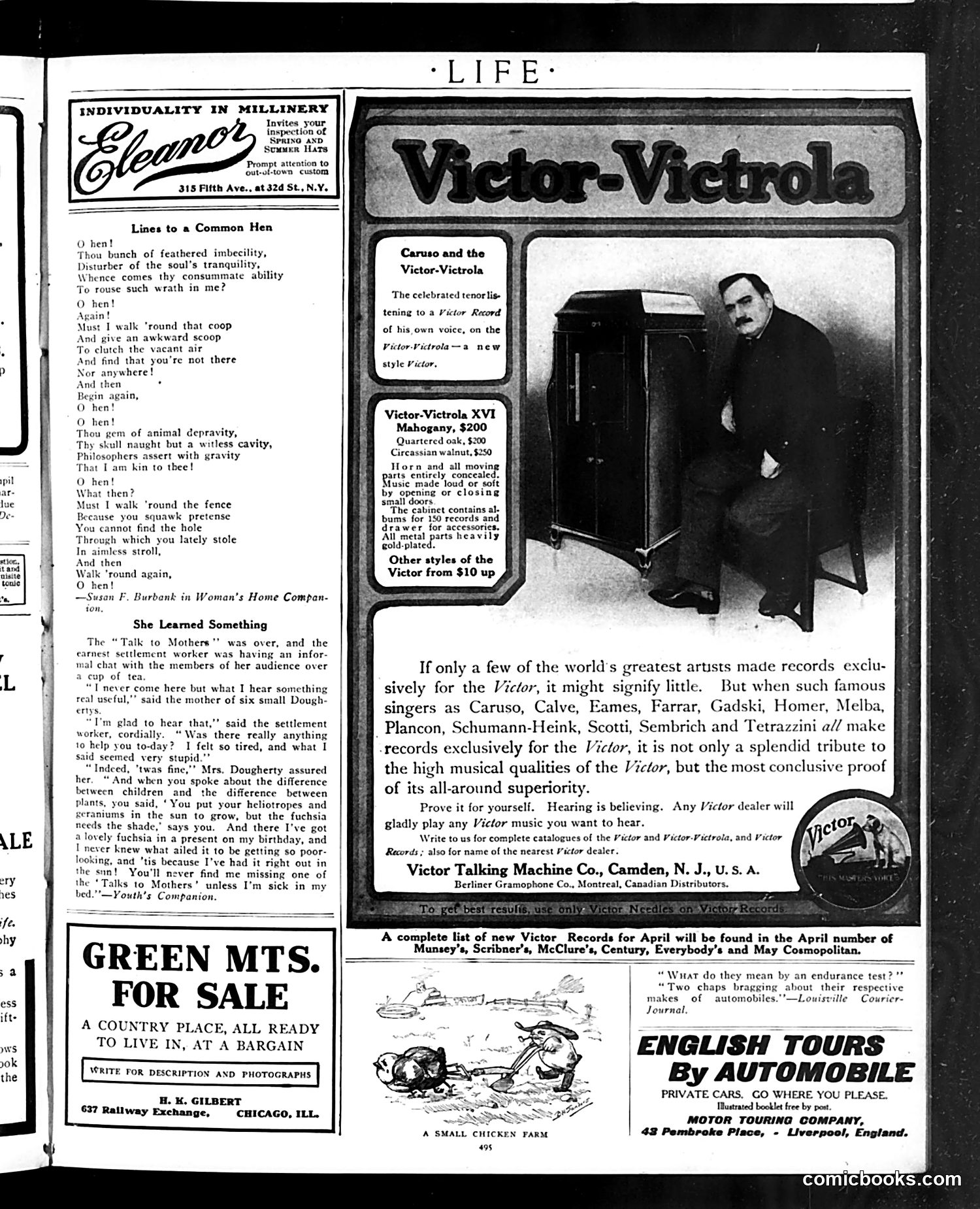
This page is primarily **advertising and light entertainment** rather than political satire. The main content includes: **"Lines to a Common Hen"** — a humorous poem by Susan F. Burbank about the frustrations of chasing an escaped chicken around a coop. It's whimsical domestic comedy, not political commentary. **"She Learned Something"** — a sentimental anecdote about a settlement worker teaching poor mothers practical household tips (keeping fuchsias in shade). It celebrates Progressive Era social work and maternal improvement. **Victor-Victrola Advertisement** — The prominent right-side ad features tenor Enrico Caruso listening to his own recorded voice on a Victor phonograph. It emphasizes that famous opera singers (Caruso, Melba, Tetrazzini, etc.) exclusively record for Victor, positioning the brand as superior. **Minor ads** include millinery, real estate, and automobile tours. The page reflects early 1900s concerns: settlement house reform, new recording technology, and genteel domestic life — not political satire.
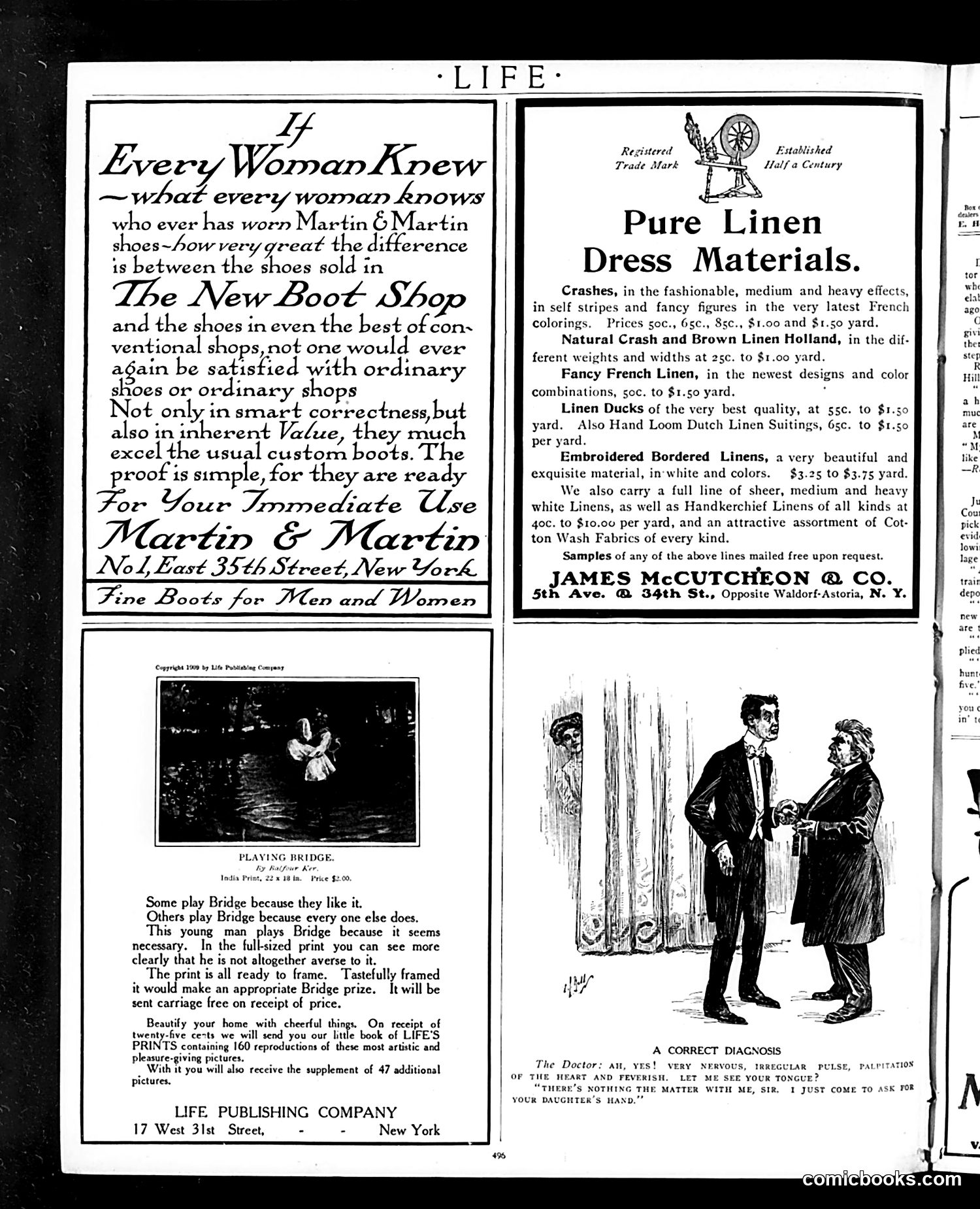
This page is primarily **advertising with two cartoon jokes** at the bottom. **Left cartoon ("Playing Bridge"):** Shows a young man playing the card game Bridge. The caption explains social pressure—people play Bridge because others do, or because it seems socially necessary, even if reluctant. This satirizes early 20th-century conformist social rituals among the upper classes. **Right cartoon ("A Correct Diagnosis"):** A doctor has examined a nervous young man with heart palpitations and irregular pulse. The punchline reveals the "patient" is actually asking for the doctor's daughter's hand in marriage—the "illness" is lovesickness/anxiety about proposing. This is a gentle joke about courtship anxiety masquerading as medical symptoms, playing on Victorian-era anxieties about romantic commitment. **Advertisements:** The page features shoe ads (Martin & Martin boots) and textile merchant James McCutcheon & Co. (linen fabrics), typical of Life's commercial content.
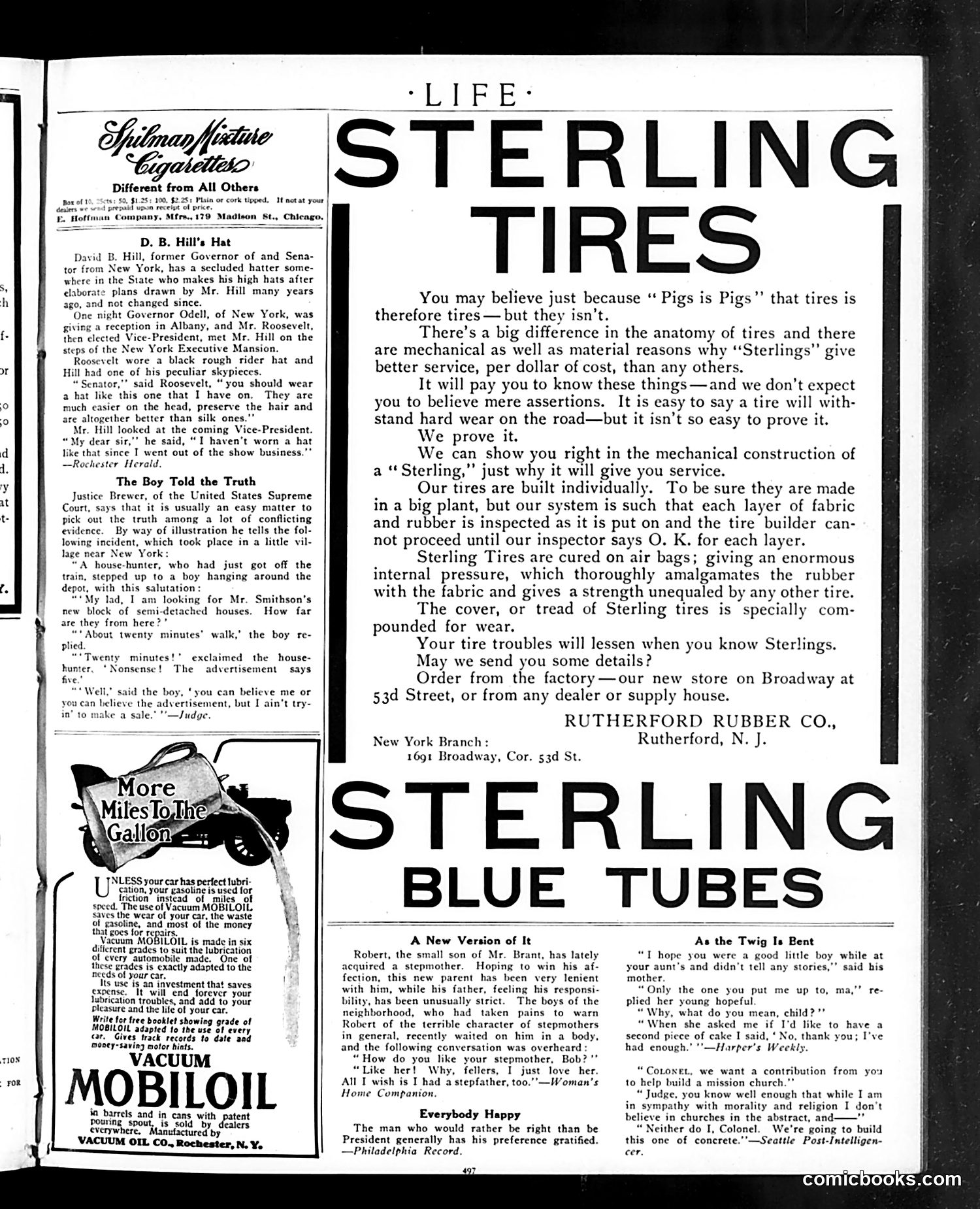
This is primarily an **advertising page** from Life magazine, featuring three main advertisements with some humorous editorial content. The page includes two short anecdotes: one mocking former New York politician D.B. Hill's outdated hat style (contrasting him with the fashionable Theodore Roosevelt), and another about a boy's honest directions versus inflated advertisement claims—both celebrating plainspoken truth-telling. The advertisements themselves are for **Vacuum Mobiloil** (motor oil) and **Sterling Tires and Tubes** (rubber products). The tire ad uses a playful reference to "Pigs is Pigs" (likely a popular saying or story) to argue that not all tires are equivalent, then emphasizes Sterling's superior manufacturing quality through individual inspection and air-bag curing. The Mobiloil ad similarly stresses quality lubrication's cost-saving benefits. These represent typical early-20th-century advertising appeals to middle-class motorists: practical reliability over mere claims, backed by technical specifications.
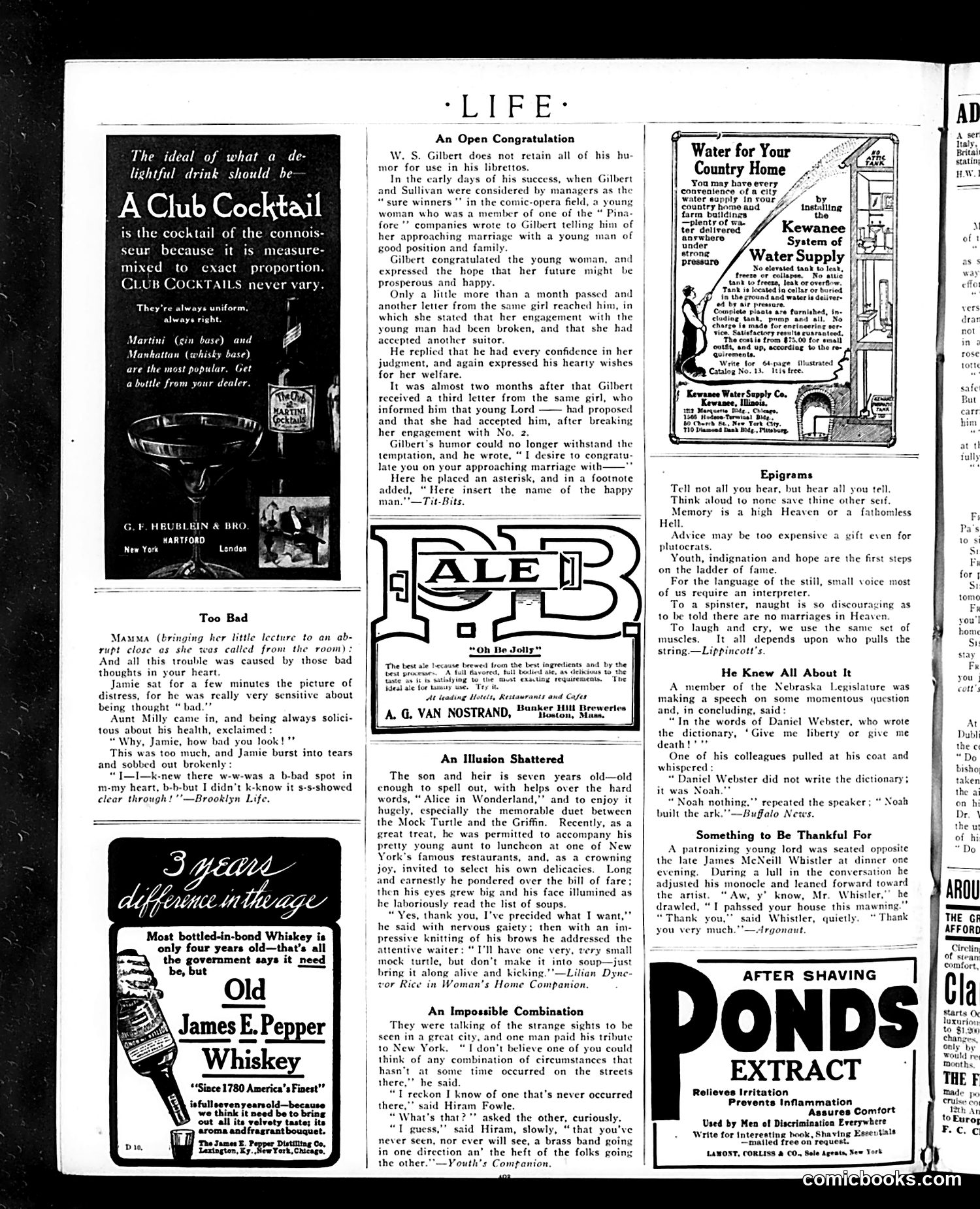
This is primarily a **advertising and humor page** from Life magazine, not a political cartoon. The main content includes: 1. **"A Club Cocktail" advertisement** (top left): Promotes pre-mixed cocktails as refined drinks for the "connoisseur." 2. **"Too Bad" humor piece** (left): A sentimental children's story where young Jamie becomes distressed after being called "bad" by his mother, then his aunt, culminating in him believing he literally has "a bad spot" in his heart. 3. **W.S. Gilbert anecdote** (center): A humorous story about the famous Gilbert & Sullivan librettist receiving three marriage congratulation letters from a woman who keeps breaking engagements and accepting new proposals. Gilbert's joke: he leaves the final suitor's name blank with an asterisk, implying more changes are coming. 4. **Various whiskey and beer advertisements** (bottom and sides). The satire targets **social pretension** (cocktail snobbery) and **romantic inconstancy**, but reflects period attitudes rather than specific political commentary.
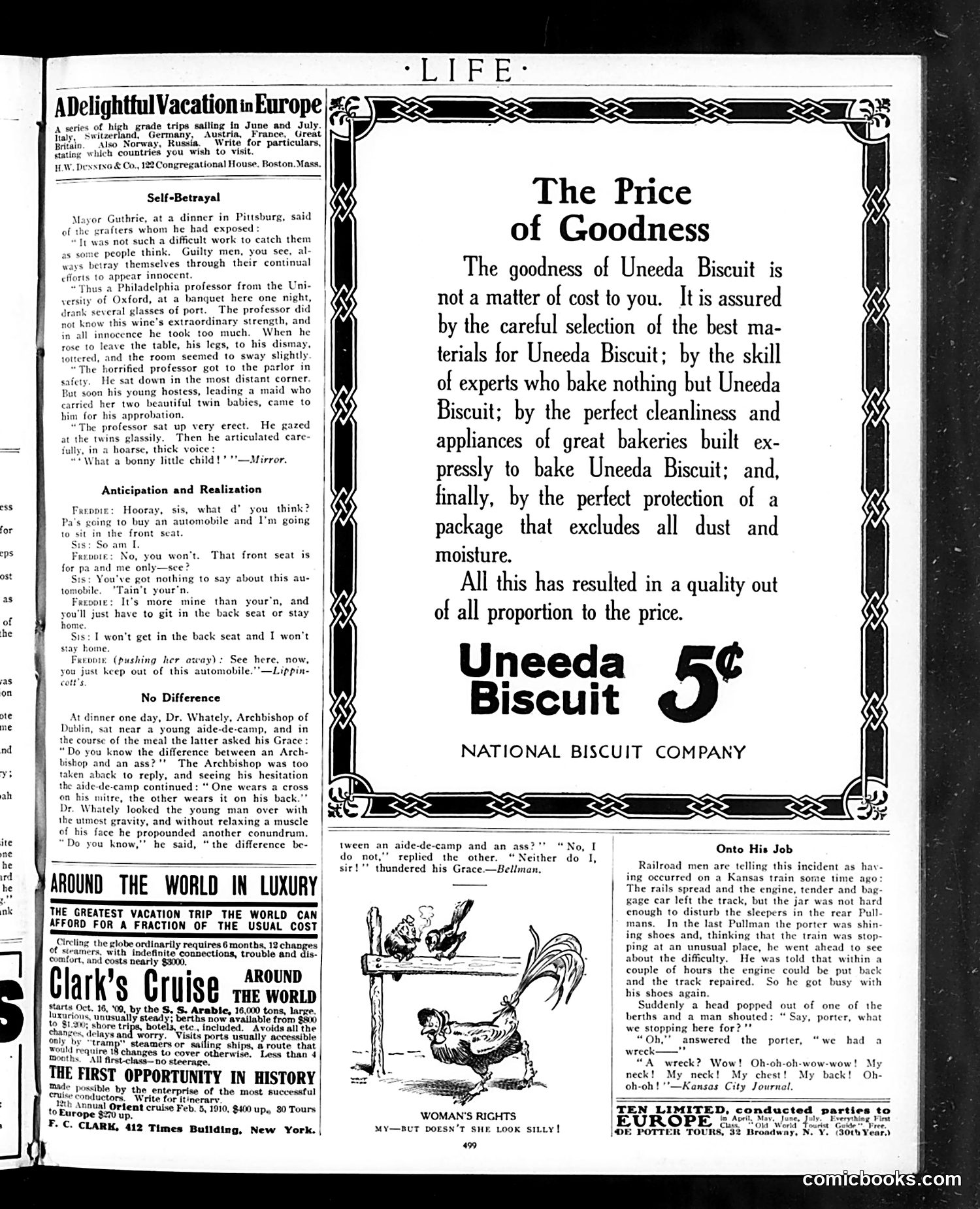
This page contains three brief humorous anecdotes and period advertisements, typical of early 1900s Life magazine's satirical format. **The three jokes satirize social hypocrisy and class dynamics:** 1. **"Self-Betrayal"**: A drunken Oxford professor attempts to hide his intoxication after drinking port, but his staggering gait betrays him. The joke mocks attempts to maintain dignity while clearly inebriated. 2. **"Anticipation and Realization"**: A daughter excitedly expects to ride in the front seat of a new automobile, but her father relegates her to the back. The satire targets patriarchal control and broken promises. 3. **"No Difference"**: An aide-de-camp insults Archbishop Whately with a riddle equating bishops and donkeys. The Archbishop retaliates with a witty comeback, satirizing military impertinence toward clergy. The remaining content consists of advertisements for European vacations, cruise ships, and Uneeda Biscuits—typical commercial appeals of the era emphasizing luxury, quality, and affordable pricing.
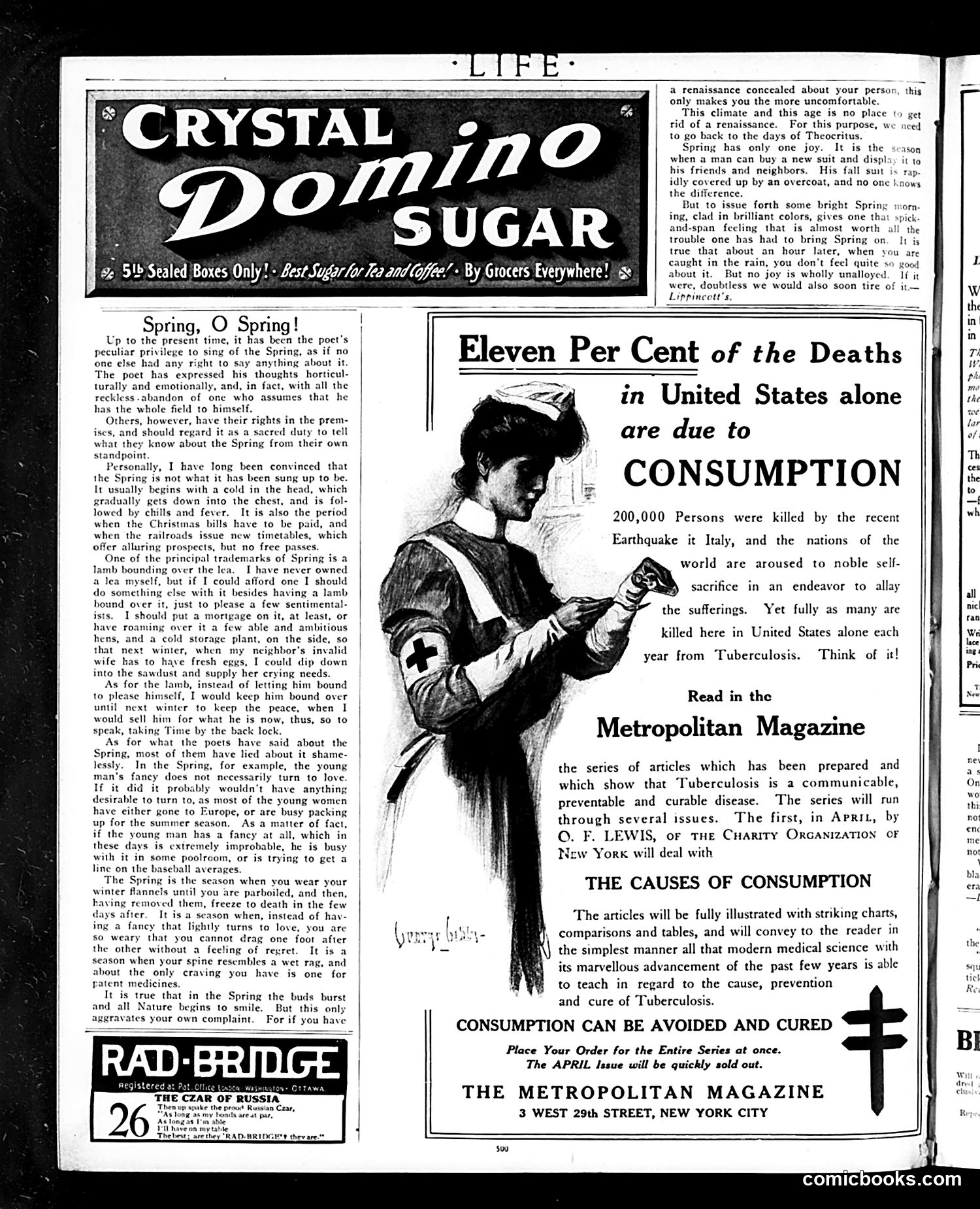
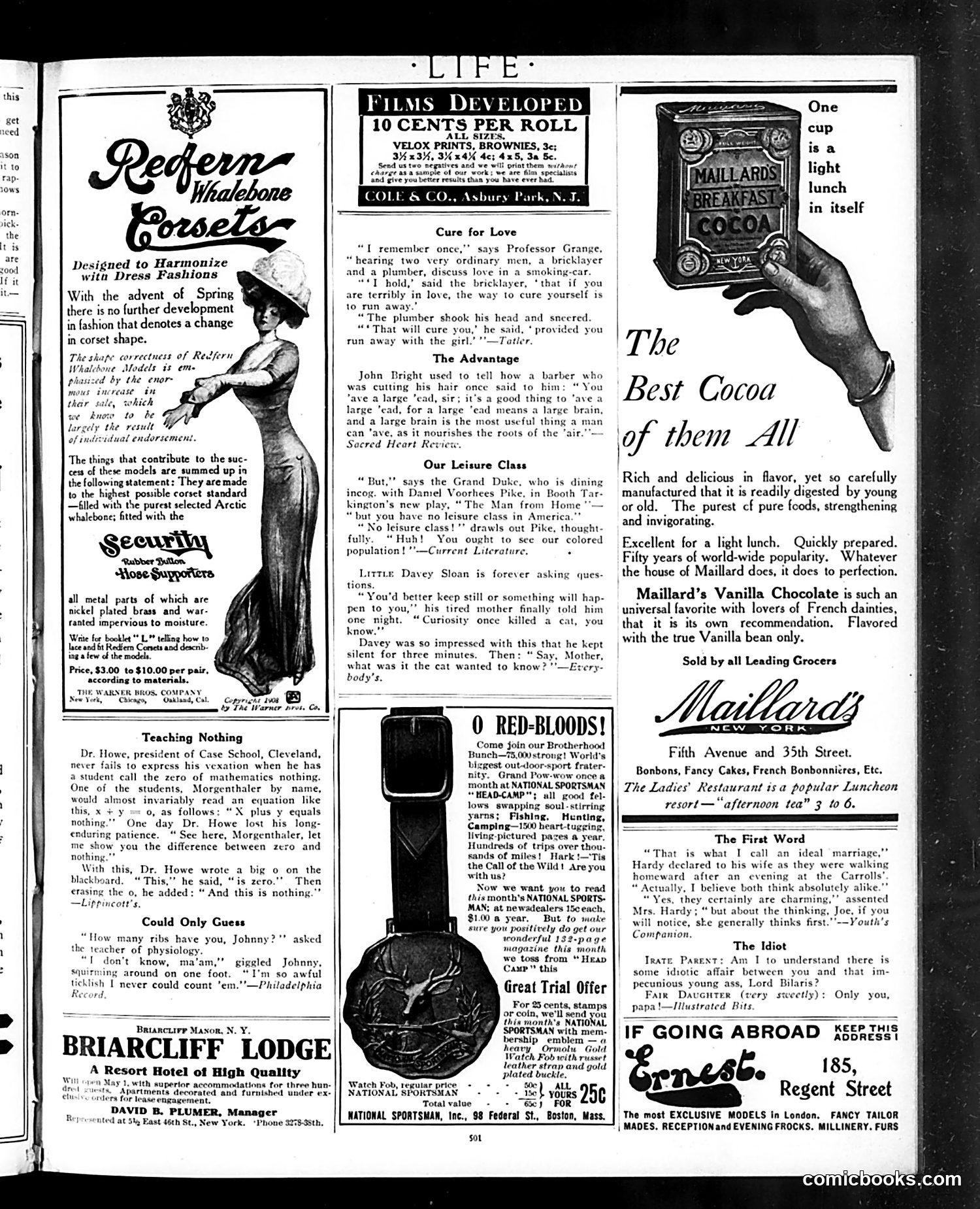
This page is primarily **advertisements and humorous anecdotes**, not political satire. The main content includes: **Left column**: Corset and hotel ads, plus three brief jokes: - A professor distinguishing "zero" from "nothing" - A child unable to count his ribs - A debate between a bricklayer and plumber about curing lovesickness **Center**: Short humorous pieces about a barber's compliment, a Grand Duke's observation that America lacks a leisure class (suggesting Black Americans are idle—a racist stereotype), and a child asking what a cat wanted to know. **Right**: Cocoa and fashion advertisements. The page reflects early 20th-century American humor: mild, anecdotal, and occasionally containing casual racism (the leisure-class joke). There are no clear political cartoons or caricatures visible. This appears to be a typical *Life* magazine miscellany page mixing ads with light comedic filler content.
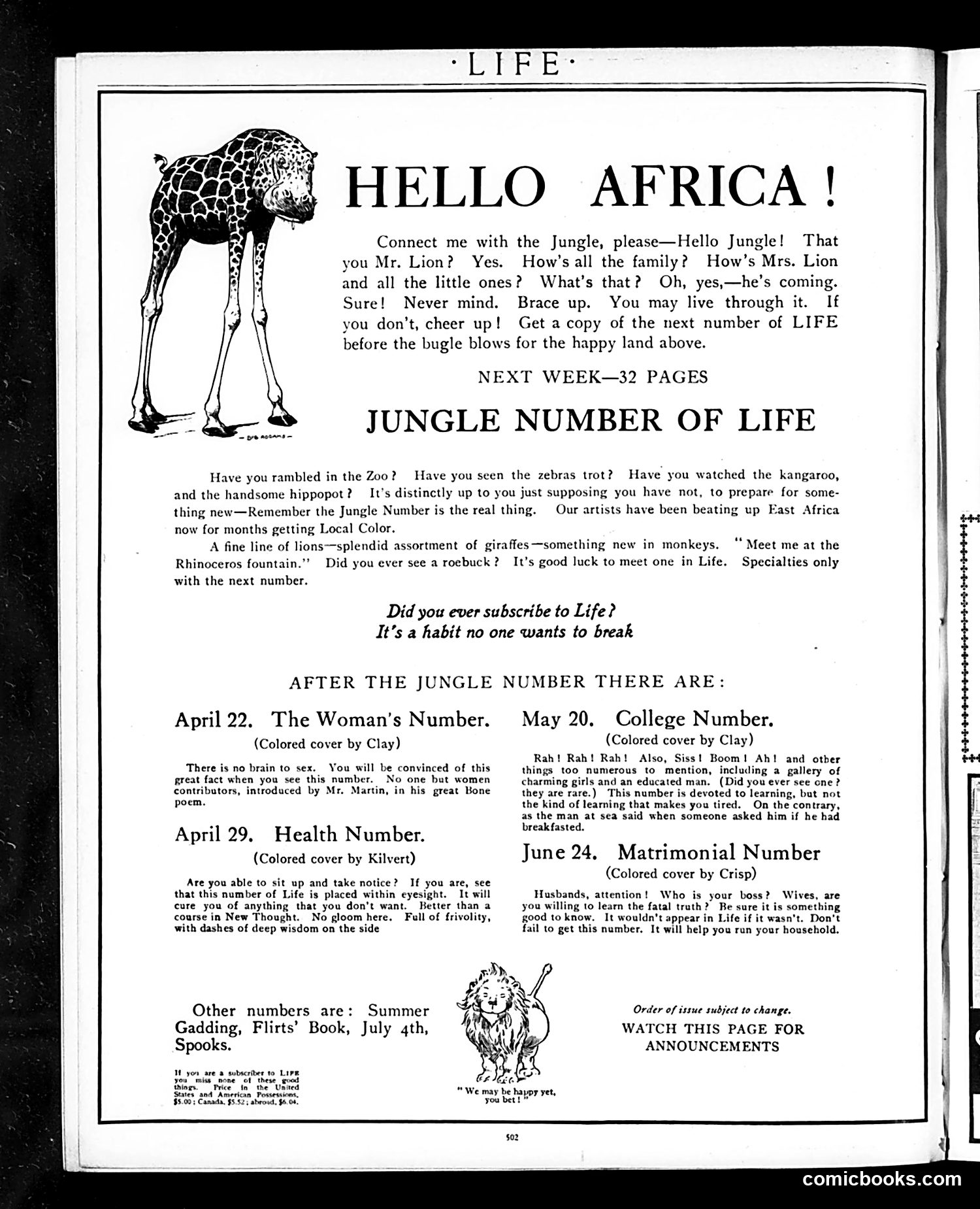
This is a promotional page for Life magazine's upcoming "Jungle Number," using colonial-era attitudes toward Africa as its hook. The giraffe illustration and anthropomorphized animal dialogue ("Hello Jungle! That you Mr. Lion?") present Africa as an exotic, amusing spectacle for American readers. The satire targets Life's own editorial strategy: the magazine boasts its artists have been "beating up East Africa" for months to capture "Local Color," meaning they're fashioning African content for entertainment value rather than serious journalism. The animal characters speaking broken English reflect period attitudes treating non-Western subjects as quaint curiosities. The page also advertises upcoming themed issues (Woman's Number, Health Number, College Number, Matrimonial Number), each with facetious descriptions mocking their target audiences—particularly the Woman's Number's opening: "There is no brain to sex," revealing the magazine's casual sexism. Overall, this reflects early-20th-century American publishing: packaging distant cultures as amusing diversions while reinforcing stereotypes.
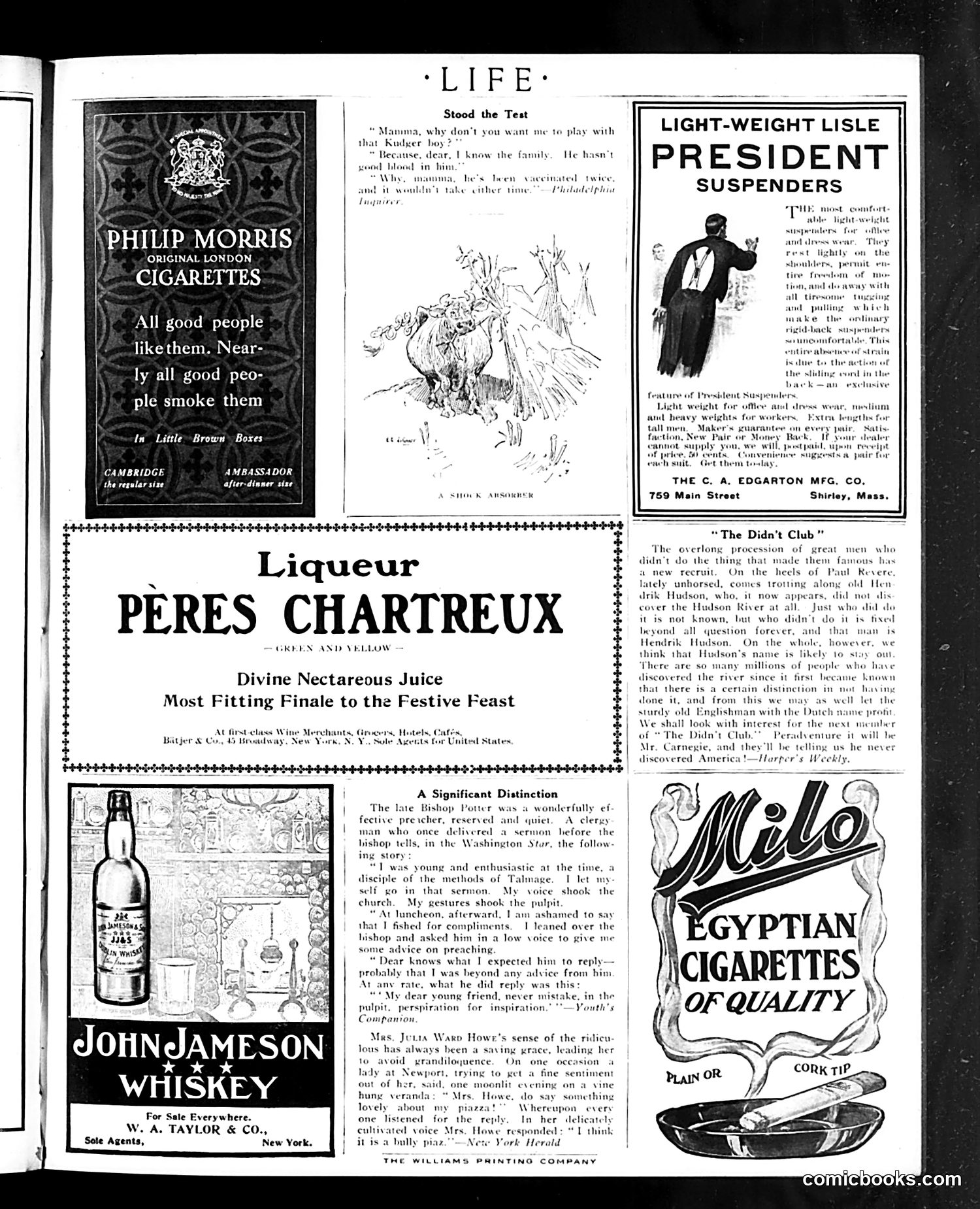
This page is primarily **advertising**, featuring cigarette, whiskey, and liqueur ads typical of early 20th-century magazines. The only substantive editorial content is **"The Didn't Club,"** a satirical piece mocking the revisionist debunking of historical figures. It references explorer **Hendrik Hudson**, whose discovery of the Hudson River was apparently being questioned by contemporary historians. The satire suggests this "didn't do it" trend is absurd—so many people have since "discovered" the river that Hudson's actual role becomes meaningless. The piece humorously anticipates future historical figures will be similarly stripped of their accomplishments. The page also includes anecdotes about **Bishop Potter** (distinguishing perspiration from inspiration in preaching) and **Julia Ward Howe** (making a witty remark about a piazza), illustrating the magazine's mix of humor, commentary, and social observation.
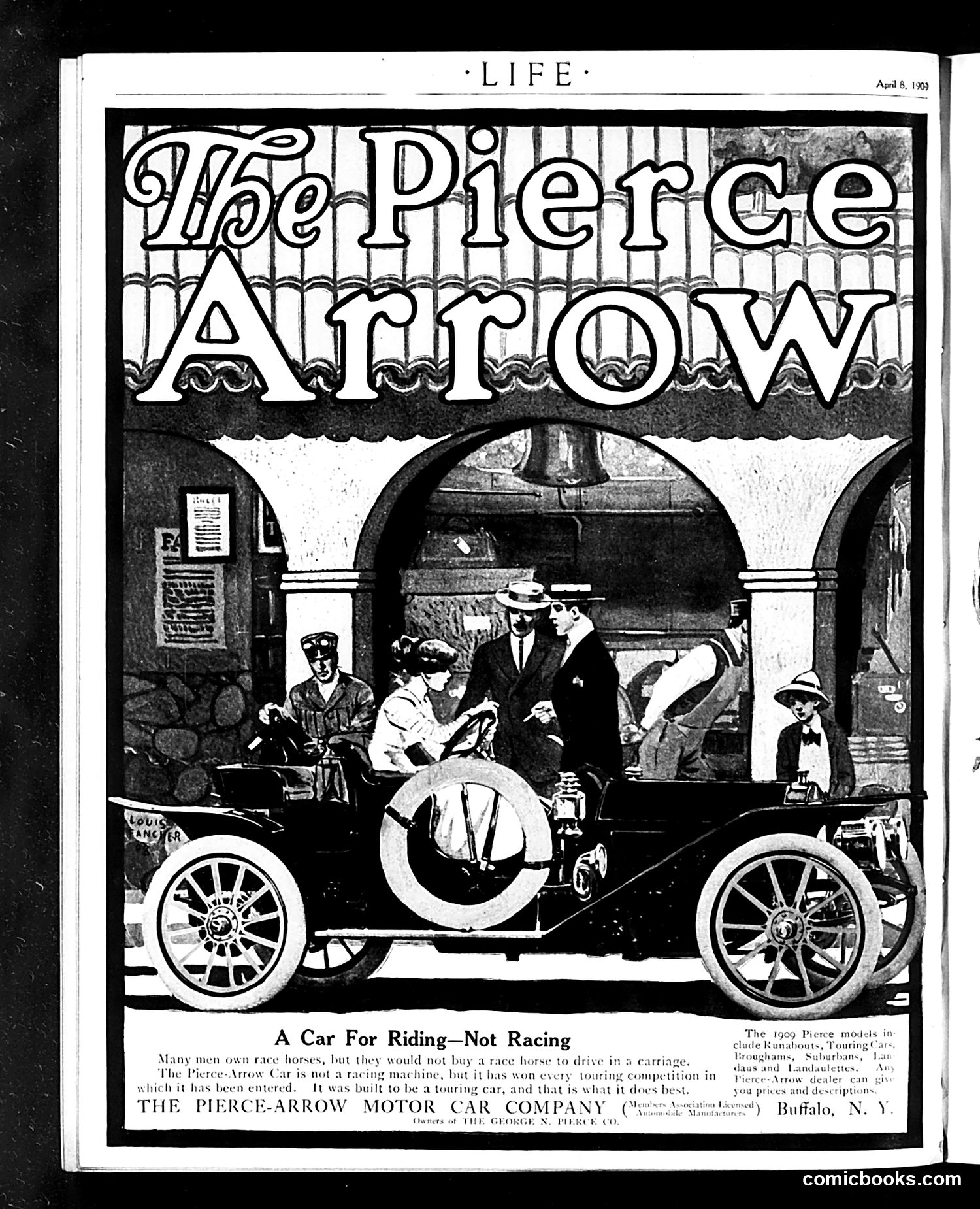
This is a **Pierce-Arrow automobile advertisement**, not political satire. The page promotes the Pierce-Arrow Motor Car Company's vehicle as a luxury touring car—built for comfortable riding and leisurely trips rather than racing. The illustration depicts well-dressed passengers (men in suits and hats, a woman) relaxing in an open automobile parked beneath classical arches, suggesting elegance and sophistication. The caption emphasizes the car's practical purpose: "A Car For Riding—Not Racing." The ad appeals to wealthy buyers by contrasting the Pierce-Arrow with racing machines, positioning it as a refined vehicle for gentlemen and ladies of means. The classical architecture and well-groomed passengers reinforce the message of luxury and status. This reflects early 1900s automobile marketing targeting America's upper class.