
Life, 1909-04-08 · page 18 of 32
Life — April 8, 1909 — page 18: what you’re looking at
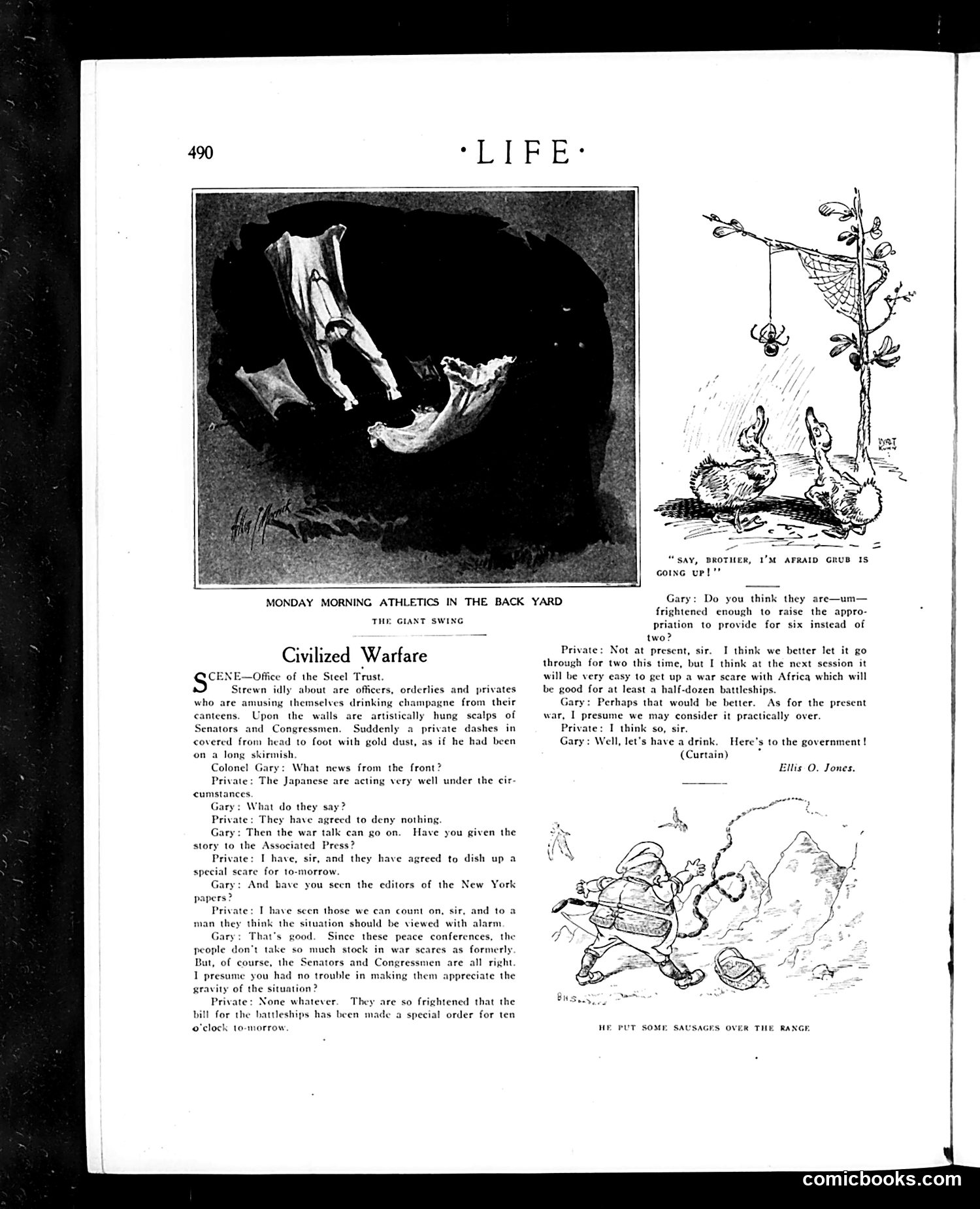
What you’re looking at
This satirical piece mocks the influence of wealthy industrialists on American foreign policy and military spending during the Russo-Japanese War era. **The Setup:** A scene in the office of "Colonel Gary" (appears to reference a steel industry figure), where officers discuss the war as a manufactured propaganda tool rather than genuine conflict. **The Satire:** The dialogue reveals a cynical system where: - War news is deliberately coordinated with newspapers to manipulate public opinion - Congressional "scalps" decorate the walls, symbolizing political control - Legislators are easily frightened into approving military expenditures (battleships) - The war itself is essentially "over" once its propaganda value is exhausted - Future conflicts (Africa) are already being planned to justify continued defense spending **The Point:** Life attacks the collusion between industrial elites, press, and politicians to manufacture war scares that serve financial interests rather than genuine national security needs. The casual tone—ending with "let's have a drink"—emphasizes how cynically removed this elite circle is from actual warfare's human costs.
📄 Transcribed text from this page (OCR, searchable)
Machine-transcribed from the original scan — historical spelling and the odd misread are preserved.
“SAY, BROTHER, I’M AFRAID GRUB IS, coinc up!"’ MONDAY MORNING ATHLETICS IN THE BACK YARD THE GIANT SWING Civilized Warfare SoENE Occ of the Steel Trust. Strewn idly about are officers, orderlies and privates who are amusing themselves drinking champagne from their canteens. Upon the walls are artistically hung scalps of enators and Congressmen. Suddenly a private dashes in covered from head to foot with gold dust, as if he had been on a long skirmish Colonel Gary: What news from the front? Private: The Japanese are acting very well under the cit- cumstances. Gary: What do they say? Private: They have agreed to deny nothing. y: Then the war talk can go on. Have you given the story to the Associated Press? Private: I have, sir, and they have agreed to dish up a ial scare for to-morrow. y: And bave you secn the editors of the New York papers? Private: I have seen those we can count on, sir, and to a man they think the situation should be viewed with alarm Gary: That's good. Since these peace conferences, the people don't take so much stock in war scares as formerly But, of co ators and Congressmen are all right 1 presume you had no trouble in making them appreciate the gravity of the situation? Private: None whatever. They are so frightened that the Dill for the battleships has been made a special order for ten o'clock to-morrow Gary: Do you think the frightened enough to raise the appro- priation to provide for six instead of two? Private: Not at present, sir. I think we better let it go through for two this time, but I think at the next session it will be very easy to get up a war scare with Africa which will be good for at least a half-dozen battleships Gary: Perhaps that would be better. As for the present war, I presume we may consider it practically over. Private: I think so, sir. Gary: Well, let’s have a drink. Here’s to the government! (Curtain) * are—um— Ellis O. Jones. PUT SOME SAUSAGES OVER THE RANGE comicbooks.com