
Life, 1909-04-08 · page 6 of 32
Life — April 8, 1909 — page 6: what you’re looking at
What you’re looking at
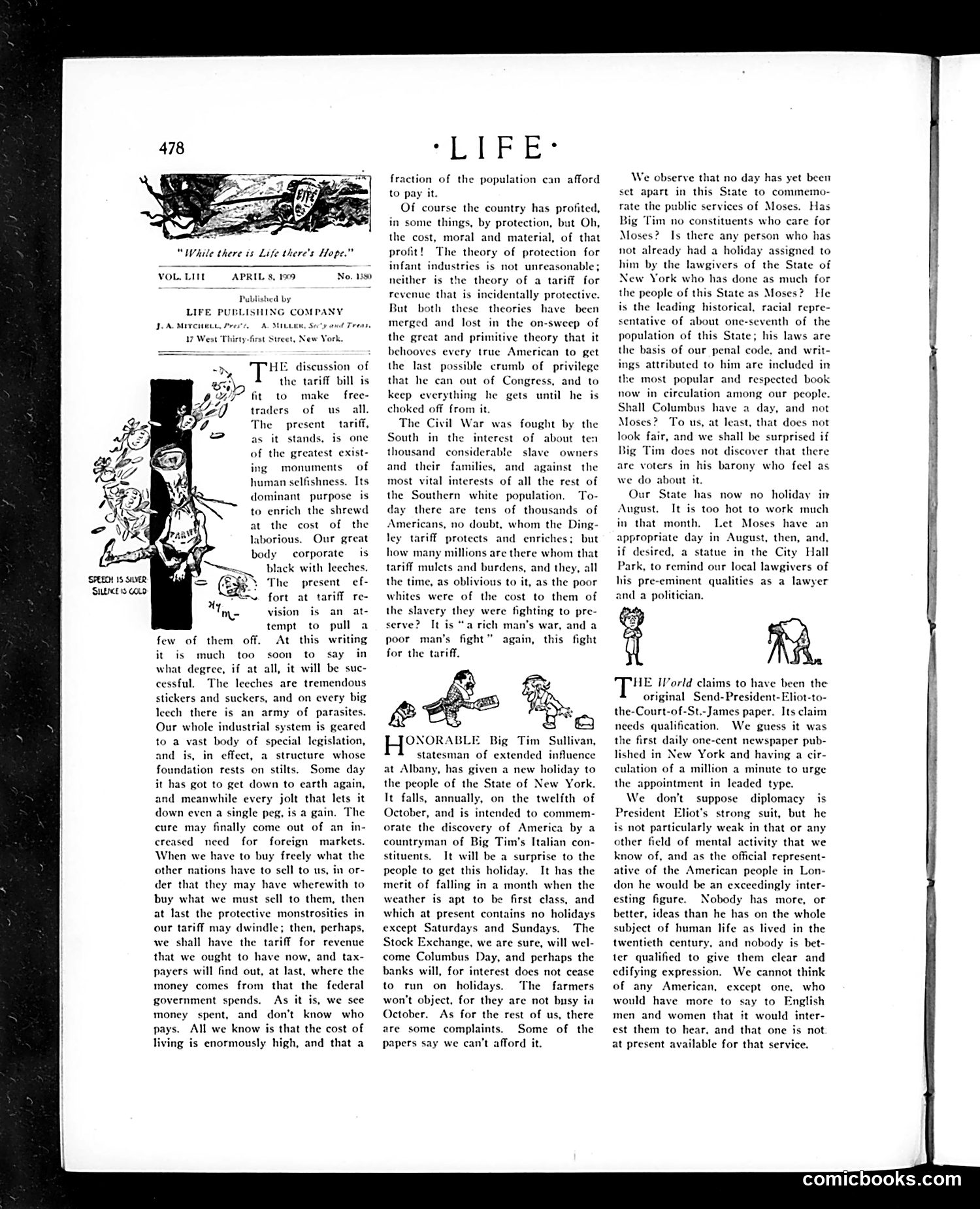
This page contains political commentary on American tariff policy and labor issues. The left sidebar features a cartoon labeled "GREED IS SOME SILENT & GOLD" depicting a grotesque figure—likely representing industrial monopoly or corporate greed—devouring resources. The main text discusses the tariff debate, referencing the Civil War's origins in conflicts over slavery and suggesting the current tariff fight is similarly a "rich man's war, and a poor man's fight." The right column mentions "Big Tim Sullivan," an Albany politician, proposing a new October holiday to commemorate Columbus Day—apparently a satire on political opportunism and the tendency to create holidays for dubious purposes. The overall thrust critiques protective tariffs as benefiting the wealthy while burdening ordinary Americans.
📄 Transcribed text from this page (OCR, searchable)
Machine-transcribed from the original scan — historical spelling and the odd misread are preserved.
‘SEED 15 SER Sturt Guo While there is Life there's Hope.” VOL. Lit APRIL 8, 1909 Published by LISHING COMPANY a Trean, LIFE PU ILA. MITCHELL, Pree. ty-first Street, New York. AO SULLEN, Sey HE discussion of the tariff bill is to make free- traders of The present as it stands, is of the greatest exist- 1g monuments of human selfishness, Its dominant purpose is to enrich the shrewd at the cost of the laborious. Our great body corporate is black with leeches, The present ¢ fort at tariff re- vision is an at- tempt to pull a few of them off. At this writing it is much too soon to say in what degree, if at all, it will be suc- cessful. The leeches are tremendous stickers and suckers, and on every big leech there is an army of parasite: Our whole industrial system is geared to a vast body of special legislation, and is, in effect, a structure whose foundation rests on stilts. Some day it has got to get down to earth again, and meanwhile every jolt that lets it down even a single peg, is a gain. The cure may finally come out of an in- creased need for foreign markets. When we have to buy freely what the other nations have to sell to us, in or- der that they may have wherewith to buy what we must sell to them, then at last the protective monstrosities in our tariff may dwindle; then, perhaps, we shall have the tariff for revenue that we ought to have now, and tax- payers will find out, at last, where the money comes from that the federal government spends. As it is, we see money spent, and don’t know who All we know is that the cost of one rLIFE* fraction of the population can afford to pay it. Of course the country has profited, in some things, by protection, but Oh, the cost, moral and material, of that profit! The theory of protection for infant industries is not unreasonable; neither is the theory of a tariff for revenue that is incidentally protective. But both these theories have been merged and lost in the on-sweep of the great and primitive theory that it behooves every true American to get the last possible crumb of privilege that he can out of Congress, and to keep everything he gets until he is choked off from it. The Civil War was fought by the South in the interest of about ten thousand considerable slave owners and their families, and against the most vital interests of all the rest of the Southern white population. To- day there are tens of thousands of Americans, no doubt, whom the Ding- ley tariff protects and enriches; but how many millions are there whom that tariff mulets and burdens, and they, all the time, as oblivious to it, as the poor whites were of the cost to them of the slavery they were fighting to pre- serve? It is “a rich man’s war, and a poor man’s fight” again, this fight for the tariff. & Aix ‘ ey ONORABLE Big Tim Sullivan, statesman of extended influence at Albany, has given a new holiday to the people of the State of New York. It falls, annually, on the twelfth of October, and is intended to commem- orate the discovery of America by a countryman of Big Tim's Ital stituents. It will be a surp people to get this holiday. It has the merit of falling in a month when the weather is apt to be first class, and which at present contains no holidays except Saturdays and Sundays. The Stock Exchange, we are sure, will wel- come Columbus Day, and perhaps the banks will, for interest does not cease to run on holidays. ‘The farmers won't object, for they are not busy ia October. As for the rest of us, there are some complaints. Some of the papers say we can’t afford it. We observe that no day has yet been set apart in this State to commemo- rate the public services of Moses. Has Bi Nn no constituents who care for Moses? Is there any person who has not already had a holiday assigned to him by the lawgivers of the State of New York who has done as much for the people of this State as Moses? He is the leading historical, racial repre- sentative of about one-seventh of the population of this State; his laws are the basis of our penal code, and writ- ings attributed to him are included in the most popular and respected book now in circulation among our people. Shall Columbus have a day, and not Moses? To us, at least, that does not look fair, and we shall be surprised if Big Tim does not discover that there are voters in his barony who feel as we do about it. Our State has now no holiday in August. It is too hot to work much in that month, Let Moses have an appropriate day in August, then, and, if desired, a statue in the City Hall Park, to remind our local lawgivers of qualities as a lawyer his pre-eminent and a politician. HE World claims to have been the original Send-President-Eliot-to- the-Court-of-St.-James paper. Its claim needs qualification. We guess it was the first daily one-cent newspaper pub- lished in New York and having a culation of a million a minute to urge the appointment in leaded type. We don't suppose diplomacy is President Eliot's strong suit, but he is not particularly weak in that or any other field of mental activity that we know of, and as the official represent- ative of the American people in Lon- don he would be an exceedingly inter- esting figure. Nobody has more, or better, ideas than he has on the whole subject of human life as lived in the twentieth century, and nobody is bet- ter qualified to give them clear and edifying expression. We cannot think of any American, except one, who would have more to say to English men and women that it would inter- est them to hear, and that one is not. at present available for that service. comicbooks.com