
Life, 1909-04-08 · page 15 of 32
Life — April 8, 1909 — page 15: what you’re looking at
What you’re looking at
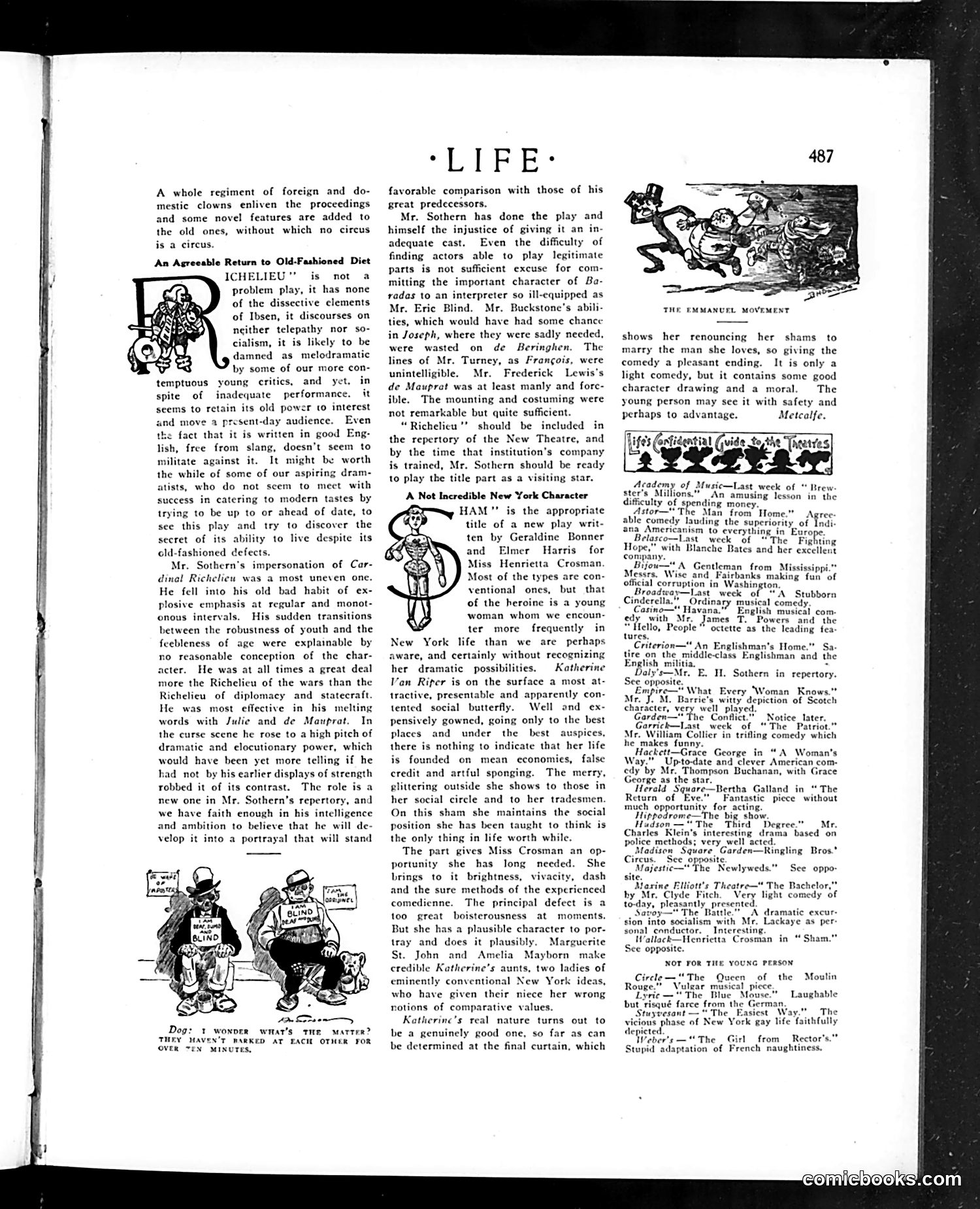
This page contains theater criticism and a single cartoon. The main reviews discuss productions of "Richelieu" (starring Mr. Sothern) and a new play called "Ham" featuring Miss Henrietta Crosman. The critic praises the enduring appeal of the classical play "Richelieu" while critiquing Sothern's uneven performance and inadequate supporting cast. The small cartoon at the bottom depicts two dogs who haven't barked at each other in ten minutes, with one asking "I wonder what's the matter?" This is a lighthearted observation about canine behavior—dogs typically bark frequently, so their unusual silence prompts concern. It's gentle humor about animal habits rather than political satire. The page represents Life's dual focus: serious cultural commentary on theater alongside humorous observational cartoons about everyday life.
📄 Transcribed text from this page (OCR, searchable)
Machine-transcribed from the original scan — historical spelling and the odd misread are preserved.
A whole regiment of foreign and do- mestic clowns enliven the proceedings and some novel features are added to the old ones, without which no circus is a circus. An Agreeable Return to Old-Fashioned Diet ICHELIEU" is not a problem play, it has none of the dissective elements of Ibsen, it discourses on neither telepathy nor so- cialism, it is likely to be damned as _ melodramatic by some of our more con- temptuous young critics, and yet, in spite of inadequate performance. it seems to retain its old power (o interest und move a present-day audience. Even the fact that it is written in good Eng- lish, free from slang, doesn’t seem to militate against it. It might be worth the while of some of our aspiring dram- atists, who do not scem to mect with success in catering to modern tastes by trying to be up to or ahead of date, to see this play and try to discover the secret of its ability to live despite its old-fashioned defects. Mr. Sothern’s impersonation of Car- dinal Richelieu was a most uneven one. He fell into his old bad habit of ex- plosive emphasis at regular and monot- onous intervals. His sudden transitions between the robustness of youth and the feebleness of age were explainable by no reasonable conception of the char- acter. He was at all times a great deal more the Richelieu of the wars than the Richelieu of diplomacy and_ statecraft. He was most effective in his melting words with Julie and de Mauprat. In the curse scene he rose to a high pitch of dramatic and clocutionary power, which would have been yet more telling if he had not by his earlier displays of strength robbed it of its contrast. The role is a new one in Mr. Sothern’s repertory, we have faith enough in his intelli and ambition to believe that he will de- velop it into a portrayal that will stand Dog: 1 wonper wmat’s tHE MATTER? Y MAVEN'T BARKED AT EACH OTHER FOR OVER TEN MINUTES, “LIFE: favorable comparison with those of his great predecessors. Mr. Sothern has done the play and himself the injustice of giving it an in- adequate cast. Even the difficulty of finding actors able to play legitimate parts is not sufficient excuse for com- mitting the important character of Ba- radas to an interpreter so ill-equipped as Mr. Eric Blind. Mr. Buckstone’s abili- ties, which would have had some chance in Joseph, where they were sadly needed, were wasted on de Beringhen. The lines of Mr. Turney, as Francois, were unintelligible. Mr. Frederick Lewis's de Mauprat was at least manly and forc- ible. The mounting and costuming were not remarkable but quite sufficient. “Richelicu'’ should be included in the repertory of the New Theatre, and by the time that institution's company is trained, Mr. Sothern should be ready to play the title part as a visiting star. A Not Incredible New York Character HAM"? is the appropriate title of a new play writ- ten by Geraldine Bonner and Elmer Harris for Miss Henrietta Crosman. Most of the types are con- ventional ones, but that of the heroine is a young woman whom we encoun- ter more frequently in New York life than we are perhaps aware, and certainly without recognizing her dramatic possibilities. Katherine Van Riper is on the surface a most at- tractive, presentable and apparently con- tented social butterfly. Well and ex- pensively gowned, going only to the best places and under the best there is nothing to indicate that her life is founded on mean economies, false credit and artful sponging. The merry, glittering outside she shows to those in her social circle and to her tradesmen. On this sham she maintains the social position she has been taught to think is the only thing in life worth while. The part gives Miss Crosman an op- portunity she has long needed. She brings to it brightness, vivacity, dash and the sure methods of the experienced comedienne. The principal defect is a too great boisterousness at moments. But she has a plausible character to por- tray and does it plausibly. Marguerite St. John and Amelia Mayborn make credible Katherine’s aunts, two ladies of eminently conventional New York ideas, who have given their niece her wrong notions of comparative values. Katherine's real nature turns out to be a genuinely good one, so far as can be determined at the final curtain, which auspices, THE EMMANUEL MOVEMENT shows her renouncing her shams to marry the man she loves, so giving the comedy a pleasant ending. It is only a light comedy, but it contains some good character drawing and a moral. The young person may see it with safety and perhaps to advantage. Metcalfe. [fifes é sie—Last week of “ Irew "An amusing lesson in th ulty of spending money. vinime Astor. he Man from Home.” Agree able comedy lauding the superiority of Indic ana Americanism to everything in Euro} Belasco—Last’ week of “The Fighting Hope,” with Blanche Bates and her excellent CORNY. een jou" A Gentleman from Mississippi.”* Messrs. Wise and Fairbanks making fun’ of official corruption in Washington. Broadway—Last week of “A Stubborn Cinderella.” | Ordinary musical comedy. Casino—" Havana.” English musical com- say with, Mr. James T. “Powers fello, People * octette ‘as the lead | An Englishman's Home." Sa- tire on the middle-class Englishman and the English militia. - Daly's—Mr. E. 11, Sothern in repertory. See opposite. Em very ‘Woman Knows." Mr. J. M. Barrie's witty depiction of Scotch character, very well played. Garden—* The Conflict.” Notice later. Garrick—Last week of “The Patriot.” Mr. William Collier in trifling comedy which he makes funny. Hackett—Grace George in “A Woman's Way." Up-to-date and clever American com- edy by Mr. Thompson Buchanan, with Grace George as the star. Herald Square—Bertha Galland in “The Return of Eve.” Fantastic piece without much opportunity for acting. Hippodrome—The big show. Hudson —“ The Third Degree.” Mr. Charles Klein's interesting drama based on police methods; very well acted. Madison Square Garden—Ringling Bros" Circus. See opposite Majestic—" The Newlyweds.” site, Marine Elliott's Theatre—" The Bachelor,” by Mr. Clyde Fitch. Very light comedy of to-day, pleasantly presented. ‘Savoy—" The Battle.” A dramatic excur- sion into socialism with Mr. Lackaye as per sonal conductor. Interesting. Wallock—Henrietta Crosman in “ Sham." € opposite. NOT TOR TIE YOUNG PERSON Circle“ The Queen of the Rouge." Vulear musical piece Lyric —“ The Blue Mouse.” but risqué farce from the German Stuyvesant —“ The Easiest Way." | The vicious phase of New York gay life faithfully depicted. Weber's —"The Girl from Rector's." Stupid adaptation of French naughtiness. See oppo- Moulin Laughable