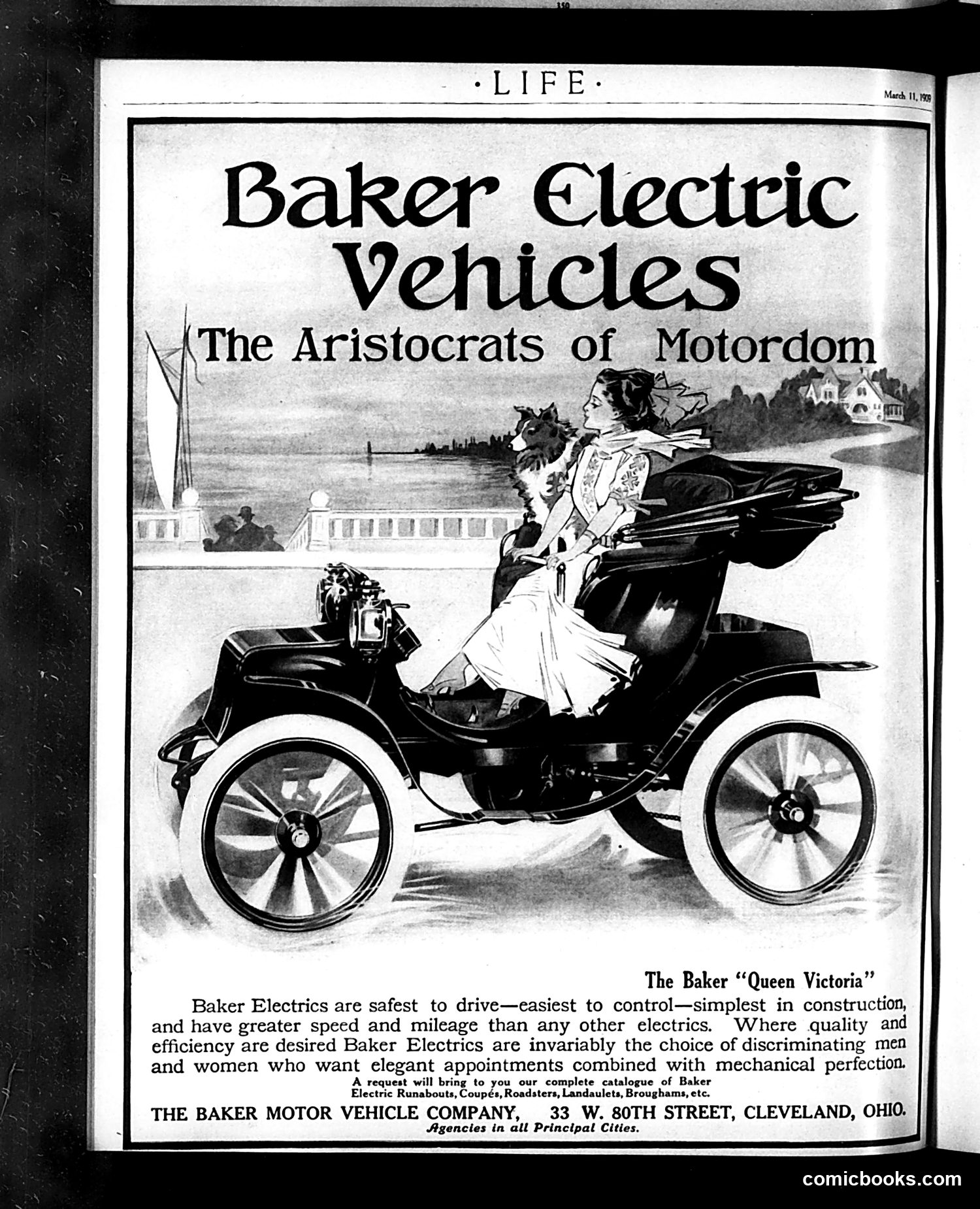
A complete issue · 36 pages · 1909
Life — March 11, 1909
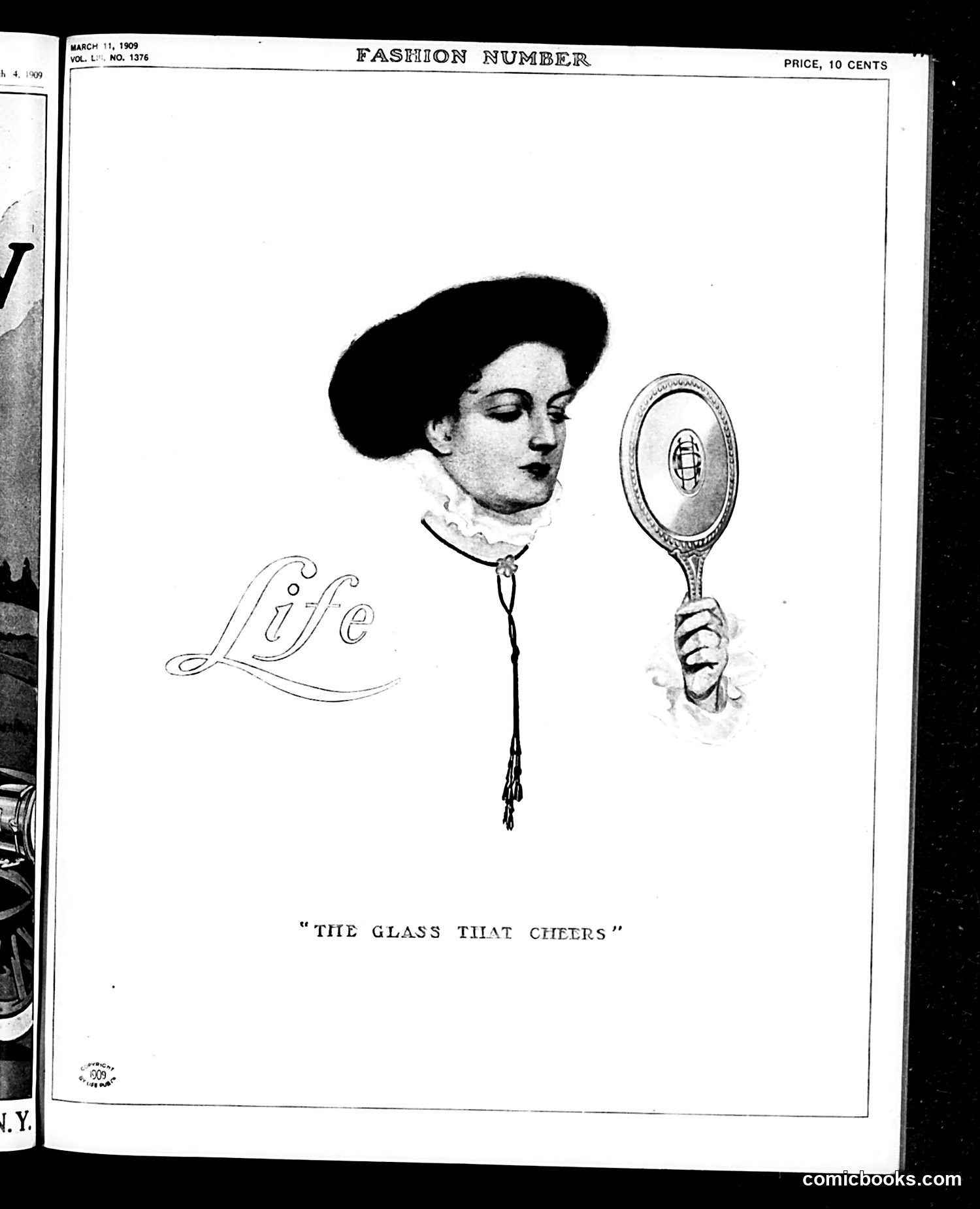
This 1909 *Life* magazine page features a fashion illustration with satirical social commentary. The drawing shows a fashionable woman in elegant Edwardian dress—a large feathered hat, high lace collar with pendant, and refined profile—holding a hand mirror while gazing at her reflection. The title "The Glass That Cheers" plays on a double meaning: both the mirror ("glass") and an alcoholic beverage. The satire likely critiques vanity and superficiality in high society, suggesting that women of means find pleasure in self-admiration and appearance rather than substance. The "Life" watermark on the left reinforces the magazine's satirical tone about contemporary social follies among the fashionable classes.
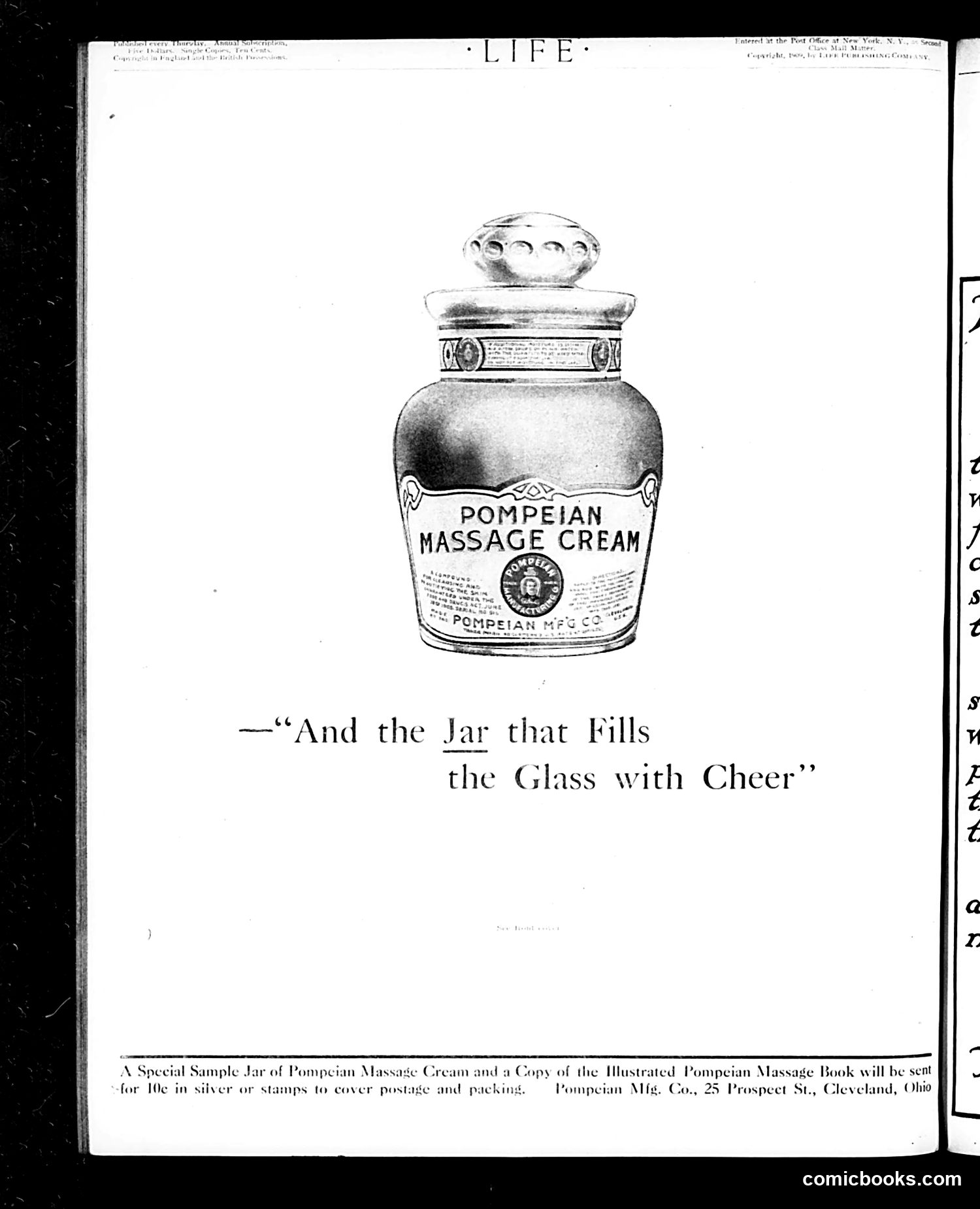
This page is primarily **advertising, not satire or political commentary**. It features a full-page advertisement for Pompeian Massage Cream, a beauty/skincare product manufactured by Pompeian Mfg. Co. in Cleveland, Ohio. The ad displays an ornate jar of the cream with classical decorative elements. The tagline—"And the Jar that Fills the Glass with Cheer"—appears to be a playful reference, possibly evoking poetry or popular phrases of the era, though the exact allusion is unclear without additional context. The bottom note offers readers a sample jar plus an illustrated instruction booklet for 10 cents (in silver or stamps). This represents typical early 20th-century *Life* magazine content: the publication carried substantial advertising alongside its satirical editorial material.
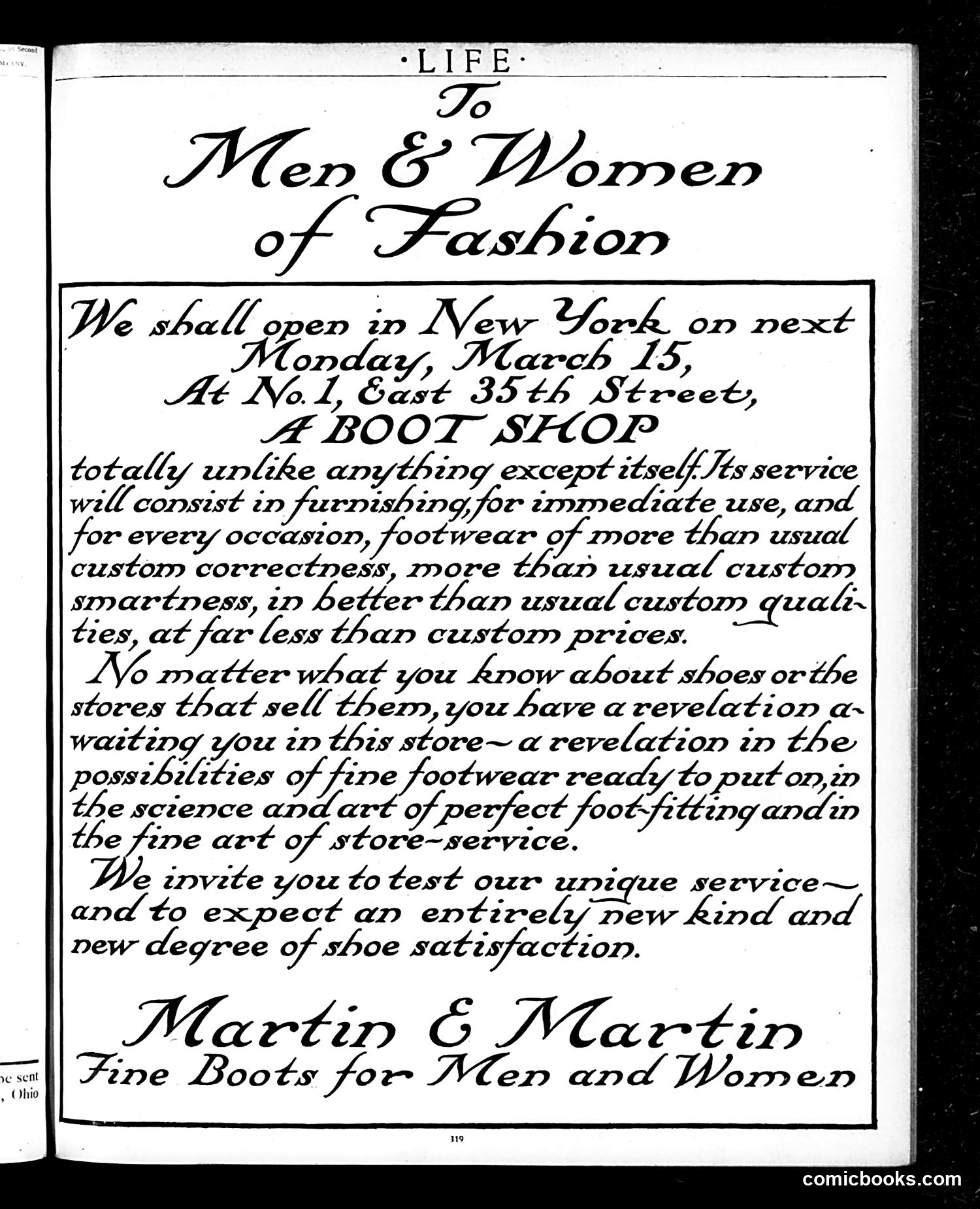
This page is **not a cartoon or satirical content** — it is a **period advertisement** for Martin & Martin, a boot shop opening in New York on Monday, March 15 (year unclear from image). The ad promotes custom footwear with claims of superior fit, quality, and service at prices lower than competitors. The language uses flowery, exaggerated rhetoric typical of early 20th-century advertising ("revelation awaiting you," "fine art of perfect foot-fitting"), which appears earnest rather than satirical. While the ad appears in *Life* magazine's advertising section, it represents straightforward commercial promotion rather than the satirical or comedic content *Life* was known for. The page number (119) and minimal decorative elements suggest this was standard paid advertising.
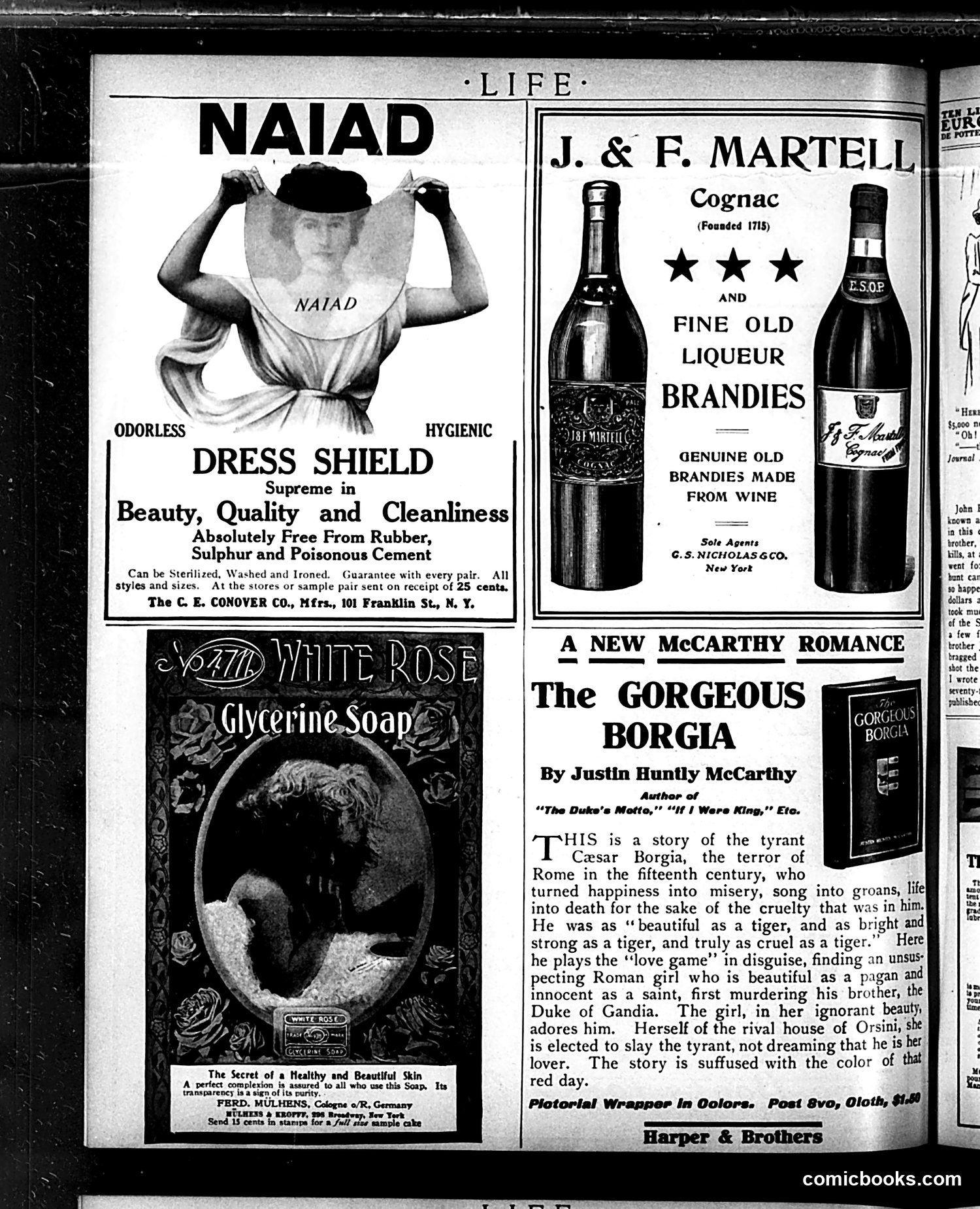
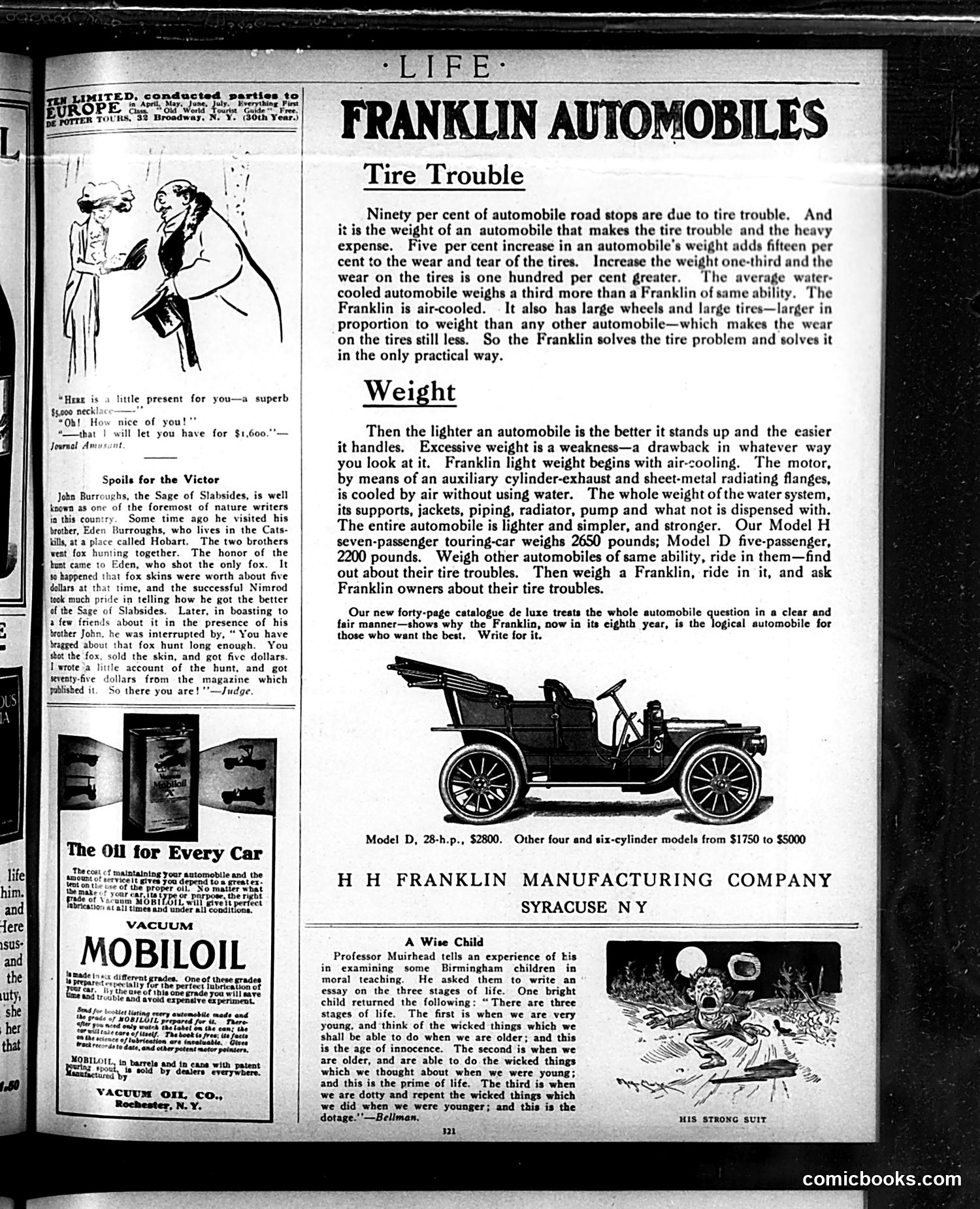
This page is primarily **advertising content** rather than political satire. The dominant feature is a Franklin Automobiles advertisement emphasizing the company's engineering advantages—particularly their air-cooling system and lighter weight, which allegedly reduce tire wear. The small cartoon in the upper left (labeled "Spoils for the Victor") appears to be an unrelated social humor sketch about gift-giving between a man and woman, unconnected to the automotive content. Below that is a Mobiloil oil advertisement. The page also includes a brief moral anecdote titled "A Wise Child" about life stages, illustrated with a small domestic scene. The content reflects early 1900s consumer marketing priorities: mechanical reliability, weight efficiency, and tire durability were major selling points for automobiles during this era.
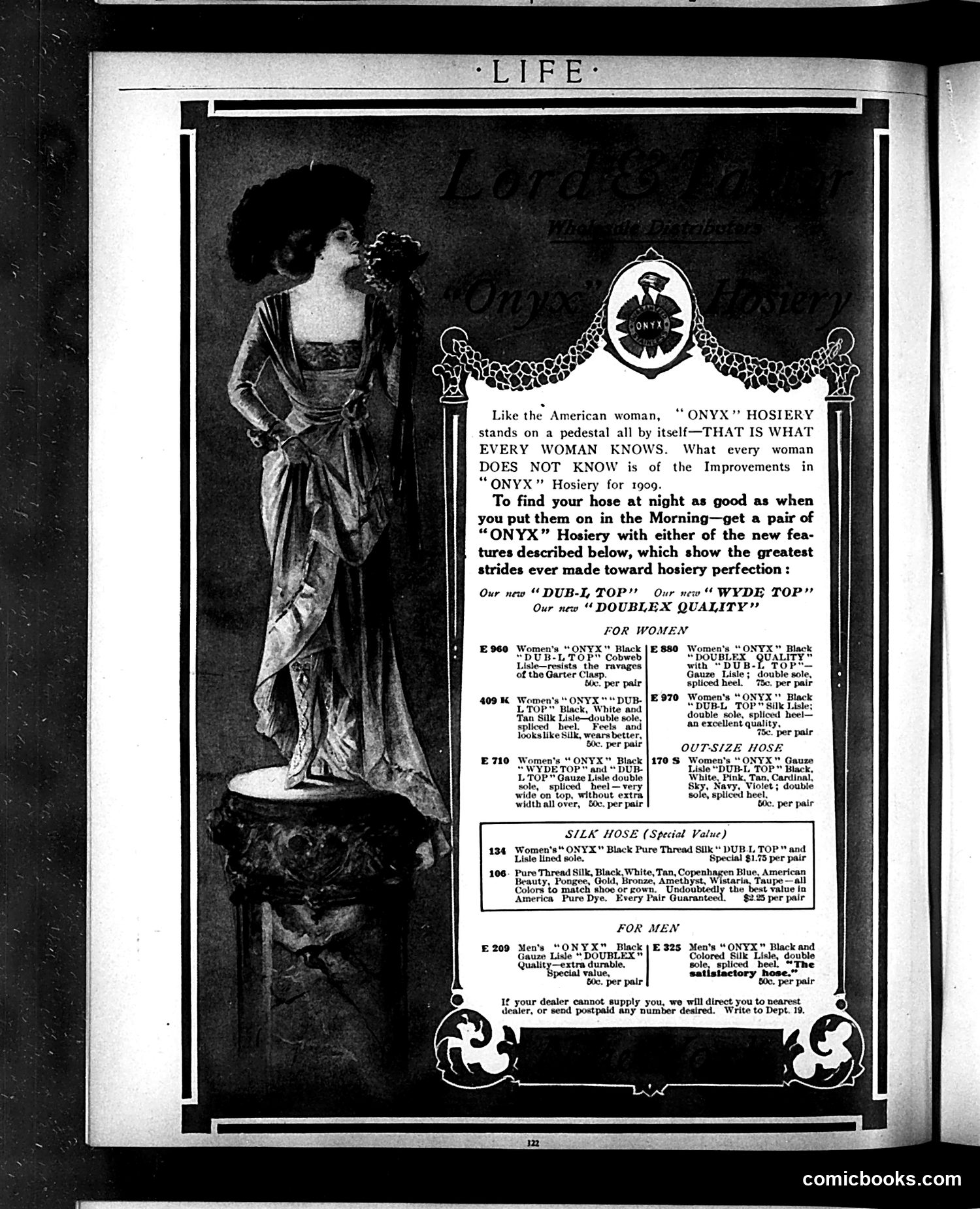
This page is **primarily an advertisement**, not a political cartoon. It promotes "ONYX" brand hosiery for 1909, featuring various product lines for women and men. The advertisement uses a classical artistic device: a full-length photograph of an elegantly dressed woman on the left side, posed like a statue on a pedestal. This visual metaphor—comparing the American woman to classical sculpture—reinforces the advertising slogan that "ONYX HOSIERY stands on a pedestal all by itself." The right side lists specific hosiery products with model numbers, prices (ranging from 50¢ to $2.25 per pair), and technical features like "Dub-L Top," "Wyde Top," and "Doublex Quality." There is **no political satire** present. This is a straightforward early-20th-century product advertisement using genteel imagery to market women's stockings.
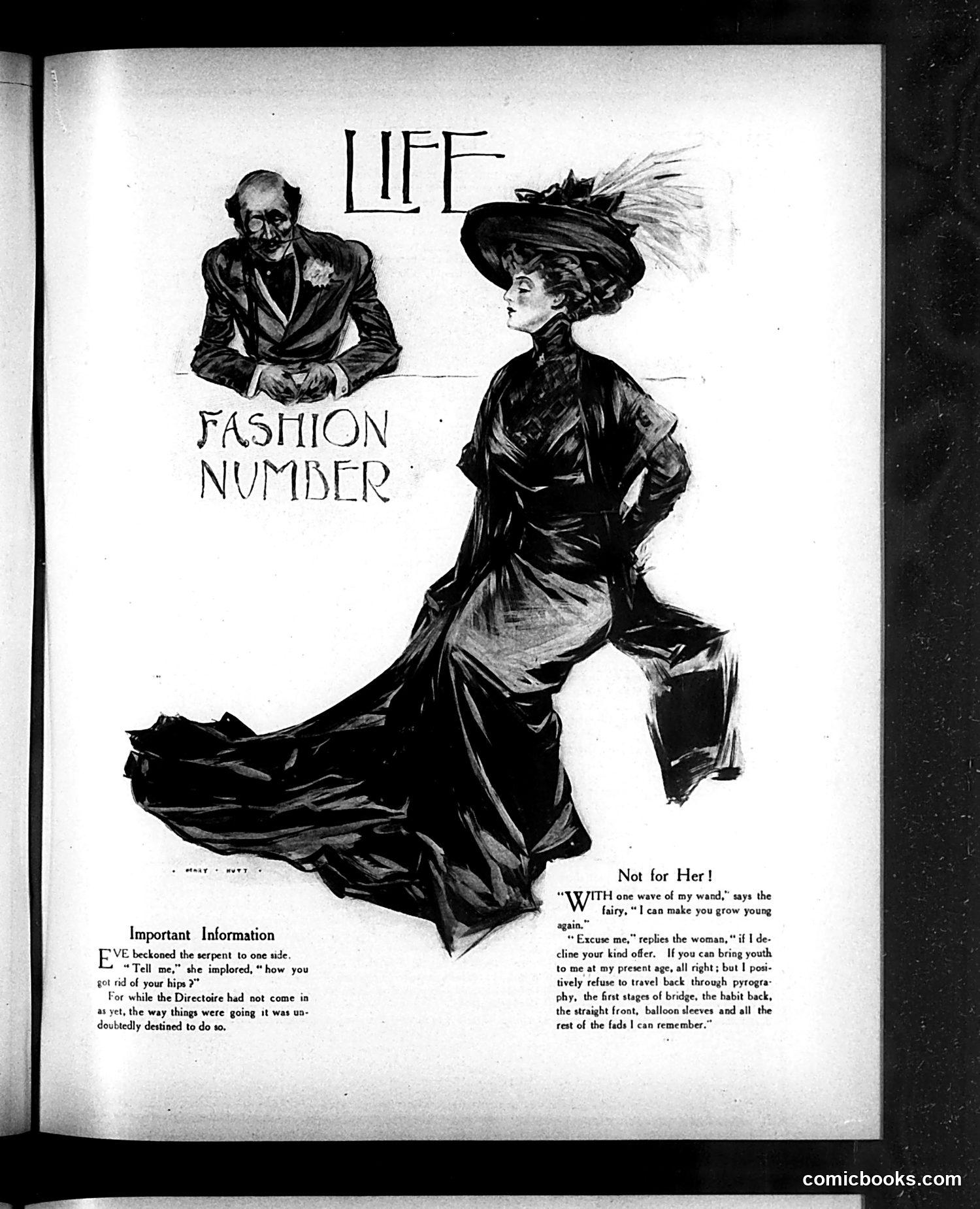
This is a "Life" magazine fashion page titled "LIFE FASHION NUMBER." The main illustration depicts an elegantly dressed woman in fashionable early 1900s attire—a fitted black coat dress with a dramatic train and an elaborate feathered hat. The satire appears in the accompanying dialogue sections. "Important Information" presents a satirical exchange where a woman has "locked the serpent to one side" and boasts of ridding herself of "hips." "Not for Her!" features a fairy offering youth-restoration magic, which the woman refuses, claiming her current fashionable silhouette already achieves the desired youthful appearance through clothing and corsetry. The joke targets women's fashion obsession and the extreme corseting that created unnaturally thin silhouettes, mocking how fashion temporarily "solved" aging concerns without actual bodily change.
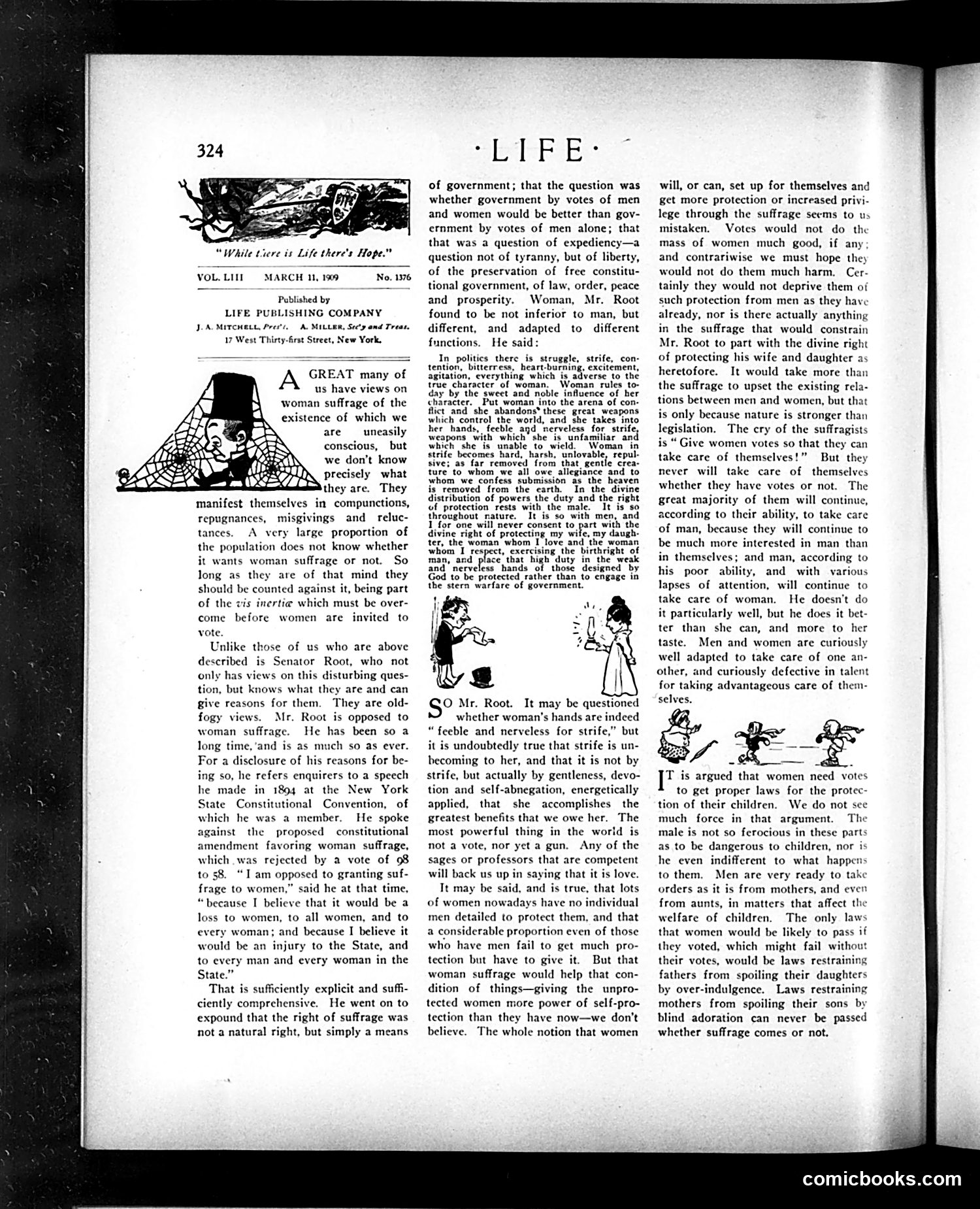
This page debates women's suffrage through Senator Elihu Root's arguments opposing voting rights for women. The article quotes Root's 1894 New York Constitutional Convention speech, where he argued that suffrage is a "means" not a "natural right," and that women lack individual protection needs that voting addresses. The satirical cartoons mock Root's position. Small illustrations show women in domestic situations—caring for children, managing households—visually undercutting his claim that women don't need political power. The satire suggests Root's logic is absurd: women actively manage society's welfare yet lack voting representation. The text counters that women *do* need votes for legal protection regarding property, children, and themselves—directly refuting Root's position that male protection suffices.
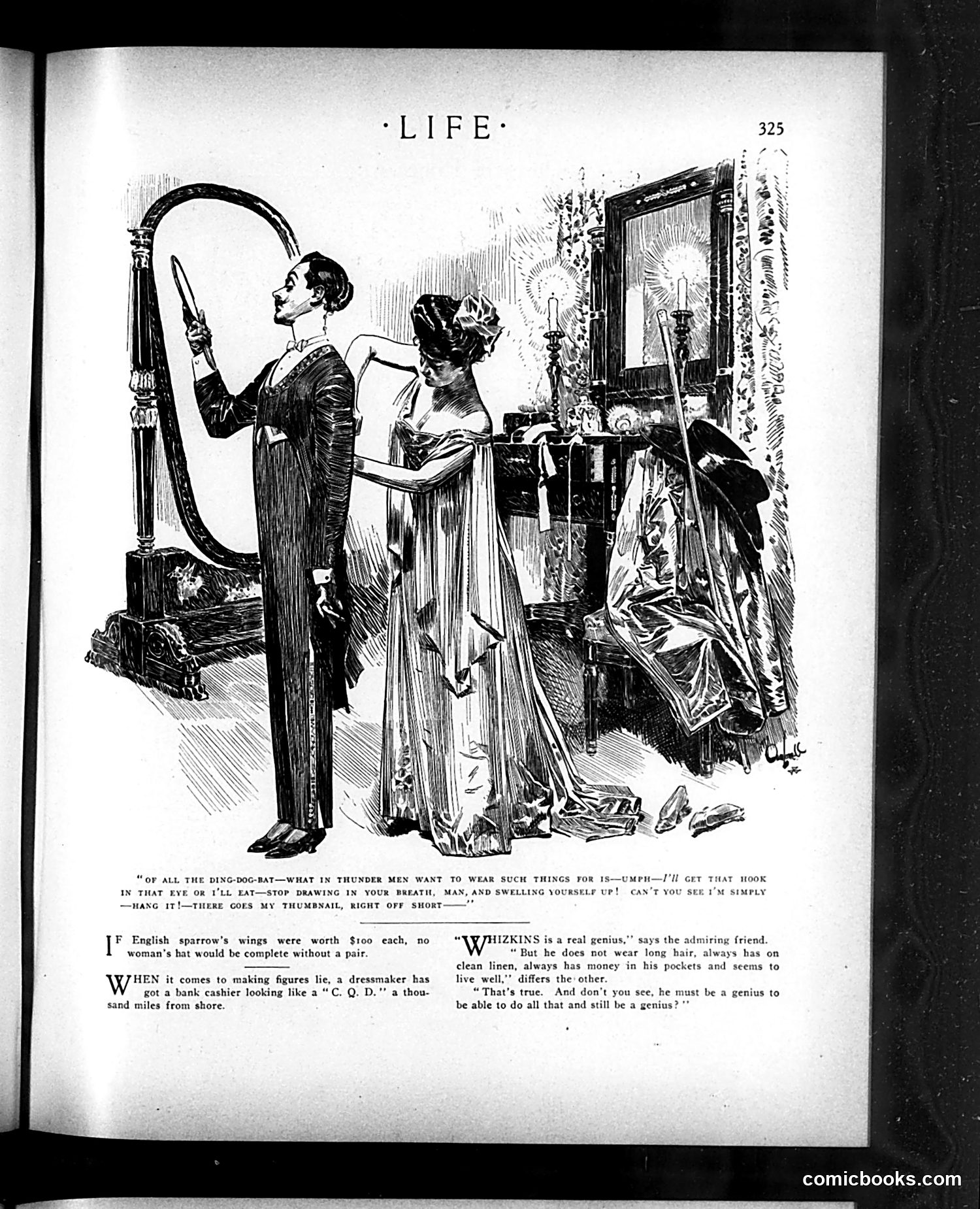
This page contains a satirical cartoon about fashion and vanity. The illustration shows a man admiring himself in a mirror while a woman stands nearby, with dialogue mocking his concern about wearing a large hat or accessory. The accompanying text discusses a dressmaker who "got a bank cashier looking like a 'C. Q. D.'" (a distress signal), and contrasts two types of geniuses: one who wears expensive accessories versus another named Whizkins who "does not wear long hair" but has money and "seems to live well." The satire targets masculine vanity and the absurdity of men obsessing over fashionable accessories. The final joke implies that true genius isn't about appearance or following fashion trends, but about practical intelligence and financial success—a commentary on early 20th-century status anxiety.
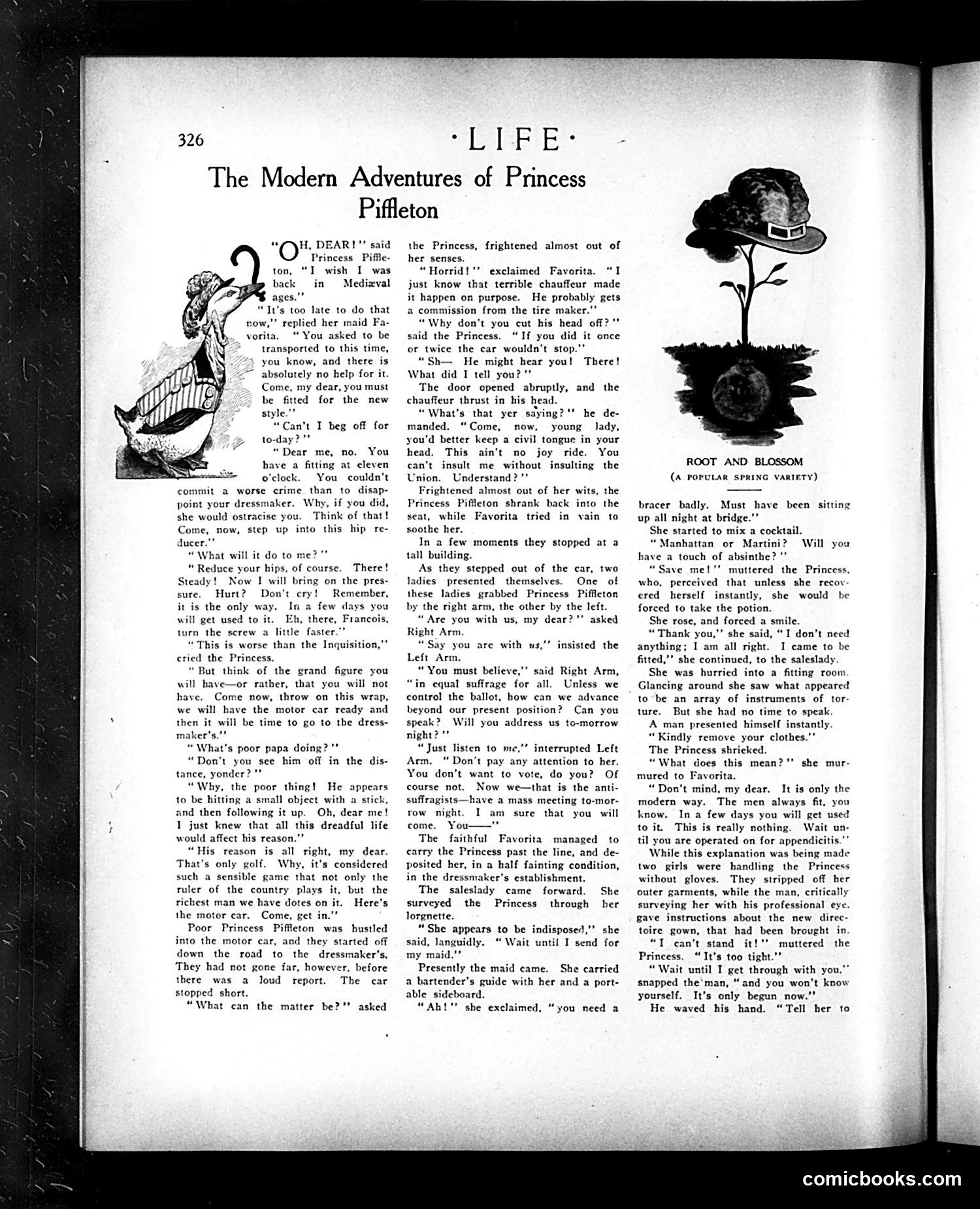
This is a satirical serial story mocking upper-class women of the early 20th century. The narrative follows Princess Piffleton, who—despite her aristocratic title—finds herself in absurdly modern, unglamorous situations involving automobiles and dressmakers. The satire targets the collision between old-world gentility and contemporary modernity: the Princess is "frightened almost out of her senses" by a rude taxi driver, while her maid Favorita struggles to maintain decorum. The joke seems to be that even privileged women cannot escape the indignities of modern life—car accidents, working-class impertinence, and the chaos of contemporary commerce. It's gentle mockery of how outdated aristocratic pretensions fare in an increasingly democratic, mechanized world.
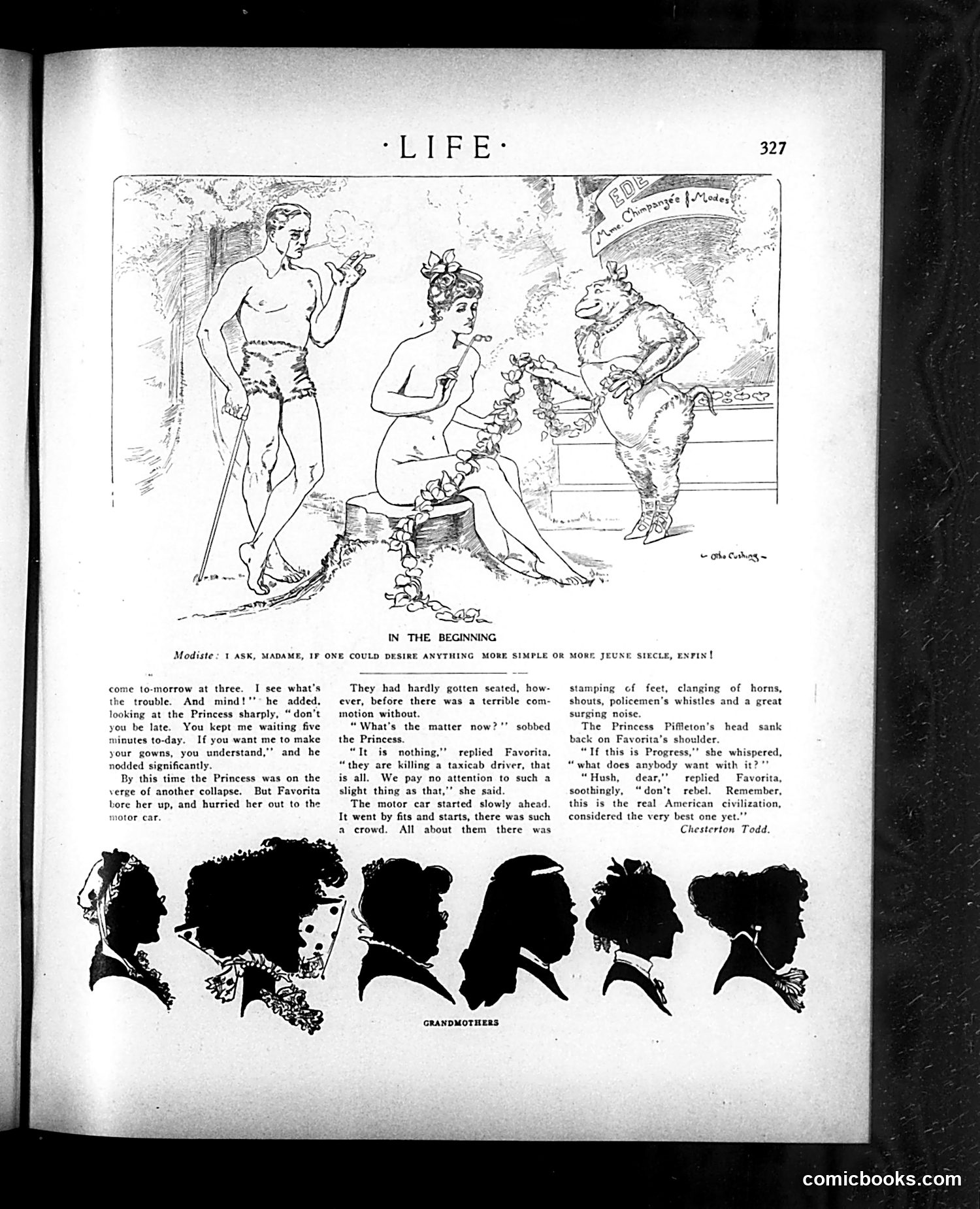
This page contains a satirical cartoon titled "In the Beginning" that depicts mythological or allegorical figures in a garden scene. The main figures appear to be nude or partially nude classical figures, including what looks like Adam and Eve alongside animal or satyr-like creatures, suggesting a playful take on creation mythology. The accompanying text, attributed to Chesterton Todd, is a humorous dialogue between characters named Modeste and the Princess about a motor car breaking down—apparently contrasting primitive "beginning" themes with modern automotive concerns. Below the main cartoon is a row of silhouetted profile portraits labeled "Grandmothers," likely satirizing generational or genealogical themes. The satire appears to humorously juxtapose classical/biblical origins with contemporary early 20th-century life and technology.
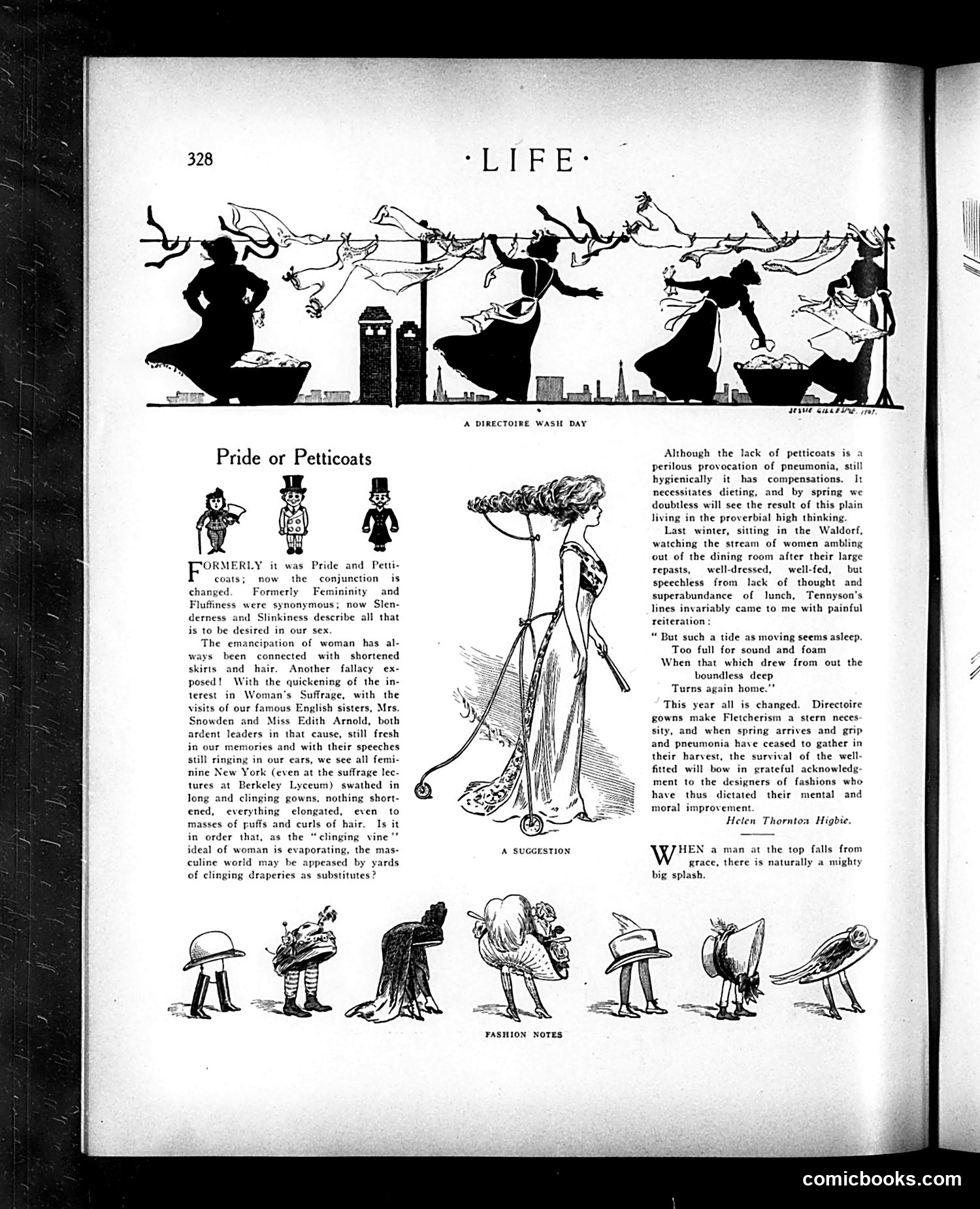
This page satirizes changing women's fashion and social roles in the early 20th century. The main article argues that women historically wore petticoats as symbols of "femininity and fluffiness," but fashion is shifting toward simpler, more practical clothing. The illustration shows a woman on a bicycle—a newly popular form of women's transportation that challenged Victorian dress conventions. The accompanying text references famous suffragettes like Mrs. Snowden and Edith Arnold, suggesting that practical clothing correlates with women's increasing independence and political activism. The "Fashion Notes" at bottom humorously depict hats and clothing items as standalone objects, mocking the era's extreme fashion accessories. Overall, the satire suggests anxiety about women abandoning restrictive Victorian dress alongside traditional gender roles.
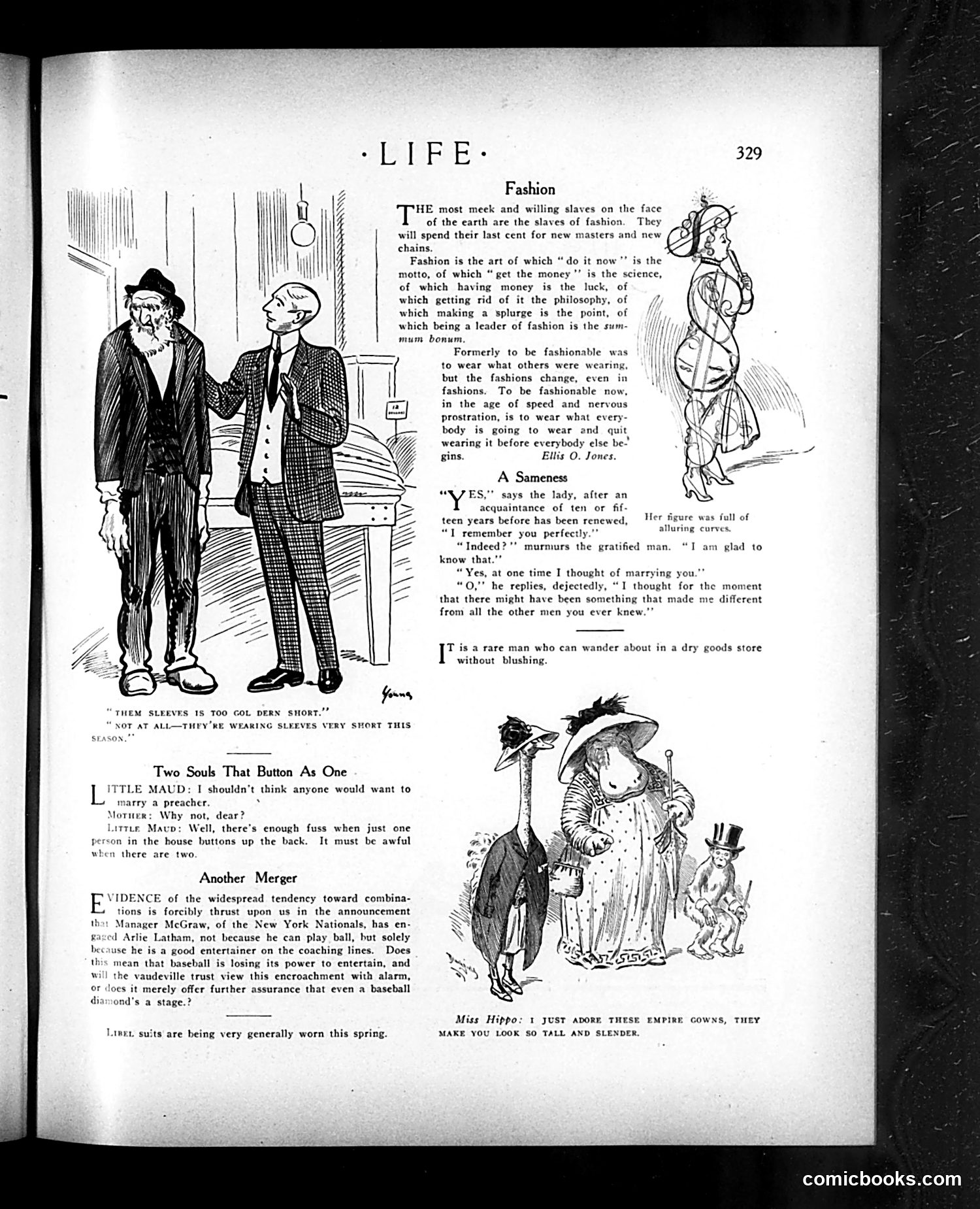
This page contains several satirical pieces about early 20th-century American society: **"Fashion"** mocks fashion's tyranny—the compulsion to constantly adopt new styles regardless of practicality. The essay critiques how fashionable people slavishly follow trends, with Elis O. Jones noting that being fashionable now means adopting styles before others do. **"A Sameness"** presents a humorous dialogue between a man and woman about their past, suggesting romantic nostalgia. **"Two Souls That Button As One"** jokes about marriage between a preacher and his wife, with the mother's observation that having two people "button up the back" (meaning they work as one unit) creates domestic friction. The cartoons and illustrations throughout satirize contemporary fashion absurdities and social conventions of the era.
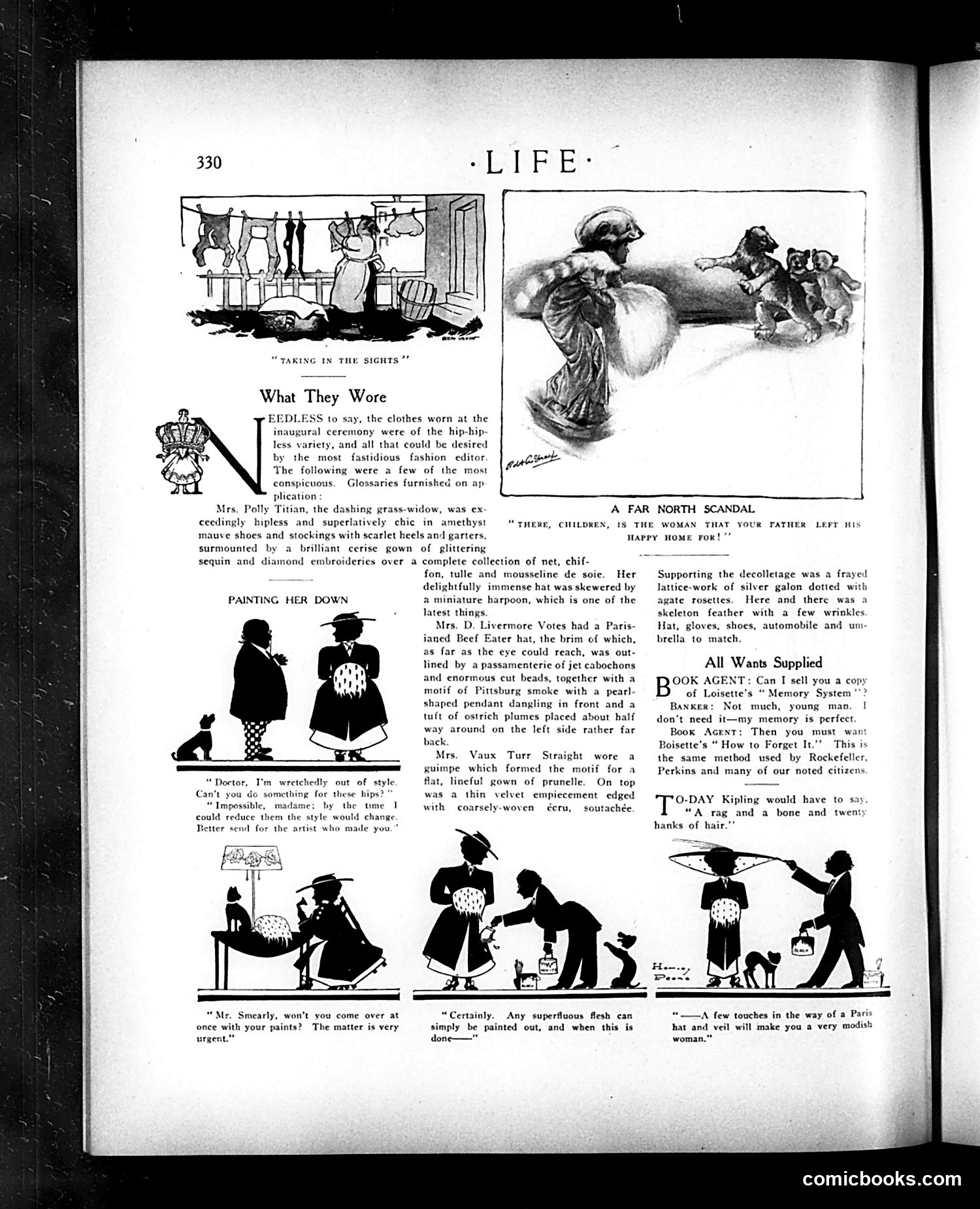
This page satirizes early 1900s women's fashion, likely following a high-society event (the "inaugural ceremony" referenced). The left column mocks excessive, absurd clothing details through mock-serious fashion descriptions—women wearing enormous hats secured with "miniature harpoons," garments trimmed with "Pittsburgh smoke," and impossible construction details. The bottom comics mock vanity and physical appearance: a woman asks her doctor to reduce her hips through medicine (he suggests cosmetic surgery instead); another wants a painter to "paint out" excess flesh. The "All Wants Supplied" section parodies self-help books and memory systems popular in the era. The right panel, "A Far North Scandal," shows a woman leaving her husband—a domestic crisis contrasted against the frivolous fashion obsession above, suggesting satirical commentary on women's priorities or the disconnection between fashionable society women and real life concerns. The satire targets conspicuous consumption and women's preoccupation with appearance over substance.
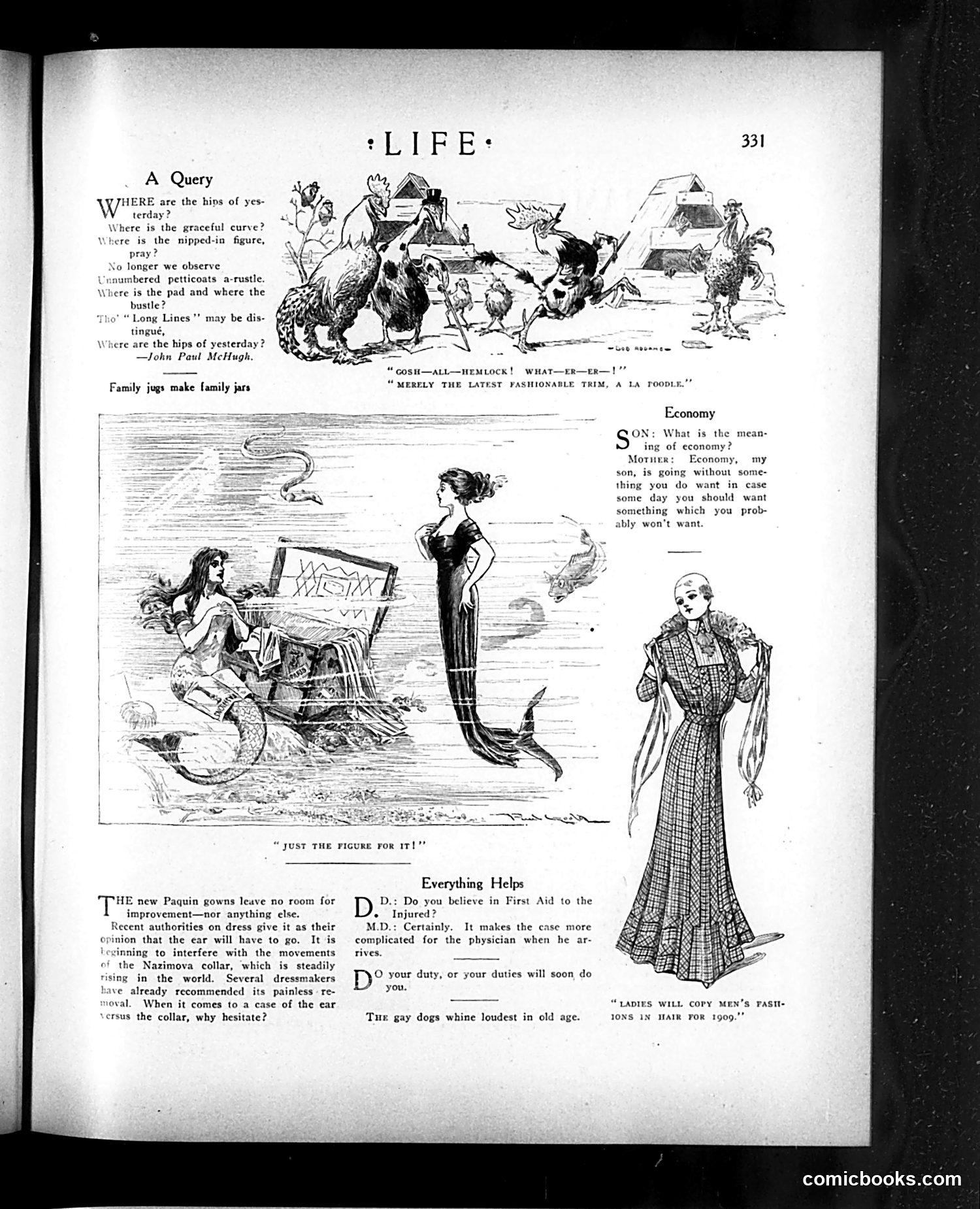
This page lampoons early 1900s fashion and social customs through multiple cartoons and humorous dialogues: **"A Query"** mocks the disappearance of Victorian silhouettes—the exaggerated hips, bustles, and petticoats that defined previous decades' women's fashion. The poet asks where these curves have gone, satirizing rapid fashion shifts. **"Just the Figure for It"** depicts a mermaid as the "latest fashionable trim"—absurdist humor about adopting extreme fashion trends without practical consideration. **"Economy"** defines the term cynically: sacrificing something you want now for something you probably won't want later—social commentary on middle-class financial anxiety. **"Everything Helps"** ridicules both high fashion designers (Paquin gowns) and the Nazimova collar, which apparently rose so high it interfered with movement and hearing. The satire suggests fashion designers prioritize style over functionality. The final caption predicts women will copy men's hairstyles in 1909, reflecting gender-norm anxieties of the era. Overall, the page satirizes fashion's absurdity, consumerism, and society's willingness to endure discomfort for style.
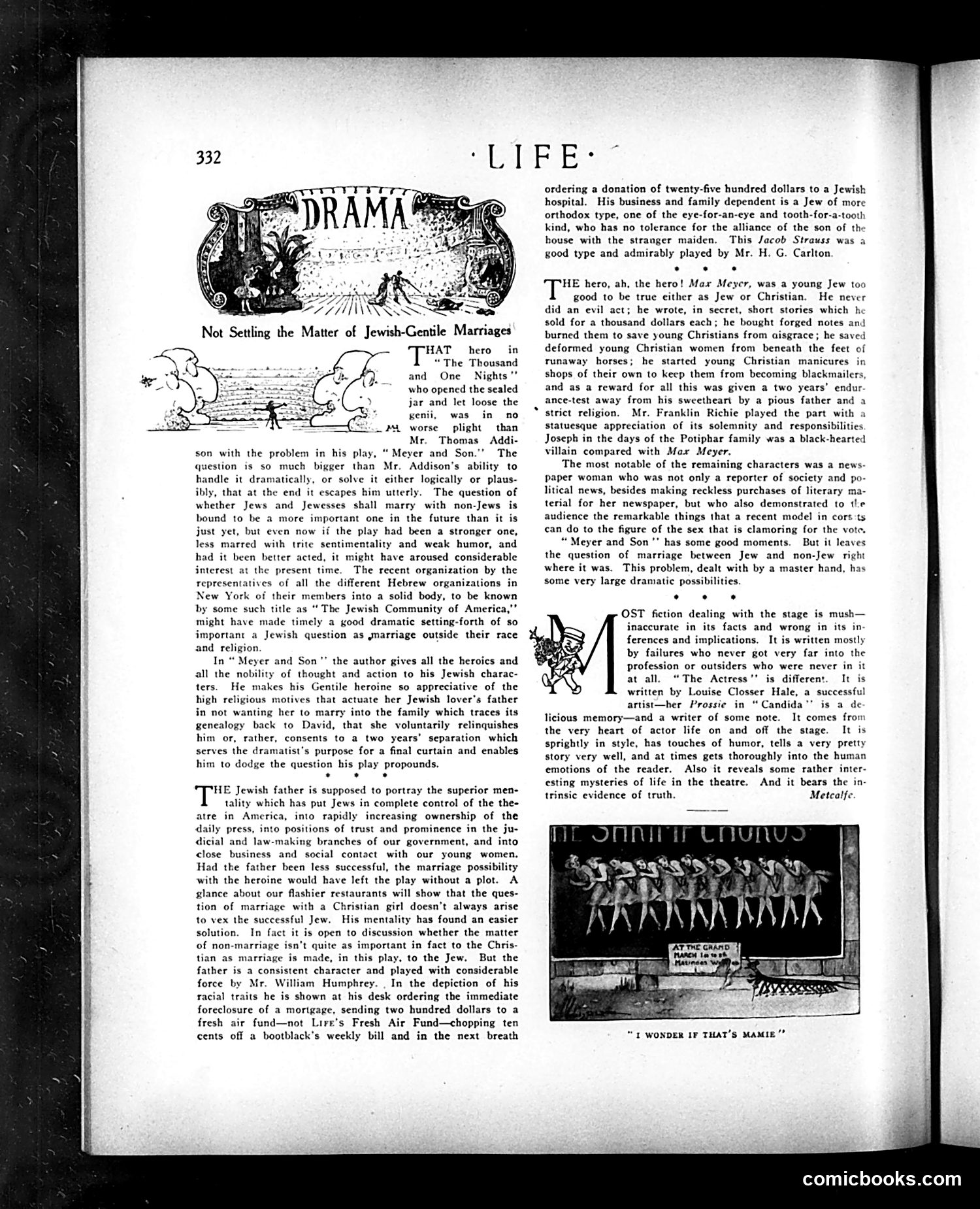
This page reviews the play "Meyer and Son" by Thomas Addison, examining its treatment of Jewish-Christian intermarriage—a contemporary social issue. The critic identifies the play's central tension: whether a Jewish man should marry a Christian woman. The review notes the playwright avoids resolving this question, instead having the Christian heroine voluntarily separate from her Jewish lover for two years. The critique contains **antisemitic commentary**, praising the Jewish father character for depicting Jewish "superiority" and "mentality," while sarcastically noting Jewish control of American theatres, press, and government positions. The character description emphasizes stereotypical Jewish traits: ruthless business practices alongside charitable donations to Jewish institutions. The hero, Max Meyer, is criticized as an unrealistic "too good to be true" character who performs implausibly noble deeds. The page reflects early 20th-century theatrical criticism intertwined with period prejudices about Jewish assimilation into American society.
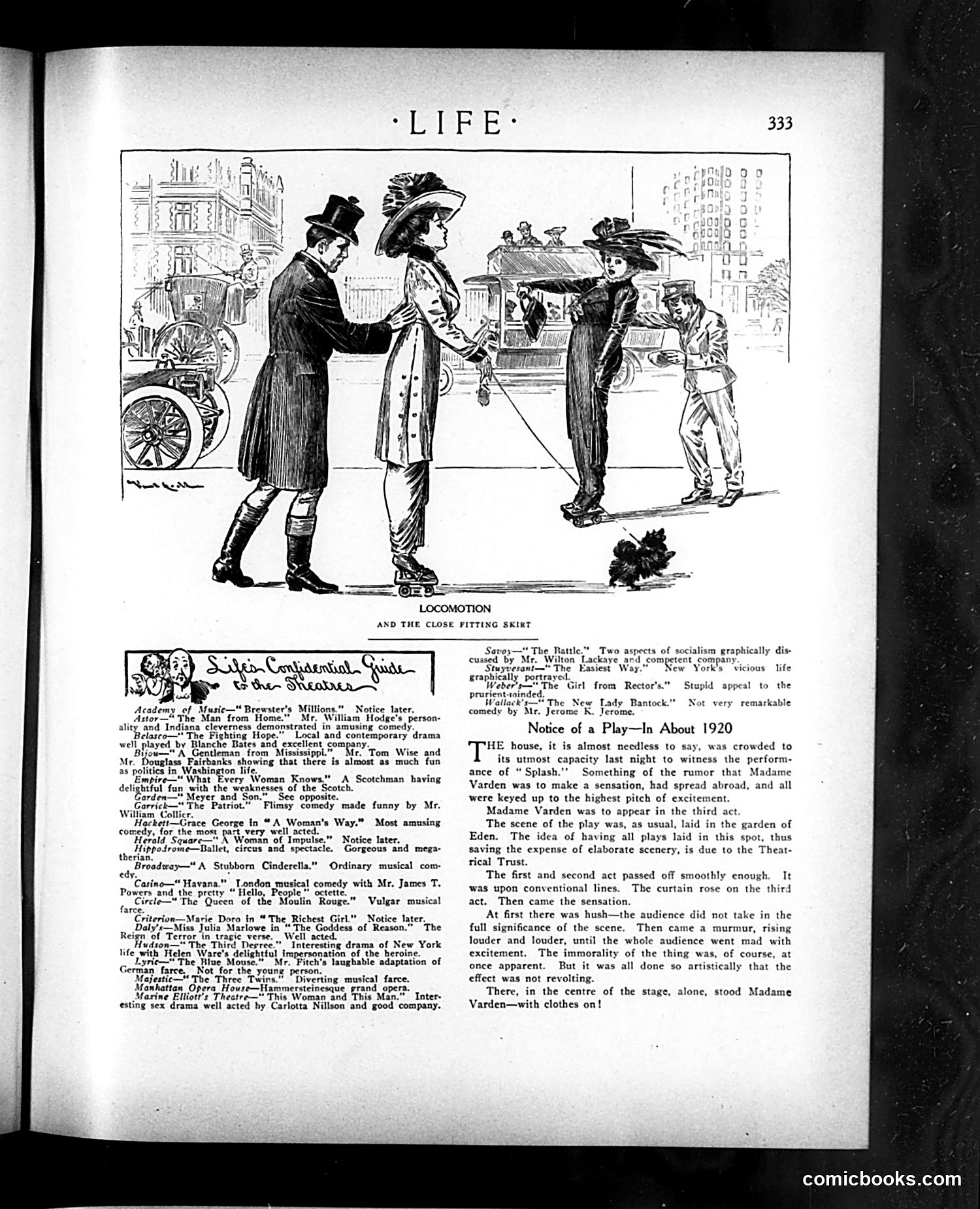
This page from *Life* magazine contains two distinct pieces of satire: **The Main Cartoon** ("Locomotion and the Close Fitting Skirt"): Shows a woman in fashionable dress being physically assisted by a man to walk—her tight skirt is so restrictive she cannot move freely. This mocks the impracticality and absurdity of early 1900s women's fashion, which prioritized appearance over function. The joke satirizes both the fashion industry's unreasonable demands on women and society's acceptance of clothing that literally immobilizes them. **"Notice of a Play—In About 1920"**: A humorous prediction that by 1920, theatrical scandals will have become so extreme that merely showing a woman *fully clothed* on stage will be shocking—the ultimate reversal of current trends toward less modest costumes. It satirizes both the theater's apparent race toward moral impropriety and the "Theatrical Trust's" cost-cutting measures (using the Garden of Eden set repeatedly). Both pieces critique early 20th-century culture: fashion's impracticality and theater's sensationalism.
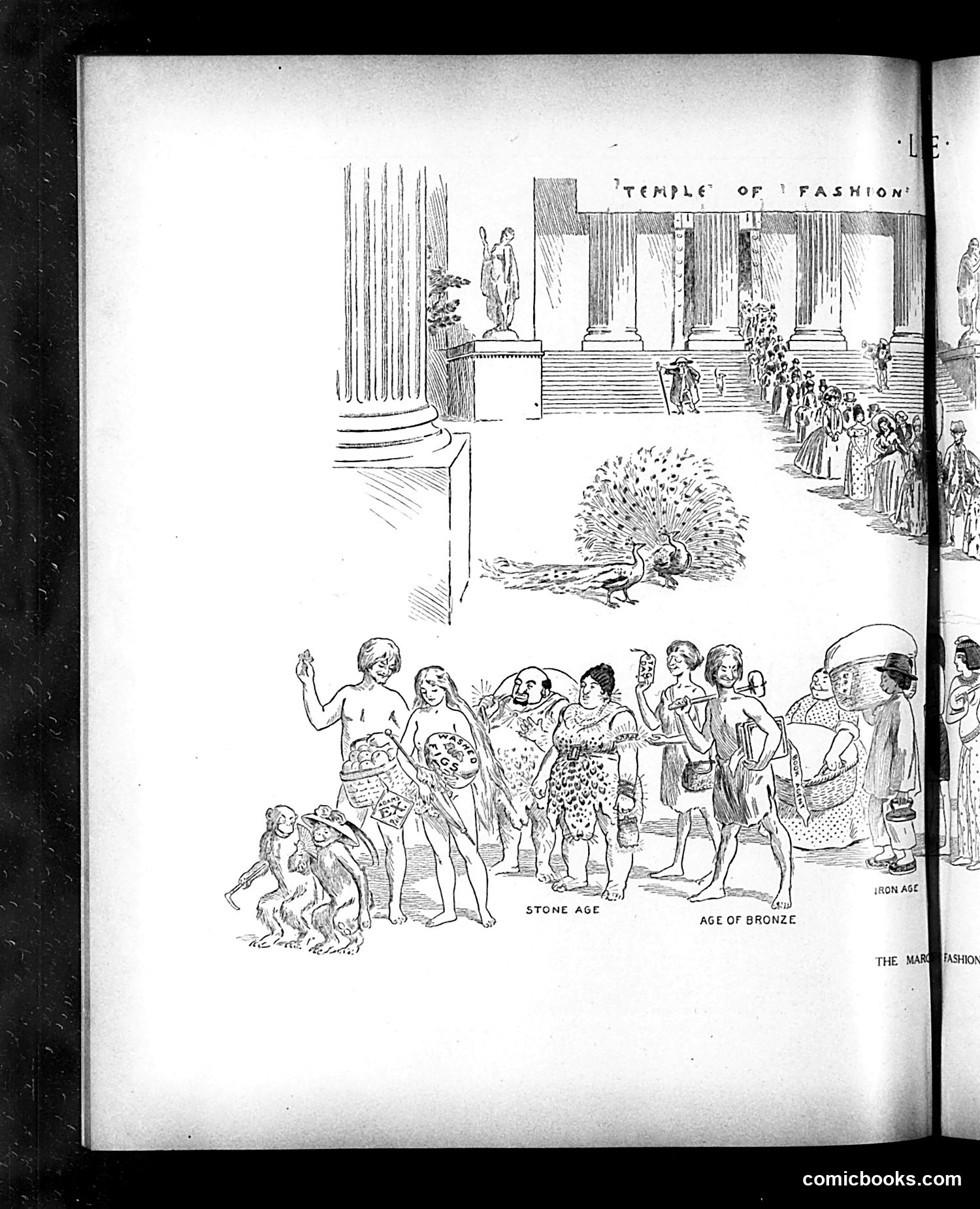
This satirical cartoon contrasts human evolution with fashion cycles. The bottom panel shows three historical periods—Stone Age, Age of Bronze, and Iron Age—each depicting people in progressively more clothed states, mimicking archaeological progression. The top panel shows an elaborate "Temple of Fashion" with classical columns and well-dressed spectators, featuring a peacock displaying its plumage. The joke appears to be that fashion operates like a natural evolutionary cycle, yet modern high society treats fashion trends as sacred or inevitable—much like nature itself. The satire mocks how fashionable society elevates clothing choices to near-religious significance, following trends as automatically as humans evolved through prehistoric ages. It suggests fashion devotion is primitive instinct dressed up as civilization.
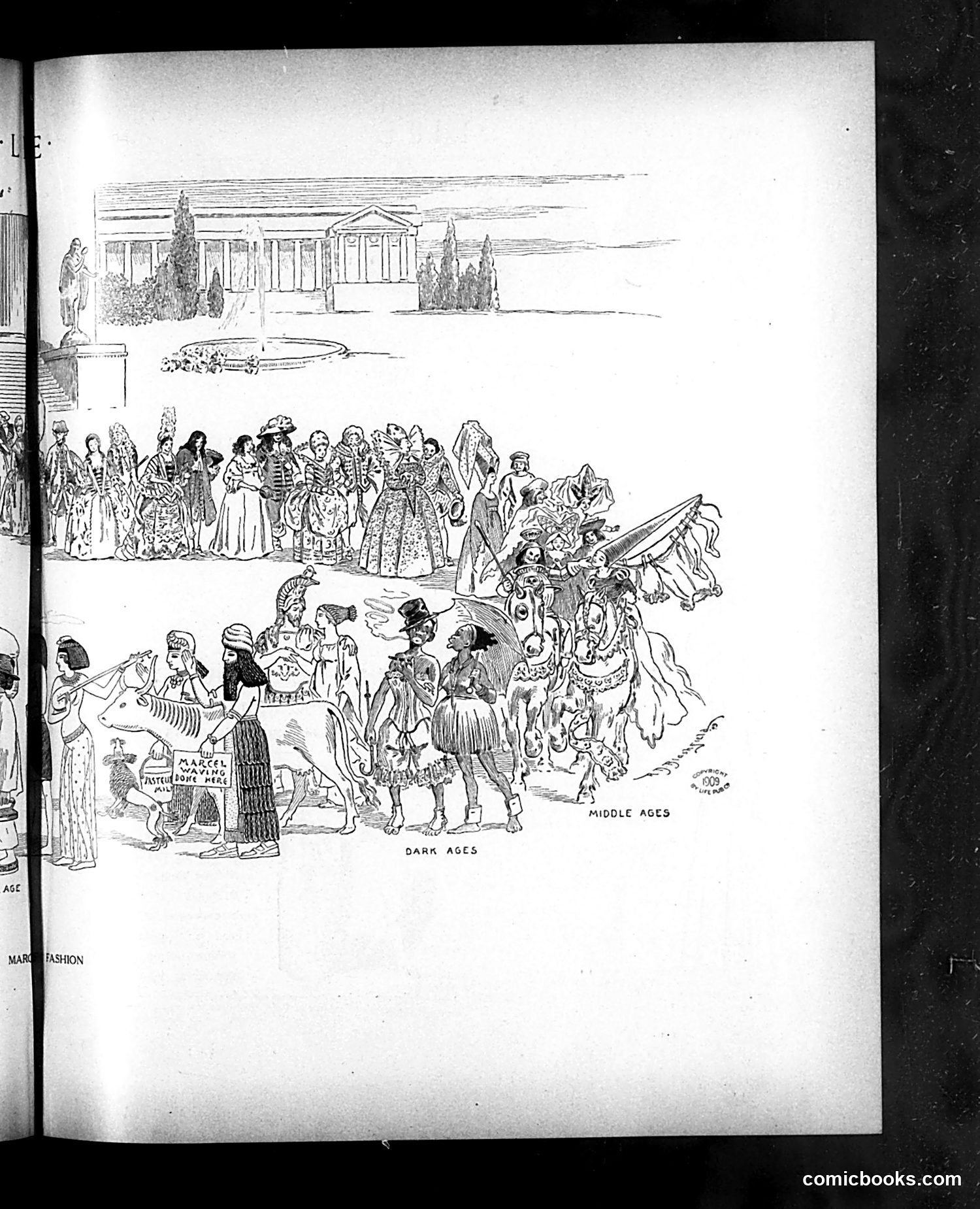
This satirical illustration contrasts two historical periods through fashion and society. The bottom section labeled "DARK AGES" depicts medieval figures in ornate period costumes—nobles on horseback, clergy, and courtiers in elaborate dress. The upper section labeled "MIDDLE AGES" shows similarly dressed figures in a formal gathering near a classical building. The satire appears to mock the notion that these periods were actually distinct, suggesting instead that both eras were characterized by similarly ostentatious, impractical fashion and rigid social hierarchies. By depicting them nearly identically, the cartoonist implies that the "progress" between these historical periods was negligible—both ages were equally "dark" in terms of fashion excess and social dysfunction. The joke critiques how little substantive change separated these supposedly different historical eras.
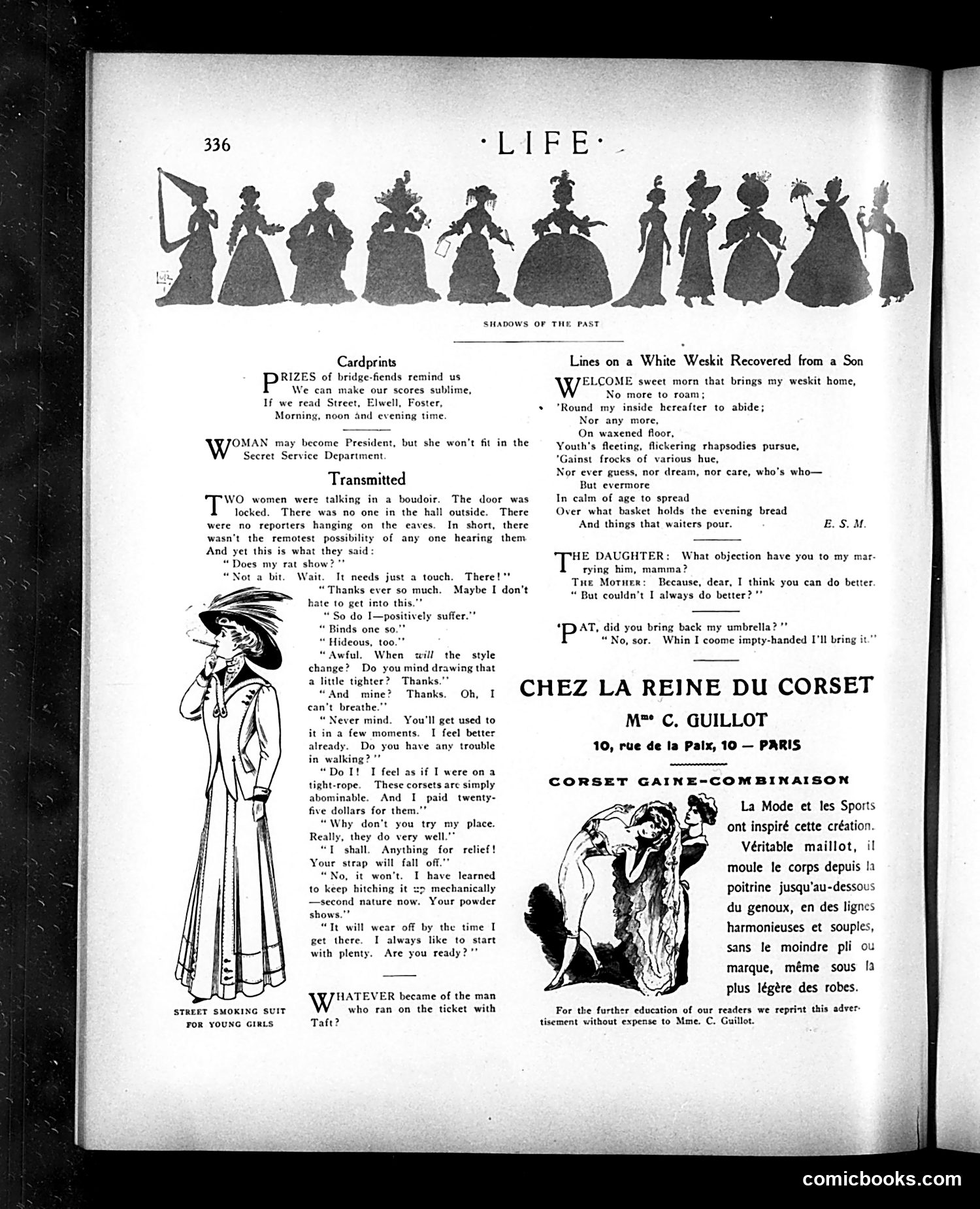
This Life magazine page satirizes early 20th-century women's fashion, specifically the restrictive corset culture. **The Main Cartoon:** The silhouette series titled "Shadows of the Past" shows the evolution of women's clothing styles, documenting historical fashion changes. **The Boudoir Dialogue:** The central joke mocks women complaining about corsets while wearing them anyway. Two women discuss how corsets are "abominable," cause breathing difficulty, restrict walking, and cost $25—yet they continue wearing them, accepting the discomfort as normal ("second nature"). The satire critiques both the impracticality of the fashion and women's apparent acceptance of self-inflicted suffering for appearance. **Additional Content:** A poem about a "weskit" (vest/corset); a brief exchange about marriage prospects; and a French corset advertisement (likely included ironically, given the page's criticism of corsets). **Historical Context:** This reflects the Progressive Era debate over women's fashion and freedom, predating widespread adoption of less restrictive clothing.
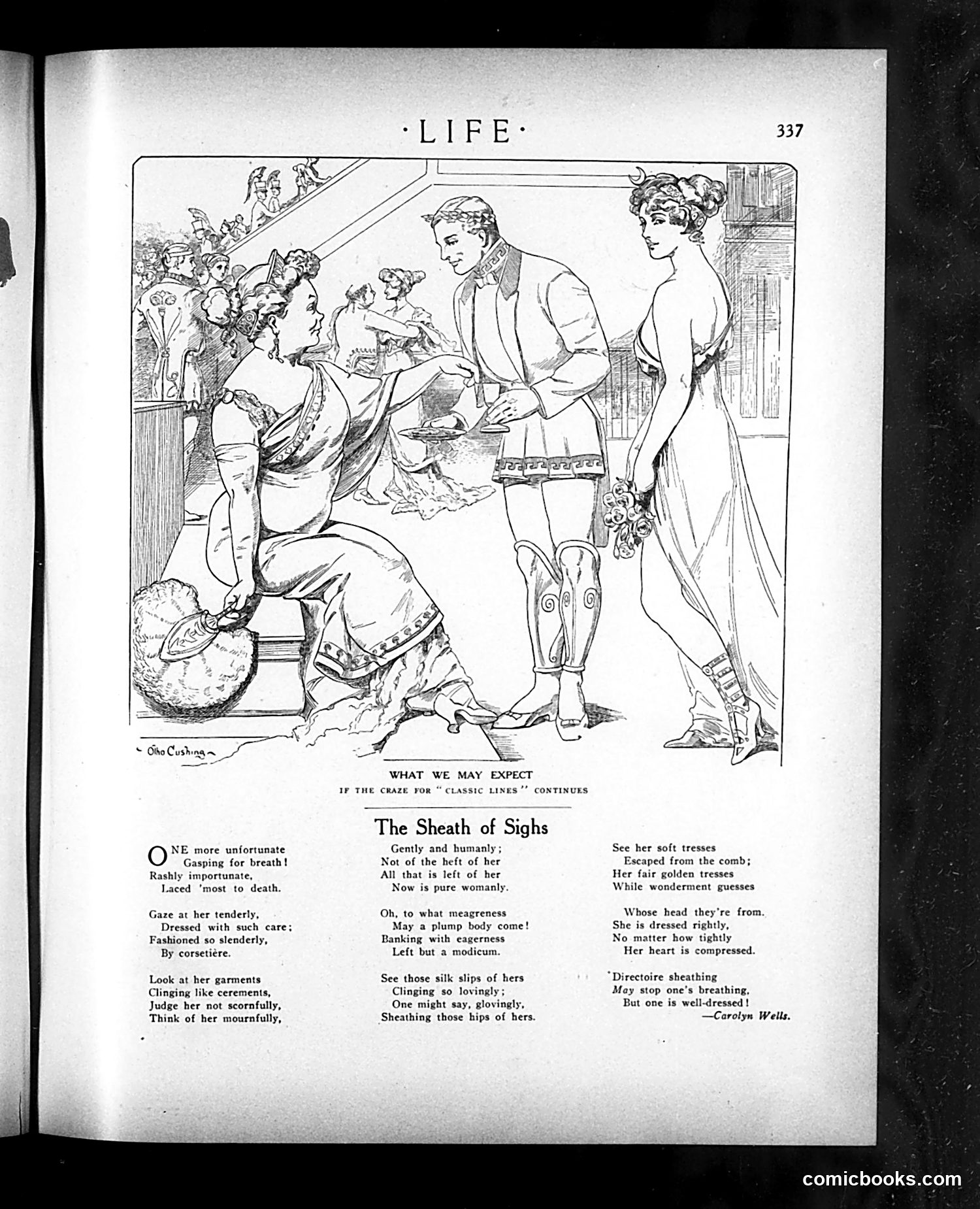
This page satirizes the early 1900s fashion craze for "classic lines" and the extremely tight-fitting "Directoire" or "sheath" dress style. The illustration shows a woman so severely corseted she appears nearly skeletal, attended by fashionable onlookers. The satire mocks the absurdity of this trend: women are literally suffocating themselves—"laced 'most to death"—to achieve a fashionably slim silhouette. The poem by Carolyn Wells emphasizes the physical cost ("may stop one's breathing") while sarcastically celebrating that "one is well-dressed." The cartoon warns that if this "craze for 'classic lines'" continues, women will waste away to nothing. It's social commentary on how fashion standards override health and common sense, with women sacrificing their bodies for appearance. The tone is darkly humorous but genuinely concerned about women's wellbeing.
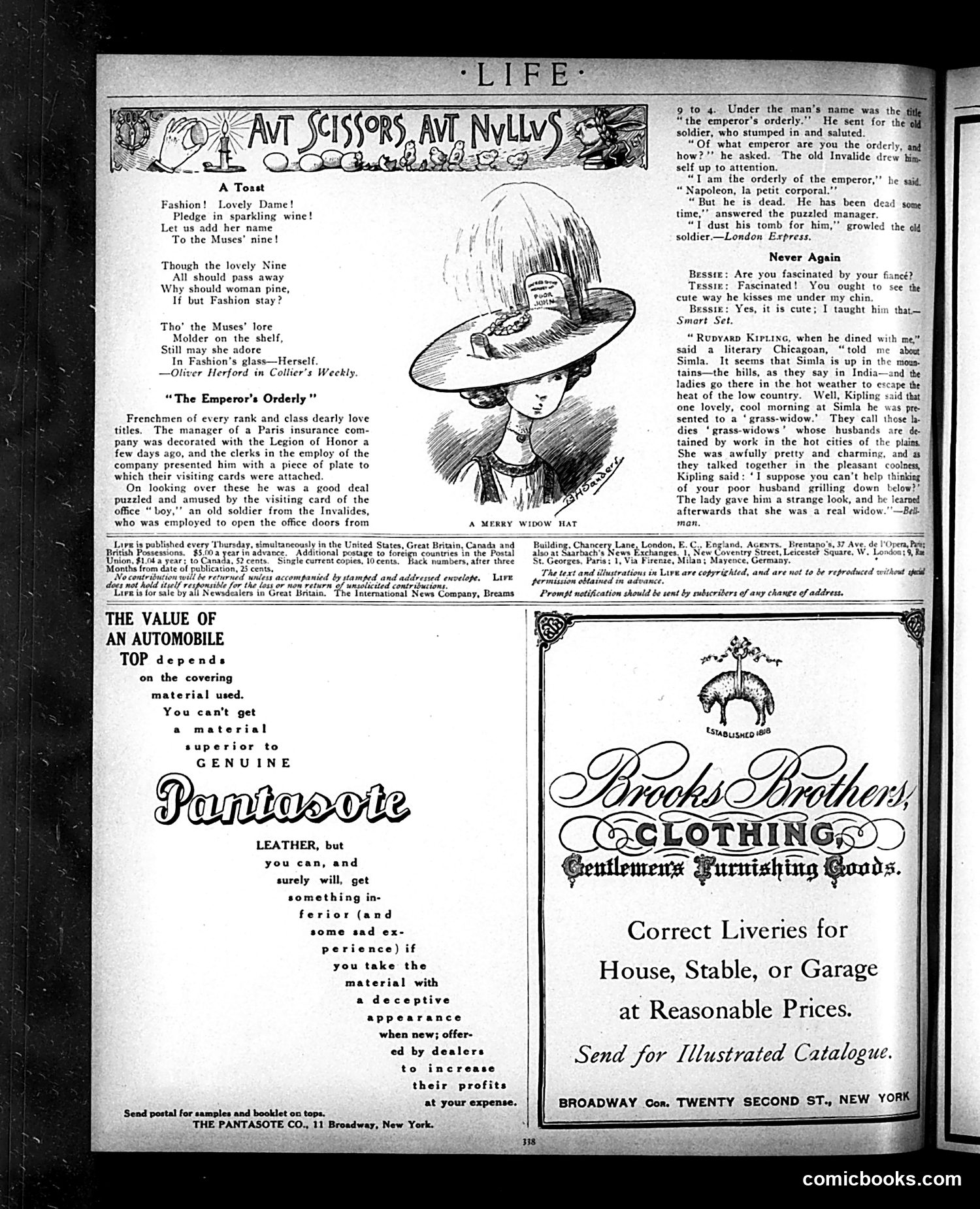
This page features three separate humorous pieces satirizing social pretension and romantic delusion: **"The Emperor's Orderly"**: An anecdote mocking French obsession with titles. A Paris office boy, a retired soldier, lists himself as "the emperor's orderly"—meaning Napoleon's. When questioned, he reveals he merely dusts Napoleon's tomb, yet maintains the grandiose title. The humor lies in the absurd gap between pretended importance and actual menial work. **"Never Again"**: A brief joke about a woman teaching her fiancé to kiss awkwardly under her chin, later regretting it when she discovers he's actually a widower—implying she's now stuck with his bad habits. **The Kipling anecdote**: A literary reference (Rudyard Kipling) about meeting a "grass-widow" (woman temporarily separated from her husband in India's hot season). The punchline: the lady was actually a real widow, making Kipling's sympathetic comment about her "poor husband grilling below" mortifyingly inappropriate. The page otherwise contains period advertisements for automobile tops and men's clothing.
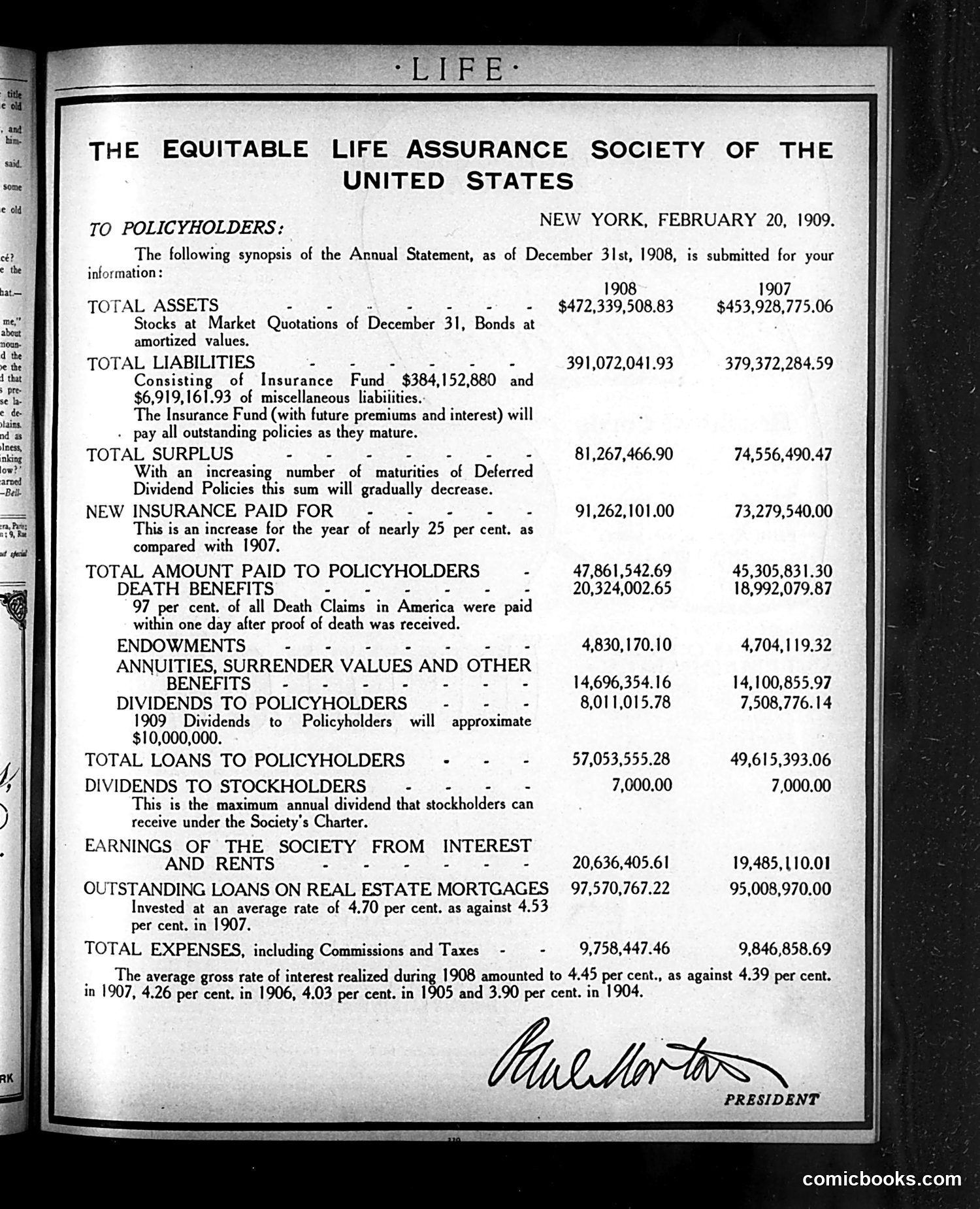
This page is **not a cartoon or satirical content**—it's a corporate financial statement. The Equitable Life Assurance Society submitted this annual report to policyholders in *Life* magazine (February 20, 1909), presenting year-end 1908 financial data. The document shows comparative figures between 1908 and 1907, highlighting growth: total assets increased from ~$454M to ~$472M; new insurance paid rose 25%; death benefits paid reached $20M. The company emphasizes efficiency (97% of death claims paid within one day) and profitability. For modern readers: This represents corporate financial disclosure in the Progressive Era, when major insurance companies advertised their stability and reliability directly to customers through mass media—a trust-building tactic during an era of business scandals and reform movements.
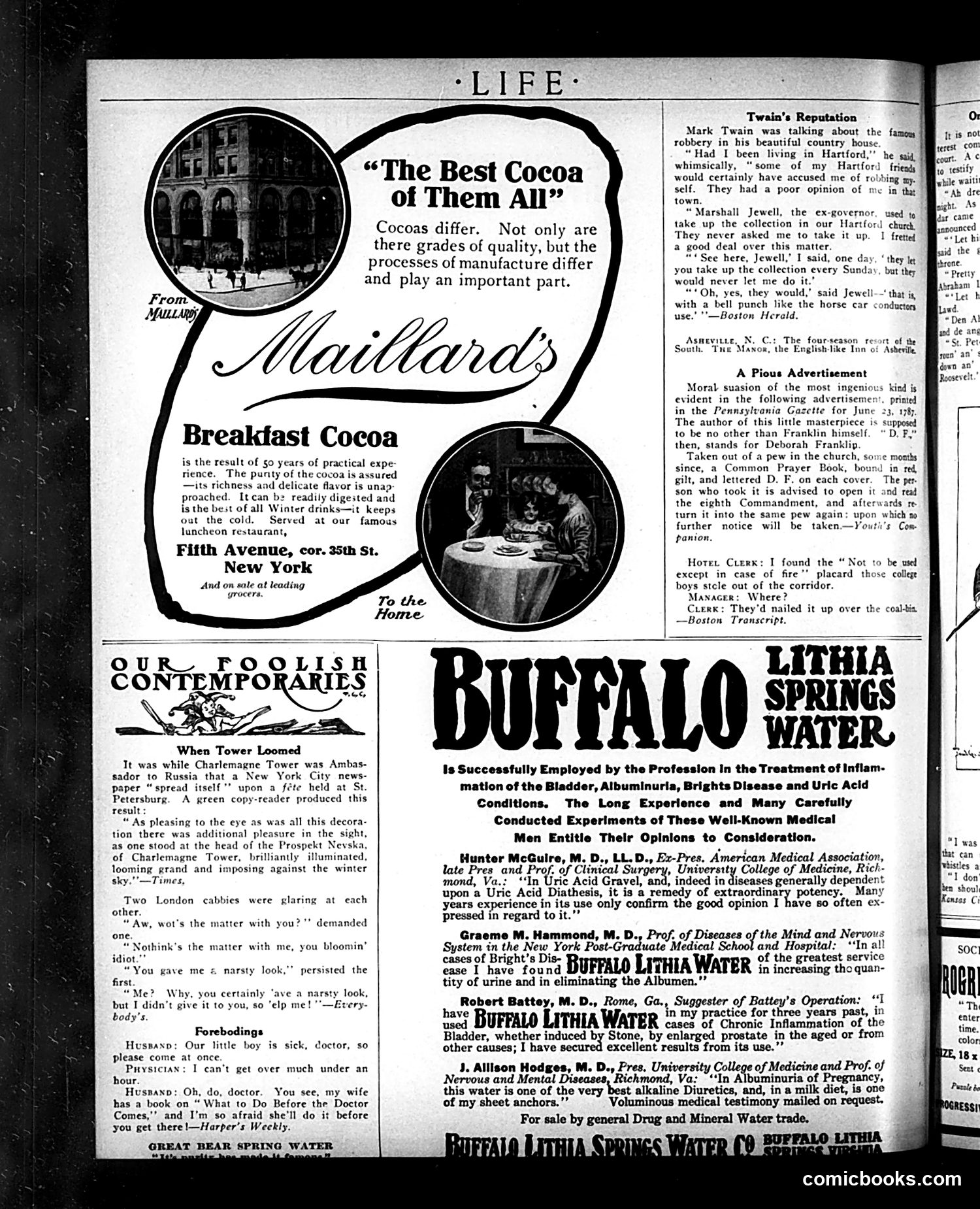
This page contains primarily **advertisements and humorous anecdotes**—not political cartoons. The main features are: **Advertisements**: Maillard's Breakfast Cocoa (top) and Buffalo Lithia Springs Water (right)—medical testimonials claiming the water treats bladder and kidney ailments. These reflect early 20th-century patent medicine marketing, exploiting perceived health concerns with pseudo-scientific endorsements. **Humorous Anecdotes**: - "Twain's Reputation": A Mark Twain story about being distrusted in his Hartford hometown (self-deprecating humor) - "Our Foolish Contemporaries": Examples of newspaper errors and absurd misunderstandings (like a reporter describing Charlemagne Tower as "illuminated" in a news dispatch) - "Forebodings": A joke about a doctor refusing to visit a patient whose wife has a self-help medical book The page exemplifies *Life* magazine's satirical formula: mocking careless journalism, social pretension, and gullibility—here particularly the credulity of medical advertising.
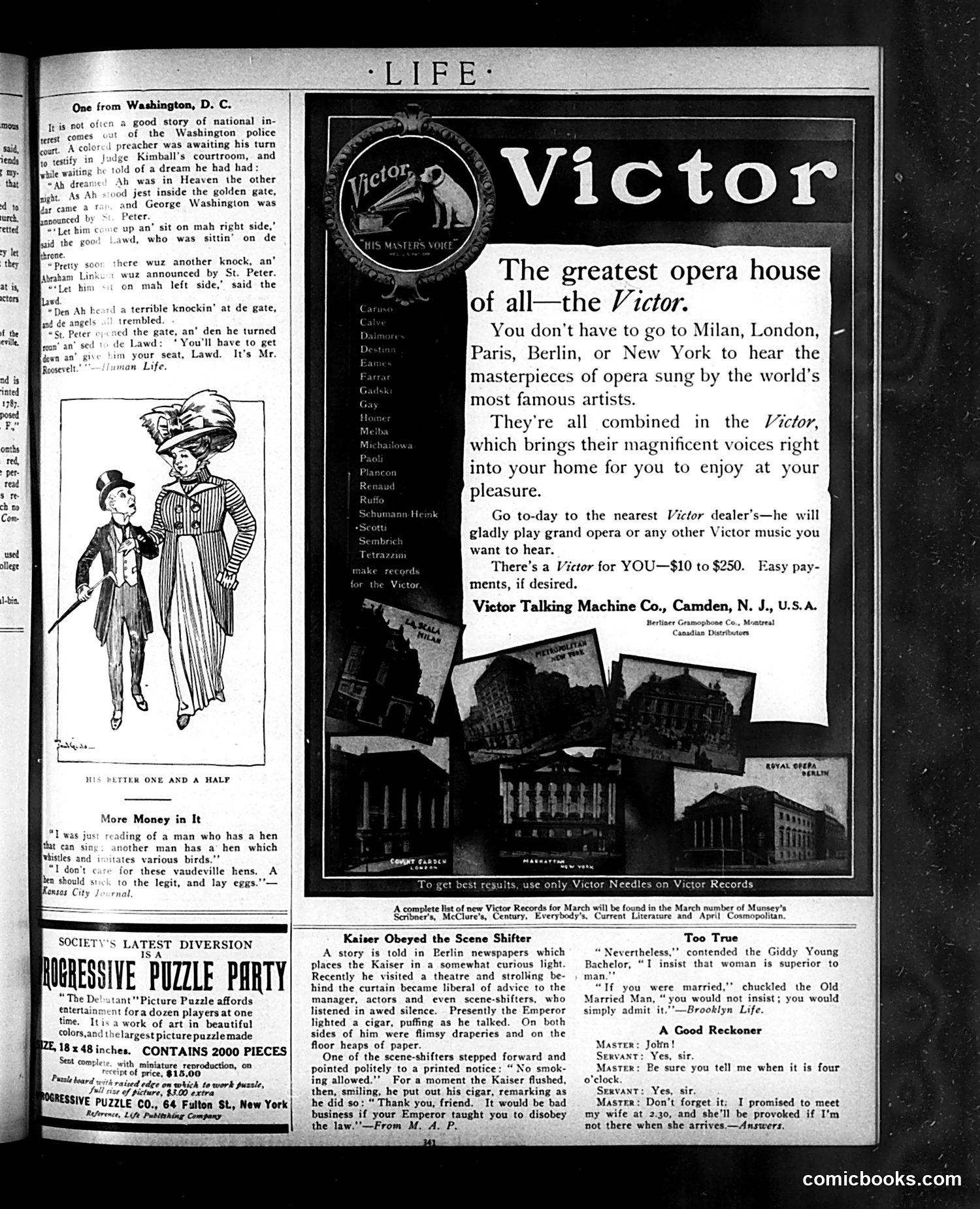
This page contains mostly **advertising and humor snippets** rather than political cartoons. The main content includes: 1. **"One from Washington, D.C."** — A joke about a colored preacher dreaming of Heaven, where St. Peter (identified as George Washington) seats him, then must remove him when Mr. Roosevelt arrives, implying Roosevelt's social priority over the preacher. This reflects early-1900s racial hierarchies. 2. **Victor Talking Machine advertisement** — A straightforward ad promoting phonograph records of famous opera singers. 3. **"More Money in It"** — A vaudeville joke about hens with different talents. 4. **"Kaiser Obeyed the Scene Shifter"** — A humorous anecdote about German Kaiser Wilhelm II respecting a theater's no-smoking rule, portraying him as surprisingly law-abiding. 5. **Brief humor pieces** about puzzles, marriage, and servant punctuality. The page is primarily **commercial and light entertainment** rather than satirical commentary. The Roosevelt reference is the only political element, reflecting contemporary American social attitudes.
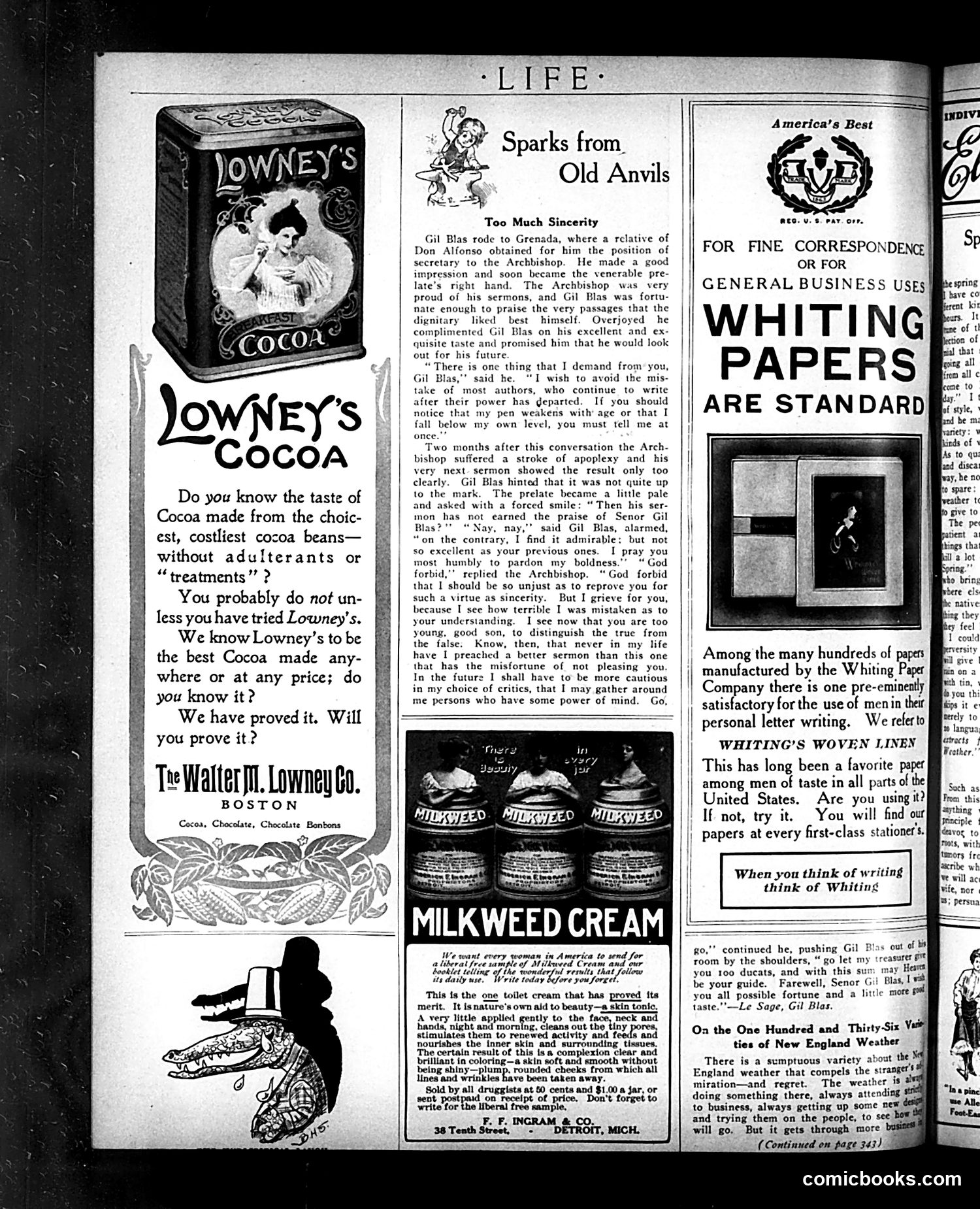
This page is primarily **advertising**, with one substantial literary piece sandwiched between commercial notices. The main content is "Sparks from Old Anvils," a satirical anecdote about **Gil Blas**, a young secretary who promises his Archbishop superior to honestly critique his sermons if his work declines. When the Archbishop suffers a stroke and delivers a noticeably inferior sermon, Gil Blas tactfully mentions it—only to be dismissed as too immature to recognize quality. **The satire's point**: The story mocks how powerful figures demand honesty while actually punishing candid feedback. The Archbishop wanted flattery disguised as sincerity; when given genuine critique, he rejects the critic rather than accept criticism. It's a commentary on human nature—how people claim to value truth but reward only agreeable opinions. The surrounding ads (Lowney's Cocoa, Milkweed Cream, Whiting Papers) are typical of Life's commercial content during this era.
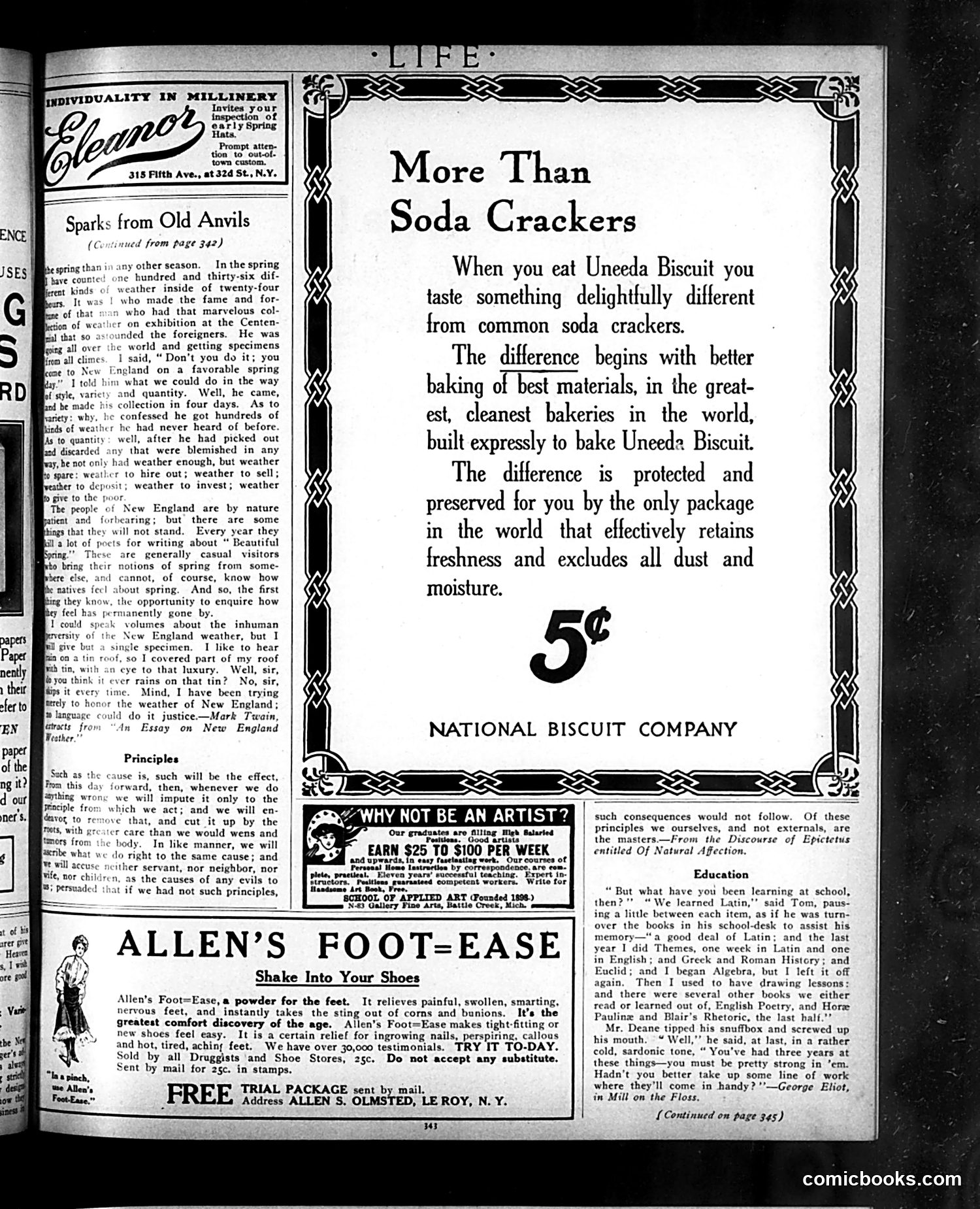
This page is primarily **advertisements interspersed with editorial content**, not political satire. The main content includes: 1. **"Sparks from Old Anvils"** — a humorous essay about New England weather, referencing Mark Twain's famous essay. It's nostalgic Americana, not satire. 2. **Uneeda Biscuit ad** — standard product advertising claiming superiority over generic soda crackers through better materials and packaging. 3. **"Why Not Be an Artist?"** — a vocational school advertisement offering art instruction. 4. **Allen's Foot-Ease ad** — a patent medicine advertisement for foot powder, a common product category of the era. 5. **"Education"** — an excerpt from what appears to be a literary work about a student's schooling, including classical subjects (Latin, Greek, rhetoric). **No political cartoons or satire** are present on this page. It represents typical early 20th-century *Life* magazine content: a mix of humor pieces, advertisements, and literary excerpts with no particular political message.
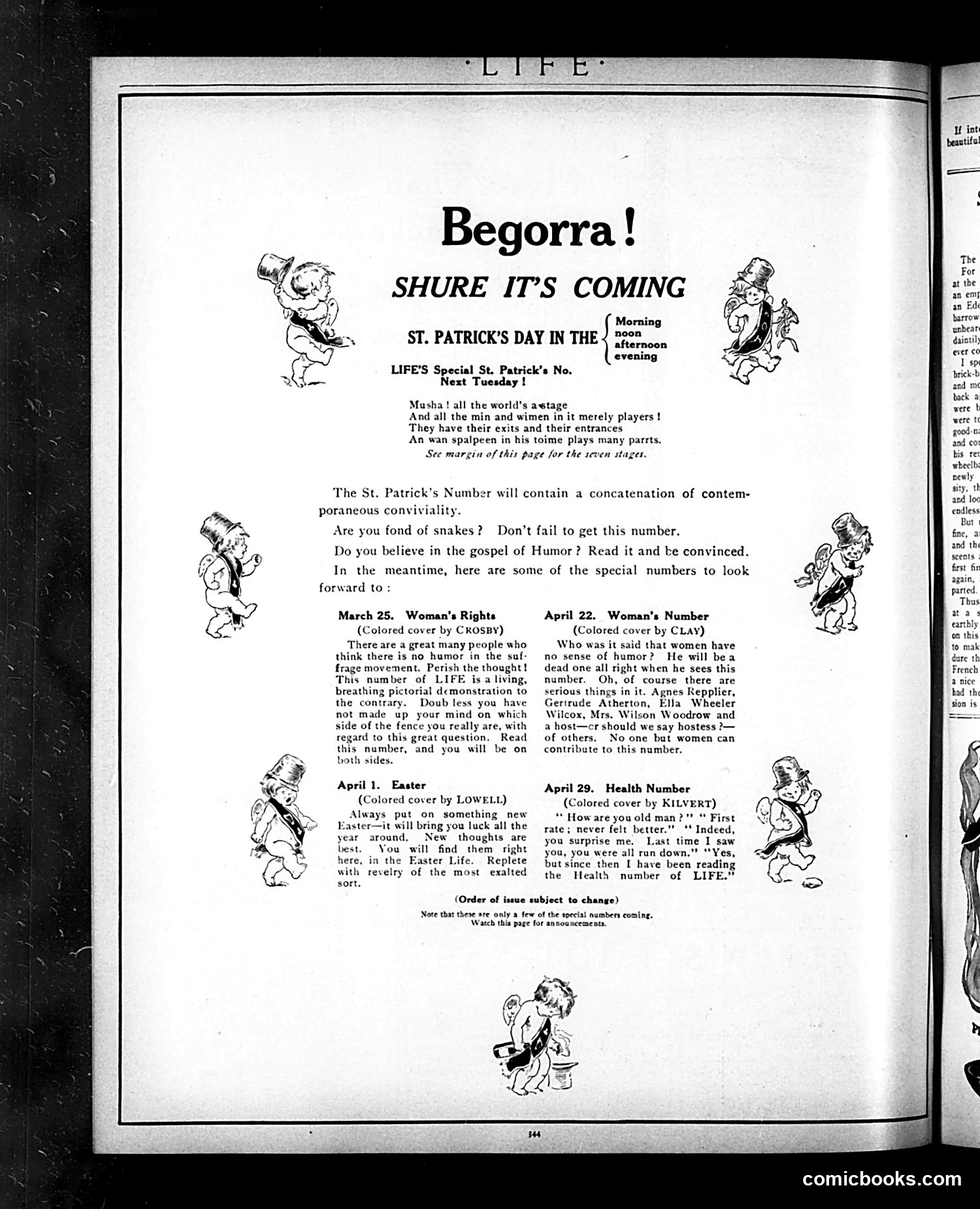
This is a promotional page for *Life* magazine's upcoming St. Patrick's Day issue, using Irish-American stereotypes common in early 20th-century American humor. The leprechaun illustrations and phonetic Irish dialect ("Begorra," "Shure," "spalpeen") reflect how Irish immigrants were caricatured in period media. The page announces several themed special issues: Woman's Rights (March 25), Easter (April 1), Woman's Number (April 22), and Health (April 29). For the Woman's Rights issue, *Life* claims humorous neutrality on suffrage—readers will find arguments "on both sides"—a joke about the magazine's satirical approach to this contentious political debate of the era. The Woman's Number credits female writers like Gertrude Atherton and references "Mrs. Wilson Woodrow," likely relating to First Lady Ellen Wilson. Overall, this promotional material reveals *Life*'s strategy: combining ethnic humor with topical social issues (women's suffrage, health, Easter) to attract diverse readers through comedy.
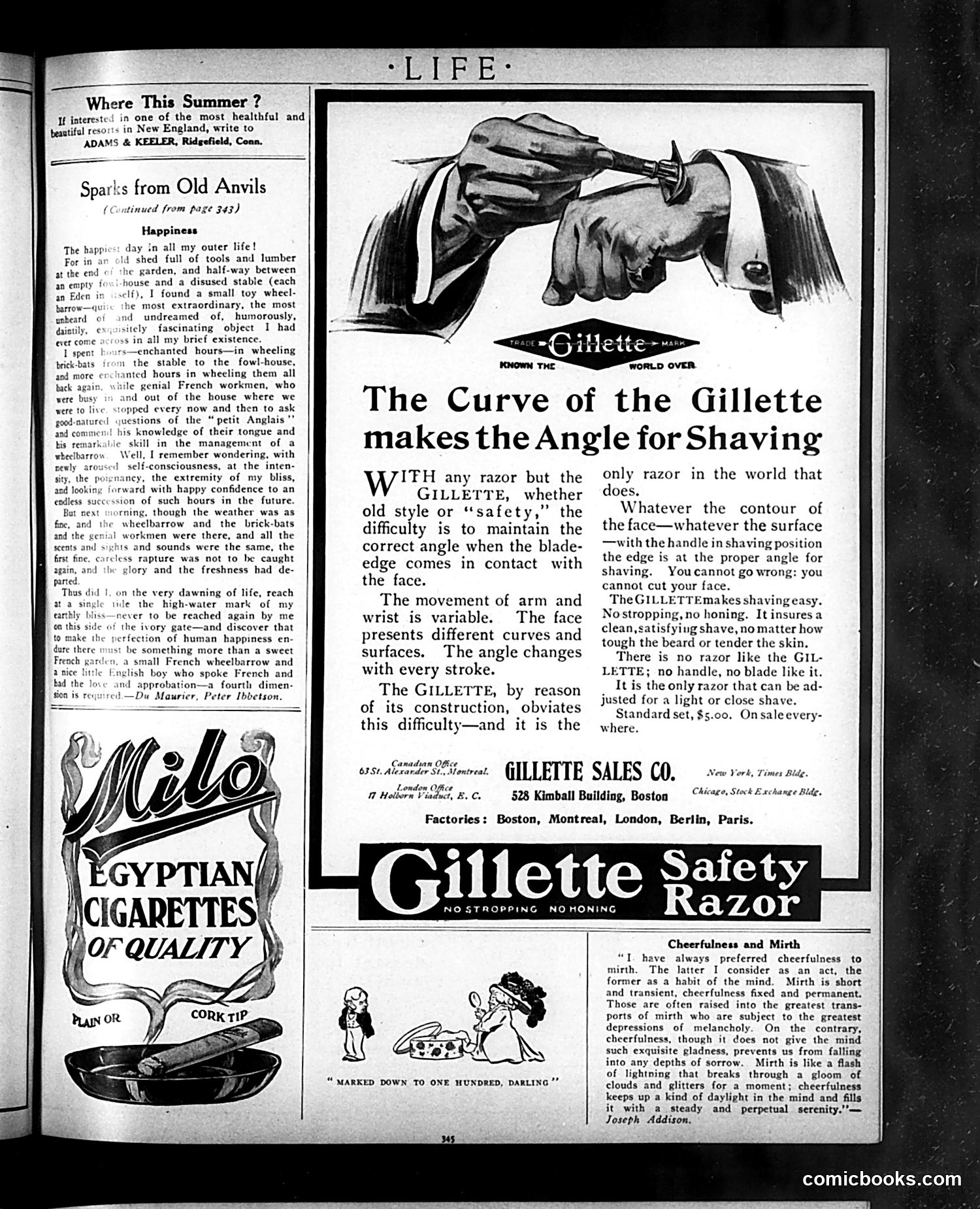
This is primarily **an advertising page** rather than editorial content. The main feature is a **Gillette Safety Razor advertisement** showcasing the razor's ergonomic design—specifically how its curved handle maintains the correct shaving angle regardless of facial contours. The ad emphasizes convenience: "no stropping, no honing," appealing to modern efficiency. The page also includes: - **Milo Egyptian Cigarettes ad** (left sidebar) - A nostalgic essay titled "Sparks from Old Anvils" describing childhood joy—likely meant to create emotional resonance with readers - A quote on "Cheerfulness and Mirth" attributed to Joseph Addison, offering genteel wisdom The **satire is minimal**; this appears to be a straightforward commercial publication mixing consumer goods advertising with light literary content. The juxtaposition of sentimental reminiscence with razor technology represents typical early-20th-century magazine strategy: pairing uplifting editorial material with product pitches to create a pleasant reading experience that encourages purchasing.
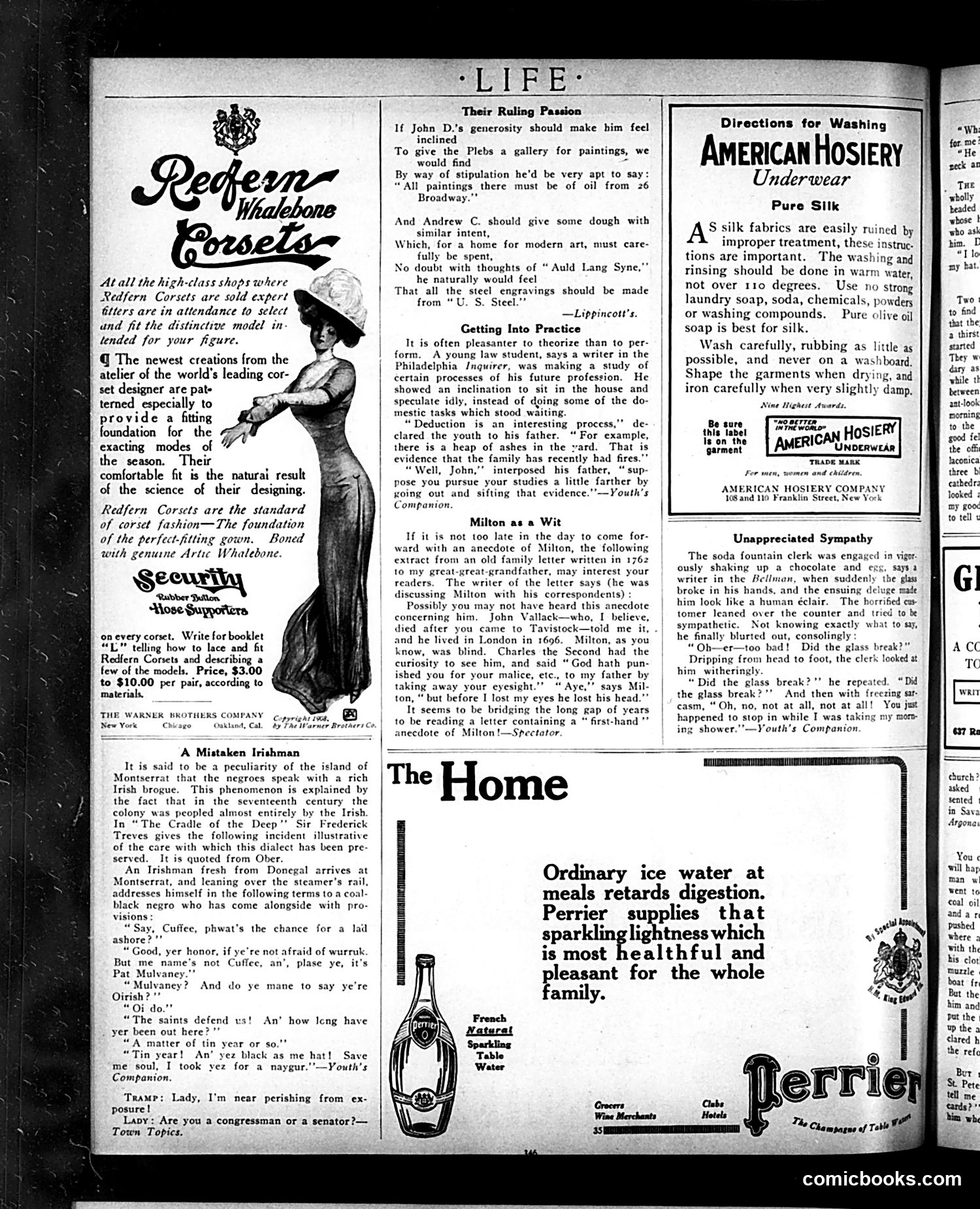
This page from Life magazine contains several satirical pieces and advertisements typical of early 20th-century American humor: **"Their Ruling Passion"** mocks wealthy industrialists John D. Rockefeller and Andrew Carnegie for their philanthropic self-interest. The satire suggests that if these oil and steel magnates donated art galleries, they would stipulate that only works featuring their own industries be displayed—turning charity into advertising for their businesses. **"A Mistaken Irishman"** is a dialect humor piece playing on Irish immigrant speech patterns, recounting an encounter between an Irish immigrant and a Black man in Montserrat who also speaks with an Irish brogue (explained by historical Irish colonial settlement). **Other brief jokes** include wordplay about congressmen and sympathy, and a father's sarcastic response to his son's overeager application of deductive reasoning. The advertisements promote corsets, hosiery, and Perrier water—typical luxury goods marketed to affluent readers.
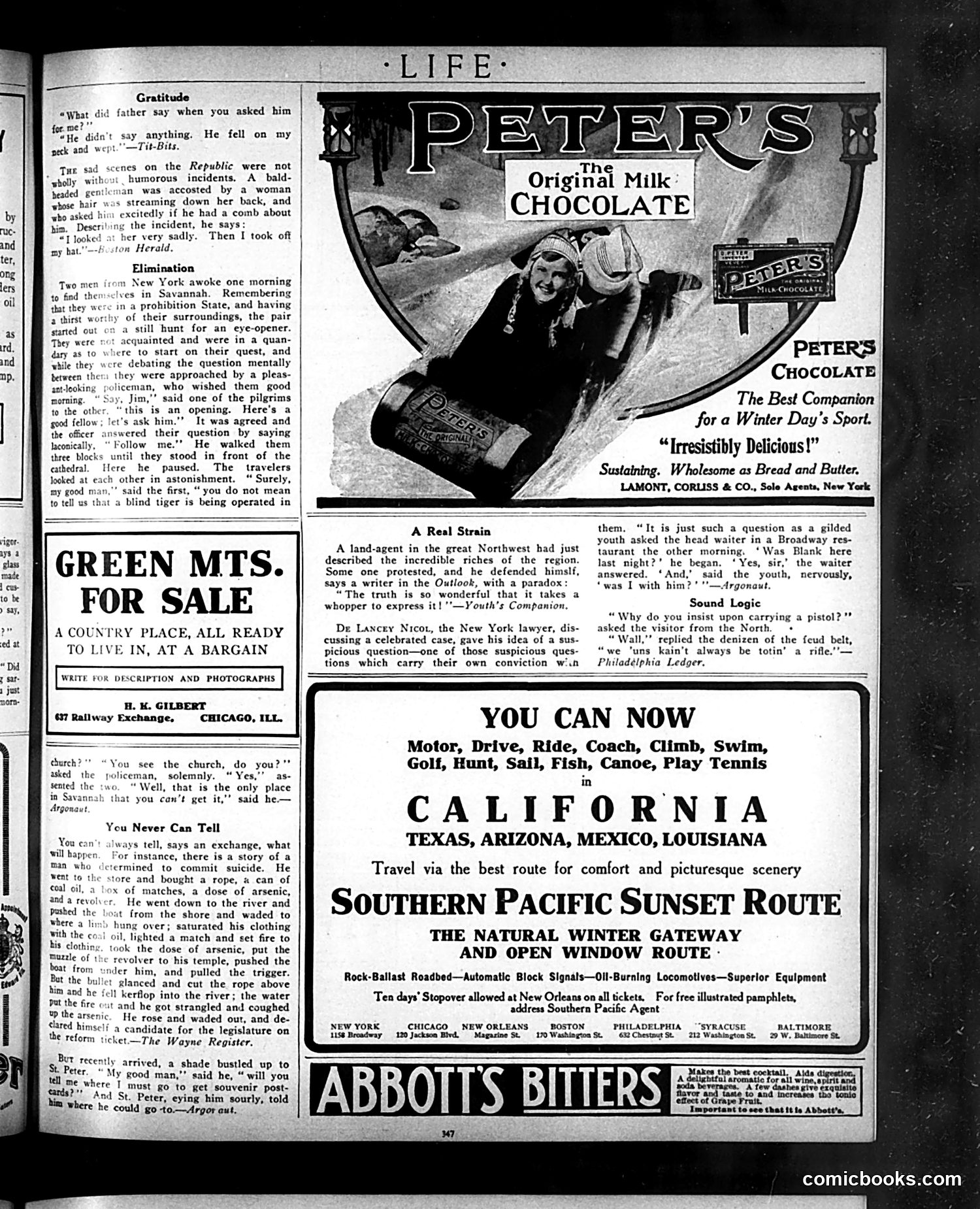
This page from **Life** magazine (a satirical publication, now public domain) contains several short humorous anecdotes typical of early 20th-century American humor, alongside period advertisements. The jokes play on contemporary social issues: **Prohibition** (the "Elimination" story about two men seeking an "eye-opener" in a dry state, directed to a cathedral as the only place alcohol isn't available—mocking both Prohibition enforcement and church hypocrisy). Another anecdote satirizes the absurdity of suicide methods gone comically wrong. A third jokes about Southern feuding culture and gun-carrying. The advertisements promote **Peter's Chocolate**, **real estate in the Green Mountains**, and the **Southern Pacific Sunset Route** for winter travel to warm climates—reflecting leisure activities available to affluent readers. The humor is gentle, moralistic satire typical of the era, relying on wordplay and situational irony rather than sharp political commentary. The page reflects American life during Prohibition and the early automobile age.
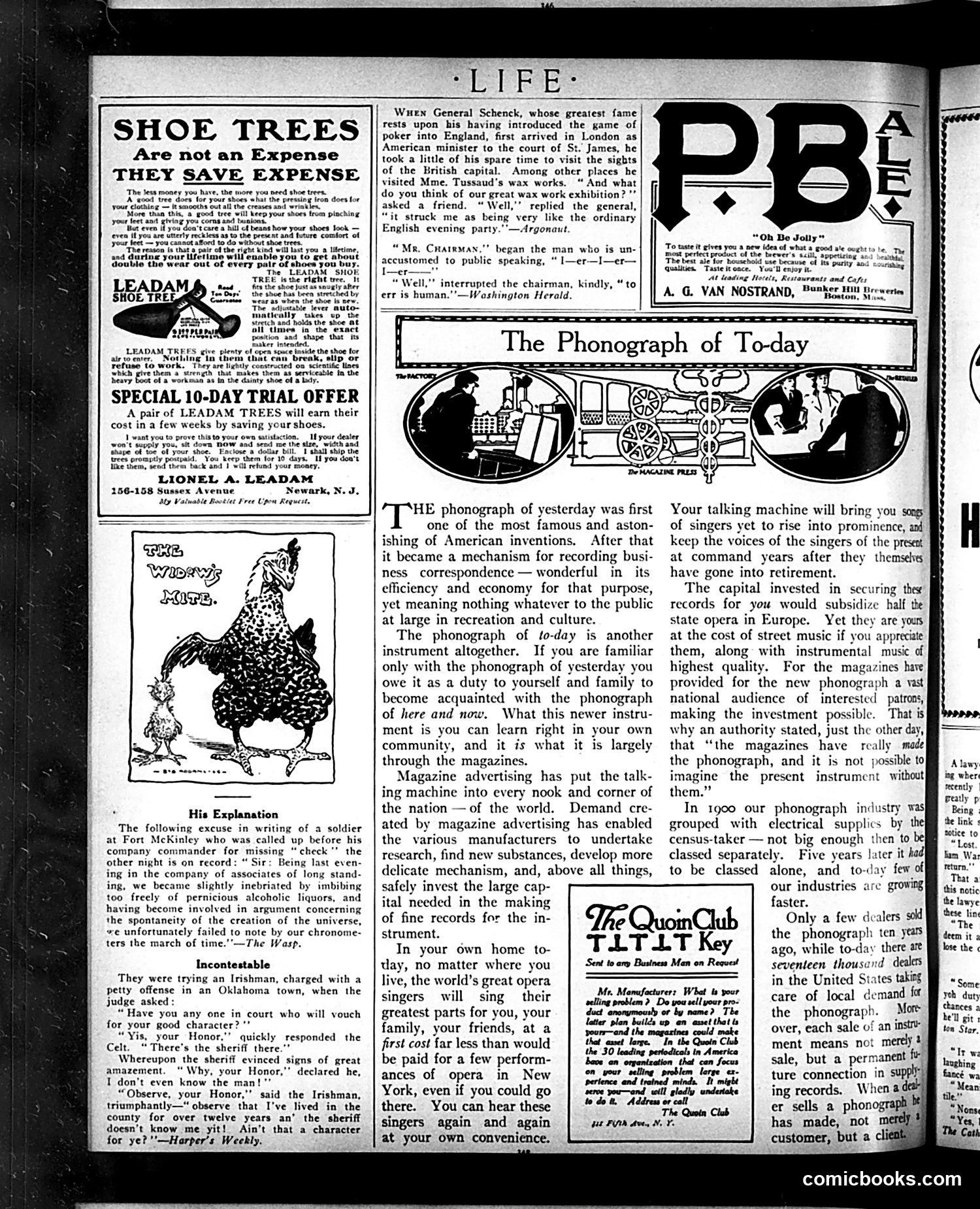
This page is primarily **advertising and humor** rather than political satire. The main content includes: **Advertisements:** Shoe trees (Leadam brand) dominate the left side, promising durability and foot comfort. **Humorous anecdotes:** Three separate jokes appear: 1. A soldier's verbose excuse for missing military check-in, blamed on philosophical debate while drunk 2. An Irish defendant's paradoxical defense—his 12-year residence yet the sheriff's non-recognition supposedly proves good character 3. General Schenck's dismissive comparison of Madame Tussauds wax figures to "ordinary English evening party" **Main feature:** "The Phonograph of To-Day" discusses how phonographs have evolved from novelty to serious home entertainment, enabling people to enjoy opera singers and high-quality music domestically. The accompanying illustration shows phonographs in domestic settings. The humor relies on wordplay, ethnic stereotypes (Irish dialect), and absurdist logic typical of early-20th-century *Life* magazine's satirical approach.
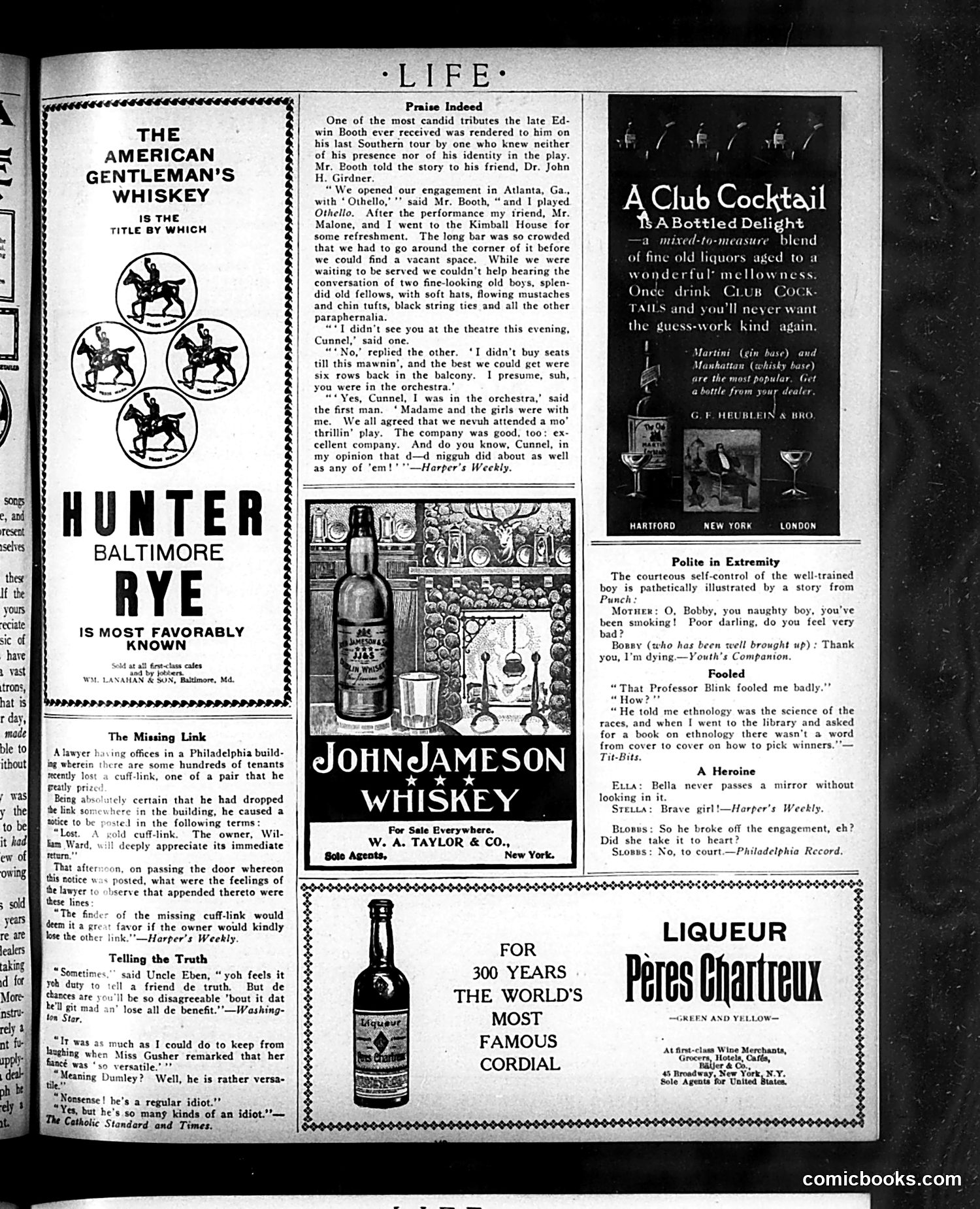
This page is primarily **advertising and humor content** from an early 20th-century Life magazine, during Prohibition or its aftermath. The main illustrated story, "Praise Indeed," recounts Edwin Booth (a famous 19th-century actor) performing in *Othello*. Two Southern gentlemen at a bar, unaware they're discussing the lead actor, compliment the production—but conclude that the Black actor "did about as well as any of 'em," a backhanded compliment reflecting racist attitudes of the era. The page is dominated by **whiskey and liquor advertisements** (Hunter Baltimore Rye, John Jameson, Club Cocktails, Peres Chartreux liqueur)—notable given this was published during American Prohibition (1920-1933), when such advertising was technically illegal but persisted in magazines. Smaller humor items ("The Missing Link," "Telling the Truth," "Polite in Extremity," "Fooled") are brief jokes exploiting wordplay and social awkwardness—typical Life magazine filler humor of the era. The page reflects period attitudes: casual racism, flouting of Prohibition law, and genteel social comedy.
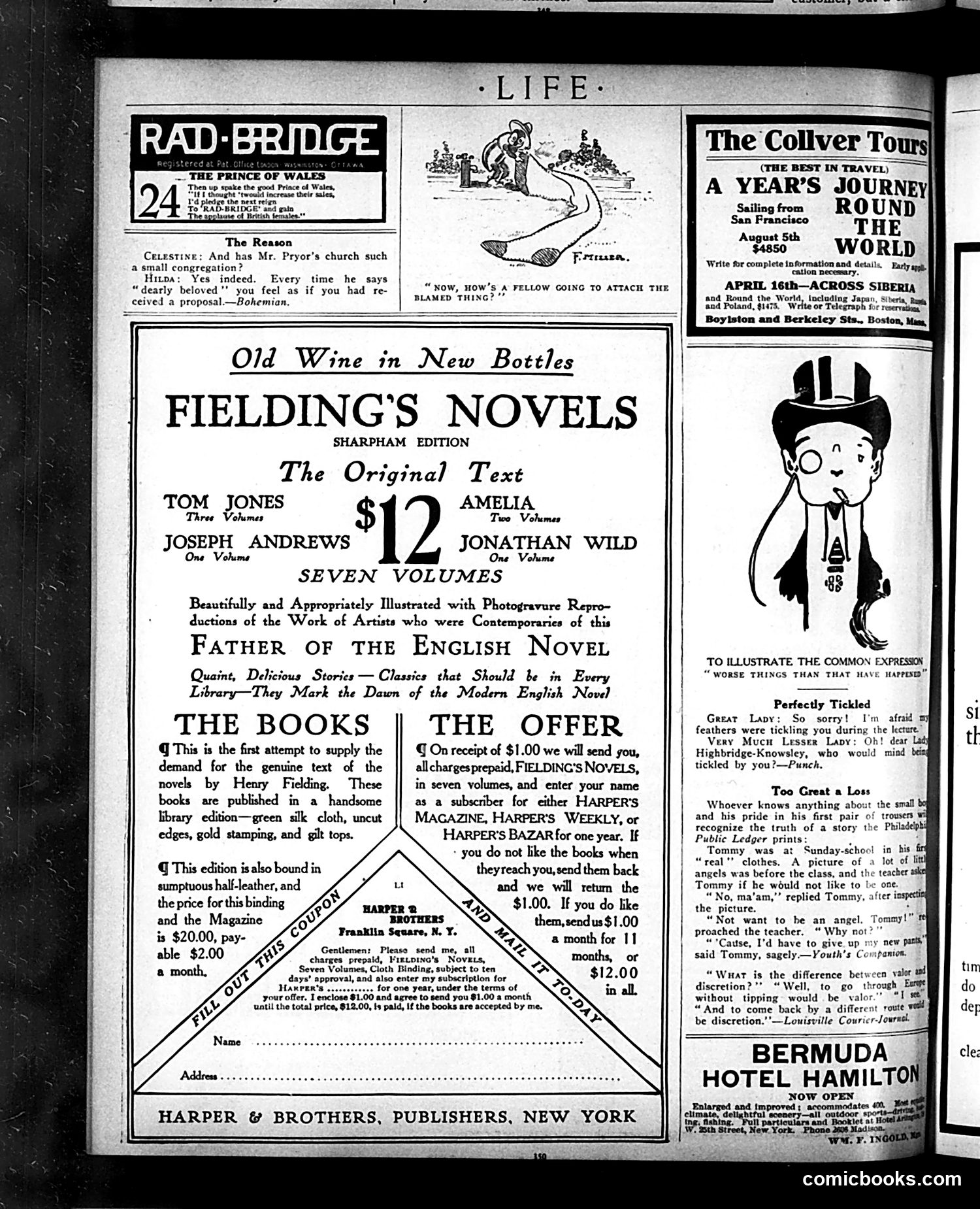
This page is primarily **advertising and literary content**, not political satire. The main feature is a book advertisement for Fielding's Novels (a classic 18th-century English work) offered through Harper & Brothers publishers. The page includes two brief humorous anecdotes: 1. **"The Reason"** — A joke about a clergyman (Mr. Pryor) with such a small congregation that when he says "dearly beloved," it feels like a marriage proposal to the few attendees. 2. **"Perfectly Tickled"** and **"Too Great a Loss"** — Two separate short jokes from *Punch* magazine about social etiquette and a child reluctant to become an angel because he'd lose his new pants. These are gentle, domestic humor pieces typical of early 20th-century magazines—no political commentary or identifiable caricatures. The page reflects the era's advertising style and wholesome comic sensibility rather than satirical cartooning.
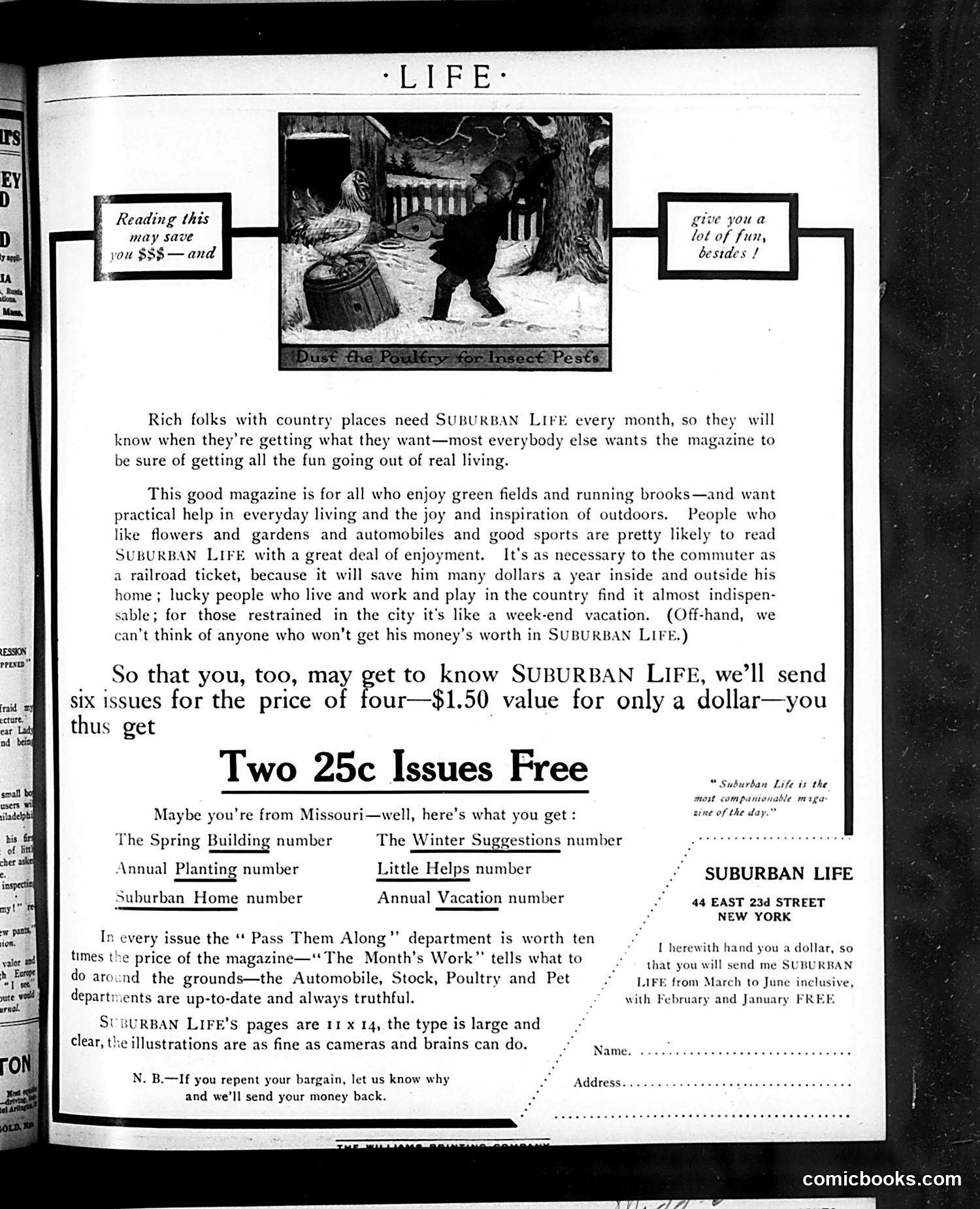
This is primarily a **magazine subscription advertisement**, not a political cartoon. The small illustration at top shows a man dusting poultry for insect pests—a practical farming task meant to exemplify the magazine's useful content. The ad targets **wealthy suburban commuters** who maintained country estates. It emphasizes that *Suburban Life* magazine offers practical advice on gardens, automobiles, poultry, and outdoor recreation—positioning country living as aspirational yet manageable with proper guidance. The pitch exploits class anxiety: the magazine is "necessary to the commuter as a railroad ticket" and will "save him many dollars a year." The offer—six issues for one dollar (with two free)—uses the appeal of a bargain to overcome hesitation. The satirical edge is mild: the phrase "Maybe you're from Missouri" (suggesting skepticism) and the guarantee "If you repent your bargain, let us know why and we'll send your money back" gently mock suburban pretension while reassuring readers of value. The overall tone reflects early 20th-century anxiety about leisure, consumption, and maintaining social status.