
Life, 1909-03-11 · page 16 of 36
Life — March 11, 1909 — page 16: what you’re looking at
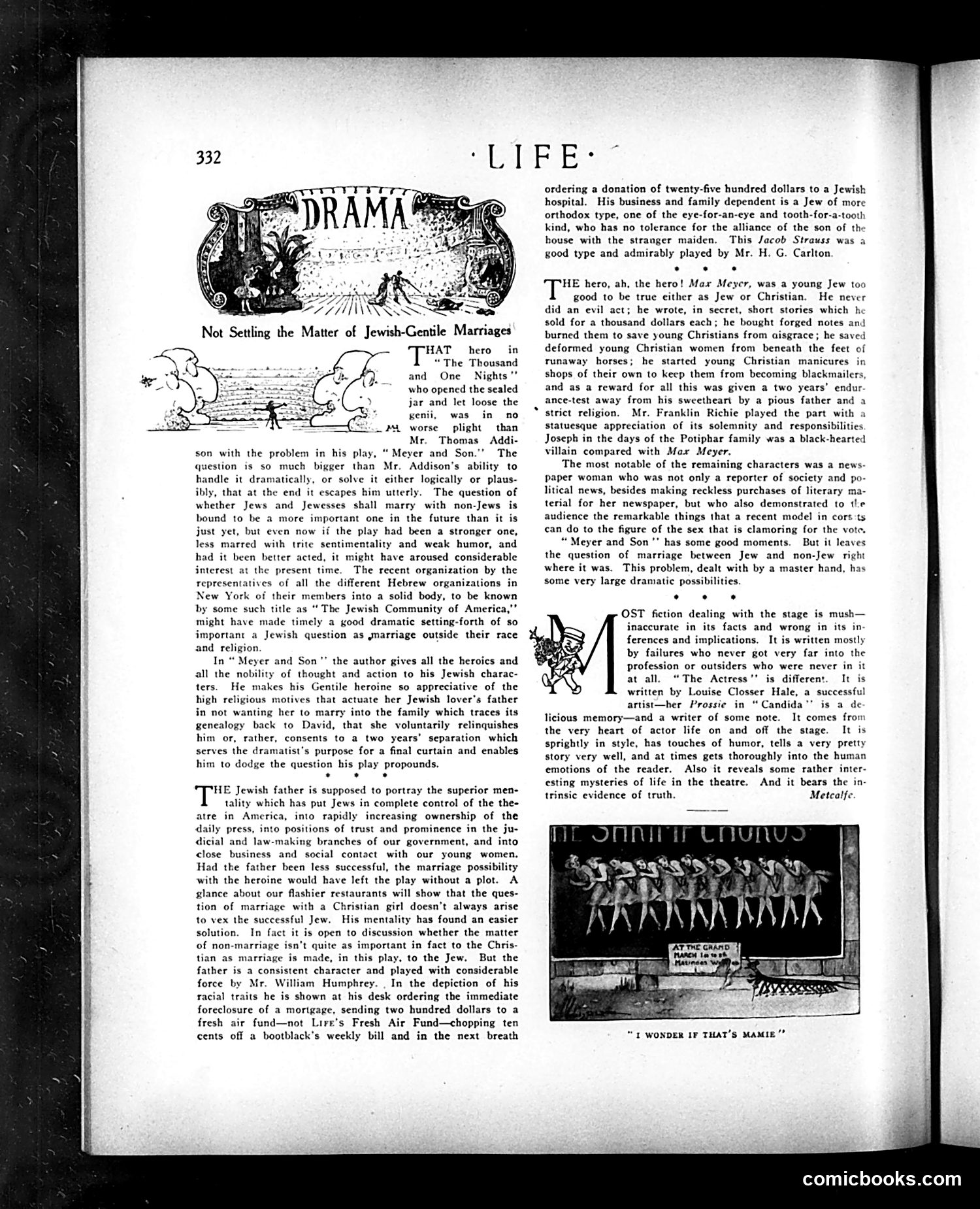
What you’re looking at
This page reviews the play "Meyer and Son" by Thomas Addison, examining its treatment of Jewish-Christian intermarriage—a contemporary social issue. The critic identifies the play's central tension: whether a Jewish man should marry a Christian woman. The review notes the playwright avoids resolving this question, instead having the Christian heroine voluntarily separate from her Jewish lover for two years. The critique contains **antisemitic commentary**, praising the Jewish father character for depicting Jewish "superiority" and "mentality," while sarcastically noting Jewish control of American theatres, press, and government positions. The character description emphasizes stereotypical Jewish traits: ruthless business practices alongside charitable donations to Jewish institutions. The hero, Max Meyer, is criticized as an unrealistic "too good to be true" character who performs implausibly noble deeds. The page reflects early 20th-century theatrical criticism intertwined with period prejudices about Jewish assimilation into American society.
📄 Transcribed text from this page (OCR, searchable)
Machine-transcribed from the original scan — historical spelling and the odd misread are preserved.
seth Era HAT hero in “The Thousand and One Nights "* who opened the sealed jar and let loose the genii, was in no M4 worse plight than Mr. Thomas Addi- son with the problem in his play, “ Meyer and Son.’’ The question is so much bigger than Mr. Addison's ability to handle it dramatically, or solve it either logically or plaus- ply, that at the end it escapes him utterly. The question of whether Jews and Jewesses shall marry with non-Jews is bound to be a more important one in the future than it is just yet, but even now if the play had been a stronger one, less marred with trite sentimentality and weak humor, and had it been better acted, it might have aroused considerable interest at the present time. The recent organization by the representatives of all the different Hebrew organizations in New York of their members into a solid body, to be known by some such title as “The Jewish Community of America,” might have made timely a good dramatic setting-forth of so important a Jewish question as marriage outside their race and religion. In “ Meyer and Son ‘’ the author gives all the heroics and all the nobility of thought and action to his Jewish charac- ters. He makes his Gentile heroine so appreciative of the high religious motives that actuate her Jewish lover's father in not wanting her to marry into the family which traces its genealogy back to David, that she voluntarily relinquishes him or, rather, consents to a two years’ separation which serves the dramatist’s purpose for a final curtain and enables him to dodge the question his play propounds. HE Jewish father is supposed to portray the superior men- tality which has put Jews in complete control of the the- atre in America, into rapidly increasing ownership of the daily press, into positions of trust and prominence in the ju- dicial and law-making branches of our government, and into close business and social contact with our young women. Had the father been less successful, the marriage possibility with the heroine would have left the play without a plot. A glance about our flashier restaurants will show that the ques- tion of marriage with a Christian girl doesn’t always arise to vex the successful Jew. His mentality has found an easier solution. In fact it is open to discussion whether the matter of non-marriage isn’t quite as important in fact to the Chris- tian as marriage is made, in this play, to the Jew. But the father is a consistent character and played with considerable force by Mr. William Humphrey. In the depiction of his racial traits he is shown at his desk ordering the immediate foreclosure of a mortgage, sending two hundred dollars to a fresh air fund—not Lire’s Fresh Air Fund—chopping ten cents off a bootblack’s weekly bill and in the next breath ordering a donation of twenty-five hundred dollars to a Jewish hospital. His business and family dependent is a Jew of more orthodox type, one of the eye-for-an-eye and tooth-for-a-tooth kind, who has no tolerance for the alliance of the son of th house with the stranger maiden. This Jacob Strauss was a good type and admirably played by Mr. H. G. Carlton HE hero, ah, the hero! Max Meyer, was a young Jew too good to be true either as Jew or Christian. He never did an evil act; he wrote, in secret, short stories which he sold for a thousand dollars each; he bought forged notes and burned them to save young Christians from aisgrace; he saved deformed young Christian women from beneath the feet of runaway horses; he started young Christian manicures in shops of their own to keep them from becoming blackmailers, and as a reward for all this was given a two years’ endur ance-test away from his sweetheart by a pious father and a strict religion. Mr. Franklin Richie played the part with a statuesque appreciation of its solemnity and responsibilities. Joseph in the days of the Potiphar family was a black-hearted villain compared with Max Meyer. The most notable of the remaining characters was a news- paper woman who was not only a reporter of society and po- litical news, besides making reckless purchases of literary ma- terial for her newspaper, but who also demonstrated to the audience the remarkable things that a recent model in cors ts can do to the figure of the sex that is clamoring for the vote. “ Meyer and Son" has some good moments. But it leaves the question of marriage between Jew and non-Jew right where it was. This problem, dealt with by a master hand, has some very large dramatic possibilities. o 8 OST fiction dealing with the stage is mush— inaccurate in its facts and wrong in its in- ferences and implications. It is written mostly by failures who never got very far into the profession or outsiders who were never in it at all. “The Actress’? is different. It is written by Louise Closser Hale, a successful artist—her Prossie in “Candida” is a de licious memory—and a writer of some note. It comes from the very heart of actor life on and off the stage. It is sprightly in style, has touches of humor, tells a very pretty story very well, and at times gets thoroughly into the human emotions of the reader. Also it reveals some rather inter- esting mysteries of life in the theatre. And it bears the in- trinsic evidence of truth. Metcalfe. “1 WONDER IF THAT’S MAMIE’? comicbooks.com