
Life, 1909-03-11 · page 8 of 36
Life — March 11, 1909 — page 8: what you’re looking at
What you’re looking at
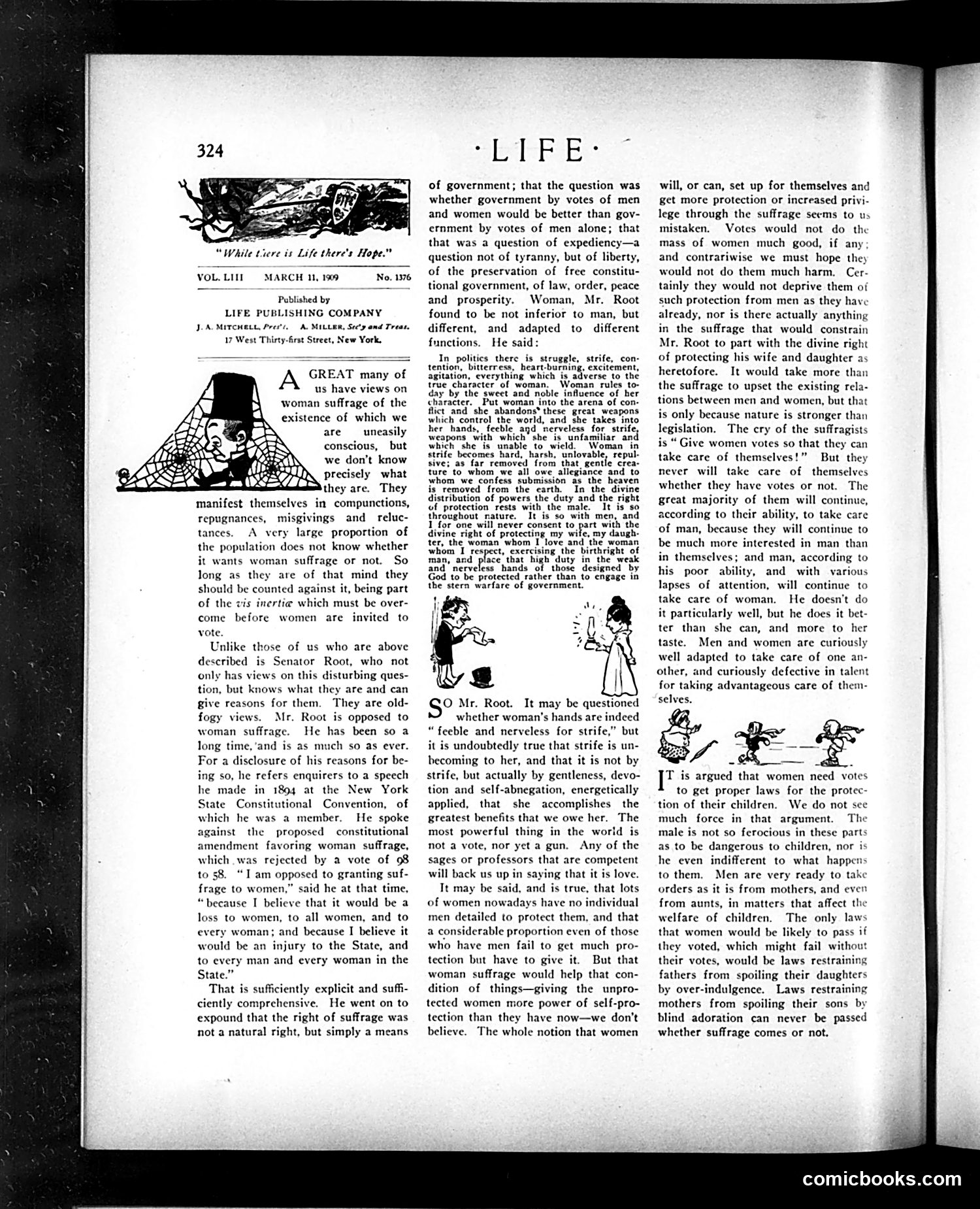
This page debates women's suffrage through Senator Elihu Root's arguments opposing voting rights for women. The article quotes Root's 1894 New York Constitutional Convention speech, where he argued that suffrage is a "means" not a "natural right," and that women lack individual protection needs that voting addresses. The satirical cartoons mock Root's position. Small illustrations show women in domestic situations—caring for children, managing households—visually undercutting his claim that women don't need political power. The satire suggests Root's logic is absurd: women actively manage society's welfare yet lack voting representation. The text counters that women *do* need votes for legal protection regarding property, children, and themselves—directly refuting Root's position that male protection suffices.
📄 Transcribed text from this page (OCR, searchable)
Machine-transcribed from the original scan — historical spelling and the odd misread are preserved.
“While Liere is Life there's Hope.” No. 1376 VOL. LIL MARCH 11, 1909 Published by LIFE PUBLISHING COMPANY JA MITCHELL, Prete, A MILLER, See’y and Tr 17 West Thirty-first Street, New York, us have views on woman suffrage of the existence of which we are uneasily conscious, but we don’t know precisely what they are. They manifest themselves in compunctions, repugnances, misgivings and reluc- tances. A very large proportion of the population does not know whether it wants woman suffrage or not. So long as they are of that mind they should be counted against it, being part of the vis inertie which must be over- come are invited to vote. Unlike those of us who are above described Senator Root, who not only has views on this disturbing ques- tion, but knows what they are and can give reasons for them. They are old- fogy views. Mr. Root is opposed to woman suffrage. He has been so a long time, 'and is as much so as ever. For a disclosure of his reasons for be- ing so, he refers enquirers to a speech he made in 1894 at the New York State Constitutional Convention, of which he was a member. He spoke against the proposed constitutional amendment favoring woman suffrage, which was rejected by a vote of 98 to 58. “I am opposed to granting suf- frage to women,” said he at that time, “because I believe that it would be a loss to women, to all women, and to every woman; and because I believe it would be an injury to the State, and to every man and every woman in the State.” That is sufficiently explicit and suffi- ciently comprehensive. He went on to expound that the right of suffrage was not a natural right, but simply a means before women elise te ¢ of government; that the question was whether government by votes of men and women would be better than gov- ernment by votes of men alone; that that was a question of expediency—a question not of tyranny, but of liberty, of the preservation of free constitu- tional government, of law, order, peace and prosperity. Woman, Mr. Root found to be not inferior to man, but different, and adapted to different functions. He said: In politics there is struggle, strife, con- tention, bitterress, heart-burning, excitement, agitation, everything which is adverse to the true character of woman, Woman rules to- day by the sweet and noble influence of her character. Put woman into the arena of con- flict and she abandons* these great weapons which control the world, and she takes into her hands, feeble and nerveless for strife weapons with which she is unfamiliar and which she is unable to wield. Woman in strife becomes hard, harsh, uniovable, repul- sive: as far removed from that, gentle crea- ture to whom we all owe allegiance and to whom we confess submission as the heaven is removed from the earth. In the divine distribution of powers the duty and the right of protection rests with the male. It is so throughout nature. It is so with men, and 1 for one will never consent to part with the divine right of protecting my wife, my daugh- ter, the woman whom I love and the woman whom I respect, exercising the birthright of man, and place’ that high duty in the weak and’ nerveless hands of those designed by God to be protected rather than to engage in the stern warfare of government. O Mr. Root. It may be questioned whether woman's hands are indeed “feeble and nerveless for strife,” but it is undoubtedly true that strife is un- becoming to her, and that it is not by strife, but actually by gentleness, devo- tion and self-abnegation, energetically applied, that she accomplishes the greatest benefits that we owe her. The most powerful thing in the world is not a vote, nor yet a gun. Any of the sages or professors that are competent will back us up in saying that it is love. Tt may be said, and is true, that lots of women nowadays have no individual men detailed to protect them, and that a considerable proportion even of those who have men fail to get much pro- tection but have to give it. But that woman suffrage would help that con- dition of things—giving the unpro- tected women more power of self-pro- tection than they have now—we don't believe. The whole notion that women will, or can, set up for themselves and get more protection or increased privi- lege through the suffrage seems to us mistaken. Votes would not do the mass of women much good, if any and contrariwise we must hope th would not do them much harm. Cer- tainly they would not deprive them of such protection from men as they have already, nor is there actually anything in the suffrage that would constrain Mr. Root to part with the divine right of protecting his wife and daughter as heretofore. It would take more than the suffrage to upset the existing rela- tions between men and women, but that is only because nature is stronger than legislation. The cry of the suffragists is “ Give women votes so that they can take care of themselves!” But they never will take care of themselves whether they have votes or not. The great majority of them will continue, according to their ability, to take care of man, because they will continue to be much more interested in man than in themselves; and man, according to his poor ability, and with various lapses of attention, will continue to take care of woman. He doesn’t do it particularly well, but he does it bet- ter than she can, and more to her taste. Men and women are curiously well adapted to take care of one ai other, and curiously defective in talent for taking advantageous care of them- selves. T is argued that women need votes to get proper laws for the protec- tion of their children. We do not see much force in that argument. The male is not so ferocious in these parts as to be dangerous to children, nor is he even indifferent to what happens to them. Men are very ready to take orders as it is from mothers, and ever’ from aunts, in matters that affect the welfare of children. The only laws that women would be likely to pass if they voted, which might fail without their votes, would be laws restrainin fathers from spoiling their daughters by over-indulgence. Laws restraining mothers from spoiling their sons by blind adoration can never be passed whether suffrage comes or not. comicbooks.com