
A complete issue · 28 pages · 1909
Life — February 25, 1909
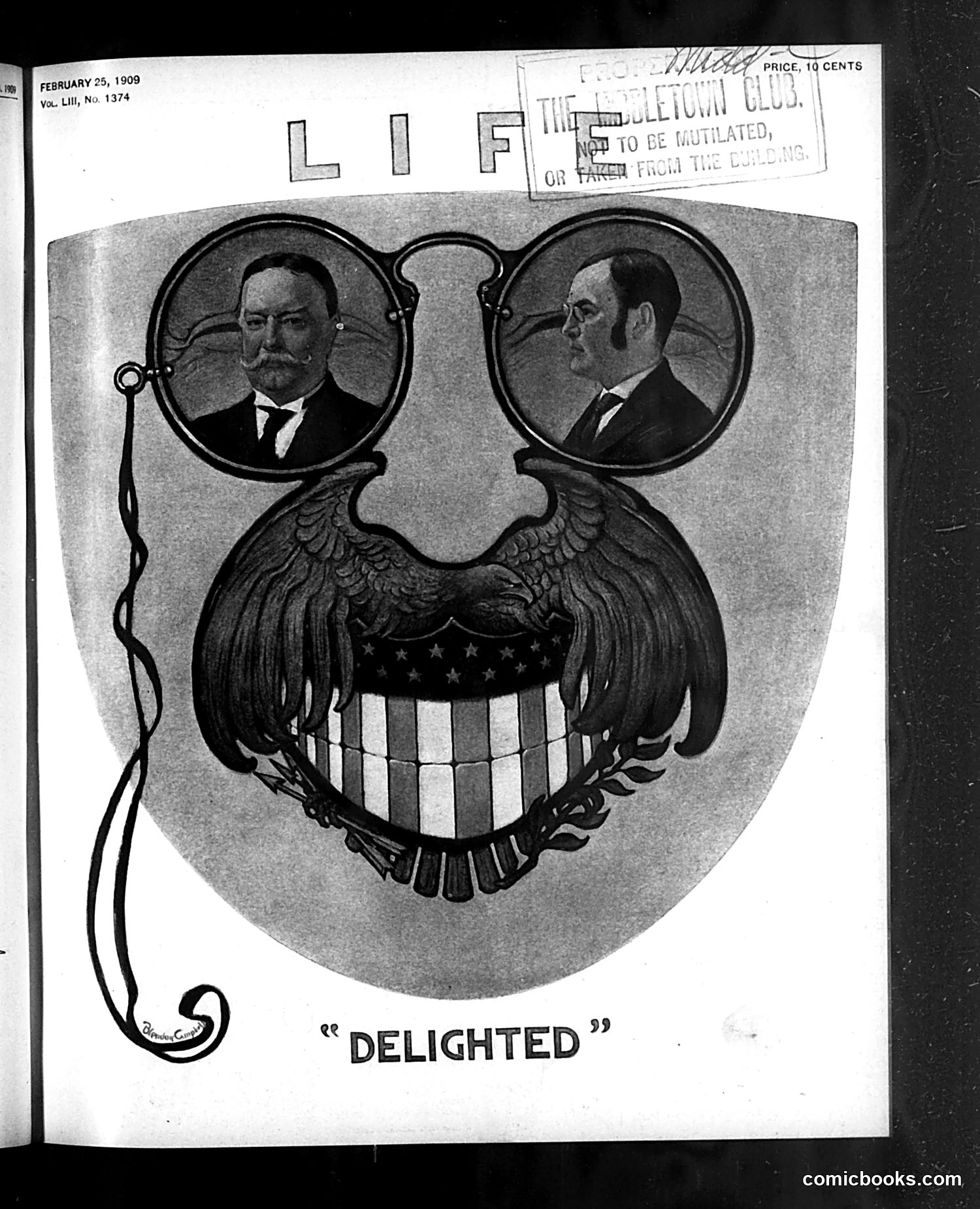
This political cartoon depicts two men's portraits positioned as the eyes of an eagle shield—a clear reference to American governmental authority. The shield features the characteristic eagle, stars, and stripes of the Great Seal of the United States. The caption "DELIGHTED" suggests these figures are pleased about some government matter or policy decision. Without additional context on the specific date and political events of February 1909, I cannot definitively identify the two individuals shown. However, the format indicates they likely represent prominent political figures—possibly President Theodore Roosevelt and his successor or a cabinet member—responding favorably to a recent governmental action or appointment. The satirical intent appears to mock their expressed satisfaction.
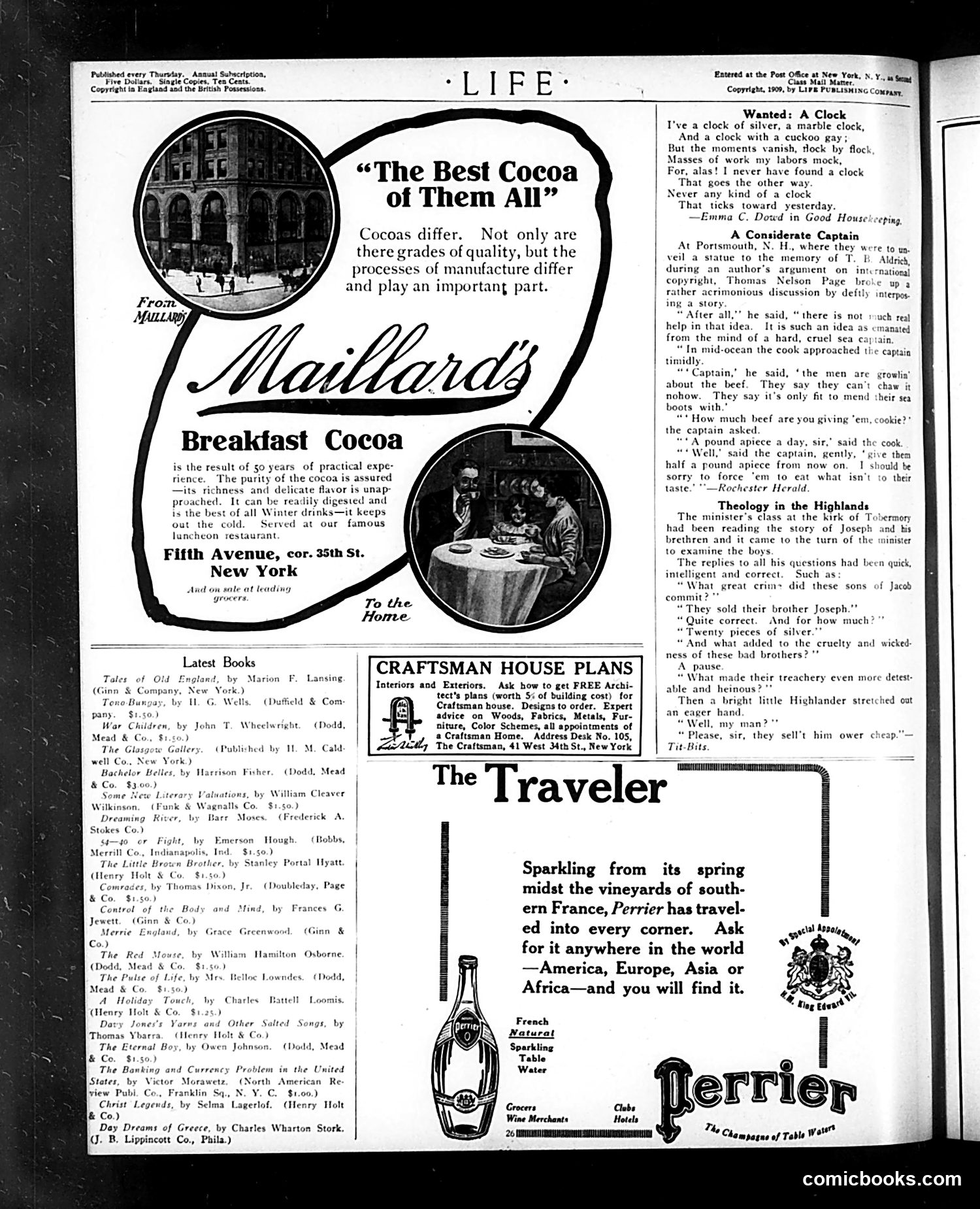
This page is primarily **advertising and book listings**, not political satire. The dominant content includes: 1. **Maillard's Cocoa advertisement** - emphasizing quality and 50 years of experience, positioned as an ideal winter breakfast drink 2. **Craftsman House Plans** - offering architectural designs for home builders 3. **Perrier water advertisement** - promoting the French sparkling water as globally available 4. **Book reviews** - listing contemporary publications The three brief **fiction excerpts** ("Wanted: A Clock," "A Considerate Captain," "Theology in the Highlands") are lighthearted stories with no apparent political content—they're entertainment pieces for readers. This appears to be a standard early 1900s magazine issue mixing commercial advertising with literary content, rather than a page focused on satirical commentary or political cartooning.
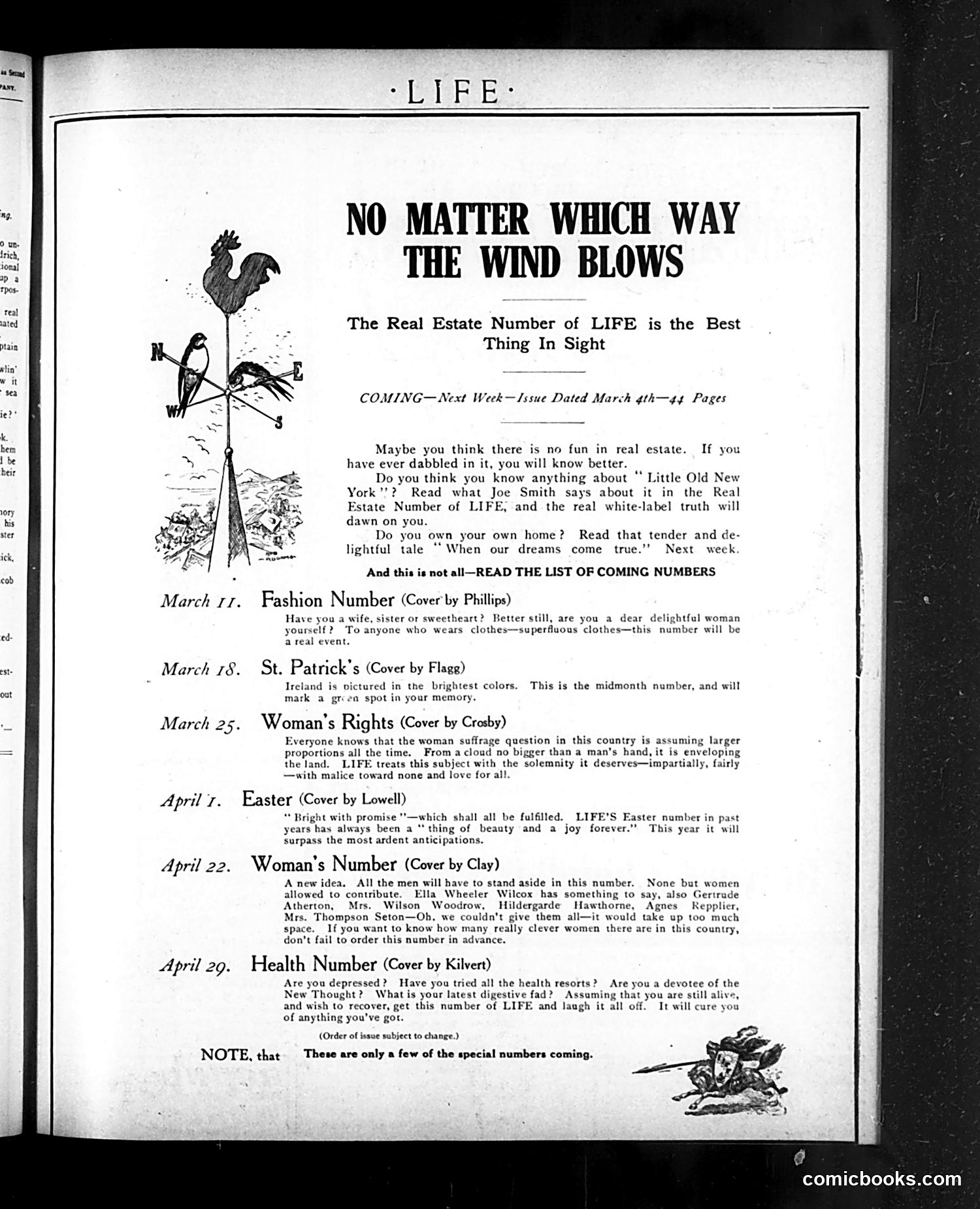
This is a **promotional page** for upcoming issues of *Life* magazine, not political satire. The page advertises special themed issues for March-April, including Fashion, St. Patrick's Day, Woman's Rights, Easter, and Health numbers. The **weather vane illustration** (rooster atop a pole with directional markers) is decorative, reinforcing the headline "No Matter Which Way the Wind Blows"—a metaphor suggesting *Life*'s magazine covers remain relevant and appealing regardless of circumstances. The text promotes real estate content by Joe Smith and encourages subscriptions to forthcoming issues. This appears to be **early 20th-century advertising copy** designed to build anticipation for themed special issues—a common magazine marketing strategy of the era.
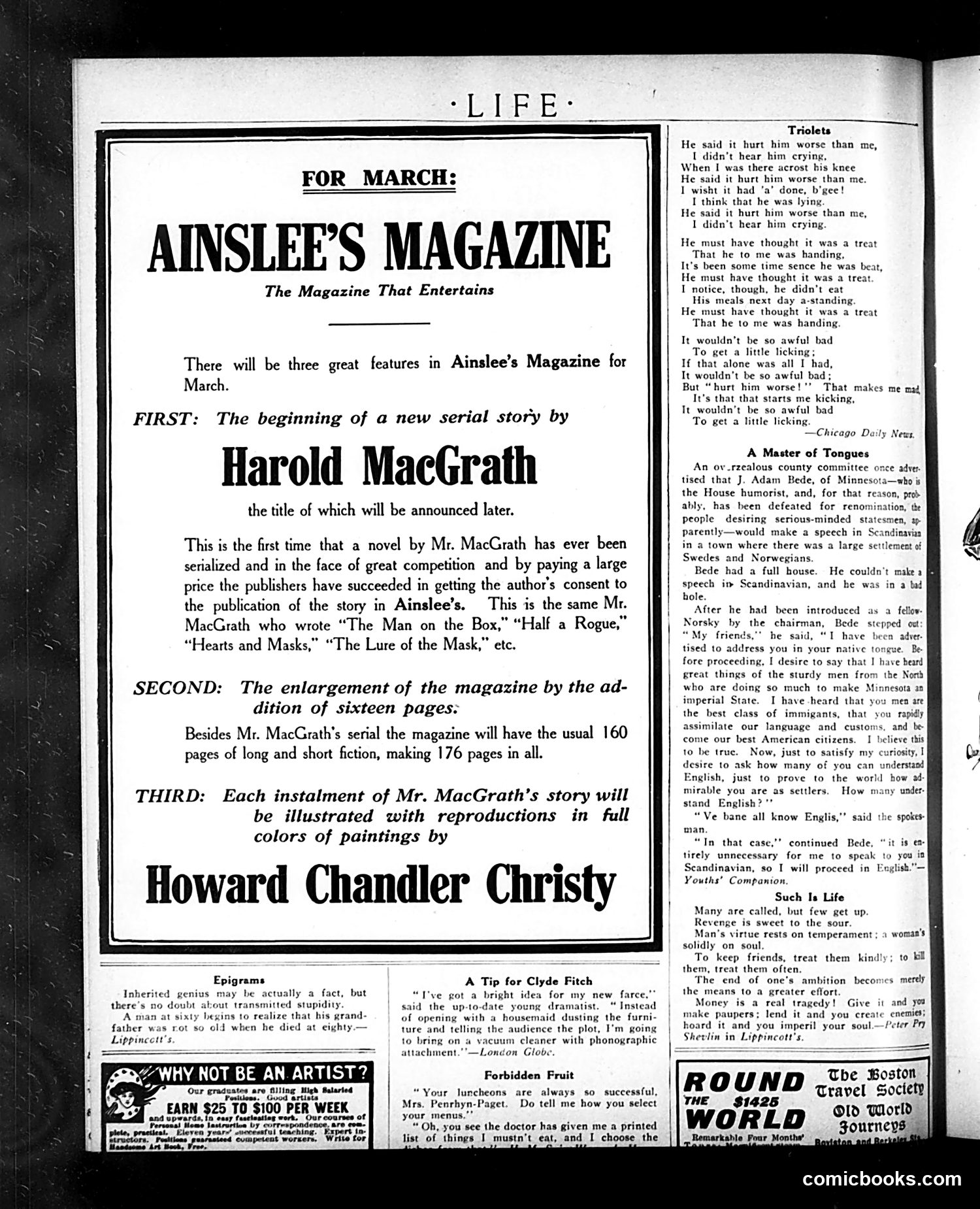
This page is primarily **promotional advertising** rather than political satire. It announces upcoming March features for *Ainslee's Magazine*, a competing publication: 1. **Harold MacGrath serial story** - promoting the first serialized novel by this popular author of adventure fiction ("The Man on the Box," "Hearts and Masks") 2. **Magazine expansion** - adding 16 pages (176 total) of fiction 3. **Howard Chandler Christy illustrations** - full-color paintings accompanying the serial The page also contains unrelated brief humor pieces and advertisements, including "Why Not Be an Artist?" recruitment ad and travel promotions. This appears to be *Life* magazine using its pages to advertise a competitor's magazine—likely a paid advertisement rather than editorial content.
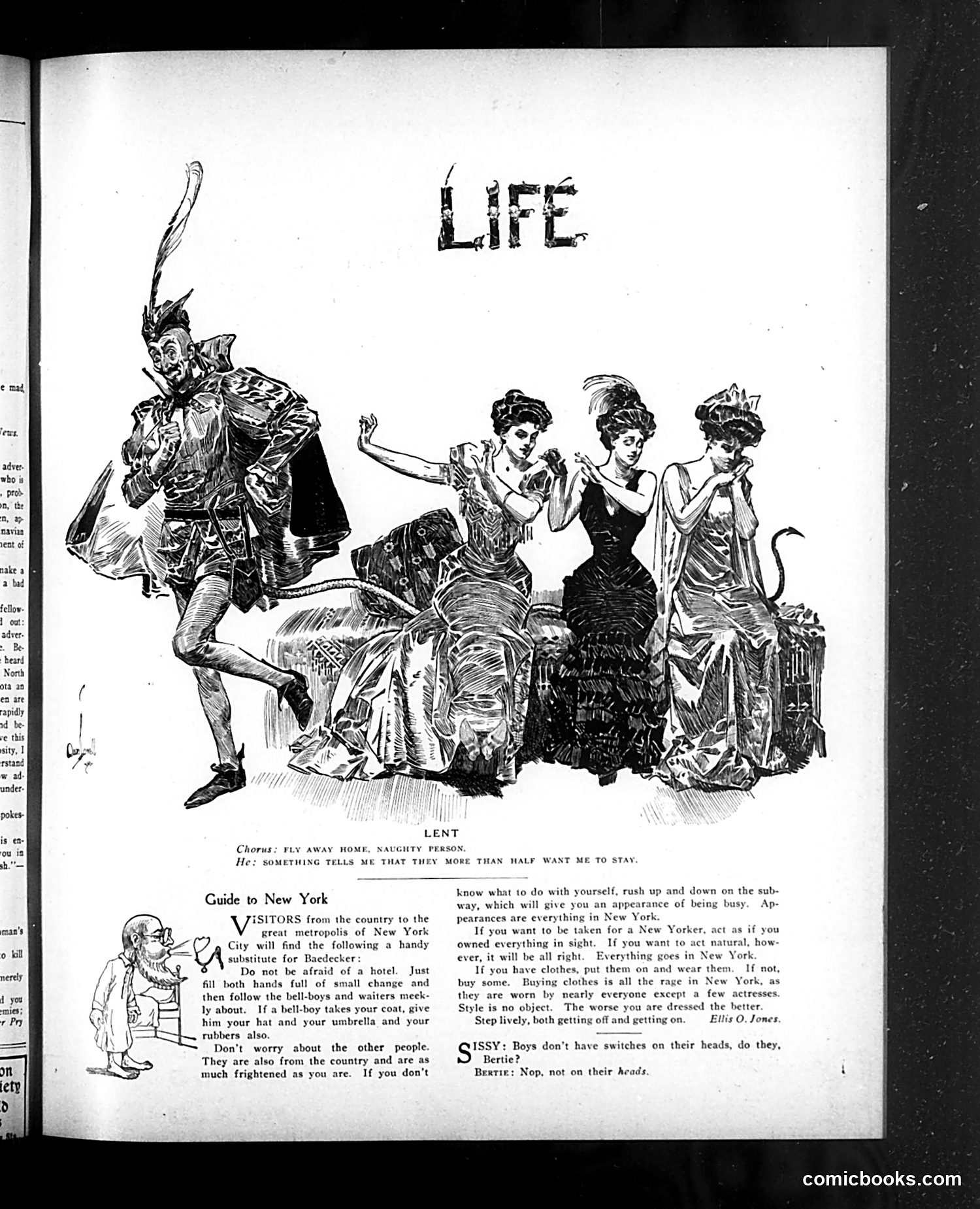
The main illustration labeled "LENT" depicts a theatrical scene: a devilish figure (representing temptation or sin) dances on the left while seated women resist his advances. The dialogue—"Fly away home, naughty person / Something tells me that they more than half want me to stay"—satirizes the tension between religious observance during Lent and secular temptation. Below is a "Guide to New York" featuring a country visitor receiving advice on urban etiquette. The cartoons mock both rural naiveté and New York sophistication—instructing visitors to act busy, adopt fashionable dress, and avoid appearing frightened. The dialogue between "Sissy" and "Bertie" jokes about urban affectations, suggesting New Yorkers adopt false personas. The satire targets class pretension and performative urbanity in turn-of-century New York society.
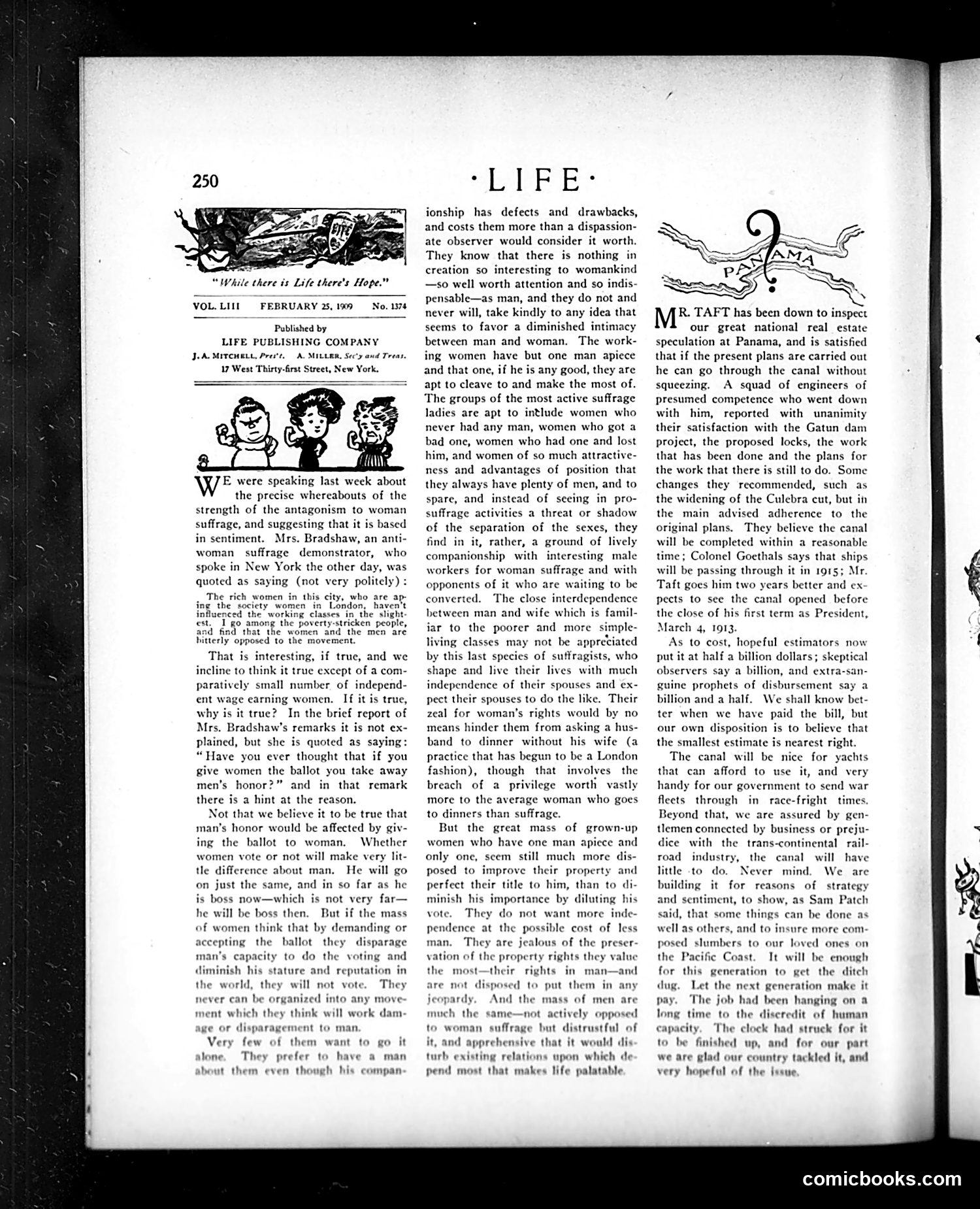
This page from Life magazine (February 28, 1913) contains an editorial essay—not a political cartoon—addressing women's suffrage and gender relations. The piece critiques arguments against women's voting rights, particularly those claiming women lack independent judgment. The author refutes the notion that women voting would somehow undermine marriage or family life, noting that women already make consequential decisions independently. The essay also discusses the Panama Canal project and mentions Mr. Taft's inspection visit, suggesting the canal's completion within a reasonable timeframe. The small cartoon header ("While there is Life there's Hope") is decorative rather than topical. The three illustrated faces appear to be generic humorous characters typical of Life's visual style, not specific political figures or caricatures.
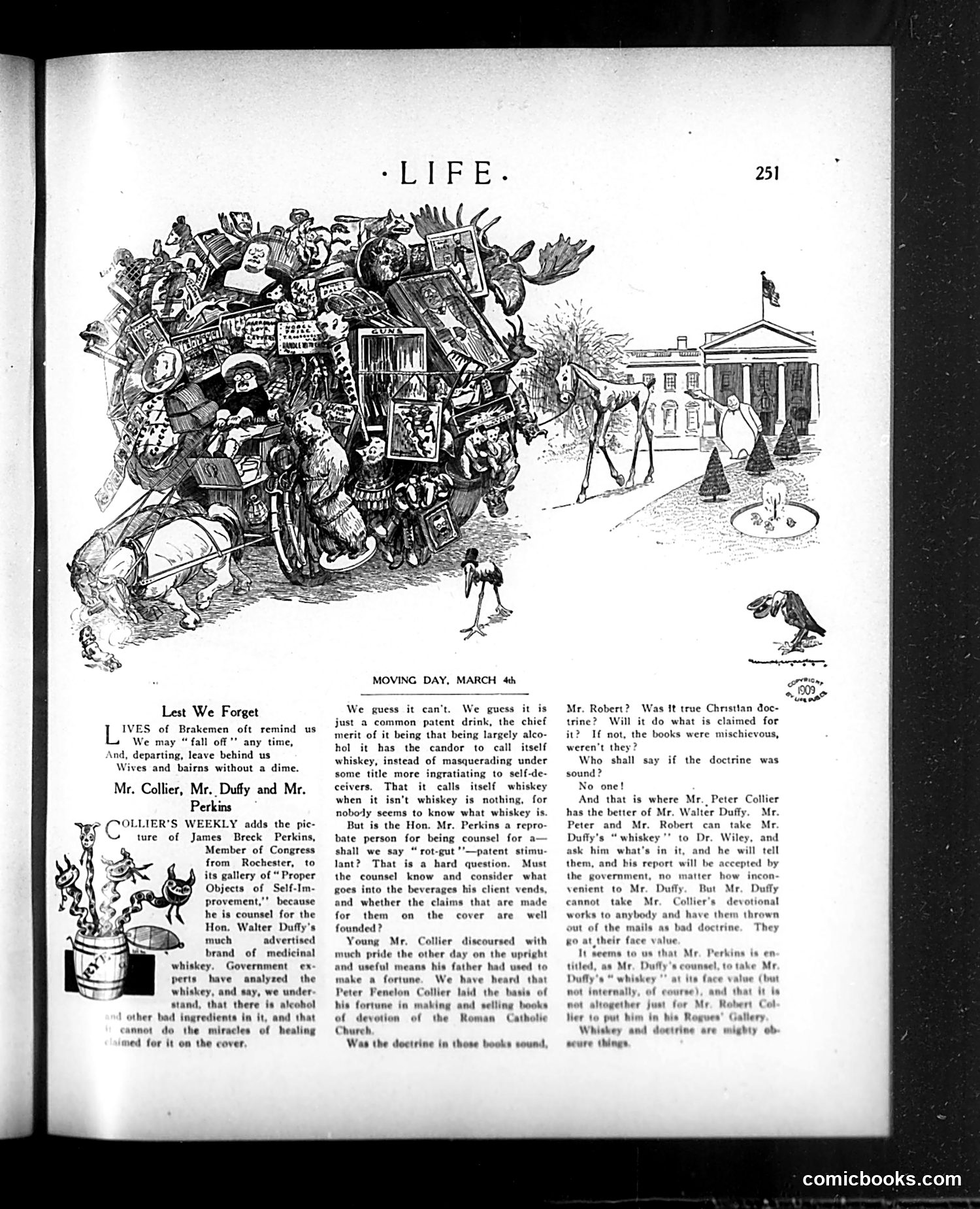
This satirical cartoon depicts the chaos of a presidential transition on Inauguration Day (March 4th was traditionally when new presidents took office). The enormous, overflowing cart represents the outgoing administration's departure from the White House, heaped with miscellaneous objects symbolizing government baggage, policies, and scandals being removed. The accompanying article criticizes several figures including Mr. Collier, Mr. Duffy, and Mr. Perkins regarding disputes over government property, whiskey, and Christian doctrine. The text suggests controversies about what departing officials could claim and disputes over inherited items and ideological positions. The cartoon satirizes the messiness and contentious nature of transferring power between administrations.
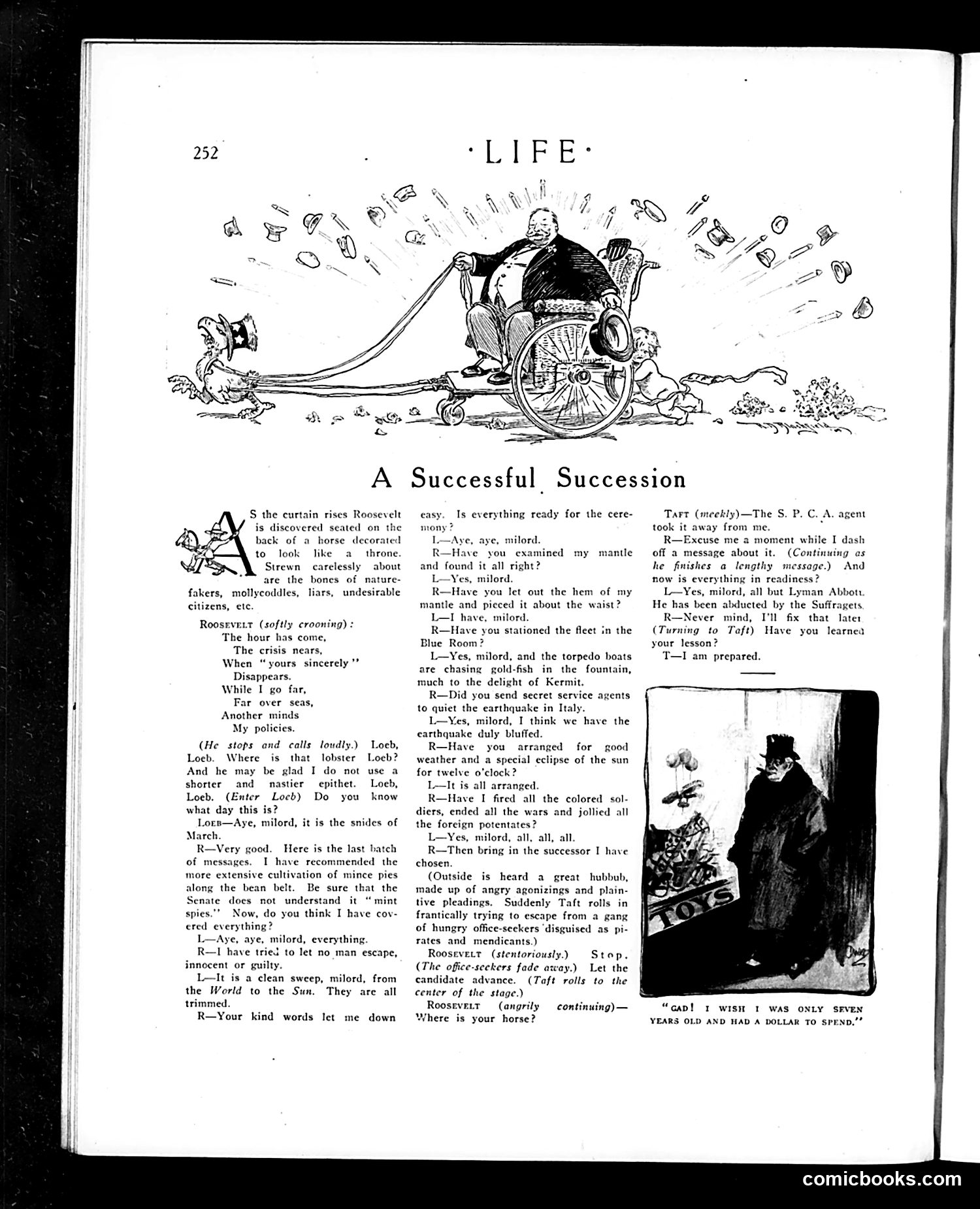
This satirical cartoon depicts **Theodore Roosevelt** (identified by the label and his distinctive appearance) in a wheelchair pulled by what appears to be a donkey, being succeeded by another figure. The title "A Successful Succession" suggests commentary on presidential transition. The dialogue reveals the joke: Roosevelt is frantically delegating last-minute executive duties—handling foreign policy crises, military matters, weather control, even arranging eclipses—to establish his successor. The absurdity of one president supposedly arranging natural phenomena and managing minute details underscores the satirical point about presidential power transfer and the challenge of genuine succession. The cartoon likely comments on Roosevelt's activist presidency and difficulty relinquishing control.
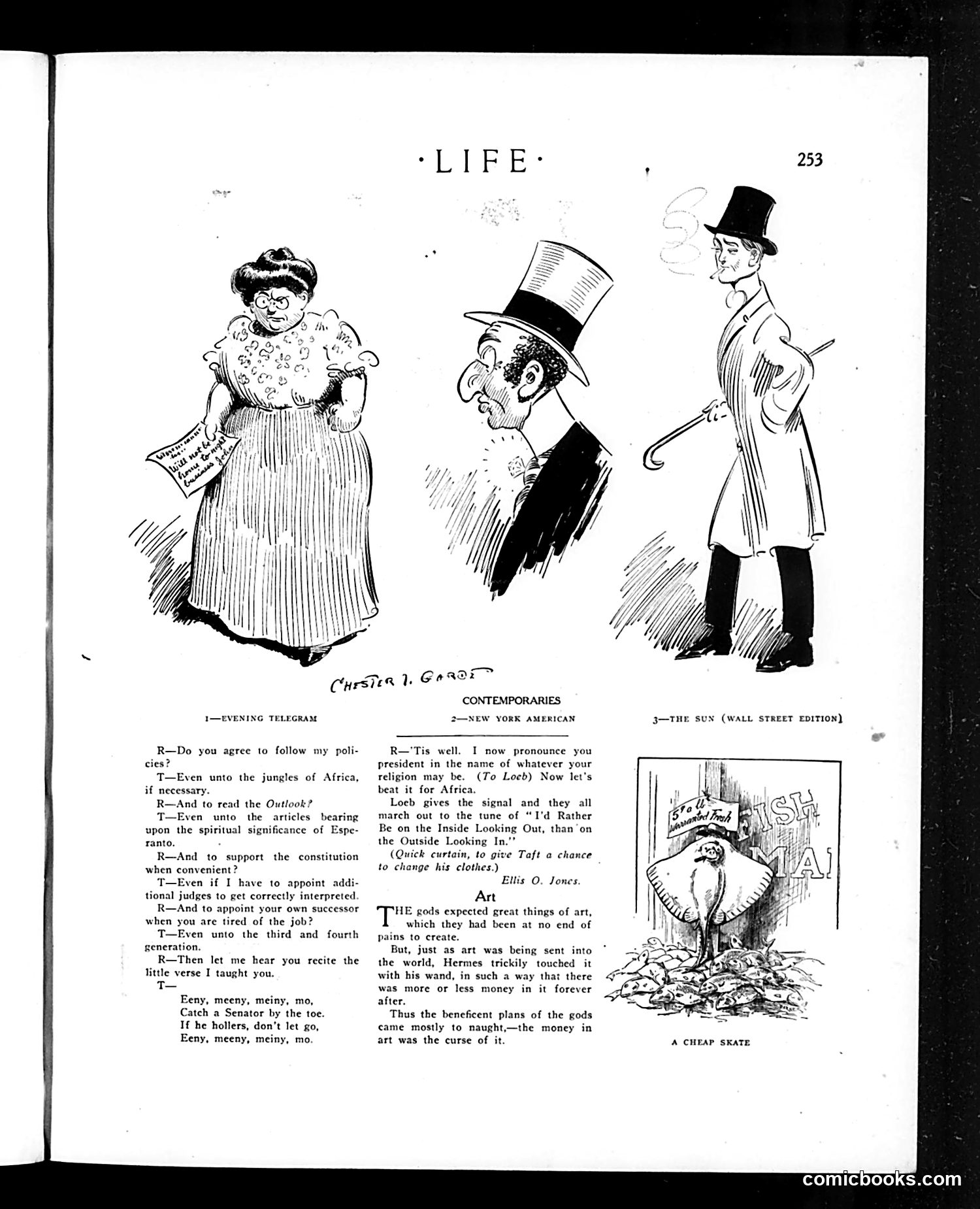
This page contains three cartoons by Chester L. Garde under "Contemporaries" satirizing public figures and social issues. **Left cartoon**: A rotund woman with a newspaper labeled "Outlook" represents someone criticized for following others' political positions uncritically—the satire suggests she adopts viewpoints from publications rather than thinking independently. **Center cartoon**: A man in a top hat is being "pronounced president" in a religious ceremony, mocking what appears to be an overly formal or absurd political appointment process, possibly referencing ecclesiastical or ceremonial excess in governance. **Right cartoon**: "The Sun (Wall Street Edition)" shows a well-dressed gentleman, likely satirizing financial news reporting or wealthy interests' influence on journalism. The accompanying text about "Art" discusses how money corrupts artistic creation—a common progressive-era critique of commercialism.
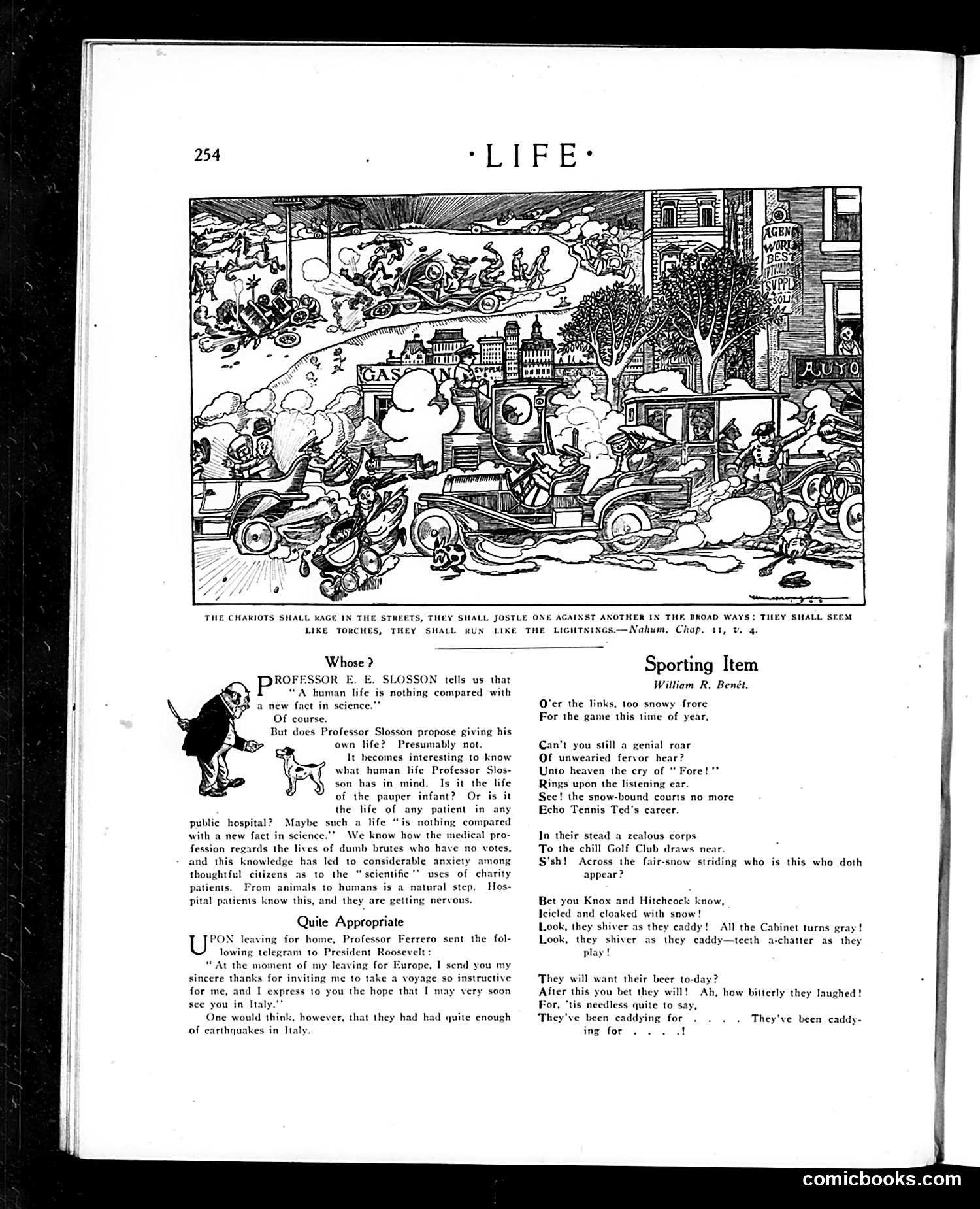
The main cartoon depicts a chaotic urban street scene filled with automobiles, pedestrians, and various activities. The caption references Nahum 2:4 ("The chariots shall rage in the streets...they shall jostle one against another...they shall seem like torches...they shall run like the lightnings"). This is satirical commentary on early 20th-century automobile culture and urban congestion. The biblical comparison treats cars as a modern plague—chaotic, dangerous, and overwhelming to city life. The dense, frenzied illustration emphasizes the disorder and collision hazard automobiles introduced to previously pedestrian-dominated streets. Below are three brief sections: "Whose?" (questioning Professor Slosson's views on scientific life), "Quite Appropriate" (a joke about a telegram from Professor Ferrero), and "Sporting Item" (a poem about winter sports by William R. Benét).
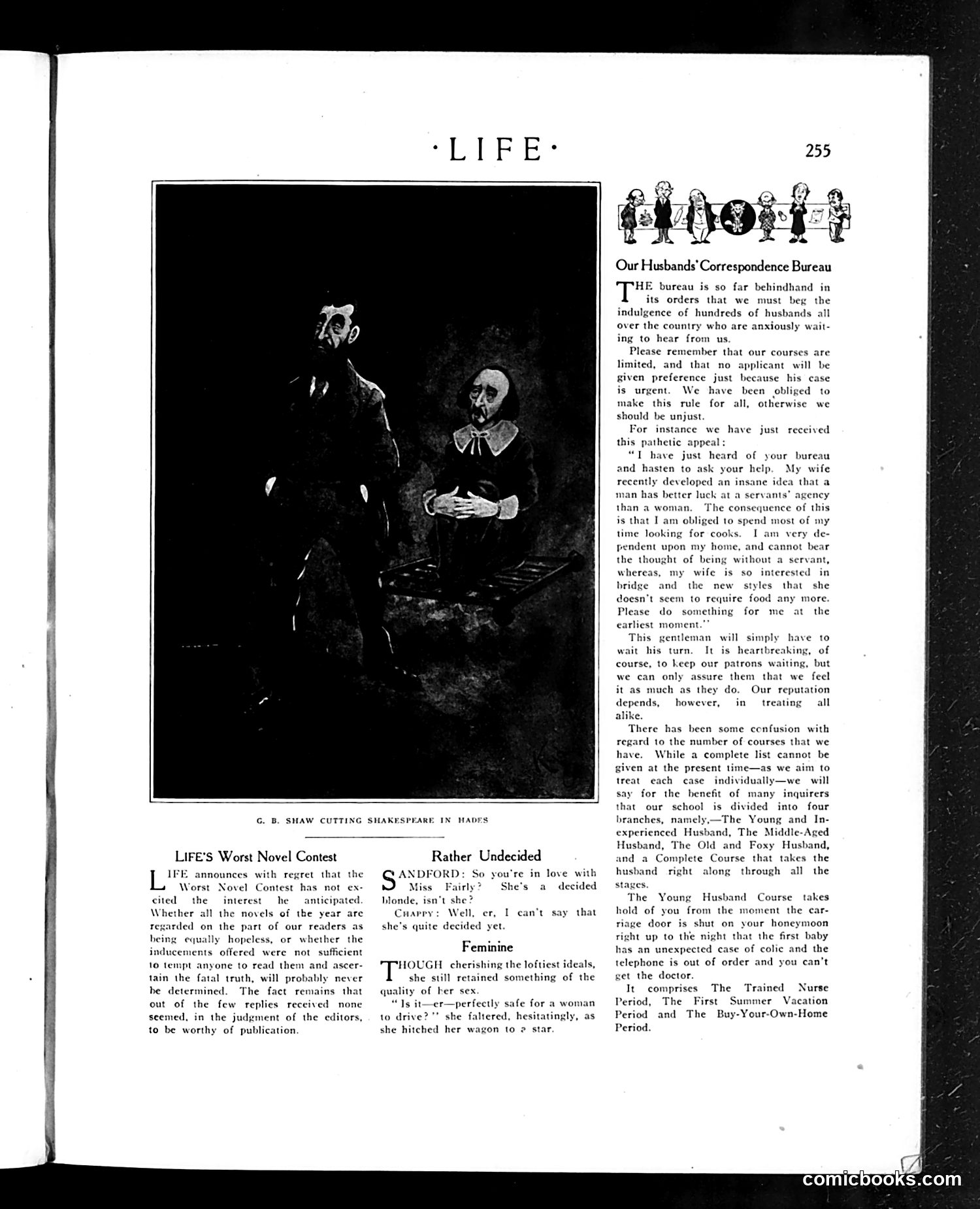
The main illustration, captioned "G. B. SHAW CUTTING SHAKESPEARE IN HADES," depicts two figures in what appears to be the underworld. One figure (likely Shakespeare) confronts another (identified as George Bernard Shaw). The satire mocks Shaw's literary criticism and his tendency to critique or "cut" (revise/diminish) Shakespeare's works. The accompanying text sections—"Life's Worst Novel Contest," "Rather Undecided," and "Feminine"—appear to be separate satirical pieces about relationships and gender roles, typical of Life magazine's humor content. The Shaw cartoon specifically ridicules the Irish playwright's well-known practice of criticizing Shakespeare and proposing theatrical revisions, suggesting such presumption would be comically confrontational even in the afterlife.
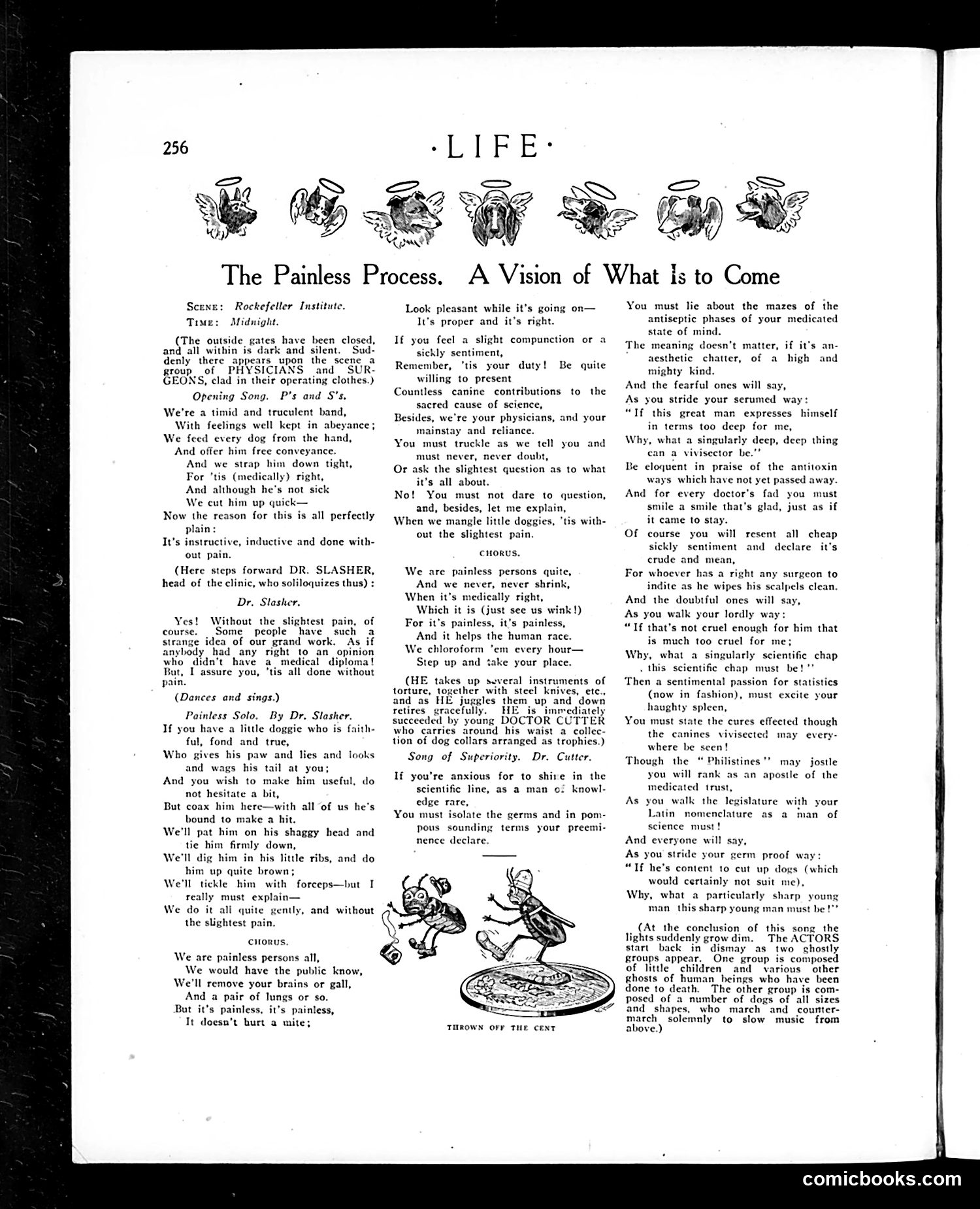
This satirical sketch mocks medical vivisection and animal experimentation at the Rockefeller Institute. The scene depicts Dr. Slasher (a caricatured surgeon) explaining to physicians how they perform painful procedures on dogs "without the slightest pain"—an obviously absurd claim presented with pseudo-scientific rationalization. The satire targets the hypocrisy of medical researchers claiming their animal torture is painless while using chloroform and surgical instruments. The accompanying chorus emphasizes the contradiction: "We are painless persons quite, / And we never shirk, / When it's medically right." The cartoon ridicules both the cruelty of vivisection and the self-deceptive language scientists use to justify it, appealing to early 20th-century readers' growing animal welfare concerns.
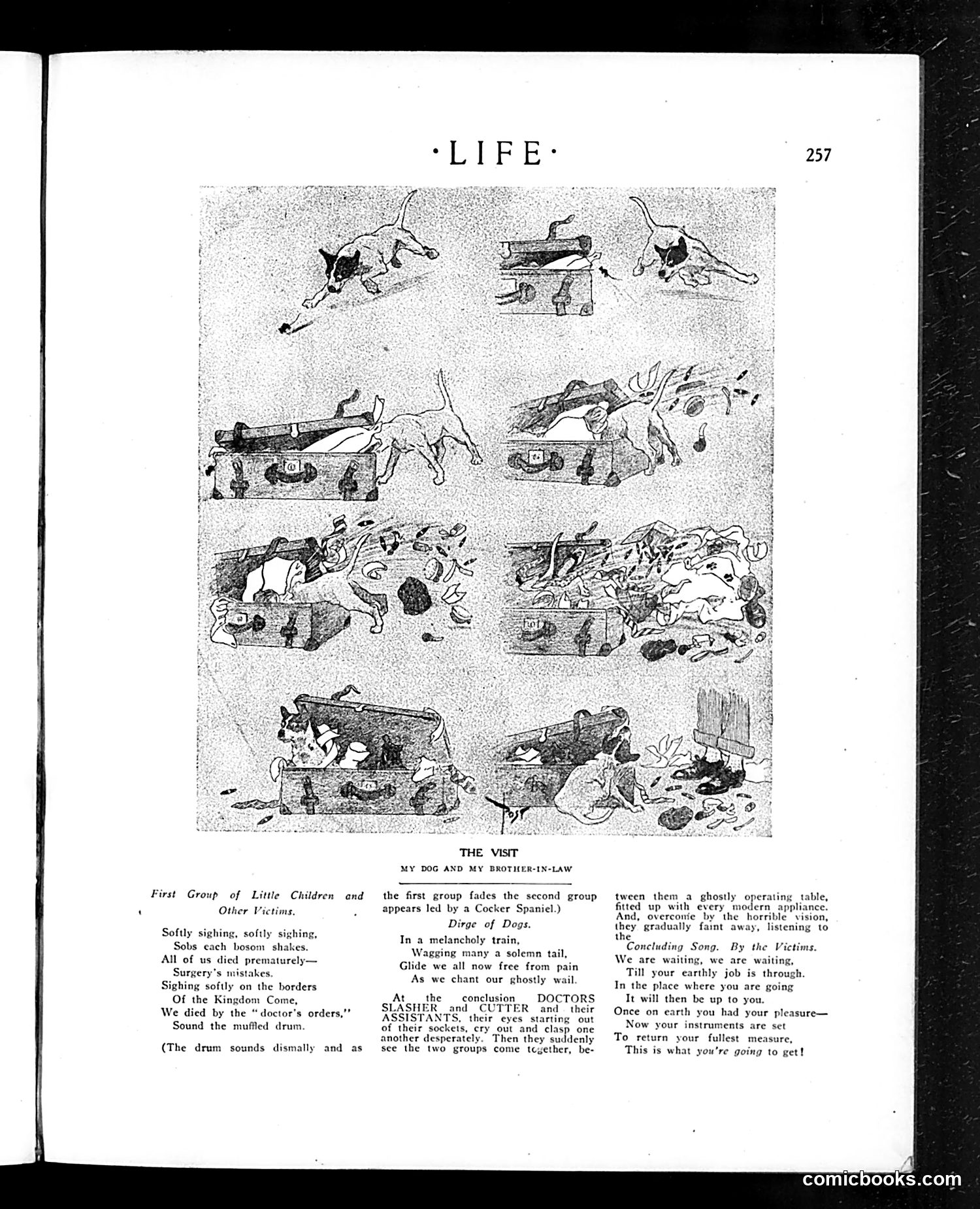
This multi-panel comic depicts a dog's visit disrupting a household. The title suggests the humor lies in comparing the chaos caused by a visiting brother-in-law to that of an unruly dog. The narrative follows two groups—children and dogs—who are "used prematurely" and die due to "surgery's mistakes." The poem references doctors, nurses, and assistants in a melancholy tone, suggesting medical incompetence or tragedy. The elaborate visual panels show escalating disorder and mayhem, with figures and objects in increasingly chaotic arrangements. The juxtaposition of the lighthearted title against the darker poetic content about death creates satirical commentary on domestic disruption, possibly critiquing medical practices or the disruptiveness of unwanted visitors in early 20th-century American life.
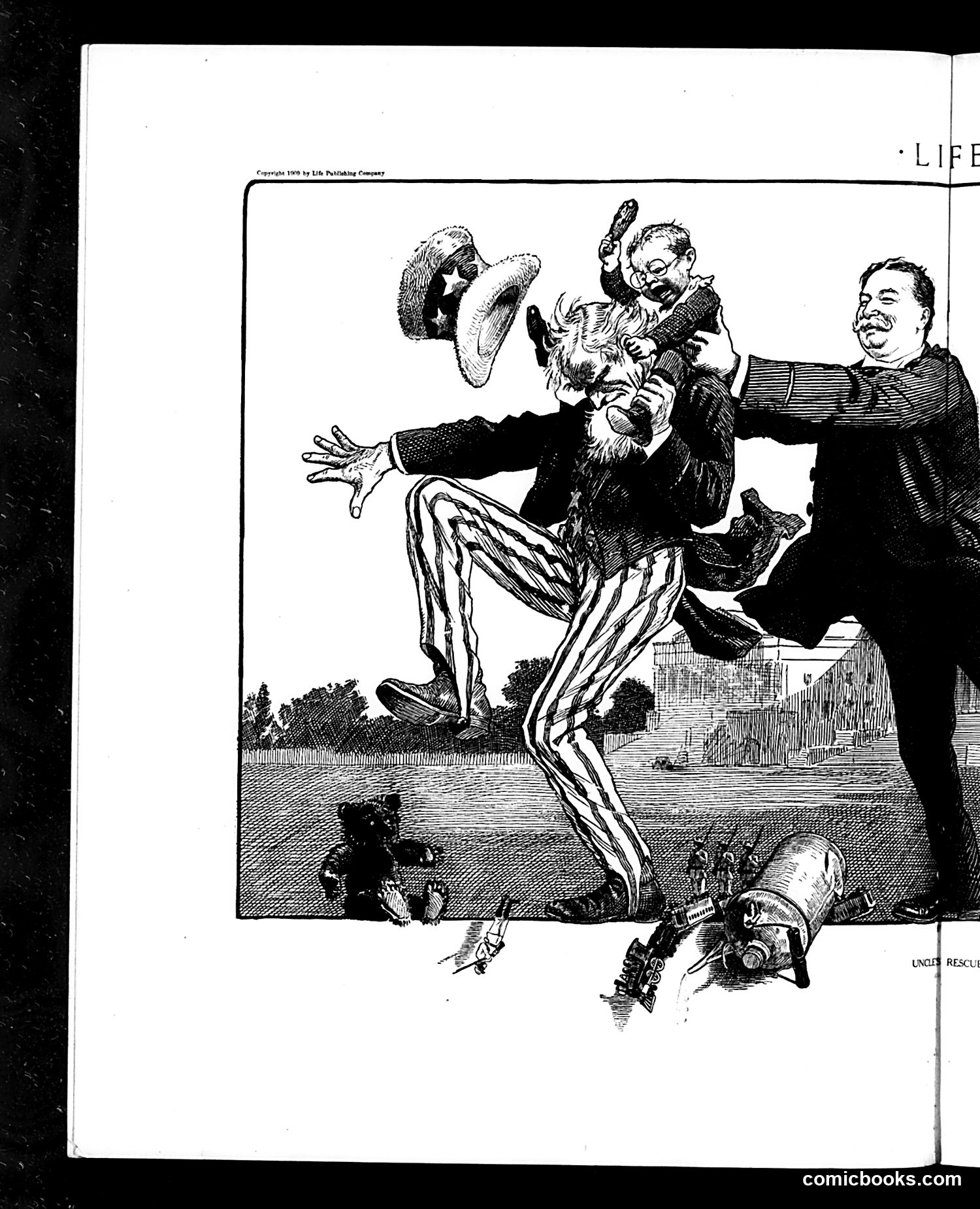
This is a satirical cartoon from *Life* magazine (copyright 1906) depicting what appears to be political manipulation or coercion. The central figure—a caricatured man with exaggerated facial features wearing striped pants—is being physically controlled or manipulated by two men in formal attire on the right side. One holds his head/face while another appears to operate his limbs like a puppet. The ground includes what looks like military equipment (a gas mask or helmet visible at bottom), suggesting themes of war, militarism, or political coercion during this era. Without identifying the specific individuals, the cartoon's message seems to be satirizing how political leaders manipulate or control public figures or public opinion—likely commentary on early 20th-century American politics, imperialism, or military involvement.
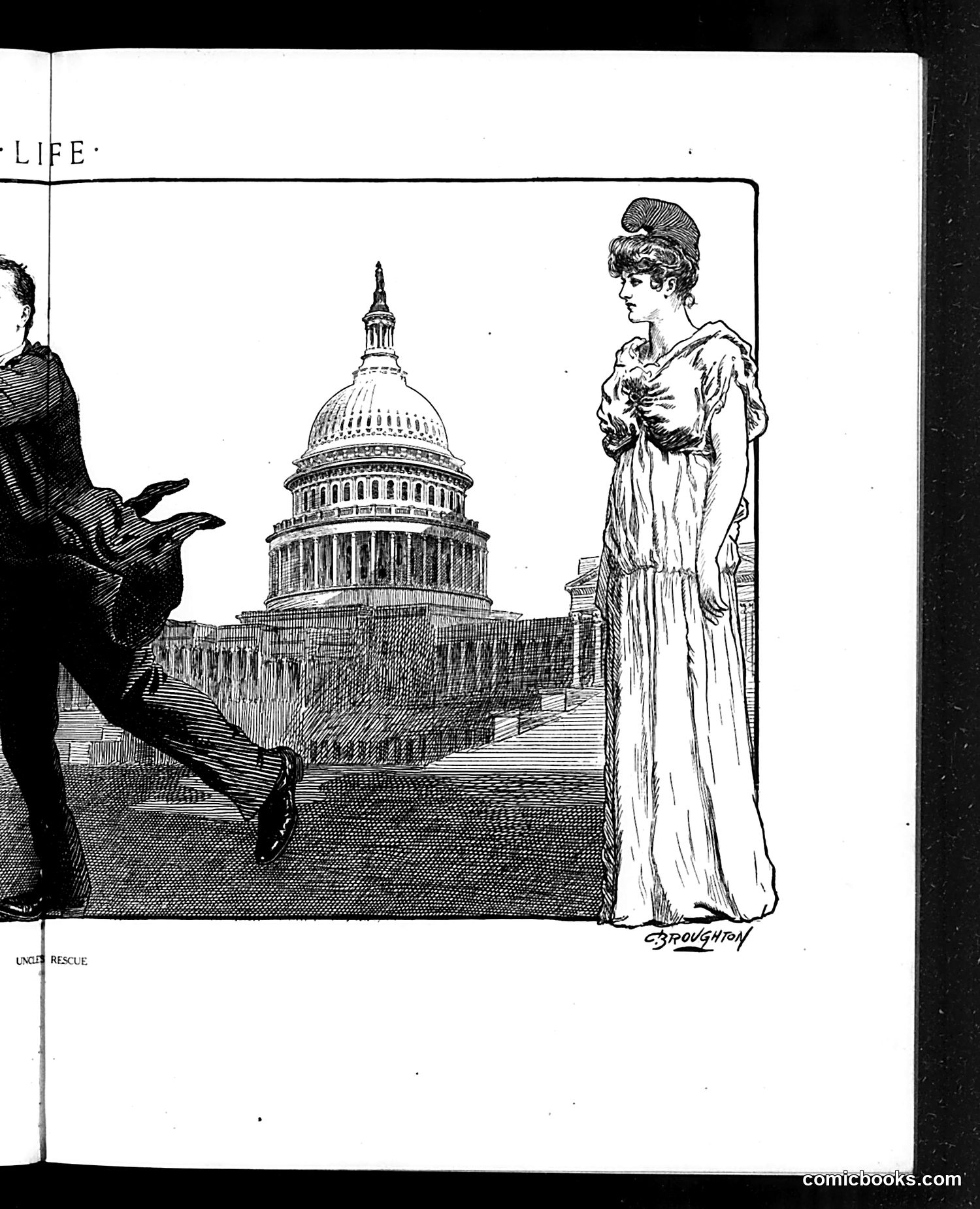
This Life magazine illustration by Stroughton depicts an allegorical scene at the U.S. Capitol. A woman in classical Greek dress (representing Liberty or America) stands dignified before the Capitol building. On the left, a man in formal attire gestures dismissively or desperately toward her—his posture suggests pleading, rejection, or exasperation. The cartoon appears to satirize the relationship between political figures (likely congressmen or politicians) and American ideals or democracy itself. The woman's composed stance contrasts sharply with the man's agitated gesture, suggesting politicians are failing or betraying the nation's principles. Without visible text identifying the specific man, the exact political situation remains unclear, though the tone suggests criticism of governmental hypocrisy or negligence toward democratic values.
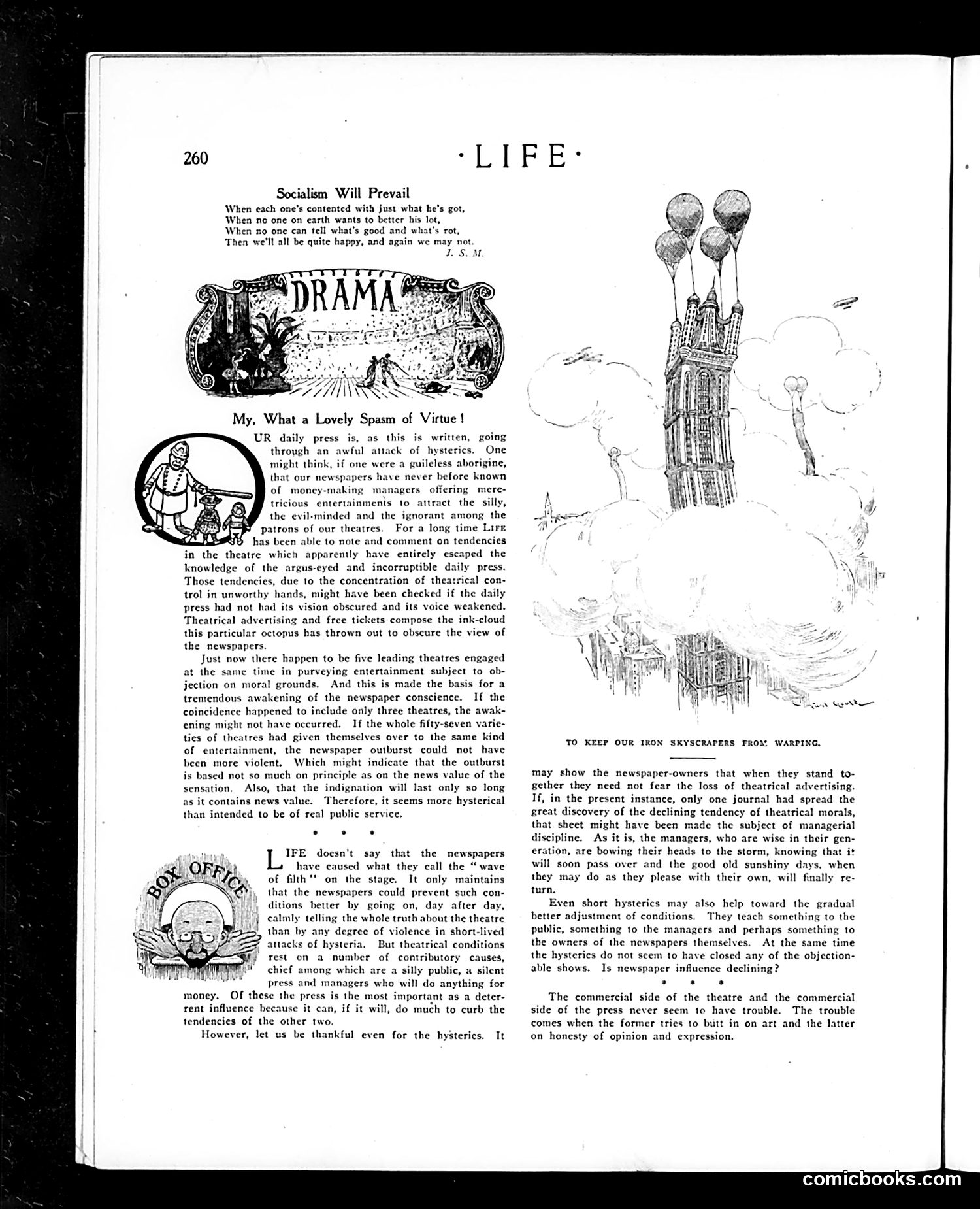
This page contains two satirical pieces criticizing hypocrisy. The opening poem mocks socialism as achieving happiness only through universal mediocrity—when no one wants anything better. The main article attacks newspapers for sudden moral outrage about immoral theatrical productions. Life's argument: newspapers ignored these problems for years while accepting theatrical advertising and free tickets (the "ink-cloud" obscuring their vision). Only now, when *five theaters simultaneously* show objectionable content, do papers cry scandal—motivated by news value, not principle. Life argues the press could more effectively curb theatrical immorality through consistent daily coverage rather than short-lived hysteria. The cartoon's message: newspapers' indignation is temporary and self-serving. Managers know the "storm" will pass and theaters can resume operations. The accompanying sketch depicts tall buildings (skyscrapers), likely referencing urban progress amid this moral decay debate.
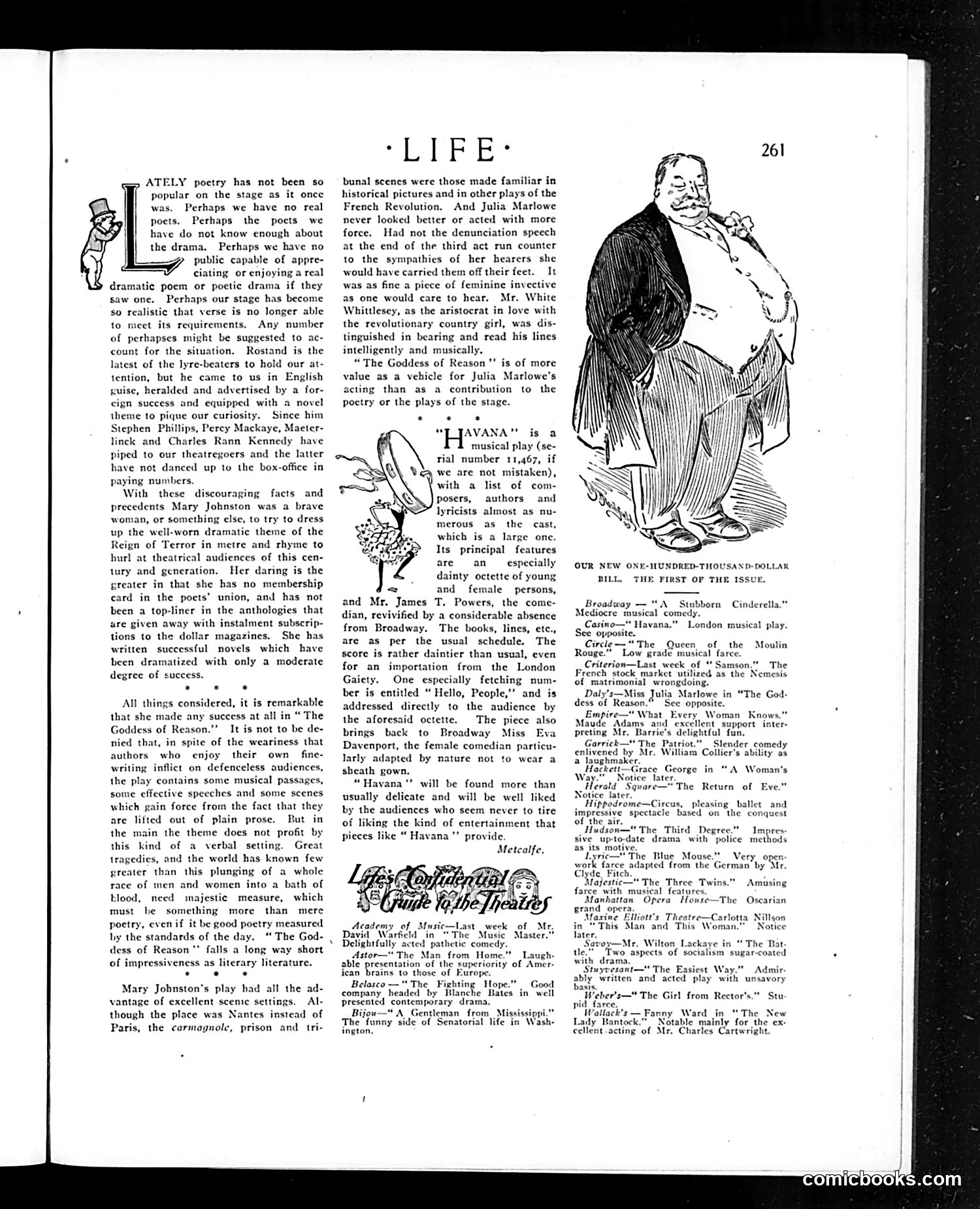
This page contains theater criticism from Life magazine, featuring two main reviews and accompanying caricatures. The text critiques "The Goddess of Reason," a verse play by Mary Johnston set during the French Revolution's Reign of Terror. The reviewer praises the production's staging and actress Julia Marlowe's performance, particularly her "denunciation speech," but argues the poetic language undermines rather than enhances the dramatic material. The play is deemed more valuable as a vehicle for Marlowe's acting than as genuine theatrical poetry. A second review briefly discusses "Havana," a musical comedy featuring comedian James T. Powers, describing it as one of many similar productions with large casts and numerous credited creators. The caricatures accompanying these reviews—appearing to show performers in theatrical poses—are typical of Life's satirical visual commentary on popular entertainment, though specific identities aren't clearly labeled in the visible portion.
This page satirizes the pretensions and self-promotion surrounding modern opera, particularly Richard Strauss's controversial works. The "muse of Richard Strauss" — revealed to be **Mary Garden**, the famous opera singer — visits music critics to demand favorable press coverage. The satire targets several things: Strauss's demanding, dissonant compositions (referenced mockingly as sounding like a storm); the scandal-seeking behavior of avant-garde artists; and the apparent collusion between performers and critics. The muse's threats to have "Salome dance before Governor Hughes for your heads" references Strauss's scandalous opera *Salome*, whose performance was controversial. The joke's punchline is that the muse wants critics to use sensational words ("decadent, unspeakable, degenerate") in reviews — essentially asking for notoriety disguised as criticism. This exposes how modern artists court controversy as publicity while claiming artistic purity ("we live for art alone").
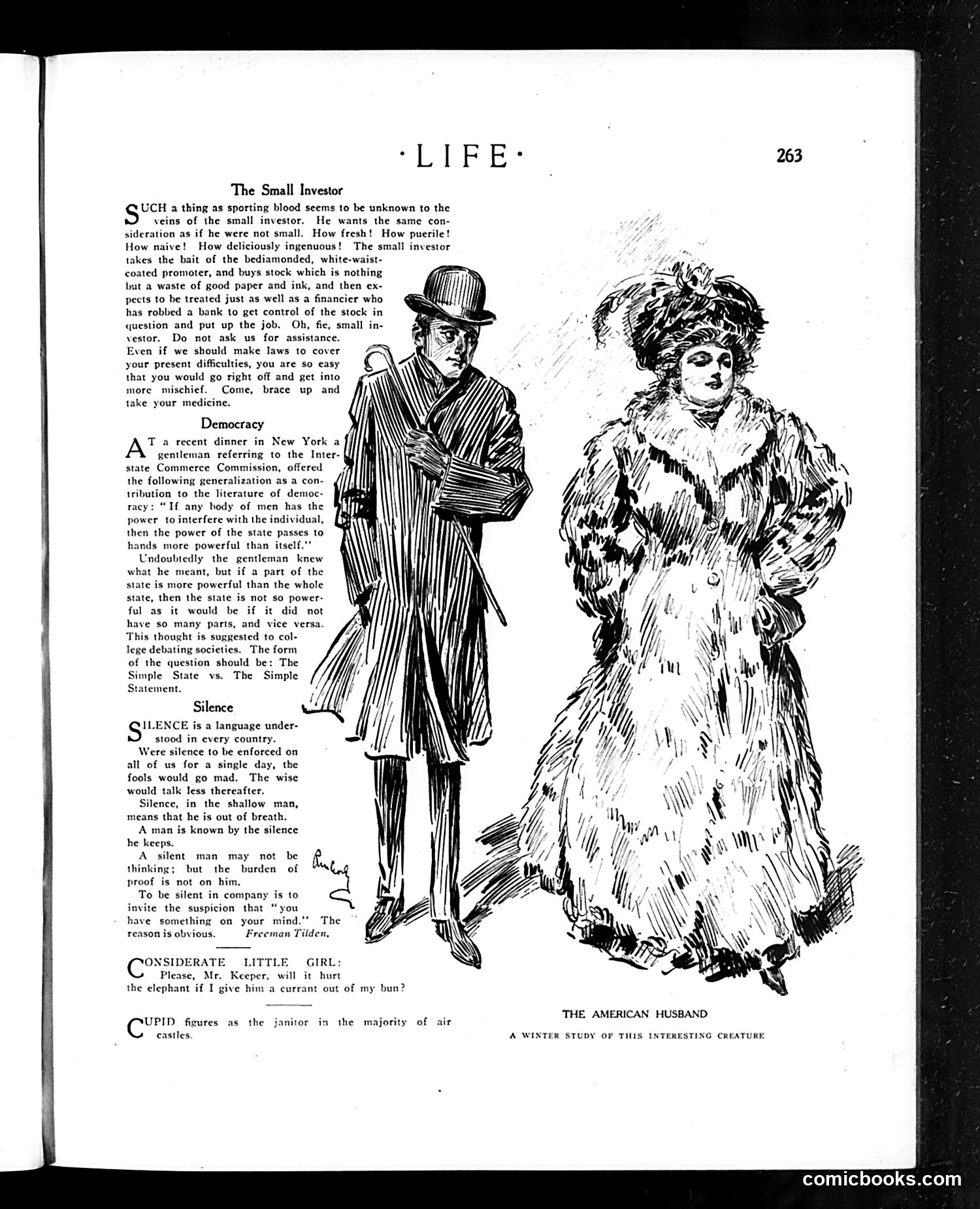
This page from *Life* magazine contains several satirical pieces mocking American society: **"The Small Investor"** ridicules naive retail investors who expect treatment equal to powerful financiers despite lacking their resources or influence. The satire suggests small investors are foolish, easily manipulated, and deserve their losses. **"Democracy"** presents a logical puzzle from an Interstate Commerce Commission dinner, poking fun at abstract political rhetoric and college debate societies—suggesting such high-minded arguments about state power are ultimately meaningless wordplay. **"Silence"** is a philosophical humor piece contrasting silent wise men with foolish ones who "go mad" without talking. The right-side illustration labeled **"The American Husband"** appears to satirize the American husband as a creature worthy of study, though the specific critique isn't elaborated in visible text. A small joke about a "Considerate Little Girl" offering an elephant a currant provides lighter humor. Overall, the page reflects early 20th-century *Life* magazine's satirical tone: mocking financial naiveté, political pretension, and social conventions.
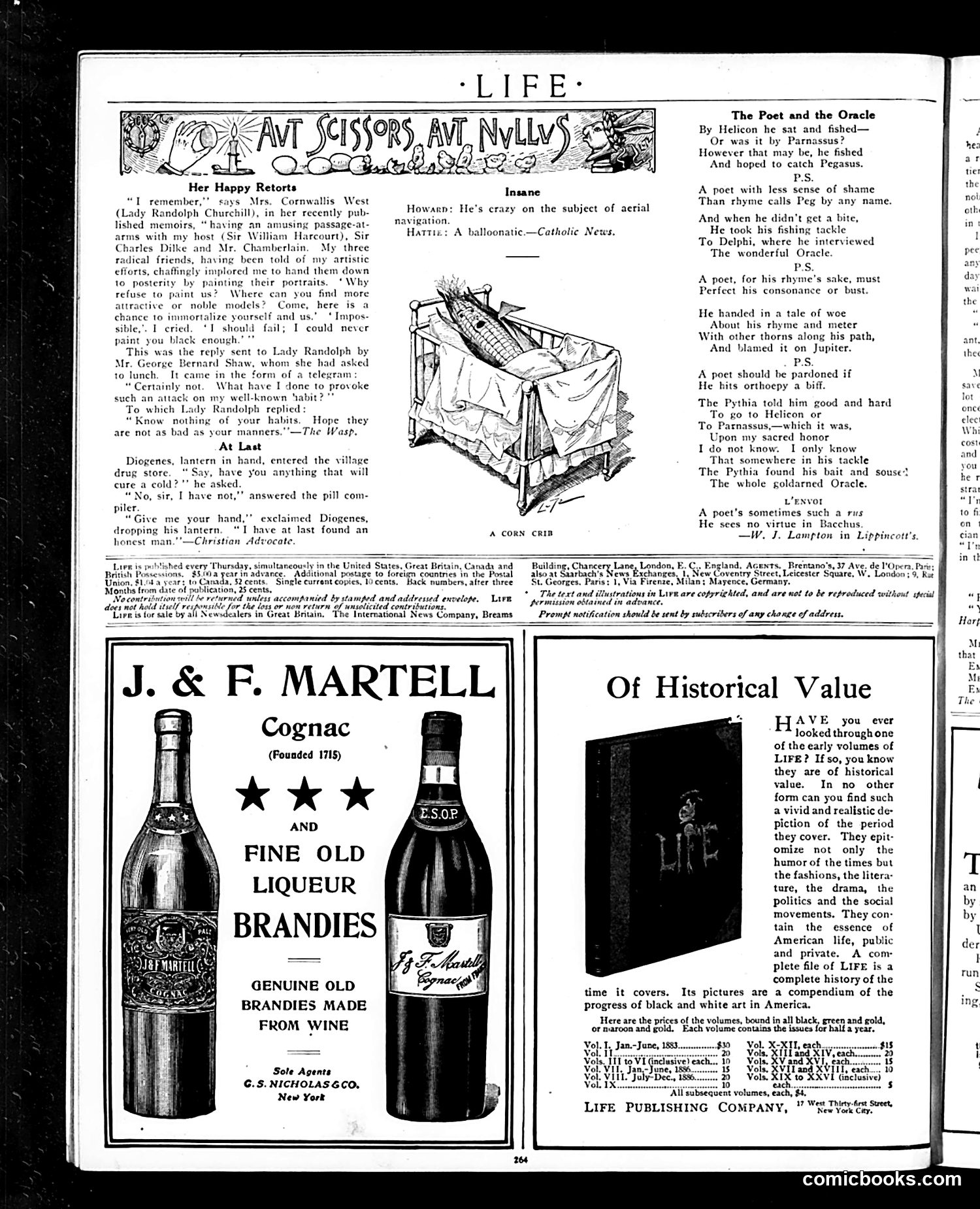
This page contains three satirical pieces mocking literary and artistic pretensions: **"Her Happy Retorts"** recounts witty exchanges involving Lady Randolph Churchill and prominent figures like George Bernard Shaw. The humor derives from sharp comebacks—Shaw declines her lunch invitation with a telegram, she retorts about his manners. The piece gently mocks high society's intellectual posturing. **"At Last"** presents a Diogenes fable: the ancient philosopher searching for an honest man finally finds one—a pharmacist who admits he cannot cure a cold. The satire targets medical quackery and false advertising prevalent in the era. **"The Poet and the Oracle"** humorously critiques pretentious poets, depicting one consulting the Oracle at Delphi about his failed rhymes and blaming Jupiter. The satire suggests poets are self-delusional, making excuses rather than improving their craft. The page also includes period advertisements (Cognac, historical Life volumes) typical of early 20th-century magazines. The overall tone mocks artistic affectation, medical fraud, and poetic self-importance—common Life magazine targets of gentle social satire.
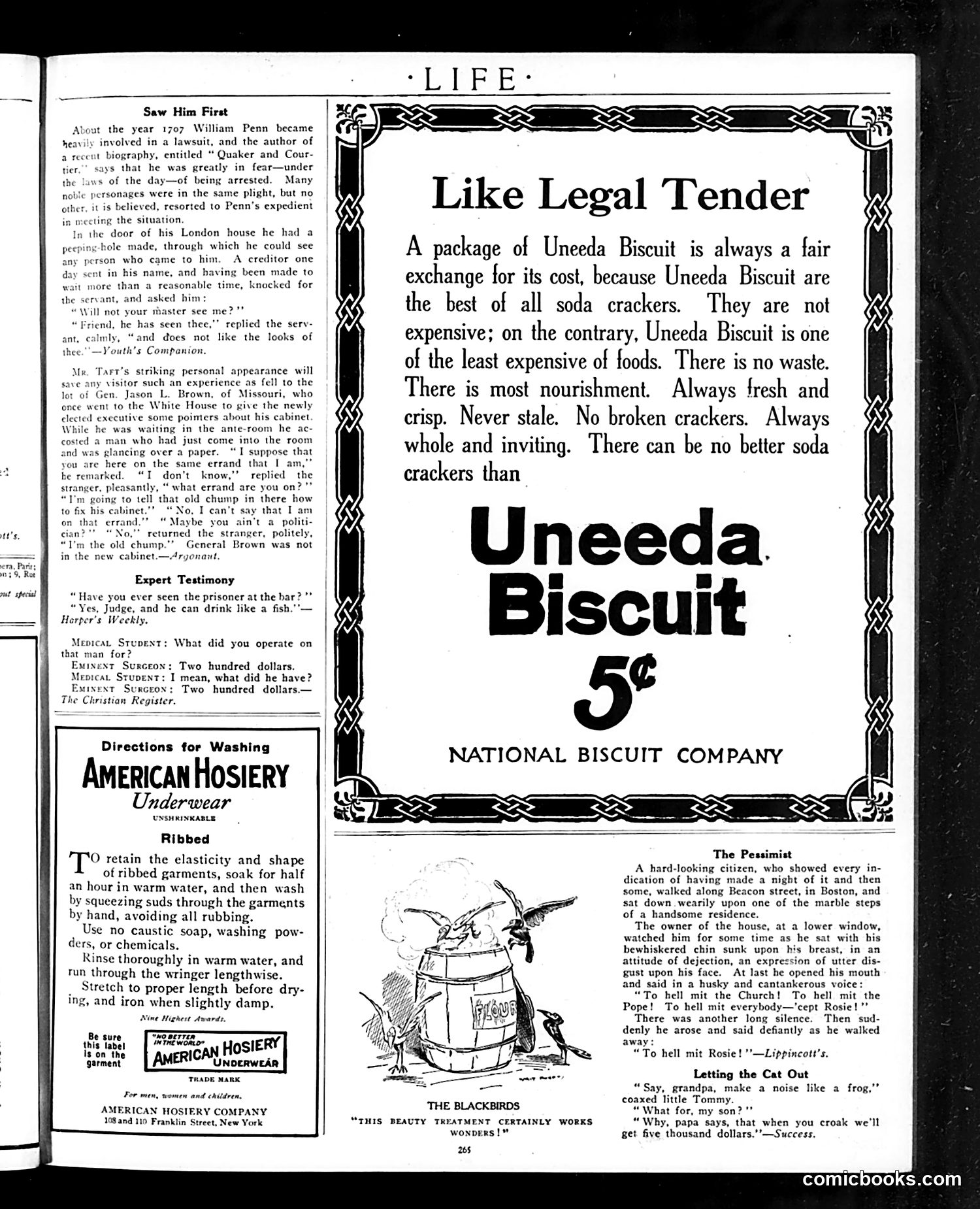
This page from the satirical magazine *Life* contains several unrelated humor pieces and advertisements typical of early 20th-century periodicals. **The cartoons/jokes** include: - "Saw Him First": An anecdote about William Penn (1707) using a peephole to avoid creditors, paired with a similar modern story about General Brown trying to access the White House - "Expert Testimony" and other short quips mocking professional pomposity (doctors, surgeons) - "The Pessimist": A sketch of a drunk man sitting on Boston steps, initially cursing the church and Pope, then cursing even his girlfriend "Rosie" - "Letting the Cat Out": A child asking grandpa to make frog noises (joke's punchline unclear from excerpt) **The satire targets** include bureaucratic absurdity, professional greed, and human hypocrisy. The page is primarily **advertising-driven**, featuring prominent ads for Uneeda Biscuits and American Hosiery underwear, reflecting the magazine's commercial nature.
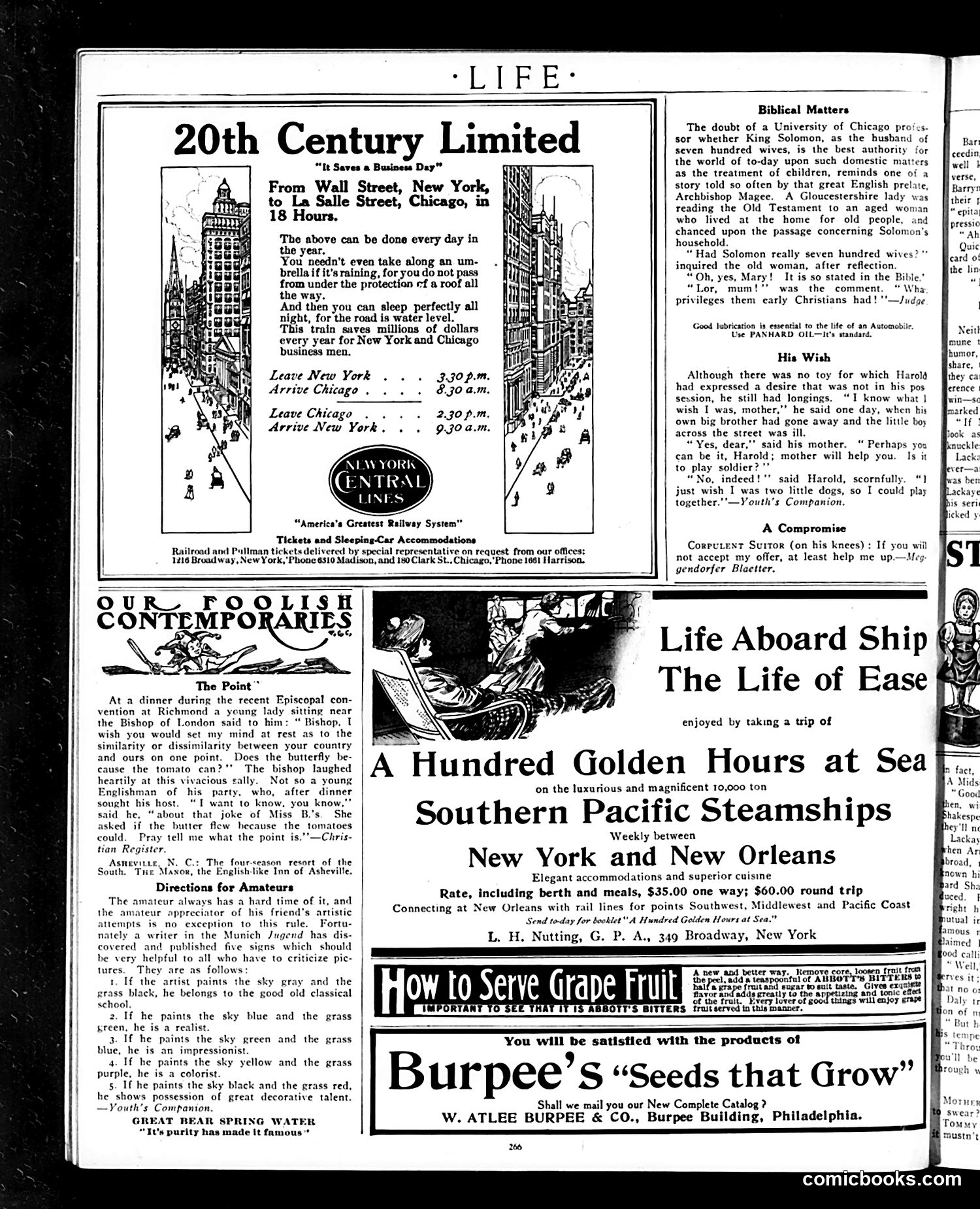
This page is primarily **advertising and miscellaneous content** rather than political satire. The dominant feature is a **20th Century Limited railroad advertisement** promoting fast train service between New York and Chicago in 18 hours—marketed to "business men" as a time-saving convenience. Below that are several **humorous anecdotes** under "Biblical Matters" and other headings: - A joke about Solomon's 700 wives, with a punchline about early Christian privilege - A child's wish to be "two little dogs" so he could play with himself - A "Compromise" cartoon showing a portly man asking for help while on his knees - Instructions for amateur art critics, satirizing different modernist art movements (Impressionism, Colorism, etc.) The page concludes with advertisements for **Burpee Seeds** and a **Southern Pacific Steamship cruise**. There is **no coherent political cartoon or unified satirical message**—rather, this is a typical Life magazine page mixing advertisements with light humor and social commentary fragments.
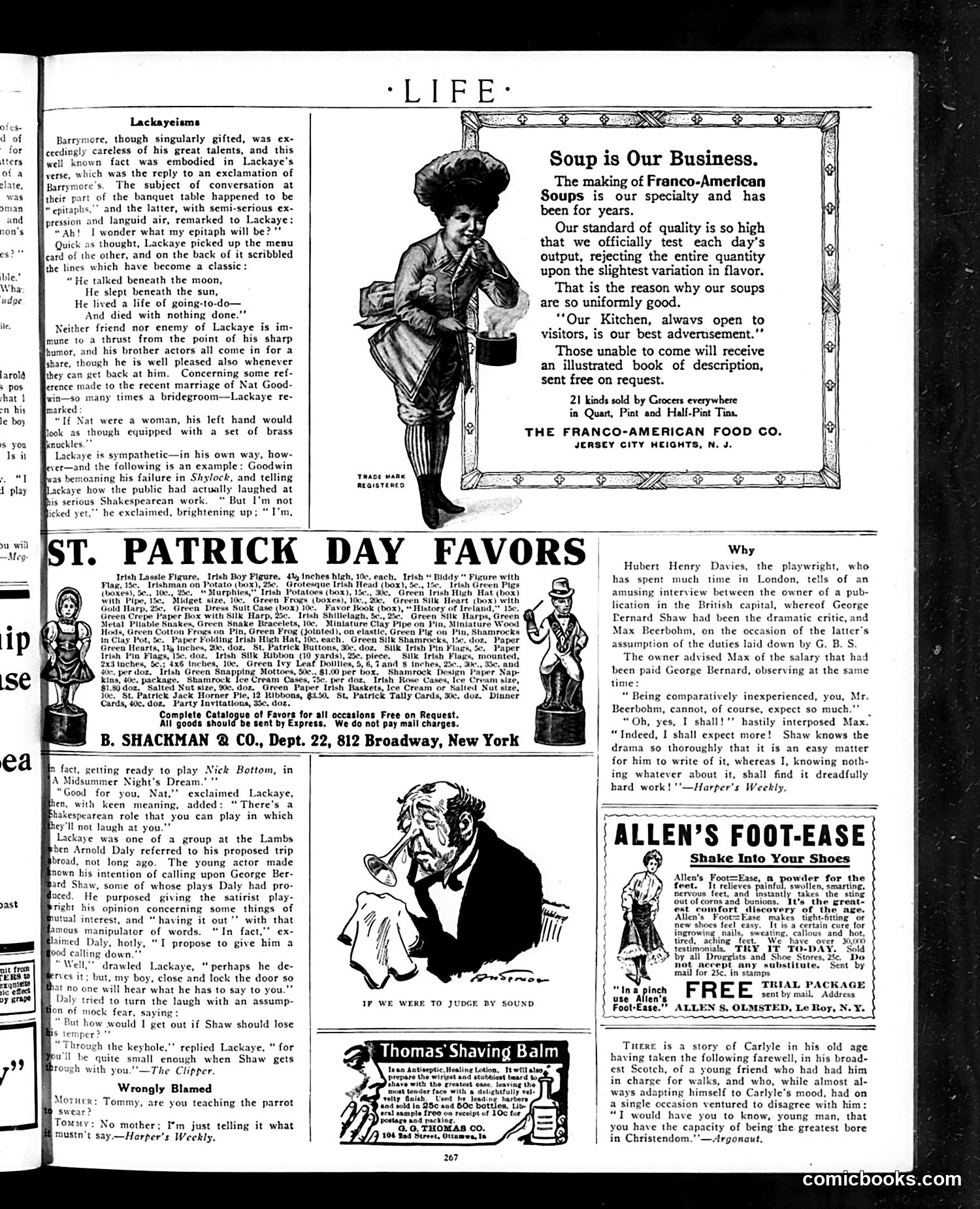
This page from *Life* magazine contains satirical commentary on actor **James Lackaye**, presented through anecdotes showcasing his sharp wit and cutting humor. The text illustrates Lackaye's reputation for clever verbal jabs directed at fellow actors and acquaintances—including a famous impromptu epitaph mocking actor John Barrymore's laziness ("He lived a life of going-to-do— / And died with nothing done"). The page also includes a brief anecdote about **George Bernard Shaw** and **Max Beerbohm**, where Shaw's successor is patronizingly told he cannot "expect much" given Shaw's superior talents—a jab at the perceived inadequacy of Beerbohm's replacement of Shaw as drama critic. The remaining content consists primarily of **period advertisements**: St. Patrick's Day novelty favors, Allen's Foot-Ease powder, Thomas's Shaving Balm, and Franco-American Soups. These ads are typical early-20th-century product placements targeting *Life*'s middle-class readership.
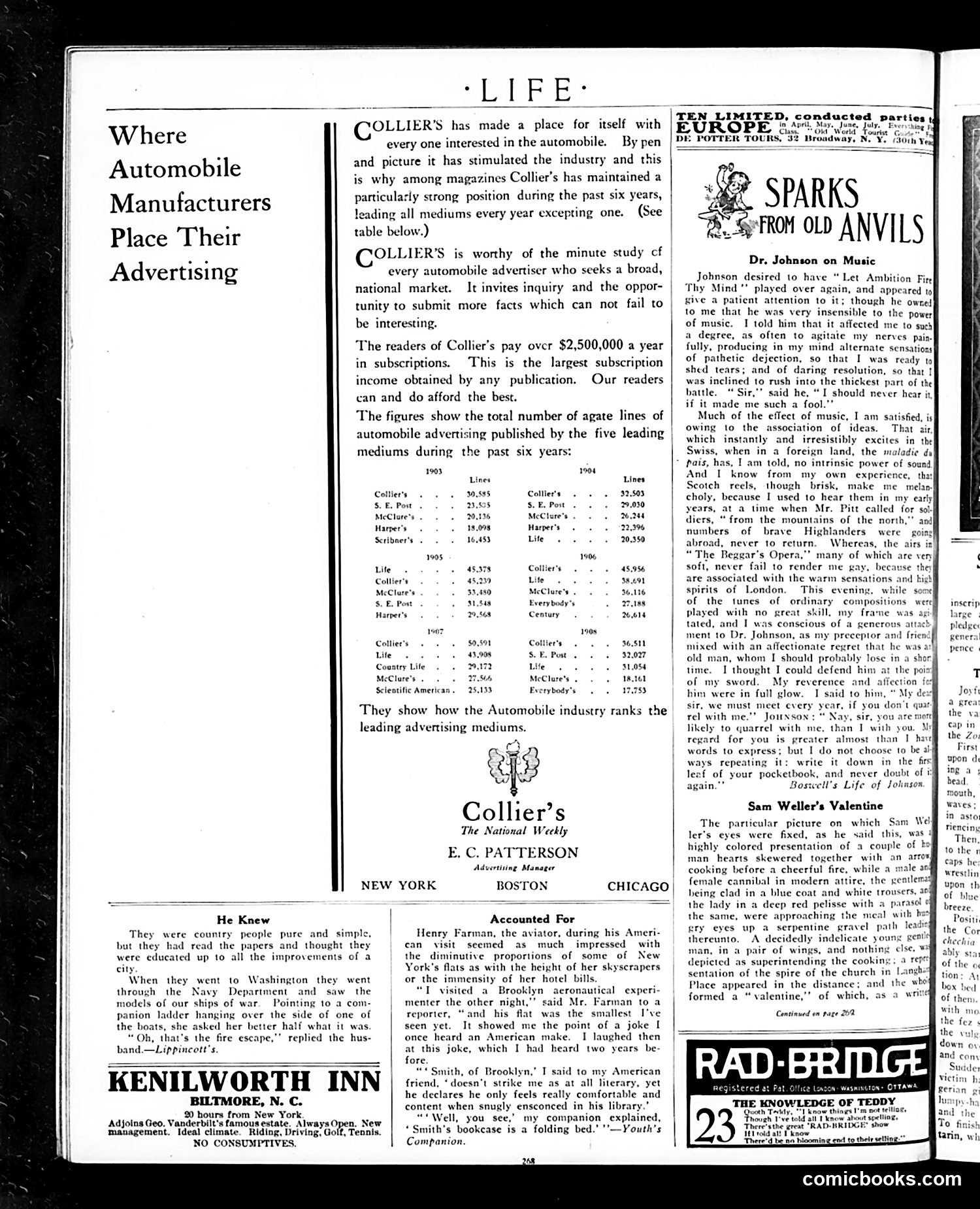
This page is primarily **advertising and business content**, not political satire. The main feature demonstrates Collier's magazine's advertising dominance in the automobile industry through data tables showing "agate lines" (ad volume) from 1903-1908. The text argues Collier's attracts affluent readers ($2.5 million annual subscriptions) whom automobile manufacturers want to reach. The page includes minor **humorous anecdotes** at bottom: - "He Knew": A country couple visiting Washington's Navy Department mistakes a fire escape for a ladder - "Accounted For": Aviator Henry Farman jokes about a Brooklyn inventor's apartment so tiny his bookcase is a folding bed These are light period humor relying on rural/urban contrasts and small-apartment jokes—common early-1900s comedy. The "Sparks from Old Anvils" column excerpts Samuel Johnson on music insensitivity. The content reflects an era when Life magazine mixed satire with lifestyle articles and advertising.
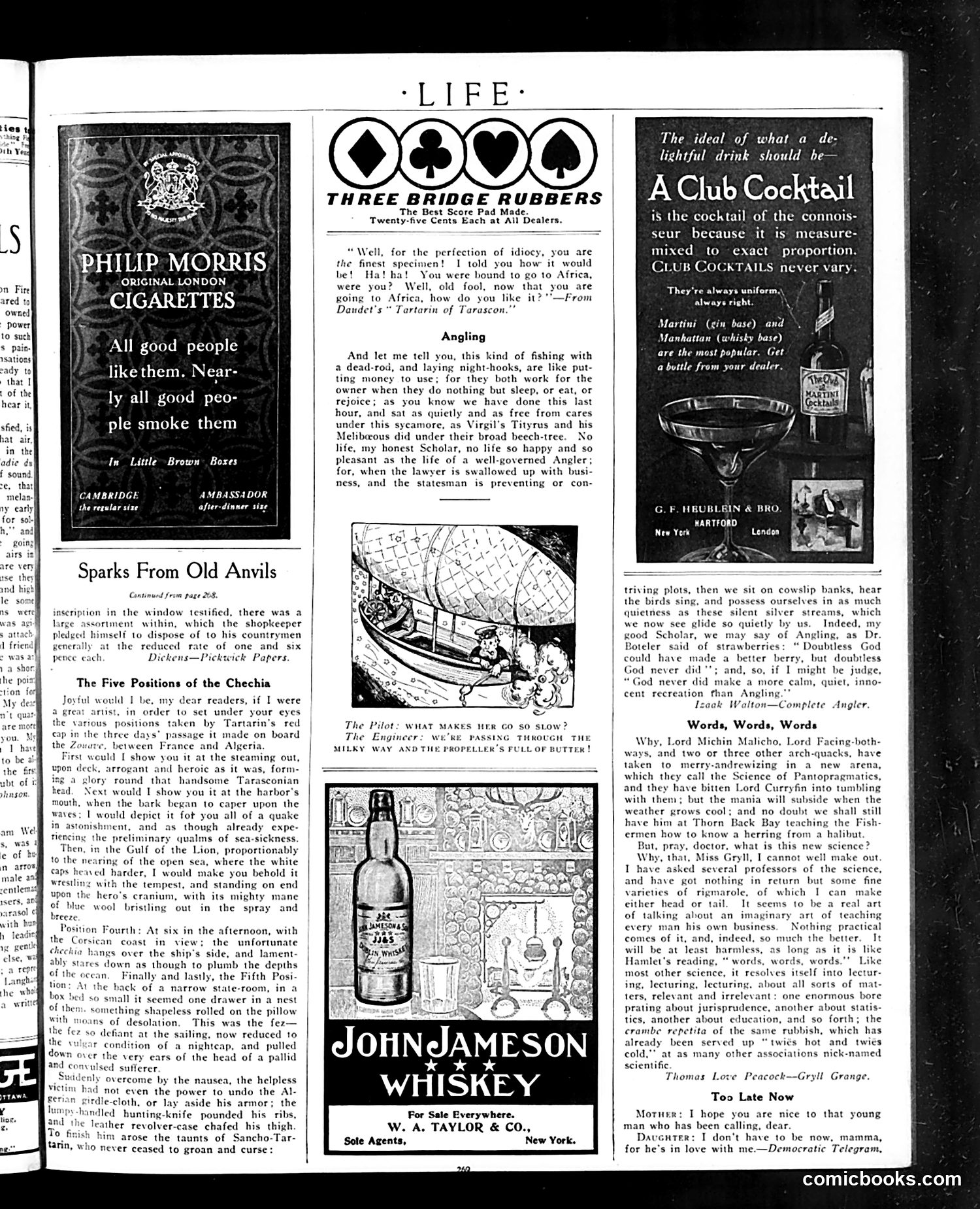
This page is primarily **advertising** interspersed with literary excerpts and light humor, typical of early 20th-century Life magazine. **Main Content:** - **Philip Morris Cigarettes ad**: Claims "all good people" smoke them - **Three Bridge Rubbers**: A score pad advertisement - **Literary excerpts**: Passages from Dickens and Alphonse Daudet about a character's red cap (chechia) during seasickness, and fishing philosophy—nostalgic, leisurely content - **Comic caption**: A pilot-and-engineer joke about moving slowly through the "Milky Way" with propellers full of butter—absurdist, whimsical humor typical of the era - **John Jameson Whiskey ad**: Premium liquor advertisement - **Club Cocktail ad**: Emphasizes precise measurement and consistency **Satire/Context:** Minimal political satire here. This reflects Life's shift toward lifestyle advertising and genteel humor. The Daudet excerpt about Tartarin's seasickness and the fishing philosophy represent period nostalgia for adventure and leisure. The butter-in-space joke is simply surreal nonsense humor popular in 1920s publications.
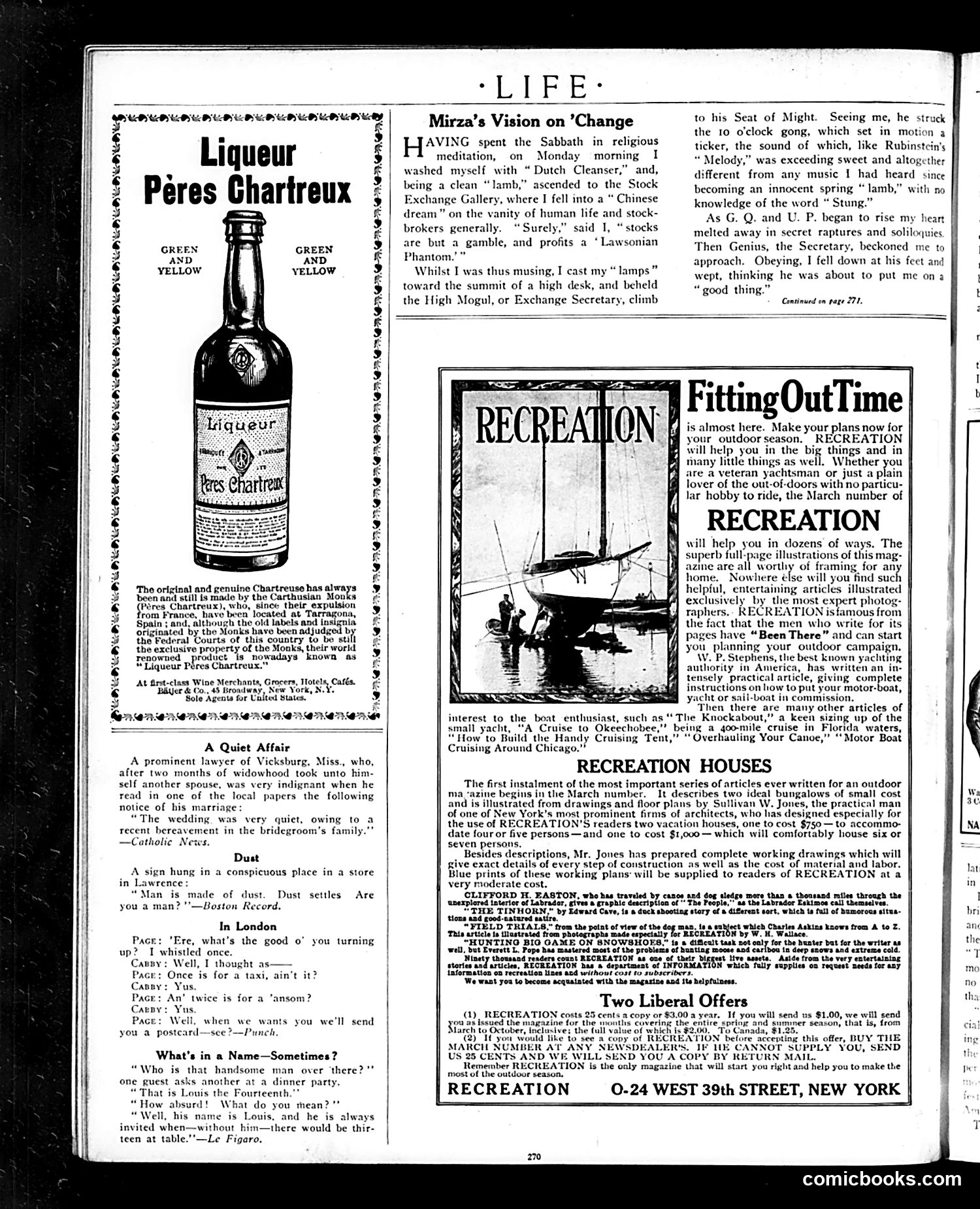
This page contains **advertisements and humorous short pieces** rather than political cartoons. The content includes: **Main Advertisement:** Liqueur Pères Chartreux—a liqueur made by Carthusian monks, historically expelled from France and now based in Spain. The ad emphasizes authenticity and legal exclusivity. **Humor Pieces:** Brief satirical vignettes mocking social conventions: - A lawyer's remarriage announced so tersely it seems indifferent to his recent widowhood - A store sign equating dust with manhood - London working-class dialogue about whistling and postcards - A dinner guest named "Louis the Fourteenth" who's always invited to reach thirteen at table **"Mirza's Vision on 'Change":** A stock market allegory where a "clean lamb" investor dreams the Exchange is vanity, witnessing the Secretary strike a gong to start the ticker—satirizing the theater and manipulation of stock trading. **RECREATION Magazine Advertisement:** Promoting outdoor lifestyle content and yachting articles. The page reflects Life's satirical humor style targeting contemporary social absurdities and financial speculation.
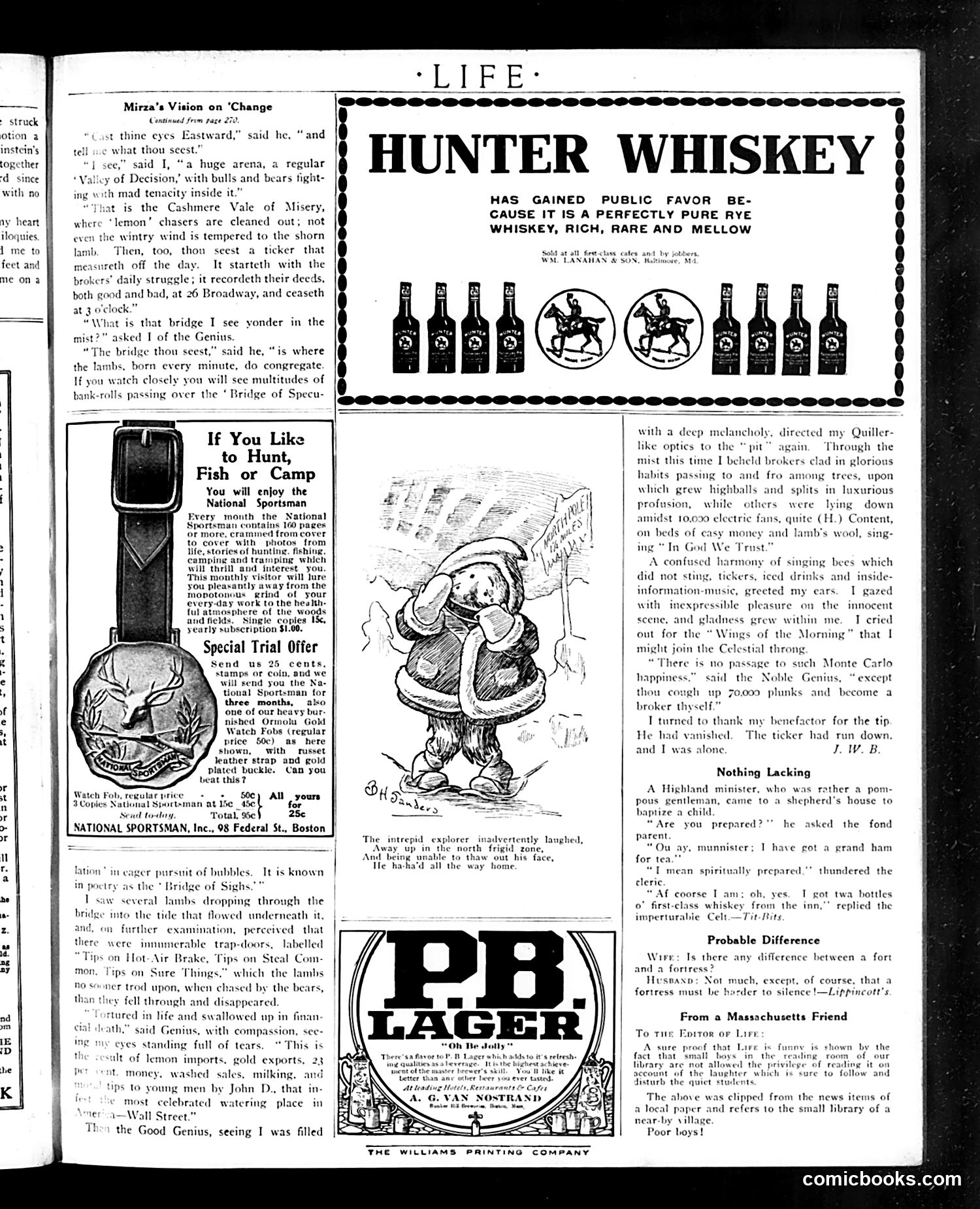
This is a satirical financial allegory presented as a mystical vision, likely referencing stock market speculation during the early 20th century. A "Genius" (guide figure) shows the narrator a metaphorical landscape of Wall Street trading: the stock exchange appears as an arena where "bulls and bears" fight; a ticker tape machine marks brokers' daily struggles; and most pointedly, a "Bridge of Speculation" where naive investors ("lambs") congregate and fall through trap-doors labeled with tempting tips ("Hot-Air Brake," "Sure Things," "Tips on Steal Common"). These trap-doors represent schemes that fleece inexperienced traders. The vision culminates in a paradise for successful brokers lounging amid "highballs and splits," but the Genius reveals entry requires "70,000 plunks"—suggesting wealth accumulation through the very schemes that trap ordinary investors. The satire critiques predatory financial practices and the false promises of easy wealth in Wall Street trading.
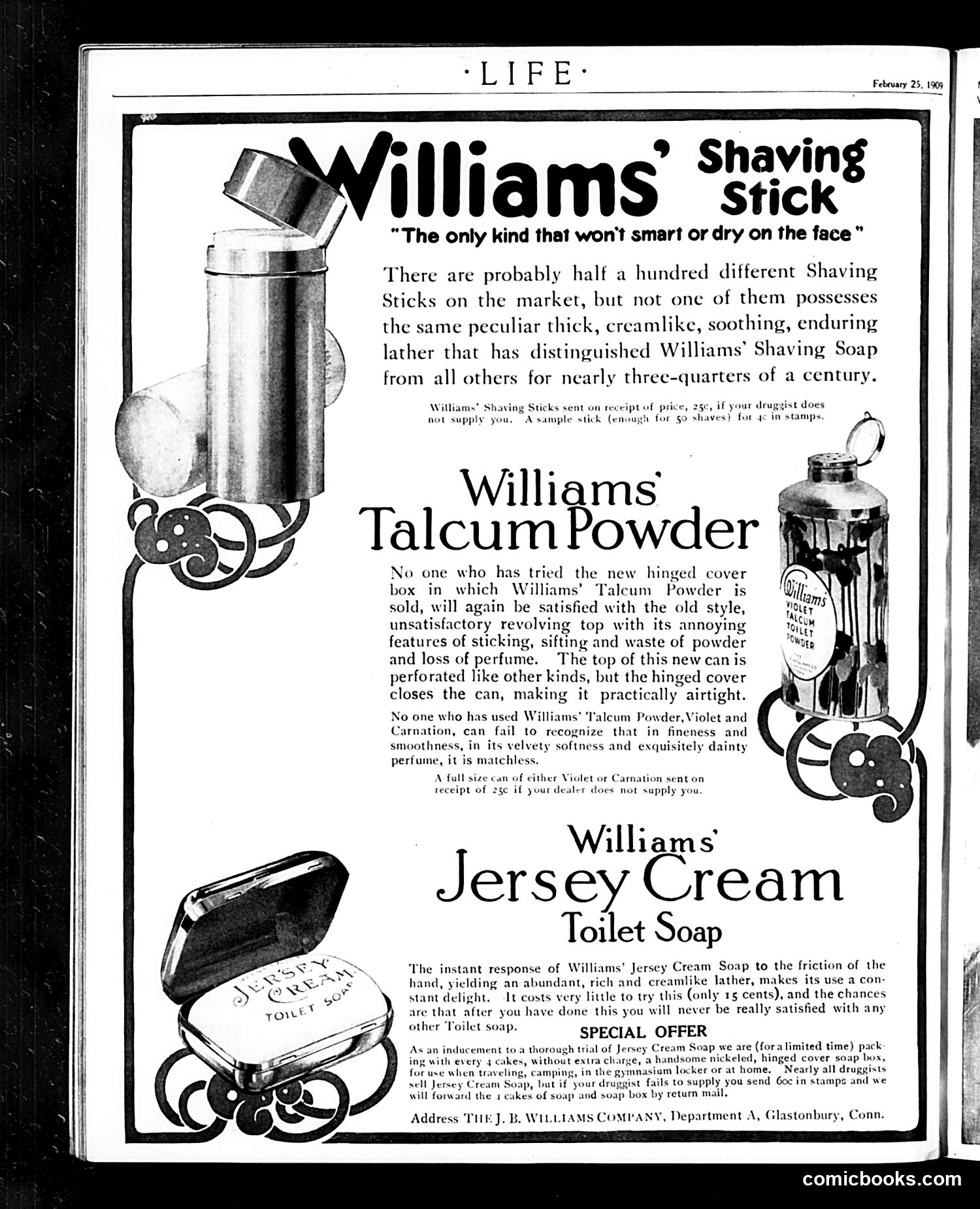
This page is primarily **advertising**, not satire or political commentary. It contains three product advertisements from The J. B. Williams Company (Glastonbury, Connecticut), dated February 25, 1909: 1. **Williams' Shaving Stick** — marketed as uniquely non-drying, with a thick, creamy lather superior to competitors 2. **Williams' Talcum Powder** — advertised with a new hinged-cover box design (improvement over older revolving tops that stuck or sifted) 3. **Williams' Jersey Cream Toilet Soap** — positioned as inexpensive (15 cents) with a special promotional offer: purchase 4 cakes and receive a complimentary hinged soap box for travel/camping The ads emphasize practical innovations (hinged boxes, non-irritating formulas) and cost-effectiveness. There are **no identifiable political figures, caricatures, or satirical commentary** visible. The decorative flourishes are purely ornamental design elements typical of early 1900s advertising layout.