
Life, 1909-02-25 · page 18 of 28
Life — February 25, 1909 — page 18: what you’re looking at
What you’re looking at
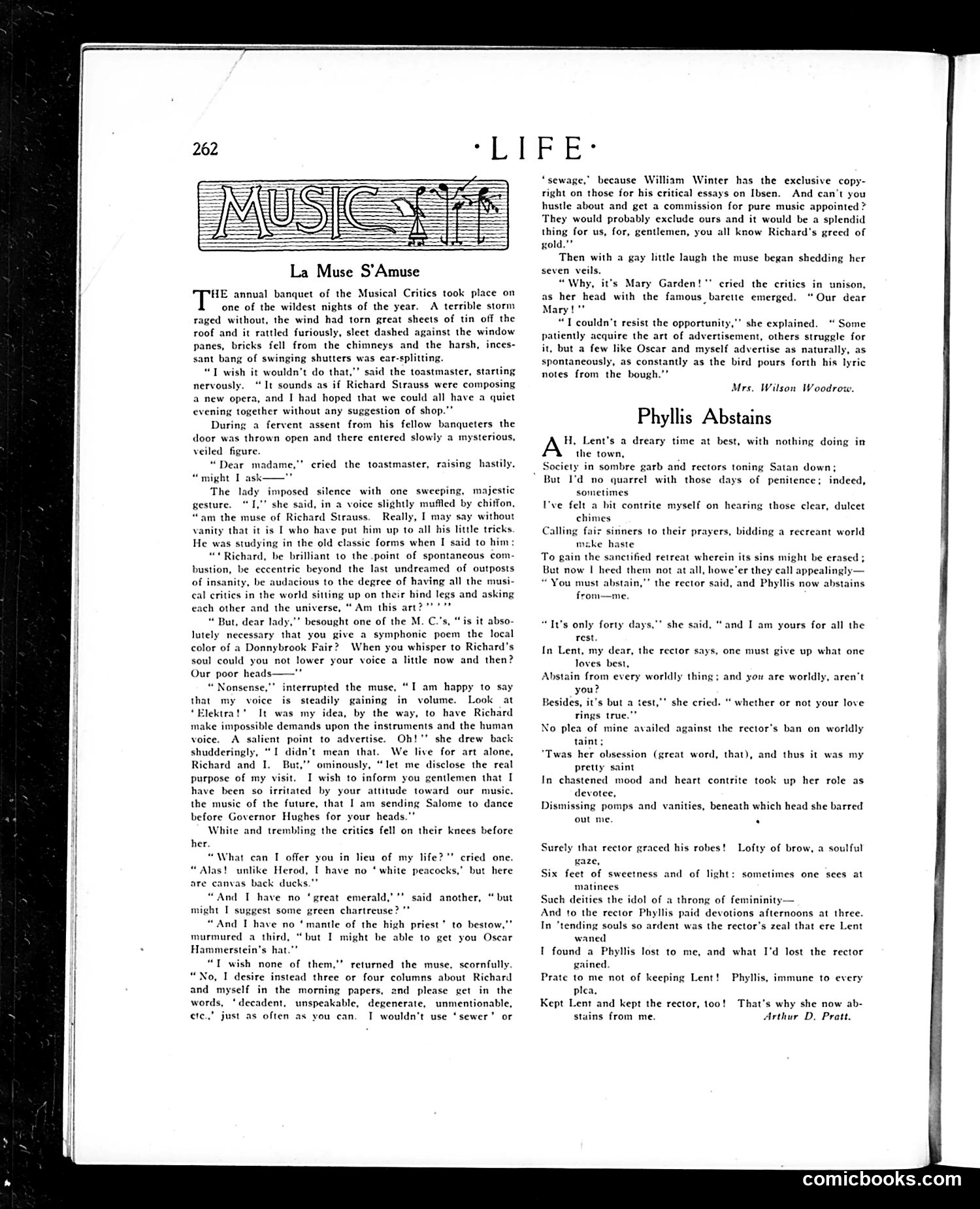
This page satirizes the pretensions and self-promotion surrounding modern opera, particularly Richard Strauss's controversial works. The "muse of Richard Strauss" — revealed to be **Mary Garden**, the famous opera singer — visits music critics to demand favorable press coverage. The satire targets several things: Strauss's demanding, dissonant compositions (referenced mockingly as sounding like a storm); the scandal-seeking behavior of avant-garde artists; and the apparent collusion between performers and critics. The muse's threats to have "Salome dance before Governor Hughes for your heads" references Strauss's scandalous opera *Salome*, whose performance was controversial. The joke's punchline is that the muse wants critics to use sensational words ("decadent, unspeakable, degenerate") in reviews — essentially asking for notoriety disguised as criticism. This exposes how modern artists court controversy as publicity while claiming artistic purity ("we live for art alone").
📄 Transcribed text from this page (OCR, searchable)
Machine-transcribed from the original scan — historical spelling and the odd misread are preserved.
“LIFE: La Muse S’'Amuse HE annual banquet of the Musical Crities took place on one of the wildest nights of the year. A terrible storm raged without, the wind had torn great sheets of tin off the roof and it rattled furiously, sleet dashed against the window panes, bricks fell from the chimneys and the harsh, inces- sant bang of swinging shutters was ear-splitting. “1 wish it wouldn't do that,”’ said the toastmaster, starting nervously. “It sounds as if Richard Strauss were composing a new opera, and I had hoped that we could all have a quiet evening together without any suggestion of shop.”’ During a fervent assent from his fellow banqueters the door was thrown open and there entered slowly a mysterious, veiled figure. “Dear madame,’ cried the toastmaster, raising hastily, “ might I ask——" The lady imposed silence with one sweeping, majestic gesture. “I,” she said, in a voice slightly muflled by chiffon, “am the muse of Richard Strauss, Really, | may say without vanity that it is | who have put him up to all his little tricks. He was studying in the old classic forms when I said to him: “Richard, be brilliant to the point of spontaneous com- bustion, be eccentric beyond the last undreamed of outposts of insanity, be audacious to the degree of having all the musi- cal critics in the world sitting up on their hind legs and asking each other and the universe, “Am this art?""""? “ But, dear lady,’? besought one of the M. C.'s, “is it abso- lutely necessary that you give a symphonic poem the local color of a Donnybrook Fair? When you whisper to Richard's soul could you not lower your voice a little now and then? Our poor heads—"* “Nonsense,” interrupted the muse, “I am happy to say that my voice is steadily gaining in volume. Look at ‘Elektra!’ It was my idea, by the way, to have Richard make impossible demands upon the instruments and the human voice. A salient point to advertise. Ob!'’ she drew back shudderingly, “I didn’t mean that. We live for art alone, Richard and I. But,’ ominously, “let me disclose the real purpose of my visit. I wish to inform you gentlemen that I have been so irritated by your attitude toward our music, the music of the future, that I am sending Salome to dance before Governor Hughes for your heads.”* White and trembling the crities fell on their knees before her “What can I offer you in liew of my life?" cried one. “Alas! unlike Herod, I have no ‘white peacocks,’ but here are canvas back ducks.” “And T have no ‘great emerald,’'’ said another, “but might I suggest some green chartreuse?” “And I have no ‘mantle of the high priest’ to bestow,”’ murmured a third, “but I might be able to get you Oscar Hammerstein's hat.”” “I wish none of them," returned the muse, scornfully. “No, I desire instead three or four columns about Richard and myself in the morning papers, and please get in the words, ‘decadent, unspeakable, degenerate, unmentionable, ¢te.," just as often as you can. T wouldn't use ‘sewer’ or ‘sewage,’ because William Winter has the exclusive copy- ight on those for his critical essays on Ibsen. And can’t you hustle about and get a commission for pure music appointed ? They would probably exclude ours and it would be a splendid thing for us, for, gentlemen, you all know Richard's greed of gold. Then with a gay little laugh the muse began shedding her seven veils. “Why, it's Mary Garden!’ cried the critics in unison, as her head with the famous barette emerged. “Our dear Mary!’ “couldn't resist the opportunity," she explained. “ Some patiently acquire the art of advertisement, others struggle for it, but a few like Oscar and myself advertise as naturally, as spontaneously, as constantly as the bird pours forth his lyric notes from the bough.”* Mrs, Wilson Woodrow. Phyllis Abstains A" Lent’s a dreary time at best, with nothing doing in the town, Society in sombre garb and rectors toning Satan down But I'd no quarrel with those days of penitence; indeed, sometimes I've felt a bit contrite myself on hearing those clear, dulcet chimes Calling fair sinners to their prayers, bidding a recreant world make haste To gain the sanctified retreat wherein its sins might be erased; But now I heed them not at all, howe’er they call appealingly— “You must abstain,” the rector said, and Phyllis now abstains from—me. “It’s only forty days. rest In Lent, my dear, the rector says, one must give up what one loves best, Abstain from every worldly thing; and you are worldly, aren't you? Besides, it’s but a test,"" she cried. “ whether or not your love * she said, “and I am yours for all the rings true.’ No plea of mine availed against the rector’s ban on worldly taint; “Twas her obsession (great word, that), and thus it was my pretty saint In chastened mood and heart contrite took up her role as devotee, Dismissing pomps and vanities, beneath which head she barred out me : Surely that rector graced his robes! Lofty of brow, a soulful kaze, Six feet of sweetness and of light: sometimes one sees at matinees Such deities the idol of a throng of femininity And to the rector Phyllis paid devotions afternoons at three. In ‘tending souls so ardent was the rector’s zeal that ere Lent waned I found a Phyl! gained. Prate to me not of keeping Lent! plea Kept Lent and kept the rector, too! That's why she now ab- stains from me. Arthur D. Pratt. lost to me, and what I'd lost the rector Phyllis, immune to every comicbooks.com