
Life, 1909-02-25 · page 17 of 28
Life — February 25, 1909 — page 17: what you’re looking at
What you’re looking at
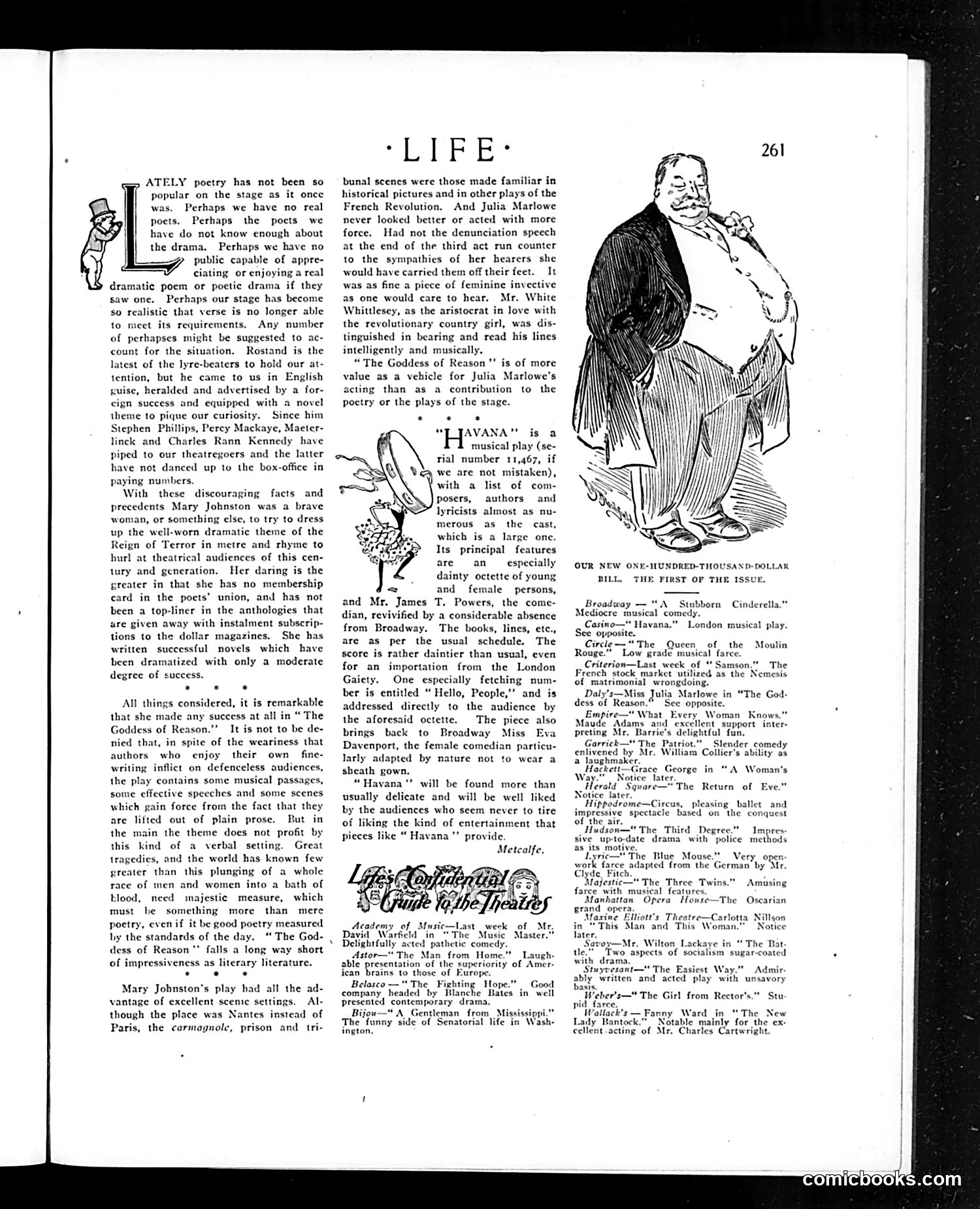
This page contains theater criticism from Life magazine, featuring two main reviews and accompanying caricatures. The text critiques "The Goddess of Reason," a verse play by Mary Johnston set during the French Revolution's Reign of Terror. The reviewer praises the production's staging and actress Julia Marlowe's performance, particularly her "denunciation speech," but argues the poetic language undermines rather than enhances the dramatic material. The play is deemed more valuable as a vehicle for Marlowe's acting than as genuine theatrical poetry. A second review briefly discusses "Havana," a musical comedy featuring comedian James T. Powers, describing it as one of many similar productions with large casts and numerous credited creators. The caricatures accompanying these reviews—appearing to show performers in theatrical poses—are typical of Life's satirical visual commentary on popular entertainment, though specific identities aren't clearly labeled in the visible portion.
📄 Transcribed text from this page (OCR, searchable)
Machine-transcribed from the original scan — historical spelling and the odd misread are preserved.
ATELY poetry has not been so popular on the stage as it once was, Perhaps we have no real poets. Perhaps the poets we have do not know enough about the drama. Perhaps we have no y public capable of appre- ciating or enjoying a real dramatic poem or poetic drama if they saw one. Perhaps our stage has become so realistic that verse is no longer able to meet its requirements. Any number of perhapses might be suggested to ac- count for the situation, Rostand is the latest of the lyre-beaters to hold our at- tention, but he came to us in English guise, heralded and advertised by a for- cign success and equipped with a novel theme to pique our curiosity. Since him Stephen Phillips, Perey Mackaye, Maeter- linck and Charles Rann Kennedy have piped to our theatregoers and the latter have not danced up to the box-office in paying numbers. With these discouraging facts and precedents Mary Johnston was a brave woman, or something else, to try to dress up the well-worn dramatic theme of the Reign of Terror in metre and rhyme to hurl at theatrical audiences of this cen- tury and generation. Her daring is the greater in that she has no membership card in the pocts’ union, and has not been a top-liner in the anthologies that ure given away with instalment subscrip- tions to the dollar magazines. She has written successful novels which have been dramatized with only a moderate degree of success. . 8 All things considered, it is remarkable that she made any success at all in “ The Goddess of Reason.”’ It is not to be de- nied that, in spite of the weariness that authors who enjoy their own _fine- writing inflict on defenceless audiences, the play contains some musical passages, some effective speeches and some scenes which gain force from the fact that they are lifted out of plain prose. But in the main the theme does not profit by this kind of a verbal setting. Great tragedies, and the world has known few greater than this plunging of a whole race of men and women into a bath of Blood, need majestic measure, which must be something more than mere poetry, even if it be good poetry measured by the standards of the day.“ The God- dess of Reason” falls a long way short of impressiveness as literary literature. Mary Johnston's play had all the ad- vantage of excellent scenic settings. Al- though the place was Nantes instead of Paris, the carmagnole, prison and tri- ‘LIF E* bunal scenes were those made familiar in historical pictures and in other plays of the French Revolution, And Julia Marlowe never looked better or acted with more force, Had not the denunciation speech at the end of the third act run counter to the sympathies of her hearers she would have carried them off their feet. It was as fine a piece of feminine invective as one would care to hear. Mr. White Whittlesey, as the aristocrat in love with the revolutionary country girl, was dis- tinguished in bearing and read his lines intelligently and musically. “The Goddess of Reason’’ is of more value as a vehicle for Julia Marlowe's acting than as a contribution to the poctry or the plays of the stage. AVANA” is a musical play (se- rial number 11,467, if we are not mistaken), with a list of com- posers, authors and lyricists almost as nu- merous as the cast, which is a large one. Its principal features are an ___ especially dainty octette of young and female persons, and Mr. James T. Powers, the come- dian, revivified by a considerable absence from Broadway. The books, lines, etc. are as per the usual schedule. The score is rather daintier than usual, even for an importation from the London Gaiety. One especially fetching num- ber is entitled “Hello, People,” and is addressed directly to the audience by the aforesaid octette. The piece also brings back to Broadway Miss Eva Davenport, the female comedian particu- larly adapted by nature not to wear a sheath gown. “Havana” will be found more than usually delicate and will be well liked by the audiences who seem never to tire of liking the kind of entertainment that pieces like “ Havana" provide. Metcalfe. ke othe [heatres Acaden of Music—Last_ week of Mr. David Warfield in “The Music Master.” Delightfully acted pathetic comedy. Astor—" The Man from Home.” Laugh- able prceenlation of the superiority of Amer- ican brains to those of Europe. Belasco—“ The Fighting Hope.” Good company headed by Tilanche Hates in well presented contemporary drama, Bijou—“ A Gentleman from Mississippi.” The funny side of Senatorial life in Wash- W ONE-HUNDRED-TIOUSAND-DOLLAR THE FIRST OF THE ISSUE. Broadway — “A Stubborn Cinderella.” Mediocre musical “comedy. Casino—* Havana.” London musical play. See opposite. Circle—“ The Queen of the Rouge." Low grade musical farce. _Criterion—Last week of * Samson." The French stock market utilized as the Nemesis of matrimonial wrongdoing. Daly’s—Miss Julia Marlowe in “The God- dess of Reason.” See opposite. Empire—" What Every Woman Knows.” Maude Adams and excellent support inter- preting Mr. Barrie's delightful fun, Garrick—" The Patriot.” | Slender comed; enlivened by Mr. William Collier's ability a5 a laughmaker. Hackett—Grace George in “A Woman's Way.” Notice later Herald Square—"'The Return of Eve.” Notice later. ~ Hippodrome—Circus, pleasing ballet and impressive spectacle based on the conquest of the air. Hudson—" The Third Degree.” Impres sive up-to-date drama with police methods as its motive Lyric—" The Tue Mouse.” Very open- work farce adapted from the German by Mr. Clyde Fitch. ajestic— The Three Twins.” farce with musical features. Manhattan Opera House—The grand opera, Maxine Elliott's Theatre—C in’ This Man and This Woman, later. Savoy—Mr. Wilton Lackaye tle.” Two aspects of socialism with drama. Stuyvesant—" The Easiest Wa ably ‘written and acted play wit pasts Weber’s—" The Girl from Rector’s.” Stu pid farce. Wallack’s — Fanny Ward in “The New Lady Bantock.” Notable mainly for the ex- cellent-acting of Mr. Charles Cartwright, Moulin Amusing Oscarian “The Bat gare