
Life, 1909-02-25 · page 6 of 28
Life — February 25, 1909 — page 6: what you’re looking at
What you’re looking at
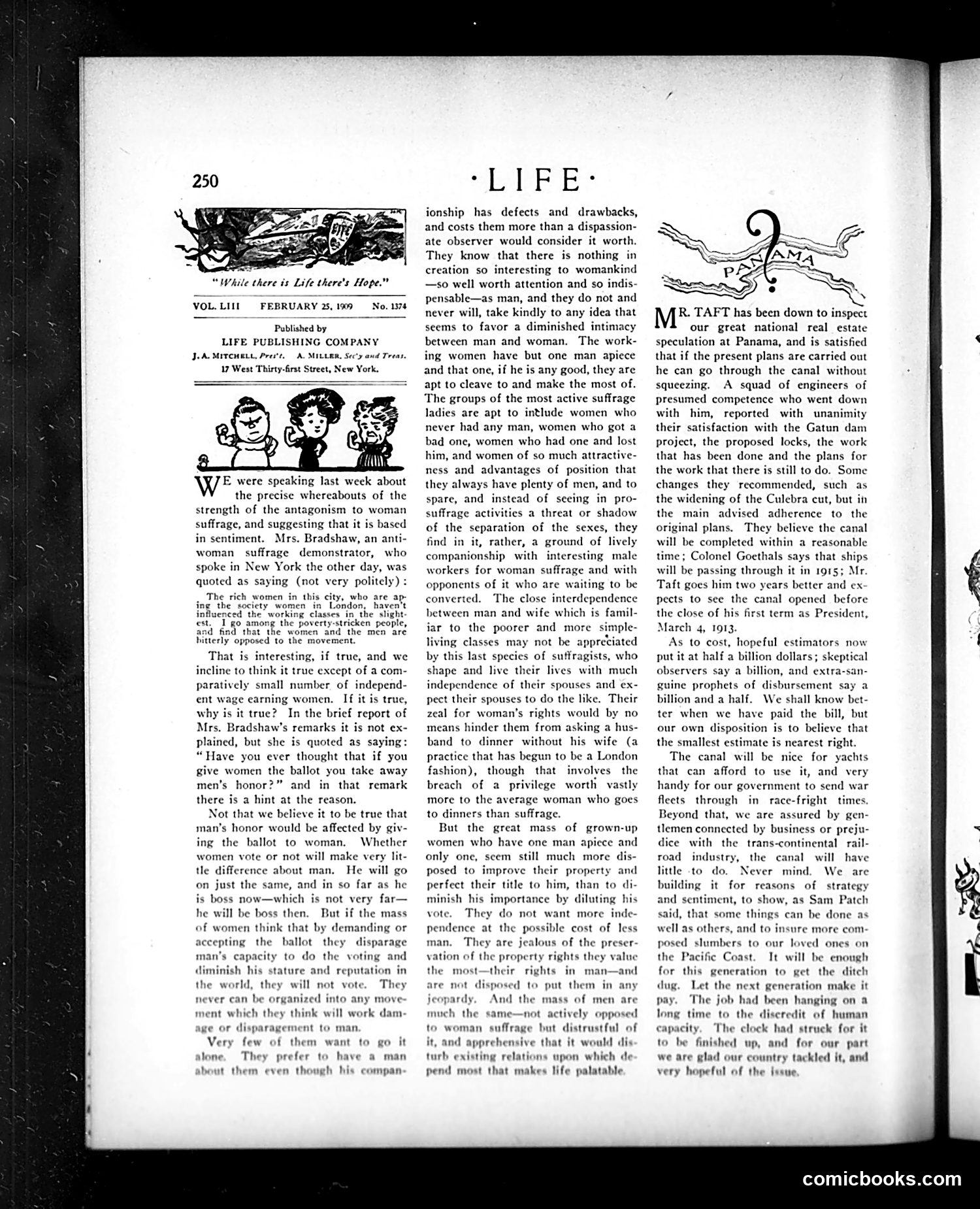
This page from Life magazine (February 28, 1913) contains an editorial essay—not a political cartoon—addressing women's suffrage and gender relations. The piece critiques arguments against women's voting rights, particularly those claiming women lack independent judgment. The author refutes the notion that women voting would somehow undermine marriage or family life, noting that women already make consequential decisions independently. The essay also discusses the Panama Canal project and mentions Mr. Taft's inspection visit, suggesting the canal's completion within a reasonable timeframe. The small cartoon header ("While there is Life there's Hope") is decorative rather than topical. The three illustrated faces appear to be generic humorous characters typical of Life's visual style, not specific political figures or caricatures.
📄 Transcribed text from this page (OCR, searchable)
Machine-transcribed from the original scan — historical spelling and the odd misread are preserved.
“While there is Life there's Hope.” VOL. LIII FEBRUARY 25, 1909 No. 1574 Published by LIFE PUBLISHING COMPANY JeA. MITCHELL, Previt, A. MILLER, Sec'y and Treas. 17 West Thirty-first Street, New York, = were speaking last week about the precise whereabouts of the strength of the antagonism to woman suffrage, and suggesting that it is based in sentiment. Mrs. Bradshaw, an anti- woman suffrage demonstrator, who spoke in New York the other day, was quoted as saying (not very politely): The rich women in this city, who are ap- ing the society women in London, haven't fluenced the working classes in the slight I go among the poverty-stricken people, find that women and the men are hitterly opposed to the movement. That is interesting, if true, and we incline to think it true except of a com- paratively small number of independ- ent wage earning women. If it is true, why is it true? In the brief report of Mrs. Bradshaw’s remarks it is not ex- plained, but she is quoted as saying: “Have you ever thought that if you give women the ballot you take away men’s honor?” and in that remark there is a hint at the reason. Not that we believe it to be true that man’s honor would be affected by giv- ing the ballot to woman. Whether women vote or not will make very lit- tle difference about man. He will go on just the same, and in so far as he is boss now—which is not very far— he will be boss then. But if the mass of women think that by demanding or epting the ballot they man’s capacity to do the voting and liminish his stature and reputation in the world, they will not vote. They never can be organized into any move ment which they think will work d: age or disparagement to man. Very few of them want alone. They prefer to have a man st them even though his compan SSbe Es ionship has defects and drawbacks, and costs them more than a dispassion- ate observer would consider it worth. They know that there is nothing in creation so interesting to womankind —so well worth attention and so indis- pensable—as man, and they do not and never will, take kindly to any idea that seems to favor a diminished intimacy between man and woman. The work- ing women have but one man apiece and that one, if he is any good, they are apt to cleave to and make the most of. The groups of the most active suffrage ladies are apt to intlude women who never had any man, women who got a bad one, women who had one and lost him, and women of so much attractive- ness and advantages of position that they always have plenty of men, and to spare, and instead of seeing in pro- suffrage activities a threat or shadow of the separation of the sexes, they find in it, rather, a ground of lively companionship with interesting male workers for woman suffrage and with opponents of it who are waiting to be converted. The close interdependence between man and wife which is fami! iar to the poorer and more simple- living classes may not be appreciated by this last species of suffragists, who. shape and live their lives with much independence of their spouses and pect their spouses to do the like. Their zeal for woman's rights would by no means hinder them from asking a hus- band to dinner without his wife (a practice that has begun to be a London fashion), though that involves the breach of a privilege worth vastly more to the average woman who goes to dinners than suffrage. But the great mass of grown-up women who have one man apiece and only one, seem still much more dis- posed to improve their property and perfect their title to him, than to di- minish his importance by diluting his vote. They do not want more inde- pendence at the possible cost of less man. They are jealous of the preser- vation of the property rights they value the most—their rights in| man—and are not disposed to put them in any jeopardy And the mass of men a much the same—not actively opposed » woman suffrage but distrustful of it, and apprehensive that it would dis turh existing relations upon which de pend most that makes life palatable. M® TAFT has been down to inspect our great national real estate speculation at Panama, and is satisfied that if the present plans are carried out he can go through the canal without squeezing. A squad of engineers of presumed competence who went down with him, reported with unanimity their satisfaction with the Gatun dam project, the proposed locks, the work that has been done and the plans for the work that there is still todo. Some changes they recommended, such as the widening of the Culebra cut, but in the main advised adherence to the original plans. They believe the canal will be completed within a reasonable time ; Colonel Goethals s that ships will be passing through it in 1915; Mr. Taft goes him two years better and ex pects to see the canal opened before the close of his first term as President, March 4, 1913. As to cost, hopeful estimators now put it at half a billion dollars; skeptical observers say a billion, and extra-san- guine prophets of disbursement say a billion and a half. We shall know bet- ter when we have paid the bill, but our own disposition is to believe that the smallest estimate is nearest right. The canal will be nice for yachts that can afford to use it, and very handy for our government to send war fleets through in race-fright times. Beyond that, we are assured by gen- tlemen connected by business or preju- dice with the trans-continental rail- road industry, the canal will have little to do. Never mind. We are building it for reasons of strategy and sentiment, to show, as Sam Patch said, that some things can be done as well as others, and to insure more com- posed slumbers to our loved ones on the Pacific Coast. It will be enough for this generation to get the ditch dug. Let the next generation make it pay, The job had been hanging on a long time to the diseredit of human capacity, The clock had struck for it to be finished up, and for our part we are glad our country tackled it, and very hopeful of the issue comicbooks.com