
Life, 1909-02-25 · page 16 of 28
Life — February 25, 1909 — page 16: what you’re looking at
What you’re looking at
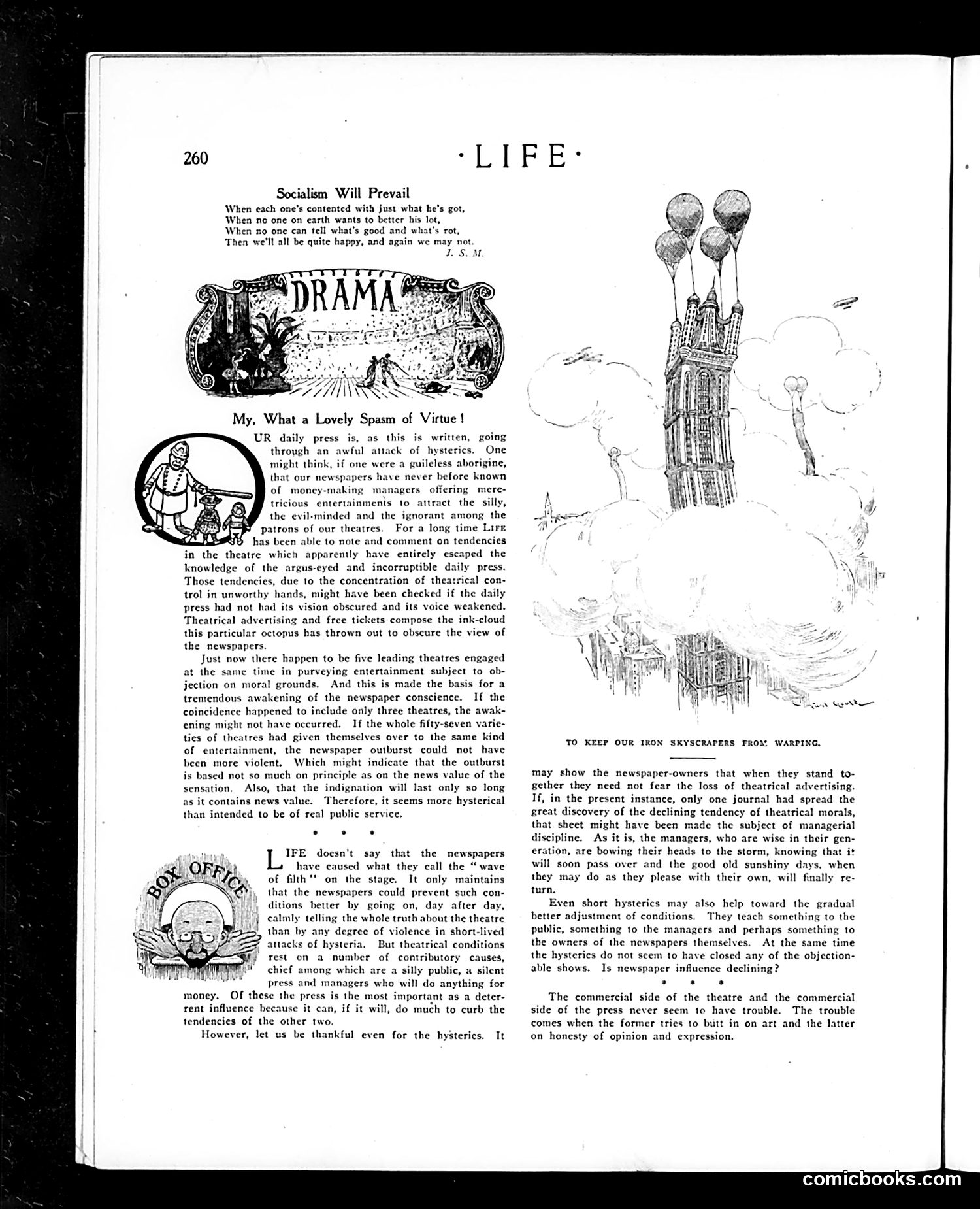
This page contains two satirical pieces criticizing hypocrisy. The opening poem mocks socialism as achieving happiness only through universal mediocrity—when no one wants anything better. The main article attacks newspapers for sudden moral outrage about immoral theatrical productions. Life's argument: newspapers ignored these problems for years while accepting theatrical advertising and free tickets (the "ink-cloud" obscuring their vision). Only now, when *five theaters simultaneously* show objectionable content, do papers cry scandal—motivated by news value, not principle. Life argues the press could more effectively curb theatrical immorality through consistent daily coverage rather than short-lived hysteria. The cartoon's message: newspapers' indignation is temporary and self-serving. Managers know the "storm" will pass and theaters can resume operations. The accompanying sketch depicts tall buildings (skyscrapers), likely referencing urban progress amid this moral decay debate.
📄 Transcribed text from this page (OCR, searchable)
Machine-transcribed from the original scan — historical spelling and the odd misread are preserved.
ee Socialism Will Prevail When each one’s contented with just what he's got, When no one on earth wants to better his lot, When no one can tell what's good and what's rot, Then we'll all be quite happy, and again we may not vs && \ My, What a Lovely Spasm of Virtue ! UR daily press is, as this is written, going through an awful attack of hysterics. One might think, if one were a guileless aborigine, that our newspapers have never before known of money-making managers offering mere- tricious entertainmenis to attract the silly, the evil-minded and the ignorant among the patrons of our theatres. For a long time Lire has been able to note and comment on tendencies: in the theatre which apparently have entirely escaped the knowledge of the argus-eyed and incorruptible daily press. Those tendencies, due to the concentration of theatrical con- trol in unworthy hands, might have been checked if the daily press had not had its vision obscured and its voice weakened. Theatrical advertising and free tickets compose the ink-cloud this particular octopus has thrown out to obscure the view of the newspapers. Just now there happen to be five leading theatres engaged at the same time in purveying entertainment subject to ob- jection on moral grounds, And this is made the basis for a tremendous awakening of the newspaper conscience. If the coincidence happened to include only three theatres, the awak- ening might not have occurred. If the whole fifty-seven varie- ties of theatres had given themselves over to the same kind of entertainment, the newspaper outburst could not have been more violent. Which might indicate that the outburst is based not so much on principle as on the news value of the sensation. Also, that the indignation will last only so long as it contains news value. Therefore, it seems more hysterical than intended to be of real public service. IFE doesn't say that have caused what they call the of filth’? on the stage. It only maintains that the newspapers could prevent such con- ditions better by going on, day after day, calmly telling the whole truth about the theatre than by any degree of violence in short-lived attacks of hysteria. But theatrical conditions rest_on a number of contributory causes, chief among which are a silly public, a silent press and managers who will do anything for money. Of these the press is the most important as a deter rent influence because it can, if it will, do much to curb the tendencies of the other two. However, let us be thankful even for the hysterics. It the newspapers “wave OFF; aes Gee TO KEEP OUR IRON SKYSCRAPERS FROX WARPING. may show the newspaper-owners that when they stand to- gether they need not fear the loss of theatrical advertising. If, in the present instance, only one journal had spread the great discovery of the declining tendency of theatrical morals, that sheet might have been made the subject of managerial discipline. As it is, the managers, who are wise in their gen- eration, are bowing their heads to the storm, knowing that it will soon pass over and the good old sunshiny days, when they may do as they please with their own, will finally re- turn. Even short hysterics may also help toward the gradual better adjustment of conditions. They teach something to the public, something to the managers and perhaps something to the owners of the newspapers themselves. At the same time the hysterics do not scem to have closed any of the objection- able shows. Is newspaper influence declining? > 8 The commercial side of the theatre and the commercial side of the press never seem to have trouble. The trouble comes when the former tries to butt in on art and the latter on honesty of opinion and expression. comicbooks.com