
A complete issue · 24 pages · 1908
Life — September 24, 1908
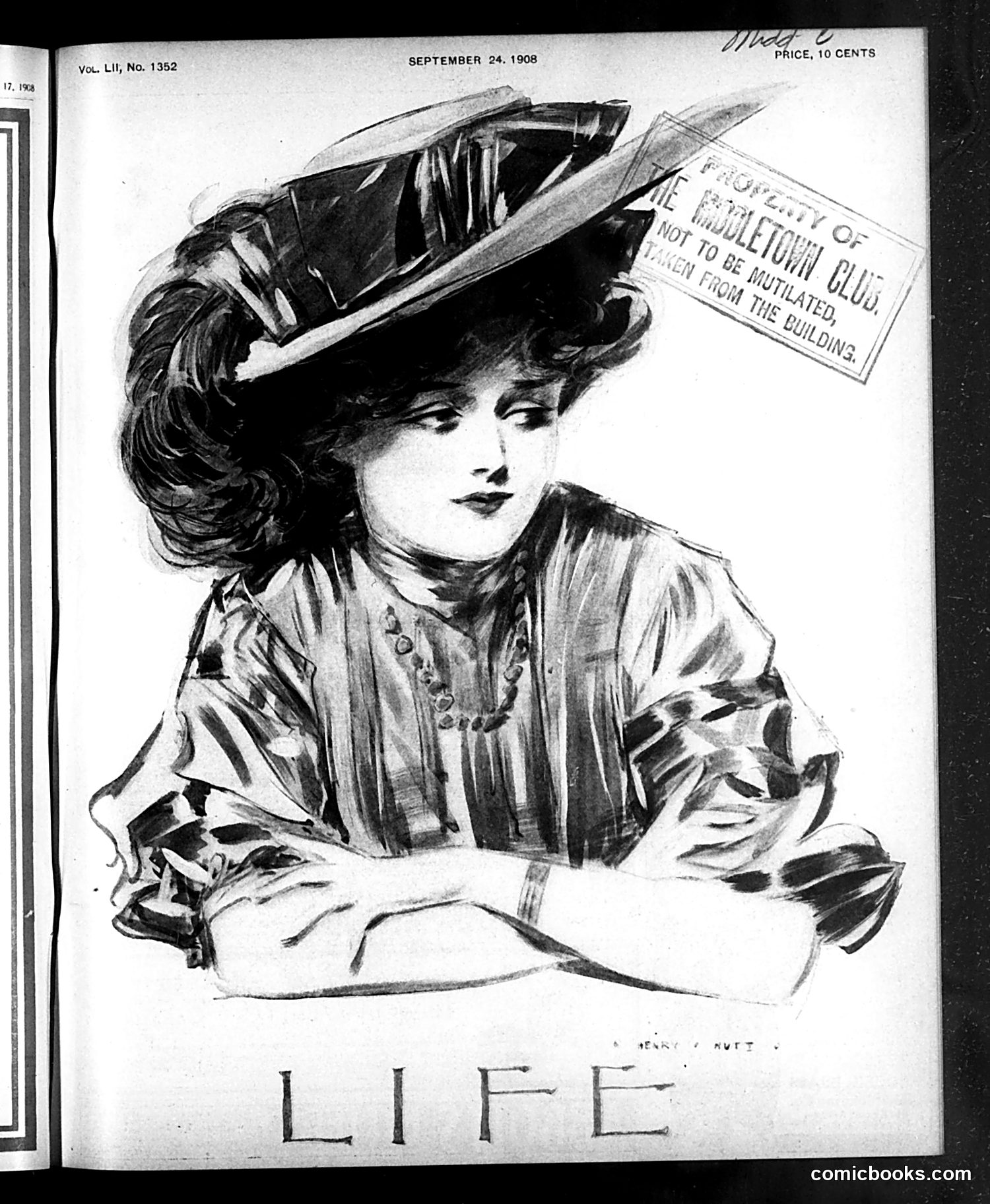
This is the cover of *Life* magazine from September 24, 1908 (price: 10 cents). It features an illustration of an elegantly dressed woman wearing an elaborate wide-brimmed hat and striped blouse, drawn in the refined style typical of early 1900s fashion illustration. The small text box attached to her hat reads: "PROPERTY OF THE BRIDGETOWN CLUB. NOT TO BE MUTILATED OR TAKEN FROM THE BUILDING." The joke appears to satirize fashionable women's hats of the era—specifically their enormous size and impracticality. By labeling this hat as "property" of a club that "must not be mutilated," the cartoon humorously suggests these hats were so large and conspicuous they resembled institutional furniture rather than wearable accessories. This mocks the extravagant millinery trends of the Edwardian period.
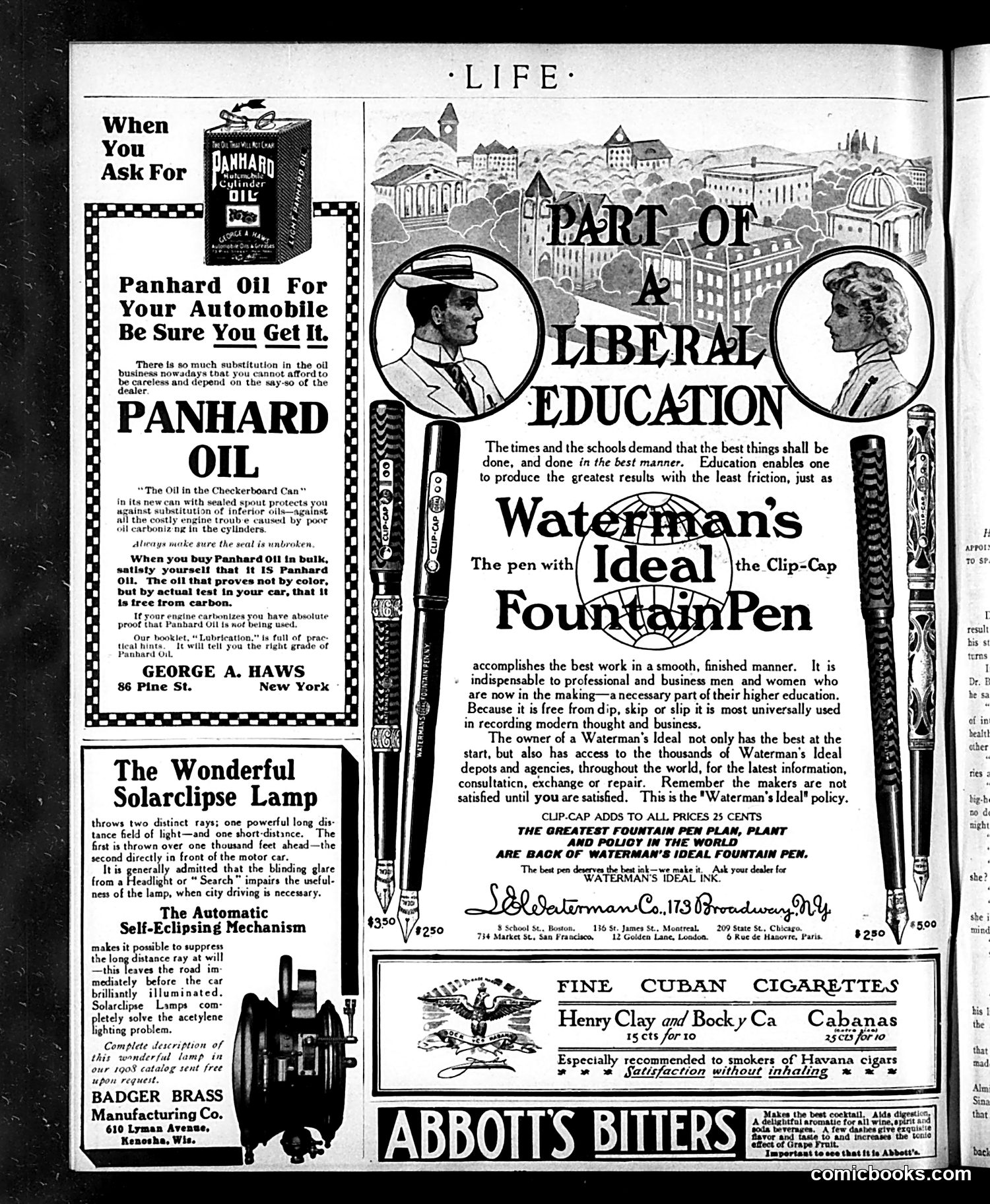
This Life magazine page is **primarily advertising**, not satirical content. The main advertisements are: 1. **Panhard Oil** (left) - automotive lubricant with testimonial from a New York distributor 2. **Waterman's Ideal Fountain Pen** (center) - positioned as essential for education and professional work, with decorative cityscape imagery 3. **Solarclipse Lamp** (lower left) - automotive lighting device 4. **Fine Cuban Cigarettes** and **Abbott's Bitters** (bottom) The Waterman's ad emphasizes that quality pens enable "the best work in a smooth, finished manner" for "professional and business men and women." The imagery of a man and woman in circular portraits alongside civic architecture suggests aspirational middle-class values. **No political satire is evident here.** This appears to be a standard early 20th-century magazine page mixing advertisements with lifestyle messaging.
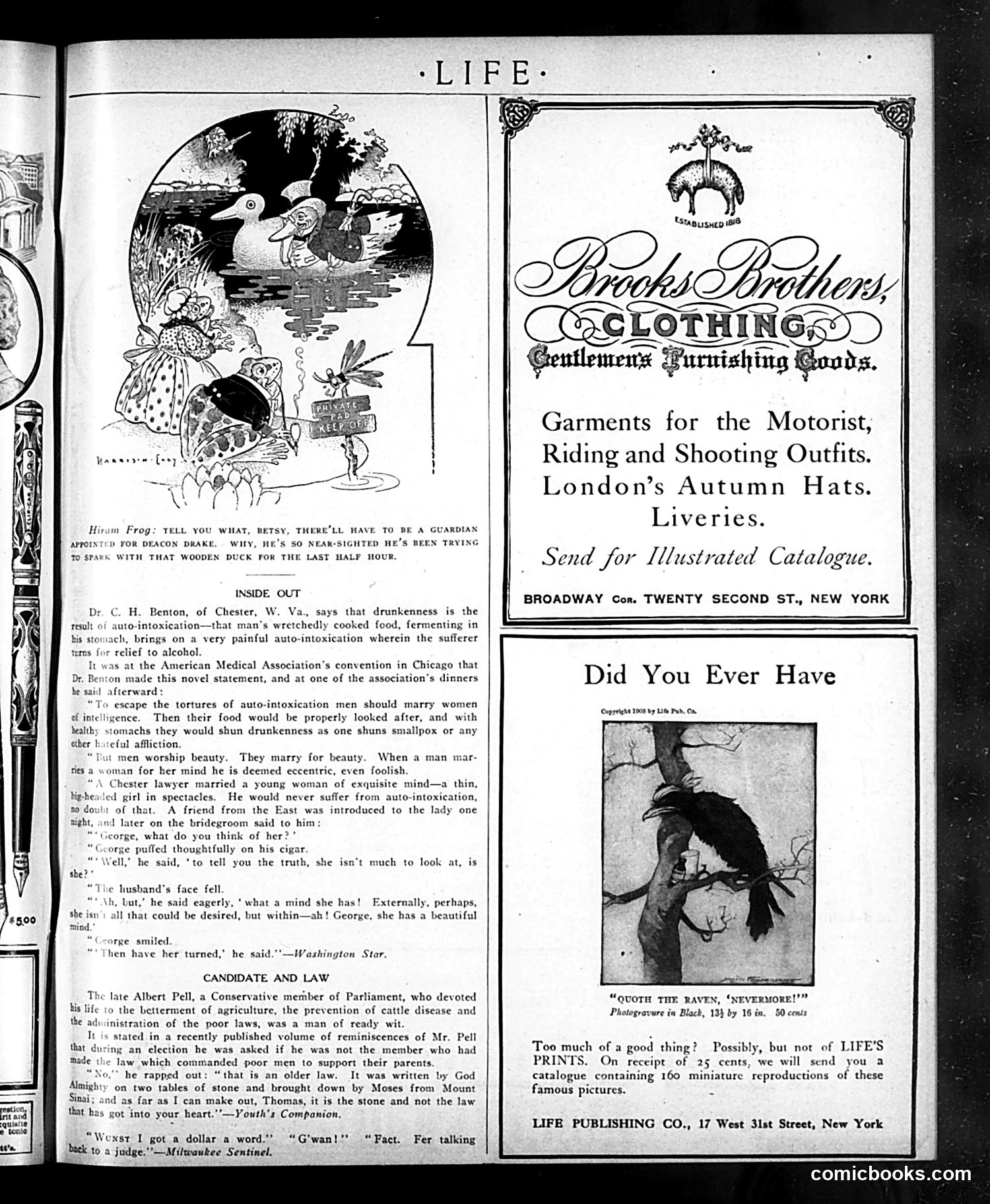
The left page contains "Inside Out," a satirical commentary on drunkenness and marriage. Dr. C.H. Benton's medical observation—that drunkenness results from fermented food causing auto-intoxication—is mocked through a story about a Chester lawyer who married a beautiful woman specifically to avoid alcoholism. The joke's punchline reveals his wife is so intellectually shallow that he finds her unappealing anyway, defeating the purpose. The cartoon itself (top left) depicts a comic scene with ducks and anthropomorphic figures in a woodland setting, though its specific reference is unclear from the visible caption. The right page is primarily **advertising**: Brooks Brothers clothing for motorists and gentlemen's furnishings, plus a Life Publishing advertisement for "Quoth the Raven, 'Nevermore'"—an Edgar Allan Poe illustration available as a print.
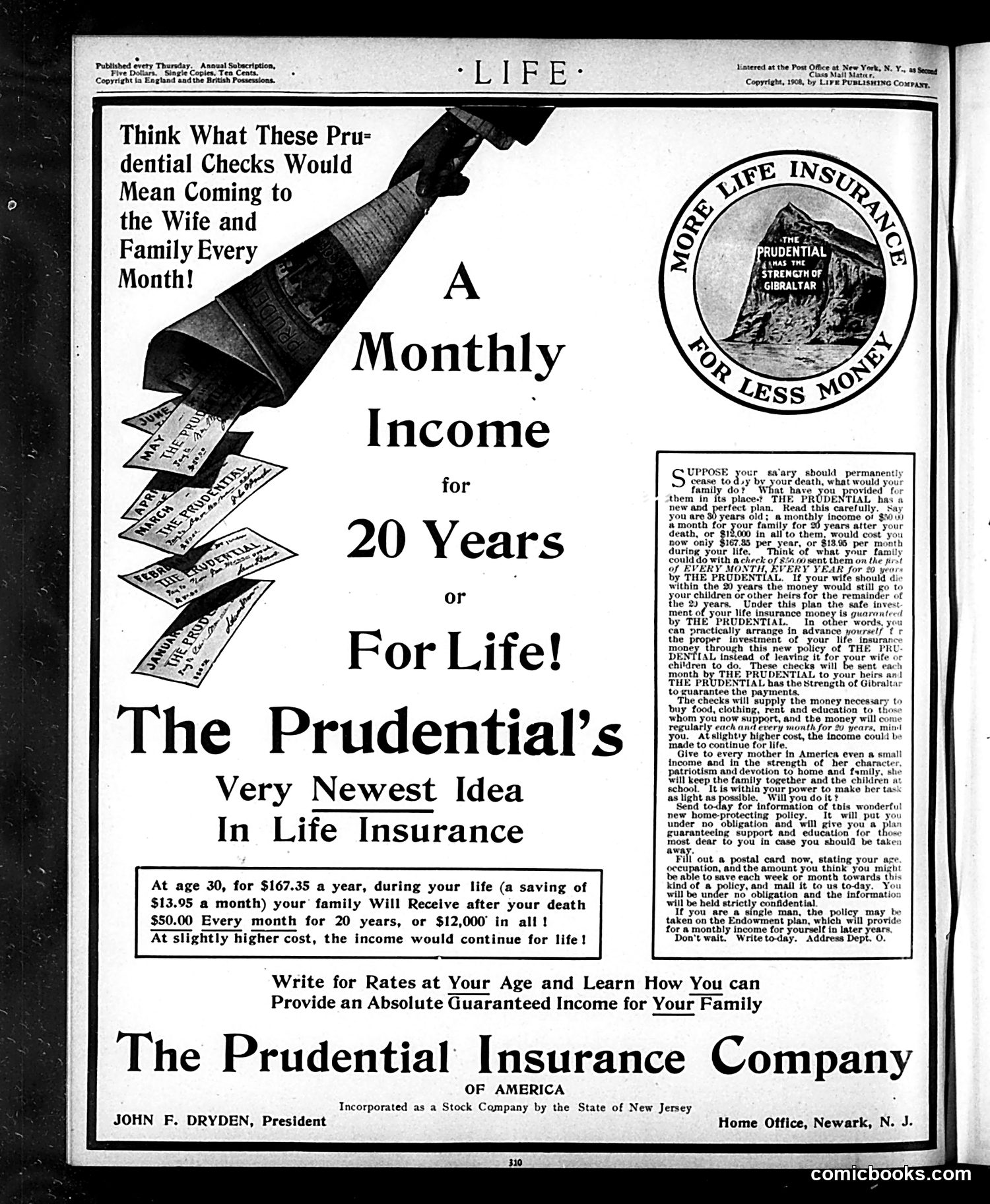
This page is **primarily a life insurance advertisement**, not satire or political commentary. The Prudential Insurance Company of America advertises a new monthly-income life insurance policy. The central image—a cornucopia or horn of plenty dispensing money—illustrates the product's appeal: a guaranteed monthly income ($50/month in the example) paid to a policyholder's family for 20 years after death, or for life. The headline promises this addresses a wife and family's financial security. The ad emphasizes affordability ($167.38 yearly at age 30) while guaranteeing continuous income "for life." There is no political cartoon here—Life magazine's pages frequently contained such advertisements alongside editorial content. This represents early-20th-century financial services marketing targeting middle-class breadwinners concerned with family security.
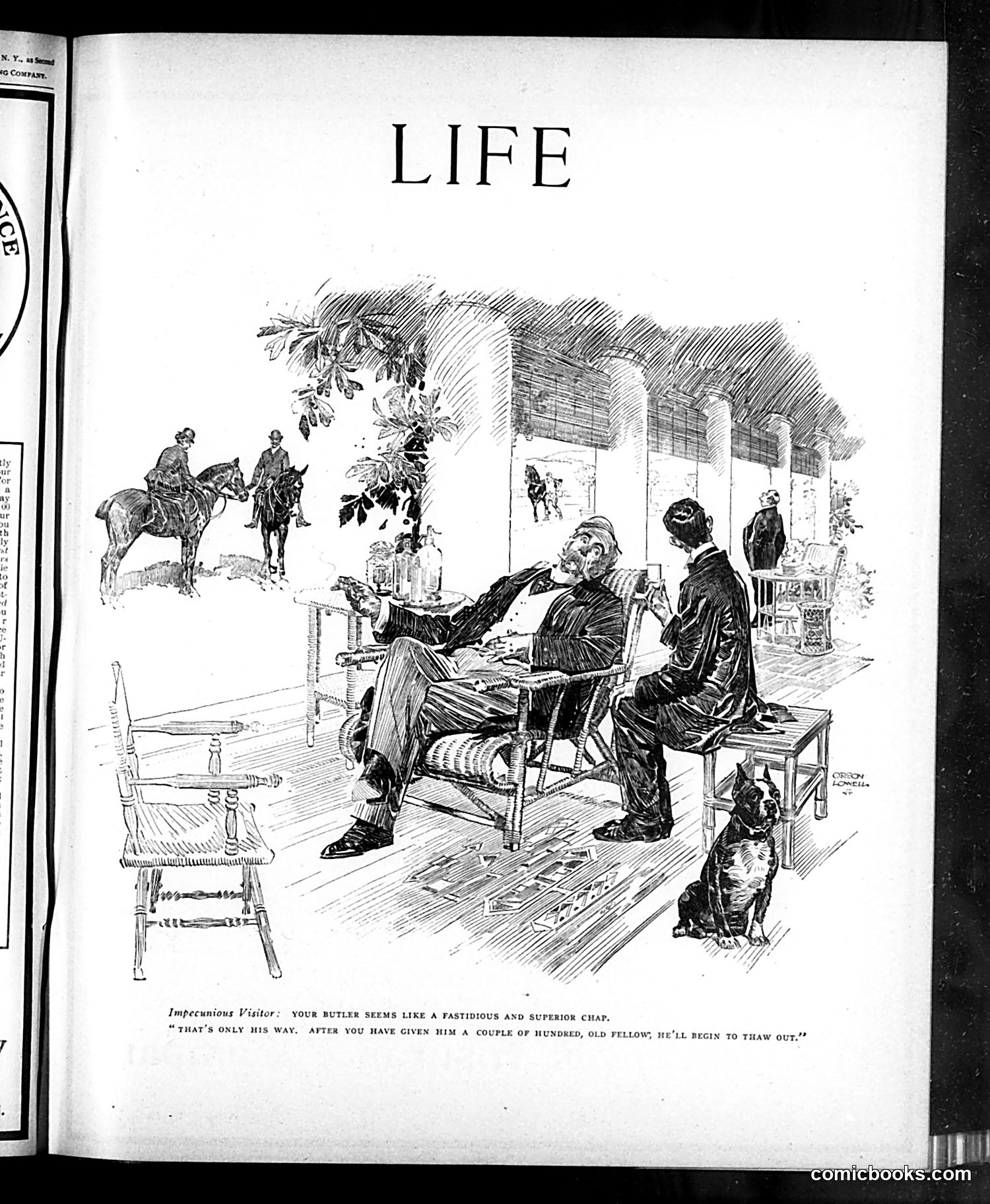
This satirical cartoon from *Life* magazine depicts a social commentary on class and wealth. The scene shows a wealthy man reclining leisurely on a porch or veranda, receiving visitors. The caption's dialogue—"Your butler seems like a fastidious and superior chap. That's only his way. After you have given him a couple of hundred, old fellow, he'll begin to thaw out"—suggests mockery of servants' apparent snobbery toward less wealthy guests. The joke satirizes the relationship between money and social pretension: a butler's coldness toward visitors can be overcome by bribery (tipping). This critiques both the servant's mercenary attitude and the wealthy man's casual acceptance of needing to "buy" civility. The horsemen visible in the background establish an upper-class setting, reinforcing themes of wealth and social hierarchy.
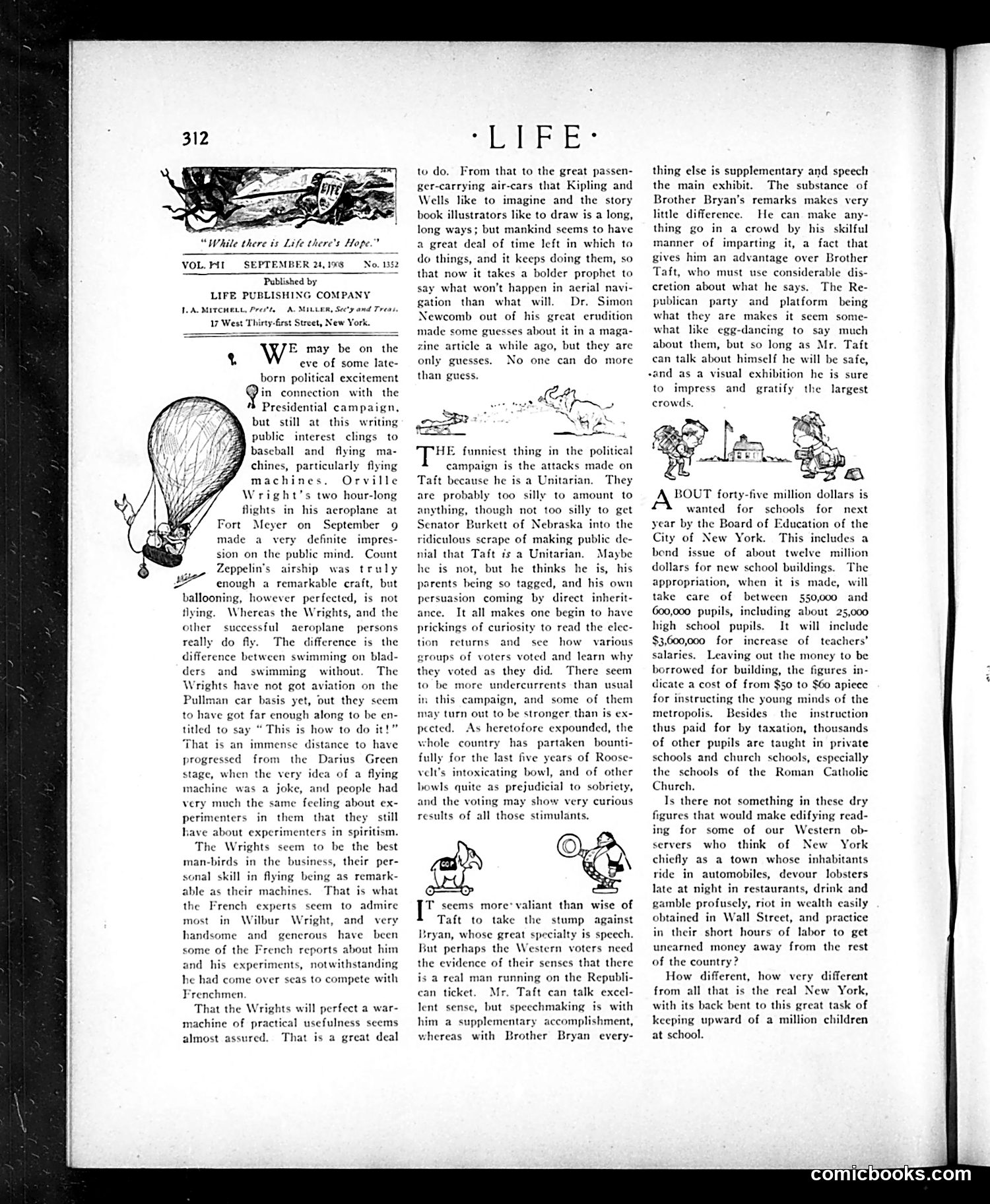
This page discusses the 1908 presidential campaign, comparing candidates William Howard Taft and William Jennings Bryan. The illustrated vignette shows the Wright brothers' airplane experiments at Fort Myer. The text mocks Bryan's attacks on Taft for being a Unitarian, calling such criticism "silly." It argues Taft's real strength lies in practical speechmaking ability, whereas Bryan relies on oratory. The piece suggests voters should evaluate candidates on substantive differences rather than religious affiliation. The airplane illustration represents modern technological progress—appearing alongside political discussion to suggest practical innovation matters more than ideological disputes. The satirical tone targets Bryan's campaign tactics as outdated and trivial compared to forward-thinking Republican governance.
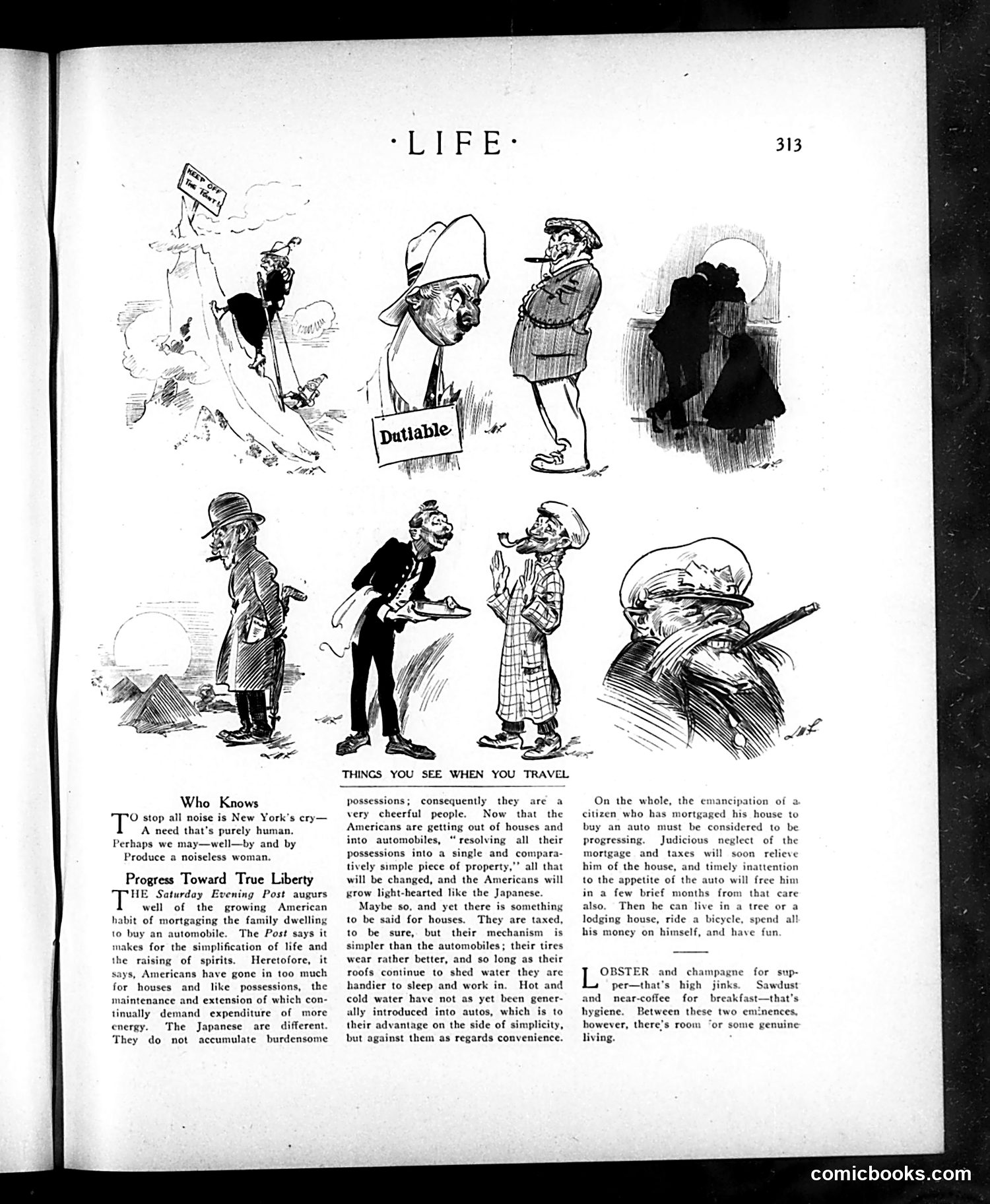
This page from *Life* magazine satirizes American attitudes toward homeownership and modernization in the early automotive era. The heading "Things You See When You Travel" accompanies seven cartoon vignettes mocking various social types encountered during trips. The central figure labeled "Dutiable" appears to reference tariff debates. Other sketches ridicule travelers' possessions and behaviors. The accompanying text, titled "Progress Toward True Liberty," ironically discusses Americans abandoning houses for automobiles, praising this shift as liberating while noting houses require constant maintenance and expense. The satire critiques consumer culture and the automobile's appeal as status symbols, suggesting Americans wrongly view car ownership as "true liberty" rather than recognizing it as another burdensome possession. The Japanese are mentioned as wisely avoiding such accumulation.
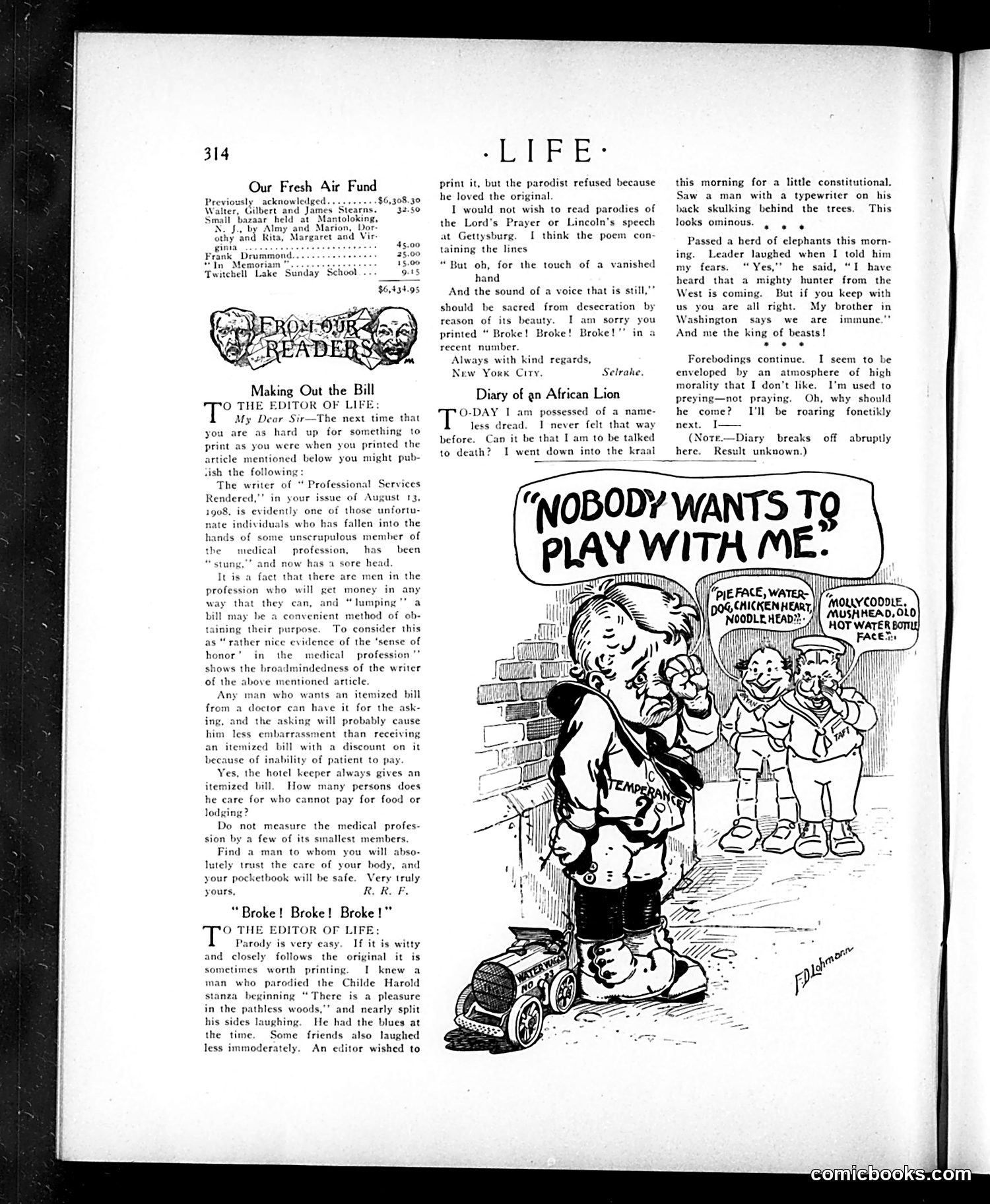
This cartoon depicts a large man labeled "Temperance" being rejected by children who call him derogatory names: "Pie Face," "Water-Dog," "Chicken-Head," "Noodle-Head," and "Hot Water Bottle Face." The satire critiques the temperance movement—the campaign to prohibit alcohol consumption—by portraying it as an unpopular, even repellent force that society's youth reject. The children's cruel insults suggest temperance advocates were viewed as socially awkward busybodies whose moral crusading made them objects of ridicule rather than respect. This reflects early 20th-century tensions between temperance reformers and their opponents, who mocked prohibition efforts as joyless and intrusive. The cartoon uses childhood rejection as a metaphor for broader public disdain.
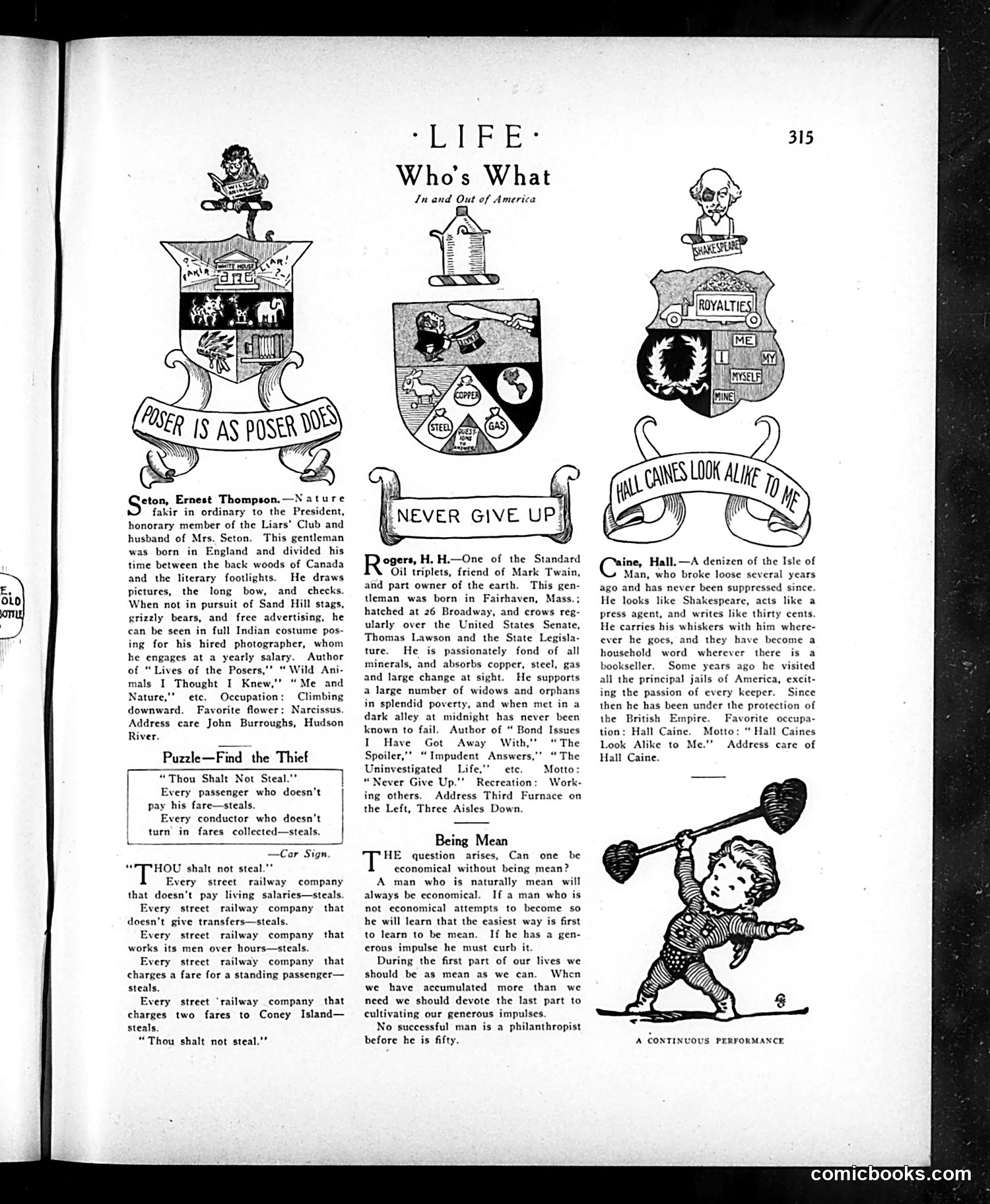
This page contains three sections: **"Who's What" heraldic coats of arms** mock prominent figures with satirical crests. The entries include Ernest Thompson (marked "Poser is as Poser Does"), H.H. Rogers (an oil industry figure), and Hall Caines (a novelist), each with emblematic shields displaying their perceived character traits or professional associations. **"Puzzle—Find the Thief"** is a verse satirizing railroad company corruption, suggesting that every entity from passengers to conductors to the companies themselves engage in stealing—making theft systemic and hypocritical. **"Being Mean"** is a philosophical essay discussing whether economical living requires meanness of character, arguing that cultivating generosity becomes important only after accumulating wealth. The overall tone is satirical social commentary on American business and character.
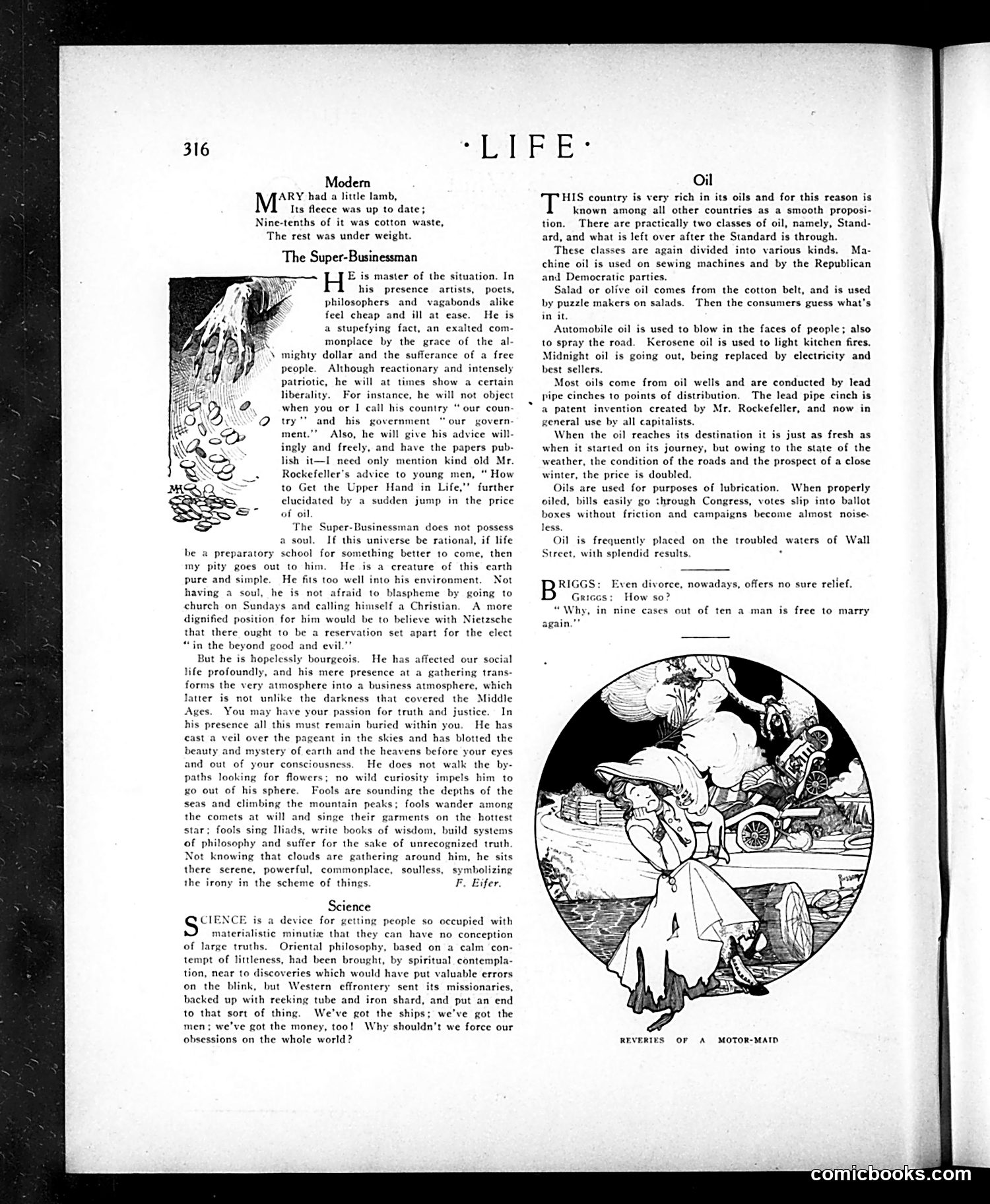
This page contains three distinct articles: "Mary Had a Little Lamb" (brief moral tale), "The Super-Businessman" (satirizing a wealthy businessman figure who disrupts social gatherings with his aggressive materialism), and "Oil" (discussing petroleum industry practices). The circular illustration titled "Reveries of a Motor-Maid" depicts a woman daydreaming about automobiles and leisure—likely satirizing the emerging car culture and women's relationship to automotive technology in the early 20th century. The "Science" section critiques Western materialism and industrial expansion, suggesting obsession with ships, money, and technological dominance over spiritual contemplation. The final dialogue between Briggs and Griggs jokes about divorce rates and remarriage. Overall, the page satirizes modern commercialism, materialism, and social pretension.
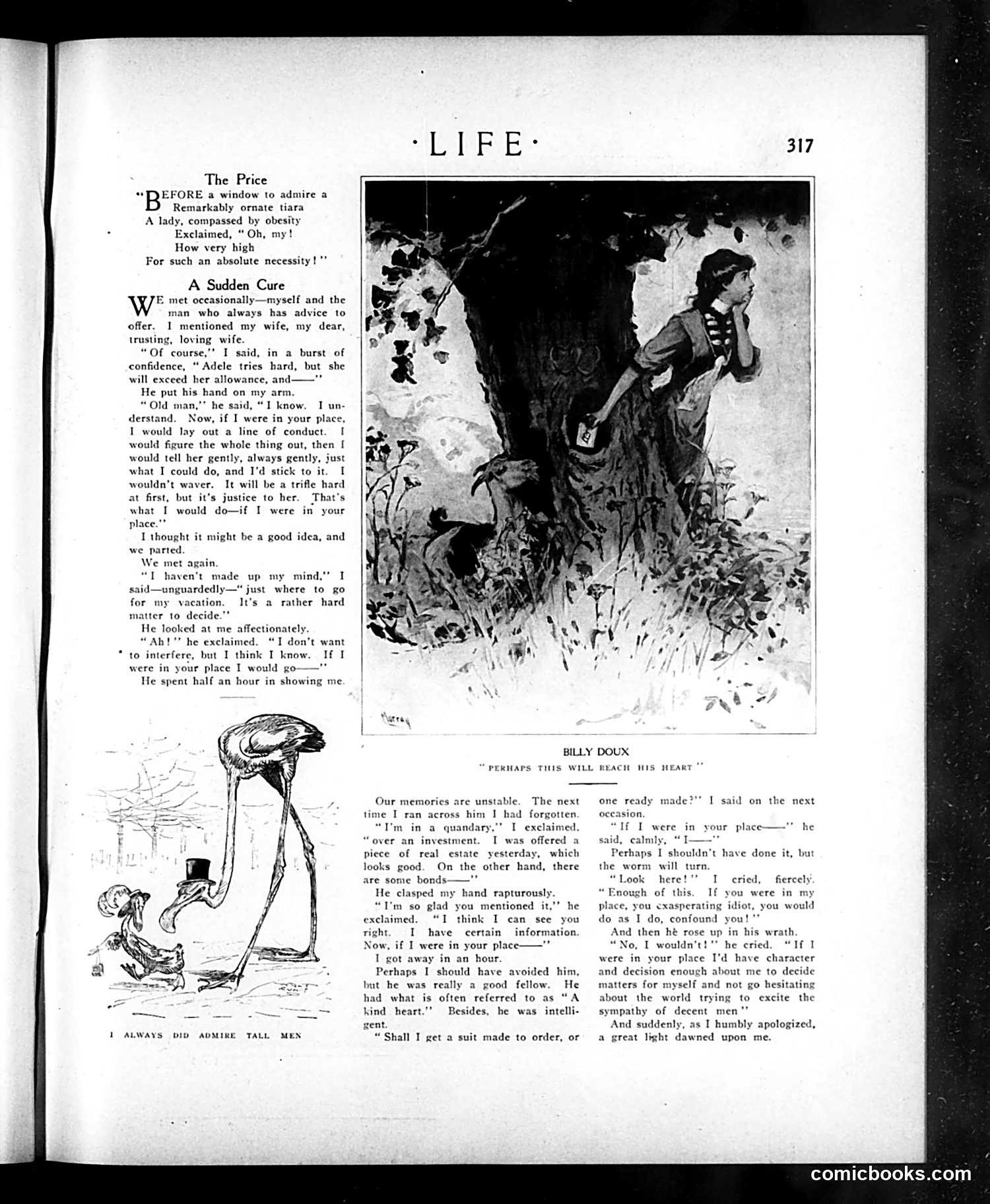
This page contains a short story titled "The Price" with two accompanying illustrations. The left cartoon shows a man in a top hat admiring an ostrich—captioned "I ALWAYS DID ADMIRE TALL MEN," a visual pun playing on the ostrich's height and the phrase's double meaning. The main illustration shows a man and woman in an outdoor setting, accompanying the narrative about a couple's disagreement over the wife's allowance and vacation plans. The story depicts marital negotiation, with the husband ultimately apologizing and capitulating to his wife's wishes. The content reflects early 20th-century gender dynamics and domestic comedy—a common satirical subject in Life magazine. The humor derives from the husband's attempt at authority undermined by his affection for his wife.
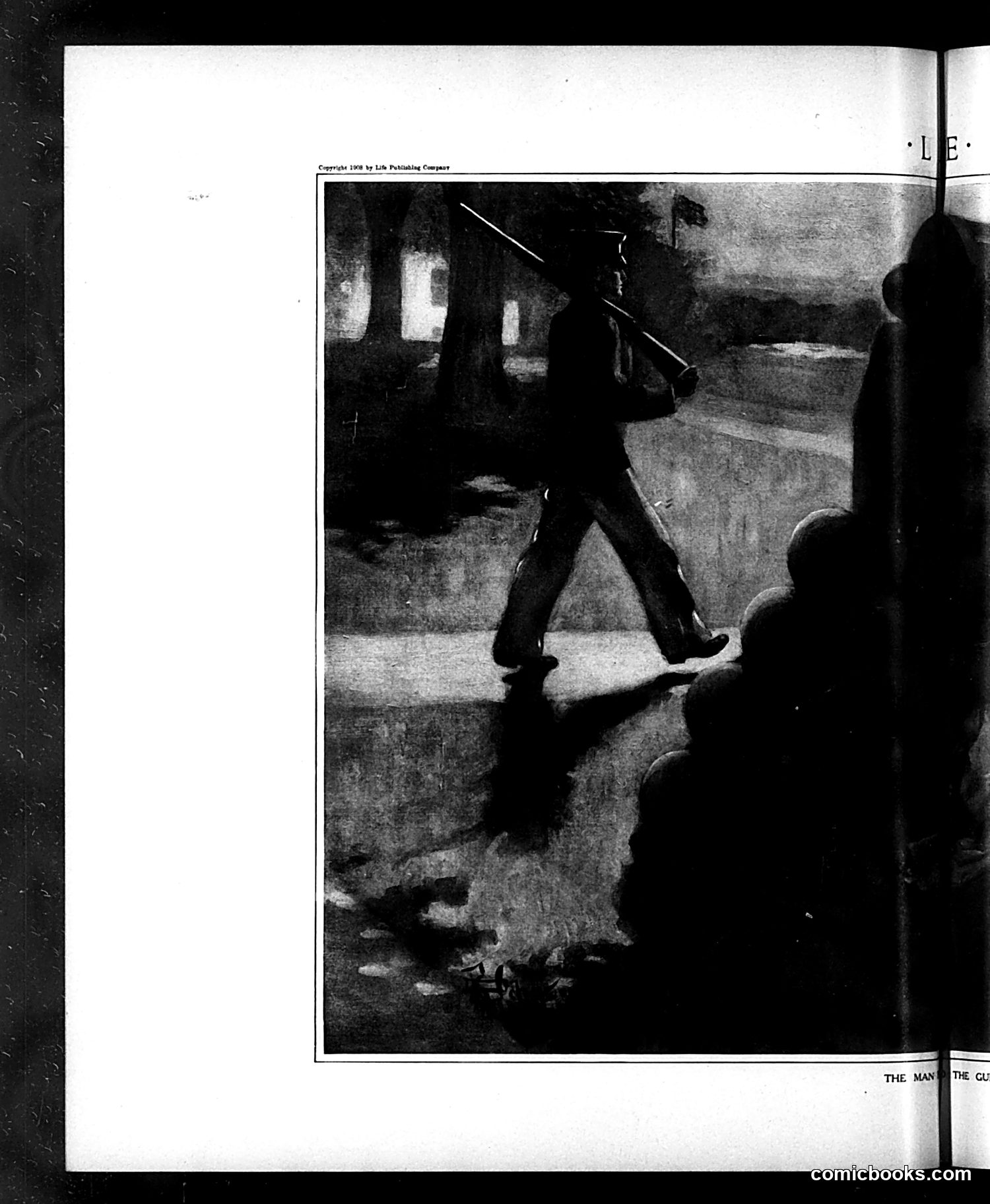
This page from Life magazine (copyright 1908) shows a black and white photograph of a man walking through what appears to be an institutional or military setting, with shadowy figures visible in the foreground and windows in the background. Without clearer text or caption visible in the image, I cannot definitively identify the specific figure or the satirical point being made. The setting suggests institutional or military context typical of early 1900s Life satire, but the photograph's quality and cropping make it difficult to determine the subject's identity or the intended commentary. To accurately explain this page's meaning for modern readers, I would need legible captions or identifying text that are not clearly visible here.
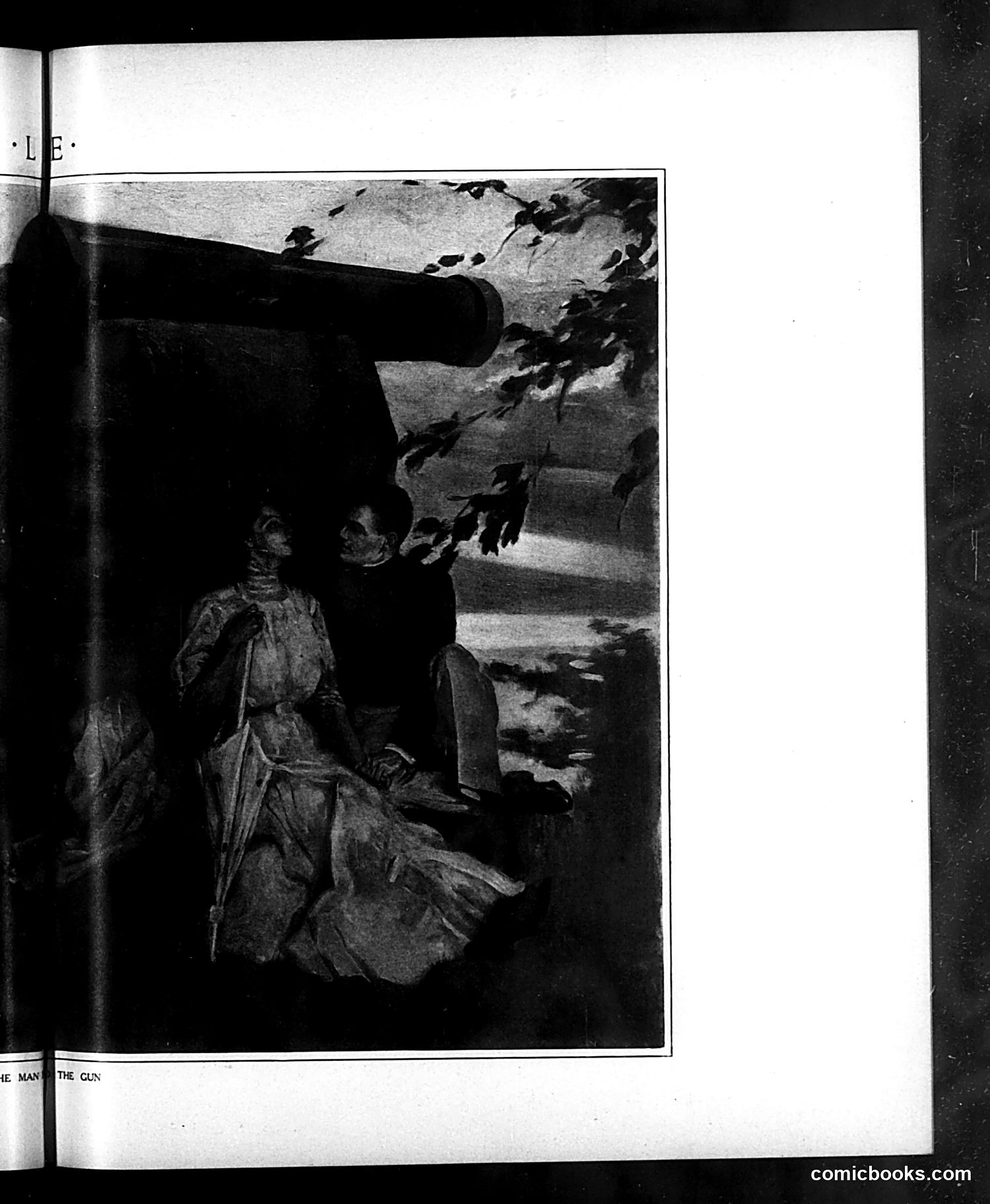
This appears to be a satirical illustration from Life magazine showing a figure in period clothing examining or aiming a large cannon. The caption "THE MAN THE GUN" suggests commentary on the relationship between power and those who wield it. Without clearer text or additional context visible on this page, I cannot definitively identify the specific historical figures or events being satirized. The dramatic black-and-white illustration style and composition suggest social or political commentary typical of Life's satirical approach, but the exact target of satire remains unclear from this image alone. The formal dress and historical setting suggest this may reference a specific political or military context, though I cannot specify which without risking inaccuracy.
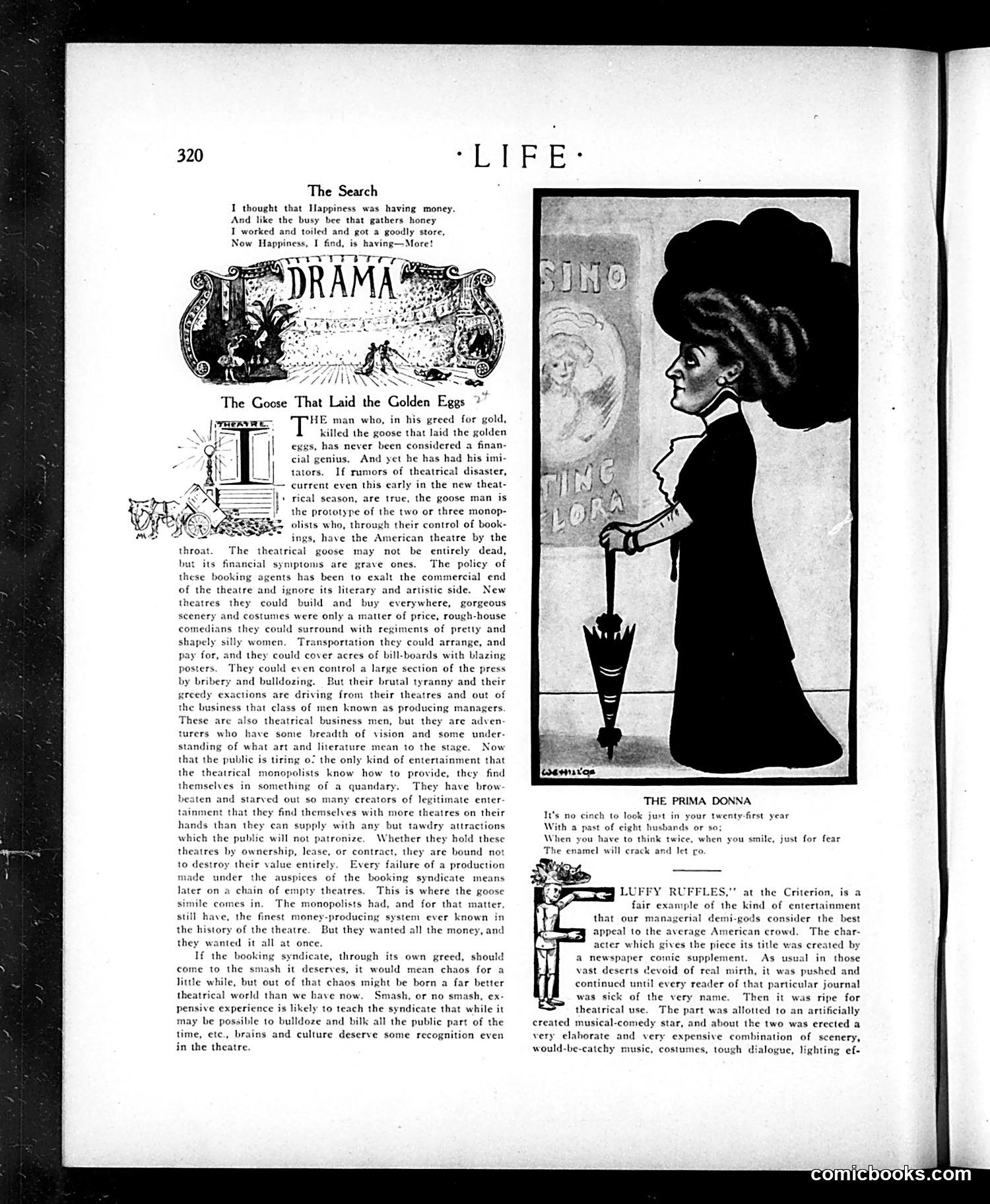
This page satirizes **theatrical monopolies** controlling American theater in the early 20th century. The main article, "The Goose That Laid the Golden Eggs," attacks **booking agents and theater syndicates** who wielded excessive power through control of theater bookings and venues. The satire's point: these monopolists, like the man in Aesop's fable, are killing their own golden goose by prioritizing short-term profit over artistic quality. They've starved out legitimate theatrical producers, filled theaters with cheap "rough-house comedians" and tawdry attractions, and resorted to bribery and intimidation. Now facing public rejection, they're left with empty theaters and no quality content to fill them. The accompanying illustration of "The Prima Donna" mocks the low-quality entertainment resulting from this system—shows recycled from newspaper comic supplements passed off as sophisticated theater. The critique advocates for cultural values in entertainment, not mere commercialism.
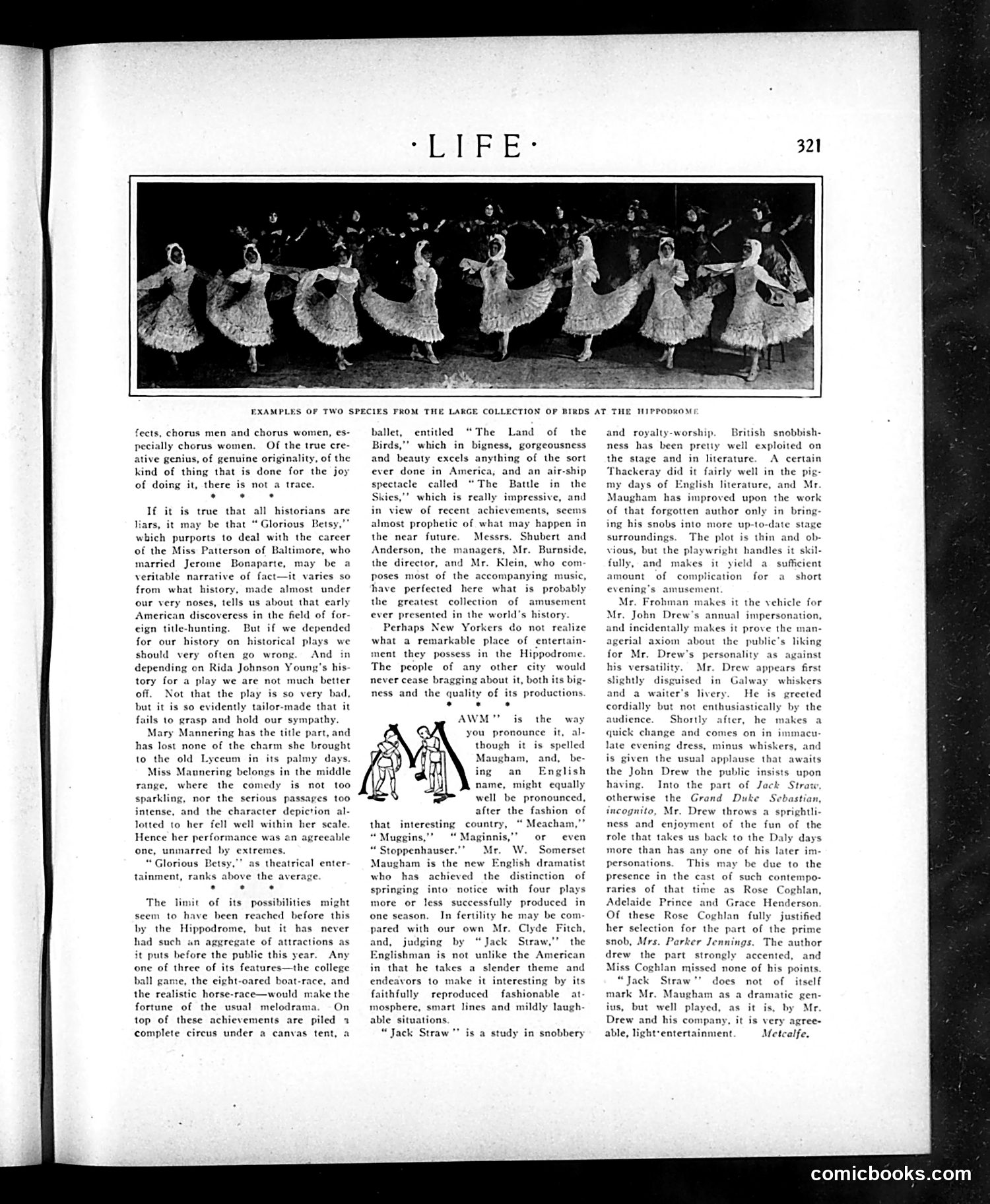
**What This Page Contains:** This page reviews theatrical productions, primarily focusing on the Hippodrome's spectacular shows and the play "Glorious Betsy." **Key Content:** The top photograph shows chorus girls in identical costumes performing at the Hippodrome—a massive entertainment venue featuring multiple attractions: a realistic horse-race, eight-oared boat-race, college ball game, circus acts under canvas, a bird-themed ballet, and an airship spectacle called "The Battle in the Skies." The text criticizes "Glorious Betsy" (about Jerome Bonaparte's American wife) as historically inaccurate but notes actress Mary Mannering performs adequately within her range. **Social Context:** The Hippodrome represents early 1900s American spectacle entertainment—enormous scale productions competing for audiences. The reviews contrast substance with spectacle: the Hippodrome excels at visual grandeur, while theatrical plays often sacrifice historical accuracy for dramatic effect. The page also discusses W. Somerset Maugham's play "Jack Straw," calling it a snobbery study, comparing Maugham favorably to American playwright Clyde Fitch.
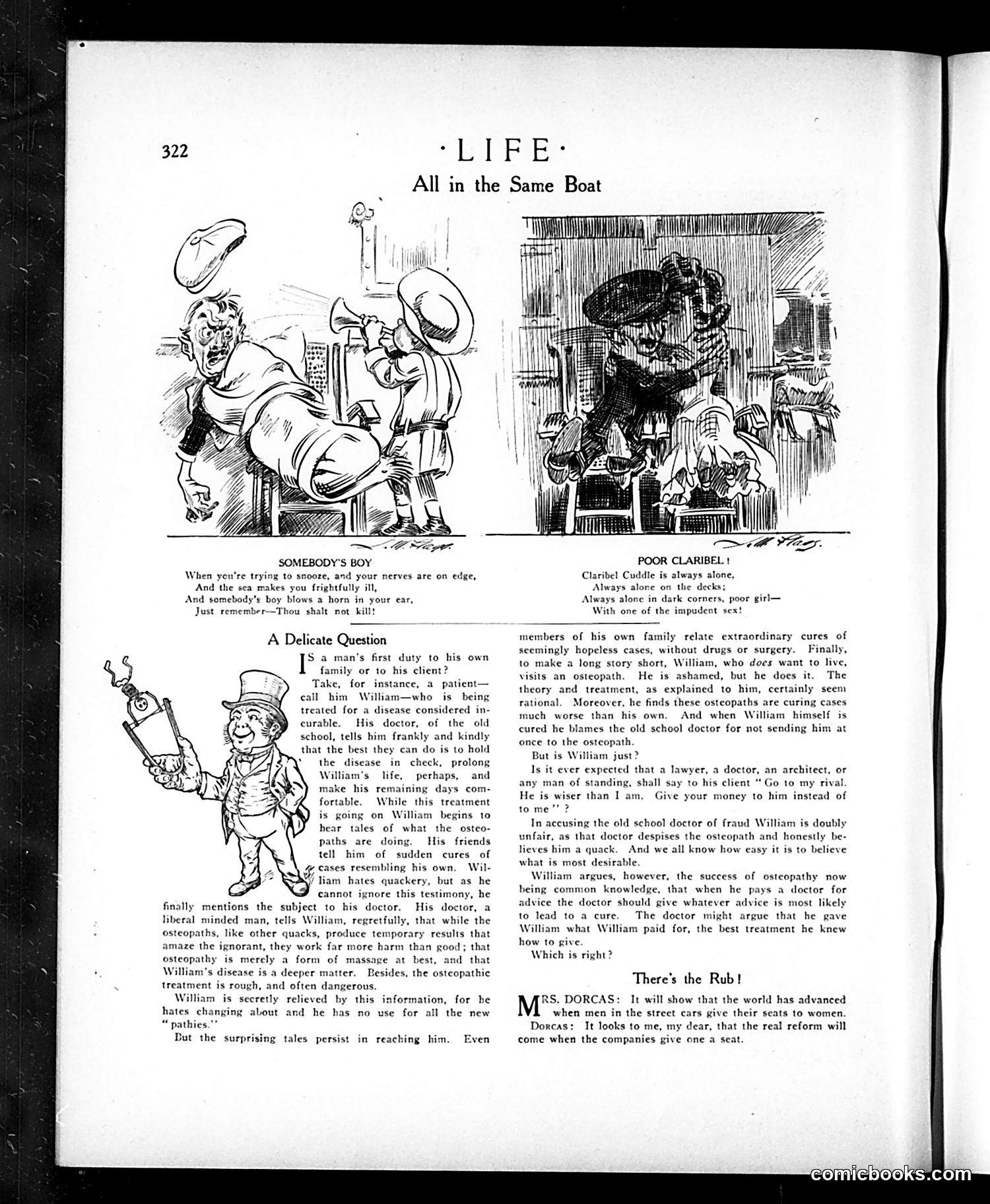
This page contains three satirical pieces on professional ethics and social behavior: **"Somebody's Boy"** (top left cartoon): Mocks inconsiderate behavior aboard ships—specifically a passenger blowing a horn while others try to rest, forcing them to suppress violent impulses ("Thou shalt not kill"). **"A Delicate Question"** (main article with cartoon): Critiques the ethics of medical practitioners. A patient, William, seeks an osteopath despite his traditional doctor's warnings that osteopathy is quackery and massage. The article debates whether doctors should recommend competitors or only their own approach. It satirizes William's unfair judgment—blaming his first doctor after osteopathy "cures" him—while questioning professional loyalty versus patient welfare. **"Poor Claribell"** (top right): A brief joke about a woman constantly chaperoned by men, suggesting impropriety. **"There's the Rub!"** (bottom): Mrs. Dorcas jokes that true social progress won't be men giving up streetcar seats to women, but rather transit companies providing enough seats for everyone—a sarcastic comment on hollow gestures versus systemic reform.
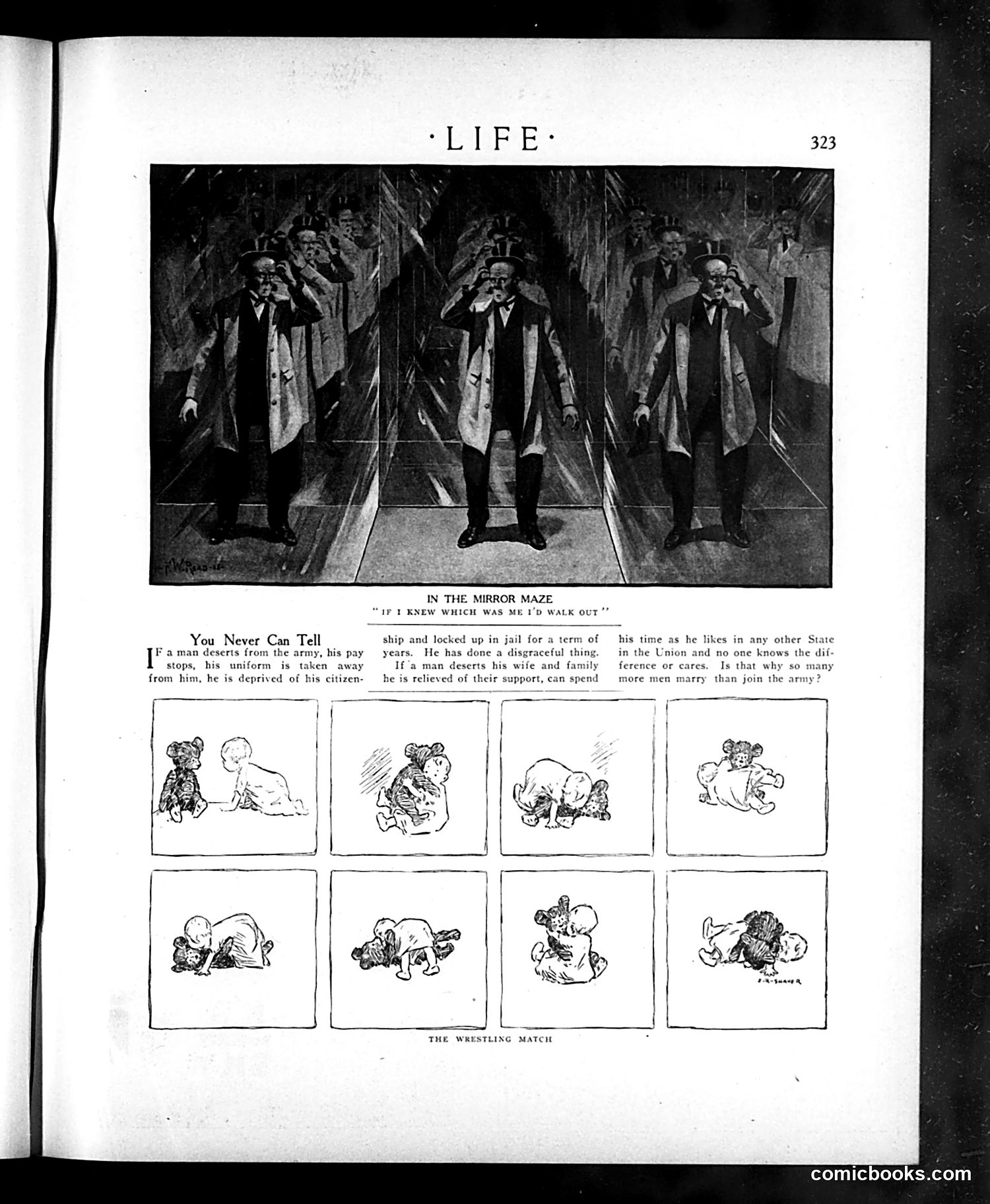
This 1910s *Life* magazine page contains two distinct commentaries on military service and masculinity. **"In the Mirror Maze"** shows a soldier confused about his own identity, captioning the satirical problem: if he deserted the army, he wouldn't know which version of himself to escape as. The accompanying text suggests desertion carries severe legal and social consequences—loss of pay, uniform, and citizenship rights—yet poses an ironic question: if desertion from one's wife results in freedom from family support, why do more men marry than enlist? **"The Wrestling Match"** below depicts a baby and teddy bear in eight sequential panels showing playful combat, likely contrasting innocent childhood wrestling with adult military conflict or masculine competition. The page's overall message appears to satirize American men's reluctance to serve in the military, suggesting they avoid it despite the equally burdensome obligations of marriage and family support.
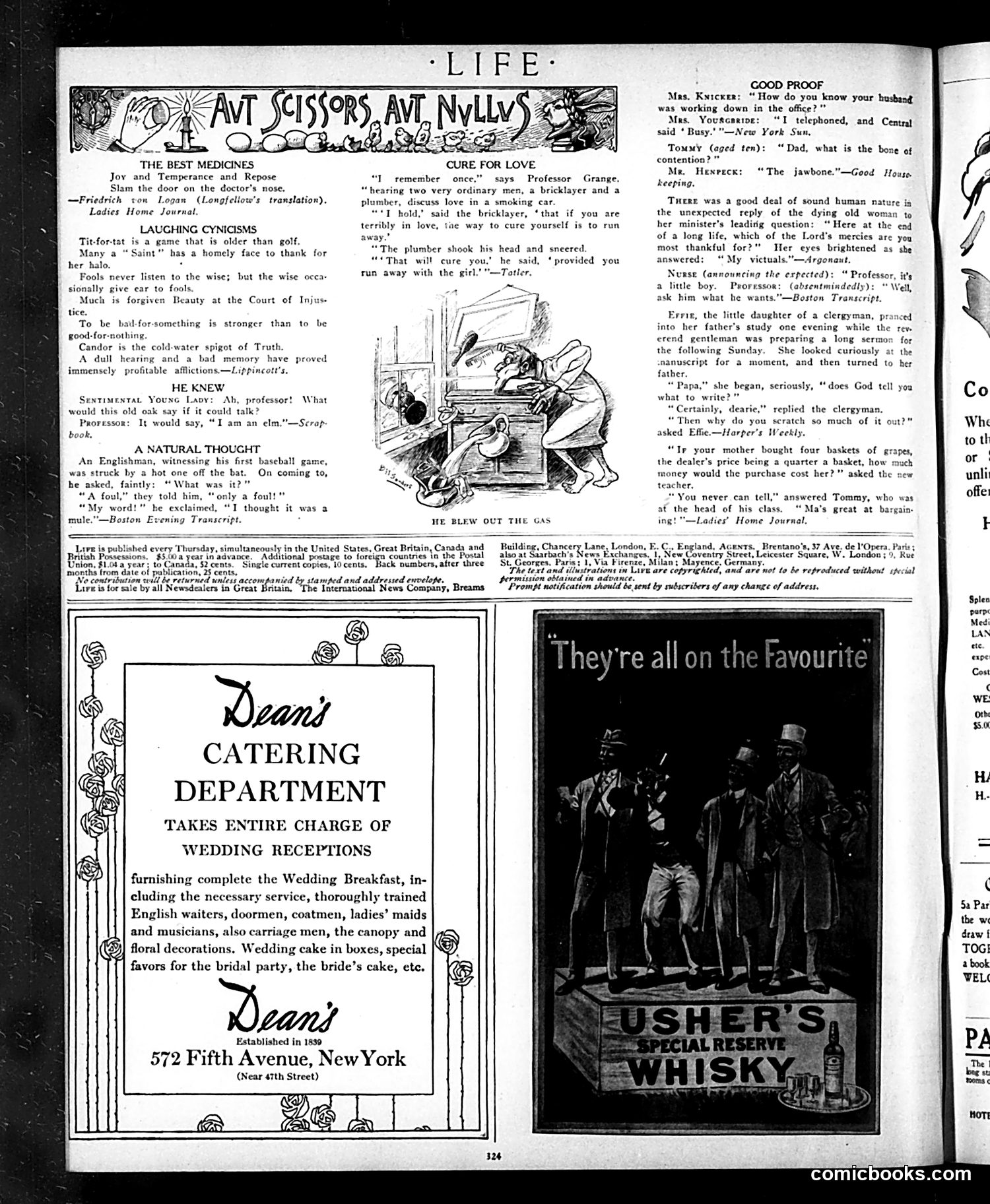
This page contains humorous anecdotes and light satire typical of early 20th-century Life magazine, rather than political cartoons. The content includes: **Main features:** - Short joke pieces about love, medicine, and human nature ("Cure for Love," "The Best Medicines") - Cynical aphorisms about behavior ("Laughing Cynicisms") - A visual cartoon titled "He Blew Out the Gas" depicting what appears to be a domestic scene with dark humor implications **Social commentary:** The jokes target pretension and human folly—professors, clergymen, and schoolteachers who speak pompously while missing obvious truths. The humor is gentle, relying on wordplay and situational irony rather than sharp political critique. The page also includes a Dean's Catering advertisement and Usher's Whisky advertisement, typical of the era's magazine content. **Overall:** This is lifestyle/entertainment content reflecting early-1900s middle-class American humor—domestic, mildly cynical, and concerned with courtship, family, and social propriety.
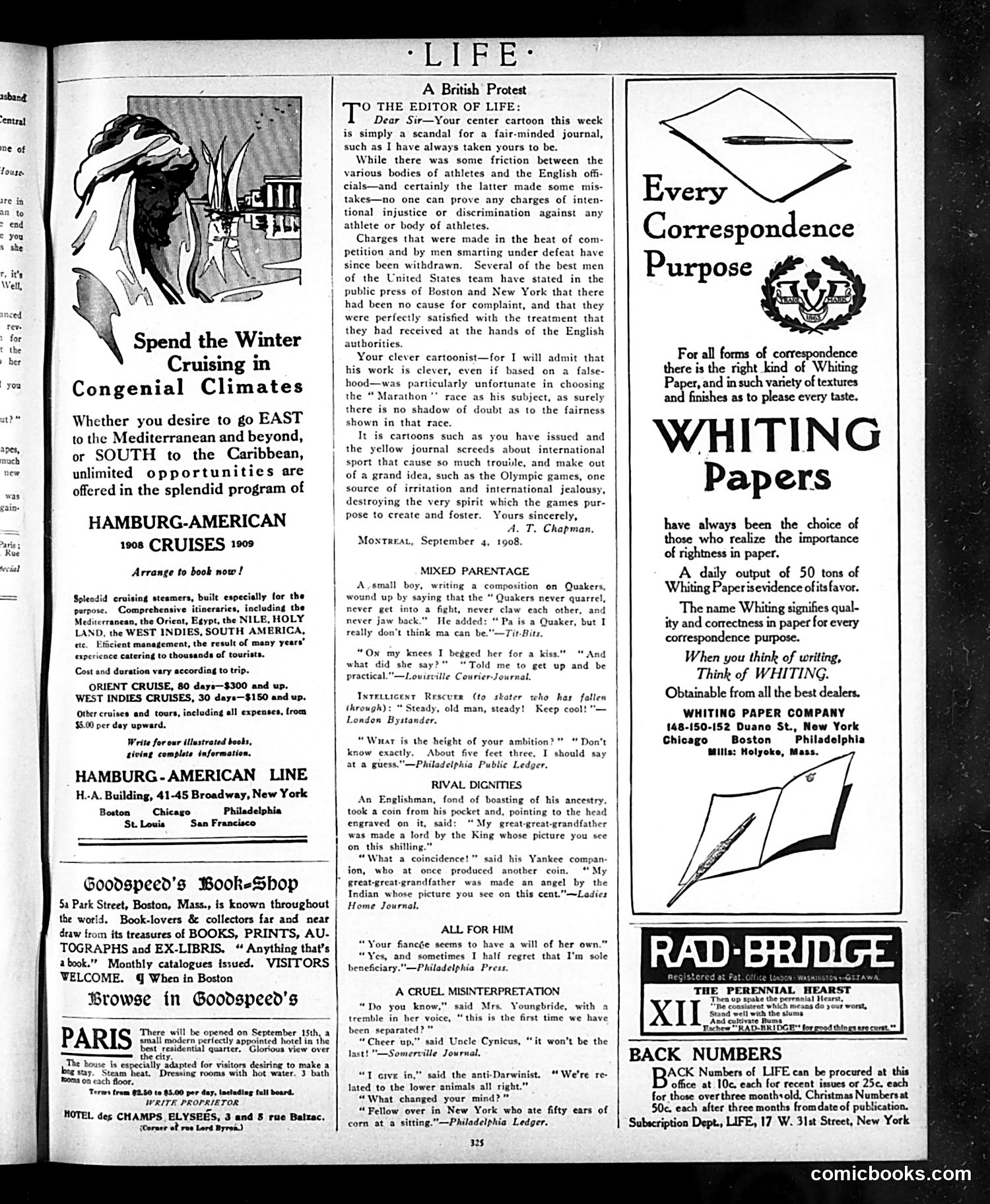
This page is primarily **advertising and letters to the editor**, not political satire. The main content includes: **"A British Protest"** — A letter objecting to Life's cartoon criticizing the 1908 Olympics (likely the London games). The writer defends the English organizers against charges of unfairness, particularly regarding the Marathon race. This reflects real tensions: international sporting events were becoming platforms for national pride and grievance. The letter-writer accuses Life's cartoonist of spreading "yellow journalism" and damaging international goodwill. **Humor sections** below include short jokes about Quakers never quarreling (though the writer's mother apparently does), a romantic mishap, and a skating accident—typical light magazine filler. The page also advertises luxury cruises, a Boston bookshop, and fine writing paper—targeting affluent readers of this era's satirical magazine.
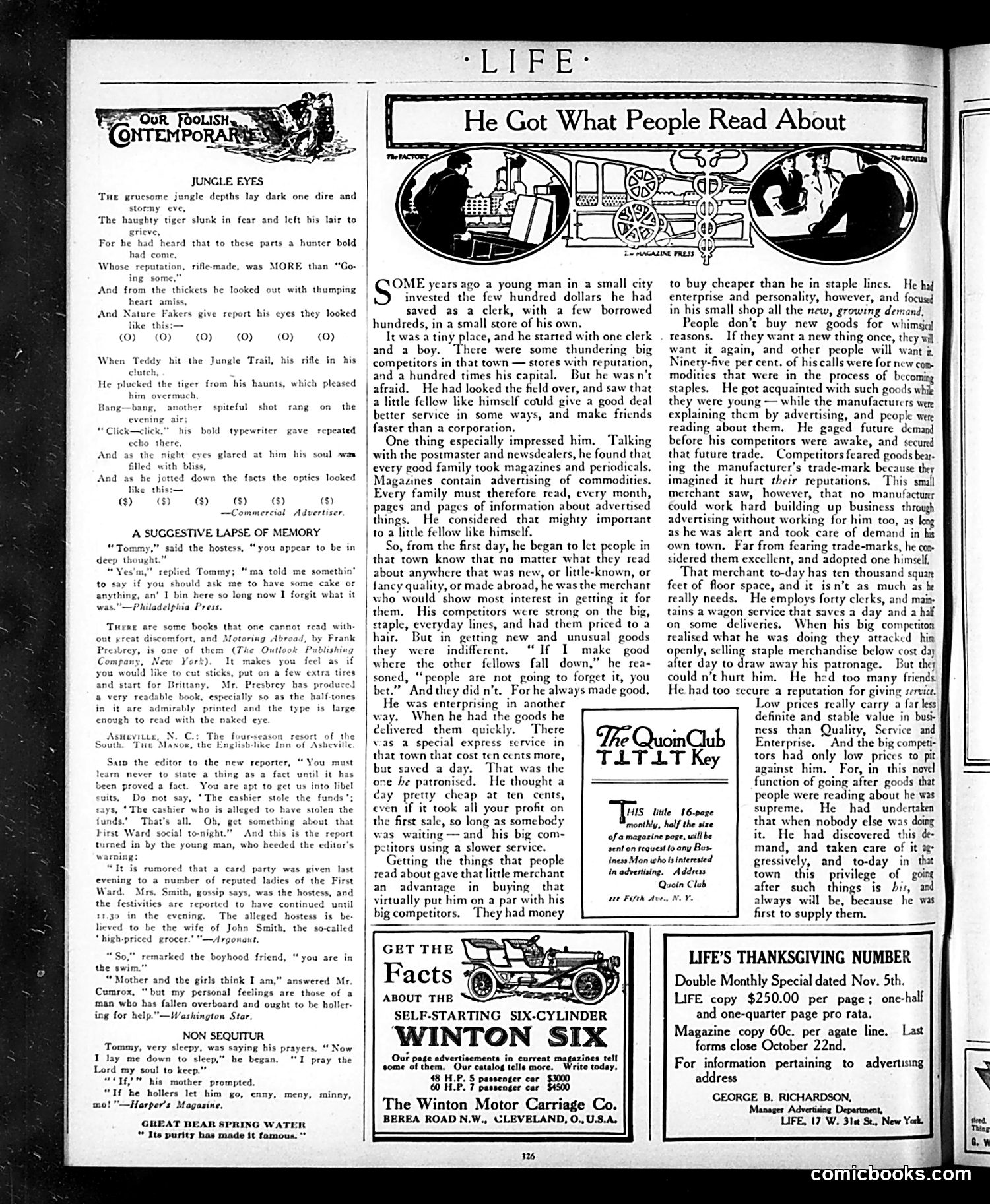
This page contains multiple short humorous pieces typical of *Life* magazine's satirical format. **"Jungle Eyes"** appears to mock **Theodore Roosevelt's** hunting exploits and his reputation as a rugged outdoorsman. The poem depicts a tiger hunter in the jungle whose fierce eyes are rendered as a series of parentheses: "(o) (o)" — a visual gag suggesting the hunter's exaggerated, wide-eyed intensity. The reference to "Nature Fakers" (visible in text) alludes to Roosevelt's public disputes with writers who allegedly misrepresented animal behavior. The satire ridicules both the romanticization of hunting adventures and the masculine bravado surrounding them. The remaining pieces are brief comedic vignettes: "A Suggestive Lapse of Memory" jokes about a forgetful guest; another piece satirizes journalistic caution about libel; "Non Sequitur" plays on childhood prayers. The page is primarily **advertising and entertainment content** rather than serious political commentary, reflecting *Life*'s role as a humorous weekly for middle-class readers.
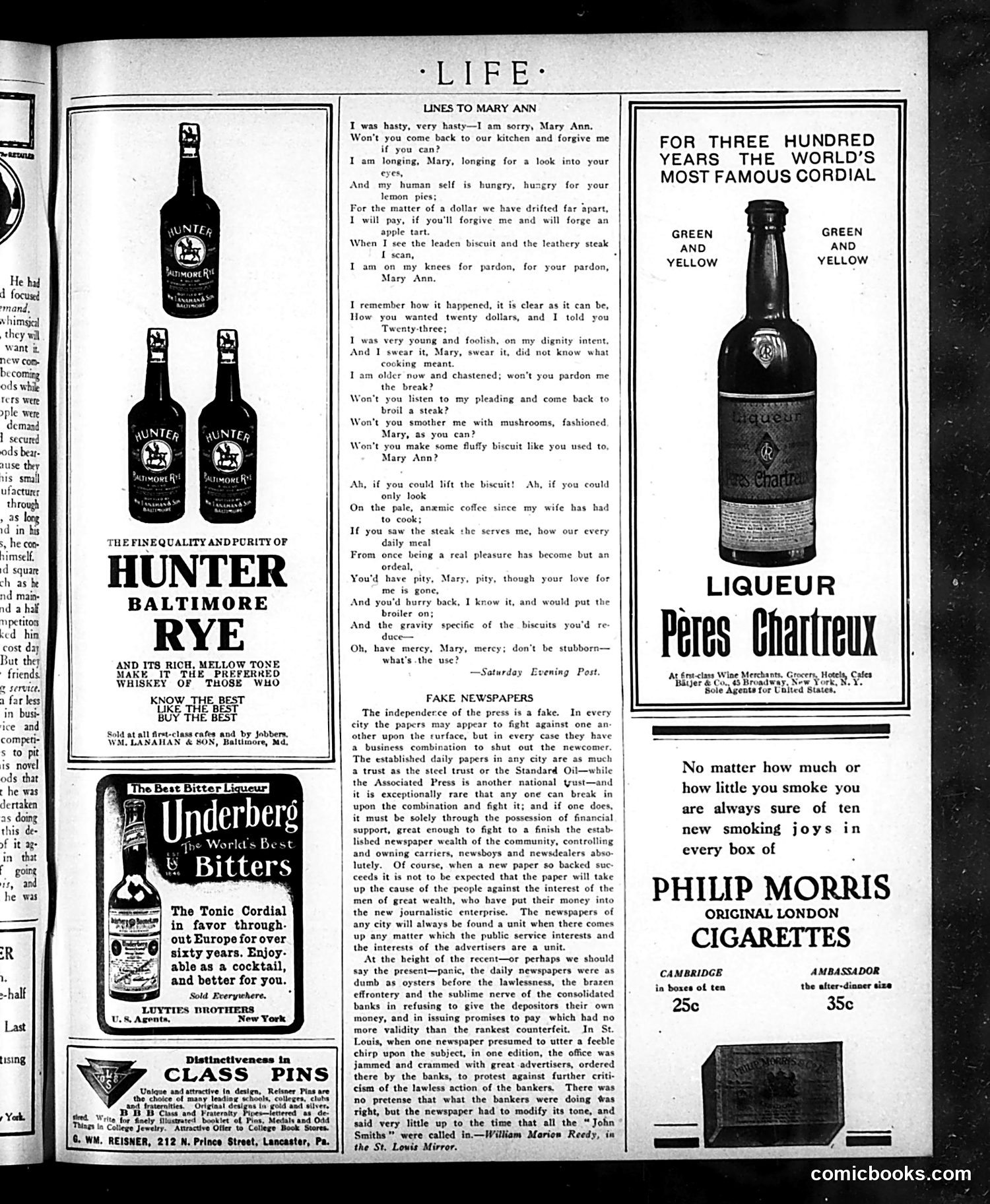
This page is primarily **advertising**, not editorial satire. It features: **Advertisements:** - Hunter Baltimore Rye whiskey (emphasizing quality and preference among connoisseurs) - Underberg Bitters (a digestive tonic marketed as suitable for cocktails) - Pères Chartreaux liqueur - Philip Morris cigarettes - Class pins/jewelry from Reisner **Editorial Content:** - "Lines to Mary Ann" (Saturday Evening Post poem): A humorous domestic piece about a husband begging his cook to return after a quarrel over wages—satirizing male entitlement and cooking incompetence - "Fake Newspapers" (excerpt): A serious critique arguing that newspaper "independence" is illusory, claiming established papers form monopolistic trusts similar to Standard Oil, controlling distribution networks to prevent competition The page reflects early 20th-century consumer culture and skepticism about media consolidation. No specific political figures or events are caricatured—the satire is social commentary on domestic relations and press freedom.
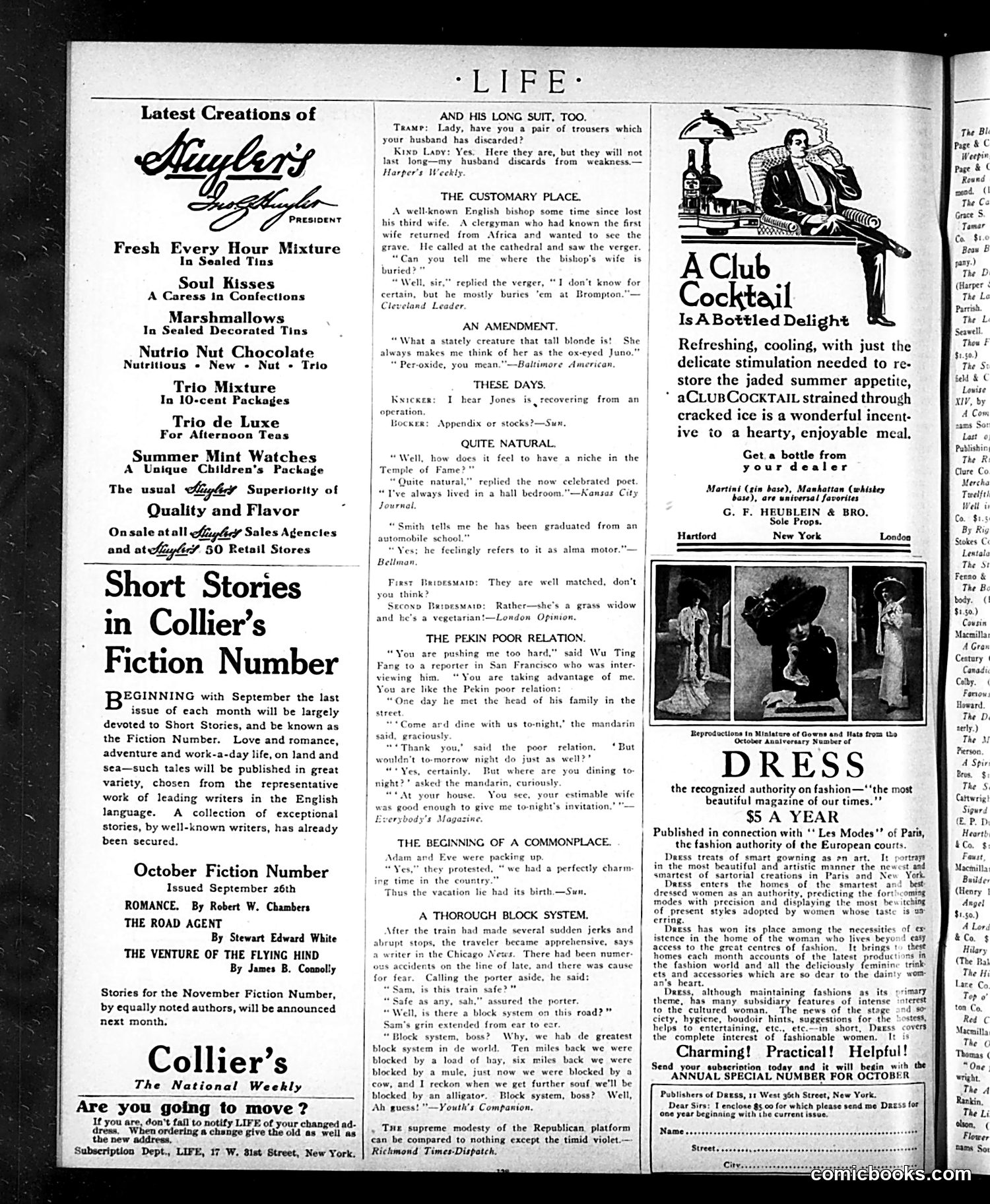
This page is primarily **advertising and editorial content**, not political satire. It features: **Left column:** Advertisements for Stuyler's confections (candies, chocolates, marshmallows) and announcements about Collier's magazine's upcoming "Fiction Number" issues featuring short stories by prominent authors like Robert W. Chambers and Stewart Edward White. **Right column:** A liquor advertisement for "Club Cocktail" and a fashion magazine advertisement for "Dress." **Center section:** Multiple brief humorous anecdotes and jokes—typical filler content for Life magazine. These include: - A joke about a bishop burying multiple wives - Wordplay about "alma motor" (vs. "alma mater") - A "poor relation" anecdote set in Pekin These are light, domestic humor pieces rather than political cartoons. The page reflects early 20th-century magazine advertising and entertainment conventions, with no apparent political commentary or caricature.
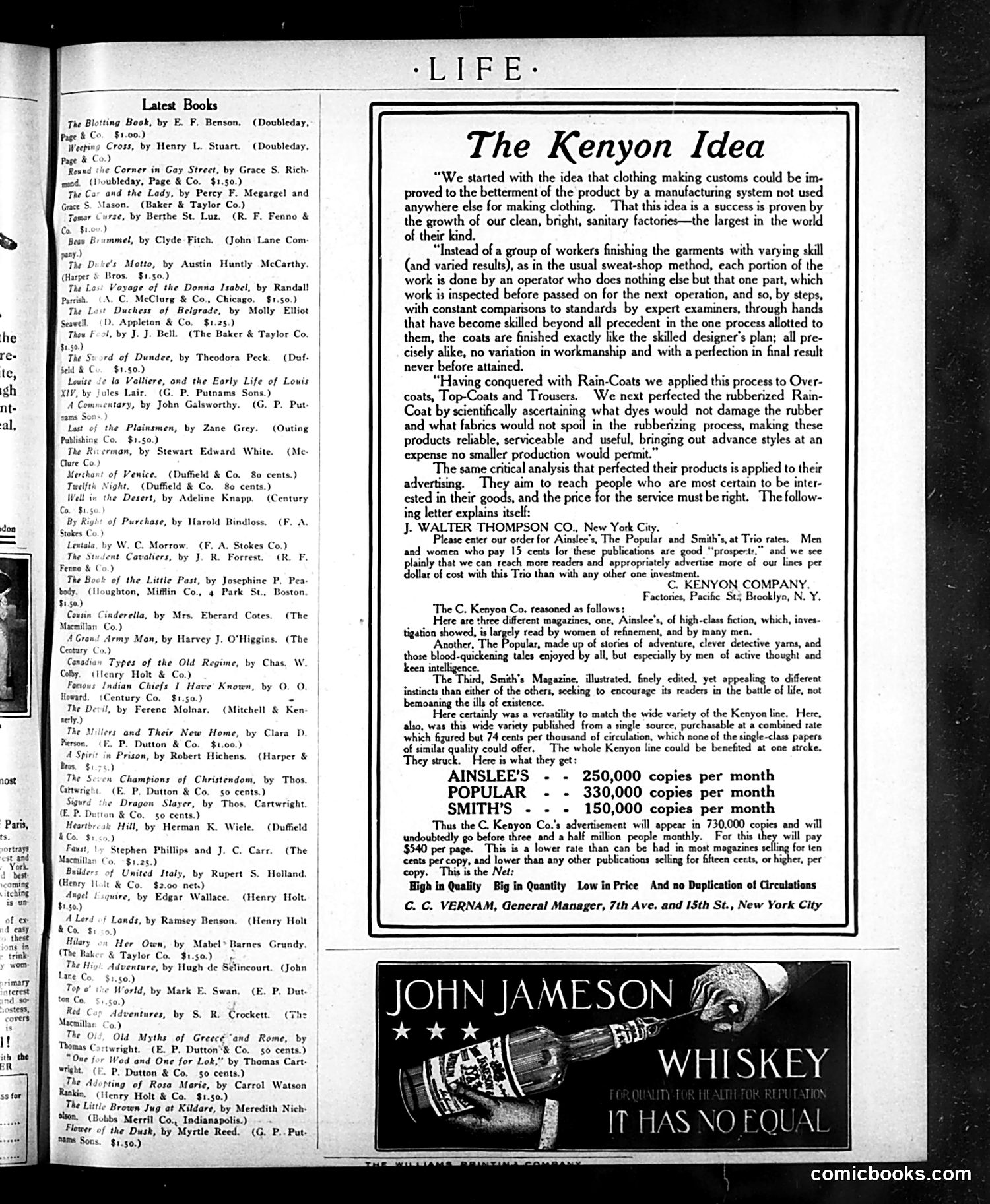
This page is primarily a **book review/listings section** followed by **advertisements**. The main content is "The Kenyon Idea," a lengthy advertisement for the C. Kenyon Co. clothing manufacturer (New York City). **The Advertisement's Message:** Kenyon presents an early **assembly-line manufacturing philosophy**—each worker specializes in one task rather than completing whole garments. This ensures consistency and quality through expert inspection at each stage. The ad emphasizes "clean, bright, sanitary factories" and claims superiority over traditional "sweat-shop" methods. **Historical Context for Modern Readers:** This reflects early 20th-century industrial optimization, predating widespread assembly-line adoption. The emphasis on "sanitary factories" suggests contrast with notorious sweatshop conditions of the era. **Bottom Advertisement:** A John Jameson Whiskey ad featuring a bottle and gloved hand, promoting the product's reputation. **Note:** This is straightforward commercial advertising rather than political satire or editorial cartooning—typical content for Life magazine's revenue model.
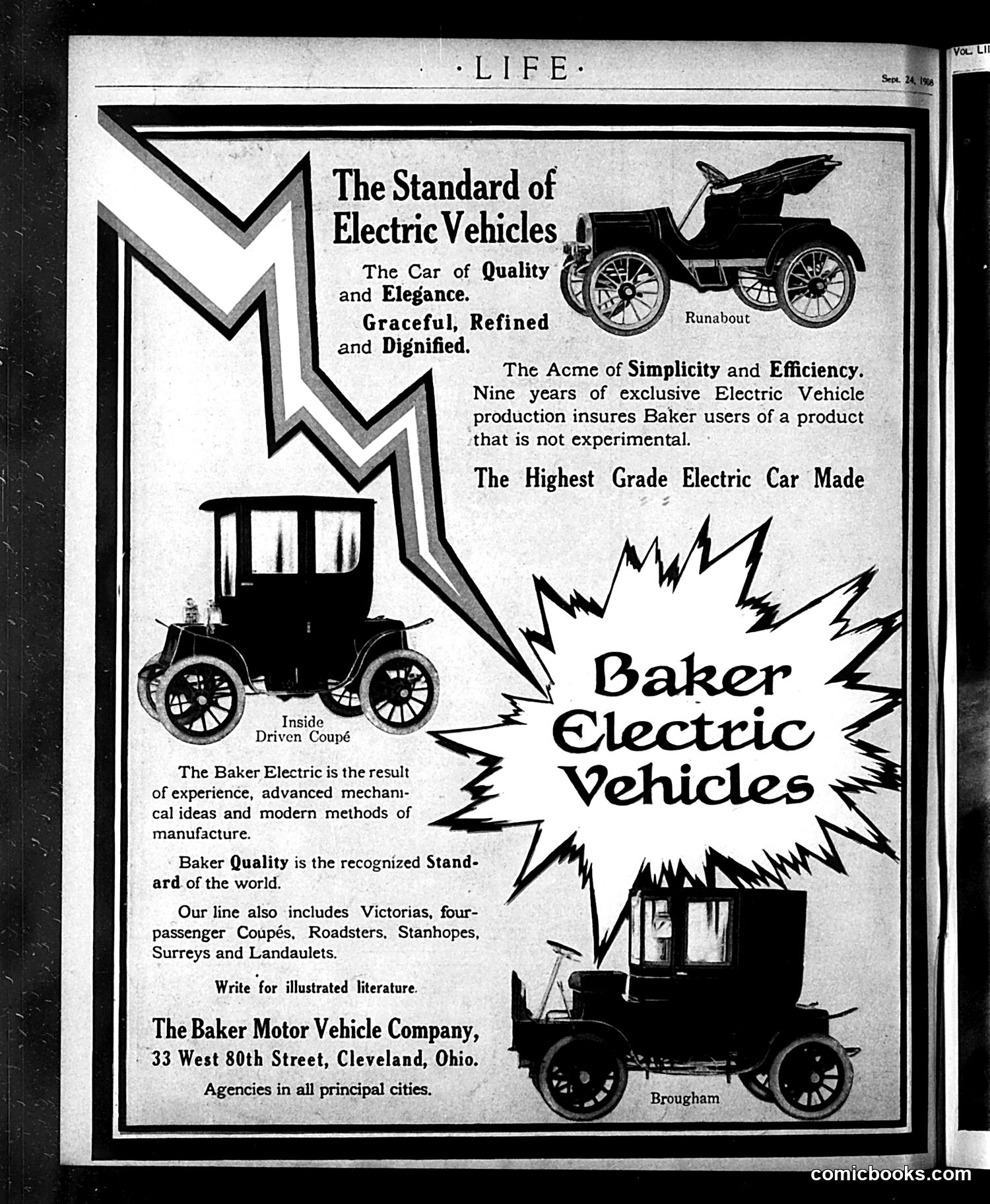
This is primarily a **advertisement, not satire**—a full-page promotion for the Baker Motor Vehicle Company of Cleveland, Ohio, published in *Life* magazine (dated Sept. 24, based on visible text). The ad promotes electric cars during the early automotive era when electric vehicles competed with gasoline engines. Baker emphasizes their nine years of exclusive electric vehicle production, positioning their cars as refined, dignified, and efficient alternatives to experimental gasoline models. The page features two vehicle illustrations (a Runabout and a Brougham) alongside marketing copy highlighting "Quality" and "Elegance." The dramatic starburst graphic containing "Baker Electric Vehicles" was a common era advertising device for emphasis. **Modern context**: This reflects a period (approximately 1900-1920) when electric cars were genuinely competitive luxury vehicles, favored for city driving before gasoline engines' superior range and power made them dominant.