
Life, 1908-09-24 · page 15 of 24
Life — September 24, 1908 — page 15: what you’re looking at
What you’re looking at
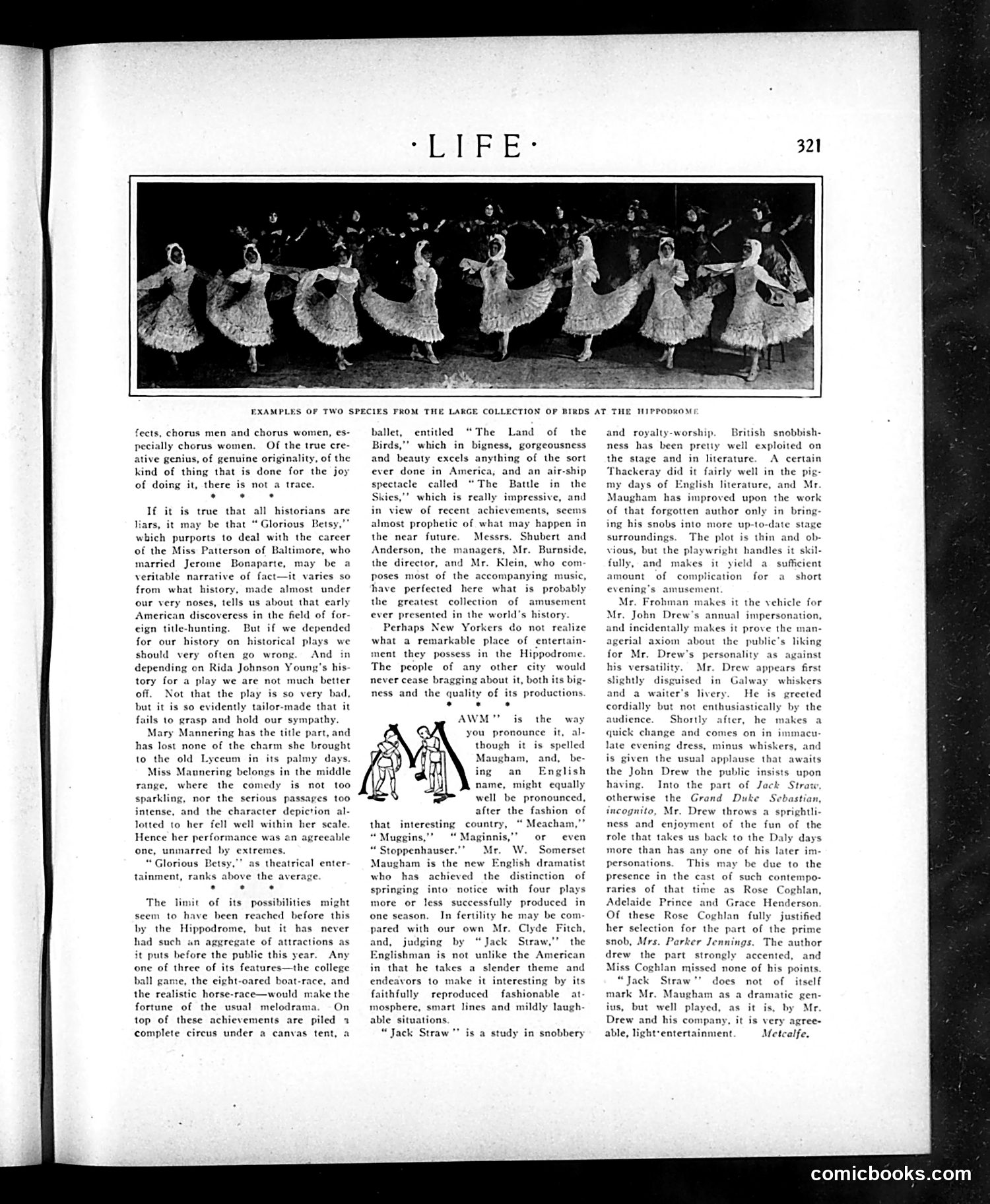
**What This Page Contains:** This page reviews theatrical productions, primarily focusing on the Hippodrome's spectacular shows and the play "Glorious Betsy." **Key Content:** The top photograph shows chorus girls in identical costumes performing at the Hippodrome—a massive entertainment venue featuring multiple attractions: a realistic horse-race, eight-oared boat-race, college ball game, circus acts under canvas, a bird-themed ballet, and an airship spectacle called "The Battle in the Skies." The text criticizes "Glorious Betsy" (about Jerome Bonaparte's American wife) as historically inaccurate but notes actress Mary Mannering performs adequately within her range. **Social Context:** The Hippodrome represents early 1900s American spectacle entertainment—enormous scale productions competing for audiences. The reviews contrast substance with spectacle: the Hippodrome excels at visual grandeur, while theatrical plays often sacrifice historical accuracy for dramatic effect. The page also discusses W. Somerset Maugham's play "Jack Straw," calling it a snobbery study, comparing Maugham favorably to American playwright Clyde Fitch.
📄 Transcribed text from this page (OCR, searchable)
Machine-transcribed from the original scan — historical spelling and the odd misread are preserved.
EXAMPLES fects, chorus men and chorus women, es- pecially chorus women, Of the true cre- ative genius, of genuine originality, of the kind of thing that is done for the joy of doing it, there is not a trace. . ef If it is true that all historians are liars, it may be that “Glorious Betsy, which purports to deal with the carcer of the Miss Patterson of Baltimore, who Jerome Bonaparte, may be a narrative of fact—it varies so made almost under married veritable from what history our very noses, tells us about that early American discoveress in the field of for- cign title-hunting. But if we depended for our history on historical plays we should very often go wrong. And in depending on Rida Johnson Young's his tory for a play we are not much better off. Not that the play is so very bad, but it is so evidently tailor-made that it fails to grasp and hold our sympathy Mary Mannering has the title part, and has lost none of the charm she brought to the old Lyceum in its palmy days. Miss Mannering belongs in the middle where the comedy is not too sparkling, nor the serious passages too intense, and the character depiction al- lotted to her fell well within her scale Hence her performance was an agreeable onc, unmarred by extremes. “Glorious Betsy,"’ as theatrical enter: tainment, ranks above the average range, The limit of its possibilities might seem to have been reached before this by the Hippodrome, but it has never had such an aggregate of attractions as it puts before the public this year. Any one of three of its features—the college ball game, the eight-oared boat-race, and the realistic horse-race—would make the fortune of the usual melodrama. On top of these achievements are piled complete circus under a canvas tent, OF TWO SPECIES PROM THE LARGE COLLE ballet, entitled “The Land of the Birds,” which in bigness, gorgeousness and beauty excels anything of the sort ever done in America, and an air-ship ¢ called “The Battle in the ics," which is really impressive, and in view of recent achievements, seems almost prophetic of what may happen in the near future. Messrs. Shubert and Anderson, the managers, Mr. Burnside, the director, and Mr. Klein, who com poses most of the accompanying music, have perfected here probably the greatest collection of amusement what is ever presented in the world’s history Perhaps New Yorkers do not realize what a remarkable place of entertain- ment they possess in the Hippodrome The people of any other city would never cease bragging about it, both its big- ness and the quality of i . 8 e AWM" is the way you pronounce it, al- though it Maugham, and, be- ing an English name, might equally well be pronounced, after the fashion of “ Meacham,” Maginnis," or even Somerset productions is spelled that interesting country “ Muggins,”” Stoppenhauser."" Mr. W. Maugham is the new English dramatist who has achieved the distinction of springing into notice with plays more or less successfully produced in one season. In fertility he may be com- pared with our own Mr. Clyde Fitch, and, judging by “Jack Straw,’’ the inglishman is not unlike the American in that he takes a slender theme and endeavors to make it interesting by its faithfully reproduced fashionable at mosphere, smart lines and mildly laugh- able situations. “Jack Straw" four is a study in snobbery TION OF BIRDS AT THE MIPPODROM British snobbish- ness has been pretty well exploited on the stage and in literature. A certain Thackeray did it fairly well in the pig my days of English literature, and Mr Maugham has improved upon the work of that forgotten author only in bri ing his snobs into more up-to-date stage The plot is thin and ob and _royalty-worship. surroundings. vious, but the playwright handles it skil- fully, and sufficient amount of complication for a short evening's amusement Mr. Frohman makes it the vehicle for Mr. John Drew's annual impersonation, and incidentally makes it prove the i: makes it yield a agerial axiom about the public's liking for Mr. Drew's personality as against his versatility. Mr. slightly disguised in Galway and a waiter’s livery. He is greeted cordially but not enthusiastically by the audience. Shortly after, he makes quick change and comes on in immacu- Drew appears first whiskers late evening dress, minus whiskers, and is given the usual applause that awaits the John Drew the public insists upon having. Into the part of Jack Strat otherwise the Grand Duke Sebastian, incognito, Mr, Drew throws a sprightl ness and enjoyment of the fun of the role that takes us back to the Daly days more than has any one of his later im- This may be due to the presence in the cast of such contempo- sof that time as Adelaide Prince and Grace Henderson Of these Rose Coghlan fully justified her selection for the part of the prime snob, Mrs. Parker Jennings. The author drew the part personations. Rose strongly acce d, and Miss Coghlan missed none of his points. Jack Straw" does not of itself mark Mr. Maugham as a dramatic gen- ius, but well played, as it is, by Mr. Drew and his company, it is very agree- able, light‘entertainment. Metcalfe. comicbooks.com