
Life, 1908-09-24 · page 7 of 24
Life — September 24, 1908 — page 7: what you’re looking at
What you’re looking at
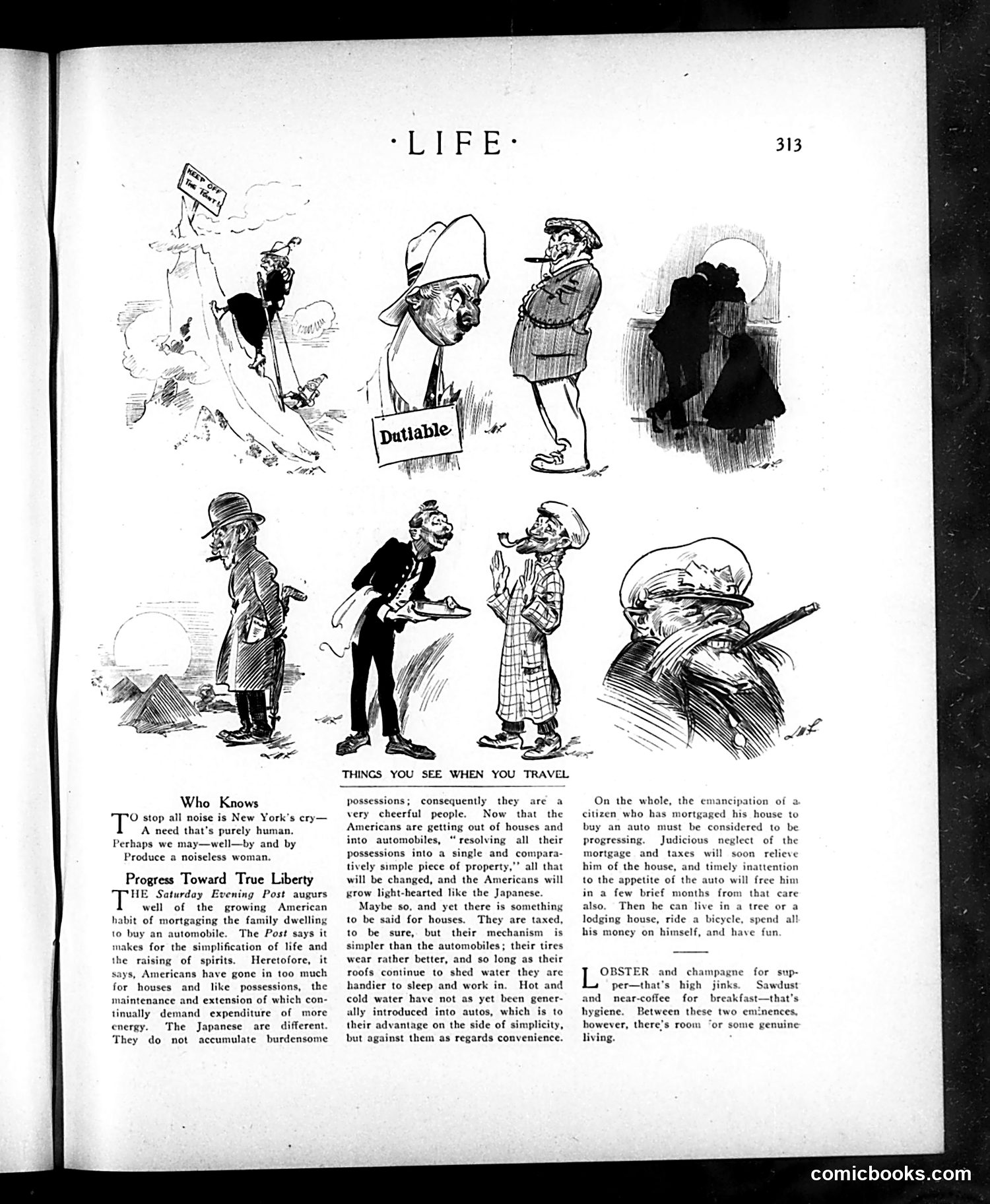
This page from *Life* magazine satirizes American attitudes toward homeownership and modernization in the early automotive era. The heading "Things You See When You Travel" accompanies seven cartoon vignettes mocking various social types encountered during trips. The central figure labeled "Dutiable" appears to reference tariff debates. Other sketches ridicule travelers' possessions and behaviors. The accompanying text, titled "Progress Toward True Liberty," ironically discusses Americans abandoning houses for automobiles, praising this shift as liberating while noting houses require constant maintenance and expense. The satire critiques consumer culture and the automobile's appeal as status symbols, suggesting Americans wrongly view car ownership as "true liberty" rather than recognizing it as another burdensome possession. The Japanese are mentioned as wisely avoiding such accumulation.
📄 Transcribed text from this page (OCR, searchable)
Machine-transcribed from the original scan — historical spelling and the odd misread are preserved.
Who Knows 0 stop all noise is New York's cry— A need that's purely human. Perhaps we may—well—by and by Produce a noiseless woman. Progress Toward True Liberty HE Saturday Evening Post augurs well of the growing American habit of mortgaging the family dwelling to buy an automobile. The Post says it makes for the simplification of life and the raising of spirits. Heretofore, it says, Americans have gone in too much for houses and like possessions, the maintenance and extension of which con- tinually demand expenditure of more energy. The Japanese are different. They do not accumulate burdensome THINGS YOU SEE WHEN YOU TRAVEL possessions; consequently they are a very cheerful people. Now that the Americans are getting out of houses and into automobiles, “resolving all their possessions into a single and compara- tively simple piece of property,”” all that will be changed, and the Americans will grow light-hearted like the Japanese. Maybe so, and yet there is something to be said for houses. They are taxed, to be sure, but their mechanism is simpler than the automobiles; their tires wear rather better, and so long as their roofs continue to shed water they are handier to sleep and work in. Hot and cold water have not as yet been gener- ally introduced into autos, which is to their advantage on the side of simplicity, but against them as regards convenience. On the whole, the citizen who has mortgaged his house to buy an auto must be considered to be progressing. Judicious neglect of the and taxes will soon relieve d timely inattention to the appetite of the auto will free him in a few brief months from that care also, Then he can live in a tree or a lodging house, ride a bicycle, spend all his money on himself, and have fun nancipation of a. OBSTER and champagne for sup- per—that’s high jinks. Sawdust and near-coffee for breakfast—that's hygiene. Between these two eminences, however, there’s room ‘or some genuine living. comicbooks.com