
Life, 1908-09-24 · page 23 of 24
Life — September 24, 1908 — page 23: what you’re looking at
What you’re looking at
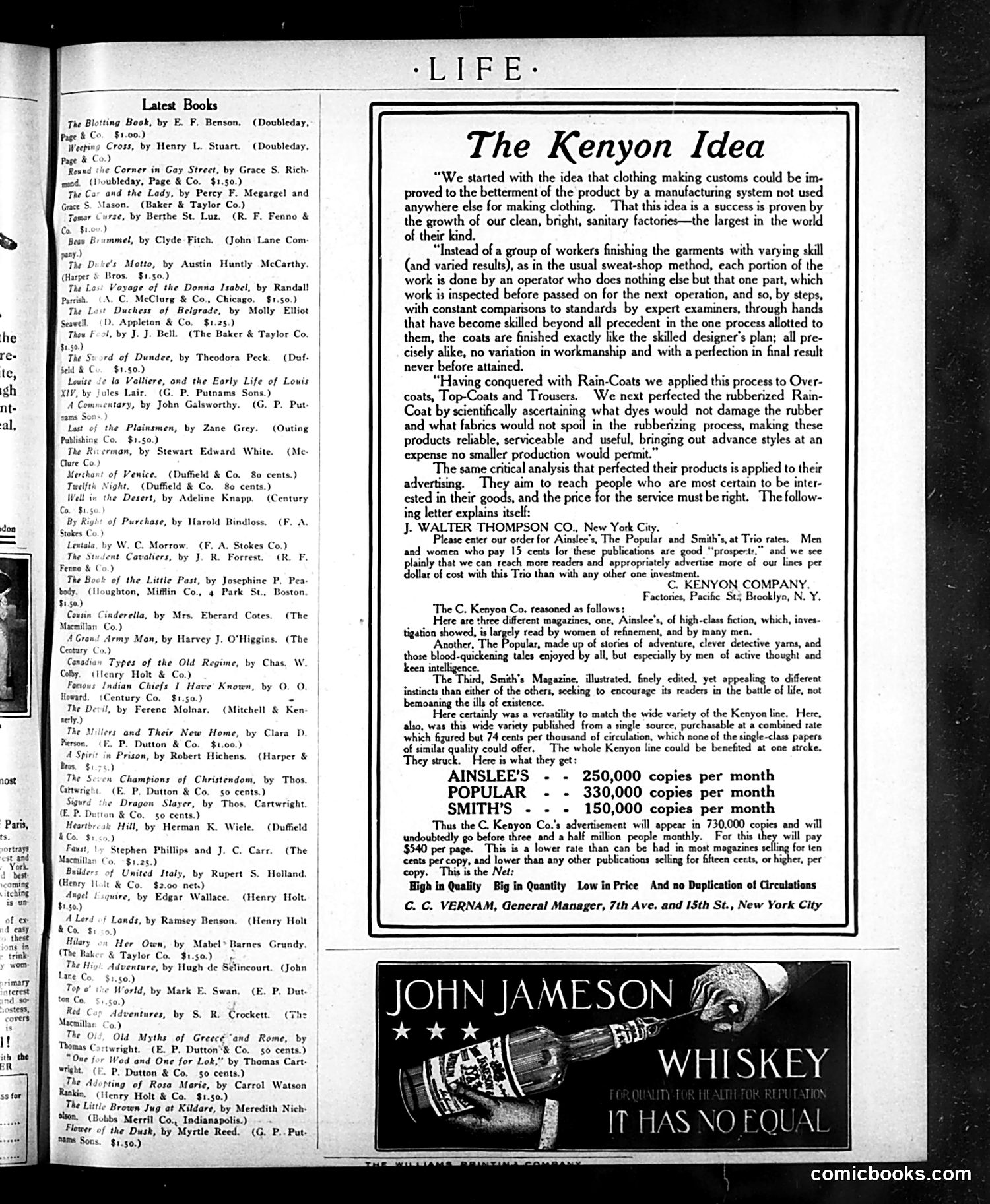
This page is primarily a **book review/listings section** followed by **advertisements**. The main content is "The Kenyon Idea," a lengthy advertisement for the C. Kenyon Co. clothing manufacturer (New York City). **The Advertisement's Message:** Kenyon presents an early **assembly-line manufacturing philosophy**—each worker specializes in one task rather than completing whole garments. This ensures consistency and quality through expert inspection at each stage. The ad emphasizes "clean, bright, sanitary factories" and claims superiority over traditional "sweat-shop" methods. **Historical Context for Modern Readers:** This reflects early 20th-century industrial optimization, predating widespread assembly-line adoption. The emphasis on "sanitary factories" suggests contrast with notorious sweatshop conditions of the era. **Bottom Advertisement:** A John Jameson Whiskey ad featuring a bottle and gloved hand, promoting the product's reputation. **Note:** This is straightforward commercial advertising rather than political satire or editorial cartooning—typical content for Life magazine's revenue model.
📄 Transcribed text from this page (OCR, searchable)
Machine-transcribed from the original scan — historical spelling and the odd misread are preserved.
Latest Books The Blotting Book, by E. F. Benson. (Doubleday, page & Co. $1.00.) Weeping Cross, by Henry L. Stuart. (Doubleday, Page & Co.) Reand ‘lie Corner in Gay Street, by Grace S. Rich mod (loubleday, Page & Co. $1.50.) The Cor and the Lady, by Percy F. Megargel and Grace $ Mason. (Baker & Taylor Co.) Tomar Curse, by Berthe St. Luz. (R. F. Fenno & Co. $1.00) Bess Byummel, by Clyde Fitch. (John Lane Com- per.) the Dete’s Motto, by Austin Huntly McCarthy. & Bros. $1.50.) Voyage of the Donna Isabel, by Randall \. C. McClurg & Co., Chicago. $1.50.) 1 Duchess of Belgrade, by Molly Elliot Se D. Appleton & Co. $1.25.) Thow Fool, by J. J. Bell. (The Baker & Taylor Co. $1.50) The Se ord of Dundee, by Theodora Peck. (Duf- Seid & C $1.50.) Leite Je la Valliere, and the Early Life of Louis XIV, by Jules Lair. (G. P. Putnams Sons.) entary, by John Galsworthy. (G. P. Put. the Plainsmen, by Zane Grey. (Outing nx Co. $1.50.) Riverman, by Stewart Edward White. (Me- of Venice. (Duffield & Co. 80 cents.) ight, (Duffield & Co. 80 cents.) he Desert, by Adeline Knapp. (Century of Purchase, by Harold Bindloss. (F. A. C. Morrow. (F. A. Stokes Co.) ent Cavaliers, by J. R. Forrest. (R. F. Ferro & Co.) The Book of the Little Past, by Josephine P. Pea body. (lloughton, Mifflin Co., 4 Park St., Boston $1.50.) Cousin Cinderella, by Mrs. Eberard Cotes. (The Macnillan Co.) A Gran! Army Man, by Harvey J. O'Higgins. (The Cectary Co.) Canadian Types of the Old Regime, by Chas. W. Coy. (ilenry Holt & Co.) Ferous Indian Chiefs 1 Have Known, by O. O. Howard, (Century Co. $1.50.) - The Devil, by Ferenc Molnar, (Mitchell & Ken. rs_and Their New Home, by Clara D. P. Dutton & Co. $1.00.) yf Shins i® Prison, by Robert Hichens. (Harper & ro. $1.75.) The Seven Champions of Christendom, by Thos. Gnwrigh. (E. P. Dutton & Co. 50 cents.) Sigurd the Dragon Slayer, by Thos. Cartwright. (EP. Dutton & Co. 50 cents.) t Hill, by Herman K. Wiele. (Duffield ) Stephen Phillips and J. C. Carr. (The oO. $1.25.) f United Italy, by Rupert S. Holland. (Henry Hult & Co. $2.00 nets) Angell squire, by Edgar Wallace. (Henry Holt. $1.50.) A Lord «f Lands, by Ramsey Benson. (Henry Holt &C0. $19.) Hilery on Her Own, by Mabel® Barnes Grundy. (The Maker & Taylor Co. $1.50.) The Hip). Adventure, by Hugh de Selincourt. (John Lare Co. $1.50.) © World, by Mark E. Swan. (E. P. Dut- tures, by S. R. Crockett. (7 Old Myths of Greece “and Rome, by twright. (E. P. Dutton*& Co. so cents.) for Wod and One for Lok,” by Thomas Cart- P. Dutton & Co. so cents.) Jopting ef Rosa Marie, by Carrol Watson Henry Holt & Co. $1.50.) Little Brown Jug at Kildare, by Meredith Nich- thon. (Bobs Merril Co. Indianapolis.) Flower of the Dusk, by Myrtle Reed. (G. P..Put- Rams Sous. $1.50.) The Kenyon Idea “We started with the idea that clothing making customs could be im- proved to the betterment of the product by a manufacturing system not used anywhere else for making clothing. That this idea is a success is proven by the growth of our clean, bright, sanitary factories—the largest in the world of their kind. “Instead of a group of workers finishing the garments with varying skill (and varied results), as in the usual sweat-shop method, each portion of the work is done by an operator who does nothing else but that one part, which work is inspected before passed on for the next operation, and so, by steps, with constant comparisons to standards by expert examiners, through hands that have become skilled beyond all precedent in the one process allotted to them, the coats are finished exactly like the skilled designer's plan; all pre- cisely alike, no variation in workmanship and with a perfection in final result never before attained. “Having conquered with Rain-Coats we applied this process to Over- coats, Top-Coats and Trousers. We next perfected the rubberized Rain- Coat by scientifically ascertaining what dyes would not damage the rubber and what fabrics would not spoil in the rubbenizing process, making these products reliable, serviceable and useful, bringing out advance styles at an expense no smaller production would permit.” The same critical analysis that perfected their products is applied to their advertising. They aim to reach people who are most certain to be inter- ested in their goods, and the price for the service must be right. The follow- ing letter explains itself: J. WALTER THOMPSON CO., New York City, Please enter our order for Aindee’s, The Popular and Smith's, at Trio rates. Men and ‘wocheal shes pay, 15 cotton these putdicalicen’ aft! goo. “etepedi.” sad we-see plainly thet we can reach more reader and appropriately advertise more of our lines per dollar of cost with this Trio than with any other one investment, C. KENYON COMPANY. Factories, Pacific St Brooklyn, N. Y. The C. Kenyon Co. reasoned as follows: Here are three different magazines, one, Ainslee’s, of high-class fiction, which, inves- tigation showed, is largely read by women of refinement, and By many men. Another, The Popular, made up of stories of adventure, clever detective yams, and those blood-quickening tales enjoyed by all, but expecially by men of active thought and keen intelligence. The Third, Smith's Magazine, illustrated, finely edited, yet appealing to different instincts than either of the others, seeking to encourage its readers in the battle of life, not bemoaning the ills of existence. Here certainly was a versatility to match the wide variety of the Kenyon line. Here, also, was this wide variety published from a single source, purchasable at a combined rate which figured but 74 cents per thousand of circulation, which none of the single-class papers of similar quality could offer. The whole Kenyon line could be benefited at one stroke. ey struck. "Here is what they get: AINSLEE’S - - 250,000 copies per month POPULAR - - 330,000 copies per month SMITH’S - - - 150,000 copies per month Thus the C. Kenyon Co.'s advertisement will appear in 730,000 copies and will undoubtedly go before three and a hall million people monthly. For this they will pay $540 per page. This is a lower rate than can be had in most magazines selling for ten cents per copy, and lower than any other publications selling for fifteen cects, or higher, per copy. This is the Net: High in Quality Big in Quantity Low in Price And no Duplication of Circalations C. C. VERNAM, General Manager, 7th Ave. and 15th St., New York City JOHN JAMESO oe comicbooks.com