
Life, 1908-09-24 · page 10 of 24
Life — September 24, 1908 — page 10: what you’re looking at
What you’re looking at
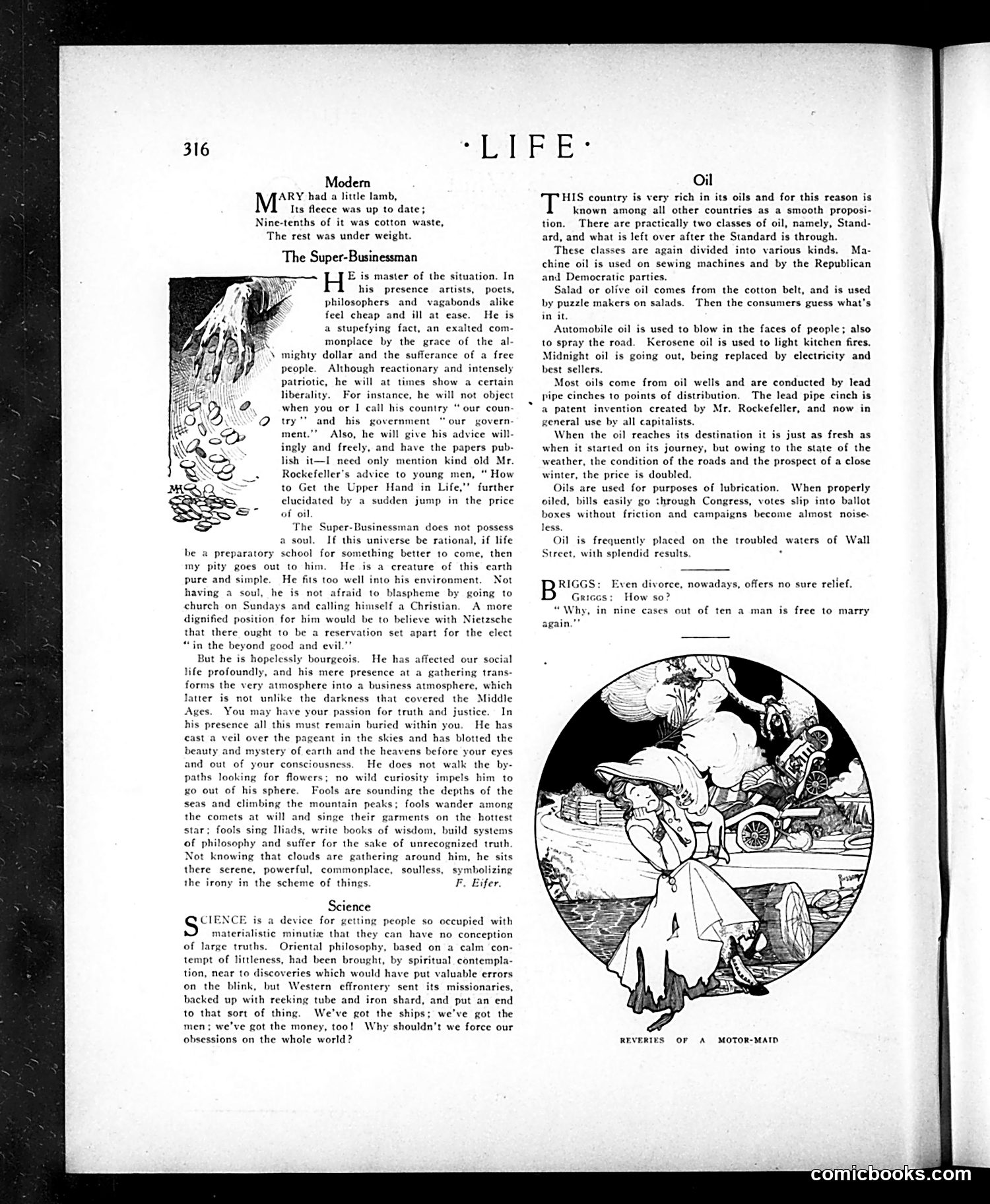
This page contains three distinct articles: "Mary Had a Little Lamb" (brief moral tale), "The Super-Businessman" (satirizing a wealthy businessman figure who disrupts social gatherings with his aggressive materialism), and "Oil" (discussing petroleum industry practices). The circular illustration titled "Reveries of a Motor-Maid" depicts a woman daydreaming about automobiles and leisure—likely satirizing the emerging car culture and women's relationship to automotive technology in the early 20th century. The "Science" section critiques Western materialism and industrial expansion, suggesting obsession with ships, money, and technological dominance over spiritual contemplation. The final dialogue between Briggs and Griggs jokes about divorce rates and remarriage. Overall, the page satirizes modern commercialism, materialism, and social pretension.
📄 Transcribed text from this page (OCR, searchable)
Machine-transcribed from the original scan — historical spelling and the odd misread are preserved.
Bl bJjble leug Modern ARY had a little lamb, Its fleece was up to date; Nine-tenths of it was cotton waste, The rest was under weight. The Super-Businessman is master of the situation. In his presence artists, poets, philosophers and vagabonds alike feel cheap and ill at ease. He is a stupefying fact, an exalted com- monplace by the grace of the al- hty dollar and the sufferance of a free people. Although reactionary and intensely patriotic, he will at times show a certain liberality. For instance, he will not object when you or I call his country “ our coun: try’’ and his government “our ment."” Also, he will give his advice will- ingly and freely, and have the papers pub- lish it—I need only mention kind old Mr. Rockefellers advice to young men, “ How to Get the Upper Hand in Life,” further elucidated by a sudden jump in the price oil. he Super-Businessman does not possess a soul. If this universe be rational, if life he a preparatory school for something better to come, then my pity goes out to him. He is a creature of this earth pure and simple. He fits too well into his environment. Not having a soul, he is not afraid to blaspheme by going to church on Sundays and calling himself a Christian. A more dignified position for him would be to believe with Nietzsche that there ought to be a reservation set apart for the elect “jin the beyond good and evil.”’ But he is hopelessly He has affected our social life profoundly, and his mere presence at a gathering trans forms the very atmosphere into a business atmosphere, which latter is not unlike the darkness that covered the Middle Ages. You may have your passion for truth and justice. In his presence all this must remain buried within you. He has cast a veil over the pageant in the skies and has blotted the beauty and mystery of earth and the heavens before your eyes and out of your consciousness. He does not walk the by paths looking for flowers; no wild curiosity impels him to x0 out of his sphere. Fools are sounding the depths of the seas and climbing the mountain peaks; fools wander among the comets at will and singe their garments on the hottest star; fools sing Iiads, write books of wisdom, build systems of philosophy and suffer for the sake of unrecognized truth Not knowing that clouds are gathering around him, he sits there serene, powerful, commonplace, soulless, symbolizing the irony in the scheme of things. F. Eifer. Science sc NCE is a device for getting people so occupied with materialistic minutie that they can have no conception of large truths. Oriental philosophy, based on a calm con- tempt of littleness, had been brought, by spiritual contempla- tion, near to discoveries which would have put valuable errors on the blink, but Western effrontery sent its missionaries, backed up with reeking tube and iron shard, and put an end to that sort of thing. We've got the ships; we've got the men; we've got the money, too! Why shouldn't we force our obsessions on the whole world? Oil HIS country is very rich in its oils and for this reason is known among all other countries as a smooth proposi- tion. There are practically two classes of oil, namely, Stand- ard, and what is left over after the Standard is through. These classes are again divided into various kinds. Ma- chine oil is used on sewing machines and by the Republican and Democratic parties. Salad or olive oil comes from the cotton belt, and is used by puzzle makers on salads. Then the consumers guess what's in it. Automobile oil is used to blow in the faces of people; also to spray the road. Kerosene oil is used to light kitchen fires. Midnight oil is going out, being replaced by electricity and best sellers. Most oils come from oil wells and are conducted by lead pipe cinches to points of distribution. The lead pipe cinch is patent invention created by Mr. Rockefeller, and now in general use by all capitalists. When the oil reaches its destination it is just as fresh as when it started on its journey, but owing to the state of the weather, the condition of the roads and the prospect of a close winter, the price is doubled, Oils are used for purposes of lubrication. When properly oiled, bills easily go through Congress, votes slip into ballot boxes without friction and campaigns become almost noise. less. Oil is frequently placed on the troubled waters of Wall Street, with splendid results : RIGGS: Even divorce, nowadays, offers no sure relief. Griccs: How so? “Why, in nine cases out of ten a man is free to marry MOTOR-MATD