
Life, 1908-09-24 · page 20 of 24
Life — September 24, 1908 — page 20: what you’re looking at
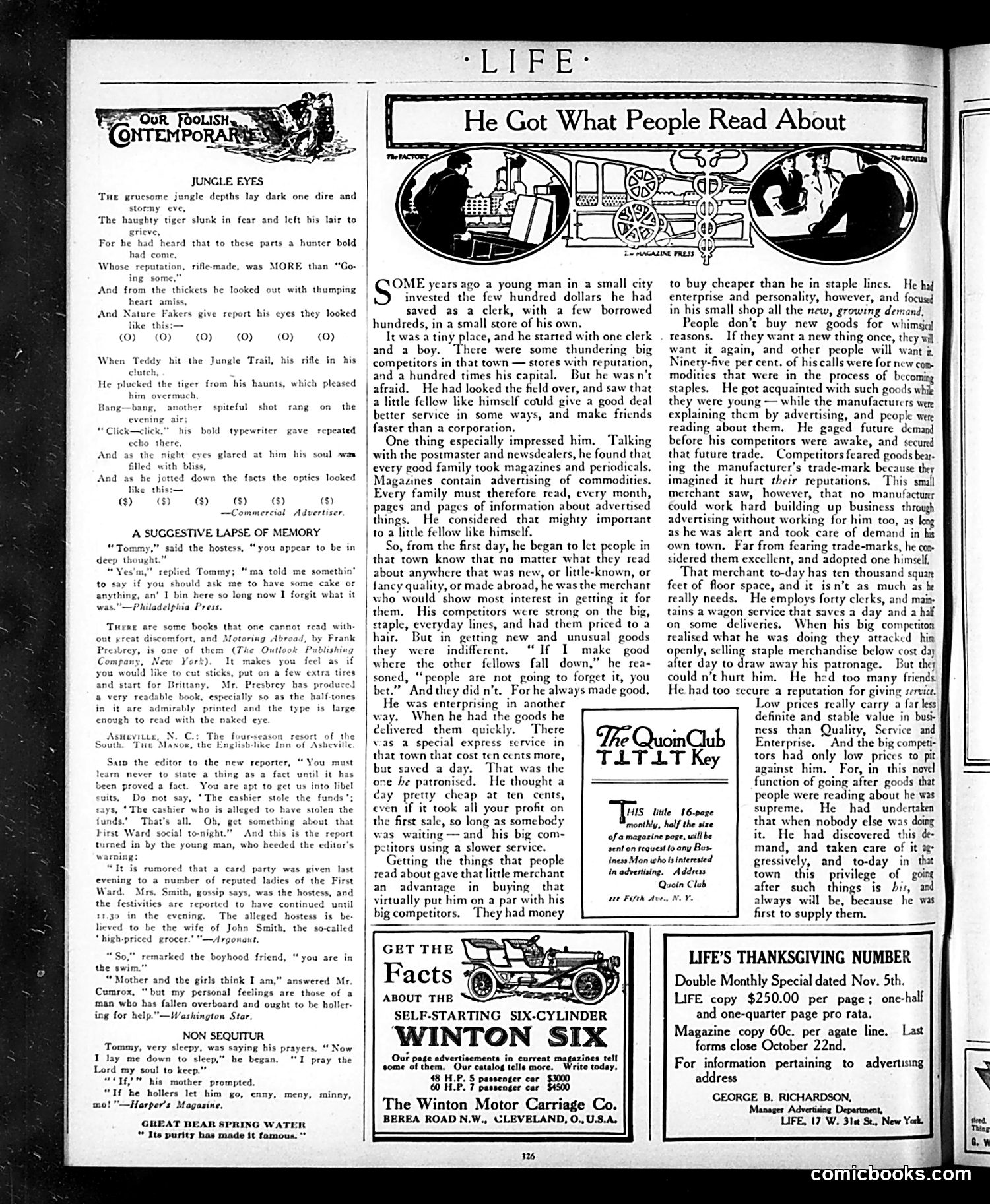
What you’re looking at
This page contains multiple short humorous pieces typical of *Life* magazine's satirical format. **"Jungle Eyes"** appears to mock **Theodore Roosevelt's** hunting exploits and his reputation as a rugged outdoorsman. The poem depicts a tiger hunter in the jungle whose fierce eyes are rendered as a series of parentheses: "(o) (o)" — a visual gag suggesting the hunter's exaggerated, wide-eyed intensity. The reference to "Nature Fakers" (visible in text) alludes to Roosevelt's public disputes with writers who allegedly misrepresented animal behavior. The satire ridicules both the romanticization of hunting adventures and the masculine bravado surrounding them. The remaining pieces are brief comedic vignettes: "A Suggestive Lapse of Memory" jokes about a forgetful guest; another piece satirizes journalistic caution about libel; "Non Sequitur" plays on childhood prayers. The page is primarily **advertising and entertainment content** rather than serious political commentary, reflecting *Life*'s role as a humorous weekly for middle-class readers.
📄 Transcribed text from this page (OCR, searchable)
Machine-transcribed from the original scan — historical spelling and the odd misread are preserved.
JUNGLE EYES Tue grucsome jungle depths lay dark one dire and stormy eve, ‘The haughty tiger slunk in fear and left his lair to grieve, For he had heard that to these parts a hunter bold had come, Whose reputatio ing some, thickets he looked out with thumping riflemade, was MORE than “Go- And Nature Fakers give report his eyes they looked like thi: (@) (0) =) =) -—@)—) Teddy clutch, He plucked the tiger from him over: hit the Jungle Trail, his rifle in his haunts, which pleased spiteful shot rang on the bold typewriter gave repeated And ight eyes glared at him his soul wae as the filled with bliss, as he jotted down the facts the optics looked like this:— (s) (8) $ «s) «) Commercial Advertiser. A SUGGESTIVE LAPSE OF MEMORY * said the hostess, “you appear to be in And “Tommy, deep thought. d Tommy; “ma told me someth to say if you should ask me to have some cake or an’ I bin here so long now I forgit what it Philadelphia Press. Tene are some books that one cannot read ereat disco: rey, is one of then Company, New York) to cu Brittany, Mr. le book, espec fort, and and start for a very read is large in it are admirably ted and the type enough to read with the naked eye. Asueynite, N.C: T . resort of the South, Tit Masox, the Englisb-like Inn of Asheville Sarp the editor to the new reporter, “You must a thing asa fact until it has You are apt to get us into libel ts. Do not say, ‘The cashier stole the funds’; s, ‘The cashier who is alleged to have stolen the funds." That's all. Oh, get someth First Ward social to-night.” And this is turned in by the young man, who heeded the editor's warni “It is rumored that a card party was given last evening to a num d ladies of the First Ward. Mrs. Smith, gossip says, was the hostess, and the festivities are reported to have continued until 11.30 in the evening. The alleged hostess is be- lieved to be the of John Smith, the so-called ‘high-priced grocer.’ "—Argonaut, learn never to been proved a fa ng about that report ber of re remarked the boyhood friend, “you are in the swi “Mother and the girls think I am,” answered Mr Cumrox, “but my personal feelings are those of a man who has fallen overboard and ought to be holler- ing for help."—Washington Star. NON SEQUITUR Tommy, very sleepy, was saying I tay me down to sleep,” he began. Lord my soul to keep.” “*I8)" his mother prompted. “If he hollers let him go, enny, meny, minny, mo!"—Harper’'s Magasine. is pi I pray the GREAT BEAR SPRING WATER * Its purity has made It famous. * OME years ago a young man in a small city S invested the few hundred dollars he had saved as a clerk, with a few borrowed hundreds, in a small store of his own. It was a tiny place, and he started with one clerk and a boy. There were some thundering big competitors in that town — stores with reputation, and a hundred times his capital. But he wasn't | afraid. He had looked the held over, and saw that | a little fellow like himself could give a good deal better service in some ways, and make friends | faster than a corporation. | One thing especially impressed him. Talking | with the postmaster and newsdealers, he found that every good family took magazines and periodicals. Magazines contain advertising of commodities. Every family must therefore read, every month, pages and pages of information about advertised things. He considered that mighty important to a little fellow like himself. So, from the first day, he began to Ict people in that town know that no matter what they read | about anywhere that was new, or little-known, or {ancy quality, or made abroad, he was the merchant who would show most interest in getting it for them. His competitors were strong on the big, | staple, everyday lines, and had them priced to a hair. But in getting new and unusual goods they were indifferent. “If I make good | where the other fellows fall down,” he rea- soned, “people are not going to forget it, you bet.” And they did n't. For he always made good. He was enterprising in another way. When he had the goods he eclivered them quickly. There Te was a special express service in e that town that cost ten cents more, but saved a day. That was the one he patronised. He thought a cay pretty cheap at ten cents, even if it took all your profit on the first sale, so long as somebody was waiting —and his big com- petitors using a slower servi Getting the things that people read about gave that little merchant | an advantage in buying that virtually put him on a par with his big competitors. They had money GET THE Facts ABOUT THE SELF-STARTING SIX-CYLINDER WINTON SIX Our page advertisements in current magazines tell some of them. Our catalog tells more. Write today. 48 HP. S passenger car $3000 @ HP. 7 passenger car $4500 The Winton Motor Carriage Co. BEREA ROAD N.W., CLEVELAND, 0.,U.S.A. QuoinClub TLTLT Key [as utile ‘monthly, half the size of a magazine poge, willbe it, sent on request fo any Bus iness Man who is interested inadvertising, Address Quoin Club ne Fn A bs to buy cheaper than he in staple lincs. He ha enterprise and personality, however, and focusd in his small shop all the new, growing demand, People don’t buy new goods for whimgal teasons. If they want a new thing once, they wil want it again, and other people will want iz Ninety-five per cent. of hiscalls were for new com. modities that were in the process of becoming staples. He got acquainted with such goods whi they were young — while the manufacturers were explaining them by advertising, and people were reading about them. He gaged future demand before his competitors were awake, and secured that future trade. Competitors feared goods bea- ing the manufacturer's trade-mark because they imagined it hurt their reputations, This small merchant saw, however, that no manufacturer could work hard building up business through advertising without working for him too, as as he was alert and took care of demand in kis own town, Far from fearing trade-marks, he com idered them excellent, and adopted one himself, That merchant to-day has ten thousand squar feet of floor space, and it isn’t as much as be really needs, He employs forty clerks, and maine tains a wagon service that saves a day’ and a haf on some deliveries. When his big competitos realised what he was doing they attacked hin openly, selling staple merchandise below cost day after day to draw away his patronage. But they could n’t hurt him. He hed too many friends He had too secure a reputation for giving service. Low prices really carry a far less definite and stable value in bus- ness than Quality, Service and Enterprise. ~ And the big competi- tors had only low prices to pit against him. For, in this novel function of going after goods that people were reading about he w3s supreme. He had undertaken that when nobody else was doing He had discovered this de mand, and taken care of it a gressively, and to-day in that town this privilege of going after such things is his, and always will be, because he was first to supply them. 16.page LIFE’S THANKSGIVING NUMBER Double Monthly Special dated Nov. 5th. LIFE copy $250.00 per page; one-half and one-quarter page pro rata. Magazine copy 60c. per agate line. forms close October 22nd. For information pertaining to advertising address GEORGE B, RICHARDSON, Manager Advertising Department, LIFE, 17 W. 31a St, New York. Last comicbooks.com