
Life, 1908-09-24 · page 16 of 24
Life — September 24, 1908 — page 16: what you’re looking at
What you’re looking at
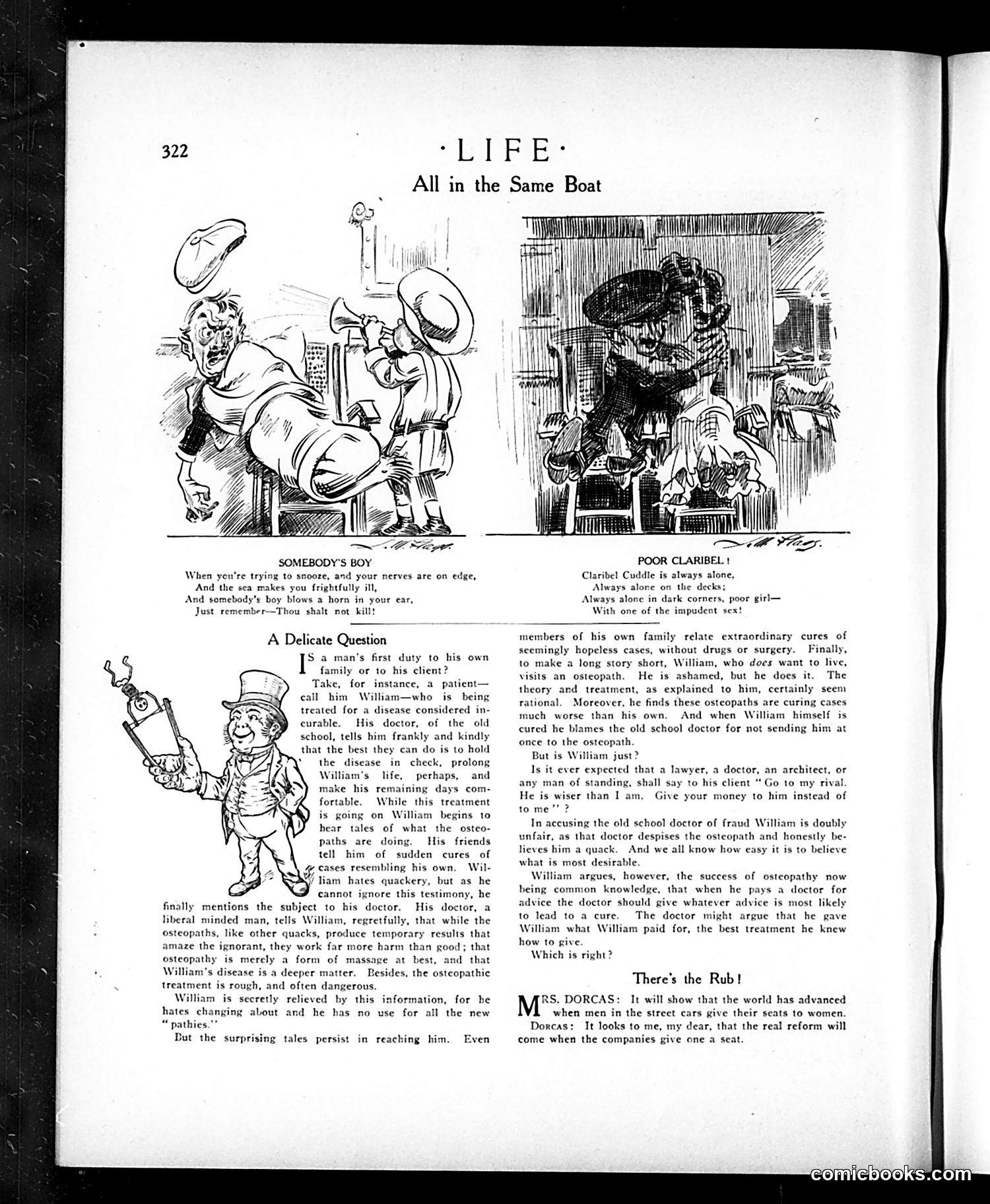
This page contains three satirical pieces on professional ethics and social behavior: **"Somebody's Boy"** (top left cartoon): Mocks inconsiderate behavior aboard ships—specifically a passenger blowing a horn while others try to rest, forcing them to suppress violent impulses ("Thou shalt not kill"). **"A Delicate Question"** (main article with cartoon): Critiques the ethics of medical practitioners. A patient, William, seeks an osteopath despite his traditional doctor's warnings that osteopathy is quackery and massage. The article debates whether doctors should recommend competitors or only their own approach. It satirizes William's unfair judgment—blaming his first doctor after osteopathy "cures" him—while questioning professional loyalty versus patient welfare. **"Poor Claribell"** (top right): A brief joke about a woman constantly chaperoned by men, suggesting impropriety. **"There's the Rub!"** (bottom): Mrs. Dorcas jokes that true social progress won't be men giving up streetcar seats to women, but rather transit companies providing enough seats for everyone—a sarcastic comment on hollow gestures versus systemic reform.
📄 Transcribed text from this page (OCR, searchable)
Machine-transcribed from the original scan — historical spelling and the odd misread are preserved.
LIFE All in the Same Boat SOMEBODY'S BOY When you're trying to snooze, and your nerves are on edge, And the sea makes you frightfully ill, And somebody's boy blows a horn in your ear, Just remember—Thow shalt not kill! A Delicate Question I a man’s first duty to his own family or to his client? Take, for instance, a patient— call him William—who is being treated for a disease considered in- curable. His doctor, of the old school, tells him frankly and kindly the best they can do is to hold the disease in check, prolong "s life, perhaps, and make his remaining days com- fortable. While this treatment is going on William begins to hear tales of what the osteo- paths are doing. His friends tell him of sudden cures of cases resembling his own. Wil- iam hates quackery, but as he 2 cannot ignore this testimony, he finally mentions the subject to his doctor. His doctor, a liberal minded man, tells William, regretfully, that while the osteopaths, like other quacks, produce temporary results that amaze the ignorant, they work far more harm than good; that osteopathy is merely a form of massage at best, and that William's disease is a deeper matter. Besides, the osteopathic treatment is rough, and often dangerous. William is secretly relieved by this information, for be hates changing about and he has no use for all the new “ pathies.”” But the surprising tales persist in reaching him. n a i DN avi i me i Y in if ith ig Claribel Cuddle is always alone, Always alone on the decks; Always alone in dark corners, poor girl— With one of the impudent sex! members of his own family relate extraordinary cures of scemingly hopeless cases, without drugs or surgery. Finally, to make a long story short, William, who does want to live, visits an osteopath. He is ashamed, but he does it. The theory and treatment, as explained to him, certainly seem Moreover, he finds these osteopaths are curing cases And when William himself is rational much worse than his own. cured he blames the old school doctor for not sending him at once to the osteopath But is William just? Is it ever expected that a lawyer, a docto architect, or any man of standing, shall say to his client “Go to my rival He is wiser than I am. Give your money to him instead of tome"? In accusing the old school doctor of fraud William is doubly unfair, as that doctor despises the osteopath and honestly be- lieves him a quack. And we all know how e what is most desirable. William argues, however, the success of osteopathy now being common knowledge, that when he pays a doctor for advice the doctor should give whatever advice is most likely to lead to a cure. The doctor might argue that he gave William what William paid for, the best treatment he knew how to give. Which is right? it is to believe There's the Rub! M RS. DORCAS: It will show that the world has advanced when men in the street cars give their seats to women. Dorcas: It looks to me, my dear, that the real reform will come when the companies give one a seat.