
A complete issue · 54 pages · 1908
Life — August 6, 1908
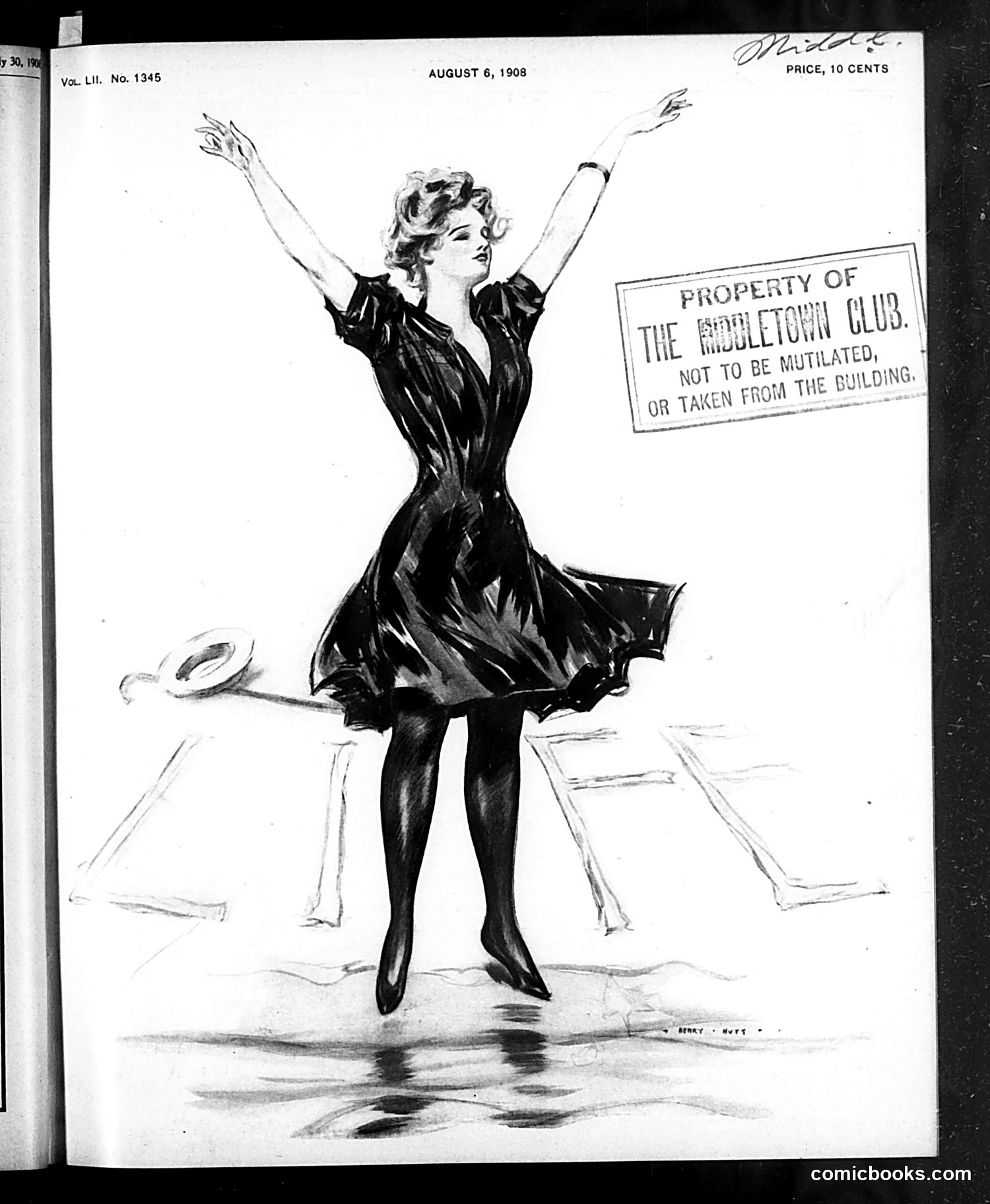
This cover features a jubilant woman in a black dress with arms raised in celebration, appearing to dance or leap. The stamp reading "PROPERTY OF THE MIDDLETOWN CLUB. NOT TO BE MUTILATED OR TAKEN FROM THE BUILDING" indicates this was a library copy. The illustration likely celebrates a social or political victory affecting women in 1908. Given the date and the woman's exuberant pose, this may reference women's suffrage activism or another women's rights development of that era. The specific "Middletown Club" reference suggests either a local organization or the magazine's satirical commentary on a particular community's social dynamics. Without additional context, the exact event being celebrated remains unclear.
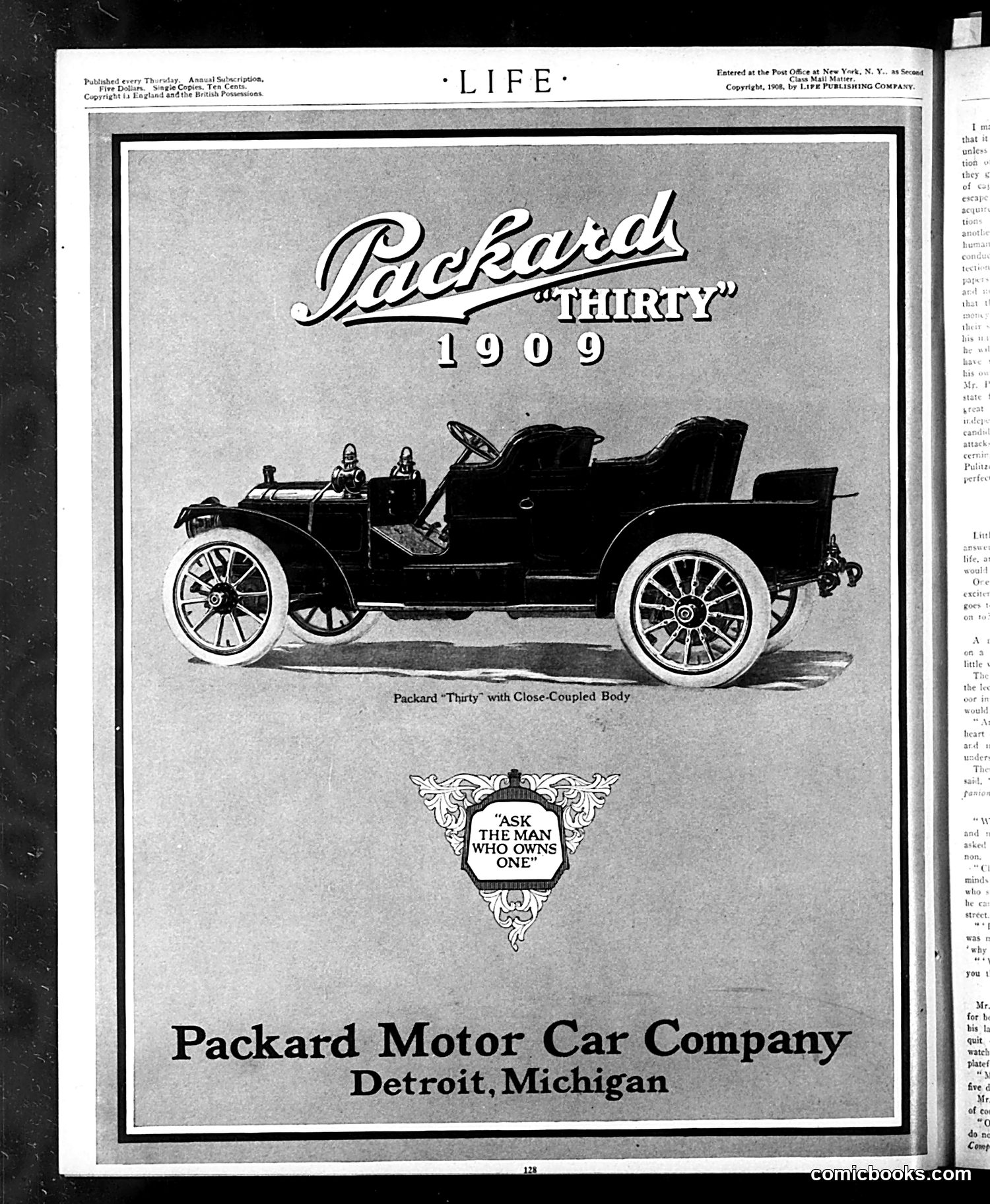
This is a **automobile advertisement**, not political satire. It appears in *Life* magazine as a paid advertisement for the Packard Motor Car Company of Detroit, Michigan. The image shows a 1909 Packard "Thirty" model automobile with a "Close-Coupled Body"—a luxury vehicle of the era. The tagline "Ask the Man Who Owns One" was Packard's famous advertising slogan, implying that satisfied owners would attest to the car's quality. There is no political or social satire here. This represents early automotive marketing in a prestigious magazine, targeting wealthy readers who could afford luxury automobiles. It reflects the early 1900s automobile industry and consumer culture.
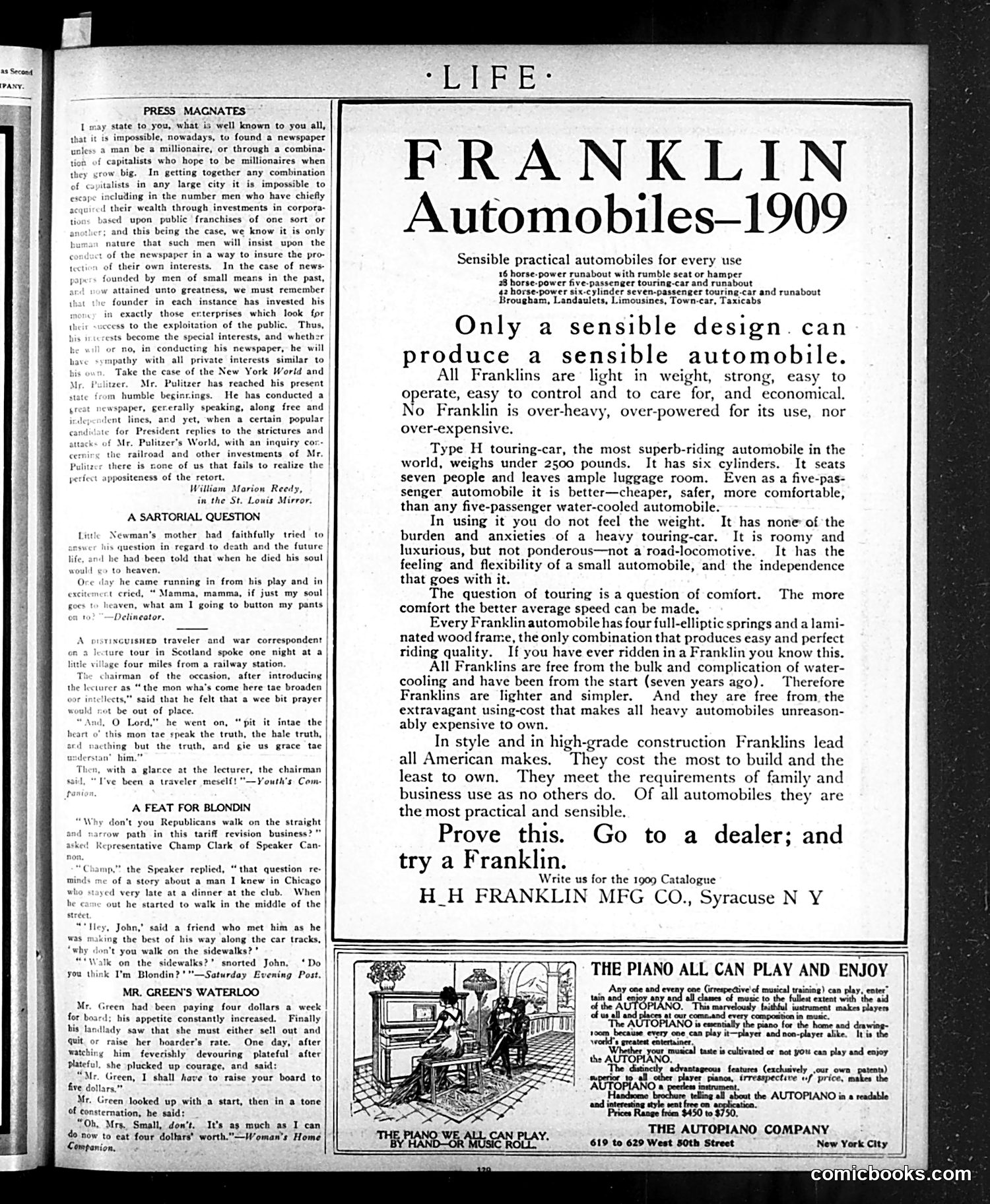
This page is primarily **advertising and editorial content** rather than political satire or cartoons. The left column contains several brief anecdotes and humorous observations (including pieces titled "A Sartorial Question" and "Mr. Green's Waterloo"), typical of Life magazine's satirical humor section. The dominant right side features a **full-page advertisement for Franklin Automobiles (1909)**. The ad emphasizes practical virtues: light weight, ease of operation, affordability, and comfort. It contrasts Franklin's sensible design against heavier, over-powered competitors—positioning the car as economical and reliable for family and business use. The bottom includes separate advertisements for "The Piano All Can Play and Enjoy" and "The Autopiano Company." This reflects early 1900s marketing: automobile ads stressed practicality and value rather than luxury, appealing to middle-class consumers considering this new technology.
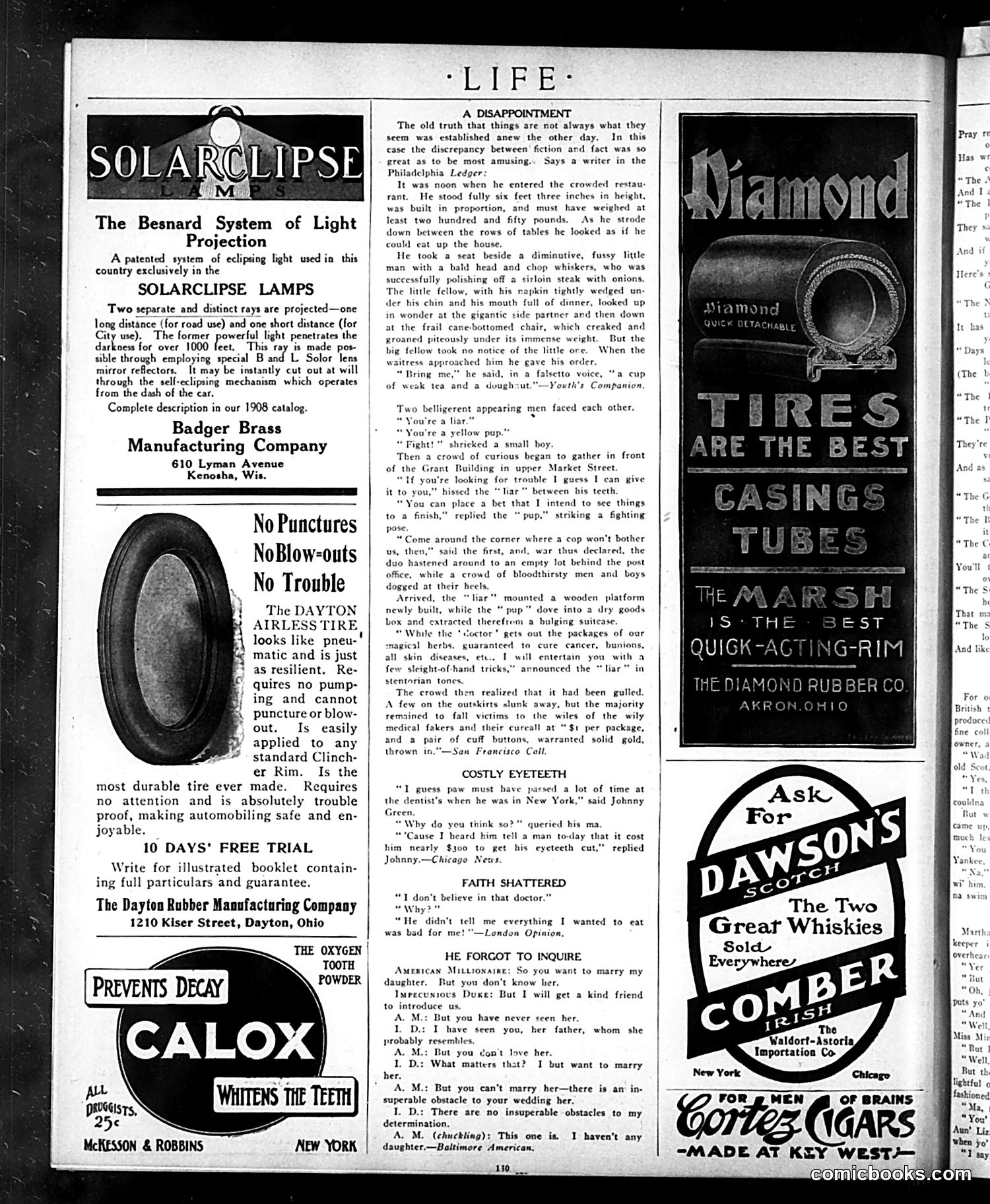
This page consists primarily of **period advertisements** rather than political cartoons. The content includes: **Notable ads:** - **Solarclipse Lamps** (Badger Brass Manufacturing) - lighting projection system - **Dayton Rubber Manufacturing** - tire advertisement emphasizing durability - **Calox Tooth Powder** - dental hygiene product - **Diamond Tires and Marsh Rims** - automotive products - **Dawson's Comber Whisky** - alcohol advertisement - **Cortes Cigars** - tobacco product The page also contains several short **humorous anecdotes** titled "Disappointment," "Costly Eyeteeth," "Faith Shattered," and "He Forgot to Inquire" — typical of Life's satirical humor columns mocking everyday social situations. **No significant political commentary or caricatures appear on this page.** It represents Life's mixed content format combining editorial humor with commercial advertising.
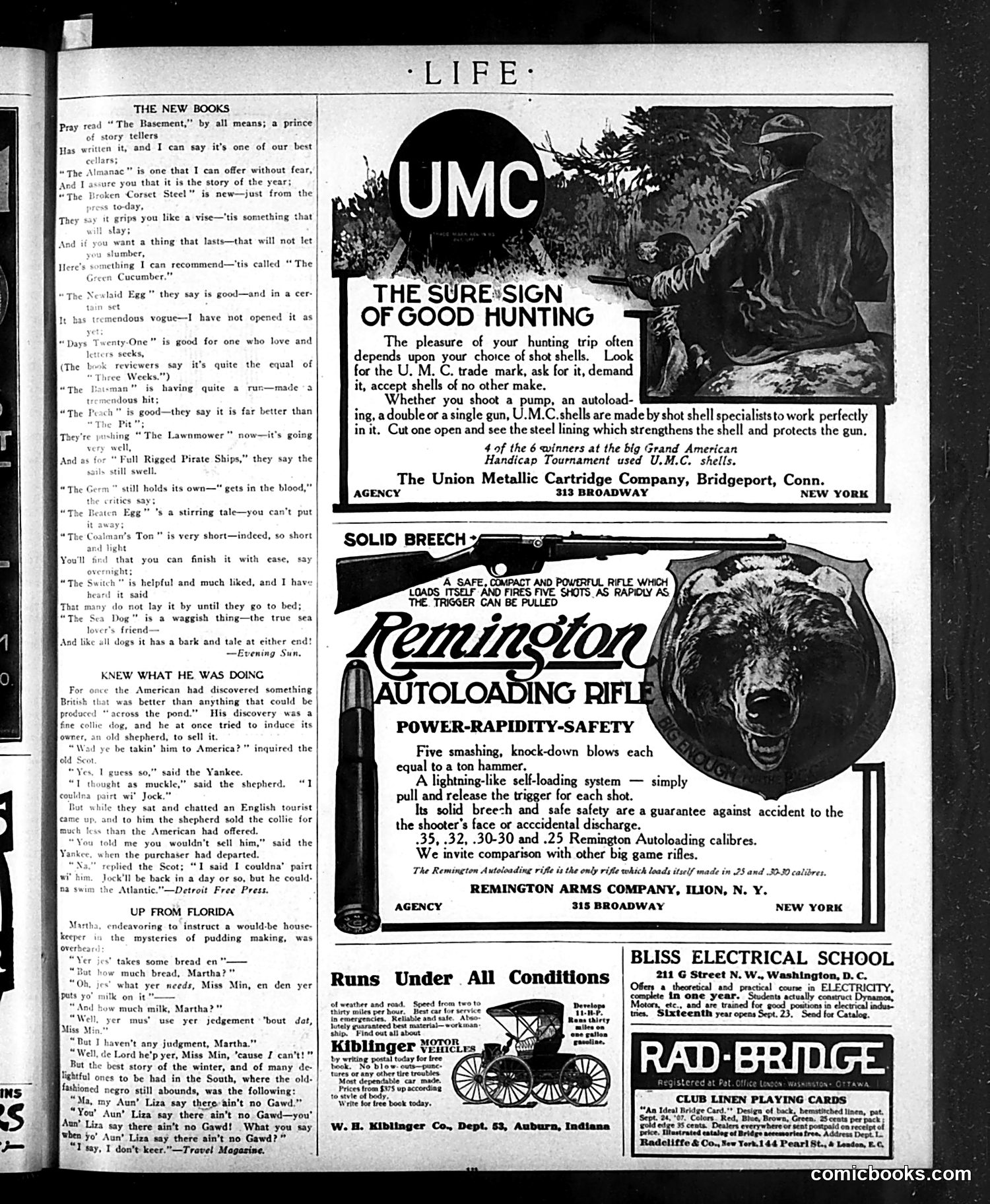
This page is primarily **advertising**, not satire or political commentary. The left column contains book reviews under "THE NEW BOOKS," discussing various recent publications. The dominant content features three vintage advertisements for hunting and sporting equipment: 1. **UMC ammunition** - emphasizing quality shells for hunting 2. **Remington autoloading rifle** - highlighting safety and rapid-fire capability 3. **W.H. Kiblinger motor cycles** - advertising reliability Below these are smaller ads for an electrical school and bridge playing cards. The only narrative content is a short story section titled "UP FROM FLORIDA" and "KNEW WHAT HE WAS DOING," featuring dialogue about an American purchasing a collie dog from an English shepherd. No political cartoons or caricatures are present on this page—it's a straightforward mix of consumer advertising and light fiction typical of early 20th-century magazines.
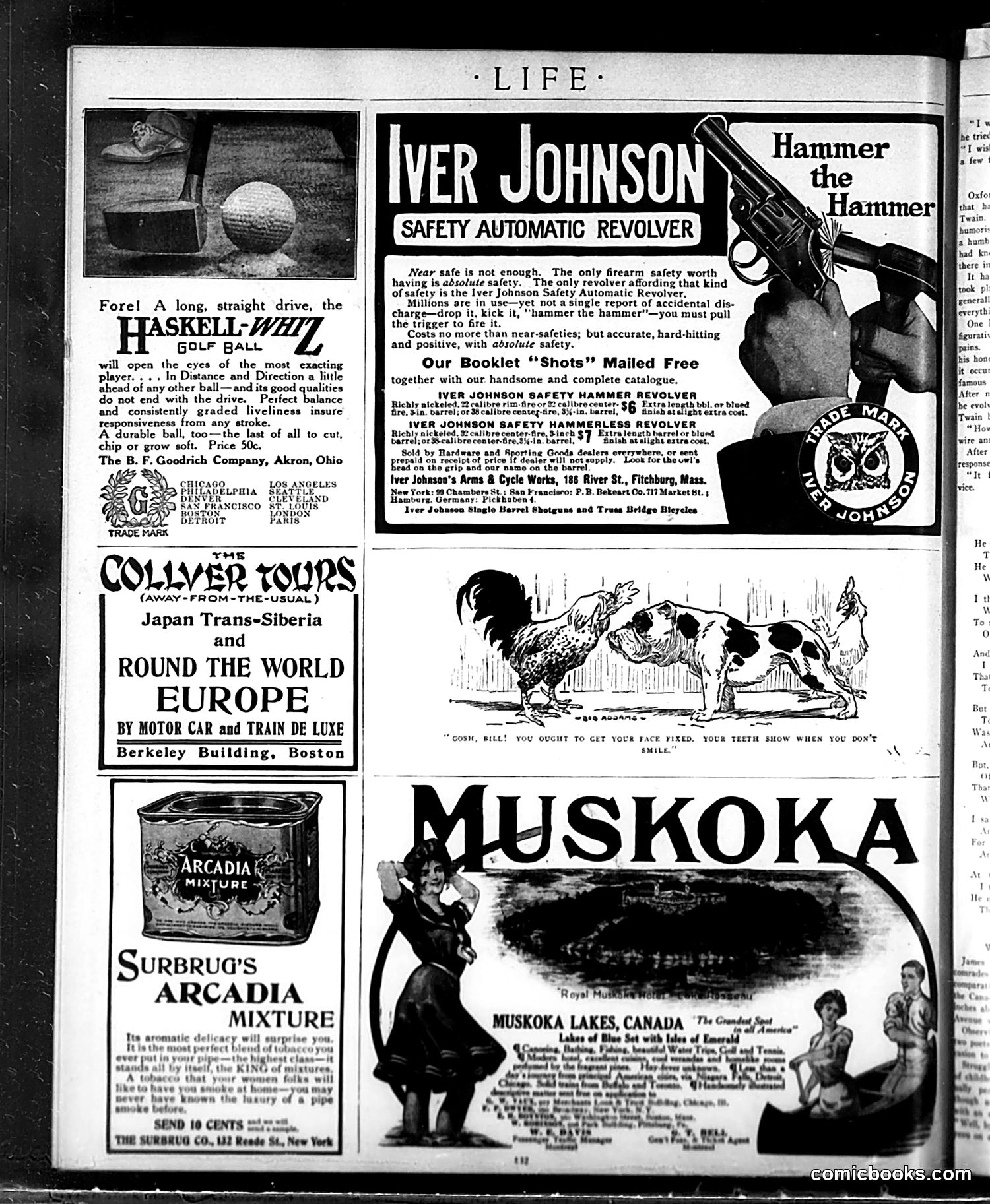
This Life magazine page is primarily **advertising rather than editorial content**. The main cartoon depicts two roosters with the caption "GOSH, BILL! YOU OUGHT TO GET YOUR FACE FIXED. YOUR TEETH SHOW WHEN YOU DON'T SMILE." This appears to be a generic humor cartoon—likely a joke about vanity or personal appearance—rather than political satire. The page features advertisements for: a golf ball (Hazelwood), an Iver Johnson revolver, travel tours, Surbrug's Arcadia tobacco mixture, and a Muskoka Lakes tourism ad. **The cartoon's humor is purely visual/personal rather than topical**—no identifiable figures or political references are present. It's simply a lighthearted jab at cosmetic concerns, typical of early 20th-century magazine humor.
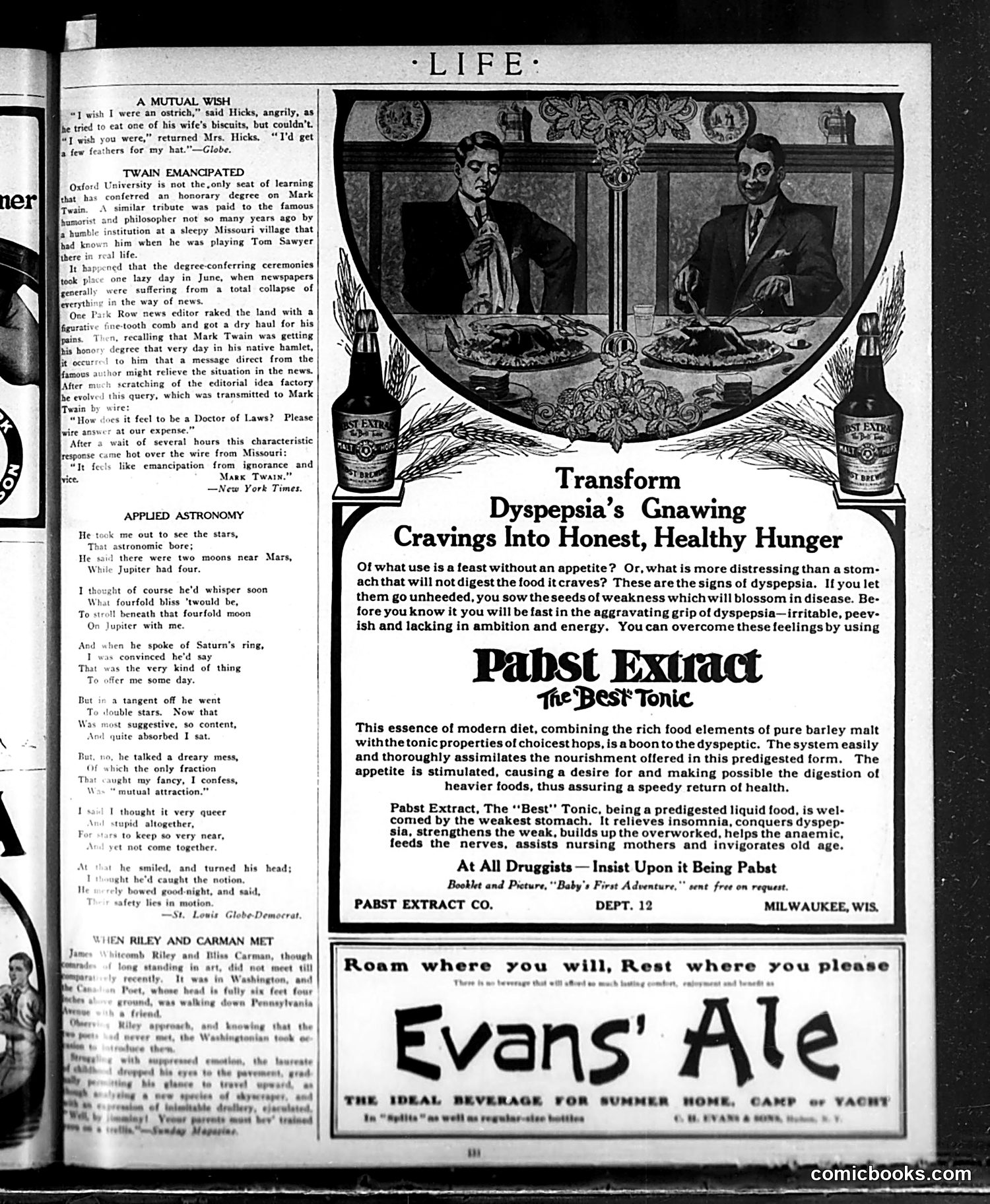
This page is primarily **advertising and literary content**, not political satire. The main elements are: **Left side:** Poetry and prose pieces, including "Applied Astronomy" (a poem) and "When Riley and Carman Met" (likely about poets James Whitcomb Riley and Bliss Carman). **Center/Right:** A large advertisement for **Pabst Extract**, a medicinal tonic claiming to cure dyspepsia (indigestion) and restore healthy appetite. The illustration shows two men in what appears to be a dining scene. **Bottom:** An advertisement for **Evans' Ale**, marketed as "the ideal beverage for summer home, camp or yacht." These are vintage patent medicine and beverage ads typical of early 20th-century magazines, not political cartoons. The page reflects the era's approach to marketing health tonics and alcoholic beverages with exaggerated medical claims.
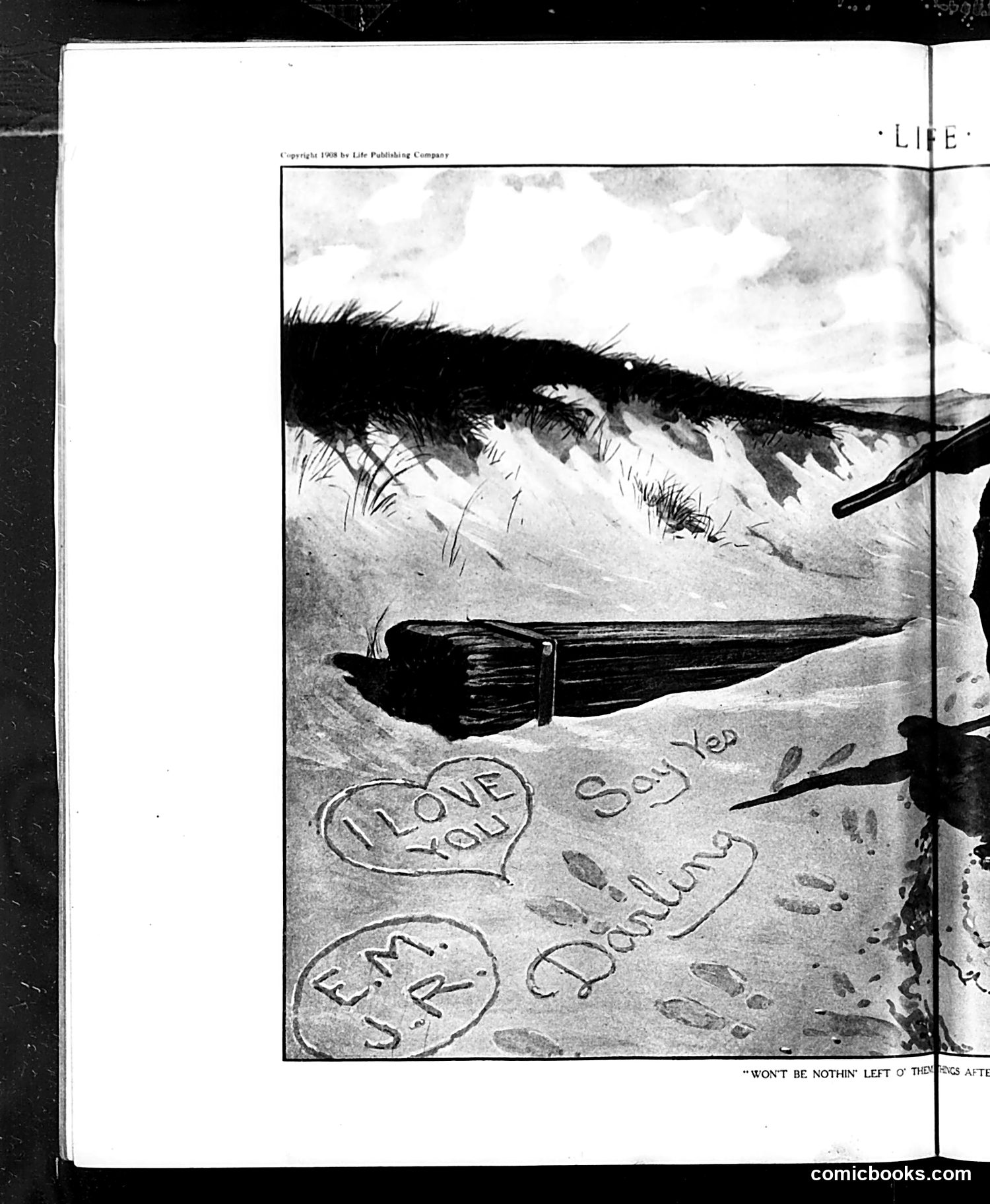
This appears to be a beach or sandy scene with written messages in the sand. The visible text includes "I LOVE YOU," "Sorry Joe," and what appears to be "EM" or similar initials. There's also a brush or broom visible in the image. The caption at the bottom reads: "WON'T BE NOTHIN' LEFT O' THIS BY MORNING AFTER..." This seems to be a romantic or sentimental cartoon playing on the impermanence of messages written in sand—a common trope suggesting that declarations of love or notes left on beaches wash away with the tide. The specific reference to "Joe" and the somewhat melancholic tone suggest commentary on temporary romantic gestures or fleeting relationships, though without additional context, the specific satirical target remains unclear.
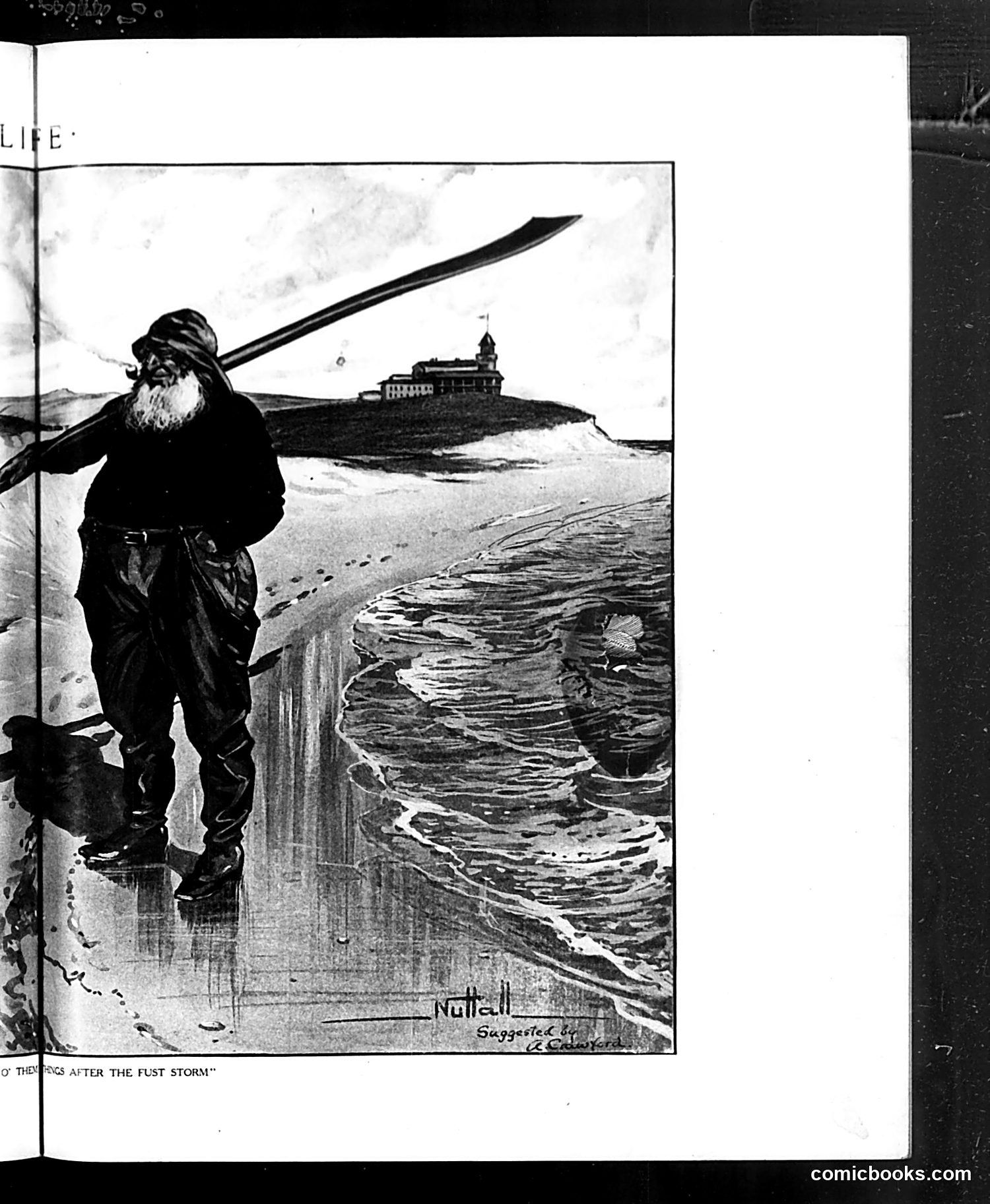
This illustration appears to depict an old bearded man with a long oar or paddle, standing at what looks like a cliff edge or boat, gazing toward a building on a distant shore. The caption reads "After the Fust Storm" (likely "First Storm"). The image suggests a narrative of someone—possibly a legendary or mythological figure—surveying aftermath or restoration after turbulent times. The elderly, weathered appearance and maritime setting evoke themes of endurance, survival, or seafaring journeys through difficulty. Without clearer context about Life magazine's date or surrounding articles, the specific satirical target remains unclear. It could reference contemporary political/social upheaval, though the style suggests early-to-mid 20th century publication. The artistic quality and composition suggest this is serious editorial commentary rather than humor.
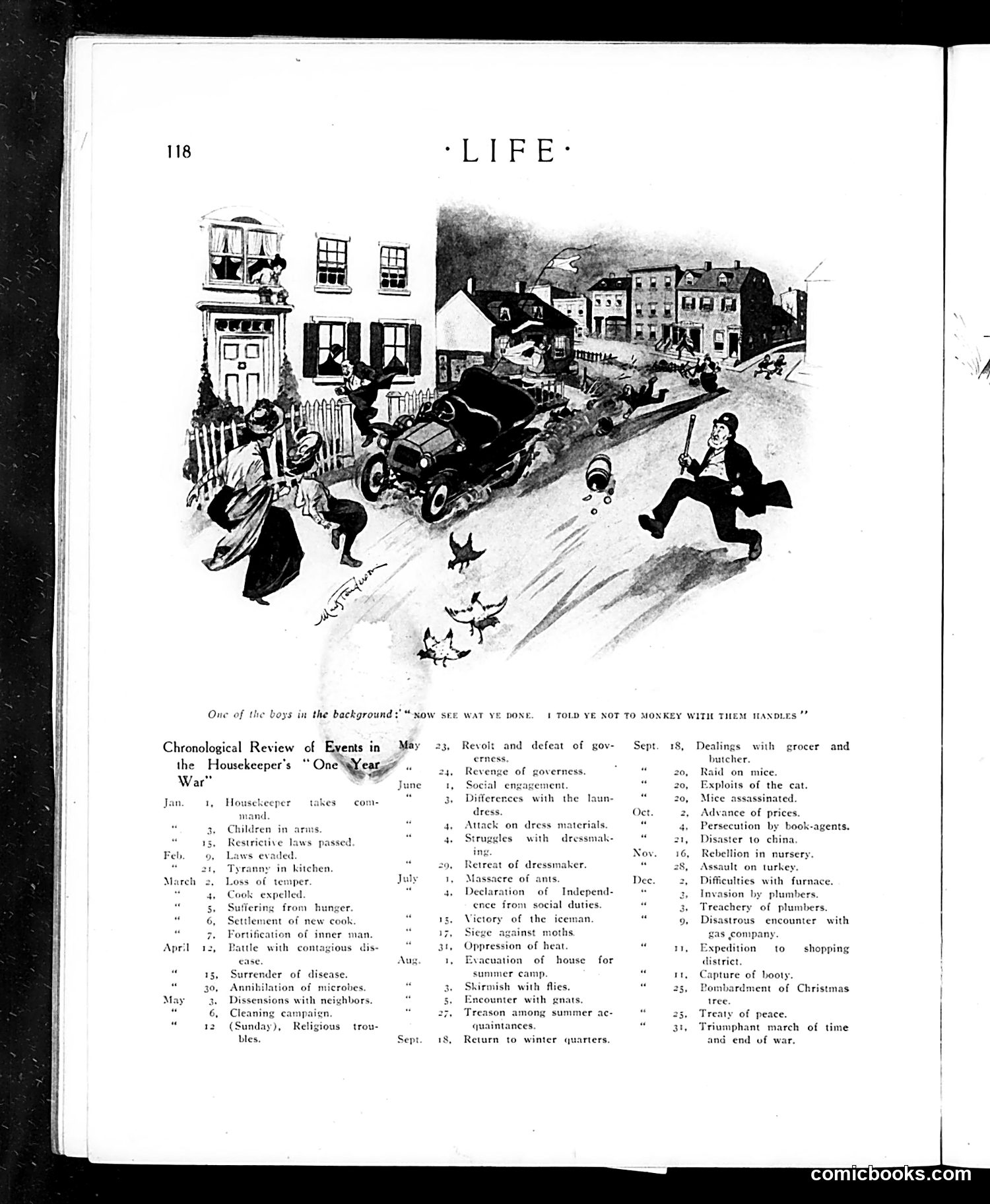
This Life magazine page satirizes domestic chaos during World War I through a humorous "chronological review" of a housekeeper's tumultuous year. The cartoon depicts a street scene with children playing, a car, a dog, and various figures in apparent disorder outside row houses. The accompanying text lists absurd monthly "events" ranging from January's "Housekeeper takes command" through December's "Triumphant march of time and end of war." The events mock both wartime hardships (rationing, price increases, labor strikes) and domestic troubles (children misbehaving, pest infestations, social conflicts). The caption "Now see way ye done. I told ye not to monkey with them handles" suggests accidents or mishaps from foolish interference—likely commentary on how ordinary people bungled their way through wartime disruptions.
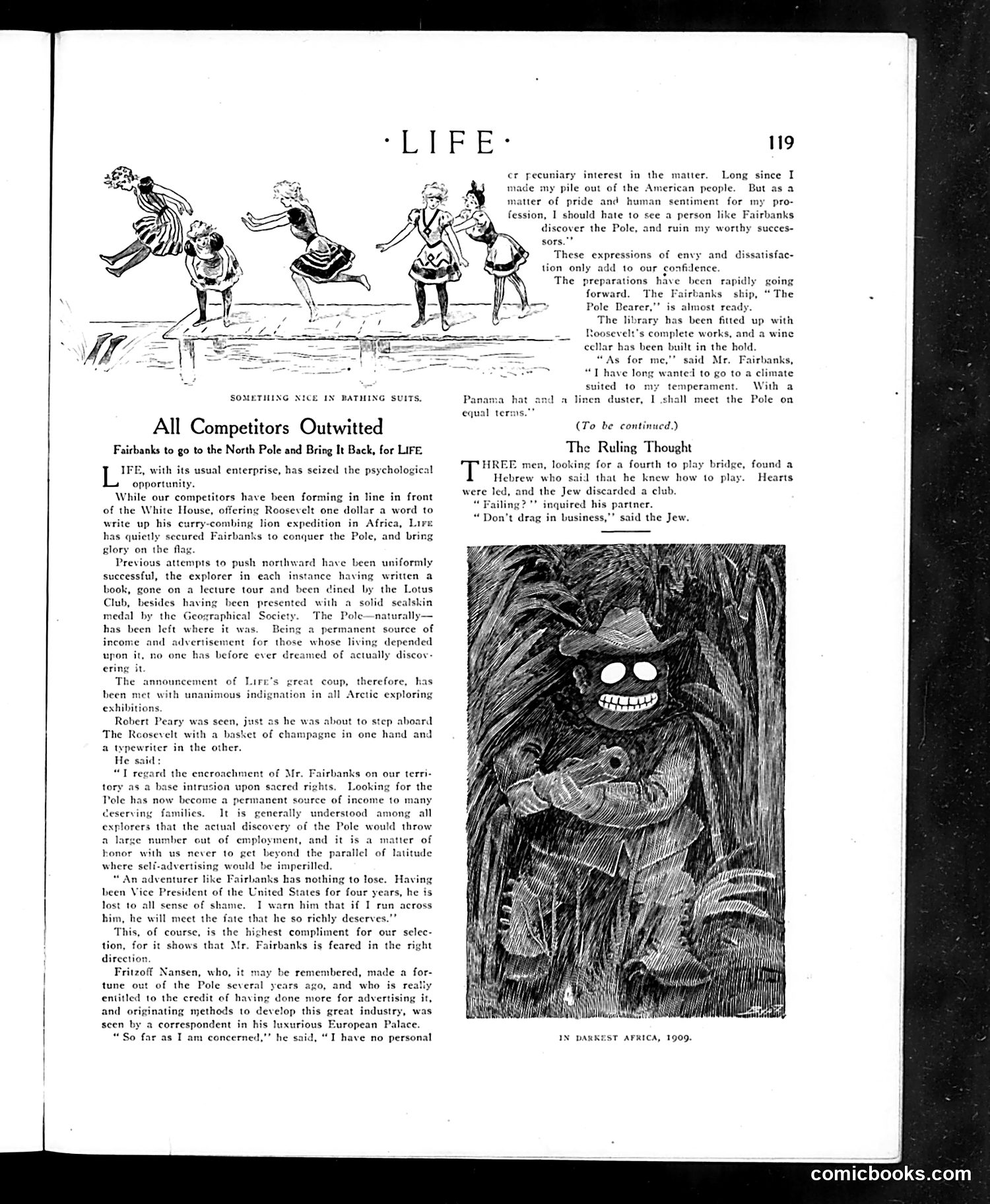
The top cartoon, "Something Nice in Bathing Suits," depicts women in early 1900s bathing attire engaged in playful beach activities. This appears to be gentle social satire about evolving women's fashion and leisure culture. The main article, "All Competitors Outwitted," discusses explorer Richard E. Byrd's polar expedition plans. Life satirizes the competitive rush among explorers to reach the North Pole, noting that while others have lectured and written books about polar exploration, Byrd's expedition has been "quietly secured" with Life's backing—a self-congratulatory jab at the magazine's sponsorship role. The illustration captioned "In Darkest Africa, 1909" appears unrelated, likely advertising content.
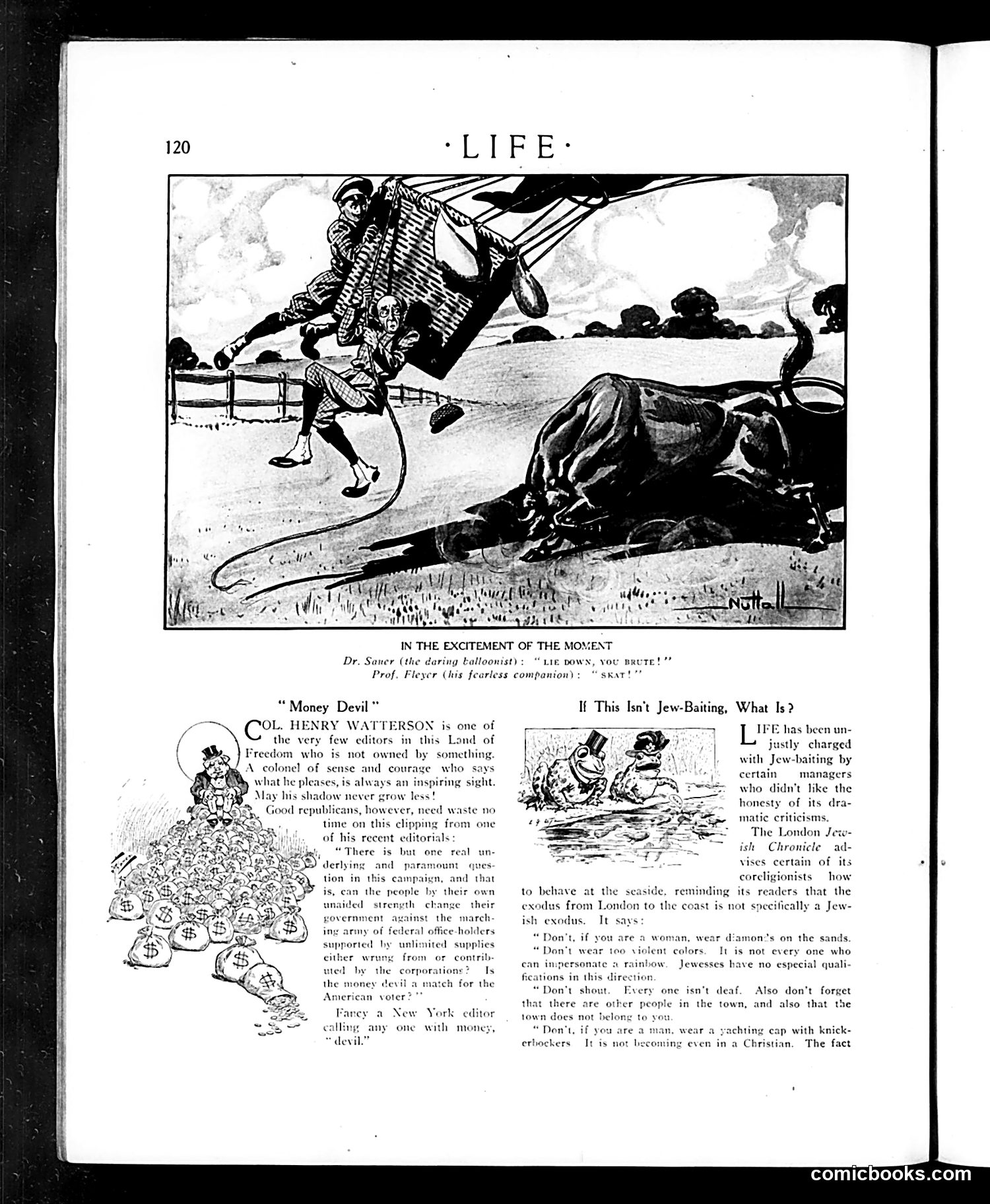
The main cartoon depicts a dramatic aviation accident where a daring balloonist crashes while two figures react in alarm below. The caption attributes dialogue to "Dr. Sames (the daring balloonist)" and "Prof. Flexer (his fearless companion)." Below this, two separate pieces address antisemitism. "Money Devil" features a caricature stereotyping Jewish people as obsessed with money, critiquing Colonel Henry Watterson's recent editorials. The right column defends Life against accusations of "Jew-baiting," arguing they're merely criticizing bad behavior, not targeting Jewish people generally—a distinction that modern readers would recognize as a common antisemitic defense. The page reveals early 20th-century American magazine content casually mixing ethnic stereotyping with claims of innocence.
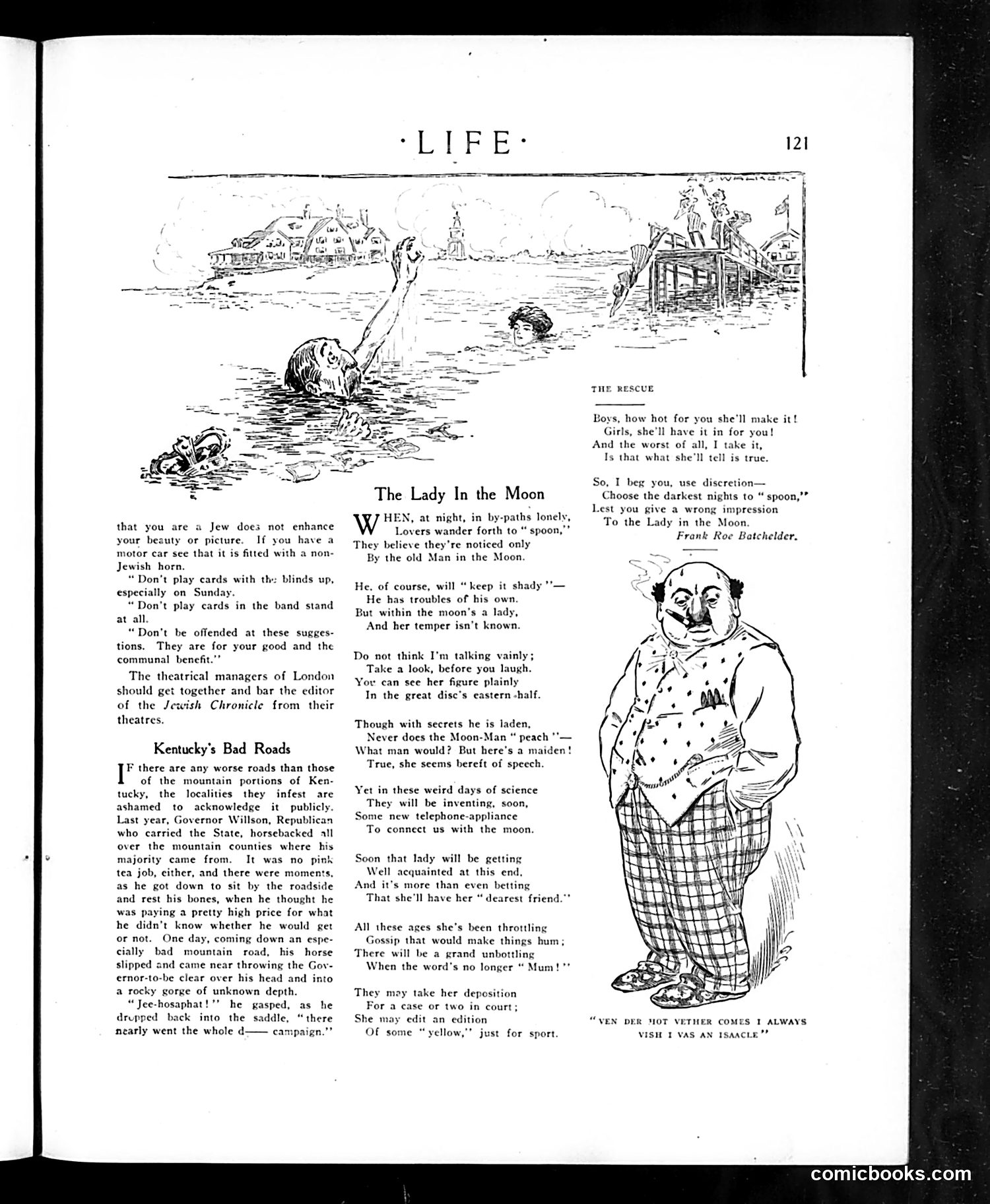
This page contains three distinct pieces of social commentary: 1. **"The Lady in the Moon"** (poem by Frank Roe Batchelder): A whimsical poem imagining the moon as a woman, reflecting early 20th-century romanticism about space and technology. 2. **"Kentucky's Bad Roads"**: A humorous anecdote about Governor Willson's horseback journey over mountain roads so treacherous that his horse nearly fell into a gorge. The satire criticizes poor infrastructure in Kentucky's mountain counties—a commentary on state governance and rural neglect. 3. **Right illustration**: A caricatured figure, captioned in Dutch, appears to be ethnic satire typical of the era. The exact reference is unclear without additional context. The page exemplifies Life's mix of literary humor, political critique, and period-typical caricature.
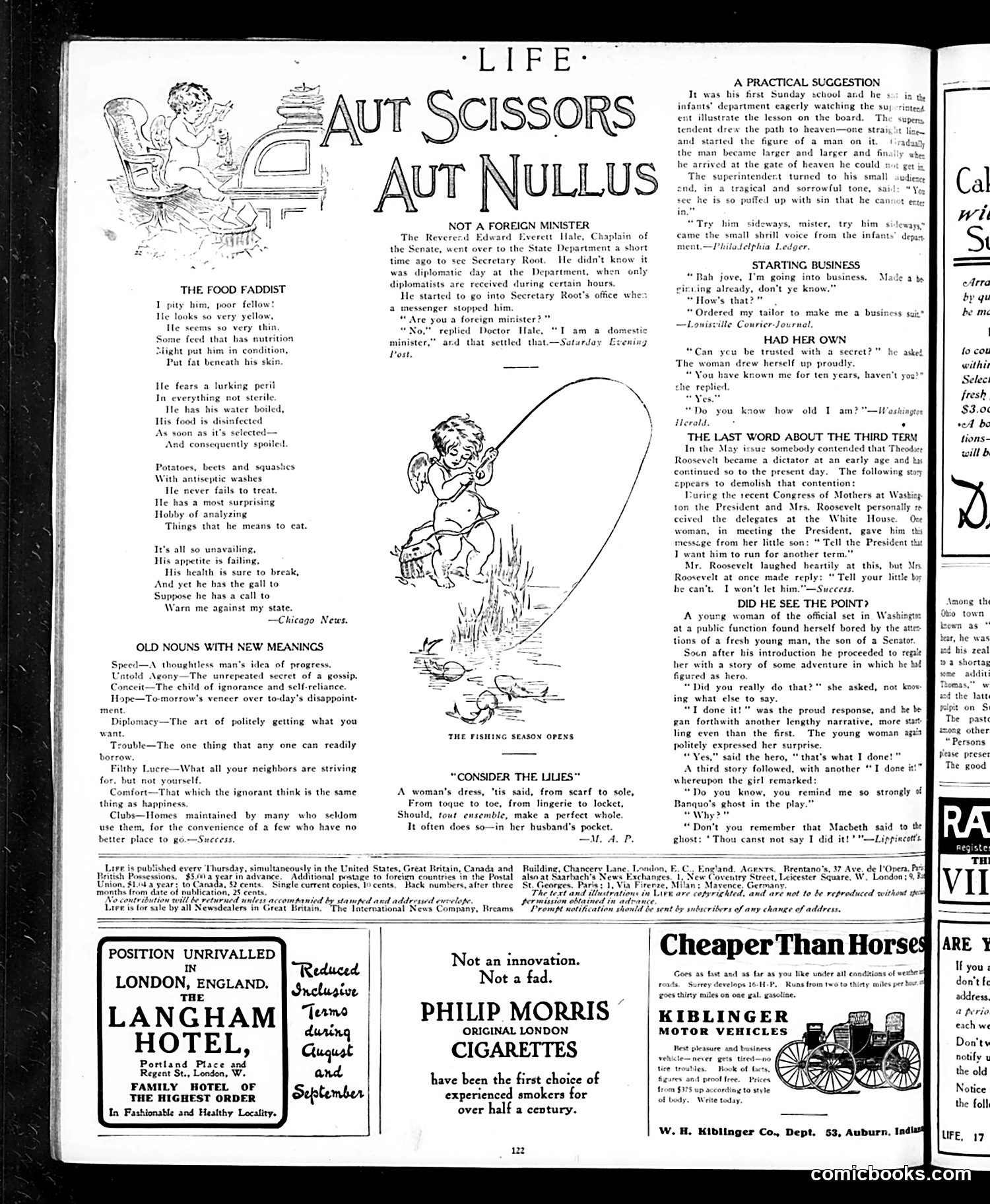
This Life magazine page (page 122) contains several satirical pieces: **"Aut Scissors Aut Nullus"** mocks the "food faddist"—someone obsessively worried about health and diet. The satire targets the then-emerging health-conscious movement, portraying such people as neurotically analyzing their food and ironically damaging their health through excessive caution. **"Not a Foreign Minister"** jokes about Reverend Edward Everett Hale being denied entry to Secretary of State Elihu Root's office because he wasn't a foreign diplomat. The humor lies in bureaucratic absurdity—a prominent religious figure being treated like an unauthorized visitor. **The remaining anecdotes** satirize social pretensions: a woman's wardrobe existing only in her husband's wallet, and—most notably—a jab at Theodore Roosevelt's "third term" ambitions, showing Mrs. Roosevelt humorously preventing the President from running again. The page is primarily humor and advertising, typical of Life's satirical format during the early 20th century.
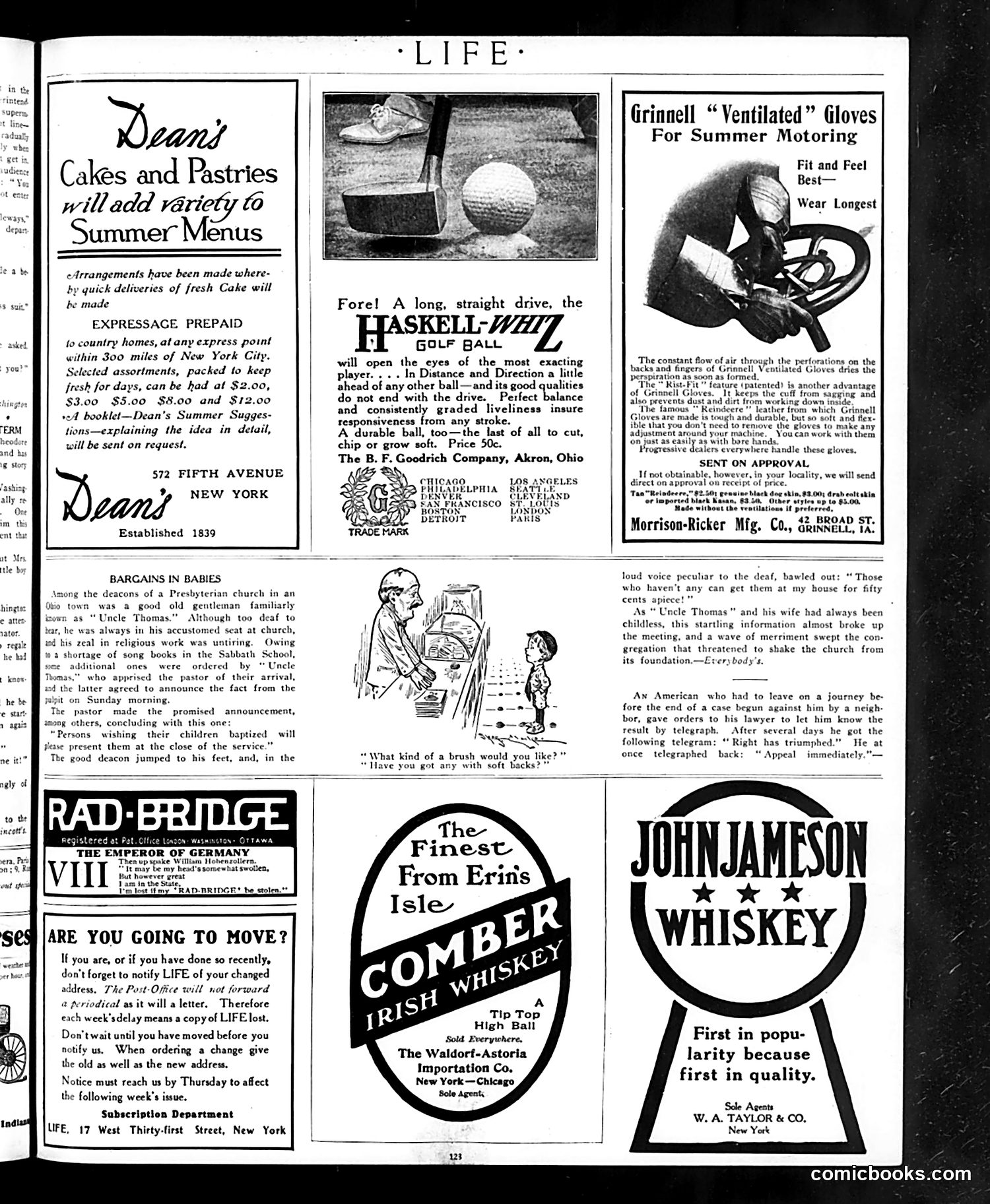
This page is primarily **advertising**, with one humorous anecdote ("Bargains in Babies"). ## The Main Cartoon/Story: The "Bargains in Babies" piece recounts a Presbyterian church incident where a deaf deacon, "Uncle Thomas," mishears an announcement. The pastor announces: "Persons wishing their children baptized will please present them at the close of the service." The hard-of-hearing deacon loudly repeats this as an offer to provide children for fifty cents each at his home. The humor derives from this misunderstanding and the implication that childless Uncle Thomas and his wife are humorously offering to sell babies—an absurd and inappropriate misreading. The joke reflects early-20th-century humor sensibilities: physical disability (deafness) as comedy fodder, and the humorous awkwardness created by miscommunication in formal church settings. The remainder of the page consists of product advertisements for cakes, golf balls, driving gloves, whiskey, and other goods typical of 1920s-era Life magazine advertising.
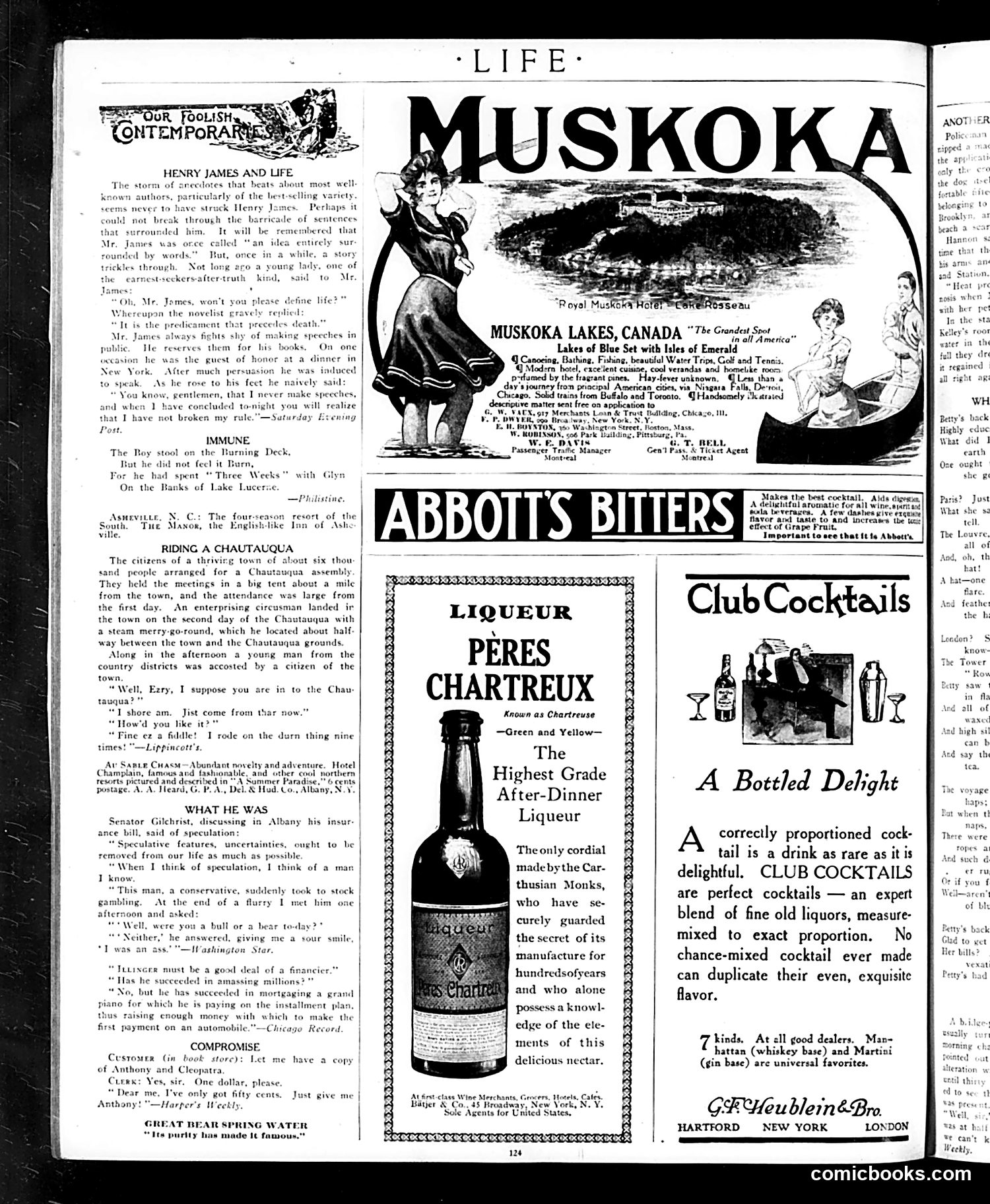
This page from Life magazine contains primarily **advertisements and satirical commentary** rather than political cartoons. The main content includes: **"Henry James and Life"** – A satirical piece mocking novelist Henry James's reluctance to speak publicly or share personal anecdotes, suggesting his ideas are trapped behind verbose, impenetrable prose. **"Riding a Chautauqua"** – A humorous rural sketch about a country man attending a Chautauqua (educational lecture circuit) who admits he skipped the intellectual programming to ride a carnival merry-go-round nine times instead. **"Compromise" and "What He Was"** – Brief jokes about financial speculation and stock market gambling during what appears to be a market boom period. The remainder consists of **period advertisements** for Muskoka Lakes resort, Abbott's Bitters liqueur, and Club Cocktails—typical early 20th-century marketing reflecting leisure culture and alcohol consumption before Prohibition.
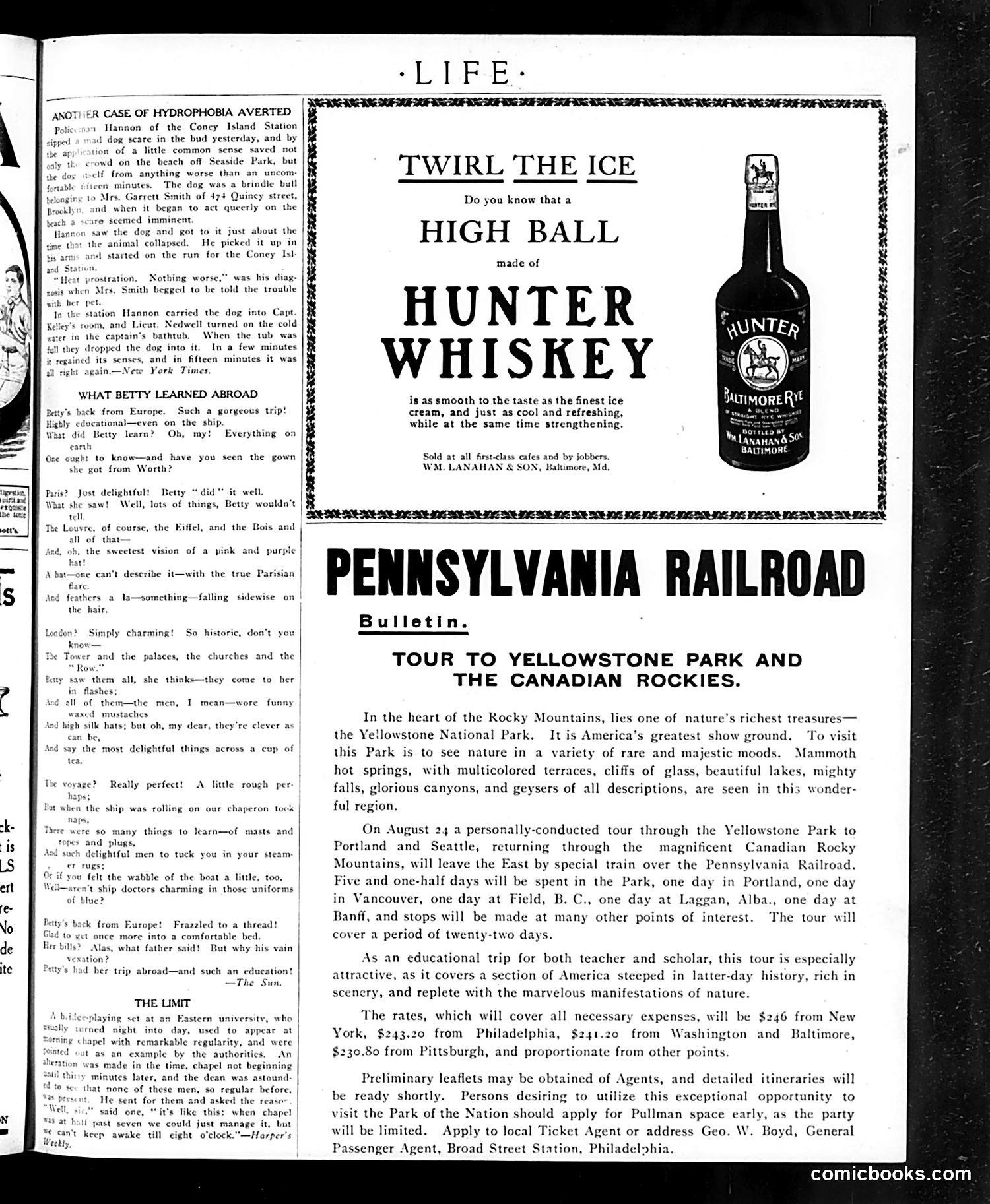
This page contains three distinct sections: **News Items**: Brief satirical anecdotes about everyday life—a dog suffering heat prostration at Coney Island, and "Betty," a wealthy young woman who returns from a European Grand Tour exhausted but impressed with Paris fashion and charming ship doctors. The humor satirizes upper-class tourism and shallow cultural appreciation. **Advertisement**: Hunter Whiskey promotes "high balls" as smooth and refreshing beverages, using period language to market alcohol as both pleasant and "strengthening." **Travel Advertisement**: The Pennsylvania Railroad advertises a guided tour to Yellowstone Park and Canadian Rockies departing August 24, targeting educated travelers seeking nature and "majestic moods." This represents early-20th-century leisure travel marketing to affluent Americans. The page reflects Life's role as a humor magazine interspersed with advertisements for luxury goods and experiences targeting the wealthy readership.
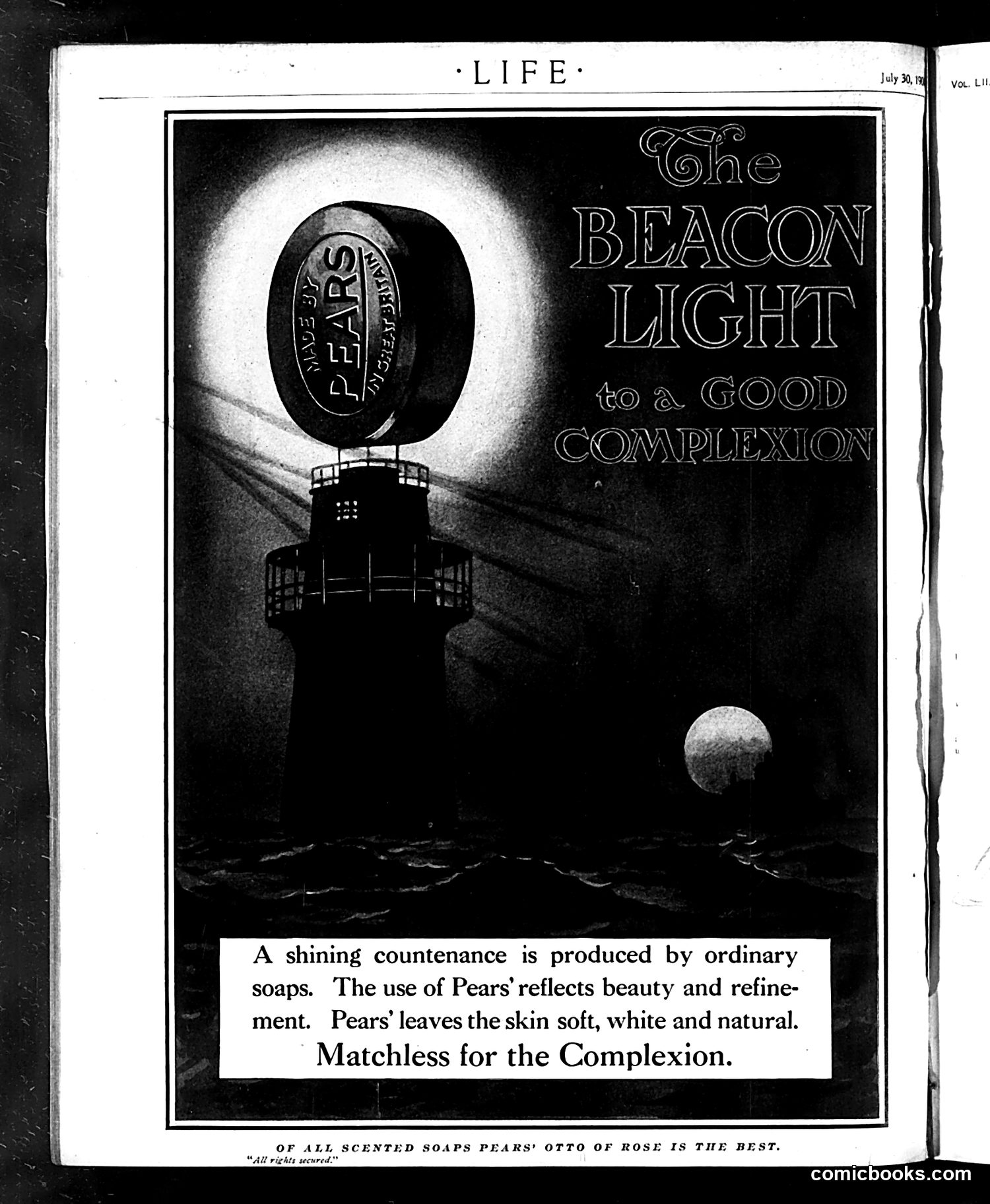
This page is primarily an **advertisement**, not satirical content. It's a Pearl's soap ad from *Life* magazine (July 30, dated, Vol. LII visible). The image depicts a **lighthouse** with a large glowing beacon beam forming the product's oval logo above it. The composition uses dramatic nighttime imagery suggesting the soap creates a "beacon light" of beauty and radiance. The text claims Pearl's soap produces a superior "shining countenance" compared to ordinary soaps, leaving skin "soft, white and natural." The tagline "Matchless for the Complexion" emphasizes superiority. This reflects early 20th-century advertising conventions: using poetic/metaphorical imagery and unsubstantiated beauty claims. The "white and natural" language reflects period beauty standards. There is no political satire here—it's straightforward commercial advertising using dramatic art deco–style visual rhetoric.
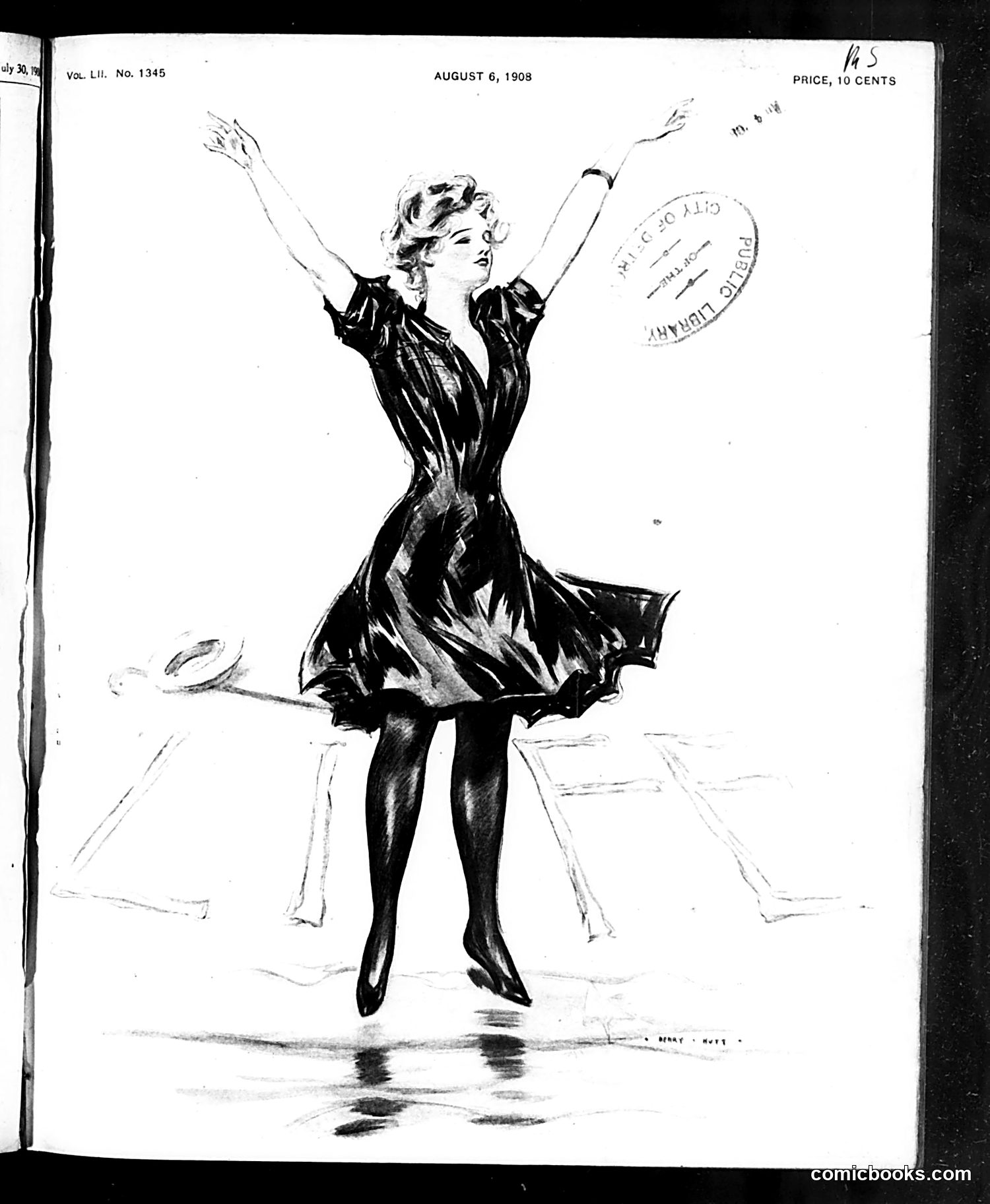
This is a cover illustration depicting a joyful woman in an elegant black dress with her arms raised in celebration, appearing to be jumping or dancing. The figure's pose and expression suggest jubilation or relief. Without additional visible text on the page identifying the specific subject, the exact satirical reference remains unclear. However, given the 1908 date, this likely relates to a contemporary political, social, or cultural event of that moment—possibly concerning women's rights, fashion, or a notable public figure of the era. The illustration's style is typical of Life magazine's satirical covers from this period, employing elegant line drawing to comment on American social conditions or newsworthy subjects. The specific context and subject would require additional historical documentation to confirm with certainty.
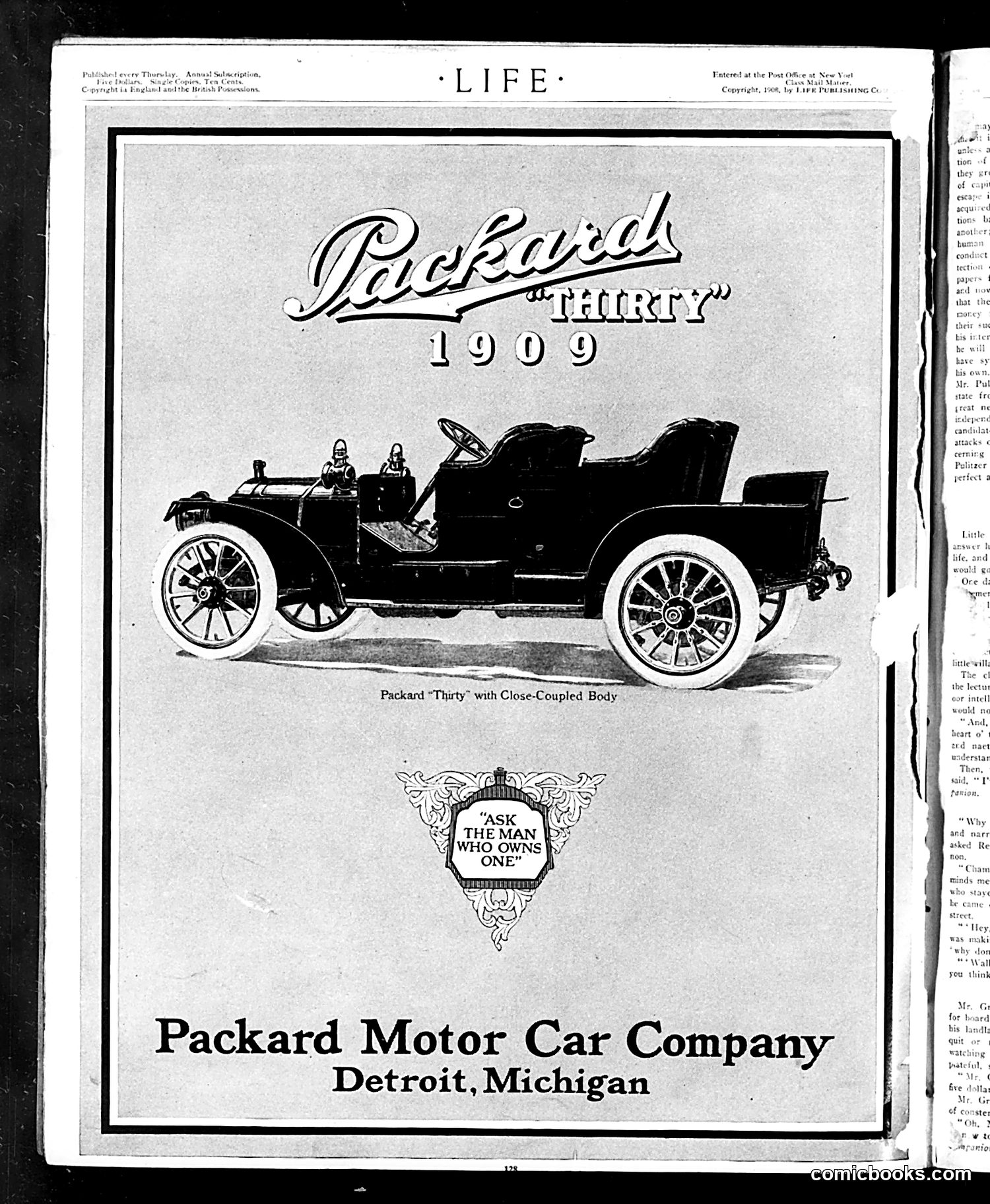
This is primarily a **product advertisement** for the Packard Motor Car Company of Detroit, Michigan, published in *Life* magazine circa 1909. The page features an illustration of the "Packard 'Thirty'" automobile with a "Close-Coupled Body" design. The vehicle is rendered in black silhouette, showing the open-air touring car typical of early automobiles, with visible spoke wheels and seating for multiple passengers. Below the car illustration is a decorative emblem containing the phrase **"ASK THE MAN WHO OWNS ONE"** — Packard's famous advertising slogan, suggesting that satisfied owners would enthusiastically endorse the vehicle. This is not political satire but rather straightforward commercial advertising aimed at wealthy consumers who could afford such automobiles in the early 1900s.
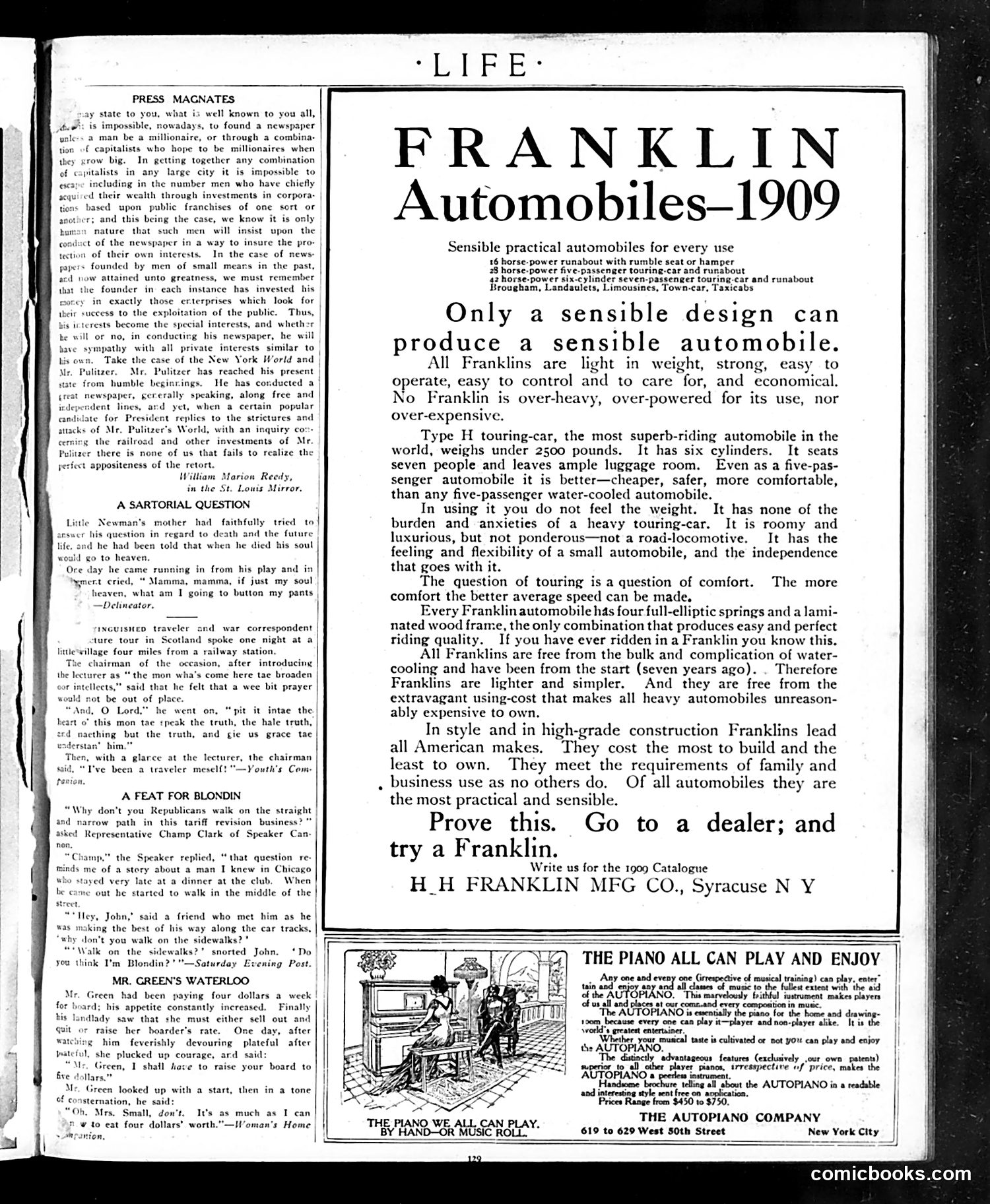
This page is primarily **advertising and humor columns**, not political satire requiring historical context. The main content is a **Franklin Automobiles advertisement** (1909), emphasizing practical design and affordability—a key marketing angle when cars were luxury items. The ad's repeated phrase "sensible design" reflects early automotive industry concerns about reliability and cost. The **left column contains three unrelated humor pieces**: 1. "Press Magnates"—commentary (attributed to William Marion Reedy) critiquing newspaper owners' conflicts of interest, specifically mentioning Joseph Pulitzer and the New York World. The point: wealthy newspaper founders retain sympathies for the business interests that enriched them. 2. "A Sartorial Question"—a child's joke about the afterlife. 3. "A Feat for Blondin"—a pun-based joke comparing tariff policy to tightrope walking. The right side includes an **Autopiano advertisement** (a player piano). None requires specialized historical knowledge to understand—they're straightforward period humor and commercial messaging typical of 1909 magazines.
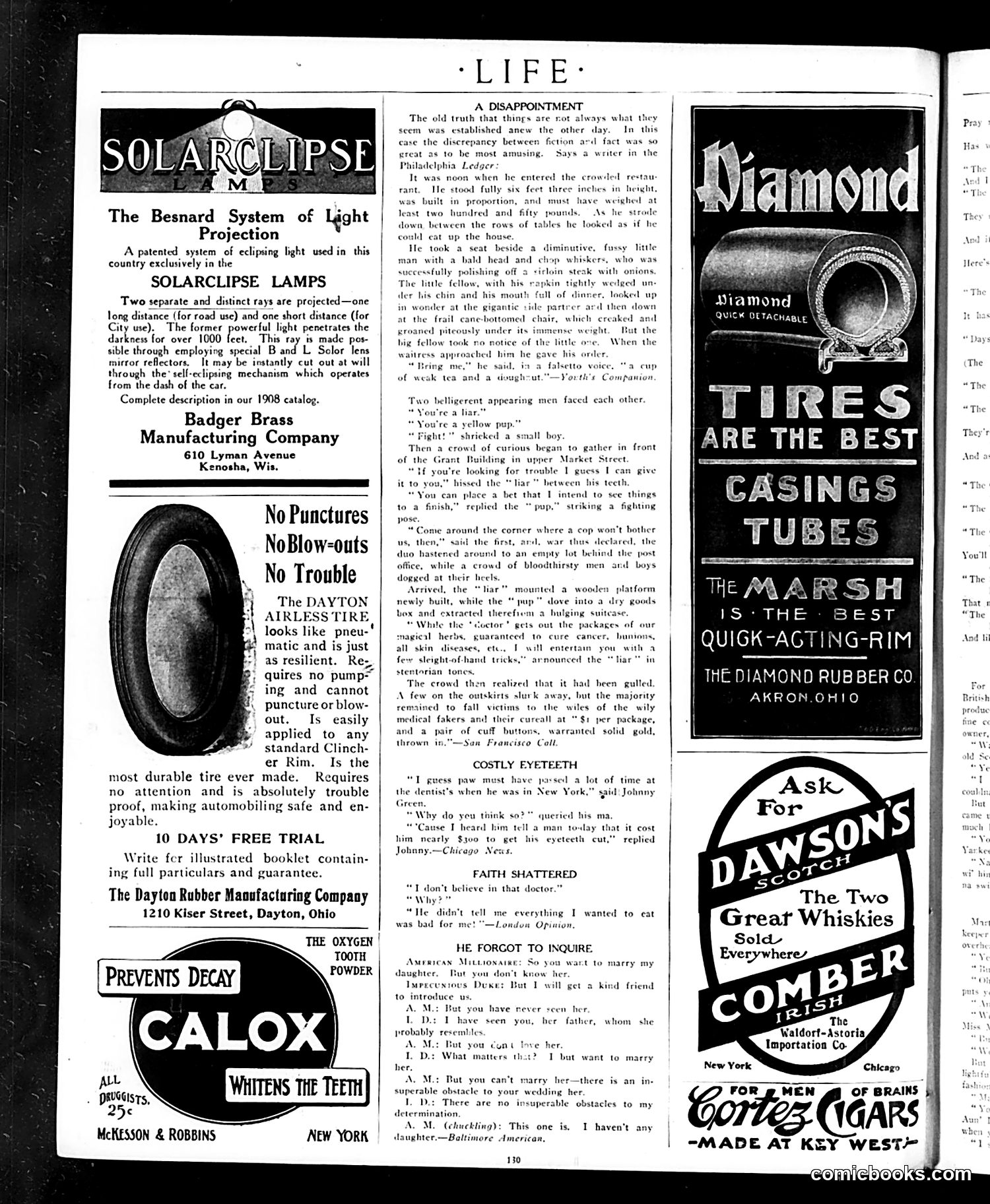
This page is primarily **advertising**, with a short satirical story titled "A Disappointment" in the center column. The story satirizes **con artists and gullible audiences**. It describes a tall, imposing man entering a crowded restaurant who appears intimidating, but turns out to be a charlatan "doctor" selling fake medical cures. Two men initially seem about to fight, but it's revealed as a street performance to draw a crowd. The "doctor" then dupes onlookers by hawking fraudulent remedies (magical herbs, "curealls") for diseases and ailments at inflated prices ($1 per package). The crowd, initially suspicious, ultimately falls victim to his scam. The satirical point: **appearances deceive**—the imposing figure isn't dangerous but deceptive; what seemed like a genuine street altercation was theater designed to manipulate. The piece mocks both the con artist's tactics and the public's susceptibility to medical quackery. The surrounding ads (tire manufacturers, lamp systems, tooth powder) reflect early 1900s consumer goods typical of Life's advertising.
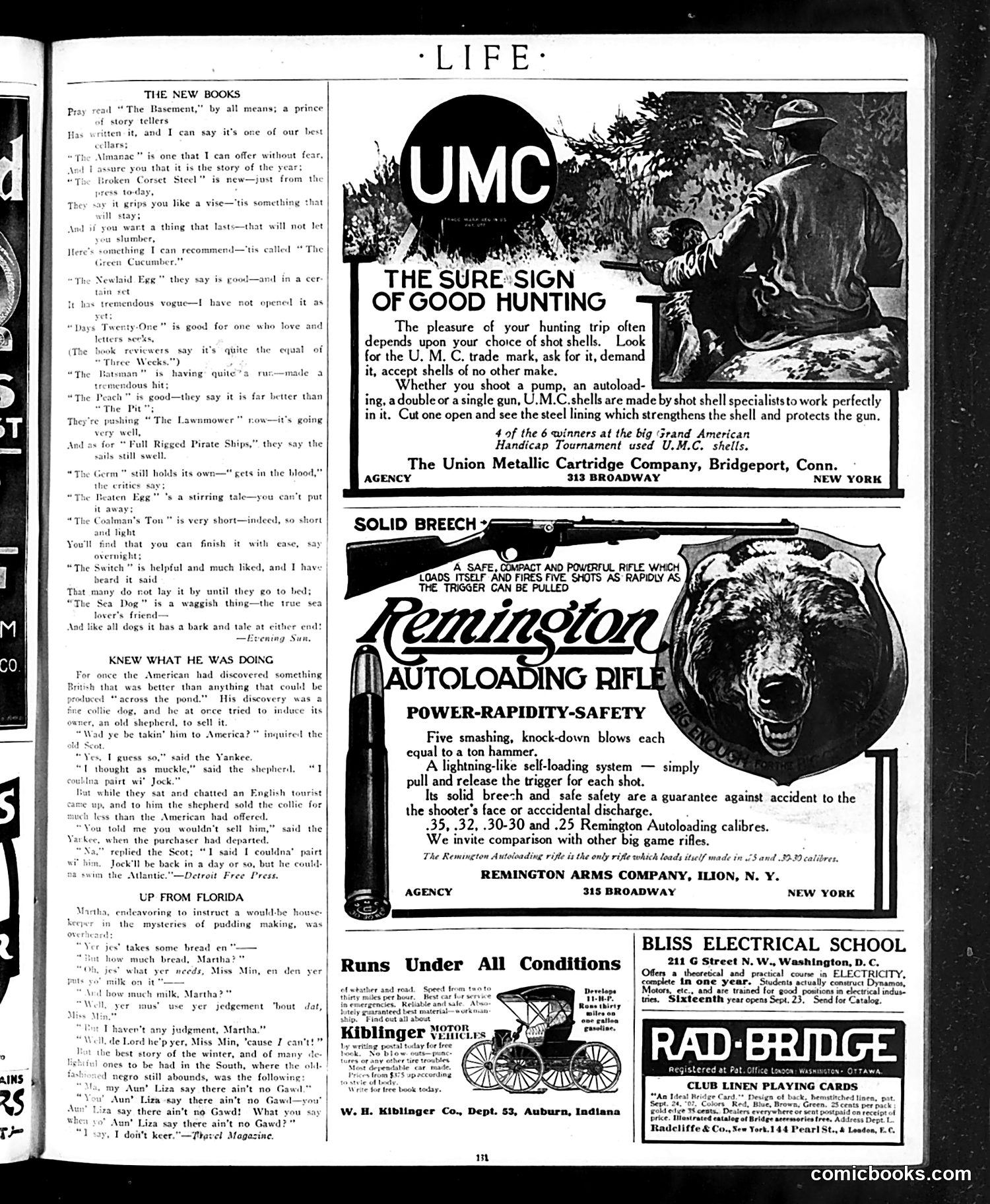
This page is primarily **advertisements for hunting rifles and firearms** interspersed with literary book reviews and humor pieces. The advertisements feature UMC (Union Metallic Cartridge Company) and Remington autoloading rifles, emphasizing their reliability for hunting and competitive shooting. These ads appeal to sportsmen and hunters—a significant American demographic in this era. The editorial content includes brief book reviews (mostly positive) and two humorous anecdotes: one about a Yankee purchasing a Scottish sheepdog ("Jock") and planning to export it to America, and another ("Up From Florida") featuring dialect humor about a cook named Martha instructing someone on bread-making. The page reflects early 20th-century American magazine culture: practical advertising targeting male readers interested in hunting, alongside light literary commentary and vernacular humor (including period-typical racial/regional dialect comedy). **No political cartoons appear on this page**—it's straightforward commercial and entertainment content typical of Life magazine's mix.
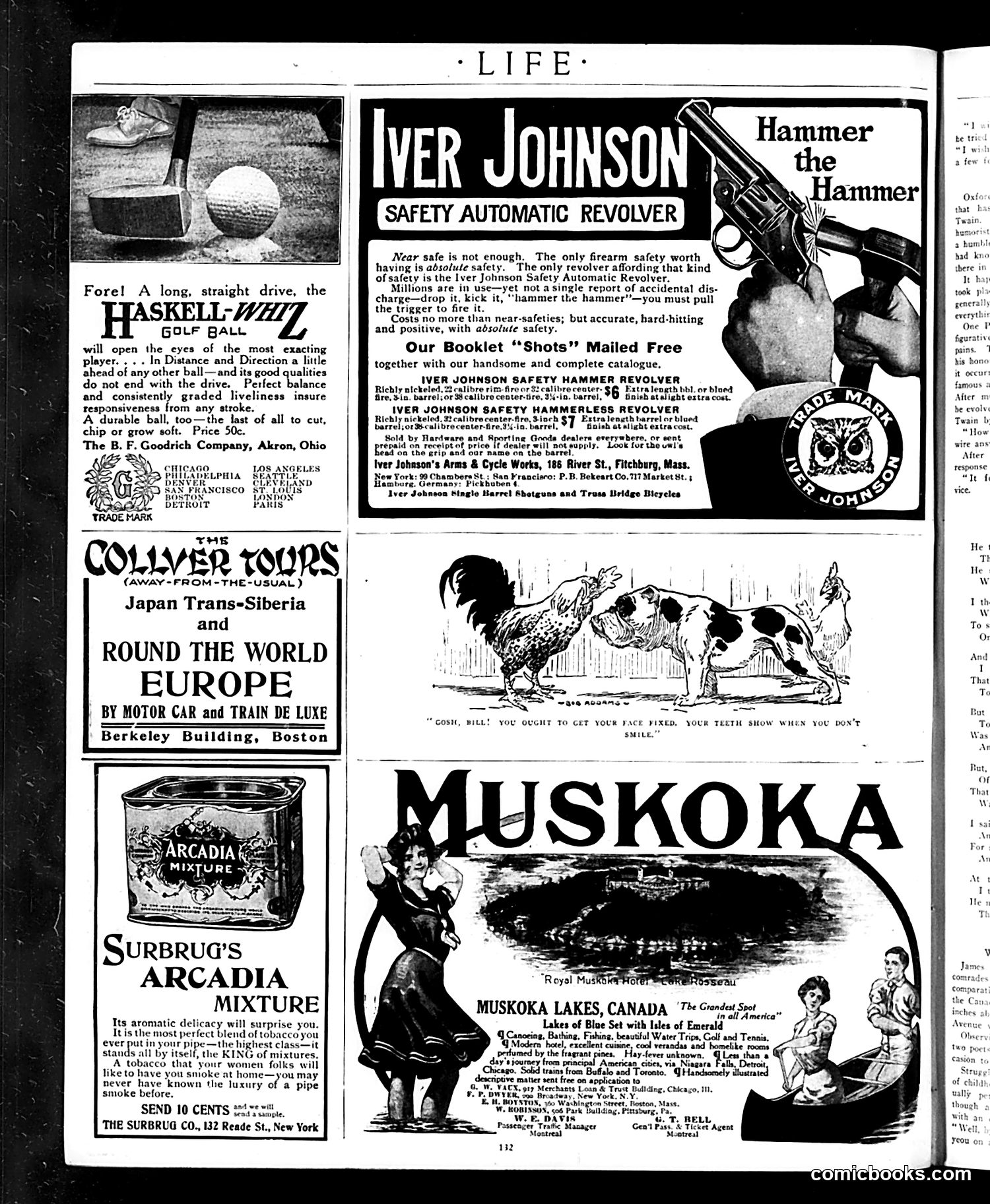
This page is primarily **advertising** with one small cartoon. The ads promote: - **Haskell golf balls** and Iver Johnson revolvers (emphasizing the "Safety Automatic" design—a gun that requires intentional trigger-pulling, not accidental hammer-dropping) - Travel tours, tobacco, and Muskoka Lakes tourism **The cartoon** (center) depicts a rooster and dog with the caption: "Gosh, Bill! You ought to get your face fixed, your teeth show when you don't smile." This is a simple **visual joke about appearance and vanity**—the animals are anthropomorphized, critiquing each other's looks in a way that mirrors human social commentary. It's gentle humor playing on the idea that even animals would care about looking presentable. The page reflects early 20th-century consumer culture: firearms marketed as safety innovations, leisure travel as aspirational, and gentle illustrated humor. Nothing overtly political appears here.
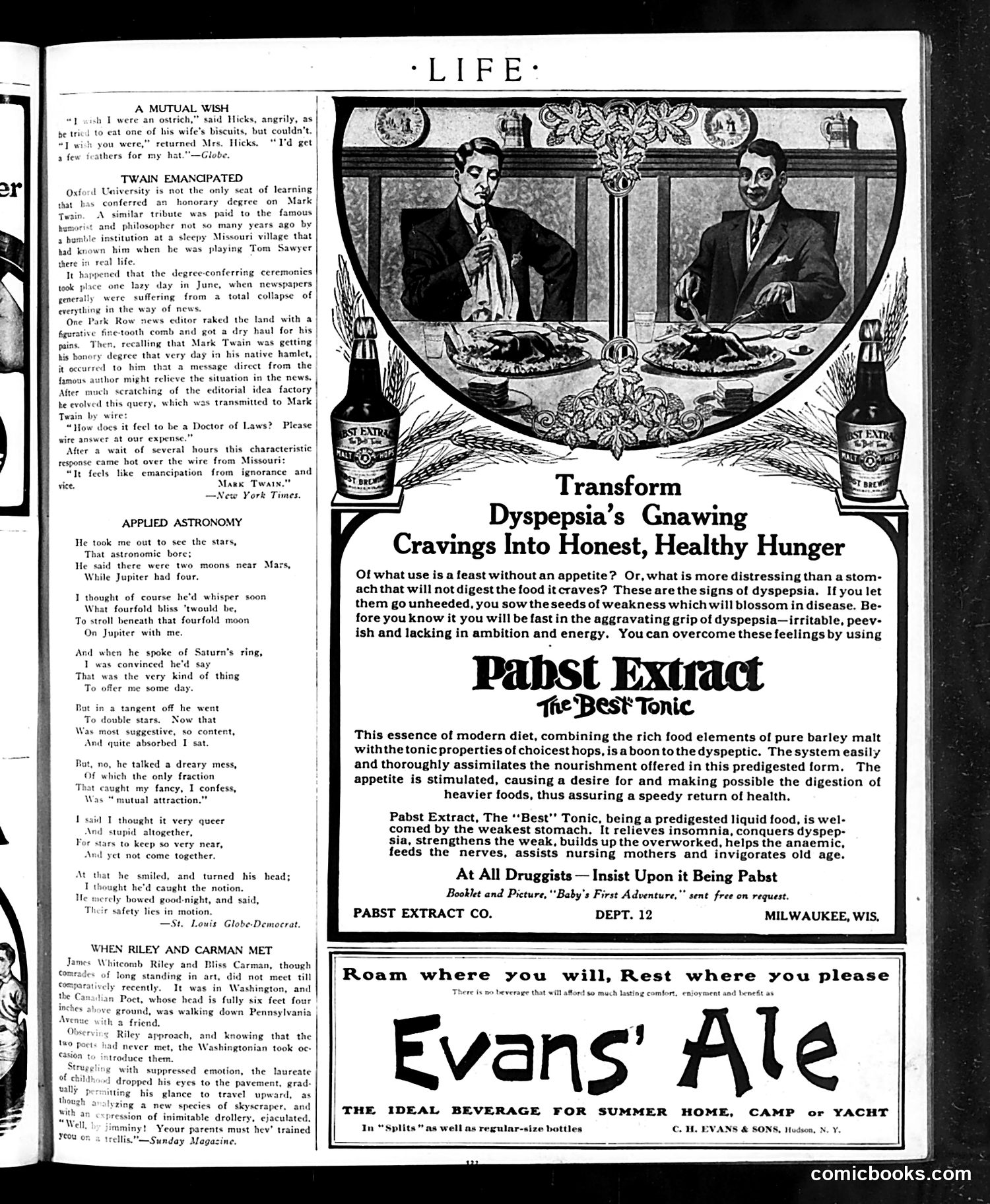
This page contains **humorous short pieces and advertisements** from an early 20th-century American satirical magazine. The notable content includes: **"Twain Emancipated"**: A anecdote about Mark Twain receiving an honorary degree. A newspaper editor wired Twain asking how it felt to be a "Doctor of Laws," and Twain replied characteristically that it felt like "emancipation from ignorance and vice"—a witty self-deprecating response. **"Applied Astronomy"**: A romantic poem about a woman taken stargazing by a boring astronomer who discusses celestial mechanics but fails to make romantic advances, disappointing her expectations. **"When Riley and Carman Met"**: A brief anecdote about American poets James Whitcomb Riley and Bliss Carman meeting for the first time in Washington. Carman, notably tall (six feet four), makes a droll comment about Riley's parents training him well—likely a joke about Riley's modest stature. The page is dominated by **full-page advertisements** for Pabst Extract tonic (for dyspepsia) and Evans' Ale, typical patent medicine and beverage ads from this era.
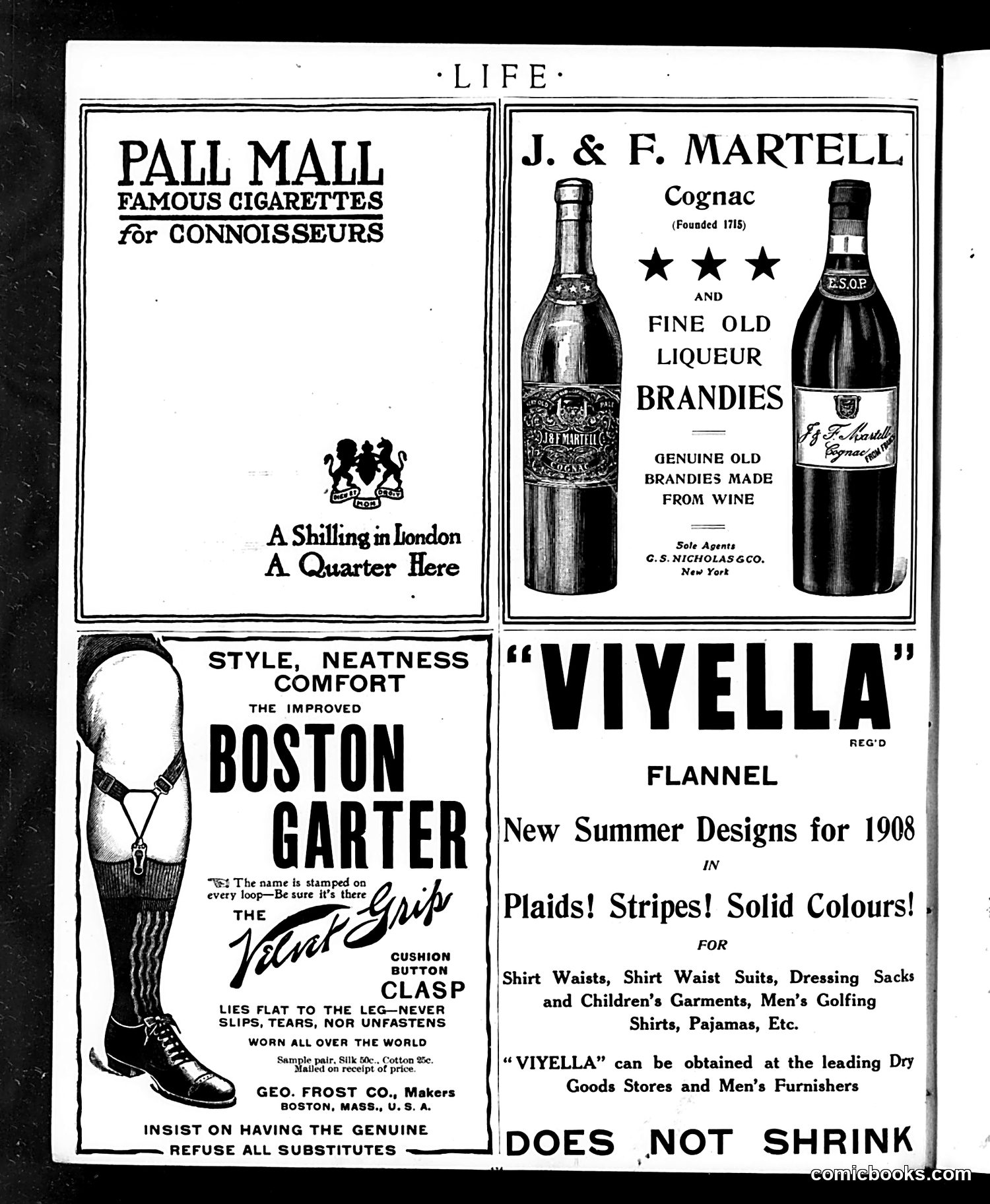
This is **primarily a advertising page**, not a political cartoon. It contains four commercial advertisements from circa 1908: 1. **Pall Mall Cigarettes** — pitched to wealthy "connoisseurs" at premium pricing (a shilling in London, a quarter in America) 2. **J. & F. Martell Cognac** — luxury French brandy, emphasizing its 1715 founding date and genuine old-world production 3. **Boston Garter** — a men's sock garter with a cushioned clasp mechanism, marketed as reliable and worldwide 4. **Viyella Flannel** — summer fabric for clothing, highlighting new 1908 designs and the selling point that it "does not shrink" **Historical context**: These ads reflect early-1900s consumer culture targeting middle and upper-class readers. The emphasis on "genuine" and "refuse substitutes" suggests growing concerns about counterfeit products in this pre-regulation era. Prices and product names (cognac, flannel) indicate aspirational luxury goods.
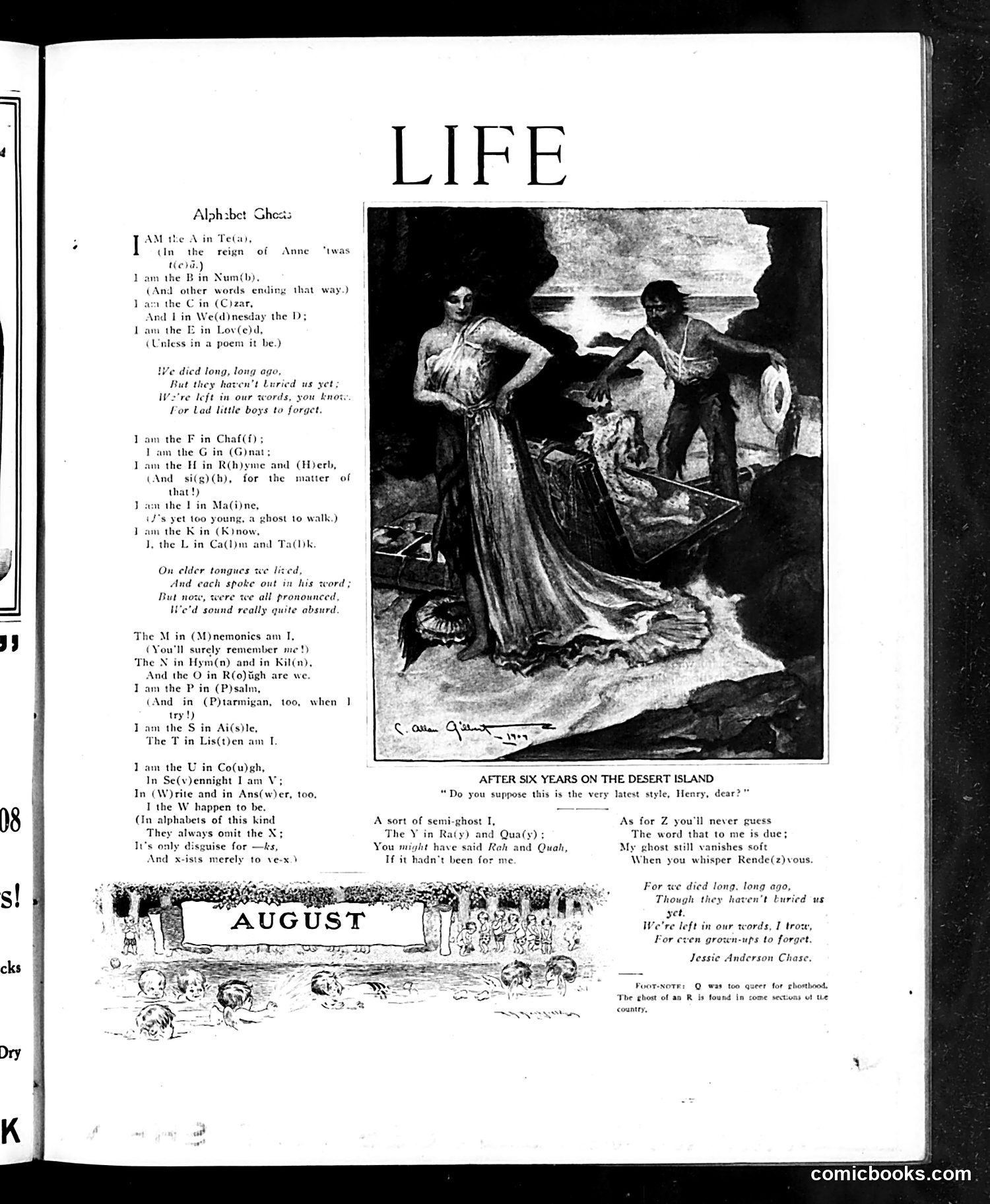
This is a humorous poem personifying silent letters in English words—letters that are pronounced in older usage but have become silent over time. Each "ghost" character (A, B, C, etc.) laments their obsolescence, explaining words where they once mattered phonetically but now merely confuse children learning to read. The accompanying illustration shows a woman and man on a desert island, with the woman modeling an outfit and asking if it's fashionable. The caption's joke is that after six years isolated, they've completely lost touch with current fashion trends—a commentary on how quickly styles change and how easily one falls behind in modern society. The satire mocks both the arbitrary nature of English spelling conventions and, in the island scene, the fickleness and rapid evolution of fashion and social trends. The page is credited to Jessie Anderson Chase and appears in the August section of the magazine.
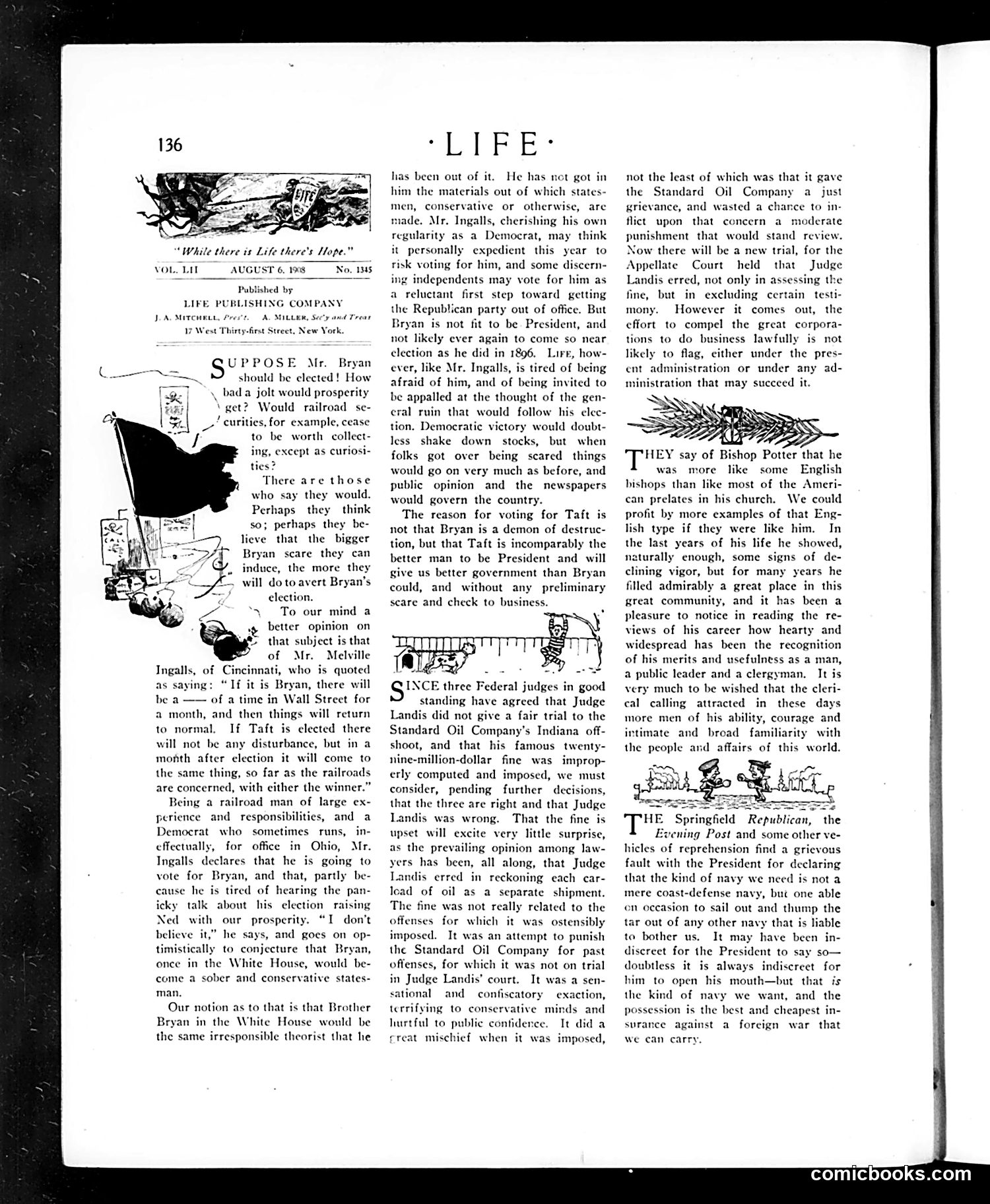
This *Life* magazine page satirizes the 1908 U.S. presidential race between William Jennings Bryan (Democrat) and William Howard Taft (Republican). **The main cartoon** (left side) depicts a figure cowering in fear—likely representing business interests or prosperity—supposedly threatened by Bryan's candidacy. The satire mocks Republicans who use "Bryan scare tactics" to frighten voters about economic disaster if Bryan wins. **The argument:** Life presents railroad executive Melville Ingalls's view that Bryan's election wouldn't cause lasting economic harm—disruption would be temporary. However, Life disagrees with his endorsement of Bryan, arguing Taft is the better presidential choice despite Bryan not being the destructive threat Republicans claim. **The secondary item** criticizes Judge Landis's $29-million fine against Standard Oil, arguing it was improperly calculated and punitive rather than legally justified—reflecting Progressive-era debates over corporate regulation. The tone is characteristically *Life*: politically engaged but skeptical of partisan fearmongering.
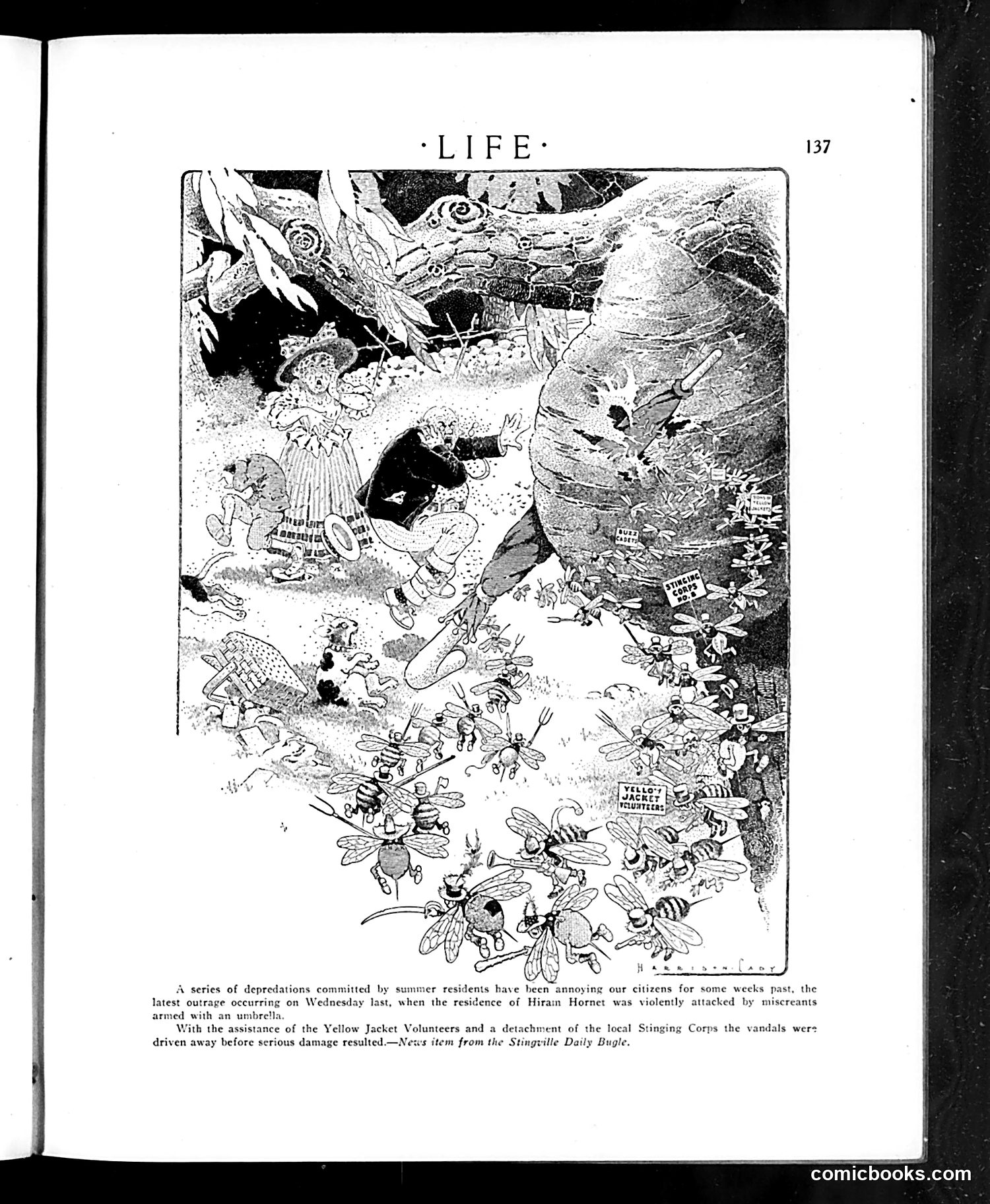
This is a satirical illustration depicting an insect community under attack. The cartoon anthropomorphizes insects—identifying characters as "Hiram Hornet," "Yellow Jacket Volunteers," and the "Stinging Corps"—to parody a news report about property vandalism and civic disorder. The joke relies on the absurdity of insects organizing militia responses to crime, treating their natural aggression ("stinging," armed with "umbrella") as legitimate self-defense. The elaborate illustration shows a bustling insect society with architecture and social structures mirroring human civilization. This appears to be humorous social commentary on how communities respond to minor disturbances, possibly mocking overwrought local news coverage or excessive vigilantism. The formal news-item framing enhances the satire by treating insect conflict with mock-serious journalism.
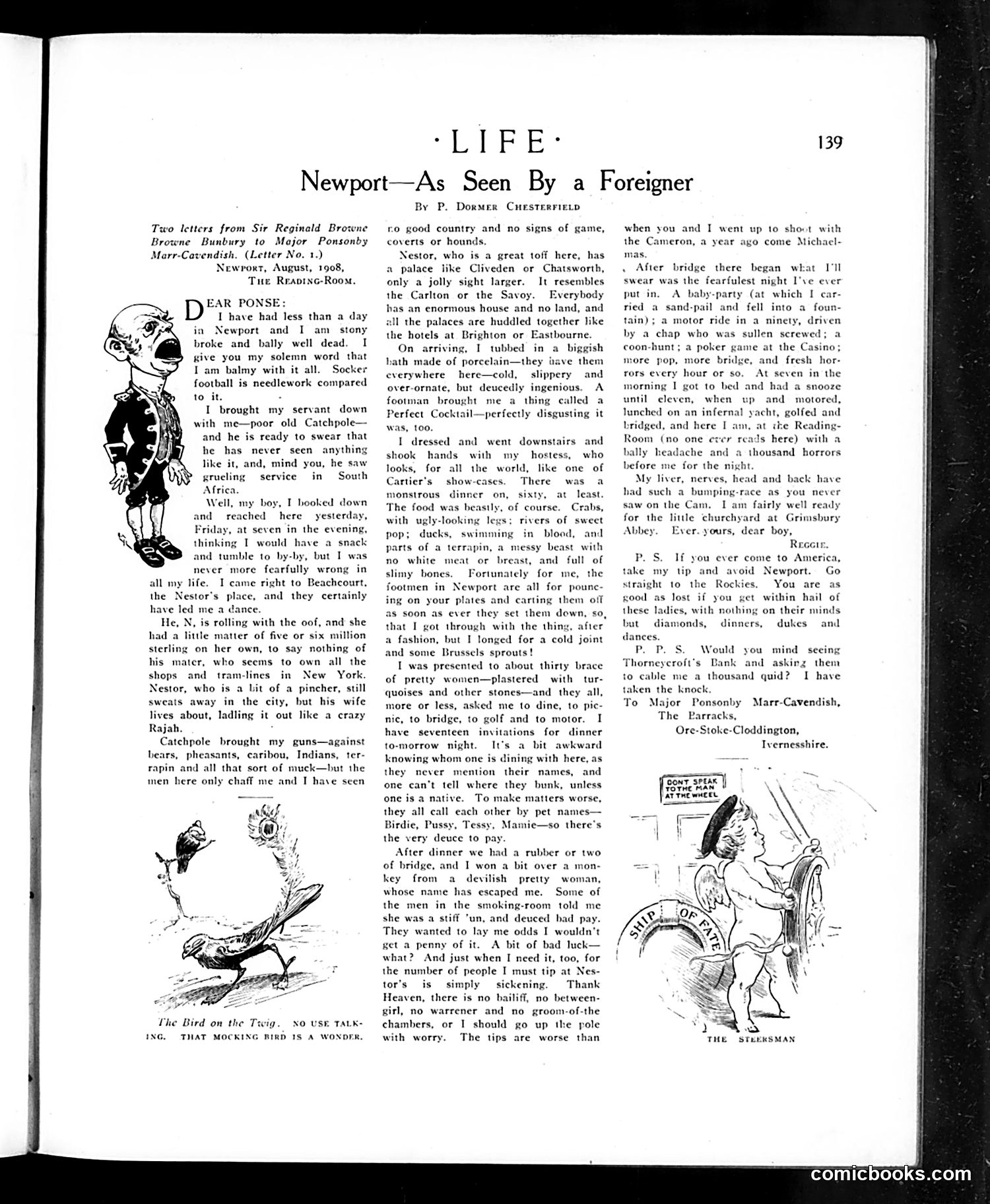
This is a satirical letter from a British visitor to Newport, Rhode Island (circa 1908), mocking American high society's nouveau riche excess. **The satirical points:** - The writer, "Sir Reginald Browne," is a broke British aristocrat exhausted by Newport's relentless social demands—dinners, golf, bridge, motoring - He's astonished by Americans' vulgar materialism: palatial mansions crammed together, women "plastered" in turquoises and jewels, extravagant (and poorly prepared) meals - The hostess, Mrs. Nestor, represents the American wealthy: "rolling with the oof" (rolling in money), with millions in personal sterling - His complaint about tipping reveals social climbing anxiety among servants in America - The cartoons (a mocking bird, a steward) underscore the foreigners' discomfort with American customs **The joke:** A British gentleman—typically portrayed as refined—is overwhelmed by American wealth and social climbing, finding the culture exhausting, tasteless, and socially confusing.
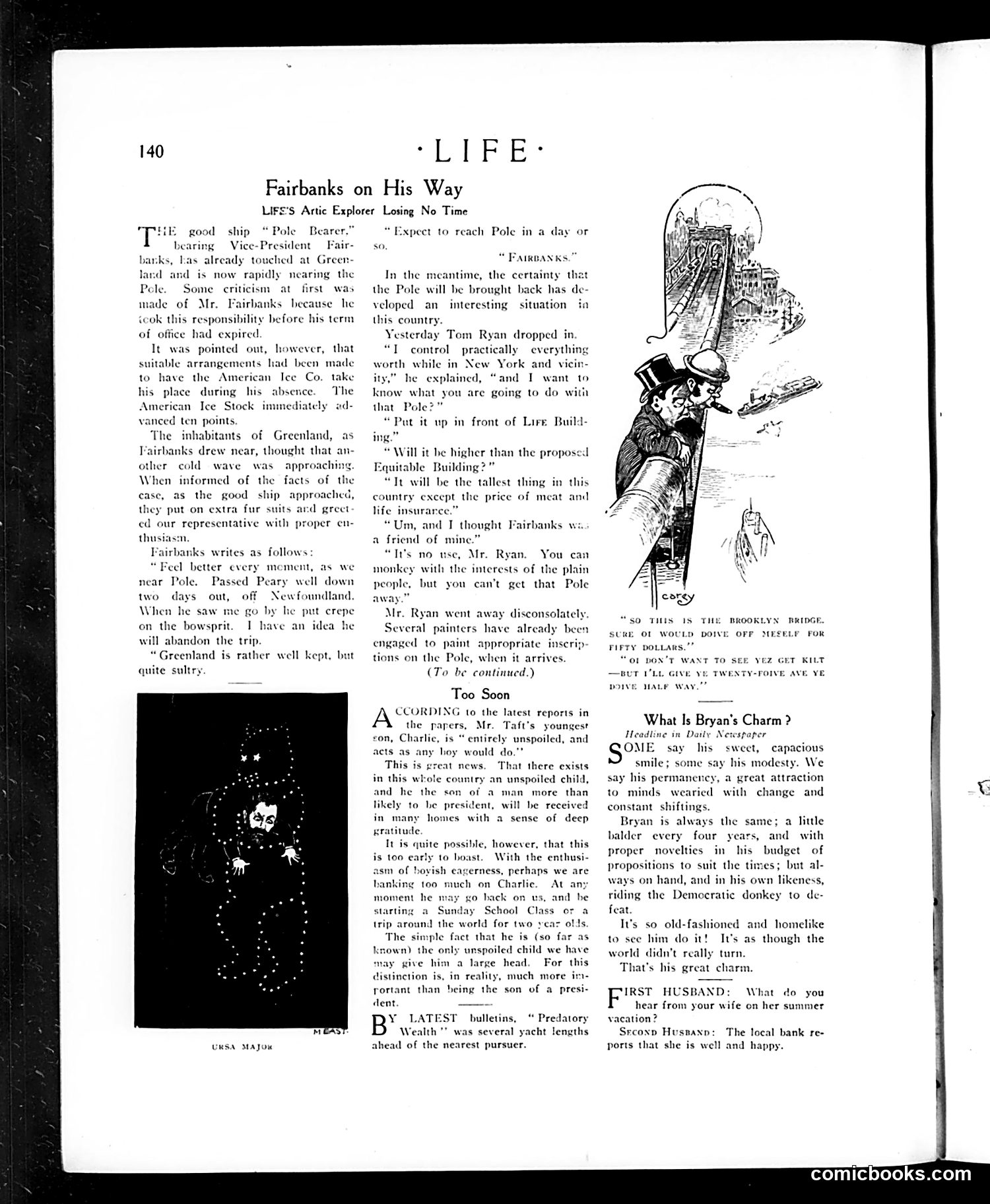
This page satirizes Vice President **James Sherman Fairbanks** (text calls him "Fairbanks," though this appears confused with Secretary of State William H. Fairbanks), who was apparently embarking on an Arctic expedition while still in office. The satire mocks his departure as irresponsible abandonment of duty—so much so that **the American Ice Company stock immediately rose** because his company replacing him assured investors. The cartoon depicts Greenlanders mistaking his arrival for a dangerous cold front. The secondary joke involves **Tom Ryan** (a prominent businessman/financier of the era) plotting to display the North Pole itself as a monument in front of Life's building—a absurdist jab at capitalist triumphalism and real-estate one-upmanship during the Gilded Age. The page also contains unrelated political commentary about **President Taft's son Charlie** and **William Jennings Bryan**, criticizing their static public personas.
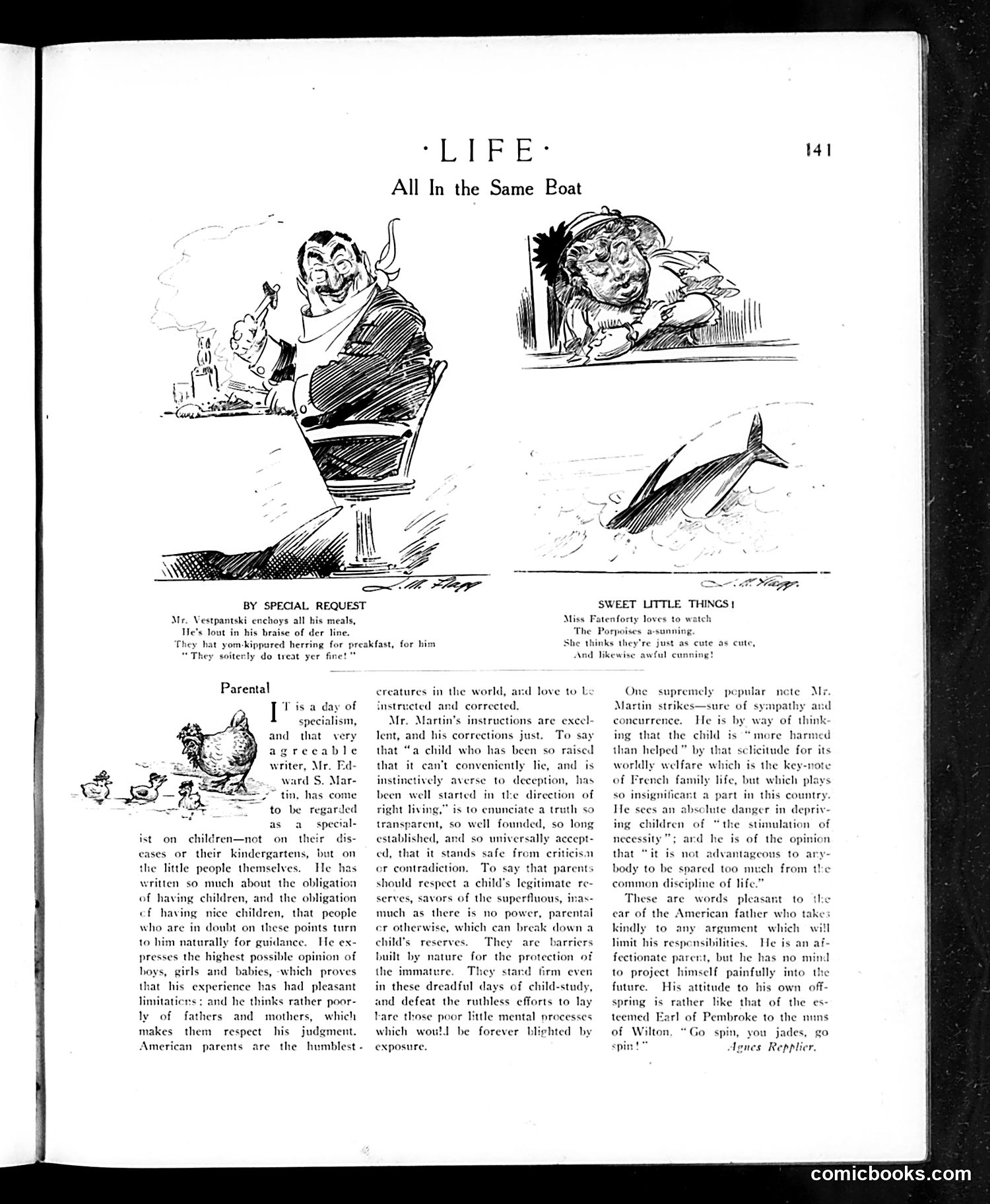
This page satirizes parenting philosophies and social pretension. The top cartoon mocks Mr. Vestpantski, who "enjoys all his meals" in luxurious style while claiming humble origins ("lout in his braise of der line")—a joke about false modesty or ethnic affectation. The main article praises Edward S. Martin, a writer and supposed expert on child-rearing, who advocates for minimal parental coddling and discipline. The satire is subtle: while praising Martin's sensible views (children need moral training, not excessive protection), the closing joke reveals the hypocrisy. The American father agrees with Martin's philosophy about not indulging children—but only because he himself wants to avoid the effort and responsibility of parenting. The final quote from the Earl of Pembroke ("Go spin, you jades") suggests dismissive indifference toward those under one's care. The "Sweet Little Things" cartoon appears to show a woman watching dolphins or porpoises, ironically captioned about cuteness—possibly mocking sentimentality about nature while ignoring human children's welfare.
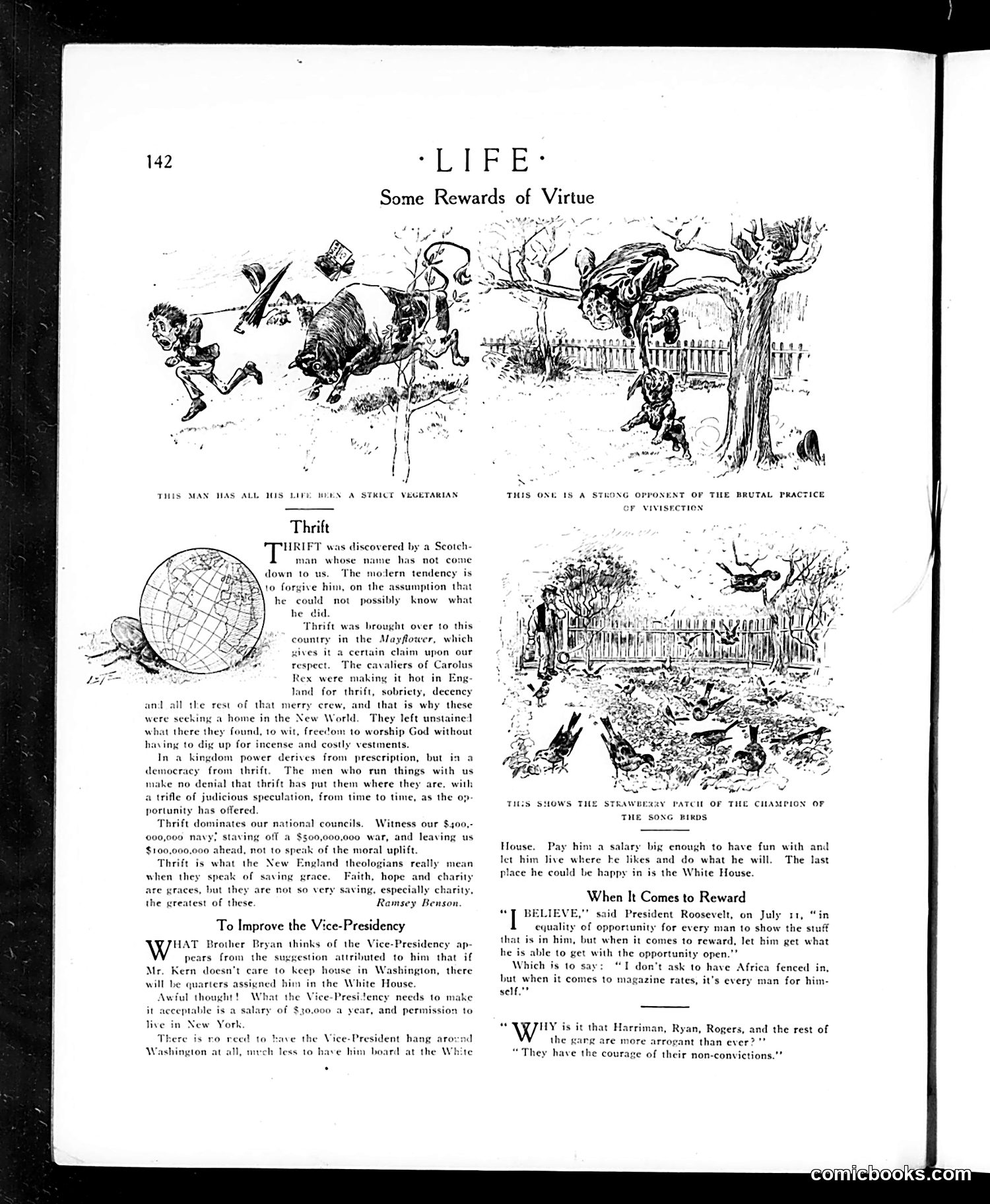
This page contains three satirical pieces mocking American hypocrisy and wealth inequality: **Top illustrations**: Contrasting vignettes showing virtue unrewarded—a strict vegetarian appears frail while enjoying nature, opposing the "brutal practice" of vivisection, and a champion of "song birds" tend their strawberry patch. The satire: virtuous living brings neither wealth nor power. **"Thrift"**: Attacks the Puritan virtue-narrative. The text mockingly praises thrift as foundational to American success, then reveals the contradiction: wealthy industrialists credit thrift while actually accumulating fortunes through "judicious speculation"—essentially gambling and investment schemes. **"Vice-Presidency"**: Suggests Brother Bryan (William Jennings Bryan) proposed the Vice-President live in the White House. The satire ridicules this as absurd; the VP should earn real money and live elsewhere. **"When It Comes to Reward"**: Quotes President Roosevelt's rhetoric about equal opportunity, then sarcastically equates it with robber barons like Harriman and Ryan claiming freedom to exploit rates and resources without ethical constraint. Overall point: American elites preach virtue while practicing ruthless capitalism.
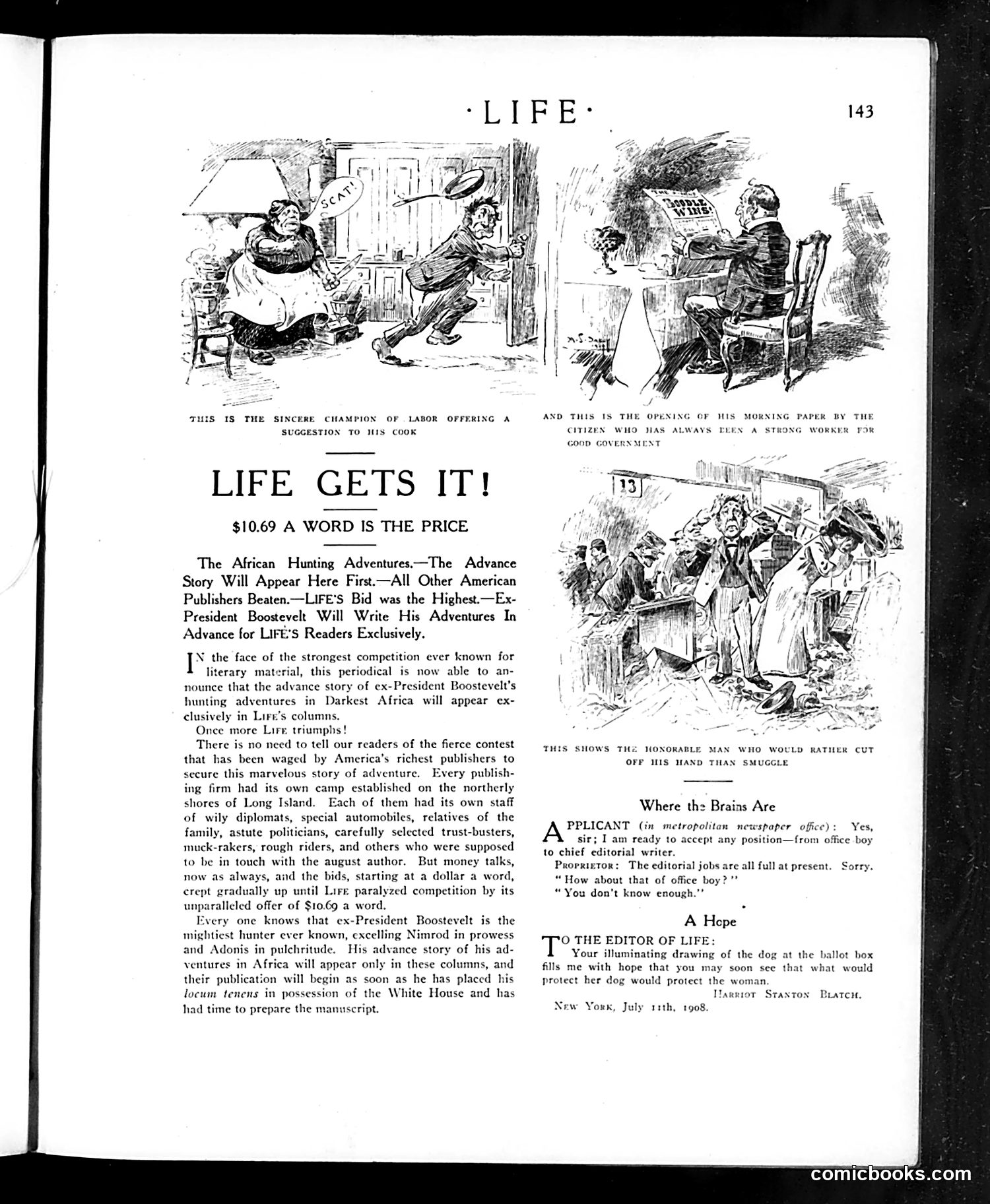
This page satirizes Theodore Roosevelt's celebrity and commercial value. The top cartoon mocks a wealthy labor advocate hypocritically ordering his cook around—criticizing workers while exploiting household staff. The main content parodies publishers' bidding war for Roosevelt's African hunting memoirs, with Life claiming victory at the absurd price of "$10.69 a word." The satirical tone suggests this is inflated nonsense; the exaggerated language ("mightiest hunter," "excelling Nimrod") mocks Roosevelt's outsized public persona. Lower cartoons continue the theme: one shows a worker reading Life's announcement with approval, the other depicts an honorable man refusing to smuggle. The "Where the Brains Are" section satirizes newspaper hiring, rejecting an applicant for office boy work as underqualified—a joke about minimal standards. The final letter from "Harriot Stanton Blatch" connects dog protection to women's rights, likely referencing 1908 suffrage debates. The page combines mockery of Roosevelt's celebrity commodity value with broader social commentary on labor, integrity, and women's rights.
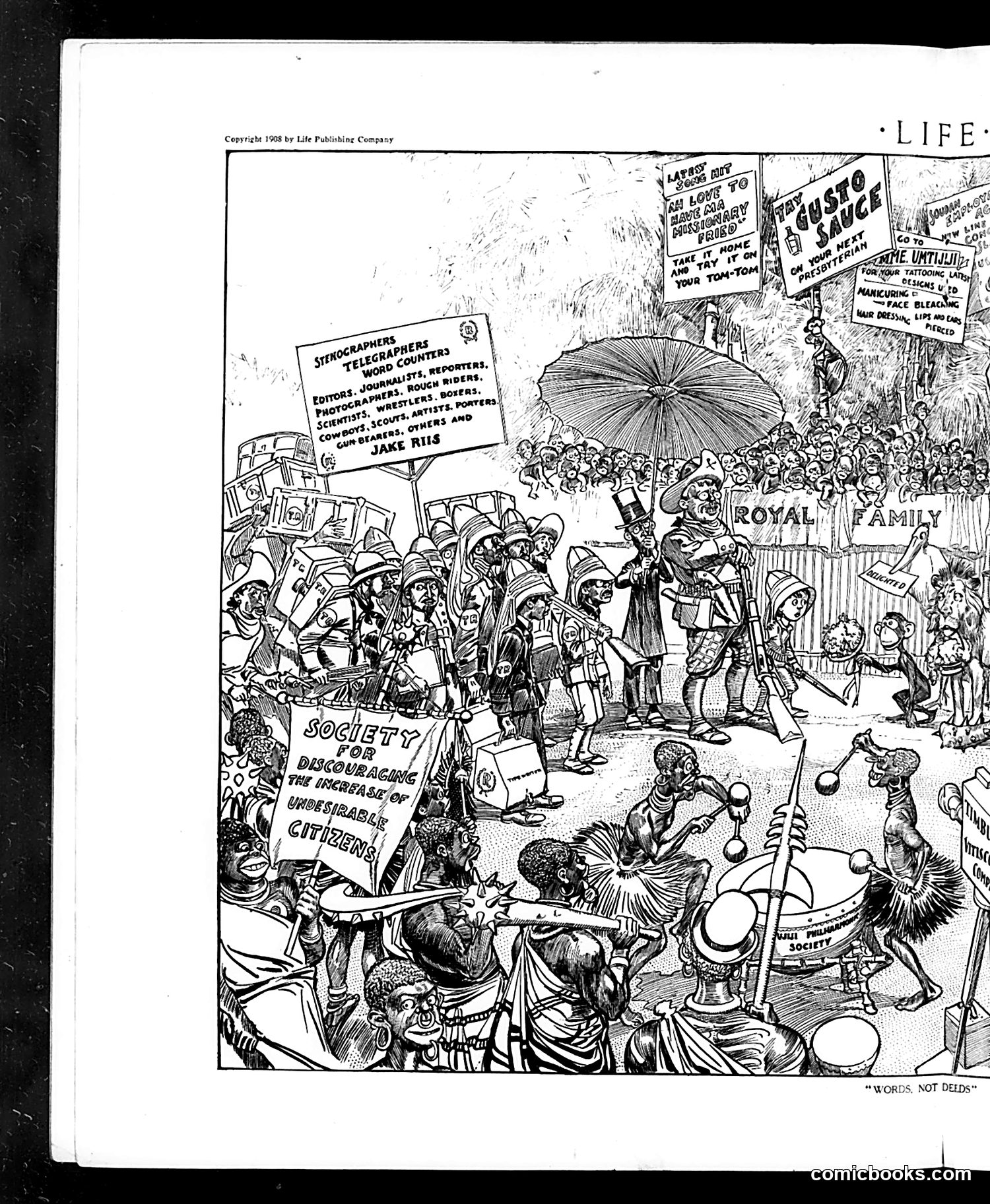
This satirical cartoon depicts a chaotic street scene where various reform groups and advocates hold signs promoting their causes—sterilography, temperance ("Rum to Sauce"), and other progressive movements. A banner reads "Society for Discouraging the Ignorance of Irresponsible Citizens." The cartoon's title, "Words, Not Deeds," suggests the satire's target: reformers and activists who loudly proclaim their missions through signs and rhetoric but accomplish little practical change. The cacophony of competing messages, the circus-like atmosphere, and the apparent disorder suggest that proliferating reform movements—characteristic of the Progressive Era—create more noise than actual social improvement. The "Royal Family" sign on the right may indicate elite indifference to these earnest but ultimately ineffective efforts.
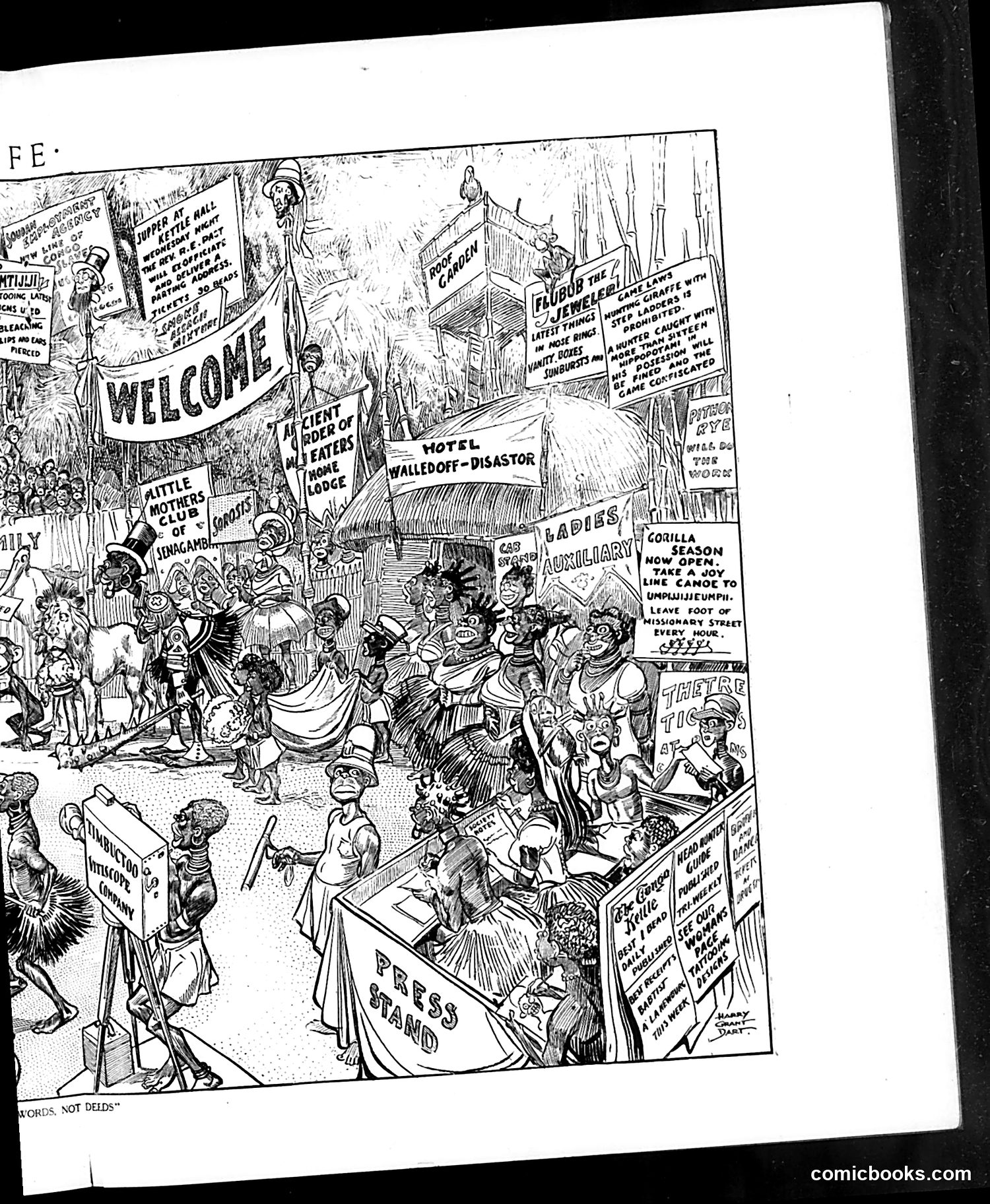
This is a satirical illustration depicting a chaotic scene of various establishments and characters competing for attention in what appears to be a crowded urban entertainment district. Visible signs include "Hotel Walledoff-Disaster," "Little Mother's Club," "Eaters Lodge," "Press Stand," and various other venues. The cartoon mocks the commercialization and overcrowding of popular entertainment districts, with exaggerated caricatured figures engaged in various activities. The dense, cluttered composition emphasizes the satirical point about urban congestion and the proliferation of dubious or low-quality establishments. The specific political or social targets remain unclear without additional context about Life magazine's publication date, but the overall message critiques commercialism and urban disorder.
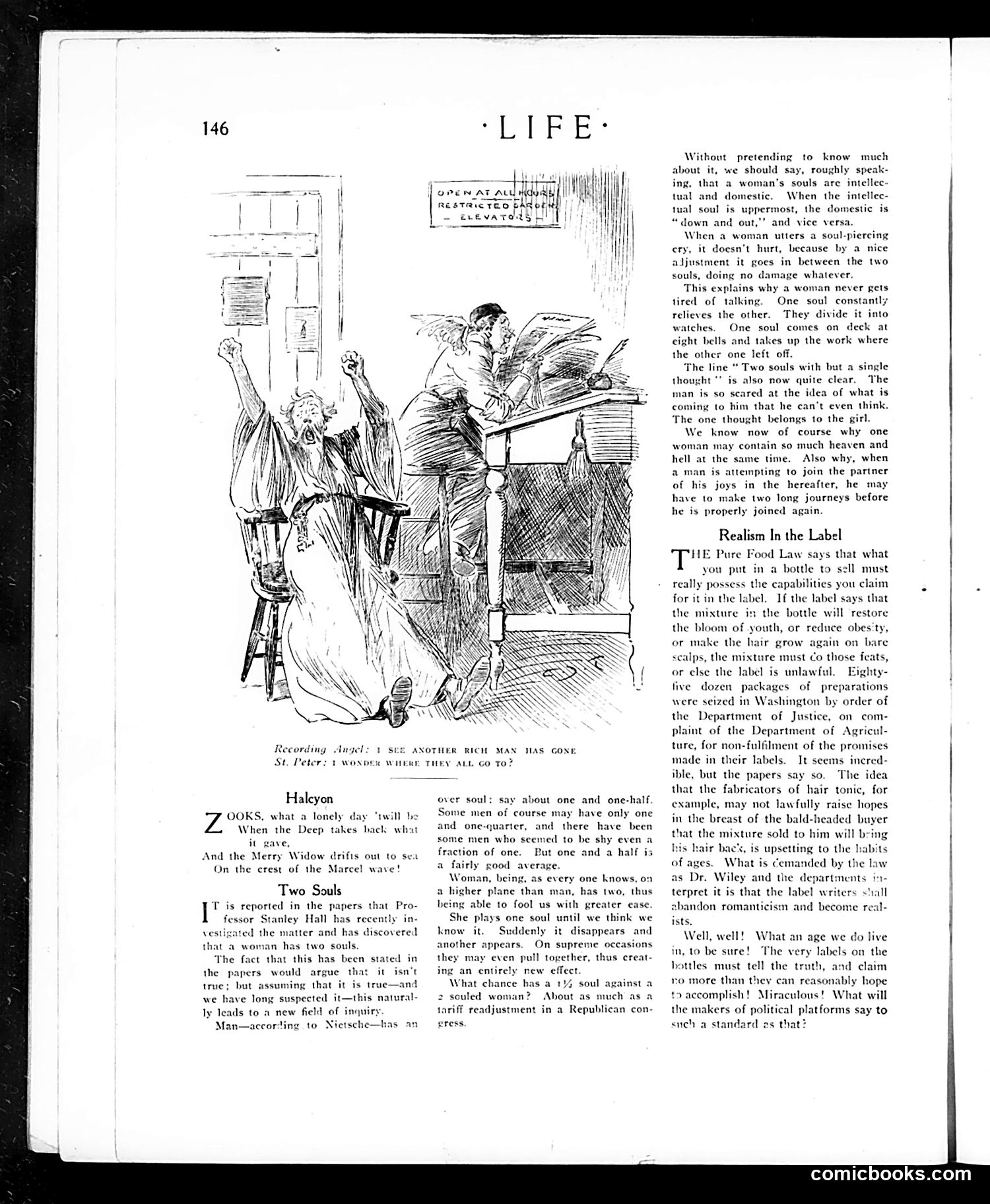
This page contains two satirical pieces targeting early 20th-century society: **"Halcyon" cartoon** (top): Shows St. Peter and Recording Angel observing wealthy men entering heaven, with the angel expressing surprise at their arrival. The caption sardonically asks where "all these rich men" go—implying wealthy individuals don't typically earn heavenly admission. **"Two Souls" essay**: Satirizes psychologist Stanley Hall's claim that women possess two souls (versus men's one-and-a-half). The writer uses this pseudoscientific claim to humorously explain female behavior—why women excel at deception, never tire of talking, and contain contradictory qualities. It's tongue-in-cheek commentary on gender stereotypes. **"Realism in the Label"**: Mocks the Pure Food Law's requirement that product labels honestly describe contents. The author treats enforcing truth in advertising (particularly for quack remedies like hair tonic and youth restorers) as absurdly idealistic, satirizing manufacturers' false marketing claims and suggesting such honesty is revolutionary. All three mock contemporary institutions: wealth/morality, pseudoscience, and consumer fraud.
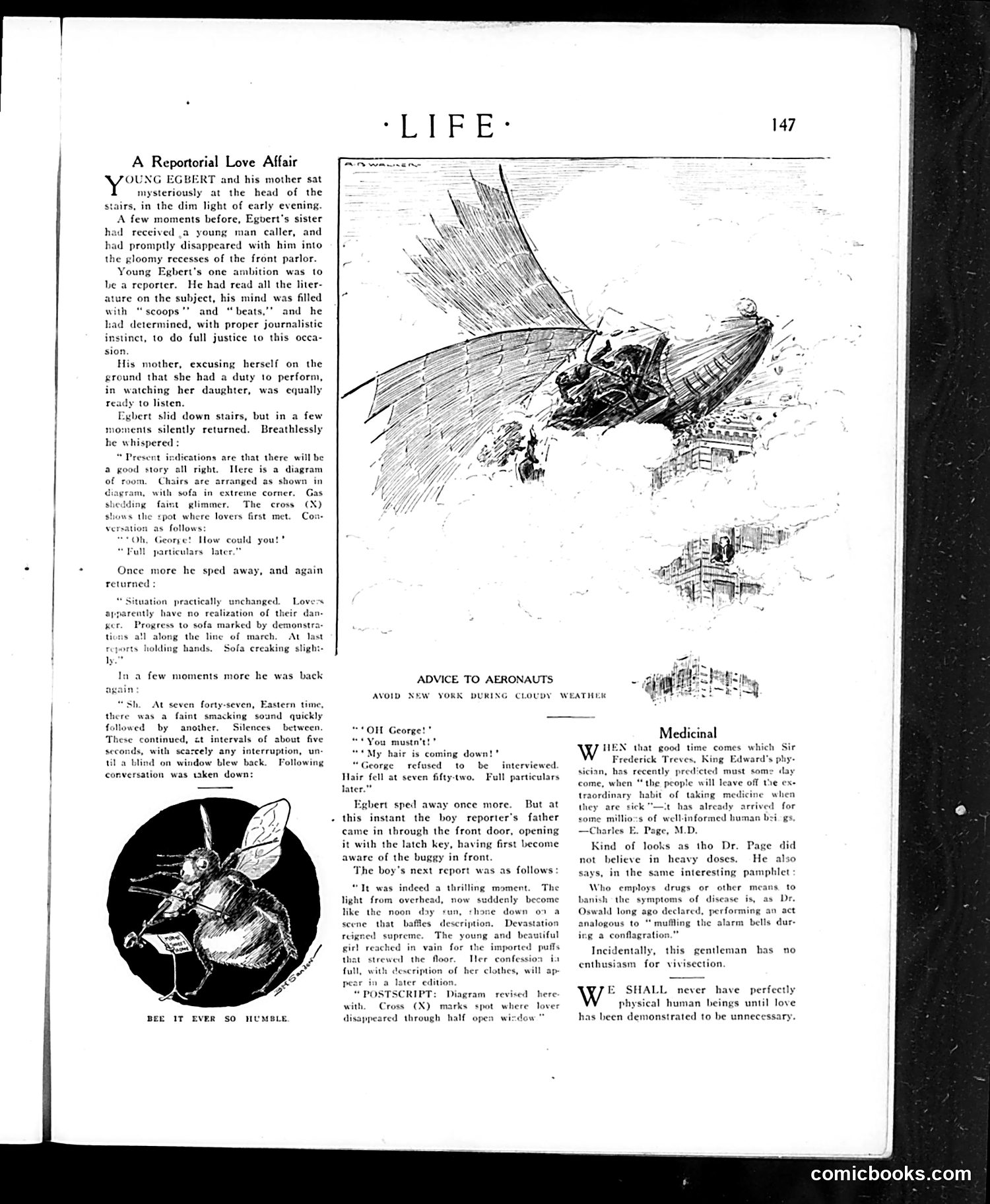
This humorous piece satirizes young ambition and journalistic overreach. Young Egbert, aspiring to be a reporter, treats his sister's romantic visit from a suitor as a "story" to cover. He stations himself as an observer, creating absurd "diagrams" and detailed "reports" on the couple's progression from conversation to physical affection—tracking their movement to the sofa, kiss sounds at timed intervals, and culminating in the father's arrival home, which sends the couple into comic disarray. The satire works on multiple levels: it mocks the pretensions of eager young journalists eager for "scoops," the mechanical nature of courtship rituals, and Egbert's complete lack of social sensitivity in treating intimate moments as reportable news. The accompanying illustration of a bee ("Bee It Ever So Humble") provides visual comedy. The page also includes brief medical commentary by Dr. Page criticizing excessive medication—unrelated filler content typical of Life's format.
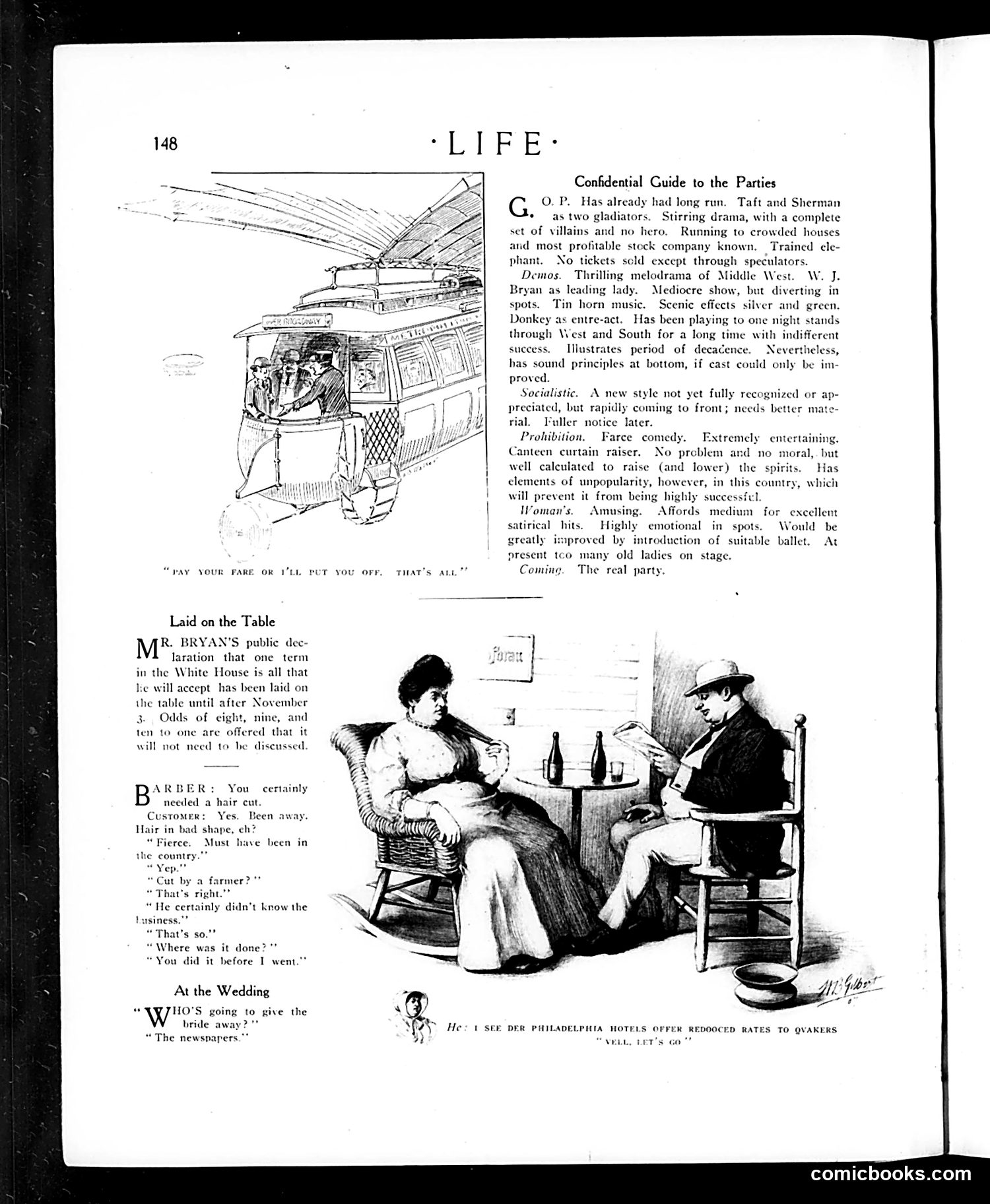
This page satirizes the 1908 U.S. presidential election. The "Confidential Guide to the Parties" reviews political campaigns as if they were theatrical productions: **The Republican Party ("O.P.")** is portrayed as a successful, crowded show featuring Taft and Sherman as "two gladiators"—referencing the competition for the Republican nomination. **The Democratic Party ("Demos")** is mocked as a mediocre melodrama with William Jennings Bryan as the "leading lady," playing to sparse audiences in the West and South, suggesting the party's declining electoral fortunes after Bryan's previous losses. **Smaller parties** receive brief dismissals—Socialists as experimental/unrefined, Prohibitionists as entertaining but unpopular. The bottom sections contain unrelated jokes: one about Bryan's claim he'd serve only one presidential term (portrayed as a bluff), and another mocking a barber's haircut. The final illustration appears to be a separate social joke about wedding etiquette and Philadelphia hotels catering to Quakers. The satire reflects contemporary frustration with party politics and campaign theatricality.
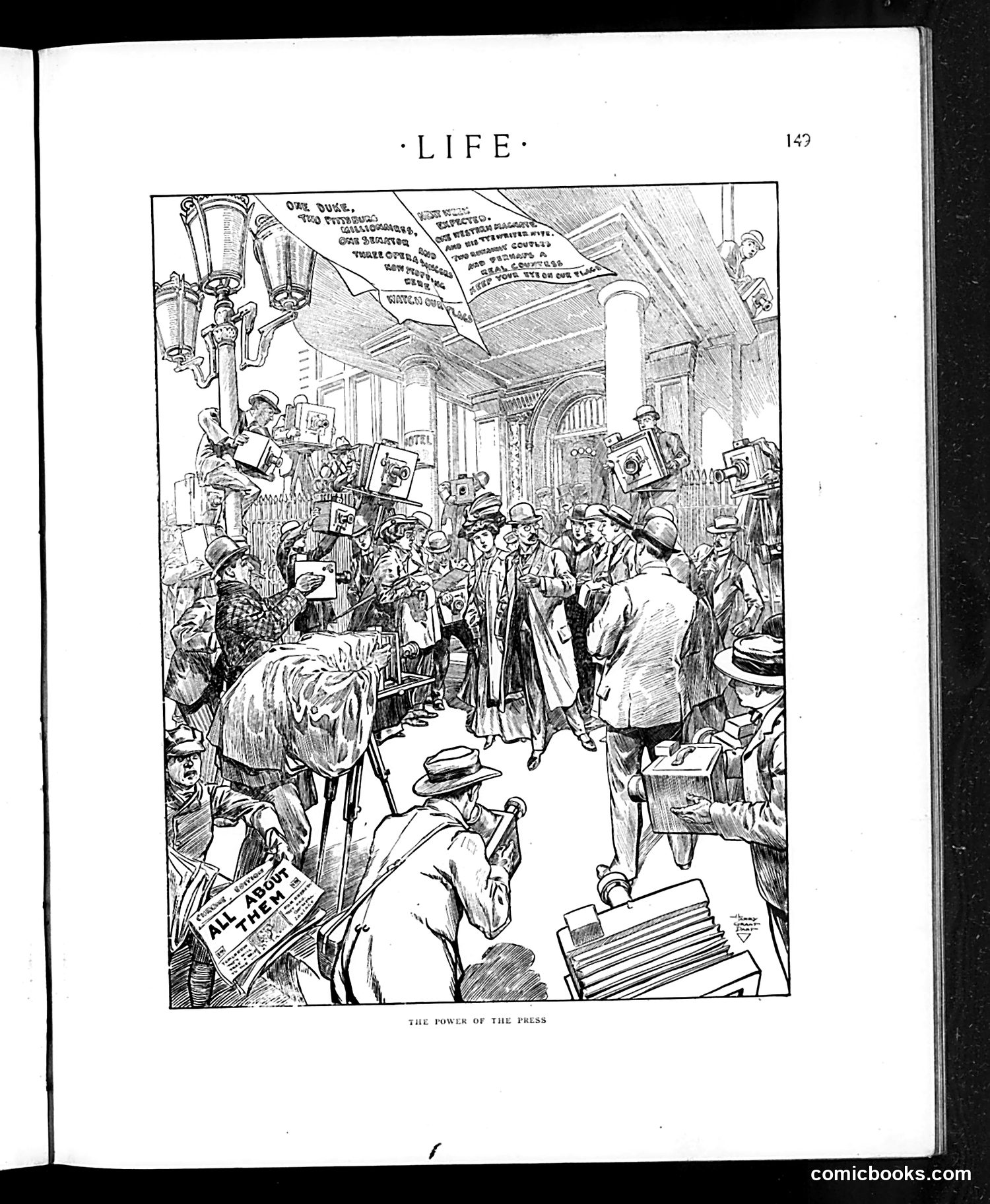
This satirical illustration depicts a crowded indoor scene—likely a train station or public building—swarming with photographers, reporters, and cameramen holding large box cameras and notepads. The title "The Power of the Press" references the growing influence of journalism and photography in early 20th-century America. The cartoon satirizes media frenzy and sensationalism: the sheer number of press representatives mobbing what appears to be a newsworthy event or public figure suggests how newspapers and photographers competed aggressively for stories. The crowded, chaotic composition emphasizes the invasive and overwhelming nature of press coverage during this era. The visible signs and speech balloons (though difficult to fully read in OCR) likely contain commentary on specific news events or media behavior of the period.
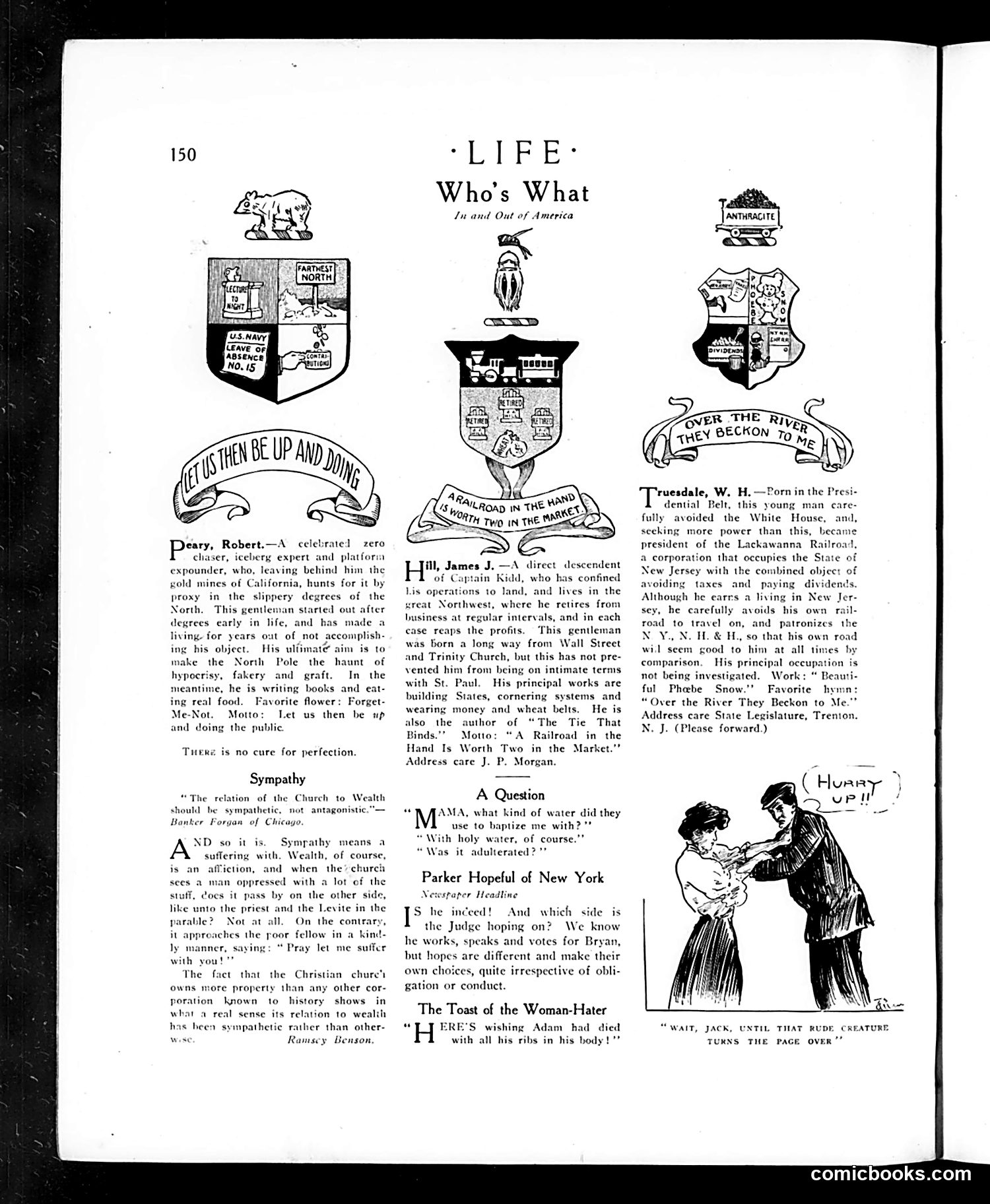
This page from *Life* magazine features satirical biographical sketches of prominent American figures, likely from the early 1900s. **"Who's What" section**: The profiles mock wealthy and powerful men with exaggerated descriptions. James J. Hill appears to be a railroad magnate ("A Railroad in the Hand Is Worth Two in the Market") who operates from Wall Street connections. Truesdale of the Lackawanna Railroad is ridiculed for avoiding his own railroad while patronizing competitors—satirizing corporate hypocrisy and tax avoidance. **Social Commentary**: The sketches attack business corruption, wealth accumulation, and the disconnect between corporate leaders' public roles and private interests. The motto references (borrowing from Scripture and popular sayings) add ironic contrast between claimed values and actual behavior. **Bottom cartoons**: "A Question" mocks wealthy parents raising children disconnected from reality. "The Toast of the Woman-Hater" references biblical misogyny. The final panel shows a woman preventing a man from turning the page—likely a joke about censorship or propriety concerns. The page overall satirizes American industrial capitalism and the hypocrisy of the wealthy elite.
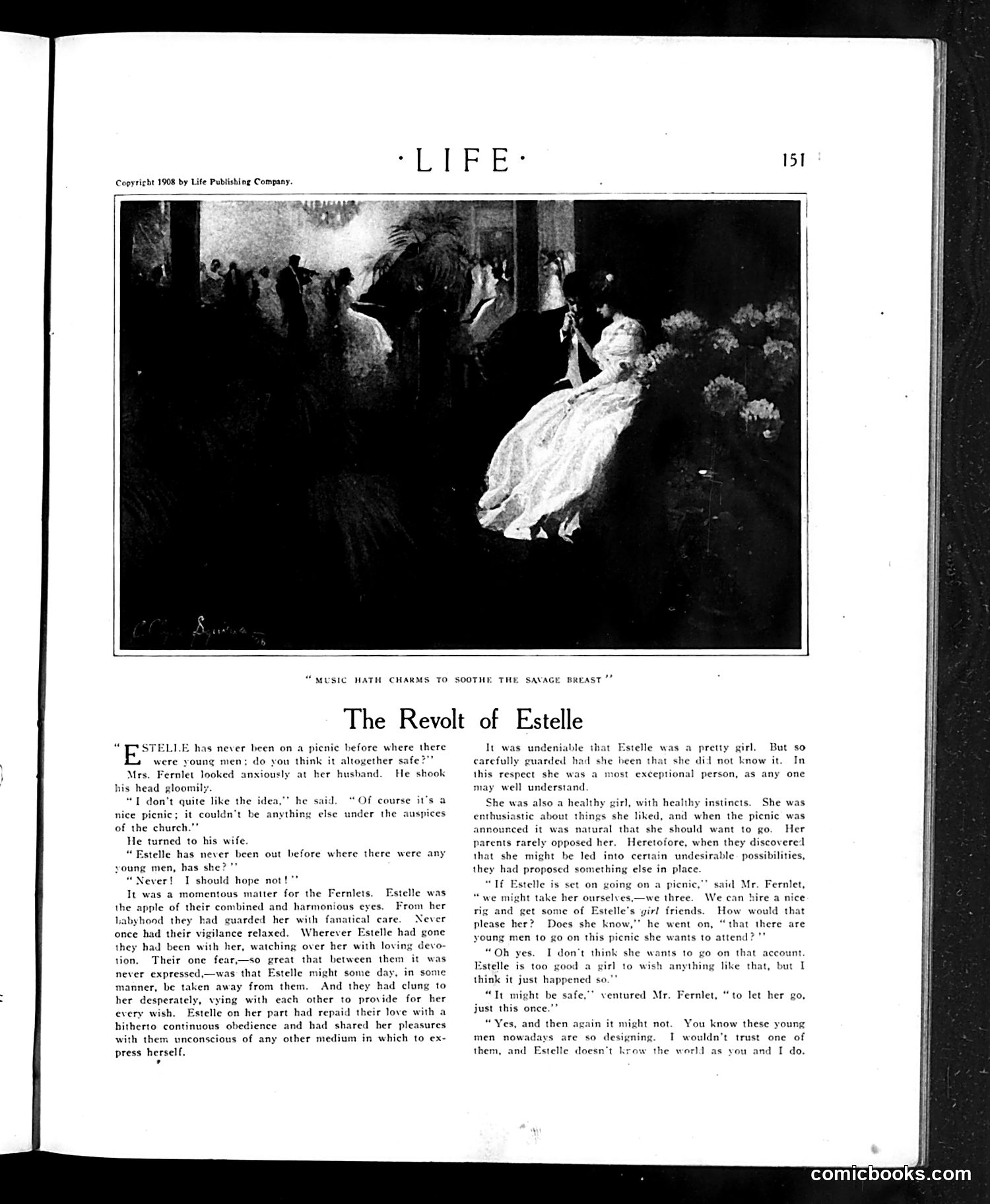
This is a serialized short story, not a political cartoon. The illustration shows a formal social gathering—likely the picnic scene—with a woman in a white dress as the focal point. The story satirizes **overprotective parenting and sheltered womanhood** in early 1900s America. The Fernlets have raised their daughter Estelle in extreme isolation, never allowing her near young men. When she expresses interest in attending a picnic, her parents debate anxiously whether it's "safe." The satire targets the era's contradictions: they've kept her ignorant that she's attractive, yet fear she'll be corrupted; they worry about "designing" young men while forbidding her normal social contact. The title "Revolt" suggests Estelle's desire for independence represents a challenge to parental control. The quote "Music hath charms to soothe the savage breast" is ironic—perhaps referencing the civilizing influence needed on unruly youth or the soothing of parental fears about modern courtship customs.
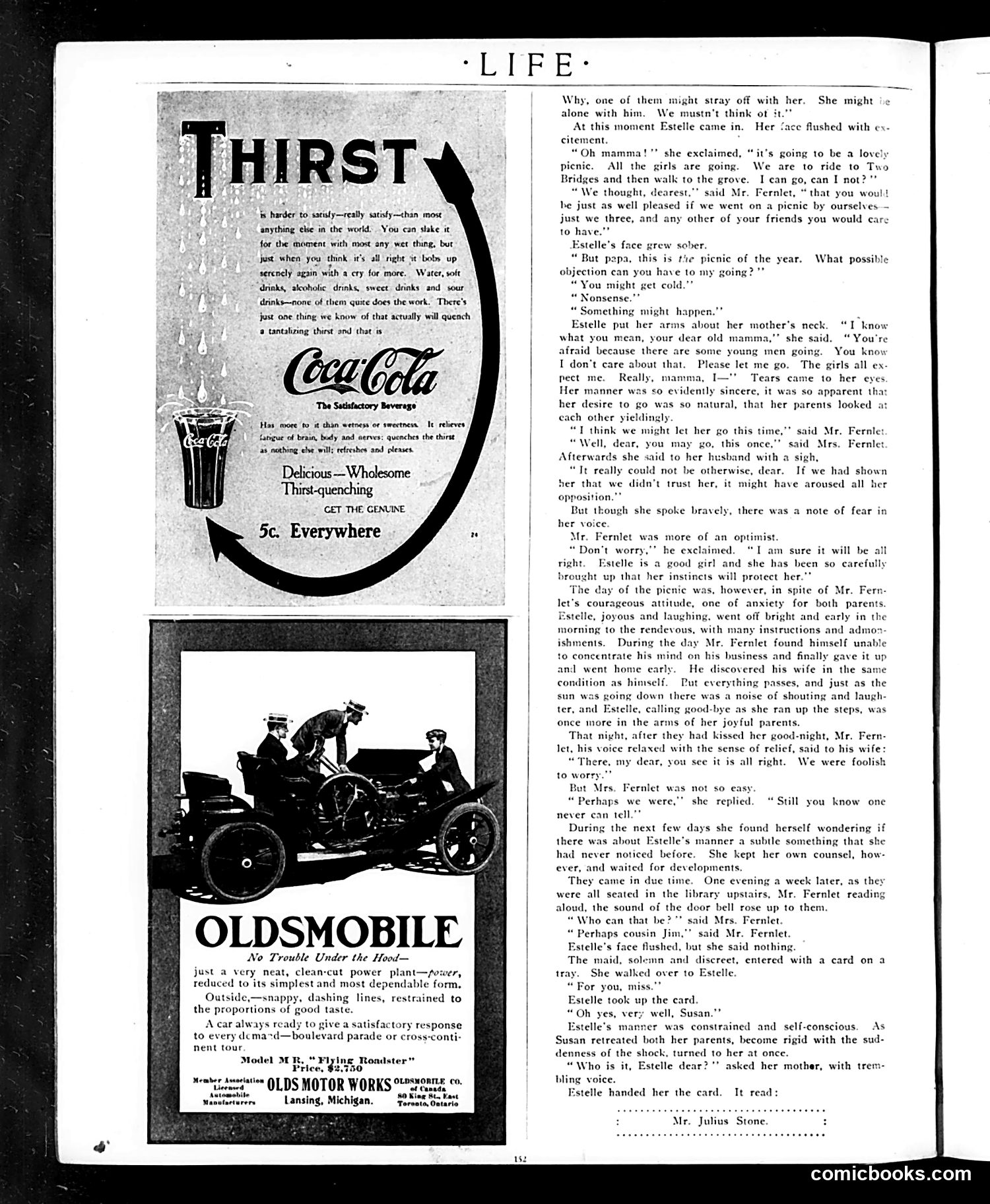
This page contains **two advertisements** and a **serialized fiction story** — not political satire or cartoons. The ads are for **Coca-Cola** ("Thirst") and **Oldsmobile** automobiles, typical early 20th-century product marketing. The main content is a domestic narrative titled "Thirst" about middle-class parents (Mr. and Mrs. Fernlet) anxiously granting their daughter Estelle permission to attend a group picnic. The story depicts period-typical parental anxiety about young women's independence and the company of young men. The parents worry she might "stray off" or encounter danger, but ultimately allow her to go, discovering (so far) their fears were unfounded. This reflects **early 1900s social concerns about courtship, parental authority, and the emerging independence of young women** — not satire, but conventional domestic melodrama typical of Life magazine's fiction section.
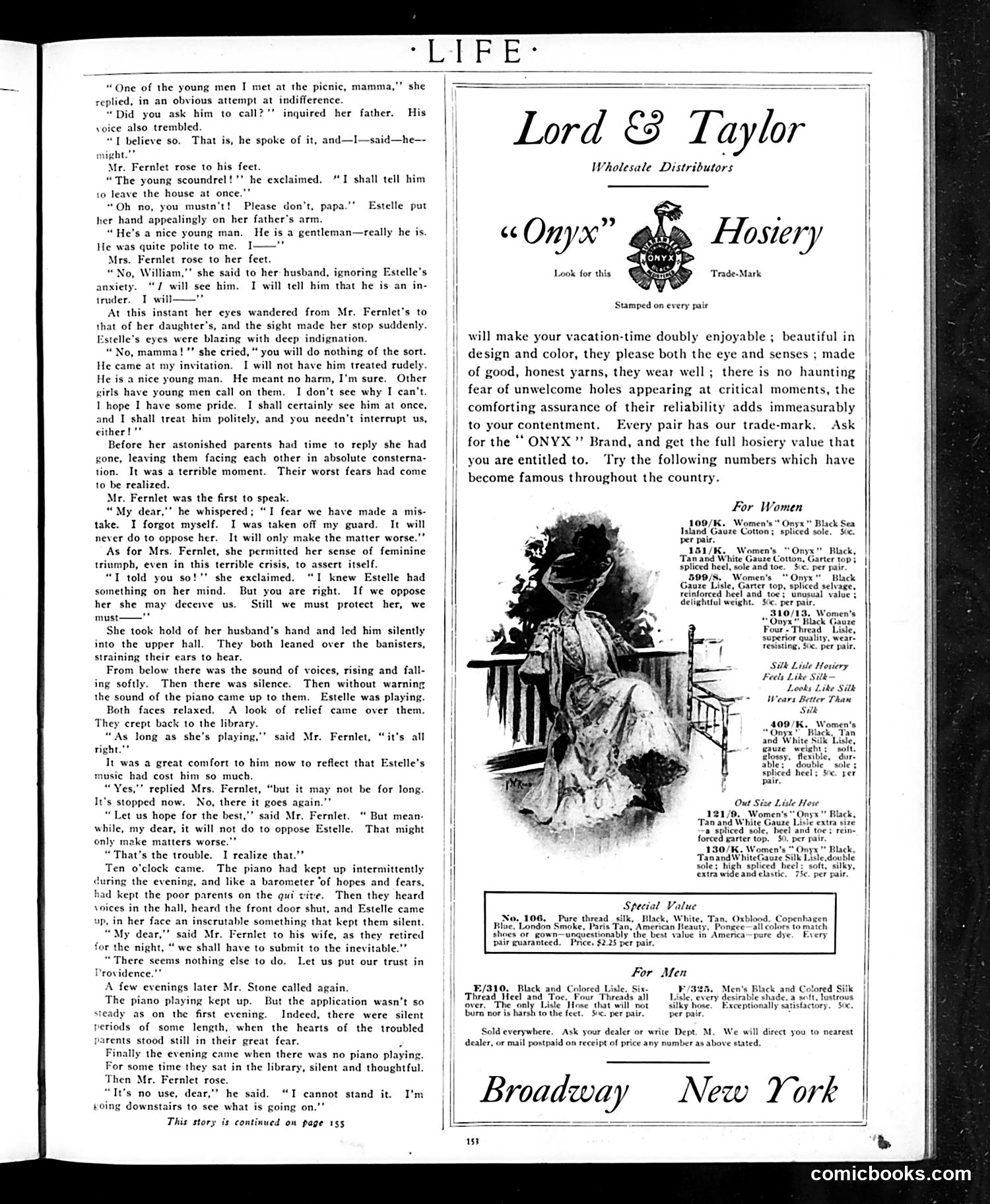
This page presents a serialized story about generational conflict over dating customs. The narrative depicts strict Victorian parents (Mr. and Mrs. Fernlet) shocked when their daughter Estelle receives an unchaperoned male visitor. The father wants to throw him out; the mother plans to confront him as an "intruder." However, Estelle boldly asserts her independence—refusing parental interference and treating the young man "politely." The parents, unable to control her, resort to eavesdropping from the stairwell, anxiously monitoring the piano music as a proxy for propriety. **The satire targets:** rigid parental authority clashing with emerging female independence in early 20th-century America. The parents' anxiety about an unsupervised visit reflects genuine social anxieties of the era, while Estelle's confident self-assertion represents modernizing attitudes about courtship. The right-hand page is purely advertising (Lord & Taylor hosiery). **For modern readers:** This captures a specific historical moment when "dating" (meeting without chaperones) was becoming normalized, scandalizing traditional families.
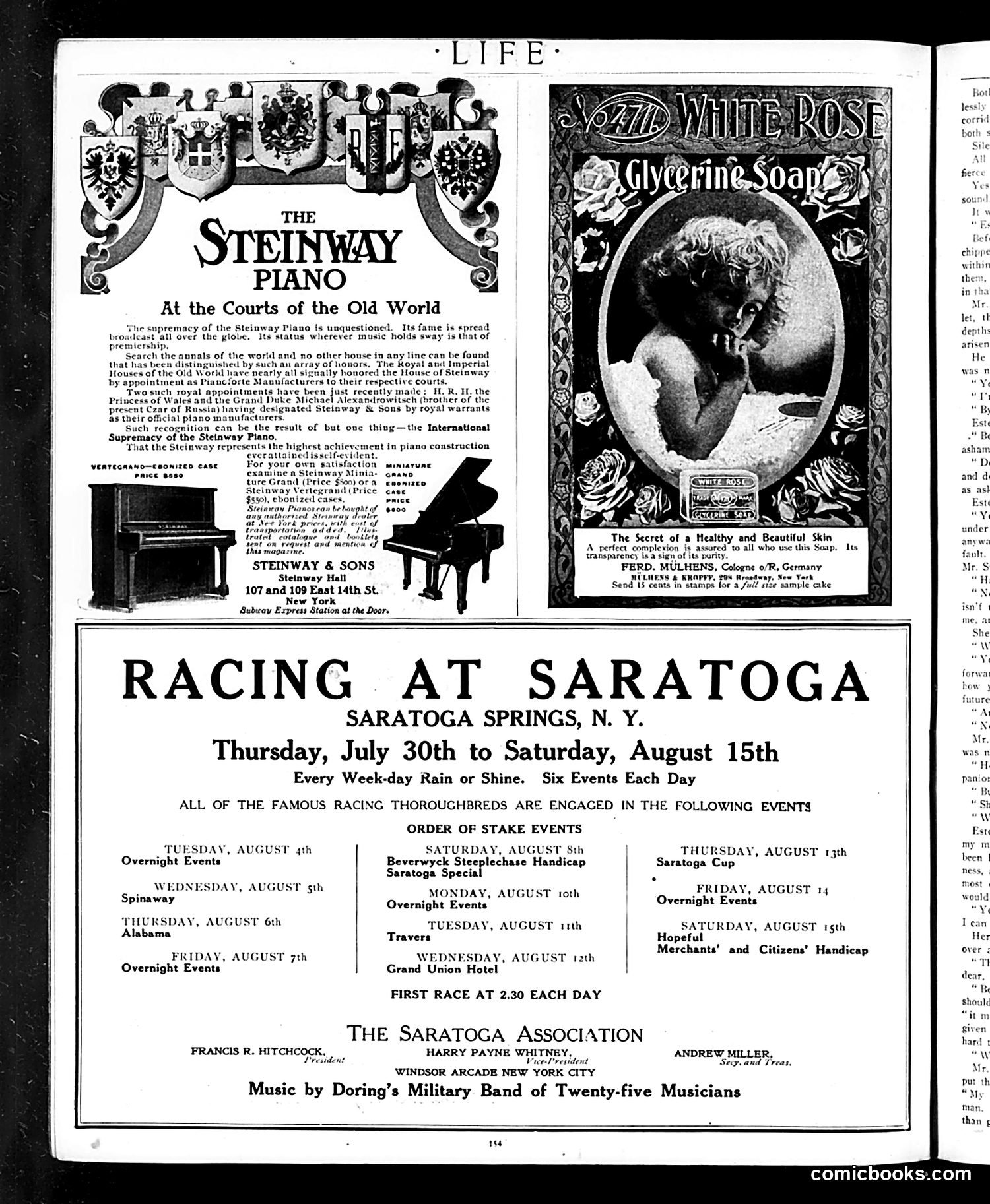
This page is primarily **advertising and announcements**, not political satire. The top half features two major advertisements: a Steinway Piano ad emphasizing its prestige ("supremacy" recognized by European royal courts), and a White Rose Glycerine Soap ad promising beauty. The bottom half announces **horse racing at Saratoga Springs, N.Y.** (July 30-August 15), listing the stake events and race schedule. This was a major social event for wealthy Americans of the era. There is **no political cartoon or satire visible** on this page. The layout is typical early 20th-century magazine advertising—luxury goods (pianos, soap) targeting affluent readers, alongside announcements of fashionable entertainment venues. The page reflects period class distinctions: these were pursuits of the wealthy elite.
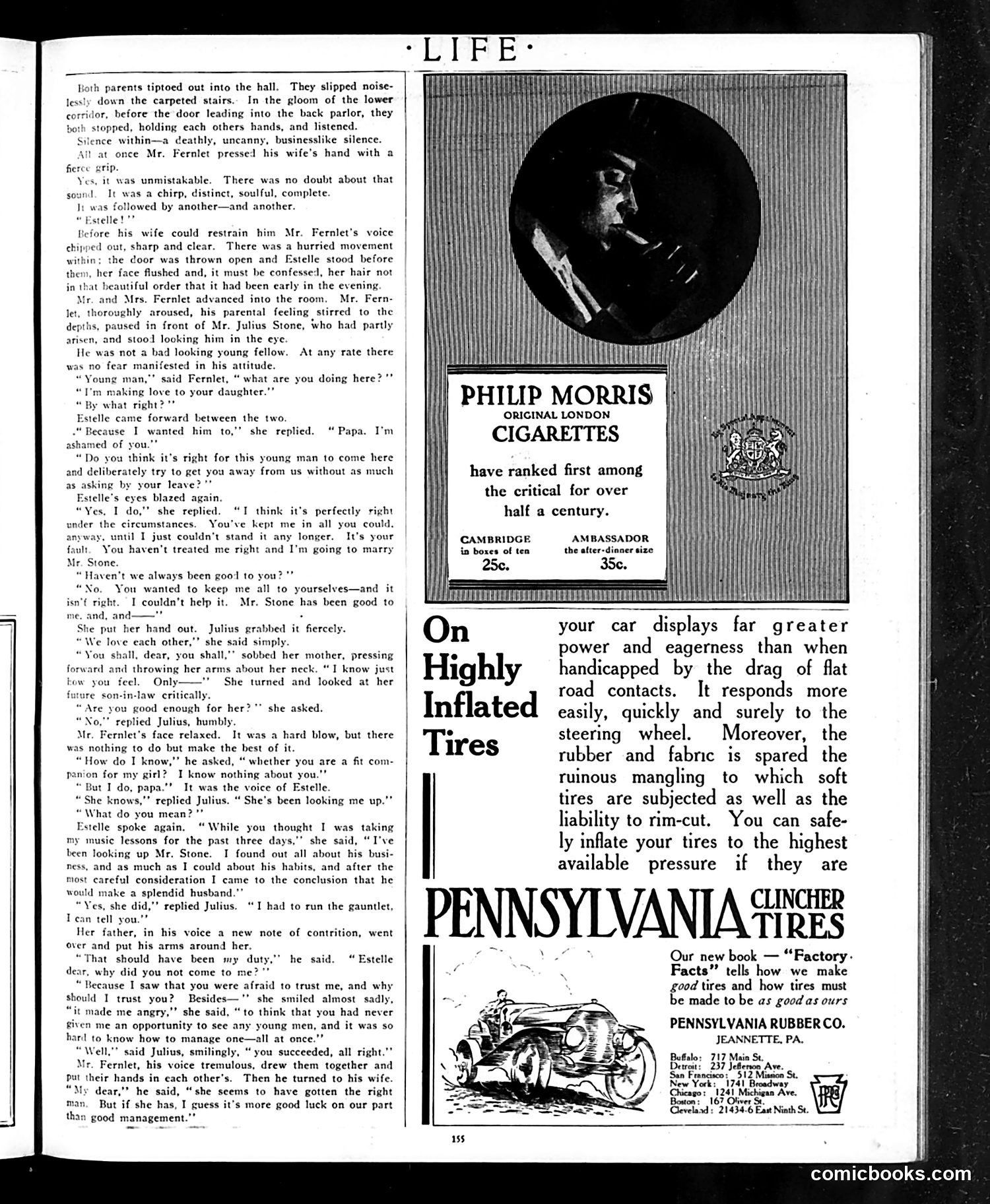
This page contains a serialized **domestic drama story** (left column) alongside period **advertisements** (right side). ## The Story The narrative depicts a confrontation between Mr. Fernlet and a young man (Julius Stone) found alone with Fernlet's daughter Estelle. The father initially assumes impropriety, but Estelle defends her choice: she claims to have independently investigated Stone's character and "looked him up" over three days, concluding he'd make a good husband. She asserts her right to autonomy against her parents' control. ## Historical Context This reflects **early 20th-century tensions** over parental authority versus daughters' independence. Estelle's behavior—investigating a suitor herself rather than relying on parental judgment—was progressive for the era, though her parents initially see it as scandalous. ## The Advertisements The page also features ads for **Philip Morris cigarettes** and **Pennsylvania Clincher tires**—standard period marketing with no satirical intent visible here. The story itself appears to be *Life* magazine's serialized fiction, not political satire.
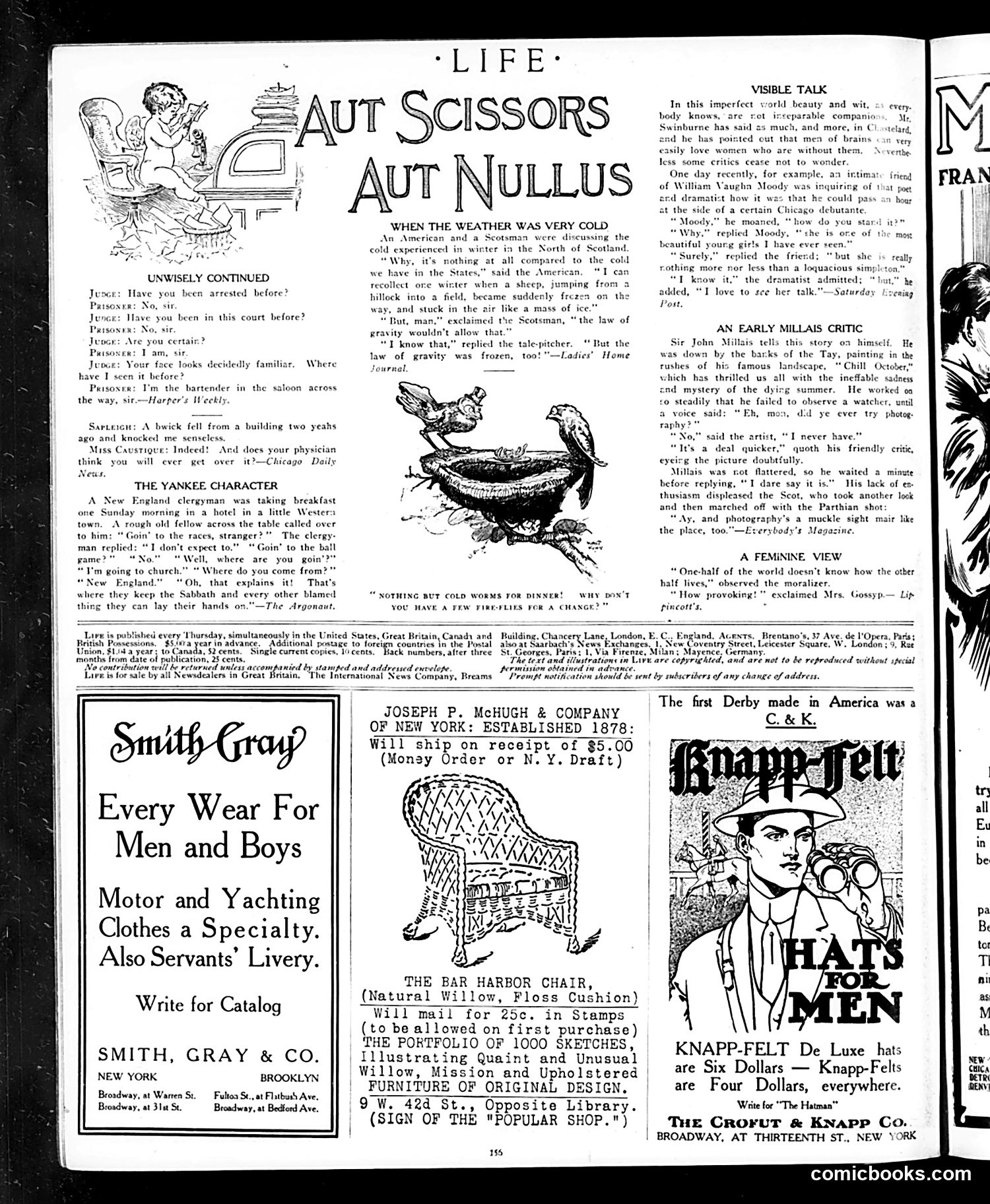
This page contains **multiple short humorous anecdotes and jokes** rather than a single cartoon. The humor relies on misunderstandings and ironic reversals typical of early 20th-century satire: **"Unwisely Continued"** (top): A judge questions a prisoner about prior arrests, then realizes he recognizes him—the prisoner is the bartender from the saloon across the street, implying the judge frequents it. **"The Yankee Character"**: A New England clergyman's stern religiosity contrasts with a Western prospector's casual irreverence, poking fun at regional stereotypes. **Cold weather anecdotes**: Including a Scottish tale where frozen gravity becomes absurdly literal—a joke playing on Scottish practicality. **"An Early Millais Critic"**: A Scottish observer critiques painter John Everett Millais's landscape work, suggesting photography would be faster—the artist's polite dismissal is undercut by the critic's blunt Parthian exit. These jokes reflect period attitudes about regional character types and class differences, with humor derived from colliding worldviews and verbal misunderstandings rather than visual satire.
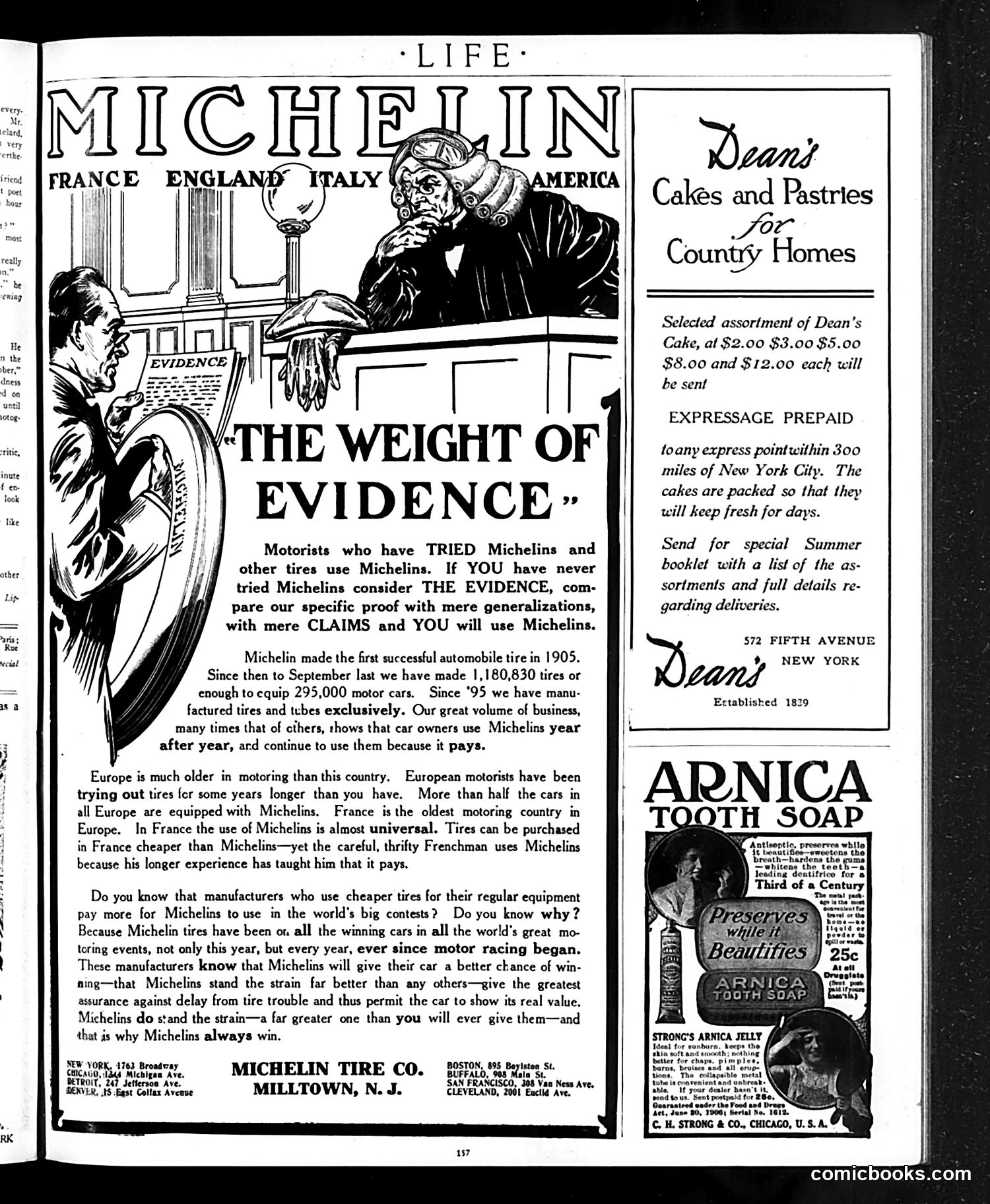
This page is primarily a **Michelin Tire Company advertisement** disguised as editorial content, occupying the left two-thirds of the page. The central cartoon depicts a judge or authority figure holding scales labeled "EVIDENCE," weighing claims against Michelin's documented performance. A man on the left holds an "EVIDENCE" document, supporting Michelin's argument. **The satire's point:** Rather than make vague marketing claims, Michelin presents "specific proof"—1,180,830 tires manufactured since 1905, dominance in European markets, and victories in all major motor racing events. The cartoon suggests that facts, not mere "generalizations" and "claims" by competitors, should determine tire choice. **Context for modern readers:** This reflects early 1900s automotive marketing, when tire reliability was genuinely consequential (affecting safety and cost). The appeal to empirical evidence and competitive racing success as proof was novel advertising strategy for the era. The right side contains unrelated period advertisements: Dean's bakery and Arnica Tooth Soap.
This page is primarily **advertising** rather than editorial content. The dominant features are product advertisements interspersed with brief humorous anecdotes. The main advertisements include: - **El Príncipe de Gales Havana Cigars** (top right) - **White Rock Table Water** (center) - **Henry Clay and Bock y Ca Cabanas** cigarettes - **Waukesha Indian Ginger Ale** (bottom) The left column contains short comic vignettes and jokes typical of early 20th-century Life magazine—satirical observations on contemporary life including charity workers, jury deliberations, and domestic situations. These are **not political cartoons** but rather social humor. The page reflects the advertising-heavy magazine format of the era, promoting luxury consumer goods (imported cigars, bottled water, ginger ale) to an affluent readership. The anecdotes use gentle satire to mock social pretension and everyday absurdities rather than addressing political issues.
This page is primarily **advertising**, not political satire or comics. It contains commercial advertisements for: - **Whitman's chocolates** and other confectionery - **Great Western champagne** - **Langham Hotel** in London - **Winchester rifle ammunition** - **Allen's Foot-Ease** powder - **Clark's Cruises** (ship travel) The only substantive editorial content consists of three brief humorous anecdotes: 1. "A Humorist in the Bud"—a schoolteacher's story about children's innocent misunderstandings 2. "A Kissing Acquaintance"—about Rev. Edward Everett Hale encountering a woman who recognizes him but whose name he doesn't know 3. "A Poor Time for Risks" and "The Finish"—brief jokes about a church sermon and campaign politics These are light, domestic humor pieces with no sharp political edge. The page reflects *Life* magazine's early 20th-century character as a general-interest publication mixing advertising with genteel comedy.
This page is primarily **advertisements and humor pieces** rather than political satire. **The main cartoon/article** is "Likely to Cut Off Anybody's Leg"—a domestic humor piece where a surgeon's young daughter, Dorothy, notices her mother has only one leg in an old photograph. When Dorothy asks if her father knew her mother then, she concludes he must have married her *after* he became a surgeon, assuming he caused her lost leg. The joke plays on childhood logic and the father's profession as a surgeon performing amputations. **The "In Egypt" piece** is a travel anecdote where American tourists name their camels after famous leaders (Chamberlain, Bismarck, Napoleon). The final tourist, an American, puzzles the guides until the driver suggests naming him "Roosevelt"—a topical reference to Theodore Roosevelt's fame and contemporary prominence. **The advertisements** promote Du Pont explosives (Panama Canal construction) and various consumer goods, representing typical early-20th-century magazine content.
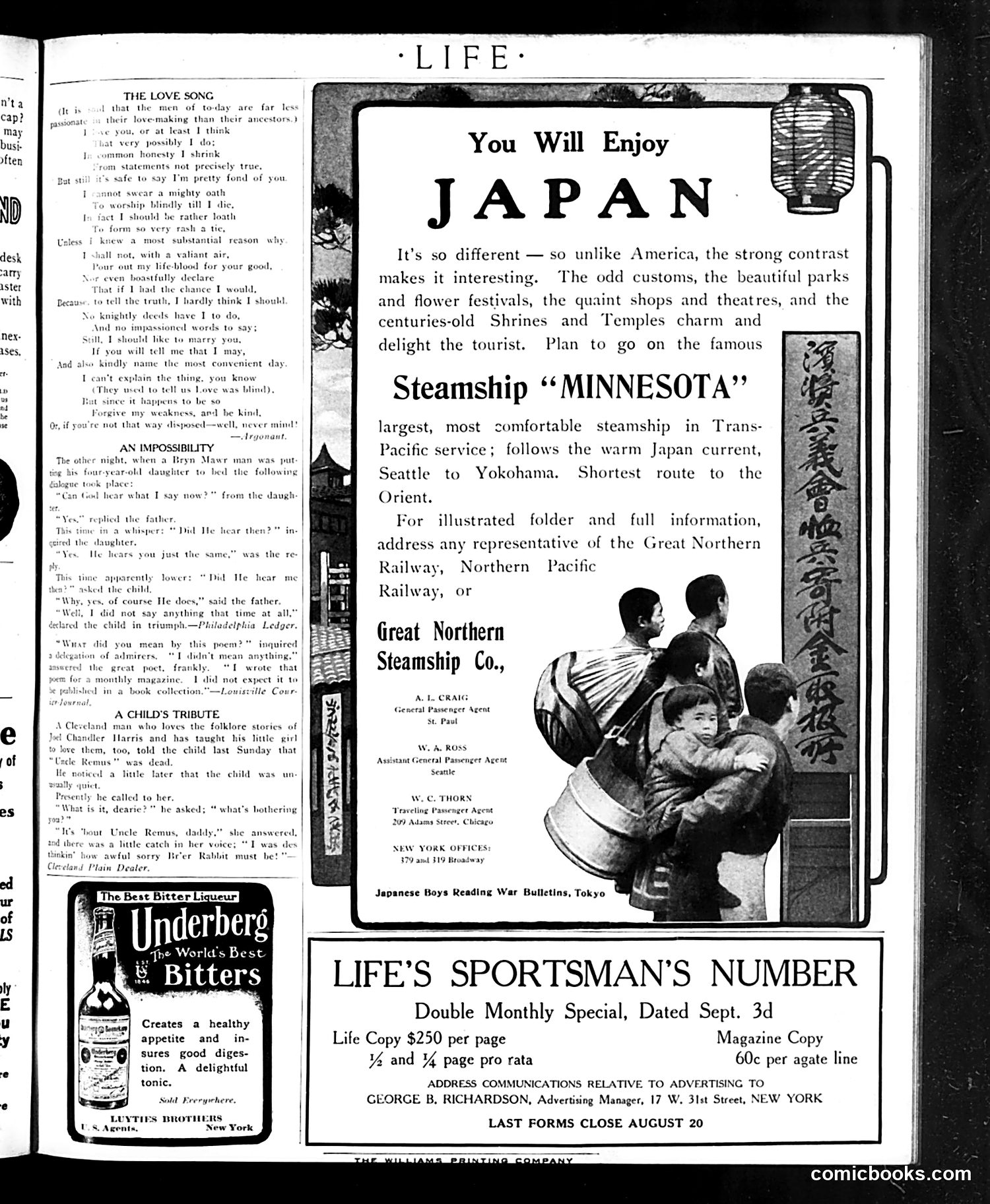
This page combines **satirical short stories** (left) with **period advertising** (right). The left side features three humorous anecdotes mocking Victorian sentimentality and religious literalism: 1. **"The Love Song"** parodies overwrought romantic poetry with a speaker who claims profound devotion but admits he wouldn't actually sacrifice for his beloved—satirizing insincere flowery declarations. 2. **"An Impossibility"** jokes about a child's literal-minded faith: when her father says God hears prayers, she later asks if He heard her curse word, fearing divine punishment. 3. **"A Child's Tribute"** references Joel Chandler Harris's "Uncle Remus" folklore stories, implying a child mourns the fictional character's death. The **right side** is a straightforward travel advertisement for steamship passage to Japan via the Great Northern Steamship Company—marketed as exotic, culturally different from America, and featuring centuries-old temples and shrines. The accompanying photo shows what appears to be Japanese children or figures. This is primarily an **advertising page**, with satirical content as secondary filler material typical of *Life* magazine's format.
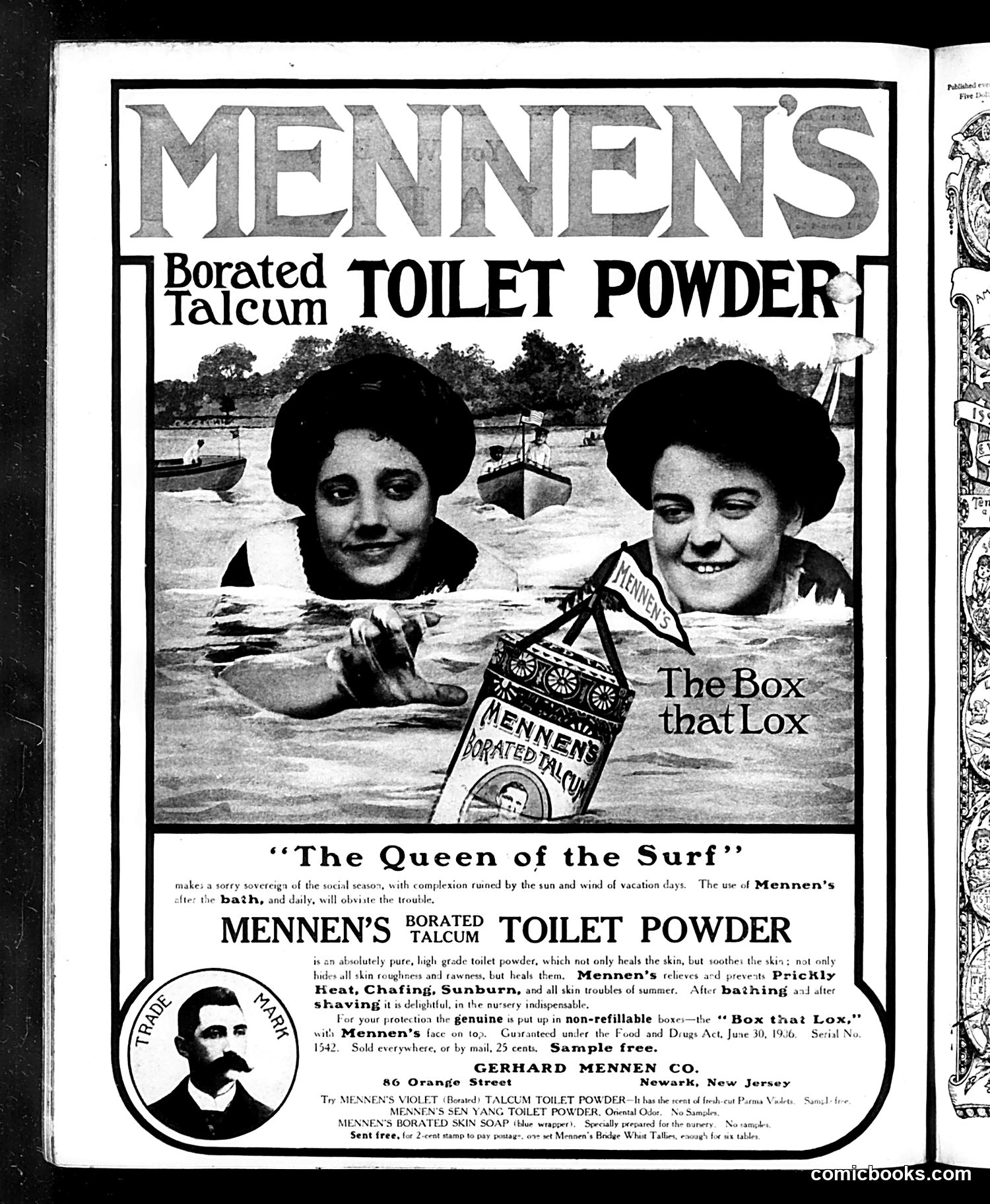
This is a **product advertisement**, not political satire. It promotes Mennen's Borated Talcum Toilet Powder to address skin problems caused by summer vacation activities. The image shows two women in water ("The Queen of the Surf"), apparently suffering sun and wind damage. The advertisement claims the powder heals and soothes skin, prevents prickly heat, chafing, and sunburn—problems associated with bathing and shaving. Key selling points include: the product is "absolutely pure, high grade," comes in a distinctive non-refillable "Box that Lox" (featuring the Mennen's face logo), and is guaranteed under the Food and Drugs Act of 1906. The ad emphasizes authenticity and protection against counterfeits. A small portrait shows Gerhard Mennen, the company founder. Additional products mentioned include violet and "Sen Yang" talcum powders. The company was based in Newark, New Jersey.